Abu Simbel
Two temples moved 65 metres up to escape the Nile.
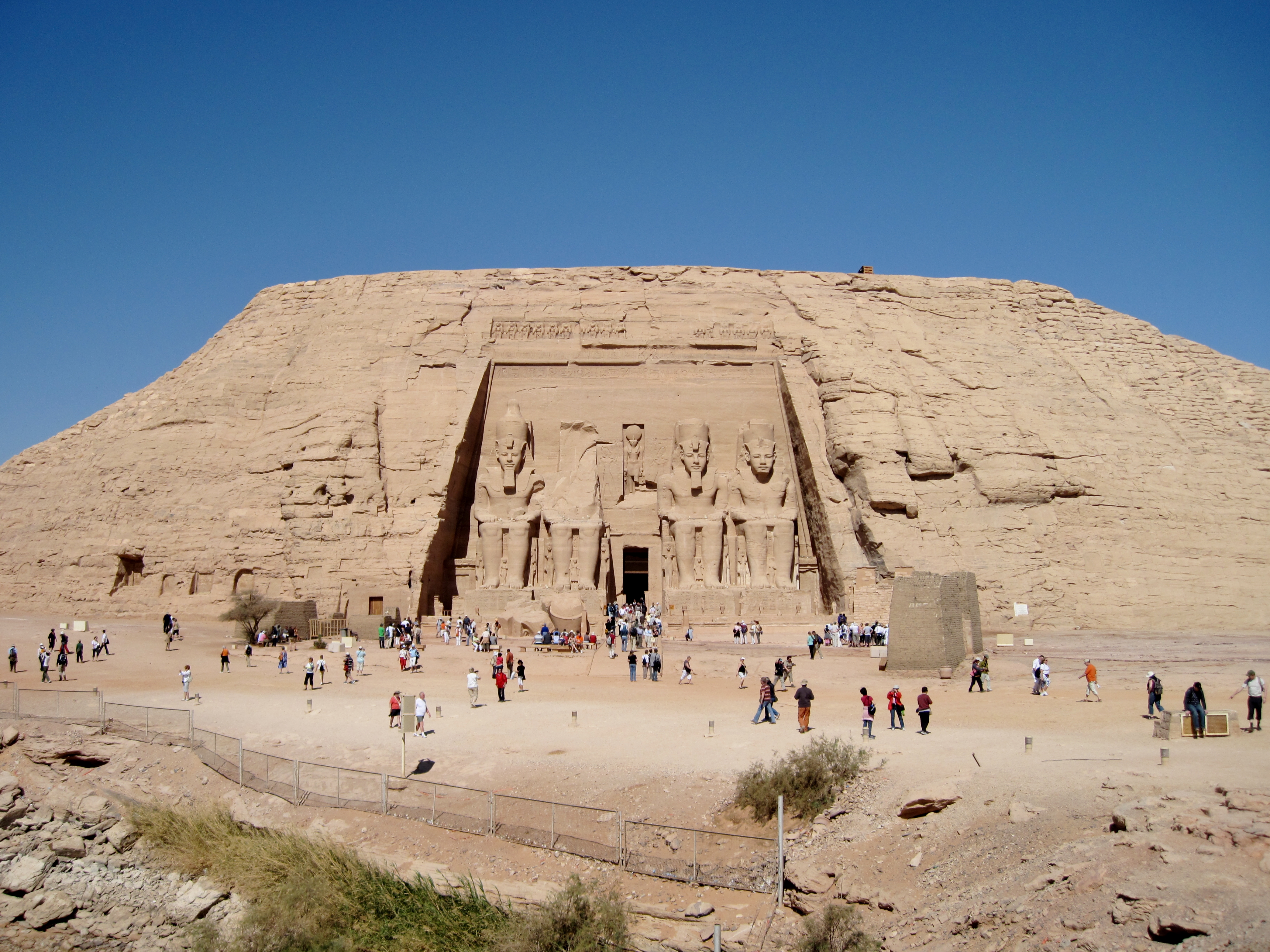
Overview
The most prominent monuments of Abu Simbel are the rock-cut temples near the modern village of that name at the Second Nile Cataract, on the border between Lower Nubia and Upper Nubia 1Abu Simbel — sec1 · Wikipedia ↗. The twin temples were originally carved out of the mountainside in the 13th century BC, during the 19th Dynasty reign of the Pharaoh Ramesses II 2Abu Simbel — wiki · Wikipedia ↗. There are two temples, the Great Temple, dedicated to Ramesses II himself, and the Small Temple, dedicated to his chief wife Queen Nefertari 1.
Their huge external rock relief figures of Ramesses II have become iconic 2. During his reign, Ramesses II embarked on an extensive building program throughout Egypt and Nubia, which Egypt controlled 1. He therefore built several grand temples in order to impress upon the Nubians Egypt's might and Egyptianize the people of Nubia 1. Sculptures inside the Great Temple commemorate Ramesses II's heroic leadership at the Battle of Kadesh 2.
The temples were long obscured by sand. An exterior view of the temples and their surroundings in 1820, published in Plates illustrative of the researches and operations in Egypt and Nubia by the Italian explorer Giovanni Belzoni, shows sand partially covering the Great Temple 3Abu Simbel — sec3 · Wikipedia ↗. Belzoni succeeded in exposing the figure over the doorway to the Great Temple, and the head and shoulders of the north-central colossi of Ramesses II, before having to abandon the effort to clear any more sand due to a lack of food and money to pay the local Nubians 4Abu Simbel — sec4 · Wikipedia ↗.
In early 1816 the French ex-consul Bernardino Drovetti made an attempt to excavate Abu Simbel, leaving 300 piastres with the local sheikh to pay for digging out the temple entrance, before continuing upriver to Wadi Halfa 3. In 1819 Bankes, accompanied by Henry Salt, Henry William Beechey, and Giovanni Finati, returned in a flotilla of four boats to Abu Simbel, to undertake a thorough investigation with the aim of fully documenting the temples, determining the nature of the statues on the facade of the Great Temple, and to locate inscriptions which might date the temples 5Abu Simbel — sec5 · Wikipedia ↗. They stopped from 23 January to 18 February 1819 at Abu Simbel on a journey south that was to take them as far as the Second Cataract 5. Later, after travelling independently, Hyde revisited Abu Simbel from 26 March 1819 until 2 April 1819 5.
Maxime Du Camp produced the first photographs of the site, among them Ibsamboul (Abu Simbel), medial colossus of the speos of Phré, a salted paper print from a negative calotype 6Abu Simbel — sec7 · Wikipedia ↗. After ascending the Nile as far as the second cataract, he stopped on his return downstream at Abu Simbel, arriving at 9 am on 27 March 1850 and departing on 30 March 6. Of these, 125 calotypes (including 10 of Abu Simbel) were printed by Blanquart-Evrard and included in a book written by Du Camp upon his return to France 6.
In the winter of 1873–1874 Amelia Edwards, accompanied by her friend Lucy Renshaw and their lady's maid Jenny Lane, were among a party of 25 who journeyed southwards down the Nile from Cairo in a hired dahabiyeh (manned houseboat) 7Abu Simbel — sec8 · Wikipedia ↗. Her visit to Abu Simbel in 1874 was published in A Thousand Miles up the Nile 7. In 1874 Thomas Cook instituted a steamer service that operated between Aswan and Wadi Halfa, passing Abu Simbel 7.
As part of the International Campaign to Save the Monuments of Nubia, an artificial hill was made from a domed structure to house the Abu Simbel Temples, under the supervision of a Polish archaeologist, Kazimierz Michałowski, from the Polish Centre of Mediterranean Archaeology University of Warsaw 2. Along with Abu Simbel, Philae and other Nubian archaeological sites, Amada was relocated between 1964 and 1965, to a new higher site 8Abu Simbel — amada · Reference ↗.
The importance of the site's setting lies in what Nubia offered: as a major source of gold and many other precious trade goods, Nubia was of great importance to the Egyptians 1. Egyptian heirs subsequently ruled much of Nubia for the next four centuries 9Abu Simbel — nubia · Reference ↗. The same building program that produced the temples is recorded in other Nubian monuments, where the stelas of the Viceroys of Kush Setau, Heqanakht and Messuy and that of Chancellor Bay describe their building activities under Ramesses II, Merneptah and Siptah respectively 8.
Drovetti's earlier effort was not the first to fall short. On the way he visited Abu Simbel, but was unable to enter the Great Temple 3. With the support of Egyptian Consul-General Henry Salt, Belzoni returned in June 1817 to Abu Simbel accompanied by Henry William Beechey, Royal Navy captains Charles Leonard Irby and James Mangles, two servants, and the Italian Giovanni Finati (also known as Mahomet), who had been loaned to them by Salt; supported by what Belzoni considered at times a troublesome crew of seven 4.
The drawings made at the site fed directly into the decipherment of hieroglyphs. Upon his return to France Huyot sent reproductions of the meticulous drawings he had made at Abu Simbel to Jean-François Champollion, who at the time was on a quest to decipher Egyptian hieroglyphs 10Abu Simbel — sec6 · Wikipedia ↗. Upon receiving them on 14 September 1822 the first cartouche Champollion saw he was able to decipher and connect to Ramesses 10.
Du Camp's photographic mission had an official origin: in 1849 the writer Maxime Du Camp was commissioned by the French Ministry of Public Instruction to record monuments and inscriptions in the Middle East using the newly developed technology of photography 6. Edwards' party ultimately reached Abu Simbel in moonlight on the evening of 31 January 1874, departing down river on 18 February after a four-day excursion to Wadi Halfa 7.
The relocation of the temples belongs to a wider salvage effort whose reach extended beyond Abu Simbel. The city's Nubian Museum is an important archaeological center, containing finds from the International Campaign to Save the Monuments of Nubia before the Aswan Dam flooded all of Lower Nubia 11Abu Simbel — aswan · Reference ↗. Aswan includes five monuments within the UNESCO World Heritage Site of the Nubian Monuments from Abu Simbel to Philae; these are the Old and Middle Kingdom tombs of Qubbet el-Hawa, the town of Elephantine, the stone quarries and Unfinished Obelisk, the Monastery of St. 11
1. Construction and Purpose
Nubia was of great importance to the Egyptians as a major source of gold and many other precious trade goods 1. The region was home to several empires, most prominently the Kingdom of Kush 9. Egyptian heirs subsequently ruled much of Nubia for the next four centuries 9. From the 3rd century BC to the 3rd century AD northern Nubia was invaded and annexed by Egypt, then under the rule of the Greeks and later the Romans; this territory was known in the Greco-Roman world as the Dodekaschoinos 9.
Various 19th Dynasty pharaohs, especially Seti I and Ramesses II, also carried out minor restorations and added to the temple's decoration 8. The stelas of the Viceroys of Kush Setau, Heqanakht and Messuy and that of Chancellor Bay describe their building activities under Ramesses II, Merneptah and Siptah respectively 8.
The building of the dam was to result in the creation of Lake Nasser, which would submerge the banks of the Nile along its entire 479 km (298 mi) length 8. The name Lake Nasser refers to the larger portion within Egypt, representing 83% of the lake's total area, while the remaining portion within Sudan is called Lake Nubia 11. After UNESCO formally launched a campaign on 8 March 1960 to save the Nubian monuments, a meeting held in Cairo of engineers and archaeologists in the early 1960s to discuss how to save Amada 8. The city's Nubian Museum is an important archaeological center, containing finds from the International Campaign to Save the Monuments of Nubia before the Aswan Dam flooded all of Lower Nubia 11.
The twin temples were originally carved out of the mountainside in the 13th century BC, during the 19th Dynasty reign of the Pharaoh Ramesses II 2. During his reign, Ramesses II embarked on an extensive building program throughout Egypt and Nubia, which Egypt controlled 1.
In early 1816 the French ex-consul Bernardino Drovetti made an attempt to excavate Abu Simbel, leaving 300 piastres with the local sheikh to pay for digging out the temple entrance, before continuing upriver to Wadi Halfa 3. On the way he visited Abu Simbel, but was unable to enter the Great Temple 3. With the support of Egyptian Consul-General Henry Salt, Belzoni returned in June 1817 to Abu Simbel accompanied by Henry William Beechey, Royal Navy captains Charles Leonard Irby and James Mangles, two servants, and the Italian Giovanni Finati (also known as Mahomet), who had been loaned to them by Salt; supported by what Belzoni considered at times a troublesome crew of seven 4. Belzoni succeeded in exposing the figure over the doorway to the Great Temple, and the head and shoulders of the north-central colossi of Ramesses II, before having to abandon the effort to clear any more sand due to a lack of food and money to pay the local Nubians 4.
In 1819 Bankes, accompanied by Henry Salt, Henry William Beechey, and Giovanni Finati, returned in a flotilla of four boats to Abu Simbel, to undertake a thorough investigation with the aim of fully documenting the temples, determining the nature of the statues on the facade of the Great Temple, and to locate inscriptions which might date the temples 5. They stopped from 23 January to 18 February 1819 at Abu Simbel on a journey south that was to take them as far as the Second Cataract 5.
Upon his return to France Huyot sent reproductions of the meticulous drawings he had made at Abu Simbel to Jean-François Champollion, who at the time was on a quest to decipher Egyptian hieroglyphs 10. Upon receiving them on 14 September 1822, the first cartouche Champollion saw he was able to decipher and connect to Ramesses 10.
In 1849 the writer Maxime Du Camp was commissioned by the French Ministry of Public Instruction to record monuments and inscriptions in the Middle East using the newly developed technology of photography 6. After ascending the Nile as far as the second cataract, they stopped on their return downstream at Abu Simbel, arriving at 9 am on 27 March 1850 and departing on 30 March 6.
In the winter of 1873–1874 Amelia Edwards, accompanied by her friend Lucy Renshaw and their lady's maid Jenny Lane, were among a party of 25 who journeyed southwards down the Nile from Cairo in a hired dahabiyeh (manned houseboat) 7. Edwards' party ultimately reached Abu Simbel in moonlight on the evening of 31 January 1874, departing down river on 18 February after a four-day excursion to Wadi Halfa 7.
2. Early Exploration and Excavation
In early 1816 the French ex-consul Bernardino Drovetti made an attempt to excavate Abu Simbel, leaving 300 piastres with the local sheikh to pay for the work of clearing the temple entrance before he continued upriver to Wadi Halfa 3. His visit to the site did not extend to entering the Great Temple 3.
Supplied with a large sailing boat by Muhammad Ali, the party of Giovanni Belzoni reached Abu Simbel on 26 November 1828 10. Belzoni returned in June 1817 with the support of Henry Salt, accompanied by Henry William Beechey, Charles Leonard Irby, James Mangles, two servants, Giovanni Finati, and a crew of seven 10. He exposed the figure over the doorway and the head and shoulders of the north-central colossi of Ramesses II before abandoning the effort because of a lack of food and money 10.
The interior of the temple was described as filled with a hot and moist vapour, unlike other grottoes, which saturated paper as though in a Turkish bath 10.
In 1819 Henry Salt and Henry William Beechey joined Giovanni Finati and a party under Bankes, who returned to Abu Simbel in a flotilla of four boats to investigate the temples thoroughly 5. Their aims were to document the temples fully, to establish the nature of the statues on the facade of the Great Temple, and to find inscriptions that might date the structures 5. On a journey south that was to take them as far as the Second Cataract they stayed at Abu Simbel from 23 January to 18 February 1819 5.
Huyot sent reproductions of the meticulous drawings he had made at Abu Simbel to Jean-François Champollion, then engaged in his quest to decipher Egyptian hieroglyphs 10. When Champollion received them on 14 September 1822 the first cartouche he was able to decipher and connect to Ramesses was among them 10.
In 1849 Maxime Du Camp was commissioned by the French Ministry of Public Instruction to record monuments and inscriptions in the Middle East using the newly developed technology of photography 6. After ascending the Nile as far as the second cataract his party stopped on the return downstream at Abu Simbel, arriving at 9 am on 27 March 1850 and departing on 30 March 6.
In the winter of 1873–1874 Amelia Edwards travelled south from Cairo in a hired dahabiyeh with her friend Lucy Renshaw and their lady's maid Jenny Lane, among a party of 25 7. The party reached Abu Simbel in moonlight on the evening of 31 January 1874 and departed down river on 18 February after a four-day excursion to Wadi Halfa 7.
3. Bankes and the 1819 Investigations
In 1819 Bankes returned to Abu Simbel in a flotilla of four boats, accompanied by Henry Salt, Henry William Beechey, and Giovanni Finati, to undertake a thorough investigation with the aim of fully documenting the temples, determining the nature of the statues on the facade of the Great Temple, and locating inscriptions which might date the temples 5.
Of that time, three weeks were consumed in excavating the whole of the southernmost colossus of Ramesses II down to its feet 5.
The party's stay at Abu Simbel ran from 23 January to 18 February 1819, taken on a journey south that was to carry them as far as the Second Cataract 5. Hyde, travelling independently of the main group, returned to the site later in the season, from 26 March 1819 until 2 April 1819 5.
4. Champollion and the Decipherment
The decipherment of Egyptian hieroglyphs and the modern study of Abu Simbel are linked through a chain of drawings and correspondence. Upon his return to France Huyot sent reproductions of the meticulous drawings he had made at Abu Simbel to Jean-François Champollion who at the time was on a quest to decipher Egyptian hieroglyphs 10.
Champollion's own visit to the site came later in the same decade. Supplied with a large sailing boat by Muhammad Ali they reached Abu Simbel on 26 November 1828 10.
The stay was not one of easy inspection. They spent two weeks at Abu Simbel first having to clear the doorway into interior of the Great Temple as the sand that had been cleared by Bankes had returned 10.
The reproductions reached Champollion on 14 September 1822, and the first cartouche he examined proved decipherable: he was able to read it and connect it to Ramesses 10.
5. Nineteenth-Century Photography and Travel
In 1849 the writer Maxime Du Camp was commissioned by the French Ministry of Public Instruction to record monuments and inscriptions in the Middle East using the newly developed technology of photography 6. His work at Abu Simbel belongs to this official enterprise, and the salted paper print of the medial colossus of the speos of Phré, made from a negative calotype by the Blanquart-Evrard process, dates from 1850 6.
A generation later the site entered the record of another kind of traveller. In the winter of 1873–1874 Amelia Edwards, accompanied by her friend Lucy Renshaw and their lady's maid Jenny Lane, was among a party of 25 who journeyed southwards down the Nile from Cairo in a hired dahabiyeh, a manned houseboat 7. The party ultimately reached Abu Simbel in moonlight on the evening of 31 January 1874 7. They departed down river on 18 February after a four-day excursion to Wadi Halfa 7.
The photographer's work at Abu Simbel belongs to this official enterprise, and the salted paper print of the medial colossus of the speos of Phré, made from a negative calotype by the Blanquart-Evrard process, dates from 1850 6.
6. Relocation and the International Campaign
The rescue of the Abu Simbel Temples formed part of the International Campaign to Save the Monuments of Nubia2. Within that campaign the temples were housed in an artificial hill made from a domed structure2. The work was carried out under the supervision of a Polish archaeologist, Kazimierz Michałowski, from the Polish Centre of Mediterranean Archaeology University of Warsaw2.
The threat arose from the building of the dam, which was to result in the creation of Lake Nasser8. The lake would submerge the banks of the Nile along its entire 479 km (298 mi) length south of the dam8. This flooding covered the entire area of historical Lower Nubia, a region that was home to 22 critical historical sites, including Amada8.
Amada was relocated between 1964 and 1965 to a new higher site8. The move took place as part of the International Campaign to Save the Monuments of Nubia, alongside Abu Simbel, Philae and other Nubian archaeological sites8.
UNESCO formally launched its campaign to save the Nubian monuments on 8 March 19608. In the early 1960s engineers and archaeologists met in Cairo to discuss how Amada might be saved8.
7. Key dates
- 1816In early 1816, the French ex-consul Bernardino Drovetti made an attempt to exc…In early 1816, the French ex-consul Bernardino Drovetti made an attempt to excavate Abu Simbel, leaving 300 piastres with the local sheikh to pay for digging out the temple entrance, before continuing upriver to Wadi Halfa.
- 1817With the support of Egyptian Consul-General Henry Salt , Belzoni returned in J…With the support of Egyptian Consul-General Henry Salt , Belzoni returned in June 1817 to Abu Simbel accompanied by Henry William Beechey , Royal Navy captains Charles Leonard Irby and James Mangles , two servants, and the Italian Giovanni Finati (also known as Mahomet), who had
- 1819Bankes documents the interior of the Great Temple In 1819 Bankes, accompanied…Bankes documents the interior of the Great Temple In 1819 Bankes, accompanied by Henry Salt, Henry William Beechey, and Giovanni Finati, returned in a flotilla of four boats to Abu Simbel, to undertake a thorough investigation with the aim of fully documenting the temples, determ
- 1822Upon receiving them on 14 September 1822, the first cartouche Champollion saw…Upon receiving them on 14 September 1822, the first cartouche Champollion saw he was able to decipher and connect to Ramesses.
- 1828Supplied with a large sailing boat by Muhammad Ali , they reached Abu Simbel o…Supplied with a large sailing boat by Muhammad Ali , they reached Abu Simbel on 26 November 1828.
- 1849The first photographs Maxime Du Camp, Ibsamboul (Abu Simbel), medial colossus…The first photographs Maxime Du Camp, Ibsamboul (Abu Simbel), medial colossus of the speos of Phré, salted paper print from a negative calotype by Blanquart-Evrard process (1850) In 1849, the writer Maxime Du Camp was commissioned by the French Ministry of Public Instruction to r
- 1850After ascending the Nile as far as the second cataract, they stopped on their…After ascending the Nile as far as the second cataract, they stopped on their return downstream at Abu Simbel, arriving at 9 am on 27 March 1850 and departing on 30 March.
- 1873Visit of Amelia Edwards Abu Simbel at the time of Amelia Edwards visit in 1874…Visit of Amelia Edwards Abu Simbel at the time of Amelia Edwards visit in 1874, as published in A Thousand Miles up the Nile In the winter of 1873–1874 Amelia Edwards , accompanied by her friend Lucy Renshaw and their lady's maid Jenny Lane, were among a party of 25 who journeyed
8. Frequently asked questions
How many photographs did Maxime Du Camp bring back from his expedition?
At the end of his expedition, Du Camp bought back to France 214 photographs of Cairo, Thebes, Philae, and Abu Simbel, as well as Palestinian and Syrian monuments and landscapes 6. These were gathered into a book titled Egypte, Nubie, Palestine et Syrie: Dessins photographiques recueillis pendant les annees 1849, 1850, 1851 6.
What did Champollion accomplish upon receiving the drawings from Abu Simbel?
Upon receiving them on 14 September 1822, the first cartouche Champollion saw he was able to decipher and connect to Ramesses 10.
Where is Abu Simbel situated in relation to the Nile cataracts?
The rock-cut temples stand near the modern village of Abu Simbel at the Second Nile Cataract, the border between Lower Nubia and Upper Nubia 12Abu Simbel — sec2 · Wikipedia ↗.
What does the Nubian Museum in Aswan hold?
How did Amelia Edwards and her companions travel to Abu Simbel?
In the winter of 1873–1874 Amelia Edwards, accompanied by her friend Lucy Renshaw and their lady's maid Jenny Lane, were among a party of 25 who journeyed southwards down the Nile from Cairo in a hired dahabiyeh (manned houseboat) 7.
What was the condition of the air inside the Great Temple?
Unlike all the other grottoes in Egypt and Nubia, its atmosphere, instead of presenting a refreshing coolness, was a hot and moist vapour, not unlike that of a Turkish bath, and so penetrating, that paper, carried within, soon became as much saturated with wet as if it had been dropped into the river 4.
References (12)
- 1Abu Simbel — sec1 — Wikipedia Web↩View source
- 2Abu Simbel — wiki — Wikipedia Web↩View source
- 3Abu Simbel — sec3 — Wikipedia Web↩View source
- 4Abu Simbel — sec4 — Wikipedia Web↩View source
- 5Abu Simbel — sec5 — Wikipedia Web↩View source
- 6Abu Simbel — sec7 — Wikipedia Web↩View source
- 7Abu Simbel — sec8 — Wikipedia Web↩View source
- 8Abu Simbel — amada — Reference Web↩View source
- 9Abu Simbel — nubia — Reference Web↩View source
- 10Abu Simbel — sec6 — Wikipedia Web↩View source
- 11Abu Simbel — aswan — Reference Web↩View source
- 12Abu Simbel — sec2 — Wikipedia Web↩View source