Rodrigues Solitaire
The flightless relative of the dodo, described from Rodrigues.
The Rodrigues solitaire was a large flightless bird related to the dodo. Rothschild's 1907 account gathers the old description: its skull, its reduced wing, its plumage, the weight of the males and the pair bond.
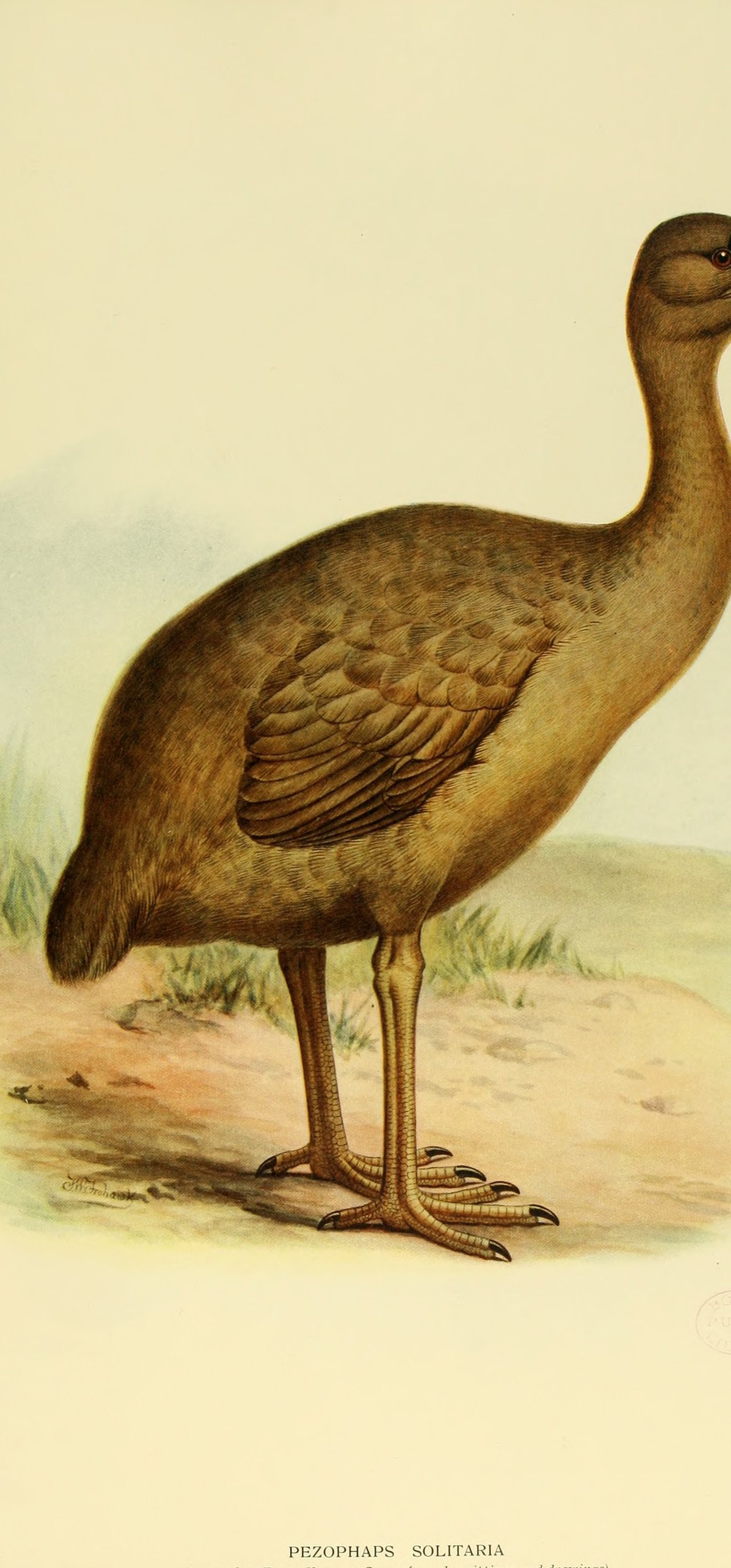
Overview
The Rodrigues solitaire is known to history through a single early observer: it was first made known by Leguat in 1708. That first record establishes the bird as a distinct subject of description rather than a mere rumour of the island, and from it the later understanding of the species proceeds. The account presents an animal of pronounced physical disparity between the sexes, for the male is much larger than the female, a difference that shapes much of what is reported of its habits and its bearing. 1Extinct Birds: an attempt to unite in one volume a short account of those birds which have become extinct in historical times · Hutchinson, London (via Internet Archive) ↗
The bird's form is described in part through its skull, which has a moderate rostrum, slightly hooked. Such a structure belongs to an animal whose resources for escape are limited, and the observer accordingly notes that it is very hard to catch in the woods. Its defence, he adds, lies chiefly in that and its beak, so that the hooked rostrum is not a curiosity of anatomy but the practical means by which the bird holds its ground. The size of the male reinforces this impression of a heavy, resistant creature, for some of the males weigh 45 pounds. 1
The plumage is described as compact and orderly, no one feather straggling from the other, an observation that conveys the smooth, continuous surface of the living bird rather than any ornament. The condition of the body varies with the year, since from March to September they are very fat, a seasonal richness that would have made the bird conspicuous and, to those who pursued it, valuable. 1
The account extends to the animal's manner of life, and here the combats between them on this occasion last sometimes pretty long, an indication of contests sustained rather than brief. Yet the same record dwells on constancy, for these two companions never disunite. Taken together, the first record thus presents the solitaire as a large and well-defended bird, seasonally fattened, given to prolonged combat, and bound in pairs that hold together. It is on this foundation that the species enters the written record. 1
1. Skull and Frame
The skull of the Rodrigues solitaire is characterised by a moderate rostrum, slightly hooked, a formation that gives the head its particular profile. In the observer's account this structure is inseparable from the bird's means of resisting pursuit, since its defence is said to lie chiefly in that and its beak. The hooked rostrum is therefore not an anatomical detail recorded in passing but the working instrument by which a heavy, earthbound bird confronts those who would take it, and the difficulty of catching it in the woods follows from the same circumstance. 1
The frame that carries such a skull is one of considerable mass, the male being much larger than the female, and some of the males reaching 45 pounds. A bird of this weight, furnished with a hooked beak as its principal defence, is poorly served by flight; the emphasis the account places on the beak as the chief means of protection implies a body whose other resources for escape are slight. The disproportion between the sexes further means that the skull and beak of the male belong to a far heavier animal than those of its mate, so that the defensive equipment of the species is borne by the larger sex. 1
The wings are reduced in the manner of the dodo, and the observer's remark that the bird is very hard to catch in the woods is consistent with a creature that cannot readily leave the ground. Its safety lies in the woods themselves and in the beak, not in the air. In consequence the skull and the reduced wing belong together as parts of a single design: a bird that holds its ground rather than flees, and whose head therefore carries the burden of its defence. 1
This reading of the frame is borne out by what the account reports of the bird's condition, for from March to September they are very fat, a seasonal accumulation laid upon an already heavy body. The plumage lies close, no one feather straggling from the other, so that the smooth surface of the living bird conceals rather than advertises the mass beneath. The skull, the hooked beak and the reduced wing thus describe an animal whose form is ordered wholly toward staying where it stands. 1
2. Appearance
The plumage of the Rodrigues solitaire is described as lying so close that no one feather straggles from the other, a neatness that speaks of habitual attention rather than mere anatomy. The birds are said to take care of it, and the smooth, unbroken surface of the living bird is presented as the visible result of that care. In a creature that cannot take refuge in flight, a well-kept coat is not ornament but condition, and the observer's remark on the absence of any straggling feather records the ordinary state of a bird whose body is its chief resource. 1
Against this uniformity of surface, the difference between the sexes is one of scale. The male is much larger than the female, and some of the males weigh as much as 45 pounds, so that the two birds, though alike in the closeness of their plumage, differ markedly in the mass that plumage covers. The care bestowed on the feathers is therefore common to both, while the frame it clothes is not; the male carries a far heavier body beneath the same smooth exterior, and the disparity between the pair is one the observer registers as a matter of size rather than of dress. 1
The closeness of the plumage belongs, moreover, to a bird whose condition changes with the season, for from March to September they are very fat. A coat that no feather disarranges is thus maintained over a body that swells and subsides through the year, and the neatness of the surface persists through a considerable change of bulk beneath it. The care the birds take of their feathers is exercised, in other words, upon an animal whose outline is not fixed, and the unbroken smoothness the observer notes is the more remarkable for being kept over so variable a frame. 1
The pairing of the birds gives this plumage a social dimension as well. The two companions never disunite, and the combats between them on this occasion sometimes last pretty long; the close-feathered, heavy-bodied pair therefore live and contend together, the male's greater size set beside the female's lesser frame within a bond that the account describes as lasting. The appearance of the species, neat and unvarying in its surface, thus conceals both the disparity of the sexes and the seasonal fullness of the body, and it is this smooth exterior that the observer records before anything of the bird's strength or habits. 1
3. Behaviour
The pair bond is described as absolute: these two companions never disunite. The phrase carries the weight of a habit observed rather than inferred, and it places the species among those birds whose social life is organised around a single, enduring association. Because the male is much larger than the female, the partnership joins two creatures of markedly unequal frame, and the account offers no suggestion that the disparity loosens the tie. The bond, in the observer's telling, is simply a fact of the bird's existence, maintained without qualification. 1
Yet the same pair that never separates is also the pair that fights. The combats between them on this occasion sometimes last pretty long, and the occasion in question is the season of pairing itself, so that contention and companionship belong together rather than standing in opposition. The struggle is not a prelude to separation but part of the relation the account describes as permanent. In a bird whose beak and wings are its chief defences, such contests are waged with weapons that are always at hand, and the length of the encounters suggests two well-matched and persistent adversaries rather than a brief display. 1
The difficulty of taking the bird follows from the same equipment. It is very hard to catch in the woods, and the woods are its own ground. A heavy body that cannot fly is not therefore helpless; the defences that serve it in combat serve it equally against pursuit, and the observer who records the difficulty of capture records it as a practical experience rather than a conjecture. The bird's strength, its weapons and its chosen cover combine to make the chase uncertain. 1
Taken together, these habits describe an animal whose life is conducted in a fixed partnership, punctuated by long and strenuous contention, and conducted in terrain where it is not easily approached. The observer's account of the species is thus an account of behaviour as much as of form: the pair that never disunites, the combats that run their course, and the bird that is very hard to catch in the woods are three aspects of a single, stubborn manner of living. 1
4. Size and Condition
The male is much larger than the female, and the difference in frame is matched by a difference in bulk that the observer states plainly: some of the males weigh 45 pounds. The figure is given without qualification and without comparison to any other bird, and it stands in the account as the measure of the animal's mass rather than as a curiosity. A body of that weight, borne by a bird that does not fly, accounts for much of what the observer reports elsewhere of its strength and of the difficulty of taking it. 1
The bird's condition, moreover, is not constant through the year. From March to September they are very fat, so that for roughly half the twelvemonth the already heavy male carries an added burden of flesh. The season of fatness is stated as a period rather than an incident, which implies a regular cycle the observer had opportunity to notice more than once. In consequence the weight recorded for the males is best understood as the weight of the bird in its fullest condition, not as an average drawn across the year. 1
This annual accumulation of fat has a bearing on the rest of the account. A bird that grows very fat between March and September is one whose movements must alter with the season, and the observer who remarks on the fatness is the same observer who finds the bird very hard to catch in the woods. The two statements sit together: the woods are the bird's ground, and within them its body is at its heaviest for much of the year. 1
The size of the male and the seasonal fatness therefore belong to a single description of the bird's physical presence. The disparity between the sexes and the annual cycle of condition are recorded as facts of the living animal, observed in the same place and by the same hand that noted its defences and its habits. 1
5. Key Facts
| Attribute | Value |
|---|---|
| Weight of males | some of the males weigh 45 pounds 1 |
| First made known | THIS bird was first made known by Leguat in 1708 1 |
| Sexual size difference | The male is much larger than the female 1 |
| Season of fatness | From March to September they are very fat 1 |
| Plumage care | No one feather is straggling from the other 1 |
6. Frequently asked questions
What was the Rodrigues solitaire?
A large flightless bird of Rodrigues, related to the dodo and first made known by Leguat in 1708. 1
How heavy were the males?
Some of the males weighed 45 pounds. 1
How did it defend itself?
With a bony tuberosity on the wing and its beak, which the old account calls its chief defences. 1
Who first described it?
The bird was first made known by Leguat in 1708. 1
7. Timeline
- 1708Leguat makes the bird known in his account of the two deserted islands.Leguat makes the bird known in his account of the two deserted islands.
- 1907Rothschild publishes his account of the species.Rothschild publishes his account of the species.
References (1)
- 1Extinct Birds: an attempt to unite in one volume a short account of those birds which have become extinct in historical times — Hutchinson, London (via Internet Archive) Archive↩View source