Antikythera mechanism
A bronze gear machine from a shipwreck, built 2,000 years before any comparable device.
Overview
The Antikythera mechanism is an ancient Greek hand-powered orrery built in the 2nd century BC and discovered in 19011Antikythera mechanism — wiki · Wikipedia ↗. It is generally referred to as the first known analogue computer2Antikythera mechanism — sec3 · Wikipedia ↗, and it is a unique Greek geared device constructed around the end of the second century bc3Antikythera mechanism — 2006 · Reference ↗.
The device was a mechanical computer of bronze gears that used ground-breaking technology to make astronomical predictions by mechanizing astronomical cycles and theories4Antikythera mechanism — nature · Reference ↗. It could be used to predict astronomical positions and eclipses decades in advance1.
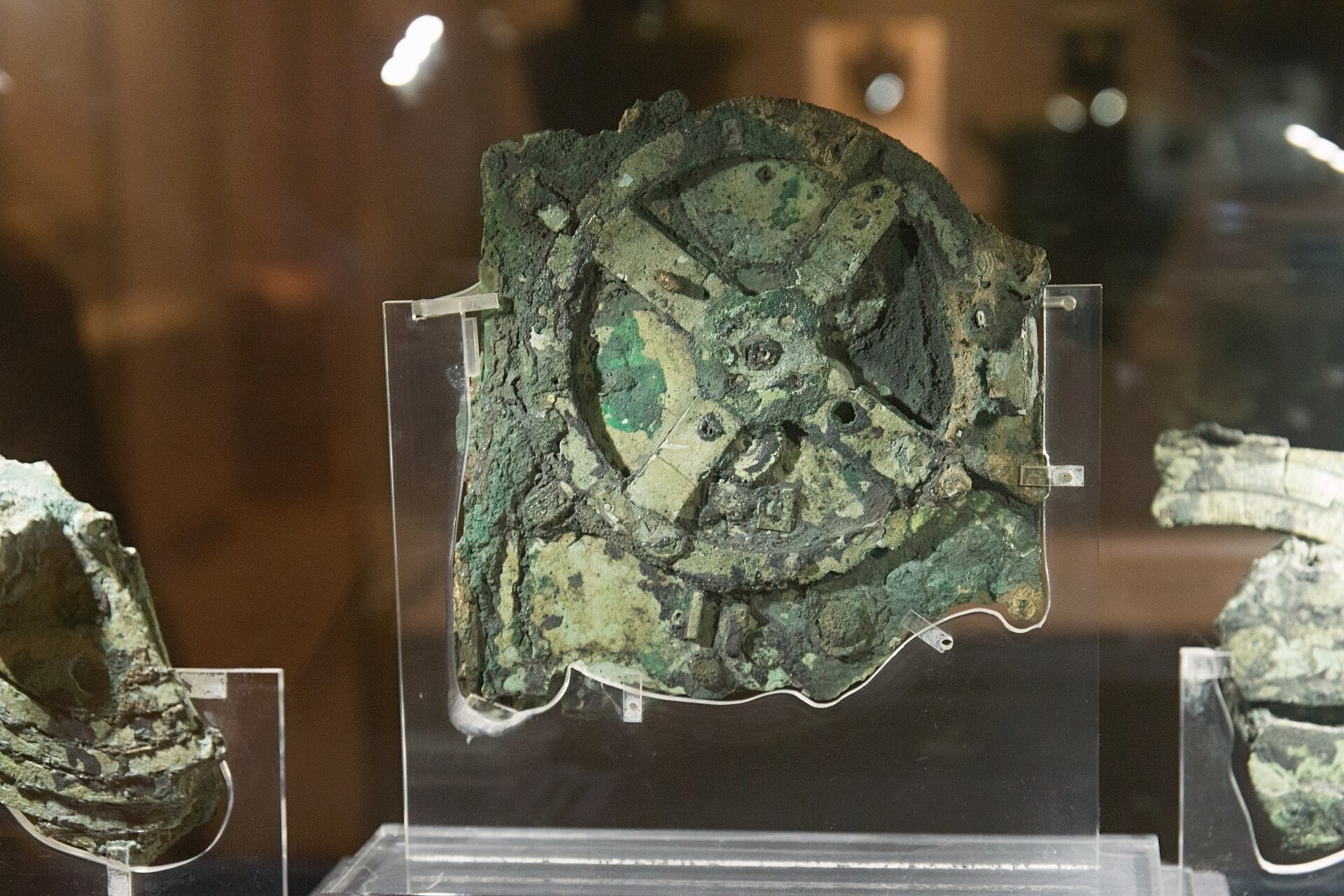
The mechanism emerged from the sea as a single encrusted piece5Antikythera mechanism — sec4 · Wikipedia ↗. It came from the wreck of a Roman cargo ship lying at a depth of 45 metres (148 ft) off Point Glyphadia on the Greek island of Antikythera6Antikythera mechanism — sec1 · Wikipedia ↗. Captain Dimitrios Kontos and a crew of sponge divers from Symi island discovered that wreck in early 1900 and recovered artefacts during the first expedition with the Hellenic Royal Navy in 1900–19016. The wreck yielded numerous statues, coins and other artifacts dating back to the fourth century BC, together with the severely corroded remnants of the device7Antikythera mechanism — wreck · Reference ↗.
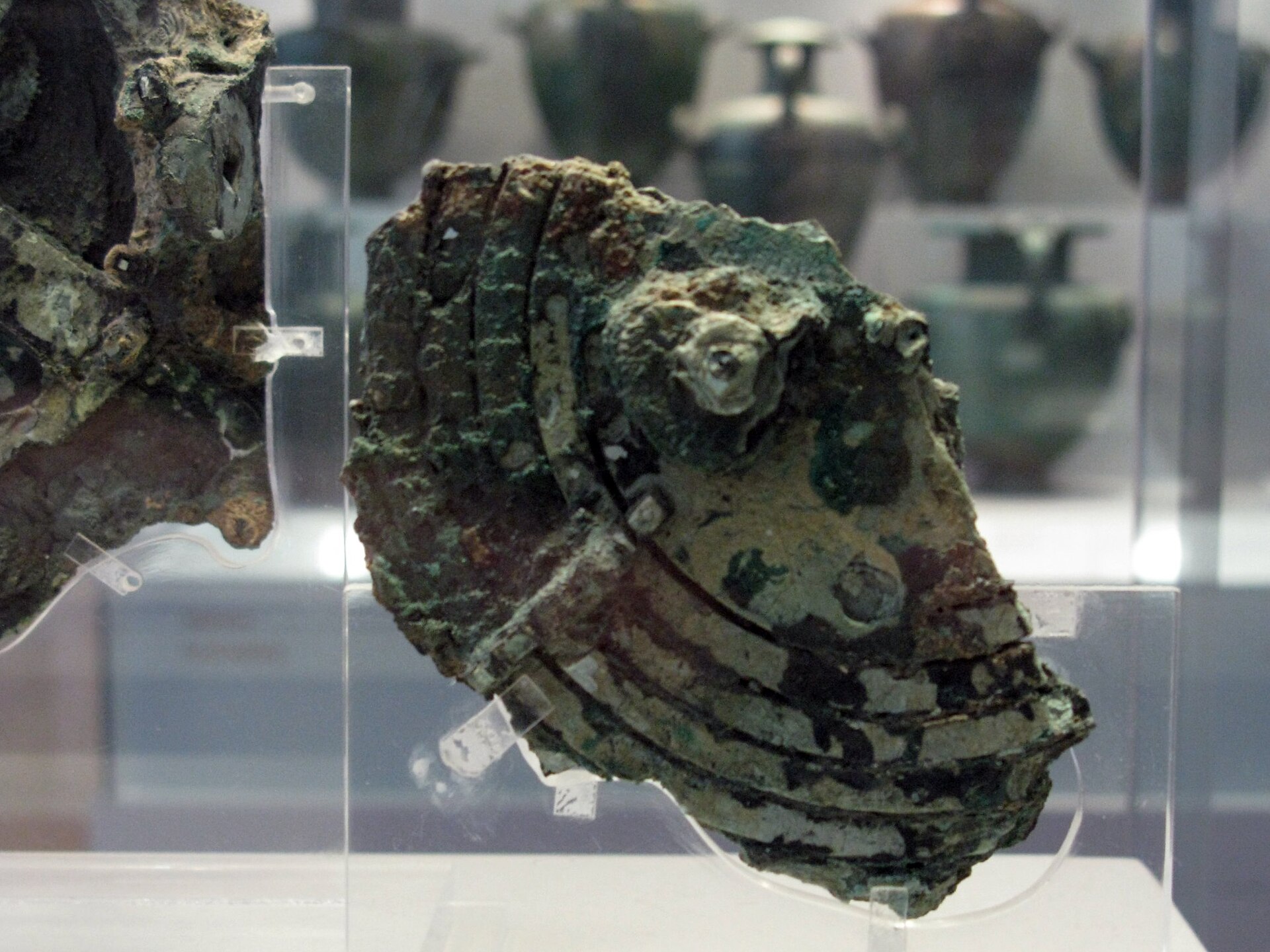
On the front face sits a fixed ring dial representing the ecliptic, with the twelve zodiacal signs marked off in equal 30-degree sectors8Antikythera mechanism — sec6 · Wikipedia ↗. The scales on Fragment C divide the year by days and signs of the zodiac9Antikythera mechanism — smit · Reference ↗. For more than a century the outer ring was presumed to represent a 365-day Egyptian solar calendar, until research by Budiselic and colleagues in 2020 challenged that presumption and provided direct statistical evidence of 354 intervals, suggesting a lunar calendar10Antikythera mechanism — sec7 · Wikipedia ↗.
The device is a cultural treasure that has engrossed scholars across many disciplines4. Its reconstruction combines cycles from Babylonian astronomy, mathematics from Plato's Academy and ancient Greek astronomical theories4. The 2006 Nature letter by Freeth and colleagues, published on 01 November 2006 in volume 444 on pages 587–591, set out the decoding of the calculator, and the specific data obtained from the fragments is detailed in that article's supplement3.
1. Discovery and recovery
The mechanism came to light through a shipwreck: a Roman cargo vessel lying at a depth of 45 metres (148 ft) off Point Glyphadia on the Greek island of Antikythera 6. Captain Dimitrios Kontos and a crew of sponge divers from Symi are associated with the wreck 11Antikythera mechanism — sec2 · Wikipedia ↗. The divers stopped at Antikythera to wait for favorable winds 7.
The cargo recovered from the site included coins, among them a disproportionate quantity of Pergamene cistophoric tetradrachms and Ephesian coins 12Antikythera mechanism — ephebe · Reference ↗. This composition led scholars to surmise that the ship had begun its journey on the Ionian coast, perhaps at Ephesus 12. None of the recovered cargo has been identified as from mainland Greece 12.
The original mechanism apparently came out of the Mediterranean as a single encrusted piece 5. Upon removal from seawater it was not treated, resulting in deformational changes 6.
In 1902, during a visit to the National Archaeological Museum in Athens, the fragment was noticed by Greek politician Spyridon Stais as containing a gear 13Antikythera mechanism — wiki · Wikipedia ↗. This observation prompted the first study of the fragment by his cousin, Valerios Stais, the museum director 13.
The surviving material is fragmentary: the major fragments of the Antikythera mechanism are labelled A–G and the minor fragments 1–75 4. Fragment A measures 180 × 150 mm and weighs 369.1 g, carries 27 gears and inscriptions, and contains the majority of the device 5. The largest gear is about 13 cm (5 in) in diameter and originally had 223 teeth 1.
The device is an ancient Greek hand-powered orrery, a model of the Solar System built in the 2nd century BC and discovered in 1901 1. It is generally referred to as the first known analogue computer 2, and it could be used to predict astronomical positions and eclipses decades in advance 13. Its construction is dated to around the end of the second century bc 3. The wreck that carried it yielded numerous statues, coins, and other artifacts dating back to the fourth century BC, alongside the severely corroded remnants of the device 7.
On the front face there is a fixed ring dial representing the ecliptic, with the twelve zodiacal signs marked off in equal 30-degree sectors 8. Since the discovery of the mechanism more than a century ago this outer ring has been presumed to represent a 365-day Egyptian solar calendar, but research (Budiselic, et al., 2020) challenged this presumption and provided direct statistical evidence there are 354 intervals, suggesting a lunar calendar 10.
The scales on Fragment C divide the year by days and signs of the zodiac 9. Solving this complex 3D puzzle reveals a creation of genius, combining cycles from Babylonian astronomy, mathematics from Plato's Academy and ancient Greek astronomical theories 4. The mechanism is a cultural treasure that has engrossed scholars across many disciplines 4, and information on the specific data obtained from the fragments is detailed in the supplement to the 2006 Nature article from Freeth et al. 14Antikythera mechanism — sec5 · Wikipedia ↗.
2. Recognition and early study
The mechanism was operated by turning a small hand crank (now lost) which was linked via a crown gear to the largest gear, the four-spoked gear visible on the front of fragment A, gear b18. The largest gear is about 13 cm (5 in) in diameter and originally had 223 teeth13.
While other contenders cannot be ruled out, of the two values that have been proposed for N on astronomical grounds, that of Budiselic et al.10.
An astrarium, also called a planetarium, is a medieval astronomical clock made in the 14th century by Italian engineer and astronomer Giovanni Dondi dell'Orologio15Antikythera mechanism — astrarium · Reference ↗. This was its main task, in comparison with the astronomical clock, the main task of which is the actual reading of time15.
The 2006 Nature letter by Freeth et al. was titled Decoding the ancient Greek astronomical calculator known as the Antikythera Mechanism, published 01 November 2006 in volume 444, pages 587–5913.
The Antikythera mechanism is an ancient Greek hand-powered orrery, a model of the Solar System, built in the 2nd century BC and discovered in 190113. It is generally referred to as the first known analogue computer2, and it could be used to predict astronomical positions and eclipses decades in advance13.
The wreck that yielded the device was found by sponge divers off Point Glyphadia on the Greek island of Antikythera in 19007. Captain Dimitrios Kontos and a crew of sponge divers from Symi island made the discovery in early 1900, and artefacts were recovered during the first expedition with the Hellenic Royal Navy in 1900–19016. The wreck yielded numerous statues, coins and other artifacts dating back to the fourth century BC, as well as the severely corroded remnants of the device many regard as the world's oldest known analog computer7. The original mechanism apparently came out of the Mediterranean as a single encrusted piece5.
In 1902, during a visit to the National Archaeological Museum in Athens, the fragment was noticed by Greek politician Spyridon Stais as containing a gear, prompting the first study of the fragment by his cousin, Valerios Stais, the museum director13. The mechanism is now held at the National Archaeological Museum in Athens1.
On the front face there is a fixed ring dial representing the ecliptic, the twelve zodiacal signs marked off with equal 30-degree sectors8. The scales on Fragment C divide the year by days and signs of the zodiac9. Since the discovery of the mechanism more than a century ago, this outer ring has been presumed to represent a 365-day Egyptian solar calendar, but research (Budiselic, et al., 2020) challenged this presumption and provided direct statistical evidence there are 354 intervals, suggesting a lunar calendar10. Information on the specific data obtained from the fragments is detailed in the supplement to the 2006 Nature article from Freeth et al.14.
The 2006 Nature letter by Freeth et al. was published 01 November 2006 in volume 444, pages 587–5913. Solving this complex 3D puzzle reveals a creation of genius—combining cycles from Babylonian astronomy, mathematics from Plato's Academy and ancient Greek astronomical theories4. The Antikythera Mechanism is a cultural treasure that has engrossed scholars across many disciplines4.
3. Physical form and fragments
The Antikythera mechanism was similar in size to a mantel clock, and bits of wood found on the fragments suggest it was housed in a wooden case9.
Of the 82 known fragments, seven are mechanically significant and contain the majority of the mechanism and inscriptions5.
| Fragment | Size [mm] | Weight [g] | Gears | Inscriptions | Notes |
|---|---|---|---|---|---|
| Fragment A | 180 × 150 | 369.1 | 27 | Yes | The main fragment contains the majority of the known mechanism. |
The surviving material is conventionally divided by letter and number: the major fragments carry the labels A–G, while the minor pieces run from 1 to 754. Among these, Fragment A is the largest, measuring 180 × 150 mm and weighing 369.1 g, and it preserves 27 gears together with inscriptions; it is the piece that contains the majority of the known mechanism5.
Condition has shaped what can be read from the device. When the mechanism was removed from seawater it received no treatment, and the resulting deformational changes have left the fragments altered from their original state6.
Detailed data on the individual fragments is set out in the supplement to the 2006 Nature article by Freeth and colleagues14.
4. Operation and dials
The mechanism was operated by turning a small hand crank (now lost) which was linked via a crown gear to the largest gear, the four-spoked gear visible on the front of fragment A, gear b1 8. The crank moves the date pointer about 78 days per full rotation, so hitting a particular day on the dial would be easily possible if the mechanism were in good working condition 8.
On the front face of the mechanism, there is a fixed ring dial representing the ecliptic, the twelve zodiacal signs marked off with equal 30-degree sectors 14. The scales on Fragment C divide the year by days and signs of the zodiac 14.
The Antikythera mechanism is an ancient Greek hand-powered orrery, a model of the Solar System, built in the 2nd century BC and discovered in 1901 13. It is generally referred to as the first known analogue computer 2, and it could be used to predict astronomical positions and eclipses decades in advance 13. The device is a unique Greek geared construction, made around the end of the second century bc 3, and its decipherment combines cycles from Babylonian astronomy, mathematics from Plato's Academy and ancient Greek astronomical theories 4.
The wreck that carried the mechanism was found at a depth of 45 metres (148 ft) off Point Glyphadia on the Greek island of Antikythera 6. Captain Dimitrios Kontos and a crew of sponge divers from Symi island discovered the Antikythera wreck in early 1900, and recovered artefacts during the first expedition with the Hellenic Royal Navy in 1900–1901 6. The wreck yielded numerous statues, coins and other artifacts dating back to the fourth century BC, as well as the severely corroded remnants of the device 7. The original mechanism apparently came out of the Mediterranean as a single encrusted piece 5.
For more than a century the outer ring of the mechanism has been presumed to represent a 365-day Egyptian solar calendar, but research published by Budiselic and colleagues in 2020 challenged this presumption and provided direct statistical evidence of 354 intervals, suggesting a lunar calendar 10. Detailed information on the specific data obtained from the fragments is set out in the supplement to the 2006 Nature article by Freeth and others 14, a letter published on 01 November 2006 under the title Decoding the ancient Greek astronomical calculator known as the Antikythera Mechanism 3.
5. Calendar ring and the 365-day presumption
Since the discovery of the mechanism more than a century ago the outer ring has been presumed to represent a 365-day Egyptian solar calendar10. Research by Budiselic et al. in 2020 challenged this presumption and provided direct statistical evidence there are 354 intervals, suggesting a lunar calendar10. Of the two values proposed for N on astronomical grounds, that of Budiselic et al. (354) is by far the more likely10.
If one supports the 365 day presumption it is recognized the mechanism predates the Julian calendar reform10. The Sothic and Callippic cycles had already pointed to a 365 + 1 / 4 day solar year10. This is seen in Ptolemy III's attempted calendar reform of 238 BC10.
The wreck that yielded the mechanism was found in early 1900 by Captain Dimitrios Kontos and a crew of sponge divers from Symi island, and artefacts were recovered during the first expedition with the Hellenic Royal Navy in 1900–19016. In 1902, during a visit to the National Archaeological Museum in Athens, Greek politician Spyridon Stais noticed that a fragment contained a gear, prompting the first study of the fragment by his cousin Valerios Stais, the museum director1.
On the front face sits a fixed ring dial representing the ecliptic, with the twelve zodiacal signs marked off in equal 30-degree sectors8. The scales on Fragment C divide the year by days and signs of the zodiac9. The crank moves the date pointer about 78 days per full rotation, so hitting a particular day on the dial would be easily possible if the mechanism were in good working condition8.
Research in 2008 by the Antikythera Mechanism Research Project suggested the concept may have originated in the colonies of Corinth, since the calendar on the Metonic Spiral was identified as coming from Corinth or one of its colonies in northwest Greece or Sicily2. A complex mechanism, it combined the functions of a modern planetarium, clock, and calendar into a singular constructive device15.
6. Origin and cultural context
Solving this complex 3D puzzle reveals a creation of genius—combining cycles from Babylonian astronomy, mathematics from Plato’s Academy and ancient Greek astronomical theories4. Eclipses and planetary motions were often interpreted as omens, while the calm regularity of the astronomical cycles must have been philosophically attractive in an uncertain and violent world3.
In 2008 research by the Antikythera Mechanism Research Project suggested the concept for the mechanism may have originated in the colonies of Corinth, since they identified the calendar on the Metonic Spiral as coming from Corinth, or one of its colonies in northwest Greece or Sicily2.
The Antikythera mechanism is generally referred to as the first known analogue computer2. The original mechanism apparently came out of the Mediterranean as a single encrusted piece5. The largest gear is about 13 cm (5 in) in diameter and originally had 223 teeth1. The scales on Fragment C divide the year by days and signs of the zodiac9. The Antikythera Mechanism is a cultural treasure that has engrossed scholars across many disciplines4.
7. Scholarship and legacy
The Antikythera mechanism has engrossed scholars across many disciplines and stands as a cultural treasure. Information on the specific data obtained from the fragments is detailed in the supplement to the 2006 Nature article from Freeth et al.14
The mechanism invites comparison with the astrarium, also called a planetarium, a medieval astronomical clock made in the 14th century by Italian engineer and astronomer Giovanni Dondi dell'Orologio.15 The main task of the Antikythera mechanism was astronomical prediction, in comparison with the astronomical clock whose main task is the actual reading of time.15 A complex mechanism, the astrarium combined the functions of a modern planetarium, clock, and calendar into a singular constructive device.15
The Antikythera mechanism is an ancient Greek hand-powered orrery, a model of the Solar System, built in the 2nd century BC and discovered in 190113. It is generally referred to as the first known analogue computer2, and it could be used to predict astronomical positions and eclipses decades in advance13. The device is a unique Greek geared device, constructed around the end of the second century bc3. Solving this complex 3D puzzle reveals a creation of genius, combining cycles from Babylonian astronomy, mathematics from Plato's Academy and ancient Greek astronomical theories4.
The wreck that carried the mechanism was that of a Roman cargo ship, found at a depth of 45 metres (148 ft) off Point Glyphadia on the Greek island of Antikythera6. Captain Dimitrios Kontos and a crew of sponge divers from Symi island discovered the Antikythera wreck in early 1900, and recovered artefacts during the first expedition with the Hellenic Royal Navy, in 1900–19016. The wreck yielded numerous statues, coins, and other artifacts dating back to the fourth century BC, as well as the severely corroded remnants of a device many regard as the world's oldest known analog computer, the Antikythera mechanism7. The original mechanism apparently came out of the Mediterranean as a single encrusted piece5.
On the front face of the mechanism, there is a fixed ring dial representing the ecliptic, the twelve zodiacal signs marked off with equal 30-degree sectors8. The scales on Fragment C divide the year by days and signs of the zodiac9. Since the discovery of the mechanism more than a century ago, this outer ring has been presumed to represent a 365-day Egyptian solar calendar, but research (Budiselic, et al., 2020) challenged this presumption and provided direct statistical evidence there are 354 intervals, suggesting a lunar calendar10.
The Antikythera Mechanism is a cultural treasure that has engrossed scholars across many disciplines4. The 2006 Nature letter Decoding the ancient Greek astronomical calculator known as the Antikythera Mechanism was published on 01 November 20063. Derek de Solla Price (1922–1983) worked with a model of the Antikythera mechanism6.
8. Key dates
- 238 BCEis by far the more likely." If one supports the 365 dayis by far the more likely." If one supports the 365 day presumption, it is recognized the mechanism predates the Julian calendar reform, but the Sothic and Callippic cycles had already pointed to a 365 + 1 / 4 day solar year, as seen in Ptolemy III 's attempt
- 60 BCEThe wreck site, which is dated about 70–60 BC, also yielded theThe wreck site, which is dated about 70–60 BC, also yielded the Antikythera mechanism , a characterful head of a Stoic philosopher, and a hoard of coins.
- 1860It was found in Aigion in Achaea after which it took itsIt was found in Aigion in Achaea after which it took its name, in 1860.
- 1900[ 1 ] [ 2 ] It was discovered by sponge divers[ 1 ] [ 2 ] It was discovered by sponge divers off Point Glyphadia on the Greek island of Antikythera in 1900.
- 1901Type Analogue computer Writing Ancient Greek Created 2nd century BC PeriodType Analogue computer Writing Ancient Greek Created 2nd century BC Period/culture Hellenistic Discovered 1901 Antikythera , Greece Present location National Archaeological Museum, Athens The Antikythera mechanism ( / ˌ æ n t ɪ k ɪ ˈ θ ɪər ə / AN -tik-ih- THEER -ə , US also / ˌ æ
- 1902[ 12 ] [ 13 ] In 1902, during a visit to[ 12 ] [ 13 ] In 1902, during a visit to the National Archaeological Museum in Athens, it was noticed by Greek politician Spyridon Stais as containing a gear , [ 14 ] prompting the first study of the fragment by his cousin, Valerios Stais , the museum director.
- 1922de Solla Price with a model of the Antikythera mechanism Captain Dimitriosde Solla Price with a model of the Antikythera mechanism Captain Dimitrios Kontos and a crew of sponge divers from Symi island discovered the Antikythera wreck in early 1900, and recovered artefacts during the first expedition with the Hellenic Ro
- 2006Mechanics Animation of the Antikythera mechanism Information on the specifMechanics Animation of the Antikythera mechanism Information on the specific data obtained from the fragments is detailed in the supplement to the 2006 Nature article from Freeth et al.
- 2008In 2008, research by the Antikythera Mechanism Research Project suggestedIn 2008, research by the Antikythera Mechanism Research Project suggested the concept for the mechanism may have originated in the colonies of Corinth , since they identified the calendar on the Metonic Spiral as coming from Corinth, or one of its colonies in northwest Greece or
- 2015Decoding the Antikythera Mechanism, the First Computer Hidden inscriptionsDecoding the Antikythera Mechanism, the First Computer Hidden inscriptions offer new clues to the origins of a mysterious astronomical mechanism Jo Marchant | Correspondent February 2015 Share Copy link Email SMS Facebook X Reddit LinkedIn Bluesky Print Add as preferred source Th
9. Frequently asked questions
Where is the Antikythera mechanism kept today?
Who first spotted that the corroded lump contained gearwork?
What kind of object is it, in modern terms?
When did the mechanism begin to attract wide attention?
How was the wreck that carried it found?
References (17)
- 1Antikythera mechanism — wiki — Wikipedia Web↩View source
- 2Antikythera mechanism — sec3 — Wikipedia Web↩View source
- 3Antikythera mechanism — 2006 — Reference 2006 Journal↩View source
- 4Antikythera mechanism — nature — Reference Journal↩View source
- 5Antikythera mechanism — sec4 — Wikipedia Web↩View source
- 6Antikythera mechanism — sec1 — Wikipedia Web↩View source
- 7Antikythera mechanism — wreck — Reference Web↩View source
- 8Antikythera mechanism — sec6 — Wikipedia Web↩View source
- 9Antikythera mechanism — smit — Reference Web↩View source
- 10Antikythera mechanism — sec7 — Wikipedia Web↩View source
- 11Antikythera mechanism — sec2 — Wikipedia Web↩View source
- 12Antikythera mechanism — ephebe — Reference Web↩View source
- 13Antikythera mechanism — wiki — Wikipedia Web↩View source
- 14Antikythera mechanism — sec5 — Wikipedia Web↩View source
- 15Antikythera mechanism — astrarium — Reference Web↩View source
- 16Antikythera mechanism — sec8 — Wikipedia WebView source
- 17Antikythera mechanism — aegium — Reference WebView source