Lalibela
Eleven churches carved downward into solid rock.
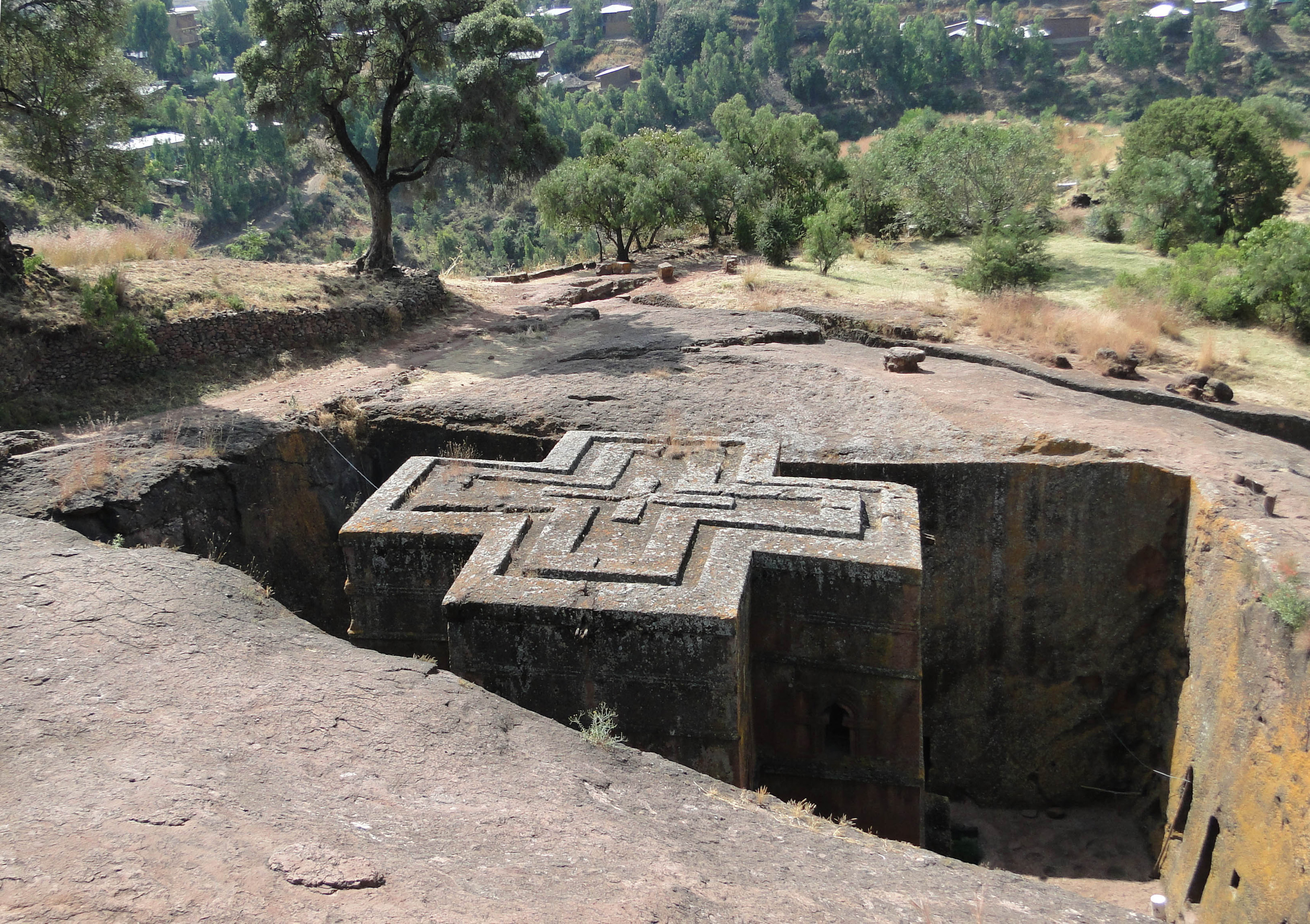
Overview
Lalibela is a town in the Amhara Region of Ethiopia, situated in the Lasta district and the North Wollo Zone1Lalibela — wiki · Wikipedia ↗. It draws visitors chiefly for its rock-cut monolithic churches, designed in contrast to the earlier monolithic churches of Ethiopia1. The whole of Lalibela stands as a large and important site for the antiquity, medieval, and post-medieval civilization of Ethiopia1, and to some Christians it ranks among Ethiopia's holiest cities and serves as a center of pilgrimage1.
The town's churches belong to the Ethiopian Orthodox Tewahedo Church, and among them Biete Maryam is one of the monolithic rock-cut churches of Lalibela2Lalibela — maryam · Reference ↗. The Church of Saint George, known in Amharic as Betä Giyorgis, is one of eleven rock-hewn monolithic churches in the town3Lalibela — lalibela · Reference ↗. The precise date of construction of these churches is unknown; Biete Maryam, like the others, was built no earlier than the 7th century AD during the Kingdom of Axum and no later than the 13th century AD during the Solomonic dynasty and Ethiopian Empire2.
The Zagwe dynasty was a medieval Agaw monarchy that ruled the northern parts of Ethiopia and Eritrea4Lalibela — dynasty · Reference ↗. The Zagwe are most famous for their king Gebre Meskel Lalibela, who is credited with having ordered the construction of the rock-hewn monolithic churches of Lalibela4. King Lalibela sought to recreate Jerusalem, structuring the churches' landscape and religious sites to achieve that aim3.
Recent archaeological excavations at Lalibela have yielded abundant pottery and faunal remains dating to 900–1100, indicating that the site was largely a secular settlement before being transformed into a religious center by King Lalibela5Lalibela — sec1 · Wikipedia ↗. The architecture of the churches contains significant Aksumite influences; Stuart Munro-Hay notes that the church of Biete Amanuel displays a stone imitation of wooden architectural features still visible in some of the ancient churches of Tigray and Eritrea6Lalibela — sec8 · Wikipedia ↗. Munro-Hay also notes that during the reign of Gebre Meskel Lalibela many Coptic Egyptians emigrated to Ethiopia and may have assisted in construction of the churches, or at least those dating to his reign6.
According to the Futuh al-Habasha of Shihab al-Dīn Aḥmad ibn ʿAbd al-Qādir ibn Sālim ibn ʿUthmān, Ahmad ibn Ibrahim al-Ghazi burned one of the churches of Lalibela during his invasion of Ethiopia7Lalibela — sec4 · Wikipedia ↗. In 1882 the French explorer Achille Raffray was given an Ethiopian manuscript at Lalibela, which adds that King Lalibela and his wife Meskal Kebra brought from Alexandria and Jerusalem about five hundred workers still referred to as Europeans, headed by someone named Sidi Meskal8Lalibela — sec5 · Wikipedia ↗.
During the Second Italo-Ethiopian War, Haile Selassie made a pilgrimage to the churches at Lalibela at considerable risk of capture before returning to his capital in April 19369Lalibela — sec6 · Wikipedia ↗. Attacks in this period significantly reduced foreign tourism to Lalibela, and by 1990 most of the tourists were Ethiopians9. The eastern part of the woreda, including Lalibela, fell to Ethiopian People's Revolutionary Democratic Front forces in 198810Lalibela — bugna · Reference ↗.
In early August 2021 Tigrayan Defense Force fighters captured the town during the Tigray War as a response to the invasion of Amhara forces into the Tigray region11Lalibela — sec7 · Wikipedia ↗. In early November 2023 Lalibela was the site of fierce fighting between the Ethiopian National Defense Force (ENDF) and Fano fighters11.
Local tradition holds that Gebre Meskel Lalibela, before ascending the throne, was guided by Jesus on a tour of Jerusalem and instructed to build a second Jerusalem in Ethiopia5. The site was originally named Roha (Warwar) and took the name Lalibela from that king of the Zagwe dynasty, who commissioned its construction3. The Zagwe ruled large parts of the territory from approximately 1137 to 1270 AD, when the last Zagwe king Za-Ilmaknun was killed in battle by the forces of the Amhara king Yekuno Amlak4.
The generally accepted chronology was established by David Roden Buxton, who observed that two of the churches follow, with great fidelity of detail, the tradition represented by Debra Damo as modified at Yemrahana Kristos5. Because carving these structures from the living rock must have taken longer than the few decades of Gebre Meskel Lalibela's reign, Buxton assumes that the work extended into the 14th century5.
The eleven rock-hewn churches of Lalibela are monolithic churches11, and the site remains in use by the Ethiopian Orthodox Christian Church to this day11. The Portuguese writer Alvares, having described the structures, declared that he wearied of writing more about them, fearing he would not be believed, and swore by God that all he had written was the truth, adding that there was much more than he had set down7.
In 1968 Mohammad Reza Pahlavi, accompanied by Emperor Haile Selassie, visited the churches, and the following year Queen Juliana and Prince Bernhard also visited Lalibela9. Lalibela lies within Bugna, a woreda in Amhara Region10; besides Lalibela, other notable landmarks in Bugna include the church of Yemrehana Krestos and the ancient churches of Makina Madbane Alem, Bilbala Tcherqos, Kankanet Mikael, and Gennete Maryam10.
The manuscript given to Achille Raffray at Lalibela also carries a second text, in Arabic, which serves as a land charter confirming specific rights of the church8.
1. Name and Origins
The historical and religious site was first known as Roha (Warwar) and took its present name from King Gebre Mesqel Lalibela of the Zagwe dynasty, who commissioned its construction3. The Zagwe ruled large parts of the territory from approximately 1137 to 1270 AD, until the last Zagwe King Za-Ilmaknun was killed in battle by the forces of the Amhara King Yekuno Amlak4. The name "Zagwe" is thought to derive from the ancient Ge'ez phrase Ze-Agaw, meaning "of the Agaw", in reference to the Mara Tekle Haymanot, the founder of the dynasty4. The Zagwe period is still shrouded in mystery; even the number of kings in this dynasty is disputed4.
The layout and names of the major buildings in Lalibela are widely accepted, especially by local clergy, to be a symbolic representation of Jerusalem1. According to local tradition, in Ethiopia prior to his accession to the throne, Gebre Meskel Lalibela was guided by Jesus on a tour of Jerusalem, and instructed to build a second Jerusalem in Ethiopia5.
The churches have been dated to the late 12th or early 13th century AD, and are thought to have been constructed during the reign of King Gebre Mesqel Lalibela, of the late Zagwe dynasty3. David Roden Buxton established the generally accepted chronology, noting that "two of them follow, with great fidelity of detail, the tradition represented by Debra Damo as modified at Yemrahana Kristos"5. Since the time spent to carve these structures from the living rock must have taken longer than the few decades of reign of Gebre Meskel Lalibela, Buxton assumes that the work extended into the 14th century5.
Local historian Getachew Mekonnen credits Queen Meskel Kibra, Lalibela's wife, with having one of the rock-hewn churches, Biete Abba Libanos, built as a memorial for her husband after his death5. Professor Taddesse Tamrat records a tradition he heard from an old priest in Lalibela that Emperor Kaleb of Axum was a man of Lasta, and his palace was at Bugna, where it is known that Gebre Mesqel had later established his centre10. Besides Lalibela, other notable landmarks in Bugna include the church of Yemrehana Krestos, as well as the ancient churches of Makina Madbane Alem, Bilbala Tcherqos, Kankanet Mikael, and Gennete Maryam10.
Lalibela is a town in the Amhara Region of Ethiopia1. It lies in the Lasta district and North Wollo Zone, and draws visitors for its rock-cut monolithic churches, which were designed in contrast to the earlier monolithic churches in Ethiopia1. The Church of Saint George, known in Amharic as Betä Giyorgis, is one of eleven rock-hewn monolithic churches at the site3. Biete Maryam is likewise one of the monolithic rock-cut churches of Lalibela belonging to the Ethiopian Orthodox Tewahedo Church2.
The Zagwe dynasty was a medieval Agaw monarchy that ruled the northern parts of Ethiopia and Eritrea4. The architecture of the churches carries significant Aksumite influences; Stuart Munro-Hay notes that the church of Biete Amanuel displays a stone imitation of wooden architectural features still visible in some of the ancient churches of Tigray and Eritrea6. Munro-Hay also notes that during the reign of Gebre Meskel Lalibela many Coptic Egyptians emigrated to Ethiopia and may have assisted in construction of the churches, or at least those dating to his reign6.
In 1882 the French explorer Achille Raffray was given an Ethiopian manuscript at Lalibela, which adds that King Lalibela and his wife Meskal Kebra brought from Alexandria and Jerusalem about five hundred workers still referred to as Europeans, headed by someone named Sidi Meskal8. According to the Futuh al-Habasha of Shihab al-Dīn Aḥmad ibn ʿAbd al-Qādir ibn Sālim ibn ʿUthmān, Ahmad ibn Ibrahim al-Ghazi burned one of the churches of Lalibela during his invasion of Ethiopia7.
During the Second Italo-Ethiopian War, Haile Selassie made a pilgrimage to the churches at Lalibela, at considerable risk of capture, before returning to his capital in April 19369. In 1968 Mohammad Reza Pahlavi, accompanied by Emperor Haile Selassie, visited the churches, and the following year Queen Juliana and Prince Bernhard also visited Lalibela9. The site remains in use by the Ethiopian Orthodox Christian Church to this day11.
2. Zagwe Dynasty and the Churches
The Zagwe dynasty was a medieval Agaw monarchy that ruled over parts of northern Ethiopia and Eritrea from approximately 1137 to 1270 AD. The dynasty came to an end when the last Zagwe King Za-Ilmaknun was killed in battle by forces of the Amhara King Yekuno Amlak. The Zagwe are most famous for Gebre Meskel Lalibela, who is credited with ordering the construction of the rock-hewn monolithic churches. The dynasty's period remains shrouded in mystery, with even the number of its kings disputed. The name 'Zagwe' has been proposed to derive from the Ge'ez Ze-Agaw, meaning 'of the Agaw', in reference to Mara Tekle Haymanot, founder of the dynasty.
The eleven churches are monolithic. The site remains in use by the Ethiopian Orthodox Christian Church to this day. Biete Maryam is one of the monolithic rock-cut churches of the Ethiopian Orthodox Tewahedo Church.
The site was originally named Roha (Warwar) and took the name Lalibela from King Gebre Mesqel Lalibela of the Zagwe dynasty, who commissioned its construction 3. Lalibela sought to recreate Jerusalem, structuring the churches' landscape and religious sites to achieve that feat 3. The town lies in the Lasta district and North Wollo Zone and is a tourist site for its rock-cut monolithic churches, designed in contrast to the earlier monolithic churches in Ethiopia 1.
The Church of Saint George, known in Amharic as Betä Giyorgis, is one of eleven rock-hewn monolithic churches in Lalibela, a town in the Amhara Region of Ethiopia 3. It has been dated to the late 12th or early 13th century AD and is thought to have been constructed during the reign of King Gebre Mesqel Lalibela of the late Zagwe dynasty 3. It is among the best known and last built of the eleven churches in the Lalibela area and has been referred to as the "Eighth Wonder of the World" 3. Like the other churches of Lalibela, the precise date of construction of Biete Maryam is unknown, although it was built no earlier than the 7th century AD, during the Kingdom of Axum, and no later than the 13th century AD, during the Solomonic dynasty and Ethiopian Empire 2.
The architecture of the churches contains significant Aksumite influences; Stuart Munro-Hay notes that the church of Biete Amanuel displays a stone imitation of wooden architectural features, which can still be seen in some of the ancient churches of Tigray and Eritrea 6. Munro-Hay also notes that during the reign of Gebre Meskel Lalibela many Coptic Egyptians emigrated to Ethiopia and may have assisted in construction of the churches, or at least those that date to his reign 6. Local historian Getachew Mekonnen credits Queen Meskel Kibra, Lalibela's wife, with having one of the rock-hewn churches, Biete Abba Libanos, built as a memorial for her husband after his death 5.
Enno Littmann theorized that certain kings were forerunners of the Zagwe dynasty 4. According to the Futuh al-Habasha of Shihab al-Dīn Aḥmad ibn ʿAbd al-Qādir ibn Sālim ibn ʿUthmān, Ahmad ibn Ibrahim al-Ghazi burned one of the churches of Lalibela during his invasion of Ethiopia 7.
During the Second Italo-Ethiopian War, Haile Selassie made a pilgrimage to the churches at Lalibela, at considerable risk of capture, before returning to his capital in April 1936 9. In 1968 Mohammad Reza Pahlavi, accompanied by Emperor Haile Selassie, visited the churches, and the next year Queen Juliana and Prince Bernhard would also visit Lalibela 9.
3. Archaeology and Chronology
Recent archaeological excavations at Lalibela have yielded abundant pottery and faunal remains dating to 900–1100, indicating that the site was largely a secular settlement before being transformed into a religious center by King Lalibela5. David Roden Buxton established the generally accepted chronology of the churches5. He noted that two of them follow, with great fidelity of detail, the tradition represented by Debra Damo as modified at Yemrahana Kristos5. Because the time spent to carve these structures from the living rock must have taken longer than the few decades of the reign of Gebre Meskel Lalibela, Buxton assumes that the work extended into the 14th century5.
The precise date of construction of the churches is unknown, bounded no earlier than the 7th century AD during the Kingdom of Axum and no later than the 13th century AD during the Solomonic dynasty and Ethiopian Empire5.
Lalibela is a town in the Amhara Region of Ethiopia, situated in the Lasta district and North Wollo Zone1. Originally named Roha (Warwar), the historical and religious site took the name Lalibela from King Gebre Mesqel Lalibela of the Zagwe dynasty, who commissioned its construction3. The Zagwe dynasty was a medieval Agaw monarchy that ruled the northern parts of Ethiopia and Eritrea, holding large parts of that territory from approximately 1137 to 1270 AD, when the last Zagwe King Za-Ilmaknun was killed in battle by the forces of the Amhara King Yekuno Amlak4.
Local tradition holds that, before his accession to the throne, Gebre Meskel Lalibela was guided by Jesus on a tour of Jerusalem and instructed to build a second Jerusalem in Ethiopia5. A later Ethiopian manuscript given to the French explorer Achille Raffray at Lalibela in 1882 adds that King Lalibela and his wife Meskal Kebra brought from Alexandria and Jerusalem about five hundred workers still referred to as Europeans, headed by someone named Sidi Meskal8. Stuart Munro-Hay notes that during the reign of Gebre Meskel Lalibela many Coptic Egyptians emigrated to Ethiopia and may have assisted in construction of the churches, or at least those that date to his reign6.
The architecture of the churches contains significant Aksumite influences; Munro-Hay observes that the church of Biete Amanuel displays a stone imitation of wooden architectural features still visible in some of the ancient churches of Tigray and Eritrea6. The eleven rock-hewn churches of Lalibela are monolithic churches, and the site remains in use by the Ethiopian Orthodox Christian Church to this day11. The Church of Saint George, known in Amharic as Betä Giyorgis, is one of those eleven, and Biete Maryam is likewise one of the monolithic rock-cut churches of the Ethiopian Orthodox Tewahedo Church32.
According to the Futuh al-Habasha of Shihab al-Dīn Aḥmad ibn ʿAbd al-Qādir ibn Sālim ibn ʿUthmān, Ahmad ibn Ibrahim al-Ghazi burned one of the churches of Lalibela during his invasion of Ethiopia7. The Portuguese priest Alvares, having described the unique church structures, wrote that he wearied of writing more about the buildings, fearing he would not be believed, and swore by God that all he had written was the truth and that there was much more than what he had written, left out lest he be taxed with falsehood7. During the Second Italo-Ethiopian War, Haile Selassie made a pilgrimage to the churches at Lalibela at considerable risk of capture before returning to his capital in April 19369. In 1968 Mohammad Reza Pahlavi, accompanied by Emperor Haile Selassie, visited the churches, and the next year Queen Juliana and Prince Bernhard would also visit Lalibela9.
The precise date of construction of Biete Maryam, like that of the other churches of Lalibela, is unknown, although it was built no earlier than the 7th century AD during the Kingdom of Axum and no later than the 13th century AD during the Solomonic dynasty and Ethiopian Empire2. Besides Lalibela, other notable landmarks in Bugna, a woreda in Amhara Region, include the church of Yemrehana Krestos as well as the ancient churches of Makina Madbane Alem, Bilbala Tcherqos, Kankanet Mikael, and Gennete Maryam10.
4. Church of Saint George
The Church of Saint George (Amharic: ቤተ ጊዮርጊስ, romanized: Betä Giyorgis) is one of eleven rock-hewn monolithic churches in Lalibela, a town in the Amhara Region of Ethiopia3. It has been dated to the late 12th or early 13th century AD, and is thought to have been constructed during the reign of King Gebre Mesqel Lalibela, of the late Zagwe dynasty3. It is among the best known and last built of the eleven churches in the Lalibela area, and has been referred to as the "Eighth Wonder of the World"3.
The church was carved downwards from a type of volcanic tuff3. The architecture of the Lalibela churches carries significant Aksumite influences; Stuart Munro-Hay notes that the church of Biete Amanuel displays a stone imitation of wooden architectural features still visible in some of the ancient churches of Tigray and Eritrea6. Munro-Hay also observes that during the reign of Gebre Meskel Lalibela many Coptic Egyptians emigrated to Ethiopia and may have assisted in construction of the churches, or at least those that date to his reign6.
According to the Futuh al-Habasha of Shihab al-Dīn Aḥmad ibn ʿAbd al-Qādir ibn Sālim ibn ʿUthmān, Ahmad ibn Ibrahim al-Ghazi burned one of the churches of Lalibela during his invasion of Ethiopia7. Sihab ad-Din Ahmad (Arab Faqih) provided a detailed description of a rock-hewn church, noting that its pillars were likewise cut from the mountain; Ahmed then gathered the monks of Lalibela and had a fire lit in the church, saying to them, "Let one of yours and one of ours enter there"7. A later assessment concludes that had Ahmad al-Ghazi burned a church at Lalibela it was most likely Biete Medhane Alem, and that if the Adalites were either mistaken or misled by the locals then the church he set fire to was Gannata Maryam, "10 miles [16 km] east of Lalibela which likewise has a colonnade of pillars cut from the mountain"7. The next reported visitor to Lalibela was Miguel de Castanhoso, a soldier under Cristóvão da Gama who left Ethiopia in 15447.
After describing the unique church structures, the early visitor Alvares wrote that he wearied of writing more about the buildings, fearing he would not be believed, and swore by God that all he had written was the truth, adding that there was much more than what he had written and that he had left it out lest he be taxed with falsehood5.
During the Second Italo-Ethiopian War, Haile Selassie made a pilgrimage to the churches at Lalibela at considerable risk of capture before returning to his capital in April 19369. In 1968 Mohammad Reza Pahlavi, accompanied by Emperor Haile Selassie, visited the churches, and the next year Queen Juliana and Prince Bernhard would also visit Lalibela9. The eleven Rock-Hewn churches of Lalibela are monolithic churches, and the site remains in use by the Ethiopian Orthodox Christian Church to this day11.
5. Architecture
The architecture of the churches contains significant Aksumite influences6. Stuart Munro-Hay notes that the church of Biete Amanuel displays a stone imitation of wooden architectural features6. Such features can still be seen in some of the ancient churches of Tigray and Eritrea6.
Munro-Hay further notes that during the reign of Gebre Meskel Lalibela many Coptic Egyptians emigrated to Ethiopia6. These emigrants may have assisted in construction of the churches, or at least those that date to his reign6.
David Roden Buxton established the generally accepted chronology of the monuments5. He observed that two of them follow, with great fidelity of detail, the tradition represented by Debra Damo as modified at Yemrahana Kristos5. Because the time spent to carve these structures from the living rock must have taken longer than the few decades of reign of Gebre Meskel Lalibela, Buxton assumes that the work extended into the 14th century5.
The churches are monolithic, cut whole from the living rock rather than assembled from quarried blocks11. Their precise date of construction is unknown; the site was built no earlier than the 7th century AD during the Kingdom of Axum and no later than the 13th century AD during the Solomonic dynasty and Ethiopian Empire2. The town itself lies in the Amhara Region of Ethiopia, in the Lasta district and North Wollo Zone, and is a tourist site for these rock-cut monolithic churches, designed in contrast to the earlier monolithic churches in Ethiopia1.
The site was originally named Roha (Warwar) and was renamed Lalibela after King Gebre Mesqel Lalibela of the Zagwe dynasty, who commissioned its construction3. The Zagwe dynasty was a medieval Agaw monarchy that ruled the northern parts of Ethiopia and Eritrea, holding large parts of that territory from approximately 1137 to 1270 AD, until the last Zagwe King Za-Ilmaknun was killed in battle by the forces of the Amhara King Yekuno Amlak4. Local tradition holds that, before his accession to the throne, Gebre Meskel Lalibela was guided by Jesus on a tour of Jerusalem and instructed to build a second Jerusalem in Ethiopia5.
An Ethiopian manuscript given to the French explorer Achille Raffray at Lalibela in 1882 adds that King Lalibela and his wife Meskal Kebra brought from Alexandria and Jerusalem about five hundred workers still referred to as Europeans, headed by someone named Sidi Meskal8. The Church of Saint George, known in Amharic as Betä Giyorgis, is one of eleven rock-hewn monolithic churches at the site3, as is Biete Maryam, which belongs to the Ethiopian Orthodox Tewahedo Church2. The site remains in use by the Ethiopian Orthodox Christian Church to this day11.
According to the Futuh al-Habasha of Shihab al-Dīn Aḥmad ibn ʿAbd al-Qādir ibn Sālim ibn ʿUthmān, Ahmad ibn Ibrahim al-Ghazi burned one of the churches of Lalibela during his invasion of Ethiopia7. During the Second Italo-Ethiopian War, Haile Selassie made a pilgrimage to the churches at Lalibela, at considerable risk of capture, before returning to his capital in April 19369. In 1968 Mohammad Reza Pahlavi, accompanied by Emperor Haile Selassie, visited the churches, and the next year Queen Juliana and Prince Bernhard would also visit Lalibela9.
Writing of the structures, Alvares declared that he wearied of writing more about these buildings, fearing he would not be believed, and swore by God that all he had written was the truth, adding that there was much more than he had written which he had left out lest he be taxed with falsehood7. The woreda of Bugna in Amhara Region, besides Lalibela, holds other notable landmarks: the church of Yemrehana Krestos and the ancient churches of Makina Madbane Alem, Bilbala Tcherqos, Kankanet Mikael, and Gennete Maryam10.
6. Historical Accounts and Visitors
The Futuh al-Habasha of Shihab al-Dīn Aḥmad ibn ʿAbd al-Qādir ibn Sālim ibn ʿUthmān records that Ahmad ibn Ibrahim al-Ghazi burned one of the churches during his invasion of Ethiopia, and Sihab ad-Din Ahmad (Arab Faqih) gave a detailed description of a rock-hewn church7. The conclusion drawn from these accounts holds that had Ahmad al-Ghazi burned a church at Lalibela it was most likely Biete Medhane Alem7. If the Adalites were either mistaken or misled by the locals, then the church set on fire was Gannata Maryam, 10 miles [16 km] east of Lalibela which likewise has a colonnade of pillars cut from the mountain7. The next reported visitor to Lalibela was Miguel de Castanhoso, a soldier under Cristóvão da Gama who left Ethiopia in 15447.
In 1882 the French explorer Achille Raffray was given an Ethiopian manuscript at Lalibela, which adds that King Lalibela and his wife Meskal Kebra brought from Alexandria and Jerusalem about five hundred workers still referred to as Europeans, headed by someone named Sidi Meskal8.
Local historian Getachew Mekonnen credits Queen Meskel Kibra, Lalibela's wife, with having one of the rock-hewn churches, Biete Abba Libanos, built as a memorial for her husband after his death5.
The earliest documented European account of the churches belongs to Francisco Álvares, whose description closes with an oath that everything he had written was the truth and that much more had been left unwritten lest he be accused of falsehood7.
The chronology of the monuments has been a matter of scholarly dispute. David Roden Buxton advanced the generally accepted sequence, observing that two of the churches follow with great fidelity of detail the tradition represented by Debra Damo as modified at Yemrahana Kristos5. Because carving these structures from the living rock must have taken longer than the few decades of Gebre Meskel Lalibela's reign, Buxton assumed that the work extended into the 14th century5. Stuart Munro-Hay, for his part, notes that during the reign of Gebre Meskel Lalibela many Coptic Egyptians emigrated to Ethiopia and may have assisted in the construction of the churches, or at least of those dating to his reign6. The architecture itself carries significant Aksumite influences, as Munro-Hay observes in the stone imitation of wooden architectural features displayed by the church of Biete Amanuel, a treatment still visible in some ancient churches of Tigray and Eritrea6.
The precise date of construction of the churches is unknown; Biete Maryam, for instance, was built no earlier than the 7th century AD during the Kingdom of Axum and no later than the 13th century AD during the Solomonic dynasty and Ethiopian Empire2.
In the 20th century the site drew both pilgrims and heads of state. During the Second Italo-Ethiopian War Haile Selassie made a pilgrimage to the churches at Lalibela at considerable risk of capture before returning to his capital in April 19369. In 1968 Mohammad Reza Pahlavi, accompanied by Emperor Haile Selassie, visited the churches, and the following year Queen Juliana and Prince Bernhard also visited Lalibela9.
Beyond Lalibela itself, the surrounding district of Bugna in the Amhara Region holds other notable landmarks, among them the church of Yemrehana Krestos and the ancient churches of Makina Madbane Alem, Bilbala Tcherqos, Kankanet Mikael and Gennete Maryam10.
7. Quotation: Alvares on the Churches
Once Alvares had set down his account of the unique church structures he turned from description to attestation. He confesses that he wearies of writing more about these buildings, since it seems to him that he shall not be believed if he writes further, and that his readers may accuse him of untruth for what he has already written 7. To meet that doubt he swears by God, in whose power he stands, that all that is written is the truth 5. He adds that there is much more than what he has written, and that he has left it aside so that he may not be taxed with its being falsehood 7.
I weary of writing more about these buildings, because it seems to me that I shall not be believed if I write more because as to what I have already written they may accuse me of untruth, therefore I swear by God, in whose power I am, that all that is written is the truth, and there is much more than what I have written, and I have left it that they may not tax me with its being falsehood.
Alvares
The passage belongs to a description of the rock-hewn monuments of Lalibela, a town in the Amhara Region of Ethiopia 3. Among the structures that drew his notice is the Church of Saint George, known in Amharic as Betä Giyorgis, one of eleven rock-hewn monolithic churches in the town 3.
The churches stand in the Lasta district and North Wollo Zone, a setting that has made the site a tourist destination on the strength of its rock-cut monolithic churches, designed in contrast to the earlier monolithic churches in Ethiopia 1. The Zagwe dynasty is most famous for its king Gebre Meskel Lalibela, credited with having ordered the construction of the rock-hewn monolithic churches of Lalibela 4. Lalibela, King of Ethiopia, sought to recreate Jerusalem, and structured the churches' landscape and religious sites in such a way as to achieve such a feat 3.
The architecture of the churches contains significant Aksumite influences; Stuart Munro-Hay notes that the church of Biete Amanuel displays a stone imitation of wooden architectural features, which can still be seen in some of the ancient churches of Tigray and Eritrea 6. Munro-Hay further notes that during the reign of Gebre Meskel Lalibela many Coptic Egyptians emigrated to Ethiopia and may have assisted in construction of the churches, or at least those that date to his reign 6. Attribution is not settled: local historian Getachew Mekonnen credits Queen Meskel Kibra, Lalibela's wife, with having one of the rock-hewn churches, Biete Abba Libanos, built as a memorial for her husband after his death 5.
The eleven Rock-Hewn churches of Lalibela are monolithic churches 11. Biete Maryam is one of the monolithic rock-cut Rock-Hewn Churches of Lalibela of the Ethiopian Orthodox Tewahedo Church 2. Like the other churches of Lalibela, its precise date of construction is unknown, although it was built no earlier than the 7th century AD (during the Kingdom of Axum) and no later than the 13th century AD (during the Solomonic dynasty and Ethiopian Empire) 2. The Church of Saint George is among the best known and last built of the eleven churches in the Lalibela area, and has been referred to as the "Eighth Wonder of the World" 3.
According to the Futuh al-Habasha of Shihab al-Dīn Aḥmad ibn ʿAbd al-Qādir ibn Sālim ibn ʿUthmān, Ahmad ibn Ibrahim al-Ghazi burned one of the churches of Lalibela during his invasion of Ethiopia 7. During the Second Italo-Ethiopian War, Haile Selassie made a pilgrimage to the churches at Lalibela, at considerable risk of capture, before returning to his capital in April 1936 9. In 1968 Mohammad Reza Pahlavi accompanied by Emperor Haile Selassie visited the churches, the next year Queen Juliana and Prince Bernhard would also visit Lalibela 9.
Besides Lalibela, other notable landmarks in Bugna include the church of Yemrehana Krestos, as well as the ancient churches of Makina Madbane Alem, Bilbala Tcherqos, Kankanet Mikael, and Gennete Maryam 10.
8. Modern Era
During the Second Italo-Ethiopian War Haile Selassie made a pilgrimage to the churches at Lalibela at considerable risk of capture before returning to his capital in April 1936 9. In 1968 Mohammad Reza Pahlavi accompanied by Emperor Haile Selassie visited the churches and the next year Queen Juliana and Prince Bernhard would also visit Lalibela 9.
In early August 2021 Tigrayan Defense Force fighters captured the town during the Tigray War as a response to the invasion of Amhara forces into the Tigray region 11.
Lalibela is a town in the Amhara Region of Ethiopia, situated in the Lasta district and North Wollo Zone, and it draws visitors chiefly for its rock-cut monolithic churches, designed in contrast to the earlier monolithic churches of the country 1. Originally named Roha (Warwar), the historical and religious site took the name Lalibela from King Gebre Mesqel Lalibela of the Zagwe dynasty, who commissioned its construction 3. The Zagwe dynasty was a medieval Agaw monarchy that ruled the northern parts of Ethiopia and Eritrea, holding large parts of that territory from approximately 1137 to 1270 AD, when the last Zagwe King Za-Ilmaknun was killed in battle by the forces of the Amhara King Yekuno Amlak 4.
Local tradition holds that, before his accession to the throne, Gebre Meskel Lalibela was guided by Jesus on a tour of Jerusalem and instructed to build a second Jerusalem in Ethiopia 5. The eleven Rock-Hewn churches of Lalibela are monolithic churches 11, and the Church of Saint George, known in Amharic as Betä Giyorgis, is one of them 3. Biete Maryam, likewise one of the monolithic rock-cut churches of Lalibela, belongs to the Ethiopian Orthodox Tewahedo Church 2, and the site remains in use by the Ethiopian Orthodox Christian Church to this day 11.
The dating of the churches is not settled. David Roden Buxton established the generally accepted chronology, observing that two of the structures follow with great fidelity of detail the tradition represented by Debra Damo as modified at Yemrahana Kristos, and reasoning that carving these structures from the living rock must have taken longer than the few decades of the reign of Gebre Meskel Lalibela, he assumes the work extended into the 14th century 5. For Biete Maryam the precise date of construction is unknown, though it was built no earlier than the 7th century AD during the Kingdom of Axum and no later than the 13th century AD during the Solomonic dynasty and Ethiopian Empire 2. Stuart Munro-Hay notes that during the reign of Gebre Meskel Lalibela many Coptic Egyptians emigrated to Ethiopia and may have assisted in construction of the churches, or at least those that date to his reign 6.
The architecture of the churches contains significant Aksumite influences; Munro-Hay notes that the church of Biete Amanuel displays a stone imitation of wooden architectural features still visible in some of the ancient churches of Tigray and Eritrea 6. According to the Futuh al-Habasha of Shihab al-Dīn Aḥmad ibn ʿAbd al-Qādir ibn Sālim ibn ʿUthmān, Ahmad ibn Ibrahim al-Ghazi burned one of the churches of Lalibela during his invasion of Ethiopia 7. After Alvares described the unique church structures he wrote that he wearied of writing more about the buildings, fearing he would not be believed, and swore by God that all he had written was the truth, adding that there was much more than what he had written which he had left out lest he be taxed with falsehood 7.
In 1882 the French explorer Achille Raffray was given an Ethiopian manuscript at Lalibela which adds that King Lalibela and his wife Meskal Kebra brought from Alexandria and Jerusalem about five hundred workers still referred to as Europeans, headed by someone named Sidi Meskal 8. A second text, in Arabic, serves as a land charter confirming specific rights of the church 8. Besides Lalibela, other notable landmarks in Bugna, a woreda in Amhara Region, include the church of Yemrehana Krestos as well as the ancient churches of Makina Madbane Alem, Bilbala Tcherqos, Kankanet Mikael, and Gennete Maryam 10.
9. Geography and Demography
Bugna is a woreda in the Amhara Region of Ethiopia. According to the 2007 national census conducted by the Central Statistical Agency of Ethiopia (CSA) the woreda has a total population of 75,48610. This represents a decrease of 55.94% from the 1994 census10. Of the total population 37,877 are men and 37,609 women10. No urban inhabitants were identified10.
Besides Lalibela other notable landmarks in Bugna include the church of Yemrehana Krestos as well as the ancient churches of Makina Madbane Alem, Bilbala Tcherqos, Kankanet Mikael, and Gennete Maryam10. Professor Taddesse Tamrat records a tradition he heard from an old priest in Lalibela that Emperor Kaleb of Axum was a man of Lasta and his palace was at Bugna where it is known that Gebre Mesqel had later established his centre10.
Lalibela is a town in the Amhara Region of Ethiopia, situated in the Lasta district and the North Wollo Zone1. Originally named Roha (Warwar), the historical and religious site took its present name from King Gebre Mesqel Lalibela of the Zagwe dynasty, who commissioned its construction3. The town is a tourist site known for its rock-cut monolithic churches, designed in contrast to the earlier monolithic churches in Ethiopia1.
The Zagwe dynasty was a medieval Agaw monarchy that ruled the northern parts of Ethiopia and Eritrea, governing large parts of that territory from approximately 1137 to 1270 AD, when the last Zagwe King Za-Ilmaknun was killed in battle by the forces of the Amhara King Yekuno Amlak4. Local tradition holds that, before his accession to the throne, Gebre Meskel Lalibela was guided by Jesus on a tour of Jerusalem and instructed to build a second Jerusalem in Ethiopia5.
The eleven rock-hewn churches of Lalibela are monolithic churches, and the site remains in use by the Ethiopian Orthodox Christian Church to this day11. The Church of Saint George, known in Amharic as Betä Giyorgis, is one of the eleven3, while Biete Maryam is one of the rock-cut churches of the Ethiopian Orthodox Tewahedo Church2. The architecture of the churches carries significant Aksumite influences; Stuart Munro-Hay notes that the church of Biete Amanuel displays a stone imitation of wooden architectural features still visible in some of the ancient churches of Tigray and Eritrea6. Munro-Hay also notes that during the reign of Gebre Meskel Lalibela many Coptic Egyptians emigrated to Ethiopia and may have assisted in the construction of the churches, or at least those dating to his reign6.
The precise date of construction of Biete Maryam is unknown, although it was built no earlier than the 7th century AD, during the Kingdom of Axum, and no later than the 13th century AD, during the Solomonic dynasty and Ethiopian Empire2. David Roden Buxton established the generally accepted chronology, observing that two of the churches follow with great fidelity of detail the tradition represented by Debra Damo as modified at Yemrahana Kristos; since carving the structures from the living rock must have taken longer than the few decades of Gebre Meskel Lalibela's reign, Buxton assumes the work extended into the 14th century5.
According to the Futuh al-Habasha of Shihab al-Dīn Aḥmad ibn ʿAbd al-Qādir ibn Sālim ibn ʿUthmān, Ahmad ibn Ibrahim al-Ghazi burned one of the churches of Lalibela during his invasion of Ethiopia7. During the Second Italo-Ethiopian War, Haile Selassie made a pilgrimage to the churches at Lalibela at considerable risk of capture before returning to his capital in April 19369. In 1968 Mohammad Reza Pahlavi, accompanied by Emperor Haile Selassie, visited the churches, and the following year Queen Juliana and Prince Bernhard also visited Lalibela9.
In 1882 the French explorer Achille Raffray was given an Ethiopian manuscript at Lalibela which adds that King Lalibela and his wife Meskal Kebra brought from Alexandria and Jerusalem about five hundred workers, still referred to as Europeans, headed by someone named Sidi Meskal8. A second text, in Arabic, serves as a land charter confirming specific rights of the church8.
10. Key dates
- 1100Recent archaeological excavations at Lalibela have yielded abundant pottery an…Recent archaeological excavations at Lalibela have yielded abundant pottery and faunal remains dating to 900–1100, indicating that the site was largely a secular settlement before being transformed into a religious center by King Lalibela.
- 1137It ruled large parts of the territory from approximately 1137 to 1270 AD, when…It ruled large parts of the territory from approximately 1137 to 1270 AD, when the last Zagwe King Za-Ilmaknun was killed in battle by the forces of the Amhara King Yekuno Amlak.
- 1544He concludes by stating that had Ahmad al-Ghazi burned a church at Lalibela, i…He concludes by stating that had Ahmad al-Ghazi burned a church at Lalibela, it was most likely Biete Medhane Alem ; and if the Adalites was either mistaken or misled by the locals, then the church he set fire to was Gannata Maryam, "10 miles [16 km] east of Lalibela which likewi
- 188219th century In 1882, French explorer Achille Raffray was given an Ethiopian m…19th century In 1882, French explorer Achille Raffray was given an Ethiopian manuscript at Lalibela, which adds that King Lalibela and his wife Meskal Kebra brought from Alexandria and Jerusalem about five hundred workers still referred to as Europeans, headed by someone named Si
- 193620th century During the Second Italo-Ethiopian War , Haile Selassie made a pil…20th century During the Second Italo-Ethiopian War , Haile Selassie made a pilgrimage to the churches at Lalibela, at considerable risk of capture, before returning to his capital in April 1936.
- 1968In 1968, Mohammad Reza Pahlavi accompanied by Emperor Haile Selassie visited t…In 1968, Mohammad Reza Pahlavi accompanied by Emperor Haile Selassie visited the churches, the next year Queen Juliana and Prince Bernhard would also visit Lalibela.
- 1988The eastern part of the woreda, including Lalibela, fell to Ethiopian People's…The eastern part of the woreda, including Lalibela, fell to Ethiopian People's Revolutionary Democratic Front forces in 1988.
- 1990These attacks significantly reduced foreign tourism to Lalibela, and by 1990 m…These attacks significantly reduced foreign tourism to Lalibela, and by 1990 most of the tourists were Ethiopians.
11. Frequently asked questions
What was Lalibela called before it took its present name?
The site was originally named Roha (Warwar) and was renamed Lalibela after King Gebre Mesqel Lalibela of the Zagwe dynasty, who commissioned its construction3.
What does the Church of Saint George look like, and how was it made?
What does the Futuh al-Habasha say about Ahmad ibn Ibrahim al-Ghazi and the churches?
Who was the next reported visitor to Lalibela after the accounts of the Adalite invasion?
The next reported visitor to Lalibela was Miguel de Castanhoso, a soldier under Cristóvão da Gama who left Ethiopia in 15447.
What did the Ethiopian manuscript given to Achille Raffray contain besides the story of the workers?
The manuscript given to Achille Raffray at Lalibela in 1882 adds that King Lalibela and his wife Meskal Kebra brought from Alexandria and Jerusalem about five hundred workers still referred to as Europeans, headed by someone named Sidi Meskal8. A second text in the manuscript, in Arabic, serves as a land charter confirming specific rights of the church8.
How did the Zagwe dynasty end?
The Zagwe ruled large parts of the territory from approximately 1137 to 1270 AD, when the last Zagwe King Za-Ilmaknun was killed in battle by the forces of the Amhara King Yekuno Amlak4.
References (12)
- 1Lalibela — wiki — Wikipedia Web↩View source
- 2Lalibela — maryam — Reference Web↩View source
- 3Lalibela — lalibela — Reference Web↩View source
- 4Lalibela — dynasty — Reference Web↩View source
- 5Lalibela — sec1 — Wikipedia Web↩View source
- 6Lalibela — sec8 — Wikipedia Web↩View source
- 7Lalibela — sec4 — Wikipedia Web↩View source
- 8Lalibela — sec5 — Wikipedia Web↩View source
- 9Lalibela — sec6 — Wikipedia Web↩View source
- 10Lalibela — bugna — Reference Web↩View source
- 11Lalibela — sec7 — Wikipedia Web↩View source
- 12Lalibela — sec2 — Wikipedia WebView source