Moa
The giant flightless birds of New Zealand, described from their bones.
The moa were large flightless birds of New Zealand. Rothschild's 1907 volume describes their skulls and limb bones, the largest species, the variation between forms, and where the type remains were found.
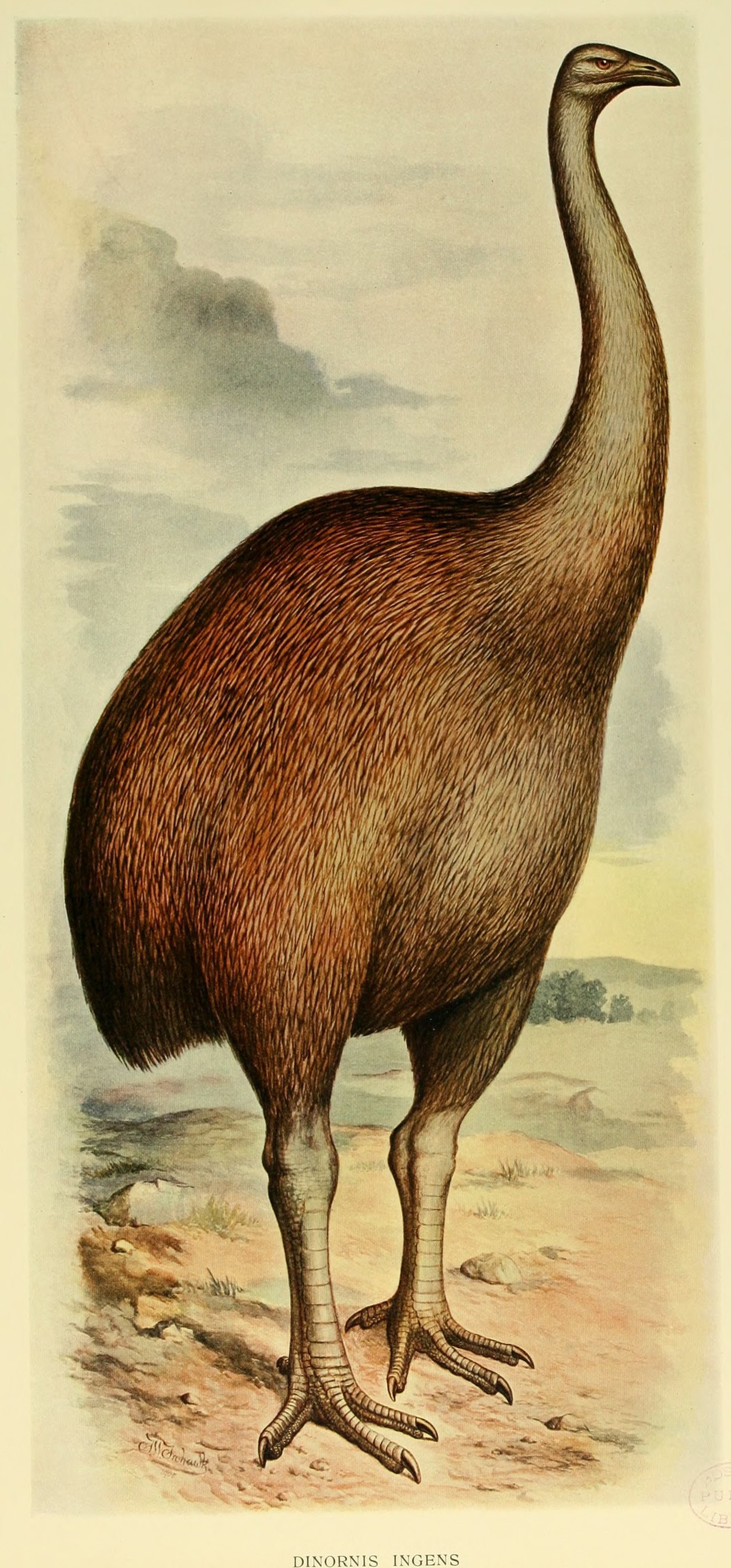
Overview
The moa of the genus Dinornis was a bird of exceptional bulk, and the species here described is the largest of that genus. Its skull was broad and much depressed, the beak comparatively wide, somewhat pointed and deflected, and the mandible formed as a narrow U. These cranial characters, taken together with the massive limb bones, mark an animal whose structure departed markedly from that of ordinary birds. 1Extinct Birds: an attempt to unite in one volume a short account of those birds which have become extinct in historical times · Hutchinson, London (via Internet Archive) ↗
The history of the genus in European science begins with a specimen from the Glenmark Swamp, in the Middle Island of New Zealand, sent to Professor Owen by Major J. Michael. The recognition of such a bird from fragmentary remains was the occasion of a wider change in the study of extinct birds, for it demonstrated that birds of great size had once inhabited islands where no such creature then lived. The type locality and the circumstances of transmission are therefore not incidental details but the starting point of the whole inquiry. 1
The dimensions of the largest species are best understood through its tibio-tarsus, which is almost invariably thirty-five inches in length and does not exceed that limit. The range of the bone, from 375 to 39, shows how slight was the variation within the species. In consequence the limb proportions, rather than any single measurement, became the means by which the several forms were distinguished. 1
Later discoveries extended the evidence considerably. A nearly perfect skeleton found in a cave at Takaka permitted the reconstruction of the animal as a whole, while the extreme slenderness and length of the femur and tibio-tarsus in the form named megalapteryx showed that the group included birds of very different build. The moa thus came to be understood not as a single monstrous bird but as a series of related species, and it was this recognition, grounded in the careful comparison of bones, that gave the study of extinct birds its method. 1
1. The Skull
The skull of Dinornis is broad and much depressed, a form that departs from the high, narrow crania usual among birds and gives the head a flattened profile. In the same region the beak is comparatively wide, somewhat pointed and deflected, so that the anterior part of the skull turns downward rather than continuing the line of the vault. The mandible, for its part, is formed as a narrow U, a shape that pairs a restricted width with an elongated and open curve. 1
These three characters are best read together rather than as separate peculiarities. A depressed and broadened skull, a wide but deflected beak, and a mandible drawn into a narrow U together describe a head whose strength lay in its breadth and whose working parts were arranged along a low, forward-sloping axis. The deflexion of the beak is the feature that most clearly distinguishes the skull from those of ordinary birds, since it alters the whole orientation of the feeding apparatus rather than merely its size. 1
The skull cannot be considered in isolation from the frame that carried it. The species to which this head belonged is the largest of the moas, and the cranial characters are consistent with an animal of great bulk, in which the head was required to serve a body of considerable mass. The broad, flattened construction may therefore be understood as one expression of the same general plan that produced the massive limb bones, rather than as an isolated anomaly of the head. 1
In the study of the genus the skull has served chiefly as a means of definition. Because the beak is wide and deflected and the mandible narrow and U-shaped, the head can be distinguished from those of other large extinct birds, and these features take their place beside the proportions of the limb bones as characters by which the several forms of moa were separated and described. 1
2. Size
The largest species of moa is distinguished above all by the dimensions of its tibio-tarsus, the bone that most directly records the stature of the living bird. In this species the tibio-tarsus is almost invariably 35 inches in length, a constancy that makes the bone a reliable index of the form rather than a variable feature of individual specimens. The figure is not an extreme reached by a few unusually large individuals but the ordinary measure of the species, and it is on this steadiness, as much as on the length itself, that the identification of the largest moa rests. 1
The bone does not, however, exceed 35 inches. The statement of the limit is as significant as the statement of the typical length, for it fixes the upper bound of the species and shows that the largest moa, great as it was, stood within a definite and measurable compass. The tibio-tarsus of the giant form therefore runs from 375 to 39, a range whose lower figure belongs to the same series as the constant 35 inches and whose upper figure marks the point beyond which the species is not found to pass. In consequence the bone serves at once to define the ordinary size of the bird and to set the ceiling of its variation. 1
The type specimen was obtained from the Glenmark Swamp, in the Middle Island of New Zealand, and was sent to Professor Owen by Major J. Michael. The association of the largest species with a single well-attested locality and a named sender gave the measurements a fixed point of reference, so that the length of the tibio-tarsus could be treated as a character of the species rather than as an isolated observation. It is this combination of a definite locality, a documented specimen, and a bone of nearly constant length that established the largest moa in the literature. 1
The tibio-tarsus thus occupies a place in the definition of the species analogous to that held by the skull among the cranial characters. Where the head is known by its breadth and the deflexion of its beak, the body is known by a single limb bone whose length is at once typical and bounded, and it is through this bone that the great size of the largest moa was first made precise. 1
3. Variation
The skull of the largest moa is broad and much depressed, and its beak is comparatively wide, somewhat pointed and deflected; the mandible, by contrast, takes the form of a narrow U. These cranial characters are not isolated curiosities but the marks by which the head of the great species is recognised, and they show that the differences between the moas are not confined to the dimensions of the limb bones. A bird known chiefly by the length of its tibio-tarsus is thus also known by the proportions of its skull and the set of its beak, and the two orders of evidence must be read together if the species is to be distinguished from its relatives. 1
Variation, in the author's account, is allowed within limits that are themselves part of the definition. The tibio-tarsus of the giant form runs from 375 to 39, yet the bone does not exceed 35 inches, and in the largest species it is almost invariably 35 inches in length. The range is therefore real but narrow, and the constancy of the typical measure is treated as a character of the species rather than as an accident of individual specimens. What variation the author permits is variation about a fixed point, not a looseness that would blur the boundary between one species and another. 1
The remaining species are separated by characters of a different order. In one, the extreme slenderness and length of the femur and tibio-tarsus are the distinguishing marks, a contrast of proportion rather than of absolute size; in another, a nearly perfect skeleton found in a cave at Takaka supplied the material on which its description could be founded. The author thus admits variation both within a species, where it is bounded and measured, and between species, where it is expressed in the relative slenderness and length of the bones rather than in a single dimension. The distinction is important, for it allows the moas to be compared on the same bones without reducing them to a single scale of magnitude. 1
4. Remains
The type bones of the largest moa came from the Glenmark Swamp, in the Middle Island of New Zealand, and reached Professor Owen through Major J. Michael, who sent them to him. The locality and the channel of transmission are worth recording together, for they establish that the material on which the species was founded was not a chance purchase or a fragment of uncertain origin but a series of remains taken from a known deposit and placed directly in the hands of the anatomist best placed to interpret them. The swamp, rather than a cave or a river bank, is the source of the type, and this circumstance belongs to the history of the species as much as any of its osteological characters. 1
Later discoveries added to this foundation in a manner the author treats as complementary rather than corrective. A nearly perfect skeleton was found in a cave at Takaka, and it is from such remains that the description of a further species could be founded. The cave skeleton is significant precisely because it is nearly perfect: where the type material from the swamp established the species on selected bones, the Takaka specimen offered a body in something like its true association, so that the relations of the parts could be judged rather than inferred. In consequence the record of the moas rests on two kinds of evidence, the one drawn from a swamp deposit and the other from a cave, and the author sets them side by side without preferring either. 1
The two sources are not, however, interchangeable in what they yield. The Glenmark bones fixed the identity of the largest species and gave the limb bone its typical and bounded measure; the Takaka skeleton supplied the completeness that a type series rarely possesses. Between them they show how the study of the moas advanced, not by a single fortunate find but by the gradual accumulation of material from different situations, each contributing what the other lacked. The author's account therefore treats the provenance of the bones as part of the evidence itself, since a skeleton from a cave and a set of bones from a swamp answer different questions about the same group of birds. 1
5. Key Facts
6. Frequently asked questions
What was the moa?
A group of large extinct flightless birds of New Zealand, described by Rothschild from their bones. 1
How large was the largest species?
Dinornis maximus is called the largest species, its tibio-tarsus reaching nearly 39 inches. 1
Where were the type bones found?
In Glenmark Swamp, on the Middle Island of New Zealand. 1
Which was the largest species?
Dinornis maximus is described as the largest species of Moa. 1
7. Timeline
- 1843Owen gives the name Dinornis novaezealandiae to the first moa bones exhibited.Owen gives the name Dinornis novaezealandiae to the first moa bones exhibited.
- 1907Rothschild publishes his account of the moa genera.Rothschild publishes his account of the moa genera.
References (1)
- 1Extinct Birds: an attempt to unite in one volume a short account of those birds which have become extinct in historical times — Hutchinson, London (via Internet Archive) Archive↩View source