Moai
The colossal ancestor statues of Rapa Nui: how they were carved, moved, toppled and rediscovered.
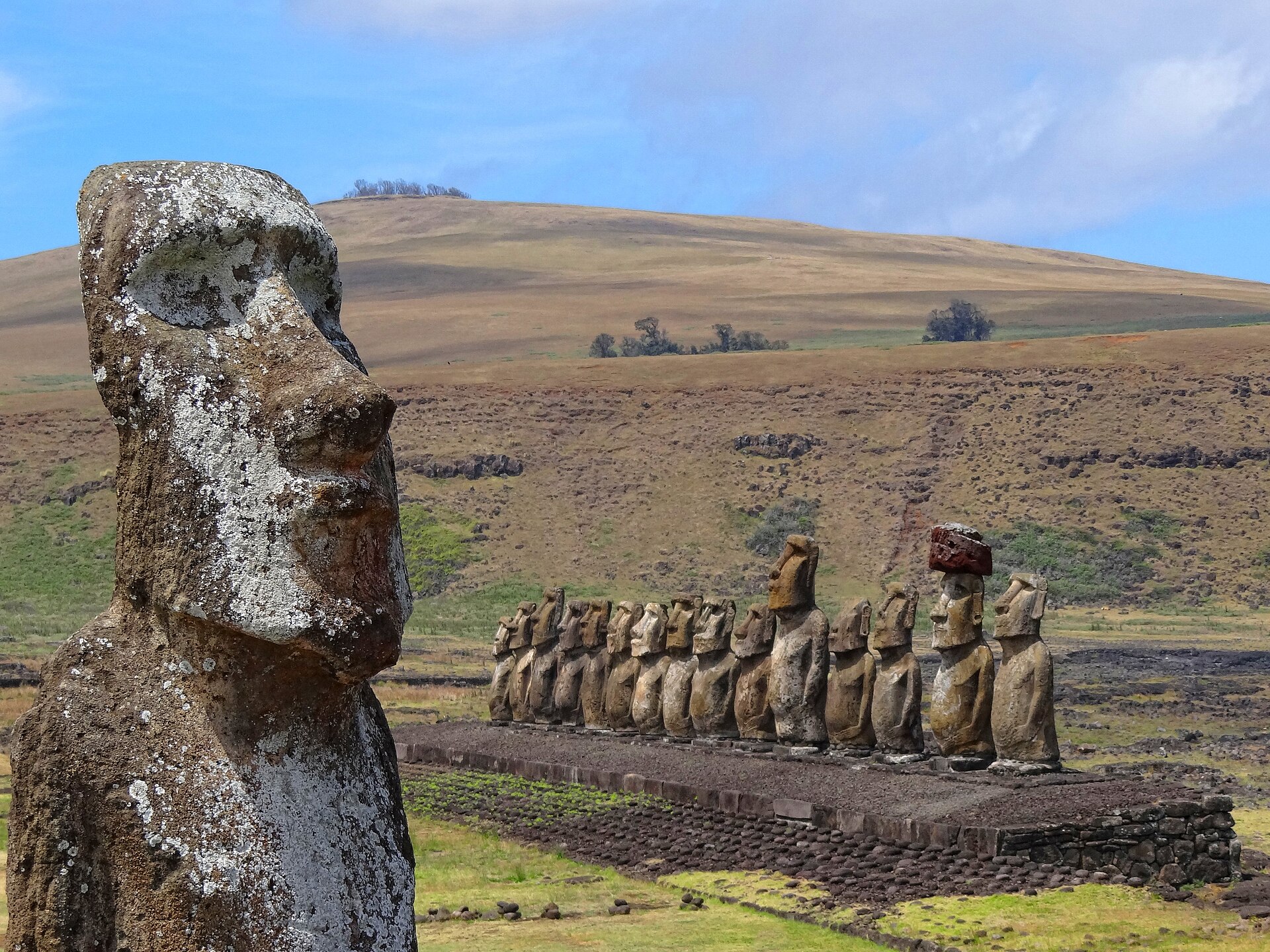
The moai are monolithic human figures carved by the Rapa Nui people of Easter Island, chiefly between about 1250 and 1500 and mostly from volcanic tuff at the Rano Raraku quarry. Nearly half of the 887 statues documented by the Easter Island Statue Project still lie at or inside the quarry, while the rest were transported and erected on stone platforms called ahu, many wearing red scoria topknots called pukao and fitted with coral eyes. European contact in 1722 found the statues still standing; all had been thrown down by 1868, and modern archaeology has reconstructed the carving, the transport experiments and the shift from the ancestor cult to the birdman cult of Orongo.
In this article
- 1Overview
- 2Documentation and Inventory
- 3Quarry at Rano Raraku
- 4Dimensions and Forms
- 5Materials and Pukao
- 6Eyes and the Ahu Connection
- 7Carving and Transport Experiments
- 8Toppling, Re-erection and Heritage
- 9Hoa Hakananai'a and Museum Collections
- 10Ahu Tongariki
- 11Timeline
- 12Timeline
- 13Frequently asked questions
- 14Knowledge graph
Overview
The figures were carved chiefly from the year 1250 to the year 1500, a span UNESCO frames more broadly as the 10th to 16th centuries, when Rapa Nui society built shrines and erected enormous stone figures and produced an unrivalled cultural landscape. Nearly half of the statues still stand at Rano Raraku, the quarry where they were made.
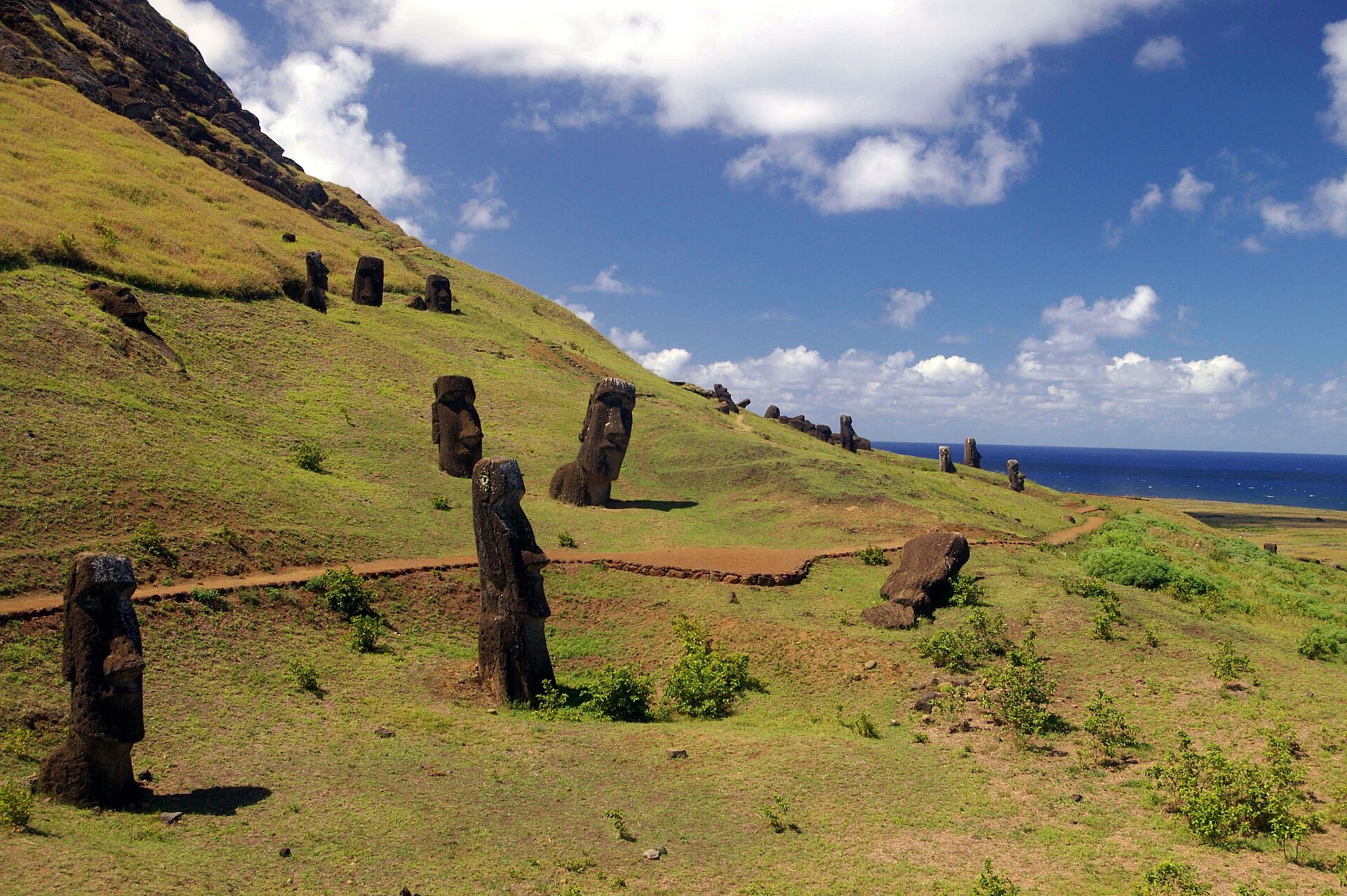
The Easter Island Statue Project has documented 887 monumental statues, and roughly half of them still lie in the immediate vicinity of the Rano Raraku quarry. More than half of Easter Island's moai remain at Rano Raraku, a mountain of hardened volcanic ash, where they lie half carved, on their backs or buried in carving debris and erosion. The quarry appears to have been abandoned abruptly, its stone tools left behind along with completed statues awaiting transport.
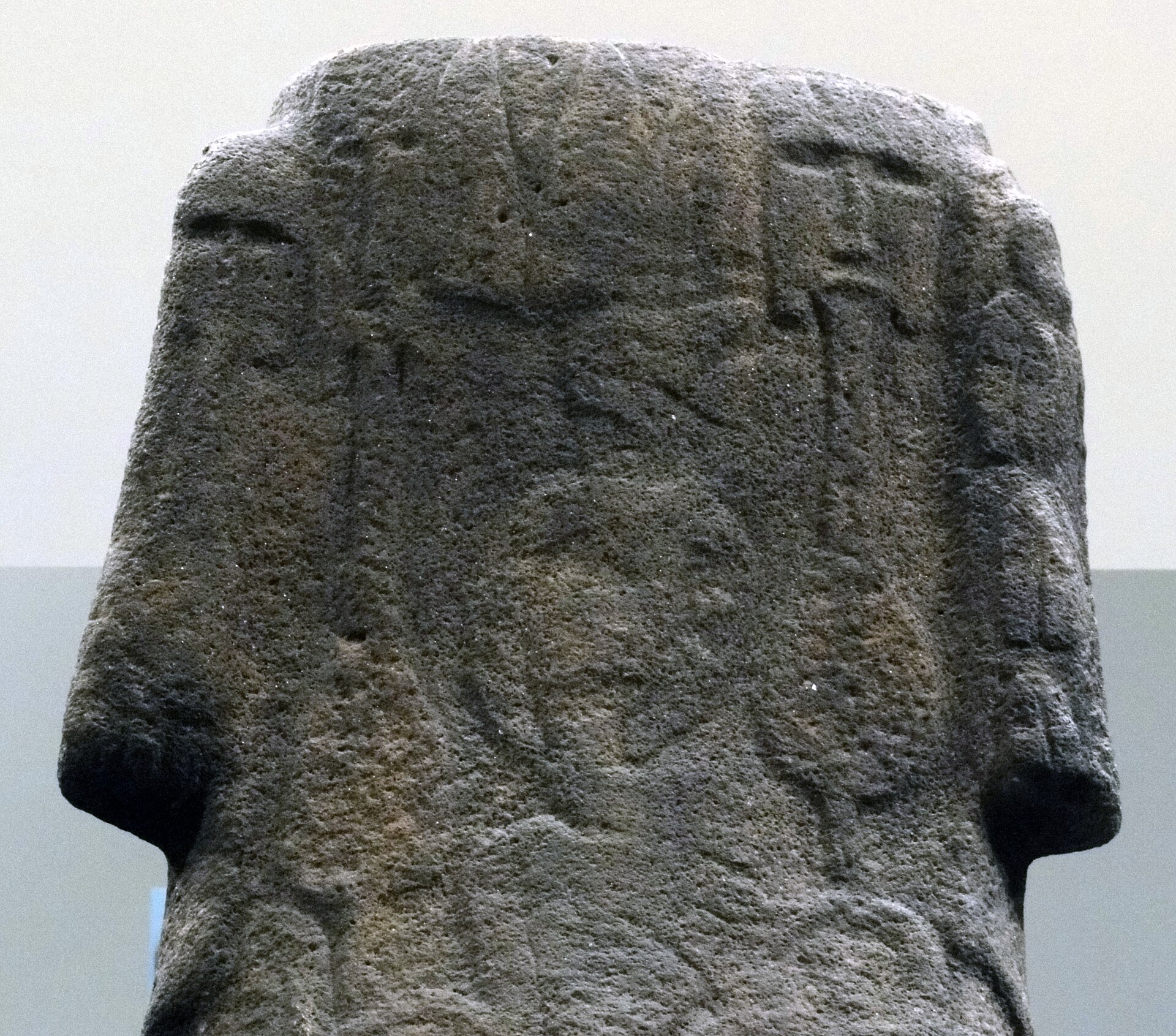
Rano Raraku is a volcanic crater on the eastern plain and the source of the sideromelane basaltic tuff from which 95% of the statues were carved. All but 53 of the more than 900 known moai were carved from Rano Raraku tuff, though the material also includes basalt, trachyte and red scoria. At the end of carving the statue was rubbed with pumice, and less eroded moai carry carved designs on their backs that mirror traditional Rapa Nui tattooing.
The standing statues on Rano Raraku's slopes were long thought to await removal, but excavation showed they were retained because the quarry itself was an important sacred site. The buried torsos of these statues were carved with the same precision as the faces, evidence that they were not meant to be seen from one vantage point. Van Tilburg argues that the moai were central to ideas of fertility, their presence believed to stimulate agricultural food production, so that carving ancestors into stone fed the living.
Every erected moai was eventually thrown down after Roggeveen's arrival in 1722; a few still stood during the late 1830s, but by the late 1860s none remained apart from the partly buried figures on Rano Raraku's slopes. UNESCO treats the Rapa Nui culture's toppling of the moai as a historical transformation deserving respect, not simply as vandalism. The moai and Rapa Nui National Park entered the 1972 UN heritage convention and were inscribed on the UNESCO World Heritage list in the mid 1990s.
1. Documentation and Inventory
The Easter Island Statue Project (EISP) presents itself as the longest continuously collaborative artifact inventory ever conducted within an Easter Island archaeological survey. Its stated aims are to locate, describe and understand the original context and use of every statue, including those abroad in museum collections. The field kit has always been a camera, compass, measuring tape and field notebook, later joined by calipers, GPS mapping and computer data management. EISP's metric database of the 887 statues is buttressed by 24,000 original and archived photographs. Jo Anne Van Tilburg's survey, cataloguing nearly 900 moai, became the most comprehensive archaeological survey of Easter Island ever performed.
The inventory records 164 image ahu, and about 35% of statues relate to one. The rest of the documented statues were hauled to and set upright on ceremonial structures called ahu, an achievement EISP ranks among the greatest megalithic feats of Pacific prehistory. Around three hundred statues stood on ceremonial platforms, nearly all along the island's 60 km coastline, and they faced inland toward the villages rather than out to sea. The seven moai of inland Ahu Akivi face out to sea rather than inland, the exception to the rule that statues watch over villages, and are tied to the legend of seven men awaiting their king.
More than 900 statues were produced. The average moai stands about 4 m tall and 1.6 m wide at the base, at about 12.5 tonnes. The tallest erected one, Paro, stood almost 10 m high and weighed 82 tonnes, while the heaviest, at Ahu Tongariki, weighed 86 tonnes. About 50 are re-erected on ahu or in museums. Ten or more original moai have been removed from the island to collections worldwide, including the Louvre in Paris and the British Museum in London.
Basalt statues are extremely rare: only 20 of them, portable and non-portable, sit in the EISP database, and seven of those are in museum collections. On 6 August 2006 Van Tilburg's team carried out the first ever laser scan of any object in any British Museum collection, recording Hoa Hakananai'a without a single contact with its surface. Hoa Hakananai'a is treated by EISP as the best documented iconographic link between the statue religion and the later Orongo rock-art tradition.
The incomplete statues in the quarry are remarkable for their number and inaccessibility; the largest, at 21.6 m, is almost twice the height of any moai ever completed and weighs an estimated 270 tonnes. The stone surface of every one of the more than 400 statues at Rano Raraku is judged to be in poor or very poor condition. Forty-six further statues on the interior slopes, together with the exterior group, are the focus of the statue preservation project. Rano Raraku is one of only two sites visited by all of the some 54,000 tourists who come to the island each year, leaving visitor management only marginally sustainable.
EISP's GPS mapping validated Routledge's block method of quarrying a statue blank, but found interior workspaces beside many statues only 30 to 50 cm wide. Archaeologist Claudio Cristino dates the quarry's establishment to about 900 or 1000 AD and says most known statues were made over at least 500 years. All erected moai were down after 1722 and before 1868. Photographs of Ahu Tongariki taken in 1914 show every coastal moai at the site still overturned.
2. Quarry at Rano Raraku
Rano Raraku is a crater of consolidated volcanic ash on the eastern plain, and it served as a quarry for about 500 years until the early eighteenth century. The archaeological zone measures 1.2 by 1.1 km and its tuff lies in rough, dipping beds. Layering, or bedding, within the volcanic tuff appears to explain the angle at which statues were cut in the quarries. Pockets of dense basalt lapilli scattered through the tuff slowed carving on some statues and disfigured the surface of others.
The crater's interior holds one of the island's three freshwater crater lakes, bordered by nga'atu or totora reeds used for thatch and swimming aids. Soil samples taken at Rano Raraku showed high calcium and phosphorus, fertiliser produced by generations of workers chipping tuff, making the quarry one of the island's most productive agricultural microclimates. Terry Hunt reads the freshwater link as evidence that the monuments reflect generations of sharing water, food, family and knowledge over more than 500 years until European contact.
NOVA's program estimates that roughly 900 moai were carved over about 500 years, hewn with stone tools from the volcanic rock of an ancient crater. Rapa Nui carvers worked the bedrock with a stone tool called a toki, and master carver Rafael Rapu estimated that twenty people carved the great unfinished figure El Gigante over five or six years. Katherine Routledge of the 1913-15 Mana Expedition calculated that a master carver and 54 men could carve a medium statue some 30 feet long in 15.5 days using stone tools.
Some incomplete moai were abandoned when carvers struck inclusions of very hard rock, and others may never have been intended to be separated from the bedrock. The quarry appears to have been abandoned abruptly, with stone tools left behind along with completed statues awaiting transport. Standing moai on the outside of the quarry are partially buried in spoil, were never given hollowed eyes or pukao, and were not thrown down in the island's civil wars. The eyes appear to have been inserted only at the end of transport or once a statue stood on its ahu, since eye sockets were never carved in moai left in the quarry.
The standing statues on the slopes were long thought to await removal, but excavation showed they were retained because the quarry itself was an important sacred site. The buried torsos were carved with the same precision as the faces, evidence they were not meant to be seen from one vantage point. EISP notes that these were the first moai excavations officially permitted at the quarry since the mid 1950s.
Hunt and Lipo found that road statues were left with wide, curved front edges so that, tilting forward, they rock sideways and take a step, and that the base was carved down after installation 1Moai · Wikipedia ↗.
Lipo and Hunt argue that the statues were moved upright in a rocking, zig-zag motion along purpose-built roads, and that once moving it conserves energy and moves quickly 14The walking moai hypothesis: archaeological evidence, experimental validation, and response to critics · Sci.News, reporting Lipo & Hunt in the Journal of Archaeological Science ↗.
3. Dimensions and Forms
| Category | Measurement | Notes |
|---|---|---|
| Average moai | about 4 m tall, 1.6 m wide at the base, around 12.5 tonnes | the typical proportions of the corpus |
| Tallest erected | Paro, almost 10 m and 82 tonnes | the extreme of the erected statues |
| Heaviest erected | 86 tonnes at Ahu Tongariki | the heaviest statue known to have been raised |
| Largest unfinished | about 21.6 m and an estimated 270 tonnes | never completed |
| Tallest statue at the quarry | 20.56 m long, at least 200 tons | unfinished and still attached to bedrock |
| Pukao | about 100 documented, up to 10 tonnes, up to about 3 m across | the topknots placed on the heads |
| Hoa Hakananai'a | basalt, 4.2 tonnes | collected from Orongo |
The over-large heads of the moai are a deliberate sculptural trait consistent with the Polynesian belief in the sanctity of the head, and the faces carry heavy brows, elongated noses and the fish-hook curl of the nostrils1. At the end of carving a statue was rubbed with pumice1. The less eroded moai carry carved designs on their backs that mirror traditional Rapa Nui tattooing1.
Tukuturi at Rano Raraku is the only kneeling moai and one of the few cut from red scoria1. Its beard and kneeling posture set it apart from standard moai, echoing the posture of the chorus in riu festivals8Rano Raraku · Wikipedia ↗. Red scoria served as the raw material for the pukao topknots placed on the heads of about 75 to 100 statues5Hoa Hakananai'a Laser Scan Project and the EISP statue inventory · Easter Island Statue Project (EISP), UCLA Cotsen Institute of Archaeology ↗. Other lithologies are rare: 13 moai were cut from basalt, 22 from trachyte and 17 from fragile red scoria1.
The seven moai of inland Ahu Akivi face out to sea rather than inland, the exception to the rule that statues watch over villages, a disposition tied to the legend of seven men awaiting their king1.
4. Materials and Pukao
The pukao are cylindrical topknots carved from a very light red volcanic scoria, quarried from a single source at Puna Pau, and shaped with a dent underneath to fit the head and a knot on top; they can measure up to about 3 metres across. One theory holds that a pukao recognised the power of the individual represented, a costly act since no evidence of crane technology has been found. Adding a pukao raised the statues to an average height of 11 m, and the topknots are believed to have been raised on ramps by only a few people. About 100 pukao are documented archaeologically, all at ahu with fallen statues or at the quarry, and more than 70 discarded pukao were found along the road that carried them toward the statues.
5. Eyes and the Ahu Connection
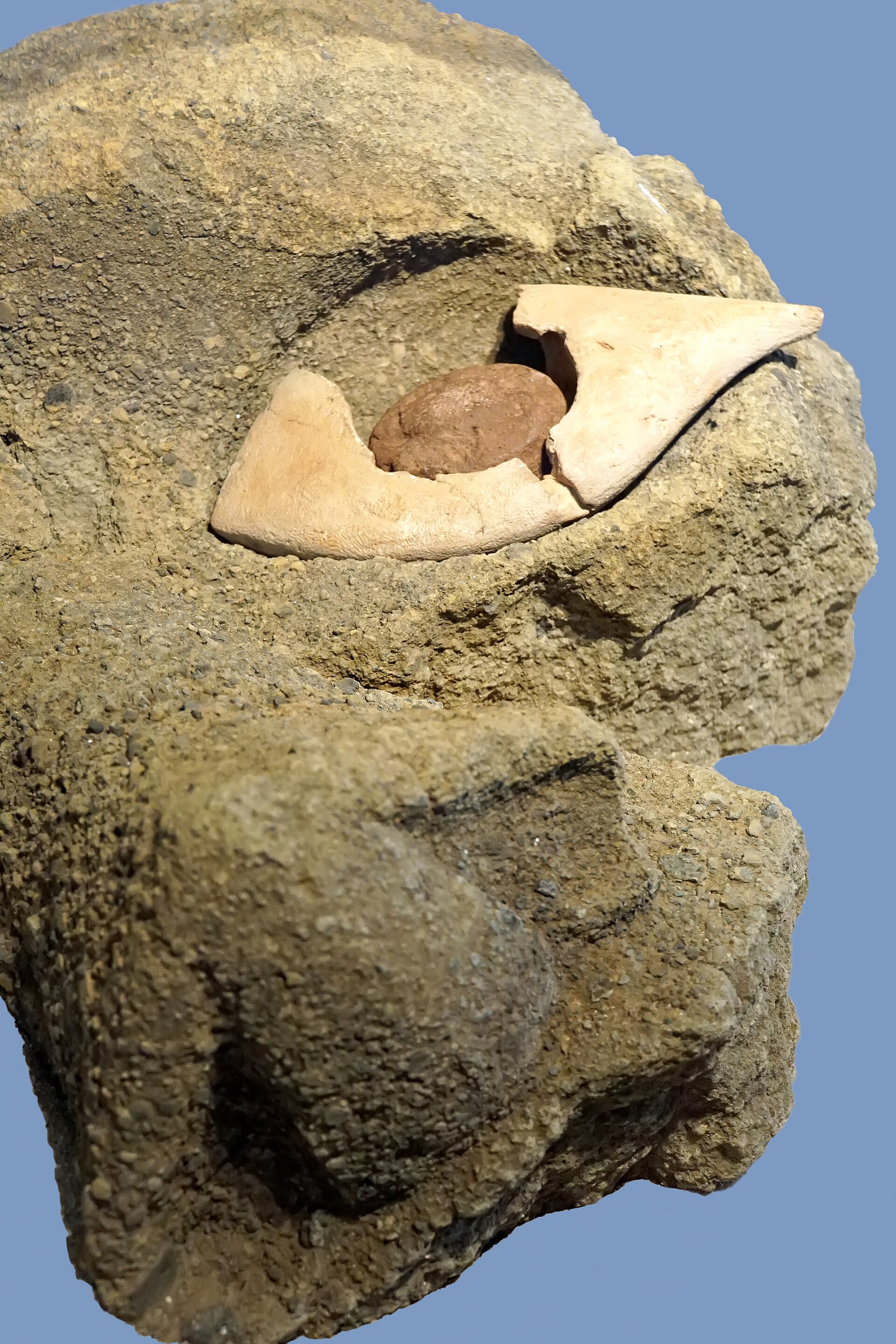
For most of the statues' recorded history the eye was a void. Until the late 1970s the deep oval eye sockets were all that anyone understood as the statues' eyes, and European visitors from 1722 onward saw only empty sockets. Because the eyes were removable ceremonial fittings used on special occasions, later scientific expeditions never saw them in place.
The identification came at Ahu Nau-Nau in 1978, when Sonia Haoa's team found an oval white coral object with an opening for a polished red scoria iris, and Sergio Rapu Haoa saw that it fit the socket of one of the moai. Six more eyes were recovered at Ahu Nau-Nau, and in the early 1980s Ahu Ko Te Riku at Tahai received permanent replica coral eyes carved by Juan Haoa Veriveri. The Ahu Nau-Nau find remains the only complete eye recovered, though fragments and a smaller eye came from Ahu Tongariki. The eyes on the Tahai moai are modern, installed between 1985 and 1986 to show how the moai would once have looked.
The placement of the eyes carries its own evidence. They appear to have been inserted only at the end of transport or once a statue stood on its ahu, since eye sockets were never carved in moai left in the quarry. The moai with carved eye sockets appear reserved for ahu and ceremonial sites, implying a selective hierarchy in their design that held until the rise of the tangata manu religion.
That hierarchy is visible in the distribution of the monuments themselves. About 35% of known statues stand on or in direct relation to ceremonial image ahu, of which 164 have been catalogued. Around three hundred statues stood on ceremonial platforms, nearly all along the island's 60 km coastline, facing inland toward the villages rather than out to sea.
Quantitative spatial modelling found that ahu locations were explained by proximity to the island's limited freshwater sources rather than by gardens or marine resources. Places without ahu or moai showed no freshwater, while even interior ahu had drinking water nearby. Terry Hunt reads the freshwater link as evidence that the monuments reflect generations of sharing water, food, family and knowledge over more than 500 years until European contact.
6. Carving and Transport Experiments
Experimental archaeology has approached the moai in two registers: how the figures were carved, and how they were moved. The EISP programme modelled moai carving on Polynesian canoe building, with specialists working with adze, clamp, chisel, cordage and drill at the command of powerful chiefs. Katherine Routledge of the 1913-15 Mana Expedition calculated that a master carver and 54 men could carve a medium statue some 30 feet long in 15.5 days using stone tools. EISP's GPS mapping validated Routledge's block method but found interior workspaces beside many statues only 30 to 50 cm wide.
Rapa Nui carvers worked the bedrock with a stone tool called a toki, and master carver Rafael Rapu estimated that twenty people carved the great unfinished figure El Gigante over five or six years. Claudio Cristino dates the quarry's establishment to about 900 or 1000 AD and says most known statues were made over at least 500 years. Moai were erected in prepared holes at the foot of the quarry slope so that their lower sections could be finished.
Because the island was largely treeless when Europeans arrived, the moving of the statues was long a mystery, and pollen evidence indicates forests were logged between 800 and 1200 CE. Jo Anne Van Tilburg argued in 1998 that fewer than half the people thought necessary could haul a statue on a sledge over lubricated rollers, and tested the idea the following year. In 1986 Pavel Pavel, Thor Heyerdahl and the Kon-Tiki Museum used eight workers on a five-tonne moai and sixteen on a nine-tonne one but stopped early because the bases chipped. Charles Love found rocking a 10-tonne replica too unstable, then moved it 46 m in two minutes with two sled runners on log rollers and 25 men.
Hunt and Lipo found that road statues were left with wide curved front edges so that, tilting forward, they rock sideways and take a step, and that the base was carved down after installation. Their 3D models identified wide D-shaped bases and a forward lean, and a 4.35-ton replica moved 100 m in 40 minutes with only 18 people. The roads of Rapa Nui measure 4.5 m wide with a concave cross-section, exactly what a forward-rocking statue needs for stability. Lipo describes statue transport as inseparable from road building, with paths cleared, statues moved, then paths cleared again in sequence.
EISP's sledge experiment set 40 people to pull a 10-ton sledge replica over rollers on rails. The experiment cast a fibreglass mould on the island and filled it with ten tons of concrete, four days of curing producing a replica that took Arévalo and Hito 24 hours of carving to finish. In the trial the replica lay on a sledge over eucalyptus rails set with wood rollers, pulled by forty people on two lines while six men with levers tended the rollers on each side. Rollers were abandoned on the ramp in favour of individual rungs of a lubricated 'canoe ladder', which covered 20 m up an 8% grade in 15 seconds.
Computer modelling put the requirement at 55 to 70 people, 48 on average, to pull the average statue, burning about 201,600 calories a day in sweet potato and banana. EISP judged that moving the average statue some 15 km over its first candidate path would take five to seven days with an optimum task involvement of 55 to 70 people. Its post-experiment conclusions were that rollers work but are hard to manage, that eucalyptus is at least as strong as the unavailable palm wood, and that heavy loads need a robust support structure.
Heyerdahl's 1955-56 attempt tied a 10-ton moai to a sledge made from a tree fork with 180 islanders pulling it, and the workforce requirement scaled badly to an estimated 1,500 people for the 82-ton Paro. Pavel Pavel's 1982 Strakonice trial used a 12-ton concrete replica and 17 people in two groups, tilting it about five degrees onto its back edge and rocking it forward. During the 1986 Easter Island trials two original moai of five and nine tons proved so stable they could tilt 70 degrees either side, but the swivelling chipped their bases and stopped the experiment. William Mulloy's 1960 scheme for Paro used giant wooden shear legs and a Y-shaped sledge, with an estimate that 90 people could have moved it the four miles to its ahu.
Katherine Routledge recorded in 1919 that Rapa Nui tradition held an old woman who cooked for the image-makers moved the statues by mana, ordering them about at her will. In 1986 Heyerdahl returned to Easter Island for a moai walking experiment aided by Czech engineer Pavel Pavel and sixteen local residents pulling ropes fixed to the statue's head and base. Even Heyerdahl's own museum account notes the team got a fifteen-ton statue to walk without much difficulty, after which he judged the transport mystery solved. Pavel Pavel first cast a 4.5 metre 12-tonne concrete statue in the South Bohemian town of Strakonice with ropes around the head and the base and sixteen helpers tilting and twisting it forward. The contrast is stark: Heyerdahl's 1956 experiment needed 180 people pulling a statue on its back, while Pavel Pavel's walking method needed only 17 people. Pavel Pavel returned to Easter Island in 2002 to fix memorial plaques in English, Spanish, Czech and Rapa Nui recording the 1986 transport by sixteen people under Heyerdahl's expedition.
NOVA records that Heyerdahl, inspired by Rapa Nui folklore about statues walking through 'mana', tried walking a nine-ton statue by rocking it forward like a refrigerator, workable but precarious off level ground. NOVA's survey of attempts puts the average transported moai at some 14 tons and notes the optimum route often crossed several miles of rough hilly terrain.
7. Toppling, Re-erection and Heritage
Every erected moai was eventually thrown down after Roggeveen's arrival in 1722; a few still stood during the late 1830s, but by the late 1860s none remained apart from the partly buried figures on Rano Raraku's slopes. Some toppled forward so that their faces were hidden, and they often broke their necks in falling, while others came off the back of their platforms. About 50 have since been re-erected on ahu or in museums.
Rapa Nui was devastated by slave-raider raids from 1862 onward, after which the survivors were sick, injured and leaderless, and missionaries converted the remaining population to Christianity. Ten or more original moai have been removed from the island to collections worldwide, including the Louvre in Paris and the British Museum in London. In the decades between 1955 and 1978 William Mulloy investigated and restored ahu, including Ahu Akivi (1960), the Tahai ceremonial complex (1970) and the ceremonial village of Orongo (1974).
The moai and Rapa Nui National Park entered the 1972 UN heritage convention and were inscribed on the UNESCO World Heritage list in the mid 1990s. Rapa Nui National Park was inscribed in 1995 and covers approximately 40% of the island, with conservation of its materials a matter of great concern while management efforts remain insufficient. UNESCO records that between the 10th and 16th centuries Rapa Nui society built shrines and erected enormous stone figures known as moai, producing an unrivalled cultural landscape.
UNESCO's account holds that resource depletion caused an ecological crisis and decline by the 16th century, and that the decline led to the destruction of the megalithic monuments. The ancestor cult was replaced by the cult of the man-bird, whose exceptional testimony is the ceremonial village of Orongo at Rano Kau with fifty-four semi-subterranean stone houses. UNESCO treats the Rapa Nui culture's toppling of the moai as a historical transformation deserving respect, not simply as vandalism. UNESCO describes the island's monumental sculpture and architecture as a tradition free from any external influence. During the height of the birdman cult there is evidence that construction of moai stopped. Orongo in the Miru political district at Rano Kau was the focal point of Miru-dominated island-wide religious practice from about AD 1400 under the birdman cult.
In 2022 a wildfire covering roughly 150 to 250 acres damaged an unknown number of moai at Rano Raraku, and some of the damage was judged irreparable. A wind-whipped grass fire burned through Rano Raraku, the crater lake dried out, and site monitors found a previously unrecorded small moai exposed among the reeds. The newly found statue, lying supine with its base to the south and estimated at 1.6 m in height, was registered as RR-0001-285 in the interior Rano Raraku quarry zone. EISP's soil specialist Sarah Sherwood hopes to learn more about the once waterlogged soils in which the new moai was found. The agencies co-managing Rapa Nui National Park, Ma'u Henua and CONAF, recognised at once the need to stabilise the small moai and protect its fragile stone.
Rano Raraku is one of only two sites visited by all of the some 54,000 tourists who come to the island each year, leaving visitor management only marginally sustainable. The island unit of the forestry service CONAF lacks the staffing to meet the needs of its many properties, a universal barrier to statue conservation and visitor monitoring.
8. Hoa Hakananai'a and Museum Collections
Hoa Hakananai'a is a basalt statue held today in the British Museum, and its name translates as 'lost or stolen friend'. The British Museum holds two basalt statues of central importance to Rapa Nui history, and one of them, catalogued as 1869.10-5.1, is Hoa Hakananai'a, re-carved on its back with bas-relief and incised petroglyphs. Captain Richard Powell of HMS Topaze took the statue and a smaller one called Hava to England, and Queen Victoria gave both to the British Museum the following year.
The dorsal petroglyphs of Hoa Hakananai'a are comparable to a complex of more than 500 similar carvings on boulders at Orongo. On 6 August 2006 Van Tilburg's team carried out the first ever laser scan of any object in any British Museum collection, recording Hoa Hakananai'a without a single contact with its surface. The statue is treated by EISP as the best documented iconographic link between the statue religion and the later Orongo rock-art tradition.
The Rapa Nui treat Hoa Hakananai'a as one of the moai which islanders call their family rather than mere rocks. Under Chilean law the moai are deemed an integral part of the land rather than artefacts, and in late 2017 Chile returned control of the moai and ancestral sites to the Rapa Nui community. Easter Island lies some 2,480 miles west of Santiago, and Chile annexed it in the late nineteenth century and made it a special territory in the 2000s.
In November 2018 Rapa Nui representatives asked the British Museum to return the statue, and the museum offered to discuss a loan while a Rapa Nui sculptor offered to carve an exact replica.
9. Ahu Tongariki
Ahu Tongariki lies one kilometre from Rano Raraku and served as the main centre and capital of the Hotu-iti clan. Every moai at the site faces sunset at the winter solstice. Its statues were toppled during the island's civil wars. In 1960 a tsunami generated by an earthquake off Chile swept the ahu inland.
Ahu Tongariki was substantially restored in the 1990s through a five-year project led by Claudio Cristino and Patricia Vargas Casanova. The work was backed by the Chilean government, the University of Chile and the crane maker Tadano.
10. Timeline
- about 900 or 1000 ADQuarry establishedThe statue quarry is established on Rapa Nui.4NOVA: Secrets of Lost Empires II — Easter Island (program transcript) · PBS / WGBH NOVA ↗
- about 1250-1500Carving periodThe main period of moai carving.1
- about AD 1400Orongo becomes focal pointOrongo becomes the focal point of the birdman cult.5
- 1722Roggeveen arrivesJacob Roggeveen's arrival opens the window during which statues were toppled.1
- 1862Slave-raider raidsSlave raiders strike the island.1
- 1868Hoa Hakananai'a takenThe Hoa Hakananai'a is removed from the island.17Rapa Nui Representatives Visit British Museum to Discuss Repatriation of Moai Statue · Smithsonian Magazine ↗
- 1913-15Mana ExpeditionThe Mana Expedition conducts its work on the island.10Megaliths and Mariners: Experimental Archaeology on Easter Island · Easter Island Statue Project (EISP), UCLA Cotsen Institute of Archaeology ↗
- 1919Routledge records mana traditionKatherine Routledge records the mana tradition.18NOVA Online: Secrets of Easter Island — Past Attempts · PBS / WGBH NOVA ↗
- 1955-56Heyerdahl sledge experimentThor Heyerdahl carries out his sledge experiment.18
- 1960Mulloy scheme for ParoWilliam Mulloy develops his scheme for Paro.18
- 1978Eyes found at AnakenaTwo coral fragments pieced together in the sand at Anakena confirm the old belief that the moai had eyes.13Mata Moai (Moai Eye) · Servicio Nacional del Patrimonio Cultural, Chile — Museo Antropológico P. Sebastián Englert ↗
- 1986Walking experimentPavel Pavel and Heyerdahl conduct the walking experiment; sixteen people transport a statue under Heyerdahl's expedition.19Easter Island, 1986-1988: the Moai Walking Experiment · Kon-Tiki Museum, Oslo ↗
- 1995World Heritage inscriptionThe site is inscribed as World Heritage.1
- 2002Memorial plaques fixedPavel Pavel returns to Easter Island to fix memorial plaques in English, Spanish, Czech and Rapa Nui recording the 1986 transport.20Czech who made Moai statues walk returns to Easter Island · Radio Prague International (Czech Radio) ↗
- 2006Laser scanA laser scan of the statues is made.5
- 2017Control returned to communityChile returns control to the Rapa Nui community.17
- 2018Return requestThe Rapa Nui request the return of the Hoa Hakananai'a.17
- 2022WildfireA wildfire affects the island.1
11. Timeline
- c. AD 300Polynesian settlementUNESCO dates the settlement of Rapa Nui by a society of Polynesian origin to about AD 300, with monumental sculpture free of external influence.
- c. AD 900-1000The Rano Raraku quarry opensArchaeologist Claudio Cristino places the establishment of the Rano Raraku quarry at around 900 or 1000 AD, after which most known statues were made over at least five centuries.
- 1250-1500The great carving periodThe Rapa Nui carve the moai, monolithic ancestor figures cut largely from Rano Raraku tuff, between roughly 1250 and 1500.
- c. AD 1400The birdman cult at OrongoFrom about AD 1400 Orongo becomes the focal point of island-wide religious practice under the birdman cult, and moai construction appears to stop.
- Easter Day 1722European arrival; the statues still standJacob Roggeveen reaches the island and the statues still gaze inland across their clan lands, but by the late 19th century all had fallen.
- 1862-1863Slave raids and missionisationSlave-raider raids devastate Rapa Nui; survivors are left sick, injured and without leadership, and missionaries convert the remaining population.
- November 1868Hoa Hakananai'a leaves the islandOfficers of HMS Topaze remove Hoa Hakananai'a from Orongo, and by this date no erected moai remain standing apart from partly buried quarry figures.
- 1955-1956Heyerdahl's first dragging experimentThor Heyerdahl has a 10-ton moai tied to a tree-fork sledge and pulled by 180 islanders, an experiment that implied 1,500 people for the 82-ton Paro.
- 1960Tsunami at Ahu TongarikiA tsunami triggered by an earthquake off Chile sweeps Ahu Tongariki inland; the site is substantially restored in the 1990s under Claudio Cristino and Patricia Vargas Casanova.
- 1978The coral eyes are identifiedDuring restoration of Ahu Nau-Nau at Anakena, a white coral eye with a red scoria iris is recognised by Sergio Rapu Haoa, and six more are found.
- 1979Eye sockets explainedSergio Rapu Haoa and colleagues establish that the deep hemispherical eye sockets were designed to hold coral eyes with obsidian or red scoria pupils.
- January 1986The moai walksThor Heyerdahl, Czech engineer Pavel Pavel and sixteen islanders make a 15-ton moai walk using ropes on head and base, and Heyerdahl declares the transport mystery solved.
- 1995World Heritage inscriptionRapa Nui National Park, including the moai and ahu, is inscribed on the UNESCO World Heritage list.
- 1999Sledge and roller testJo Anne Van Tilburg supervises an experiment in which 60 people tow a nine-tonne moai replica on a sledge over rollers, succeeding on the second attempt.
- January 2019Ahu locations tied to freshwaterQuantitative spatial modelling shows that the locations of ahu are explained by proximity to the island's limited freshwater sources.
- 2022Fire at Rano RarakuA wildfire covering roughly 150 to 250 acres damages an unknown number of moai at Rano Raraku, with some damage judged irreparable.
- February 2023A new moai surfacesAfter a grass fire burns through Rano Raraku and the crater lake dries, monitors find a small 1.6 m moai exposed among the reeds, registered as RR-0001-285.
- 2025The walking hypothesis tested at scaleLipo and Hunt publish in the Journal of Archaeological Science, backed by a 4.35-ton replica moved 100 m in 40 minutes by 18 people and by the form of the roads.
12. Frequently asked questions
How many moai are still lying at the quarry, and how many are visible there?
What did the walking experiments actually achieve?
How many people and how long would it take to move an average statue?
Moving the average statue some 15 km over its first candidate path would take five to seven days with an optimum task involvement of 55 to 70 people 10. Computer modelling put the pulling requirement at 55 to 70 people, 48 on average, burning about 201,600 calories a day in sweet potato and banana 10.
When were the eyes of the moai first identified?
What happened to Hoa Hakananai'a, and where is it now?
Hoa Hakananai'a is a basalt statue of 4.2 tonnes taken from Orongo in 1868 and now held in the British Museum 17. Its name translates as 'lost or stolen friend', and in November 2018 Rapa Nui representatives asked the museum to return it, with the museum offering to discuss a loan and a Rapa Nui sculptor offering to carve an exact replica 17.
What is the largest unfinished moai, and why were some left in the bedrock?
References (20)
- 1Moai — Wikipedia Web↩View source
- 2Rapa Nui National Park — UNESCO World Heritage Centre WebView source
- 3What is the Easter Island Statue Project? — Easter Island Statue Project (EISP), UCLA Cotsen Institute of Archaeology WebView source
- 4NOVA: Secrets of Lost Empires II — Easter Island (program transcript) — PBS / WGBH NOVA Web↩View source
- 5Hoa Hakananai'a Laser Scan Project and the EISP statue inventory — Easter Island Statue Project (EISP), UCLA Cotsen Institute of Archaeology Web↩View source
- 6Written in Stone: Jo Anne Van Tilburg and the archaeology of Rapa Nui — UCLA Magazine / UCLA Newsroom WebView source
- 7The Eyes of the Moai: From Mystery to Archaeological Discovery — Moe Varua Rapa Nui WebView source
- 8Rano Raraku — Wikipedia Web↩View source
- 9Lessons from the Field: Sustainable Archaeology on Easter Island — Easter Island Statue Project (EISP), UCLA Cotsen Institute of Archaeology WebView source
- 10Megaliths and Mariners: Experimental Archaeology on Easter Island — Easter Island Statue Project (EISP), UCLA Cotsen Institute of Archaeology Web↩View source
- 11Ahu Tongariki — Wikipedia WebView source
- 12Solving the ancient mysteries of Easter Island (ahu locations and freshwater sources) — ScienceDaily, source Binghamton University 2019 WebView source
- 13Mata Moai (Moai Eye) — Servicio Nacional del Patrimonio Cultural, Chile — Museo Antropológico P. Sebastián Englert Web↩View source
- 14The walking moai hypothesis: archaeological evidence, experimental validation, and response to critics — Sci.News, reporting Lipo & Hunt in the Journal of Archaeological Science Web↩View source
- 15Pukao — Wikipedia WebView source
- 16New Moai Statue Discovered (Letter from the Director, February 2023) — Easter Island Statue Project (EISP), UCLA Cotsen Institute of Archaeology 2023 WebView source
- 17Rapa Nui Representatives Visit British Museum to Discuss Repatriation of Moai Statue — Smithsonian Magazine Web↩View source
- 18NOVA Online: Secrets of Easter Island — Past Attempts — PBS / WGBH NOVA Web↩View source
- 19Easter Island, 1986-1988: the Moai Walking Experiment — Kon-Tiki Museum, Oslo 1986 Web↩View source
- 20Czech who made Moai statues walk returns to Easter Island — Radio Prague International (Czech Radio) Web↩View source