Ostrich
Range, nesting and the care of the young, from a Victorian dictionary.
Newton records the ostrich's narrowing range from Egypt to the Syrian desert, its common nest of some thirty eggs, the extra eggs scattered round it, and how the young are fed and protected.
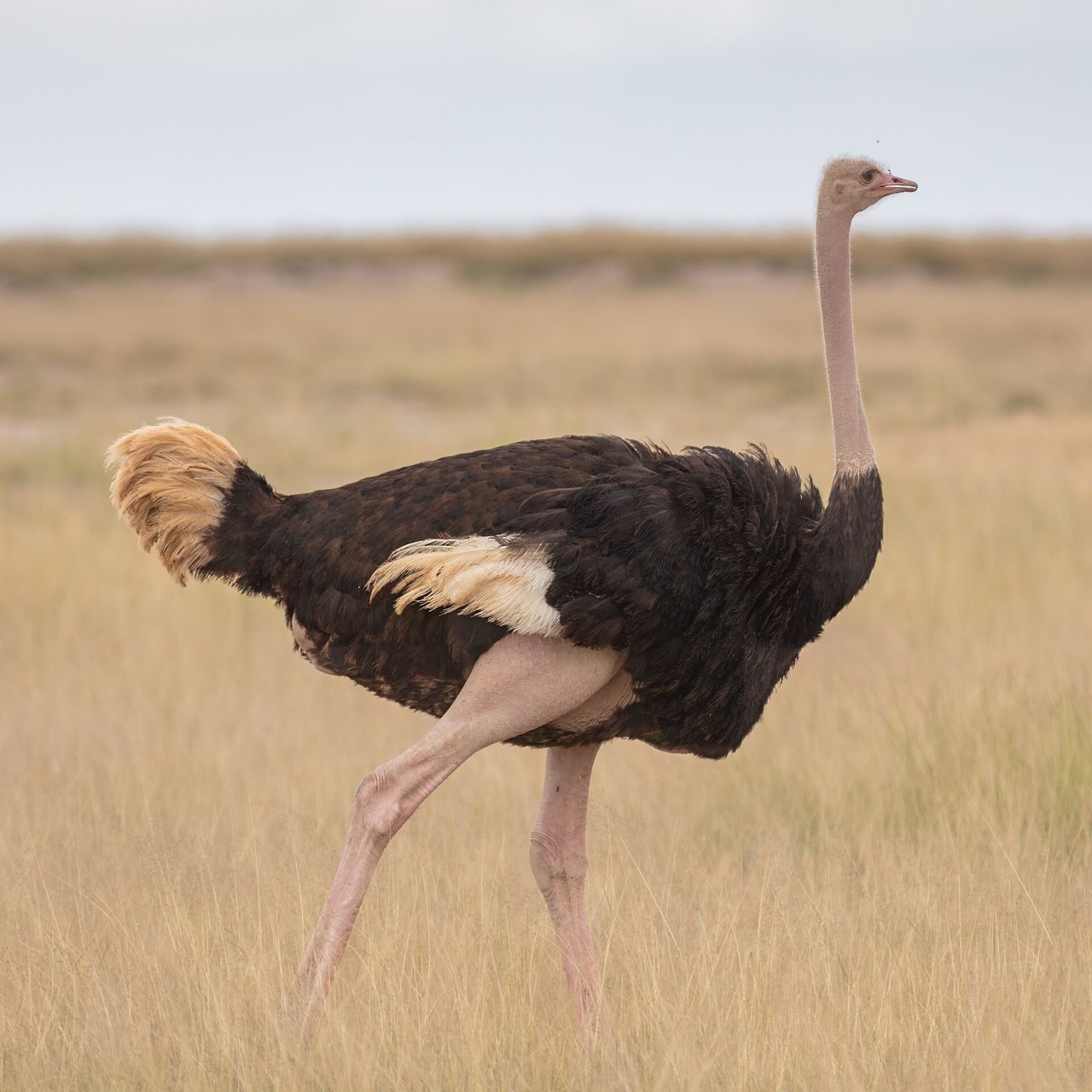
Overview
The ostrich is among the most conspicuous of birds, and for that reason it recurs so often in the older books of travel. Its size and its habits alike draw the eye, and the writers of those books seldom passed it over in silence. Yet the same records that preserve its place in the literature of travel also mark its decline, for the bird is disappearing before the persecution of man, and the regions in which it was once abundant have narrowed accordingly. The evidence of its former range survives chiefly in such notices, and it is to these that the naturalist must turn when the living bird can no longer be found where it once was common. 1A Dictionary of Birds · Adam and Charles Black, London (via Internet Archive) ↗
The older travellers testify to an abundance that has since passed away. Xenophon's notice of its abundance in Assyria preserves a memory of the bird in a country where it is no longer to be looked for, and the same testimony is repeated from other quarters. The limits of its range are likewise recorded with some precision, for it was known to occur as far as the borders of Egypt and the Cape Colony, while its northern limit lay directly to the eastward of Damascus. Such notices, scattered through the literature of travel, are the more valuable because the bird itself is retreating before the advance of settlement. 1
The nesting habits of the ostrich are no less remarkable than its size, and they help to explain the attention it received from early observers. Some thirty eggs are laid in the nest, and round it are scattered perhaps as many more, so that the nest itself is but the centre of a wider deposit. The birds are said to place the nest where it may not be discovered, and to guard their common treasure from jackals and small beasts-of-prey. The care of the eggs is thus divided between concealment and defence, and the arrangement of the scattered eggs about the nest has been thought to serve the same end. 1
Not all the eggs, however, are left to the tending of the parents, for the hatching is often left wholly to the sun. Those that are not so left are said to be broken by the old birds to serve as nourishment, a practice that early writers recorded with some surprise. The ostrich therefore presents in its economy a mixture of vigilance and neglect that has always attracted the notice of travellers, and it is this conspicuousness, joined to the bird's gradual disappearance, that gives the old accounts their lasting interest. 1
1. Disappearing
The disappearance of the ostrich before the persecution of man is not uniform across its range, and the record preserves the contrast between regions where it has been extirpated and those where it lingered into the present century. The borders of Egypt and the Cape Colony are named as places where the bird was still to be met with, and it is against these surviving populations that the loss elsewhere must be measured. The same authority that notes the retreat of the species also fixes its northern limit directly to the eastward of Damascus, so that the geographical frame of the account is drawn tightly about the lands where the bird could still be found within living memory. 1
The value of such a frame lies in what it reveals about the pace of the retreat. Xenophon's notice of the ostrich's abundance in Assyria stands as the earliest testimony to a population that has since vanished from that country, and the distance between the Assyria of his account and the northern limit recorded in the Dictionary is the measure of what persecution has accomplished. What was once abundant in Assyria is no longer to be looked for there, and the bird survives chiefly in the regions named on the borders of Egypt and the Cape Colony. The present century has therefore witnessed not a gradual thinning but a contraction of the species into the remoter parts of its former range. 1
The habits of the bird offer no protection against this pressure. Some thirty eggs are laid in the nest, and round it are scattered perhaps as many more, an arrangement that presupposes open ground where the nest may be placed where it may not be discovered. The birds guard their common treasure from jackals and small beasts-of-prey, but such vigilance is directed against natural enemies and avails nothing against the advance of settlement. The very conspicuousness of the nest, with its wide scatter of eggs about the central deposit, makes the species easy to find where men have reason to seek it. 1
In consequence the ostrich retreats wherever the hand of man reaches it, and the old accounts acquire their interest precisely because they describe a bird that the present century has driven from much of its former ground. The persecution that has narrowed its range is the same persecution that makes the early notices worth preserving, for they alone record the abundance that has passed away. 1
2. Range
The range of the ostrich, as the Dictionary describes it, is bounded by lands that mark the outer edges of its distribution rather than its heartland. The borders of Egypt and the Cape Colony are named as the places where the bird was still to be met with, and these two extremities give the account its span. The northern limit is fixed directly to the eastward of Damascus, a line that carries the species beyond the Syrian desert into the countries lying farther east. Within these limits the bird was once widely distributed, and the Dictionary's notice of Xenophon, who recorded its abundance in Assyria, shows how far north and east the population formerly extended. 1
The mention of Assyria is significant because it establishes that the ostrich was not always confined to the arid margins where later observers found it. Xenophon's testimony belongs to an early period, and the abundance he describes in Assyria stands in contrast with the narrower range the Dictionary records. Persia and the Syrian desert fall within the same broad compass, and the bird's presence there is consistent with the northern limit the Dictionary gives. The species thus occupied a continuous belt of country stretching from the borders of Egypt eastward through the Syrian desert and Persia to Assyria, and southward to the Cape Colony. 1
That this range has contracted is made plain by the Dictionary's observation that the ostrich is disappearing before the persecution of man. The phrase is not confined to any single district; it describes a general retreat across the whole of the bird's territory. The borders of Egypt and the Cape Colony, named as the places where it lingered, are therefore to be understood as the remnants of a much wider distribution, and the northern limit near Damascus marks the farthest point to which the species still reached in the regions east of the Syrian desert. 1
The geographical frame the Dictionary supplies is thus both a record of former extent and a measure of decline. From the Cape Colony to the borders of Egypt, and from the Syrian desert to Assyria and Persia, the ostrich once ranged across a connected tract of country. The persecution that has driven it from much of this ground is the same force that makes the early notices of its abundance worth preserving, since they alone record the extent of a range that the present century has seen reduced. 1
3. Nesting
The nest itself is described as a common treasure, and the Dictionary's account of its care turns on the birds' effort to place the nest where it may not be discovered and to guard their common treasure from jackals and small beasts-of-prey. The phrasing implies a shared undertaking rather than the labour of a single pair, and the threats named are those of small predators rather than the larger carnivora. Concealment and vigilance are thus presented as the two means by which the clutch is protected, and the Dictionary treats both as characteristic of the bird's nesting habit. 1

Some thirty eggs are laid in the nest, a number that the Dictionary sets beside a further circumstance: round it are scattered perhaps as many more. The scattered eggs are therefore roughly equal in number to those in the nest proper, so that the total laid is about double the clutch actually incubated. The Dictionary does not explain the scattering, but its juxtaposition of the two figures suggests that the nest is not the sole repository of the eggs and that a considerable proportion lies outside it. 1
Of the eggs that remain in the nest, the Dictionary observes that the task of incubation is often left wholly to the sun, the heat of the ground supplying what brooding would otherwise provide. This remark bears directly on the scattered eggs, for the Dictionary notes that these last are said to be broken by the old birds to serve as nourishment. The two statements together describe a division of the clutch: the eggs within the nest are relied upon to hatch, while those lying round about are available to the parent birds. 1
The nesting account is therefore one of economy as much as of habit. The concealed nest, guarded against jackals and small beasts-of-prey, holds the thirty eggs on which the continuation of the brood depends, and the sun is trusted to do what the sitting bird might otherwise do. The surplus eggs scattered around the nest, equal in number to those within it, are turned to account as food. In this arrangement the Dictionary presents the ostrich's nesting as adapted at once to the exposure of its ground and to the losses that exposure invites. 1
4. Care of Eggs and Young
The Dictionary's account of the ostrich's nesting habit is inseparable from the bird's exposure on open ground, and its treatment of the young turns on the same economy of concealment and vigilance that governs the nest. The eggs are not, for the most part, brooded: the task of hatching is often left wholly to the sun, the warmth of the ground supplying what the sitting bird would otherwise provide. In consequence the parent birds are freed from the long constraint of incubation, and the Dictionary's remark implies that the clutch depends on the climate rather than on the attendance of the hen. 1
Against this reliance on the sun must be set the losses to which so exposed a nest is liable. The Dictionary notes that the eggs are said to be broken by the old birds to serve as nourishment, a statement that stands beside its observation that some thirty eggs lie in the nest while perhaps as many more are scattered round about. The two remarks together suggest a division of the clutch: the eggs within the nest are left to hatch, while those lying outside it are available as food. The Dictionary does not elaborate the practice, but its juxtaposition of the figures implies that the surplus is turned to account rather than wasted. 1
The care of the young is thus bound up with the care of the eggs. The birds place the nest where it may not be discovered and guard their common treasure from jackals and small beasts-of-prey, and the Dictionary presents concealment and vigilance as the two means by which the brood is protected. The threats it names are those of small predators rather than the larger carnivora, and the phrasing implies a shared undertaking rather than the labour of a single pair. 1
What the Dictionary records of the ostrich's nesting is therefore an arrangement adapted at once to the exposure of its ground and to the losses that exposure invites. The concealed and guarded nest holds the eggs on which the continuation of the brood depends; the sun is trusted to do what the sitting bird might otherwise do; and the surplus scattered around the nest is turned to account as food. In this the Dictionary presents a habit shaped throughout by the conditions of open country. 1
5. Key Facts
| Attribute | Value |
|---|---|
| Eggs in the nest | Some thirty eggs are laid in the nest 1 |
| Eggs scattered round it | round it are scattered perhaps as many more 1 |
| Northern limit | lying directly to the eastward of Damascus 1 |
| Lost from | as on the borders of Egypt and the Cape Colony 1 |
| Hatching | for that is often left wholly to the sun 1 |
6. Frequently asked questions
Why does the ostrich appear so often in old books?
Because it is conspicuous, and because it is disappearing before the persecution of man. 1
How many eggs are laid?
Some thirty in the nest, with perhaps as many more scattered round it. 1
What are the scattered eggs for?
They are said to be broken by the old birds as food for the newly hatched chicks. 1
Where is the ostrich's northern limit?
No further than the Syrian desert eastward of Damascus. 1
7. Timeline
- 1893Newton publishes A Dictionary of Birds.Newton publishes A Dictionary of Birds.
References (1)
- 1A Dictionary of Birds — Adam and Charles Black, London (via Internet Archive) Archive↩View source