Passenger Pigeon
The North American pigeon whose immense flocks vanished within a century.
The passenger pigeon once occurred throughout North America in great abundance. Rothschild's 1907 account records its range, its migrations, the shrinking breeding grounds and the last specimens taken.
Overview
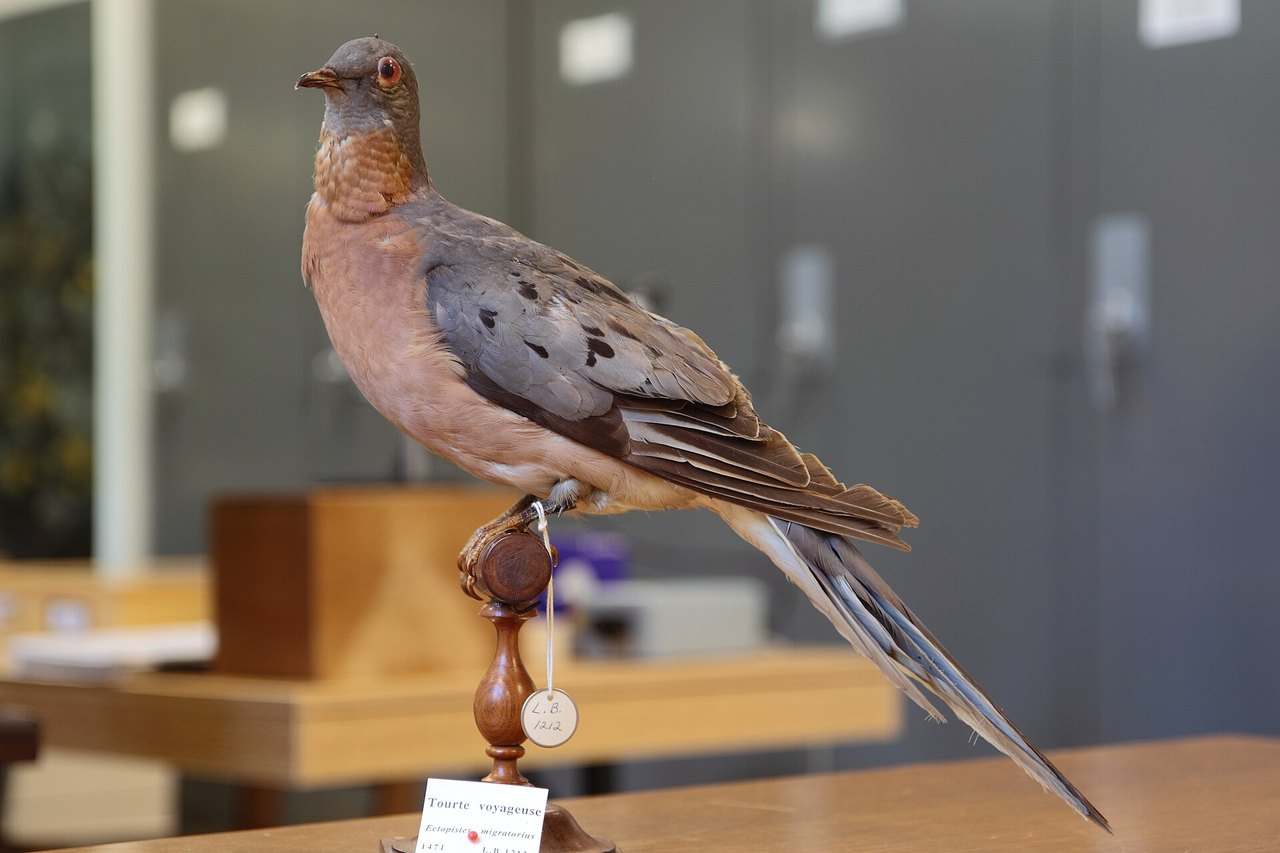
The passenger pigeon was a North American bird whose former range extended throughout the continent in great abundance, from the Atlantic to the great Central Plains and north to at least 62. Its build was distinctive: the tarsus was very short, while the tail was very long and excessively cuneate, with central rectrices sharply pointed. These proportions belong to a bird built for sustained movement, and movement defined its life. Sometimes incredible numbers flocked together, and the species migrated southwards after the breeding season. 1Extinct Birds: an attempt to unite in one volume a short account of those birds which have become extinct in historical times · Hutchinson, London (via Internet Archive) ↗
That habit of gathering in vast numbers is central to understanding the bird, and equally central to understanding its fate. A population distributed across a whole continent and given to spectacular concentrations could appear inexhaustible, yet the record of its range tells a different story. The breeding range became mainly restricted, and the only marked exception to this contraction is noted in the account. In consequence, a species once spread from the Atlantic seaboard to the central plains was reduced to a remnant of its former ground. 1
The final extinction of the passenger pigeon in a wild state is the endpoint of that contraction. The bird's decline is therefore instructive precisely because of the scale it began from: abundance across North America, enormous flocks, and a long seasonal migration did not protect it. The same concentration that made the species remarkable made it vulnerable, and the loss of the wild population closed the history of a bird that had once been among the most numerous on the continent. 1
1. Form
The form of the passenger pigeon is best understood through the proportions of its tail and legs, which together indicate a bird shaped by flight. The tail was very long and excessively cuneate, and its central rectrices were sharply pointed. Such a wedge-shaped tail, tapering to fine points at the centre, is not an ornament but a steering and balancing surface, and its length relative to the body suggests that the bird's economy was organised around movement through open air rather than around the ground. The tarsus, by contrast, was very short, a proportion consistent with a foot suited to perching and to brief contact with a surface rather than to walking or scratching at length. 1
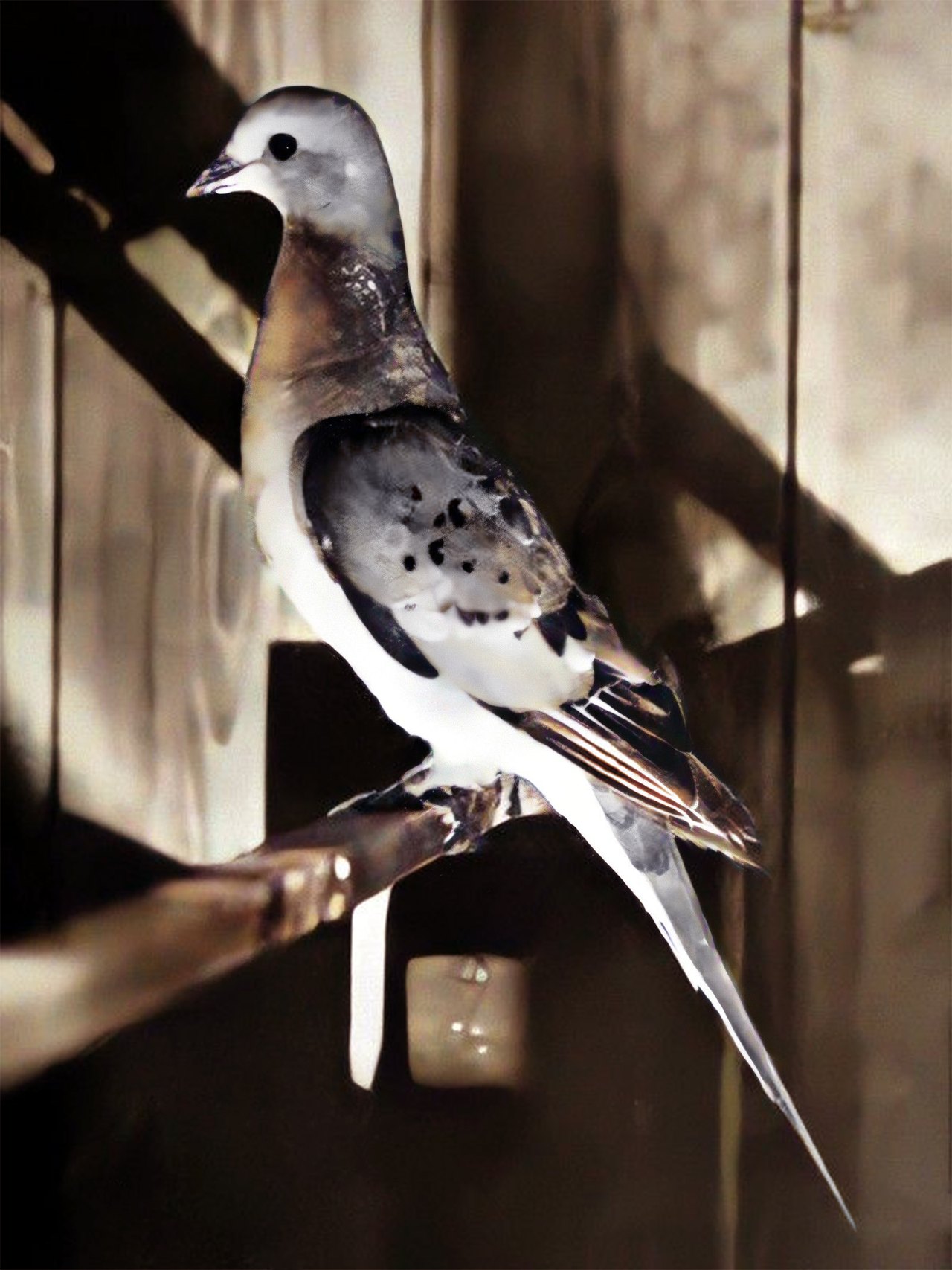
These two features, taken together, describe an animal whose structure is concentrated in its wings and tail while its legs are reduced to a minimum. The long cuneate tail and the sharply pointed central rectrices would have given the bird fine control in rapid, sustained flight, and the short tarsus implies that it had little need for extended use of the ground. In consequence, the shape of the passenger pigeon accords with a life spent largely in the air and in the trees, and the body carries no suggestion of a bird that foraged or nested by walking. 1
The form of the bird cannot be separated from the manner in which it lived, since the same proportions that suited it to sustained movement also suited it to movement in company. Sometimes incredible numbers flocked together, and the species migrated southwards after the breeding season. A long, wedge-shaped tail and pointed rectrices are of particular value to a bird that must hold position and change direction within dense aggregations, and a short tarsus is no handicap to a species whose time is passed in flight and on branches rather than on open ground. 1
The build of the passenger pigeon therefore belongs to a bird whose structure was adapted, in every proportion here recorded, to a life of movement and congregation. The tail and the tarsus together describe an animal organised for the air, and it is this organisation that gives the species its character as a creature of the flock and of the seasonal journey. 1
2. Former Range
The passenger pigeon was formerly distributed throughout North America in great abundance, and its range extended from the Atlantic to the great Central Plains. This breadth describes a bird whose presence was continental rather than local, occupying the eastern seaboard and the interior grasslands alike. Within that expanse it occurred in great numbers, so that abundance and wide distribution were not separate qualities but two aspects of the same occupation of the continent. 1
The range reached far to the north, extending north to at least 62. The species was therefore not confined to the temperate latitudes of the Atlantic states and the plains but penetrated high northern regions as well, and its distribution is best understood as a single vast sweep from the eastern ocean across the interior and far to the north. Such a span implies a bird capable of sustaining itself across widely differing conditions, and the record of its former range is accordingly one of the broadest known for any North American species. 1
The species migrated southwards after the breeding season, so that the occupied range was not static but shifted with the year. The northern limits of its distribution were therefore seasonal rather than permanent, and the great abundance recorded across the continent reflects a population that moved through the range as the seasons turned. In consequence, the former range is not simply a line on a map but a description of a bird whose presence across North America was renewed and withdrawn in the course of each year. 1
The extent of that range did not endure. The breeding range became mainly restricted, and the species passed into final extinction in a wild state. The contraction of so vast a distribution, from the Atlantic to the plains and north to high latitudes, to a restricted breeding area marks the reversal of the pattern described above, and the former range stands in the record as the measure of what was lost. 1
3. Migration and Flocks
The seasonal movement of the passenger pigeon was the mechanism by which its continental range was occupied, and the accounts of the species dwell on the scale of the gatherings that accompanied it. Sometimes incredible numbers flocked together. The phrase belongs to the record of a bird whose congregations were not incidental to its habits but the defining feature of them, and the migration southwards after the breeding season is best read as the annual occasion on which these assemblies were formed and set in motion. 1
What the accounts describe is therefore a movement of population rather than the passage of individuals. A species distributed from the Atlantic to the great Central Plains, and reaching north to at least 62, could not have renewed its presence across so wide a sweep by scattered parties; the flocks were the means by which the range was held. In consequence the migration and the flocking are not two subjects but one, the seasonal journey being the form taken by a bird whose numbers were such that its movements became an event in the landscape. 1
The record of the species is not, however, a uniform chronicle of such gatherings. The breeding range became mainly restricted, and the only marked exception in the accounts stands against the wider pattern of contraction. The immense flocks belong, therefore, to the earlier portion of the record, and the later entries describe a bird whose presence had narrowed. The final extinction of the Passenger Pigeon in a wild state closes the sequence. 1
Read in this order, the accounts of migration and flocking carry a weight beyond description. The gatherings that once accompanied the southward movement measure the abundance that the restricted breeding range no longer supported, and the seasonal journey, which had renewed the species across North America each year, is remembered chiefly for the numbers that made it. 1
4. Decline
The contraction of the breeding range is the central fact of the decline, and the accounts treat it as a change in the manner of breeding rather than merely a change of address. Where the species had gathered in colonies, the later record describes isolated pairs. The distinction matters because the colonies were the engine of the species' abundance: a bird that nests in a few dense assemblies renews itself differently from one that nests in scattered pairs, and the shift from the one to the other is the mechanism by which a numerous species becomes a rare one. The shrinking range and the dispersal into pairs are therefore not separate symptoms but a single process, the breaking up of the great gatherings into remnants too few to sustain themselves. 1
The earlier distribution gives the measure of the change. The species was formerly found throughout North America in great abundance, from the Atlantic to the great Central Plains and north to at least 62. The breeding range, by contrast, became mainly restricted. The contrast between a continental presence and a confined one is the whole history of the decline in miniature, and the accounts record it without embellishment, as a fact of geography that carries its own meaning. 1
The colonies themselves belong to the earlier portion of the record. The gatherings of incredible numbers were the form the species took when it was abundant, and the isolated pairs are what remained when it was not. In consequence the later entries describe a bird whose presence had narrowed to scattered remnants, and the final extinction of the Passenger Pigeon in a wild state closes the sequence. The only marked exception in the accounts stands against this wider pattern of contraction, a single departure from the general rule that the breeding assemblies had failed. 1
Read in this order, the record of the decline is a record of scale. The colonies that once accompanied the southward movement measure the abundance that the restricted breeding range could no longer support, and the shift to isolated pairs is the visible sign that the mechanism of renewal had failed. The species did not vanish from a single cause but contracted step by step, from continent to region, from region to scattered pairs, until nothing remained to gather. 1
5. Extinction
The final extinction of the Passenger Pigeon in a wild state is recorded as the close of a sequence rather than as an isolated event. What precedes it in the book is a contraction already visible in the geography of the species: a bird formerly found throughout North America in great abundance, from the Atlantic to the great Central Plains and north to at least 62, came to occupy a breeding range mainly restricted. The author's reasoning treats these two statements as the ends of a single movement, so that the disappearance in the wild is the terminus of a decline whose stages the earlier pages had already described. 1
The colonies belong to the abundant phase of that history. The gatherings of incredible numbers were the form the species took when it was numerous, and the southward migration after the breeding season was the occasion on which those numbers were most conspicuous. Once the breeding assemblies had broken into isolated pairs, the gatherings could no longer be repeated on the old scale, and the migration that had accompanied them lost the character the book had attributed to it. In consequence the extinction in a wild state follows from the failure of the assemblies rather than from any separate catastrophe. 1
Against this pattern the book sets a single qualification. One breeding record is described as the only marked exception, a departure from the general rule that the breeding assemblies had failed. The author does not treat that exception as a reversal of the decline; it stands as the one instance that does not conform to the wider account, and the narrative returns from it to the general contraction. 1
The conclusion the book draws is therefore cumulative. The species contracted from continent to region and from region to scattered pairs, and the final extinction in a wild state is the point at which nothing remained to gather. The author presents the outcome as the end of a process already legible in the shrinking range and the dispersed breeding, not as a sudden disappearance. 1
6. Key Facts
| Attribute | Value |
|---|---|
| Tail shape | TAIL very long and excessively cuneate 1 |
| Tail feathers | central rectrices sharply pointed 1 |
| Tarsus | Tarsus very short 1 |
| Range | from the Atlantic to the great Central Plains 1 |
| Migration | migrate southwards after the breeding season 1 |
7. Frequently asked questions
What was the passenger pigeon?
A North American pigeon that once occurred in enormous abundance and became extinct in the wild. 1
Where did it live?
Rothschild records it from the Atlantic to the Central Plains, and north to at least 62 degrees latitude. 1
Did it migrate?
Yes: it moved south after breeding and returned in spring, and shifted with the food supply. 1
When did it disappear?
The book concludes that the close of the nineteenth century saw its final extinction in a wild state. 1
8. Timeline
- 1895The breeding range is reported as mainly restricted to the northern borders.The breeding range is reported as mainly restricted to the northern borders.
- 1907Rothschild publishes his account of the species.Rothschild publishes his account of the species.
References (1)
- 1Extinct Birds: an attempt to unite in one volume a short account of those birds which have become extinct in historical times — Hutchinson, London (via Internet Archive) Archive↩View source