Penguin
The flipper, the scaled plumage and the rookeries, from a Victorian dictionary.
Newton calls the penguins perhaps the strangest group of their class. He describes the unbending flipper, the scale-like feathers, and the rookeries where the birds fight back but cannot fly away.
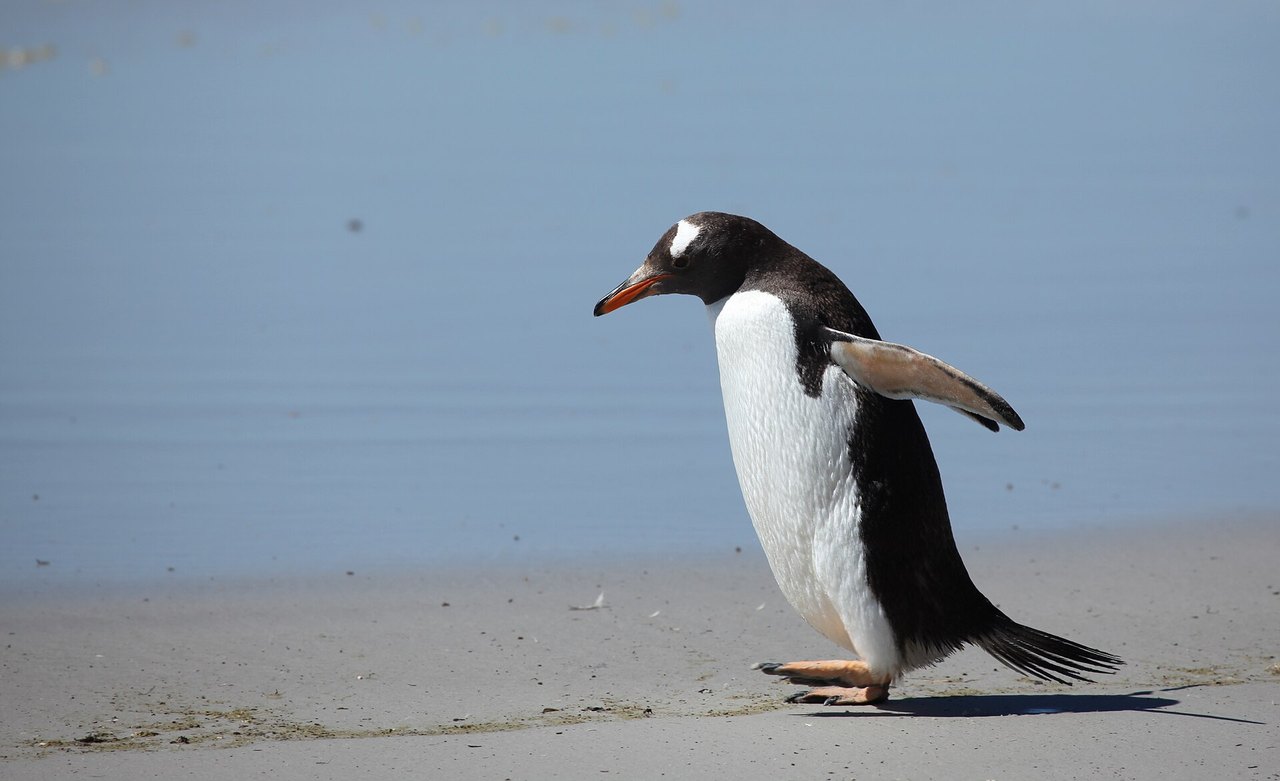
Overview
The name Penguin, as English ornithologists use it, is a general term for certain birds of the Southern Ocean, though the word did not originate there. It was first applied to a bird inhabiting the seas of Newfoundland, the species that subsequently became known as the Great Auk. The French call the southern birds Manchots, and it is under that separate name that they are distinguished from the northern bird that once bore the English title. 1A Dictionary of Birds · Adam and Charles Black, London (via Internet Archive) ↗
In the Dictionary of Birds the author regards these southern birds as forming, in some respects, perhaps the most singular group of the whole Class. The judgment rests on the combination of structures rather than on any single feature. Their wings serve as flippers, as incapable of flexure as the flippers of a Cetacean, yet in the water they are most efficient paddles. A bird whose forelimbs cannot bend like a wing but drive it through the sea like a paddle is, on the author's reasoning, an anomaly among birds. 1
The plumage adds to the singularity. It generally consists of small scale-like feathers, a covering that departs from the ordinary feathering of birds. Nor is the bird merely strange in build; it has a temper of its own, for penguins bite hard when they get the chance. The author's portrait is therefore of an animal singular in limb, in covering, and in disposition alike. 1
The group is a varied one. The Spheniscidae have been divided into at least eight genera, so that the singularity the author describes is not the property of a single form but of a whole assemblage of southern birds. 1
1. The Name
The word Penguin reached the southern birds by a roundabout route, and the Dictionary of Birds is careful about the direction of travel. English ornithologists, the author notes, always use the word in a general sense for certain birds inhabiting the Southern Ocean; that is its established English meaning. But the name was not coined for them. It was first applied to a bird inhabiting the seas of Newfoundland, the species that subsequently became known as the Great Auk. The southern birds, therefore, inherited a title that had belonged to a northern one. 1
The French, by contrast, call the southern birds Manchots, and it is under that separate name that they are distinguished from the northern bird that once bore the English title. The author sets the two usages side by side without attempting to derive one from the other. His concern is with what the English word denotes in practice, and on that point he is unambiguous: whatever its history, it serves as a general term for the birds of the Southern Ocean. 1
That the name should have migrated from a northern species to a southern group is the fact the author records, not a puzzle he sets out to solve. He offers no etymology and no argument about how the transfer came about. The Dictionary's treatment is descriptive throughout: the word is given its current English sense, its earlier application to the Great Auk is noted, and the French alternative is recorded alongside it. Readers who want the origin of the term itself will not find it here. 1
What the author does supply is a sense of how much the name has to cover. The birds to which it now applies are, in his judgment, perhaps the most singular group of the whole Class, and they are themselves divided into at least eight genera. A general term is thus made to serve a large and varied assemblage, and the author's usage reflects that breadth rather than narrowing the word to any single form. 1
2. Wings and Water
The wing of a penguin is a flipper, and the author is emphatic about what that means: it is as incapable of flexure as the flipper of a Cetacean. No joint in it answers to the hand of an ordinary bird. What would elsewhere bend and fold is here fixed, and the limb is given over wholly to one office. In the water, he writes, they are most efficient paddles. The same rigidity that would be a defect in the air becomes the condition of propulsion in the sea, where a surface that cannot give or fold drives against the water rather than slipping through it. 1
The plumage answers to the same design. It consists generally of small scale-like feathers, a close overlapping surface rather than the loose and separable vanes of a flying bird. Covering and limb are of a piece: the body is clad in a smooth integument and the forelimbs are shaped as blades, so that the whole anterior of the animal presents an unbroken face to the water. 1
The author does not labour the point, but his comparison carries it. To liken the flipper to that of a whale is to place the penguin among swimmers by construction and not by habit, and the phrase about efficient paddles confirms the judgment in the element where it matters. The stroke is not described in detail; what the Dictionary gives is the reason it must succeed, namely a limb whose immobility is total. 1
3. Plumage
The plumage answers to the same design. It consists generally of small scale-like feathers, a close overlapping surface rather than the loose and separable vanes of a flying bird. Covering and limb are of a piece: the body is clad in a smooth integument and the forelimbs are shaped as blades, so that the whole anterior of the animal presents an unbroken face to the water. 1
What the Dictionary records of the feathers is their scale, and the scale is the whole of the description. Small and scale-like, they lie as a continuous armour over the body rather than as plumage in the ordinary sense. The author does not describe bare spaces left among them, nor does he speculate on what such gaps might do; the entry gives the character of the covering and passes on. The reader is left with a surface that reads as one piece, and with the sense that the bird's dress, like its wing, has been reduced to the single office of moving through water. 1
Set beside the flipper, the feathers complete a consistent picture. A limb that cannot flex and a coat that does not part belong to the same economy: nothing on the penguin's exterior is designed to open, fold or give way. The author's comparison of the flipper to that of a Cetacean carries the same implication for the body as for the wing, since a whale's hide is likewise a close and unbroken surface. In the water, he writes, the flippers are most efficient paddles, and a plumage of small scales offers them nothing to catch or drag against. 1
The Dictionary's treatment of the plumage is brief, and its brevity is itself instructive. The author is content to name the character of the feathers and let the reader draw the consequence, which is that the penguin is clothed for the sea and not for the air. Nothing in his account suggests a bird that could shed or ruffle its coat to any purpose. The scale-like feather, like the inflexible flipper, is a structure with one use, and the entry records it as such. 1
4. Rookeries
The Dictionary places the penguin among birds that in some respects form perhaps the most singular group of the whole Class, and the breeding gatherings are part of what sets them apart. English ornithologists, the author notes, always use the word Penguin in a general sense for certain birds inhabiting the Southern Ocean, so the account that follows gathers many kinds under one name. The French call these birds Manchots. The name itself has a history that runs northward before it settles in the south: it belonged first to a bird inhabiting the seas of Newfoundland, which subsequently became known as the Great Auk. What the southern birds share, and what the gatherings express, is a manner of life sufficiently distinct to have drawn a separate name and a separate chapter. 1
At the nest the birds are not passive. They bite hard when they get the chance, and the Dictionary records the trait without softening it. Defence of the gathering therefore rests on the birds themselves rather than on any structure or retreat; the beak is the weapon, and it is used. The author offers no account of collective mobbing or of a coordinated response to intruders, only the plain fact of a sharp bite delivered at close quarters. In a group so singular, the reader is left to understand that the colony is defended by the temper of its members. 1
Against destruction the birds have little enough. The Dictionary's classification divides the Spheniscidae into at least eight genera, a division that speaks to variety within the group and, by implication, to many separate gatherings scattered through the southern seas. The author does not describe wholesale slaughter at the rookeries, nor does he name a particular agent of decline; what he gives is the bare circumstance that these are birds of the far south, named and sorted by naturalists, and that the name they carry was first attached to a northern bird now known as the Great Auk. The parallel is left to stand on its own. 1
The gatherings, then, belong to a group the author regards as perhaps the most singular of the whole Class, and the Dictionary treats them as a subject for classification and description rather than for alarm. The birds bite; the genera are counted; the name is traced to its northern origin. Nothing in the entry suggests that the author foresaw the loss of the rookeries, and nothing in it suggests that he did not. 1
5. Key Facts
| Attribute | Value |
|---|---|
| French name | called by the French Manchots 1 |
| The flipper | as incapable of flexure as the flippers of a Cetacean 1 |
| In the water | In the water they are most efficient paddles 1 |
| Plumage | generally consists of small scale-like feathers 1 |
| Genera recognised | The Spheniscidfe have been divided into at least eight genera 1 |
| Standing in its class | which in some respects form perhaps the most singular group of the whole Class 1 |
6. Frequently asked questions
What does the name penguin mean here?
It was first applied to a bird of the Newfoundland seas that became known as the great auk; English ornithologists now use it for birds of the Southern Ocean. 1
Why can't penguins bend their wings?
The flipper is as incapable of flexure as the flipper of a cetacean, though it moves freely at the shoulder joint. 1
How many kinds are recognised?
The family has been divided into at least eight genera, though only three or four seem valid. 1
Do penguins fight back?
They cannot escape by flight, but they bite hard when they get the chance. 1
7. Timeline
- 1893Newton publishes A Dictionary of Birds.Newton publishes A Dictionary of Birds.
References (1)
- 1A Dictionary of Birds — Adam and Charles Black, London (via Internet Archive) Archive↩View source