Star-fish
Arms, sieve and stomach, described for young readers in 1887.
Cooper describes where star-fishes live, the five hollow arms, the sieve on the back that admits water, the stomach it turns inside out into an oyster, and the hundred thousand dollars of damage done yearly to oyster-beds.
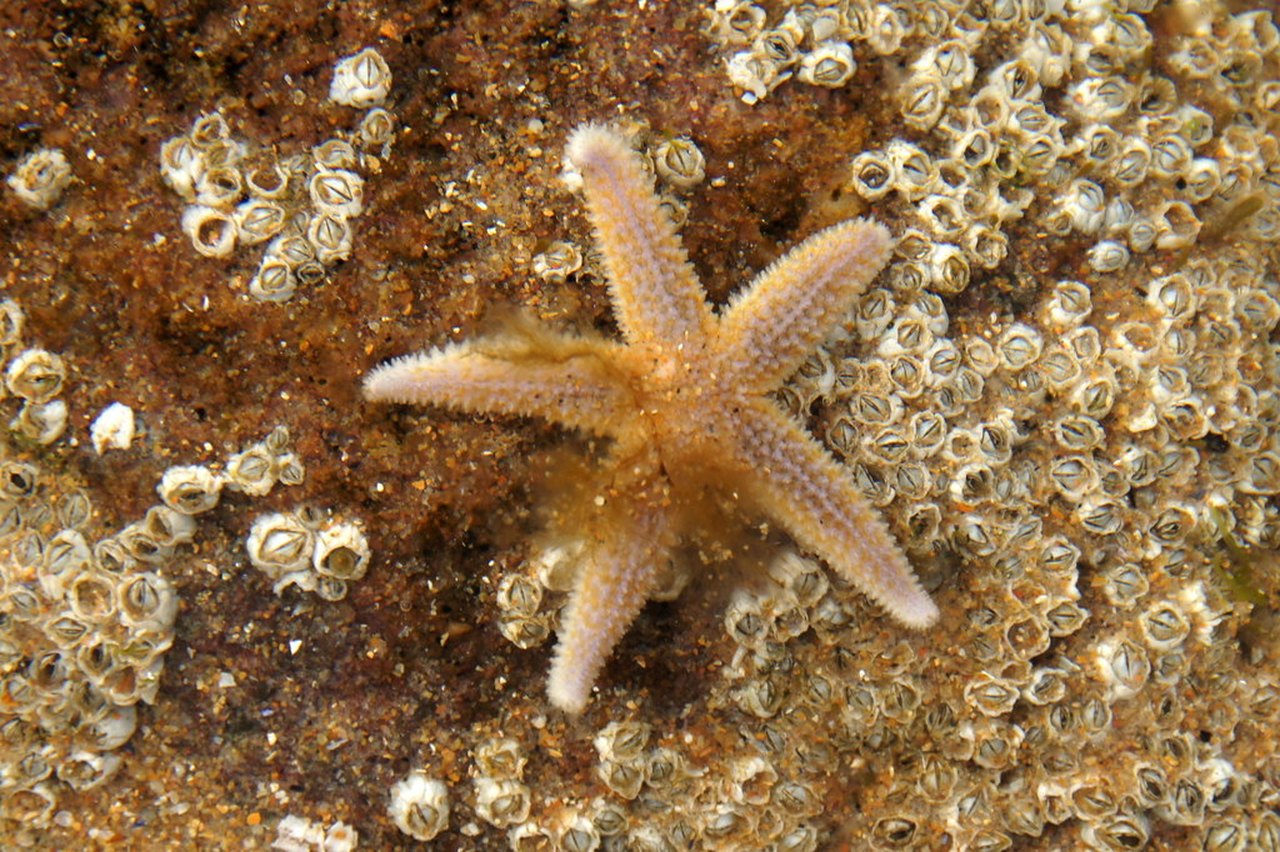
Overview
The star-fish belongs, in Cooper's account, to the rocky coast. It is there that the animal is found in greatest numbers, and there that it finds the conditions it needs. Muddy or sandy bottoms suit it poorly; it does not thrive upon them. What the stone offers is shelter, for the crevices between the stones afford good hiding-places, and the creature takes full advantage of them. A shore of broken rock, therefore, is the place to look for star-fishes, and the author treats this preference as a settled point of their natural history rather than a matter of accident. 1Animal Life in the Sea and on the Land: a zoology for young people · Harper & Brothers, New York (via Internet Archive) ↗
The animal's structure is simple enough to describe. It has five hollow rays or arms, and along these arms run the ambulacral plates that give the body its firmness. On the upper surface lies the Madreporic Body, a small and distinct feature that Cooper singles out for attention, and which he takes to act as a sieve. From these parts the star-fish derives the power that makes it so unwelcome to the oyster beds. When it feeds, it turns its stomach right out into the oyster shell, and multitudes of tiny suckers spring up to help it hold and draw. The arrangement is not elaborate, but it is effective, and the damage it does is considerable. 1
That damage has been reckoned in money. Cooper puts the loss at an amount reaching $100,000, a figure that explains the hostility with which the star-fish is regarded by those who make their living from shellfish. The animal's numbers are not steady. Large numbers of star-fishes sometimes appear suddenly and unexpectedly upon the shores, and such visitations are the more serious for coming without warning. Against them the remedy Cooper records is a rough one: the creatures are dipped once or twice in boiling water. 1
What emerges from the account is an animal whose whole economy is bound up with the shore it frequents. The rock gives it hiding-places; the oyster beds give it food; and its five arms and their suckers give it the means to take what the beds provide. Cooper writes as a close observer of a common creature, and his interest lies less in classification than in the plain facts of where the star-fish lives and what it does there. 1
1. Keeping and Drying
The boiling water that serves as a remedy against the star-fish on the oyster beds serves a quieter purpose as well, for Cooper recommends the same treatment to anyone who would preserve a specimen. The creature is dipped once or twice in boiling water, and by this means the difficulty of drying it is overcome. The trick is a modest one, but it answers a real problem: a star-fish taken fresh from the shore does not dry readily, and the author offers the plunge as the practical way of setting it right. 1
What the boiling achieves is a matter of the animal's build. Its five hollow rays or arms are not solid throughout, and it is this hollowness, together with the softness of the living tissue, that makes the drying of a star-fish troublesome. Cooper does not labour the point; he gives the remedy and passes on, treating the difficulty as one his readers will recognise and the boiling as the answer to it. 1
The recommendation sits oddly beside the rest of the account, in which the same creature is a pest to be destroyed. On the oyster beds it turns its stomach right out into the shell, and the multitudes of tiny suckers that spring up to help it hold and draw make it formidable there. The damage it does is reckoned at $100,000, and when large numbers of star-fishes appear suddenly and unexpectedly upon the shores, the boiling water is turned against them in earnest. The collector's dip and the oysterman's remedy are, in Cooper's book, the same operation put to different ends. 1
For the reader who wants a star-fish for the cabinet, then, the author's instruction is brief and practical. The animal is to be dipped once or twice in boiling water, and the difficulty of drying it is thereby removed. Nothing more elaborate is asked, and Cooper evidently thought none was needed. 1
2. Arms
The star-fish's five hollow rays or arms are the parts by which the creature is most readily known, and their hollowness is not a decorative detail but a condition of the animal's life. Cooper describes the arms as hollow throughout, and this interior space is continuous with the body, so that the whole structure is one cavity rather than a solid disc with appendages. It is this construction, together with the softness of the living tissue, that makes a fresh specimen so difficult to dry and explains why the author recommends the plunge into boiling water as the practical remedy for the collector. 1
On the oyster beds the arms serve a more active purpose. The star-fish turns its stomach right out into the shell, and the multitudes of tiny suckers that spring up along the arms help it to hold and draw. The suckers are the working parts of the rays, and the hollow arms carry the mechanism by which they are extended and withdrawn. Cooper's account of the feeding is brief, but it makes plain that the arms are not merely limbs of locomotion: they are the instruments by which the creature takes its food from a shell it cannot enter. 1
The loss of an arm is a matter Cooper treats without alarm. The star-fish is not destroyed by the loss of a ray, for the arms are capable of being replaced, and the creature continues to live and feed while the missing member is made good. The hollow construction of the arm is what makes this possible, since the new growth arises from the body and extends outward along the same cavity. A star-fish taken from the rocks with fewer than five rays is therefore not a damaged specimen in any permanent sense, and the author does not present the loss as a serious injury. 1
What the arms cannot do is compensate for an unsuitable shore. Star-fishes like rocky coasts the best, and they do not thrive upon muddy or sandy bottoms, where the crevices between the stones afford no hiding-places and the suckers find nothing to grip. The arms are fitted for rock and for the shells that grow there, and their hollowness and their suckers alike are wasted on soft ground. In consequence the creature is found where the stones are, and its five rays are the sign of a body built for that footing. 1
3. The Upper Surface
The upper surface of the star-fish is armoured with spines, and among them stand the small organs Cooper calls the snapping forks. These are not ornaments. They are mounted on the back of the creature and are capable of closing upon whatever comes within their reach, so that the upper surface is defended as well as supported. The spines give the body a rough and prickly exterior, and the forks add to it a grasping action of their own. Between the two, the back of the animal is a working surface rather than a mere covering. 1
Near the middle of the back lies the structure Cooper names the Madreporic Body. Its office is indicated by its form, for it is described as being a sieve. The comparison is exact in the author's account: the body is perforated so that water may pass, and it is by this means that the interior of the animal is kept supplied. The position of the sieve near the centre of the back is therefore not accidental, since it places the opening where the surrounding spines and forks can protect it while the water is admitted. 1
Cooper's treatment of these parts is brief, and he does not pretend to settle every question they raise. The snapping forks in particular are named and their action indicated rather than fully explained, and the reader is left with the description rather than with a demonstration of how the mechanism works. What the author does make clear is that the upper surface is not a passive shell. Spines, forks and the perforated body together form the outward face of an animal that must admit water, repel intruders and hold its place on the rock at the same time. 1
That the star-fish is built for rocky coasts the upper surface confirms, for the spines and forks are suited to a life among stones and shells, and the sieve must be kept clear if the creature is to thrive. On muddy or sandy bottoms the animal does not prosper, and the apparatus of the back is of a kind fitted to the harder ground where star-fishes are chiefly found. 1
4. Feeding
The oyster is the star-fish's chief prey, and the manner of taking it is the most remarkable thing Cooper has to record. Since the shell cannot be forced by main strength, the star-fish brings its stomach out through its mouth and turns it right out into the oyster shell. The soft organ is thus applied directly to the flesh within, and digestion begins outside the body of the eater rather than inside it. 1
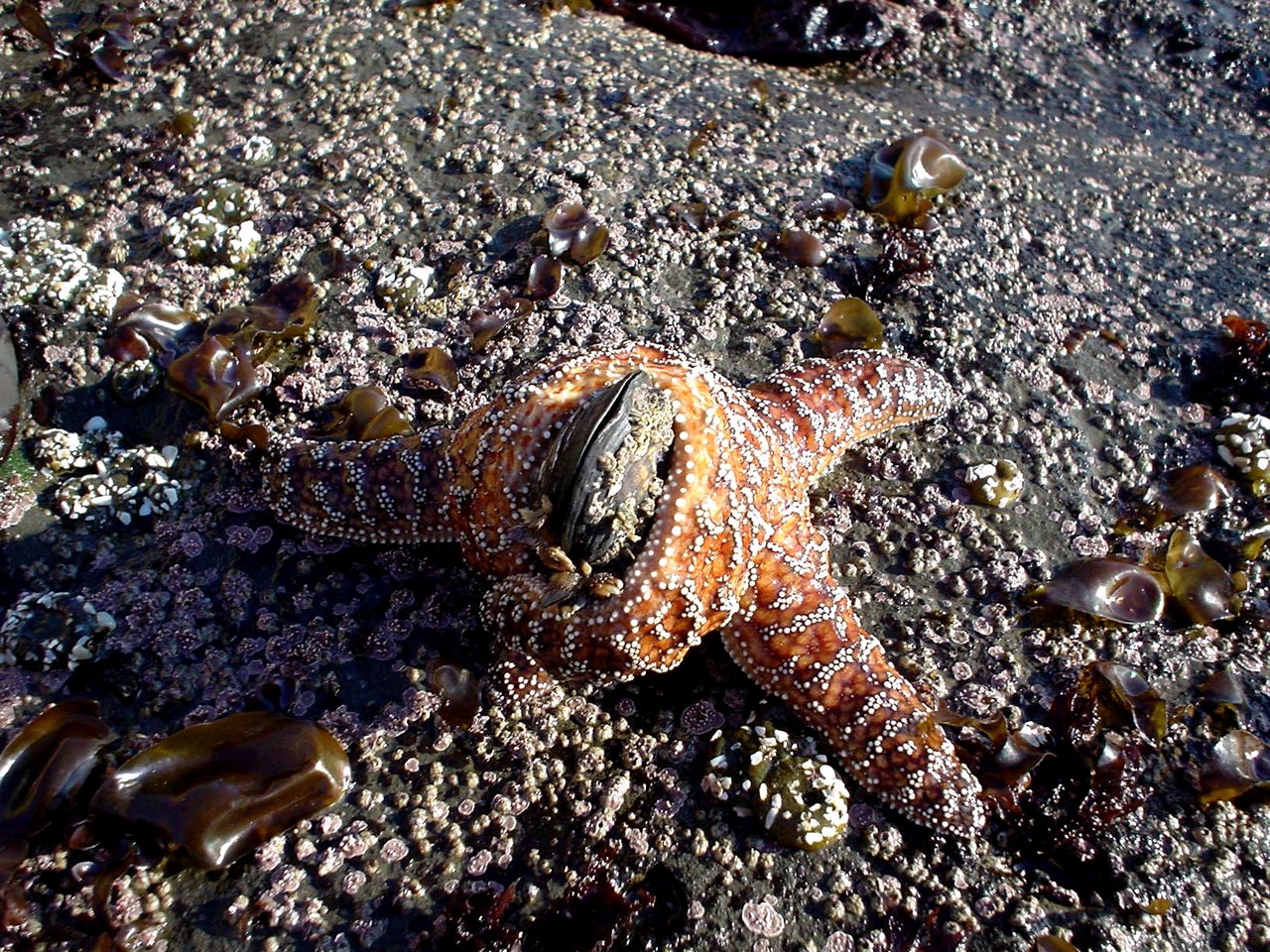
To bring the shells within reach of this manoeuvre, the multitudes of tiny suckers spring up to help. These are the same hollow rays' appendages that serve the creature in climbing, and here they are employed to grip the two valves and hold them steady while the stomach is inserted. The oyster, once its shells are held apart, has no defence; the star-fish has only to wait upon its own digestion. 1
Cooper's account of the process is given without qualification, and he does not describe the muscular arrangement by which the stomach is everted and withdrawn again. The reader is left with the fact itself, which is striking enough: an animal that feeds by turning itself partly inside out, and that does so upon prey protected by a shell. The habit explains in part why the star-fish is so destructive to oyster beds, for a single creature can deal with many oysters in the course of its life. 1
The damage done by these animals is not slight. Cooper sets the loss at an amount of $100,000, a figure that indicates how seriously the oyster fisheries regarded them. Large numbers of star-fishes sometimes appear suddenly and unexpectedly upon the shores, and when they come in force the beds suffer accordingly. The suddenness of these visitations, no less than the manner of feeding, made the star-fish a creature the oyster-grower had reason to watch for. 1
5. Damage to Oyster-beds
The loss Cooper reports is set down as a plain figure: the damage amounts to $100,000. He offers no breakdown of how the sum was reckoned, nor any year to which it belongs, and the reader is left to take the number as the book gives it. What the figure measures is the seriousness with which the oyster fisheries regarded the star-fish, and on that point Cooper is in no doubt. 1
How the swarms arrive is described only in terms of surprise. Large numbers of star-fishes sometimes appear suddenly and unexpectedly upon the shores. There is no account of where they come from or by what route, and no warning is given of their coming; the visitation is upon the beds before anyone has looked for it. In consequence the oyster-grower could not forecast the loss, and the suddenness of the arrivals is set beside the manner of feeding as the second reason the creature had to be watched for. 1
The haunts of the animal explain why the oyster-beds are exposed to it. Star-fishes like rocky coasts the best, and the crevices between the stones afford good hiding-places, so that a coast suited to the one is seldom far from the other. They do not thrive upon muddy or sandy bottoms, and the ground that suits the oyster is therefore the ground on which the star-fish is most at home. 1
Against so persistent a pest the book records a homely remedy: dip them once or twice in boiling water. The instruction is given without elaboration, and Cooper does not say how the creatures are to be collected for the purpose, nor whether the method was thought sufficient to check the swarms. It stands in the text as the practical answer to a damage reckoned at $100,000, and as such it carries the measure of how little could be done against a foe that arrived unannounced and in numbers. 1
6. Key Facts
| Attribute | Value |
|---|---|
| Favourite ground | star-fishes like rocky coasts the best 1 |
| Arms | has five hollow rays or arms 1 |
| The round spot on the back | The Madreporic Body 1 |
| How it eats an oyster | They turn their stomachs right out into the oyster shell 1 |
| Annual damage to oyster-beds | amounts to $100,000 1 |
| Avoids | They do not thrive upon muddy or sandy bottoms 1 |
7. Frequently asked questions
Where do star-fishes live?
Rocky coasts suit them best, where crevices between stones give shelter; they do not thrive on muddy or sandy bottoms. 1
How many arms does a common star-fish have?
Five hollow rays or arms, extending from the centre like a star. 1
How does it eat an oyster?
It turns its stomach right out into the shell and sucks up the soft body. 1
How much damage do they do?
The book estimates $100,000 a year to the oyster-beds between Staten Island and Cape Cod. 1
8. Timeline
- 1887Cooper publishes her zoology for young people.Cooper publishes her zoology for young people.
References (1)
- 1Animal Life in the Sea and on the Land: a zoology for young people — Harper & Brothers, New York (via Internet Archive) Archive↩View source