Swift
A bird that performs its whole life in the air, from a Victorian dictionary.
Newton describes the swift's crescent outline, its nesting in eaves and quarry faces, the functions it performs on the wing, the edible nests of Collocalia, and the caves it shares with bats.
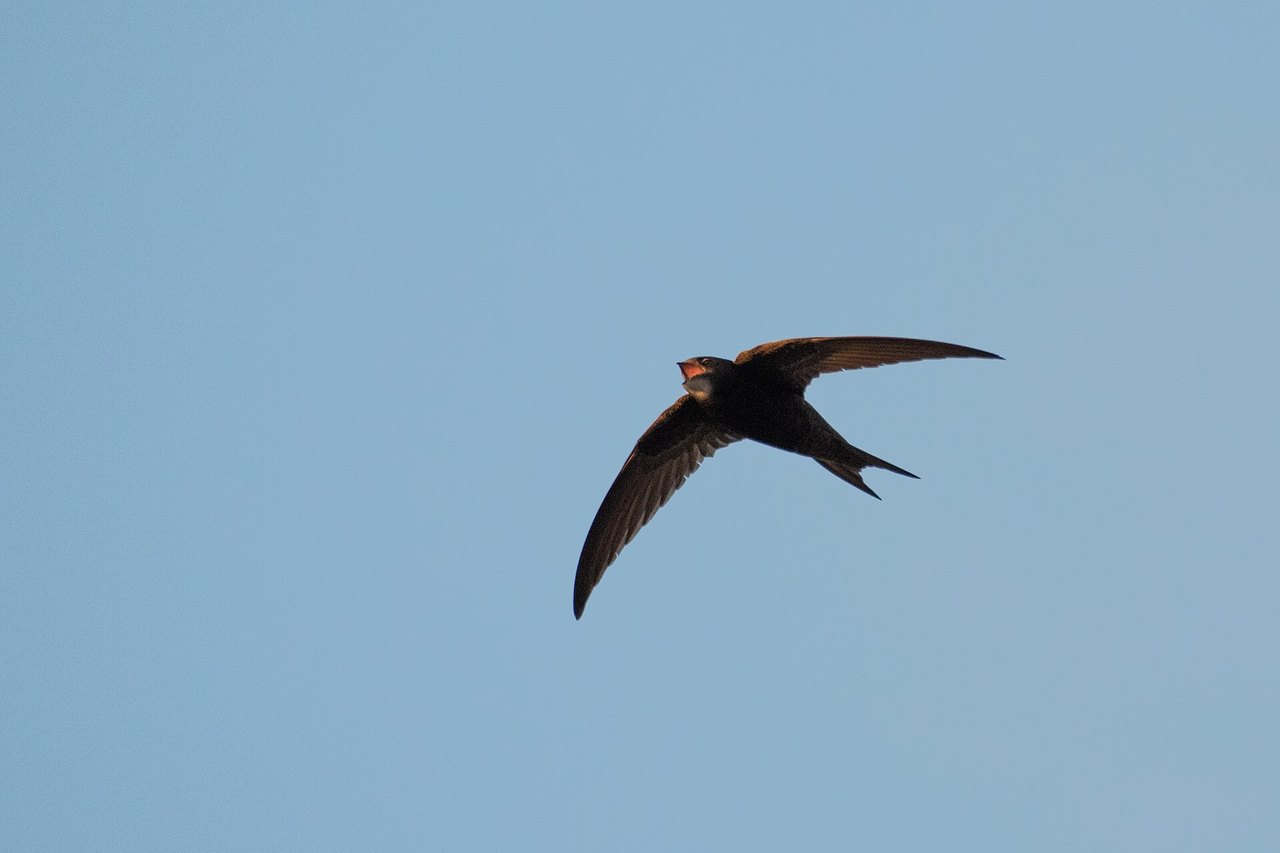
Overview
The swift is a bird recognised less by its bulk than by the outline it cuts against the sky. Newton allows that it is considerably larger than a Swallow, yet size is not what fixes the bird in the observer's mind. The head scarcely projects from the anterior outline of the pointed wings, so that the whole creature reads as a single continuous form rather than a body with parts attached. That silhouette, scythe-like and unbroken, is the swift's signature; a bird seen at distance is identified by the sweep of its wings before any question of measurement arises. 1A Dictionary of Birds · Adam and Charles Black, London (via Internet Archive) ↗
The shape is not merely a convenience for the watcher. Every natural function, except sleep, oviposition and incubation, is performed on the wing. Feeding, pairing, and the gathering of nesting material all take place in the air, and it is there that the bird remains for hours together. The body is therefore built around sustained flight rather than around the ground, and the suppressed head is part of that arrangement. Newton's description implies a creature for which the air is the ordinary medium and the solid world the exception. 1
That exception is narrow. For nesting the swift requires only holes under the eaves of buildings, or a crevice in the face of a quarry, or even a hollow tree. The tenancy of the nest is brief. The bird generally disappears from England very early in August, though occasionally it is to be seen for even two months later. The greater part of its year is spent elsewhere and aloft. 1
The association of the swift with darkness is a separate matter, and Newton treats it as such. In the caves where certain swifts breed in great numbers, the mammals are the lodgers by day and the birds by night, so that the same hollow is occupied in turn by bats and by swifts. The genus Collocalia, whose species are of uncertain number, is known for nests that consist essentially of mucus secreted by the salivary glands, a substance which dries and looks like isinglass. These are the edible nests of commerce, and they belong to a group distinguished by its chemistry quite as much as by its flight. 1
1. The Season
The swift's stay in England is short, and Newton fixes its going with some precision. It generally disappears from England very early in August. Against that rule he sets the exception: the bird is occasionally to be seen for even two months later. The wording is careful, and the difference between the general departure and the stragglers matters, since a bird met in October belongs to the exception rather than the rule. What the late individuals are doing, and whether they are the same birds that bred, Newton does not say. 1
The season is brief because so much of the bird's life is carried on where no season need be marked. Every natural function, except sleep, oviposition and incubation, is performed on the wing, and it is there that the bird remains for hours together. Feeding and the collection of nesting material therefore cost no time on the ground, and the nest itself, once found, is occupied only long enough to serve. The swift's calendar is compressed into the few weeks its eggs and young require, and the rest of the year is spent in a medium that leaves no record for the observer in England. 1
Where the bird goes when it leaves is not Newton's subject here, but the manner of its going is consistent with the shape he has described. The head scarcely projects from the anterior outline of the pointed wings, and a creature so built is not one that lingers about hedgerows. Its departure is early and its return is not mentioned among the facts of its English season; the bird is simply absent, and then present. 1
The swift's relation to shelter is equally seasonal. Holes under the eaves of buildings serve it, or a crevice in the face of a quarry, or even a hollow tree, and the tenancy of any of these is brief. In the caves where certain swifts breed in great numbers the arrangement is stranger still: the mammals are the lodgers by day and the birds by night, so that the same hollow passes between bats and swifts according to the hour. The genus Collocalia, whose species are of uncertain number, builds nests that consist essentially of mucus secreted by the salivary glands, a substance which dries and looks like isinglass. These are the edible nests of commerce, and they belong to a group set apart by its chemistry as much as by its flight. 1
2. Nests and Nesting-places
The swift's choice of a nesting-place is governed less by preference than by the narrowness of the opening it requires. Holes under the eaves of buildings serve it, and so does a crevice in the face of a quarry; even a hollow tree will do. What these situations share is a dark recess entered from the air, so that the bird is never obliged to alight on open ground. Newton records the alternatives without ranking them, and the impression left is that the swift takes whatever cavity offers, provided the approach to it can be made on the wing. 1
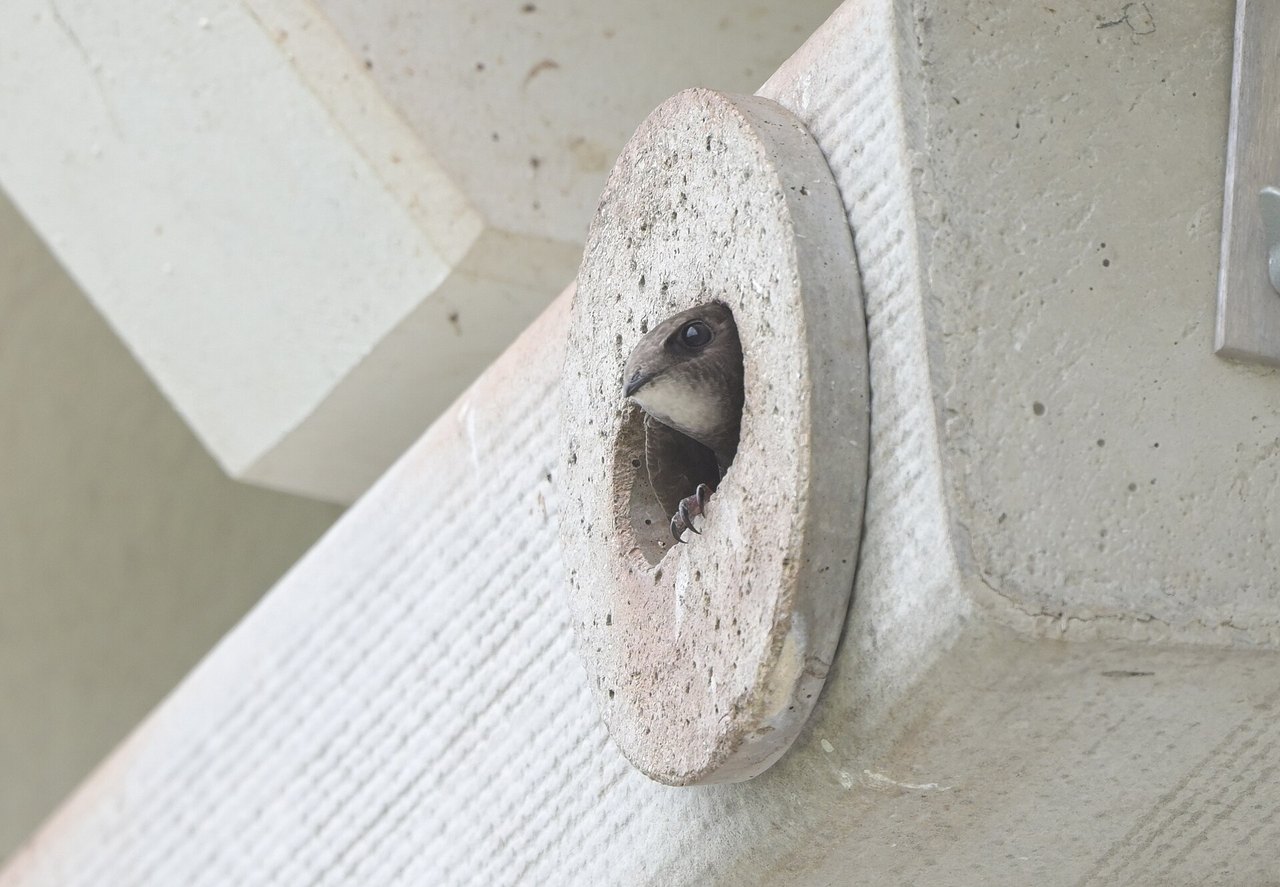
The habit is consistent with a body built for nothing else. The head scarcely projects from the anterior outline of the pointed wings, and a bird so formed cannot easily pick its way along a ledge or rise from a flat surface. In consequence the nest is placed where the final approach is a glide into shadow, and the site is occupied only so long as the eggs and young require. The swift is considerably larger than a Swallow, yet its whole economy is arranged around an entrance that a Swallow would find cramped. 1
Newton extends the survey beyond the English bird to the swifts that breed in caves, to which they resort in great numbers. In those places the same hollow is shared with another order of animal: the mammals are the lodgers by day and the birds by night, so that the cave passes between bats and swifts according to the hour. The arrangement is worth setting down as he gives it, since it shows how far the swift's tenancy of a dark recess can be pressed. 1
Among the genus Collocalia, whose species are of uncertain number, the nest itself is the object of trade. These nests consist essentially of mucus secreted by the salivary glands, a substance which dries and looks like isinglass. The chemistry sets these birds apart from the eaves- and quarry-dwelling swift quite as sharply as any difference of form, and it is on the nest rather than the bird that the commerce depends. 1
3. A Life in the Air
The swift is a bird of the air in a sense that few others can claim, for every natural function except sleep, oviposition and incubation is performed on the wing. Feeding, drinking, courtship and the gathering of nesting material all take place in flight, and Newton observes that the bird remains aloft for hours together. The body is shaped to make this possible: the head scarcely projects from the anterior outline of the pointed wings, so that the whole forward profile is a single continuous curve. In form the swift is considerably larger than a Swallow, yet its outline is more compact, the wings sweeping back from a head that barely interrupts their line. 1
That crescent outline, resembling the handle of the crescentic cutting-knife used in several trades, is the shape of a bird that rarely comes to rest. The wings are held in a curve that carries the body through the air with little visible effort, and the hours spent aloft are not a feat of endurance but the ordinary condition of the bird's life. Newton's account leaves the impression of a creature for which the ground is an anomaly, a surface to be approached only at the nest and only in the final glide into shadow. 1
The swift's season in England is correspondingly brief. It generally disappears very early in August, though individuals are occasionally to be seen for even two months later. The departure follows the completion of the nesting cycle, and the bird that has spent its summer almost entirely in the air returns to it for the journey south. What the swift does with the hours it spends aloft, beyond the functions Newton enumerates, he does not say; the record is one of observed habit rather than of explanation. 1
The habit is not confined to the English bird. Newton extends the survey to the swifts that breed in caves, to which they resort in great numbers, and there the same hollow is shared with another order of animal: the mammals are the lodgers by day and the birds by night, so that the cave passes between bats and swifts according to the hour. The arrangement shows how far the swift's tenancy of a dark recess can be pressed, and how completely the bird's economy is organised around the air it occupies. 1
4. Edible Nests
Among the swift's relatives the nesting habit departs altogether from the crevice in the face of a quarry or the hollow tree, and from the holes under the eaves of buildings that the English bird frequents. Newton turns to the genus Collocalia, whose species he declines to number, the count being uncertain, and describes nests that consist essentially of mucus secreted by the salivary glands. The secretion is worked into a cup that dries and looks like isinglass, and it is this resemblance, rather than any quality of the bird, that has fixed the value of the nest in trade. 1
The worth of the material therefore rests on a single property of the dried secretion, its likeness to isinglass, and on nothing else that Newton records. He gives no account of the birds that build these nests beyond their membership of the genus, and no description of how the mucus is applied or how often the cup is renewed. What the nests are, in his telling, is a product of the salivary glands that happens to dry into a substance men recognise and prize. 1
The setting of these nests is the cave, to which the birds resort in great numbers. It is in the same caves that the bats take their lodging, the mammals by day and the birds by night, so that a single hollow serves two tenants in turn. The mucus nest is thus built in a dark recess shared with another order of animal, and the birds that make it are known to Newton chiefly through the commerce in what they leave behind. 1
On the value of the nests he is content to let the comparison with isinglass stand. Whether the trade rests on the substance as food or as an article of another use he does not say here, and the reader is left with the dried cup itself, translucent and firm, as the measure of what the swift of the caves produces. 1
5. Sharing with Bats
The cave is not the swift's only lodging, but it is the one in which the bird's tenancy is most sharply divided against another animal's. Newton records that the swift breeds in caves, resorting to them in great numbers, and that the same hollow is held by two orders in turn: the mammals are the lodgers by day and the birds by night. The cave therefore changes hands with the light, bats occupying it through the hours of darkness while the swift is abroad, and the swift returning to it when the bats have gone. Nothing in the arrangement suggests conflict; it is a rota, and the hollow serves both parties without either displacing the other. 1
What makes the division workable is the extent to which the swift's life is already given over to the air. Every natural function except sleep, oviposition and incubation is performed on the wing, and the bird remains there for hours together. The cave is thus required for very little: a place to sleep, a place to lay and a place to sit on the egg. The rest of existence, feeding and whatever else the day demands, is transacted overhead, which leaves the recess free for the bats during precisely the hours when the birds have no use for it. 1
The body is fitted to that arrangement. The head scarcely projects from the anterior outline of the pointed wings, so that the bird in flight is a single continuous form, and it is considerably larger than a Swallow. Newton compares the outline to the handle of the crescentic cutting-knife used in several trades, a shape that carries the eye along the wing rather than interrupting it at the head. A bird so built has little to do with the ground, and the cave mouth is approached as one more passage of flight rather than as a place of settlement. 1
The English bird, by contrast, is not tied to caves at all. It nests in holes under the eaves of buildings, in a crevice in the face of a quarry, or even in a hollow tree, and it generally disappears from England very early in August, though it is occasionally to be seen for even two months later. The cave-dwelling swifts of which Newton speaks belong to other lands and other habits; the division of the hollow with the bats is a circumstance of those colonies, not of the bird that leaves the eaves behind at the summer's end. 1
6. Key Facts
| Attribute | Value |
|---|---|
| Done on the wing | every natural function, except sleep, oviposition and incubation, is performed on the wing 1 |
| Nesting-place | holes under the eaves of buildings 1 |
| The edible nest | markable nests consist essentially of mucus, secreted by the salivary glands 1 |
| Edible-nest swifts | form a genus Collocalia, of which the number of species is uncertain 1 |
| Leaves England | it generally disappears from England very early in August 1 |
| Sharing a cave | the mammals being the lodgers by day and the birds by night 1 |
7. Frequently asked questions
How can you tell a swift from a swallow?
Rather by its shape than its size: the head barely projects and the wings form one continuous curve. 1
Where does it nest?
Usually in holes under the eaves of buildings, but a quarry crevice or a hollow tree will do. 1
Why does it spend so long in the air?
Because every natural function except sleep, egg-laying and incubation is performed on the wing. 1
What are edible nests?
Nests of the genus Collocalia, made of saliva that dries like isinglass; their value depends on colour and purity. 1
8. Timeline
- 1893Newton publishes A Dictionary of Birds.Newton publishes A Dictionary of Birds.
References (1)
- 1A Dictionary of Birds — Adam and Charles Black, London (via Internet Archive) Archive↩View source