Pompeii: The Buried City
Streets, forum and amphitheatre measured by a Victorian visitor.
Adams's 1881 account of Pompeii gives its position, the width of its streets, the dimensions of its forum buildings and amphitheatre, and the story of its burial and rediscovery.
Overview
Pompeii, as W. H. Davenport Adams describes it, was a city of Campania situated on the right bank of the Sarno, six miles from Herculaneum and about four miles from Naples. Its neighbour Stabiae lay between four and five miles away. Adams treats the site as the starting point for an account of the city's remains, and the book sets out to describe those remains as they had been uncovered: the streets, the public buildings, the temples, and the private houses, together with the objects found within them. The distance from the coast and the proximity of the other buried towns place Pompeii within a network of settlements that shared a common fate, and Adams uses these relationships to orient the reader before turning to the city itself. 1Pompeii and Herculaneum, the buried cities of Campania: their history, their destruction, and their remains · T. Nelson and Sons, London (via Internet Archive) ↗
The book's descriptive method is architectural and topographical. Adams works through the city's principal structures, giving their dimensions and explaining their construction. The basilica, for instance, measured 220 feet in length by 80 feet in breadth, while the building associated with Eumachia was 130 feet long and 65 feet broad. The temple with its Doric columns, about 12 feet in height, had a cella of about 42 feet by 28 feet 6 inches. Such measurements are not offered as mere statistics; Adams uses them to convey the scale of civic life and to show how the buildings functioned as public spaces. 1
Adams also attends to the infrastructure that supported the city. He notes the depth at which wells were sunk, ninety feet, and the width of the streets, which did not exceed 93 English feet. The porticoes and colonnades receive similar treatment: the eastern colonnade ran about 450 feet in length, the western nearly 300 feet, and the portico on the western side had a depth of 24 feet. These details serve to reconstruct the physical fabric of the town and to demonstrate how its public architecture shaped movement and assembly. 1
The book further describes the city's places of entertainment, including the amphitheatre, whose major axis measured 430 feet and minor axis 335 feet. Adams observes that the dimensions of the arena, 190 and 178 feet respectively, were less than those of the Coliseum. In this way the overview moves from the city's setting and origins to its buildings and public works, presenting Pompeii as a coherent urban whole rather than a collection of isolated ruins. 1
1. Position and Neighbours
Pompeii stood on the right bank of the Sarno, a river that carried its trade and gave the city its commercial life. The site lay six miles from Herculaneum, and the river's distance from that town is given as the same figure, so that the waterway and the neighbouring city are measured together in Adams's account. The Sarno therefore appears not merely as a boundary but as the artery along which Pompeii's goods moved, connecting the town to the settlements around it. 1
The other neighbours are fixed with similar precision. Stabiae lay between four and five miles from Pompeii, close enough to be counted among the towns of the same district. Herculaneum, at six miles, stood farther off, and beyond it Naples lay about four miles from Herculaneum. These distances place Pompeii within a compact group of cities strung along the coast and the river plain, each within easy reach of the others. 1
Adams does not treat these measurements as idle geography. By establishing how near the buried towns stood to one another, he prepares the reader to understand that the catastrophe which overtook Pompeii fell upon a whole region rather than a single isolated place. The proximity of Stabiae and Herculaneum, and the shared river, make the city's position intelligible as part of a settled and connected landscape. 1
The account of the site's neighbours thus serves a larger purpose in the book. Having located Pompeii on the Sarno and measured its distance from the towns about it, Adams can turn to the remains themselves with the reader already oriented. The position of the city, its river, and its near neighbours form the frame within which the streets, temples, and houses are afterwards described. 1
2. Streets and Gates
Adams records that the width of Pompeii's streets does not exceed 93 English feet, a figure that situates the thoroughfares within the modest scale of a provincial town rather than a great metropolis. The measurement is offered as an upper limit, so that the streets are understood to fall at or below it, and the reader is left to grasp the city's proportions through this single bound rather than through an inventory of individual roadways. In consequence, the street plan emerges as something compact and legible, its dimensions subordinate to the larger public buildings that dominate the account. 1
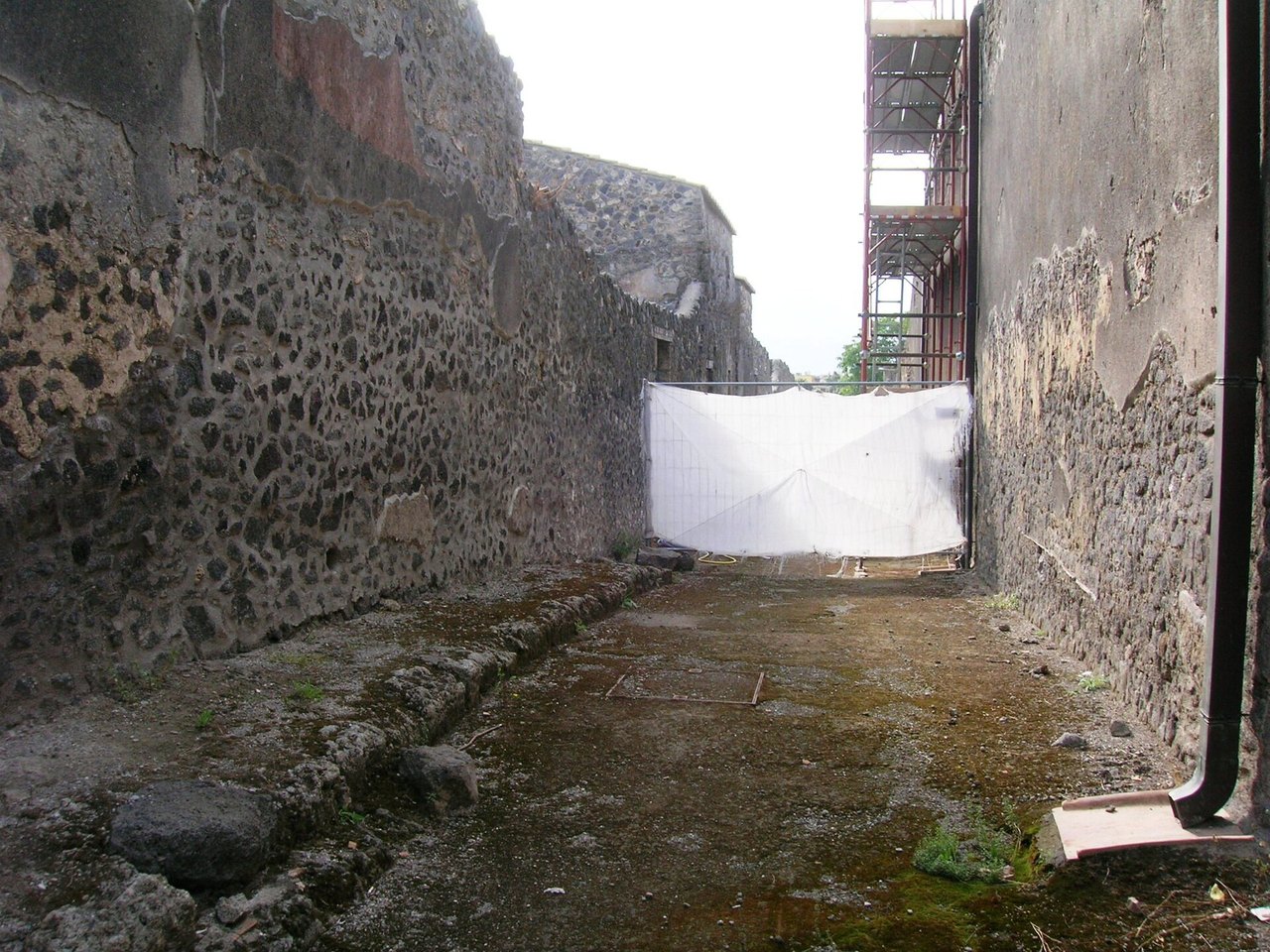
The gateways and the cemeteries beyond the walls belong to the same consideration of the city's edges, where the built fabric meets the surrounding country. Adams treats these approaches as part of the urban whole, the points at which the streets pass out into the landscape and the tombs of the dead line the roads leading away from the town. The gates therefore mark the transition between the ordered interior and the open ground outside, and the cemeteries that flank them give the approaches a character distinct from the streets within. 1
The measurements of the streets and the treatment of the gates and cemeteries together serve Adams's larger purpose of presenting Pompeii as a coherent urban whole rather than a collection of isolated ruins. By fixing the width of the streets and attending to the gateways and the burial grounds outside the walls, he establishes the frame within which the temples, houses, and public works are afterwards described. The city's edges, no less than its centre, are made intelligible as parts of a single organised plan. 1
This attention to the boundaries of the town prepares the reader for the buildings that follow in the account. Having established how wide the streets ran and how the gates and cemeteries marked the limits of the city, Adams can turn to the remains within with the reader already oriented to the scale and extent of the place. The streets and gates thus form the threshold of the description, the point from which the interior of Pompeii is afterwards surveyed. 1
3. The Forum buildings
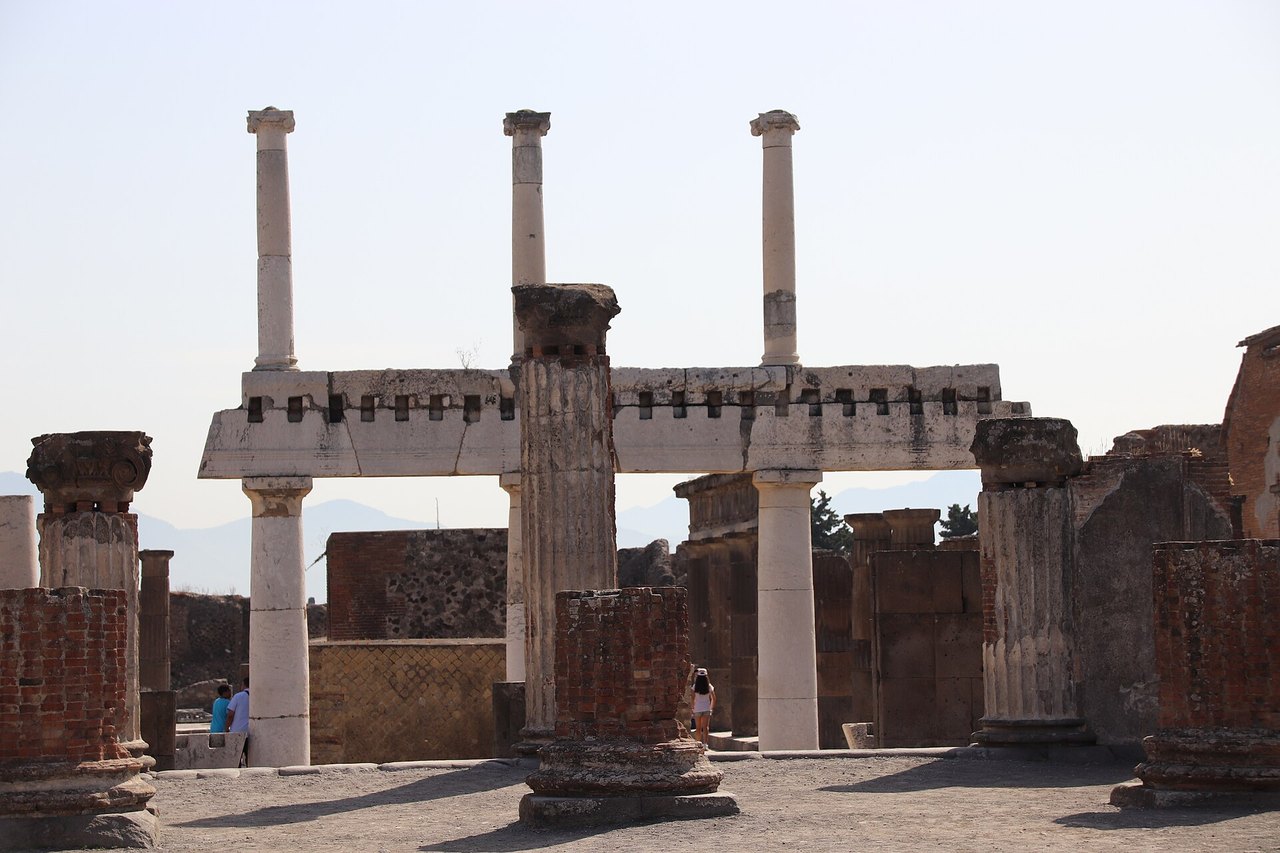
The Forum buildings are described by Adams with a precision that fixes their scale against the open space they served. The temple is measured in part by its Doric columns, which stand about 12 feet in height, and by the cella, whose area is given as about 42 feet by 28 feet 6 inches. These figures are modest, and Adams presents them as the terms on which the sacred building may be understood within the Forum's enclosure. 1
The basilica, by contrast, is the largest of the Forum structures in Adams's account, extending 220 feet in length by 80 feet in breadth. Its proportions mark it out as a building of public assembly rather than worship, and the dimensions are offered as the measure of its importance among the buildings around the square. In consequence the basilica dominates the Forum in extent, and the reader is led to see the commercial and judicial life of the city as occupying a space of considerable scale. 1
The building of Eumachia is smaller, 130 feet long and 65 feet broad, and Adams records it as a distinct structure within the same group. Its dimensions place it between the temple and the basilica in size, and the account treats it as one of the principal monuments of the Forum rather than as a subordinate annex. The three buildings together, therefore, give the Forum its architectural character, each with its own measured extent. 1
Adams's concern with these dimensions is not mere antiquarian inventory. By giving the length and breadth of the basilica and the building of Eumachia, and the area of the temple's cella, he allows the reader to grasp the relative scale of the public buildings that framed the civic centre. The figures are set down as the basis for understanding how the Forum was organised, and the buildings are presented as parts of a single architectural scheme rather than as isolated ruins. 1
4. The Amphitheatre
The amphitheatre at Pompeii is measured by Adams along its two axes, the major axis running 430 feet and the minor axis 335 feet. These are the terms on which he establishes the scale of the building, and they serve to place it among the largest structures of the city. By giving both dimensions rather than a single figure, Adams conveys the oval plan of the arena and the seating that surrounded it, so that the reader may form a clear conception of the whole. 1
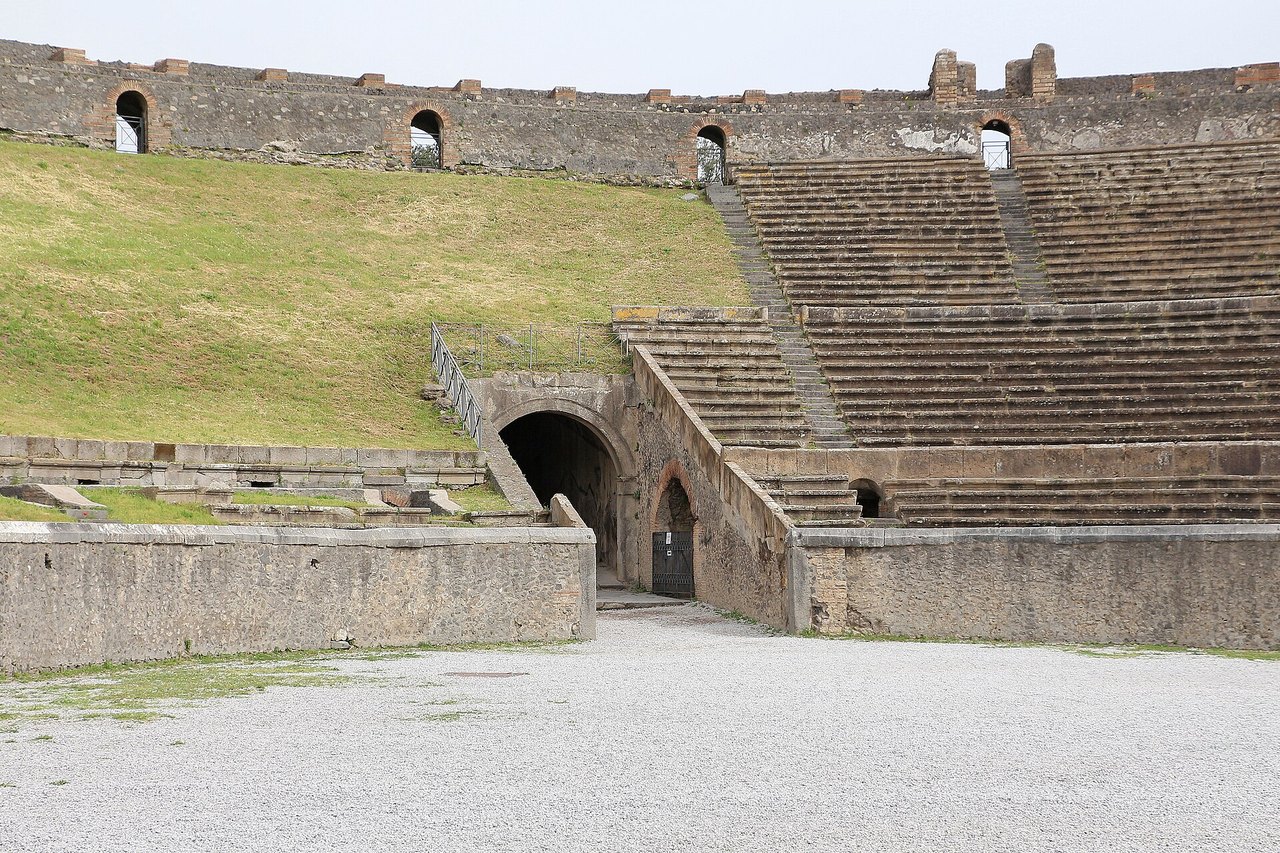
The comparison with the Colosseum is drawn explicitly, and it is a comparison of magnitude rather than of kind. Adams records that the corresponding dimensions at Pompeii are 190 and 178 feet respectively, less than that of the Coliseum. The contrast is instructive: the provincial amphitheatre, though substantial, is shown to fall short of the great metropolitan building, and the reader is invited to measure Pompeii against Rome. In consequence the building takes its place within a wider architectural order, its size understood not in isolation but in relation to the most famous of all amphitheatres. 1
Adams's method throughout is to let measurement carry the argument. The axes of the amphitheatre and the comparison with the Colosseum together establish a sense of proportion, and the figures are set down as the basis for judging how the city's public buildings stood in relation to one another and to the capital. The amphitheatre is thus presented as a monument whose interest lies in its measured extent and in what that extent reveals about the ambitions of a provincial town. 1
5. Burial and Rediscovery
The cities of the Campanian plain are fixed by Adams in relation to one another and to Naples, and this geography prepares the ground for the account of their burial and rediscovery. Herculaneum lies about four miles from Naples, while Pompeii stands on the right bank of the Sarno, six miles from Herculaneum, and Stabiae is placed between four and five miles from Pompeii. These distances establish the compact setting of the cities that were overwhelmed together, and they allow the reader to understand that the disaster overtook a populated district rather than an isolated town. 1
Pompeii's own history before the catastrophe is touched upon in the mention of Sulla's colony, settled with a body of his veterans. The detail serves to remind the reader that the city had already been remade once by Roman power before it was lost, and that the ruins later uncovered belonged to a place with a political as well as an architectural past. 1
The depth at which the remains were found is given by Adams as ninety feet, a figure that conveys the scale of the material that had accumulated above the buried city. It is this depth that explains why the place passed out of memory and why its recovery was a work of excavation rather than of simple discovery. The streets and buildings described in the preceding pages, from the width of the thoroughfares to the colonnades, were therefore brought to light only after the removal of a considerable overburden, and the reader is invited to measure the labour of rediscovery against the extent of what was recovered. 1
Adams's account thus moves from the geographical setting of the cities to the historical circumstance of Pompeii's colonisation and finally to the physical conditions of its burial. The distances between the Campanian towns, the colony of veterans, and the depth of the deposit together frame the rediscovery as the recovery of a known place from a known depth, and the ruins are presented as the surviving record of a city whose position and whose past were both precisely fixed. 1
6. Key Facts
| Attribute | Value |
|---|---|
| Widest street | does not exceed 93 English feet 1 |
| The basilica | 220 feet in length by 80 feet in breadth 1 |
| Building of Eumachia | 130 feet long, and 65 feet broad 1 |
| Amphitheatre axes | 430 feet; the minor axis, 335 feet 1 |
| Site of Pompeii | on the right bank of the Sarno, six miles from Herculaneum 1 |
| Depth of the 1684 well | at a depth of ninety feet 1 |
7. Frequently asked questions
Where did Pompeii stand?
On the right bank of the Sarno, six miles from Herculaneum and about four miles from Naples. 1
How wide were its streets?
The widest, including the side footway, did not exceed 93 English feet. 1
How large is the amphitheatre?
Its major axis is 430 feet and its minor 335, smaller than the Colosseum by 190 and 178 feet. 1
How was the city found again?
In 1684 a baker at Portici sank a well that reached, at ninety feet, near the stage of the Herculaneum theatre. 1
8. Timeline
- 80 BCESulla settles a colony of veterans in the town.Sulla settles a colony of veterans in the town.
- 79Vesuvius buries Pompeii and Herculaneum.Vesuvius buries Pompeii and Herculaneum.
- 1684A well at Portici strikes the Herculaneum theatre at ninety feet.A well at Portici strikes the Herculaneum theatre at ninety feet.
- 1881Adams publishes his account of the two buried cities.Adams publishes his account of the two buried cities.
References (1)
- 1Pompeii and Herculaneum, the buried cities of Campania: their history, their destruction, and their remains — T. Nelson and Sons, London (via Internet Archive) Archive↩View source