Quail
The plumage, the call and the sea crossing, from a Victorian dictionary.
Newton's Dictionary of Birds describes the quail's plumage feather by feather, its call, its exhaustion over the sea, the old English method of netting it, and the species it is related to.
Overview
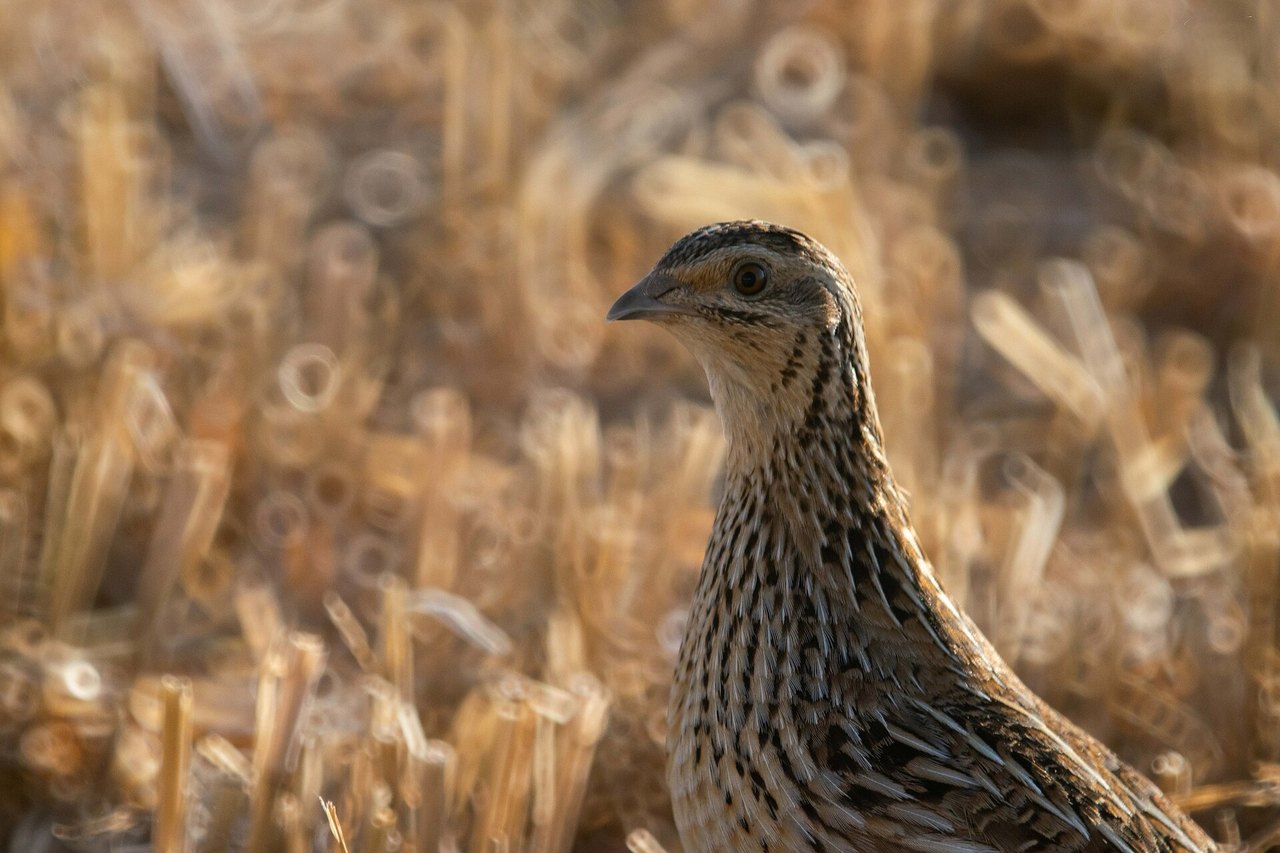
The quail of Newton's Dictionary of Birds is a small game bird whose appearance is defined by the transverse barring of its upper parts, the reddish-brown ground being broken on almost every feather by patches of dark brown. The head carries three longitudinal streaks of ochreous-white, a marking that runs lengthwise against the crosswise patterning of the body. Newton observes that the variation within the bird is rather individual than attributable to local causes, so that differences among birds are to be read as the peculiarities of single specimens rather than as the signatures of region. 1A Dictionary of Birds · Adam and Charles Black, London (via Internet Archive) ↗
Country people knew the quail by a name that belongs to the book of Exodus, for Newton holds it generally admitted that the bird so called in that narrative is the one intended by its author. The identification carries the common name back to scriptural usage, and it is in this sense that the bird entered the speech of the countryside rather than in any name of merely local invention. 1
The bird's habits gave it a further place in rural practice. In England quails were taken in a net, attracted thereto by means of a Quail-call, so that the capture of the bird depended on the imitation of its voice. The same migratory impulse that brought the birds within reach of the netter also carried them over water, and on transmarine voyages they frequently drop exhausted into the sea. The quail, therefore, is an object of the fowler's craft and of the naturalist's notice at once, a bird whose movements across land and sea are as characteristic of it as the barring of its plumage. 1
Beyond the bird itself, Newton's account extends to the genus Coturnix, of which five or six other species are recognised, and to the closely allied Turnix, which comprises a score of species or perhaps more. It is characteristic of Turnix to want the hind toe, a structural mark that separates it from the true quails. The restricted genus and its near relative thus stand as two groups distinguished by the details of their form, the one familiar to country people under a name drawn from Exodus, the other known chiefly through the number of its species and the absence of a single toe. 1
1. Plumage
The colouring of the quail is described by Newton in terms of the individual feather rather than of broad areas of colour, and it is this minute attention that gives the description its character. Above, the bird is reddish-brown, and almost each feather is transversely patched with dark brown, so that the upper parts present a surface broken at short intervals by crosswise bars. The effect is not one of uniform ground varied here and there, but of a pattern repeated on feather after feather, each contributing its own dark patch to the whole. 1
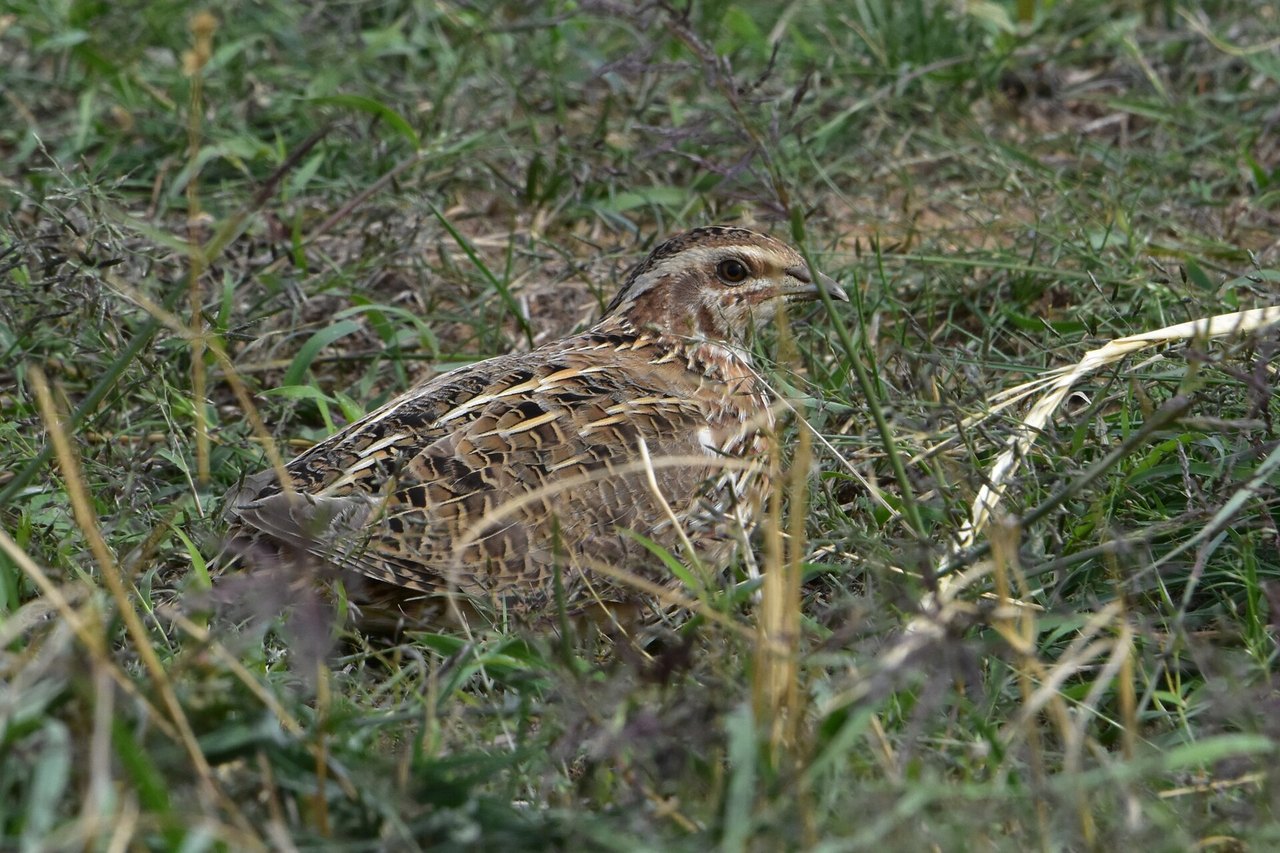
Against this crosswise patterning the head sets a marking of a different order. Three longitudinal streaks of ochreous-white run lengthwise upon it, and their direction is therefore at right angles, as it were, to the transverse barring of the body. The contrast is one of orientation as much as of colour: the pale streaks of the head lie along the bird, while the dark patches of the back lie across it. 1
Newton is careful to qualify the constancy of these markings. The variation to be observed is rather individual than attributable to local causes, so that the differences among quails are not to be read as the signatures of region. A bird from one district is not thereby distinguishable by its plumage from a bird of another; the departures from the common type belong to single specimens, and the naturalist who would classify them by locality will look in vain for a governing rule. 1
The description is thus at once exact and restrained. Newton gives the reddish-brown ground and the dark transverse patches of the upper parts, the three pale streaks of the head, and the individual character of the variation, and he goes no further than the feathers themselves will warrant. It is the plumage as it may be seen feather by feather, and not the plumage as a badge of place, that his account sets before the reader. 1
2. Variation
The variation Newton records in the quail is of a modest and scattered kind, and he is concerned above all to say what it is not. It is rather individual than attributable to local causes. The differences that appear among quails are therefore not to be read as the signatures of region; a bird from one district is not thereby distinguishable by its plumage from a bird of another. The departures from the common type belong to single specimens, and the naturalist who would sort them by locality will look in vain for a governing rule. In consequence the species presents no geographical varieties of the kind that so often divide a widely ranging bird into recognisable races, and the student who compares a series must reckon each aberrant bird on its own account rather than as the representative of a place. 1
This individual character of the variation stands in contrast with the fixity of the markings themselves, which Newton describes feather by feather. Above, the bird is reddish-brown, and almost each feather is transversely patched with dark brown, so that the upper parts present a surface broken at short intervals by crosswise bars. Upon the head, by a different orientation, run three longitudinal streaks of ochreous-white. The pattern is thus repeated on feather after feather with great constancy, and the variation of which Newton speaks is a departure from a type that is itself sharply defined, not a looseness pervading the whole plumage. 1
The causes to which such variation might be ascribed are dismissed rather than explored. Newton does not attribute the differences to climate, to soil, or to the influence of locality upon the race; he assigns them to the individual alone. The point is stated briefly and without elaboration, and it serves chiefly to clear the ground, leaving the reader with a bird whose appearance is remarkably uniform in its plan and variable only in the persons of single examples. 1
Beyond the quail proper, the group to which it belongs is itself small, comprising five or six other species of the restricted genus Coturnix, so that the close comparison of many forms which might tempt a naturalist to seek local causes of variation is here wanting. The quail, in Newton's account, is a bird whose markings are constant in design and whose differences are the property of individuals. 1
3. Migration
The quail's journeys are not confined to dry land, and Newton records that in its transmarine voyages the bird frequently drops exhausted into the sea. The crossing of water is thus the occasion of a characteristic and repeated loss, in which birds already spent by flight fall upon the surface and are lost. The fact is stated plainly, without elaboration of route or season, but it fixes the character of the quail's migration as something more hazardous than a movement over country: the sea is a stage of the passage on which the bird's strength gives out. 1
What renders the sea crossing notable is that the quail is elsewhere a bird that may be taken by artifice on land. Newton notes that quails were taken in England in a net, attracted thereto by means of a Quail-call. The same bird that can be drawn to a call and captured in a net in an English field is, over water, reduced to a condition in which it falls into the sea from exhaustion. The two facts sit together in Newton's account as the two extremes of the bird's condition: the one showing it responsive and easily decoyed, the other showing it spent and helpless. 1
The migration is further connected, in Newton's account, with the bird of the book of Exodus, the quail of that narrative being generally admitted to be the bird intended by the author. The identification is offered as one generally accepted rather than as Newton's own argument, and it associates the species with a celebrated passage of a host through country rather than with the perils of the deep. The natural history of the bird, however, is not exhausted by that association, and the record of birds dropping into the sea stands as the observation of the naturalist rather than the language of the text. 1
In consequence the quail is presented as a bird whose movements carry it beyond the land of its ordinary occurrence, and whose powers are sometimes insufficient for the water it must cross. The loss over the sea is not treated as exceptional; Newton's word is that the bird frequently drops exhausted, and the adverb gives the occurrence the weight of a recurring feature of the passage. The migration of the quail, so described, is a movement attended by a known and repeated cost. 1
4. Catching Quail
The old English method of taking quail depended on the bird's responsiveness to sound. Newton records that quails were taken in England in a net, attracted thereto by means of a Quail-call. The practice thus joined two instruments, a net and a call, and rested on the readiness of the bird to answer a summons it took for the voice of its own kind. The call drew the quail within reach of the net, and the net completed what the call had begun. In this account the capture is not a matter of pursuit or of the gun, but of decoy, and the bird's own sociable instinct is the means of its taking. 1
Set beside the record of the sea passage, the netting establishes the range of the bird's condition as Newton presents it. The quail that comes to a call and is taken in an English field is the same bird that, over water, drops exhausted into the sea. The one account shows it responsive and easily drawn; the other shows it spent and helpless. Newton offers no reconciliation of the two, and none is needed: the facts describe a bird whose powers serve it on land and fail it on the deep, and the old method of capture exploits precisely the faculty that makes it gregarious. 1
The method belongs to England, and Newton states it as an English practice, without extending it to other countries or describing its regulation. It is given as a fact of the bird's history rather than as a custom requiring explanation, and it takes its place among the observations by which the species is known. The Quail-call and the net are named as the means, and the attraction of the bird to the call is the operative circumstance on which the whole practice turns. 1
In consequence the account of the quail in Newton's Dictionary holds together two aspects of a single nature: a bird that may be summoned and netted on land, and a bird that in its crossings of the sea is frequently lost. The capture by call and net is the human use of the bird's own habit, and it stands in the record beside the natural hazard of the passage as evidence of how the quail behaves among its kind and how it fares when the land is left behind. 1
5. Kinds of Quail
The restricted genus Coturnix, which contains the true quails, is not large. Newton allows five or six other species besides the bird already described, so that the group is compact and its members closely comparable. Within it the plumage follows a consistent plan: reddish-brown above, with almost each feather transversely patched with dark brown, and the head marked by three longitudinal streaks of ochreous-white. These characters are given as belonging to the genus rather than to any one locality, for Newton observes that the variation is rather individual than attributable to local causes. The differences between one bird and another are therefore differences of the individual, not the impress of place, and the several species are to be distinguished by other means than the colour of the country they inhabit. 1
Distinct from these are the hemipodes, placed in the genus Turnix, which Newton reckons at a score of species or perhaps more. Their distinguishing mark is structural rather than chromatic: it is characteristic of this genus to want the hind toe. The absence of that toe separates them at once from the true quails, and the genus is accordingly a large one, its species numerous though its members are thus plainly set apart. 1
The two groups are therefore to be understood by different signs. In Coturnix the systematist reads the transverse patching of the feathers and the streaked head, and finds the variation individual rather than local; in Turnix he has a single conspicuous character of structure, the missing hind toe, by which the genus is known. The one is a small group defined by the detail of its plumage, the other a numerous group defined by what it lacks. 1
6. Key Facts
| Attribute | Value |
|---|---|
| Upper plumage | reddish-brown above, almost each feather being transversely patched with dark brown 1 |
| Head markings | three longitudinal streaks of ochreous-white 1 |
| Variation | the variation is rather individual than attributable to local causes 1 |
| Other species of Coturnix | Five or six other species of the restricted genus Coturnix 1 |
| Hemipodes | It is characteristic of this genus to want the hind toe 1 |
| Over water | transmarine voyages frequently drop exhausted into the sea 1 |
7. Frequently asked questions
What does the quail look like?
Reddish-brown above, nearly every feather patched transversely with dark brown, the head dark brown with three ochre-white streaks. 1
Does the quail vary much?
It varies, but the variation is individual rather than caused by locality. 1
How was quail caught in England?
With a net, the birds being drawn to it by a quail-call whose notes were easily imitated. 1
What happens to quail over the sea?
On transmarine voyages they frequently drop exhausted into the sea or onto any vessel in their way. 1
8. Timeline
- 1893Newton publishes A Dictionary of Birds.Newton publishes A Dictionary of Birds.
References (1)
- 1A Dictionary of Birds — Adam and Charles Black, London (via Internet Archive) Archive↩View source