Coast Redwood
The tallest trees on Earth, surviving on fog, thick bark and shared roots in a narrow strip of Pacific coast.
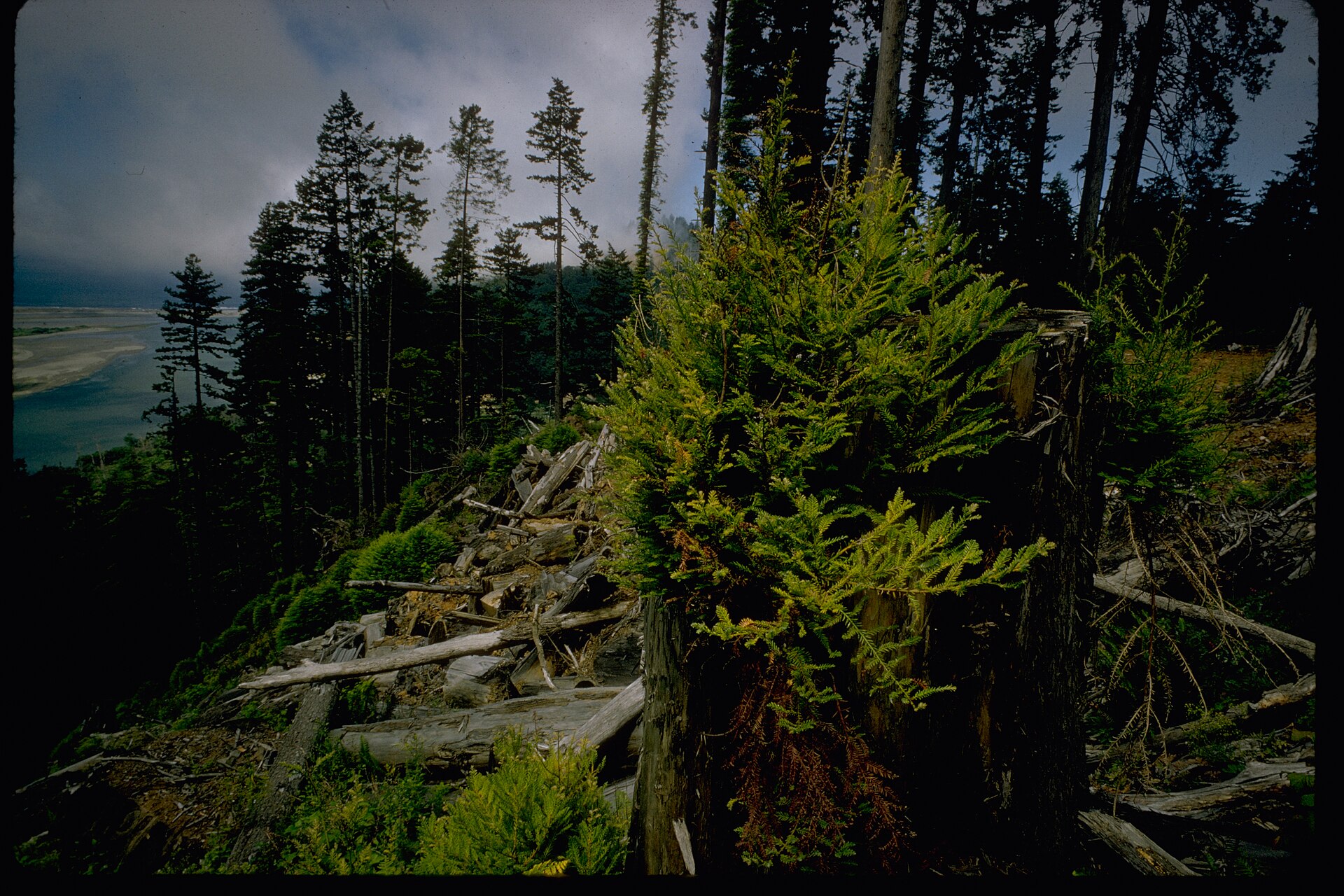
The coast redwood (Sequoia sempervirens) is the sole living species of its genus and the tallest tree species on Earth, with the record tree Hyperion measured at 116.22 metres. It grows in a narrow band along the Pacific coast from central California to south-western Oregon, where summer fog supplies nearly 40 percent of its water through the canopy. Its fibrous bark, which can exceed 30 centimetres in thickness, and its tannin-rich wood make mature trees highly fire-resistant. Before logging began in the 1850s the species covered roughly 810,000 hectares; only about 4 percent of the original old-growth forest survives, much of it within Redwood National and State Parks.
In this article
- 1Overview
- 2Description and Size
- 3Roots, Water and Fog
- 4Discovery and Measurement of the Tallest Trees
- 5Height Records and Measurement Figures
- 6Ecology of the Canopy
- 7Fire, Disturbance and Cultural Burning
- 8Chronology
- 9Dendrochronology
- 10Frequently Asked Questions
- 11Timeline
- 12Frequently asked questions
- 13Knowledge graph
Overview
The coast redwood is known scientifically as Sequoia sempervirens and is the sole living species of the genus Sequoia within the cypress family Cupressaceae. Its native range is a narrow Pacific coastal band running from central California to south-western Oregon. The species has produced the tallest living trees on Earth.
1. Description and Size
Mature coast redwoods typically reach 60–100 m (200–330 ft) in height. The tallest tree confirmed in the record is Hyperion, measured in 2006 at 379.1 ft (115.5 m). Trunks can grow to a maximum diameter of up to 8.9 m (29 ft) at breast height. Models of the species' limits suggest a theoretical maximum height of 122–130 m barring mechanical damage.
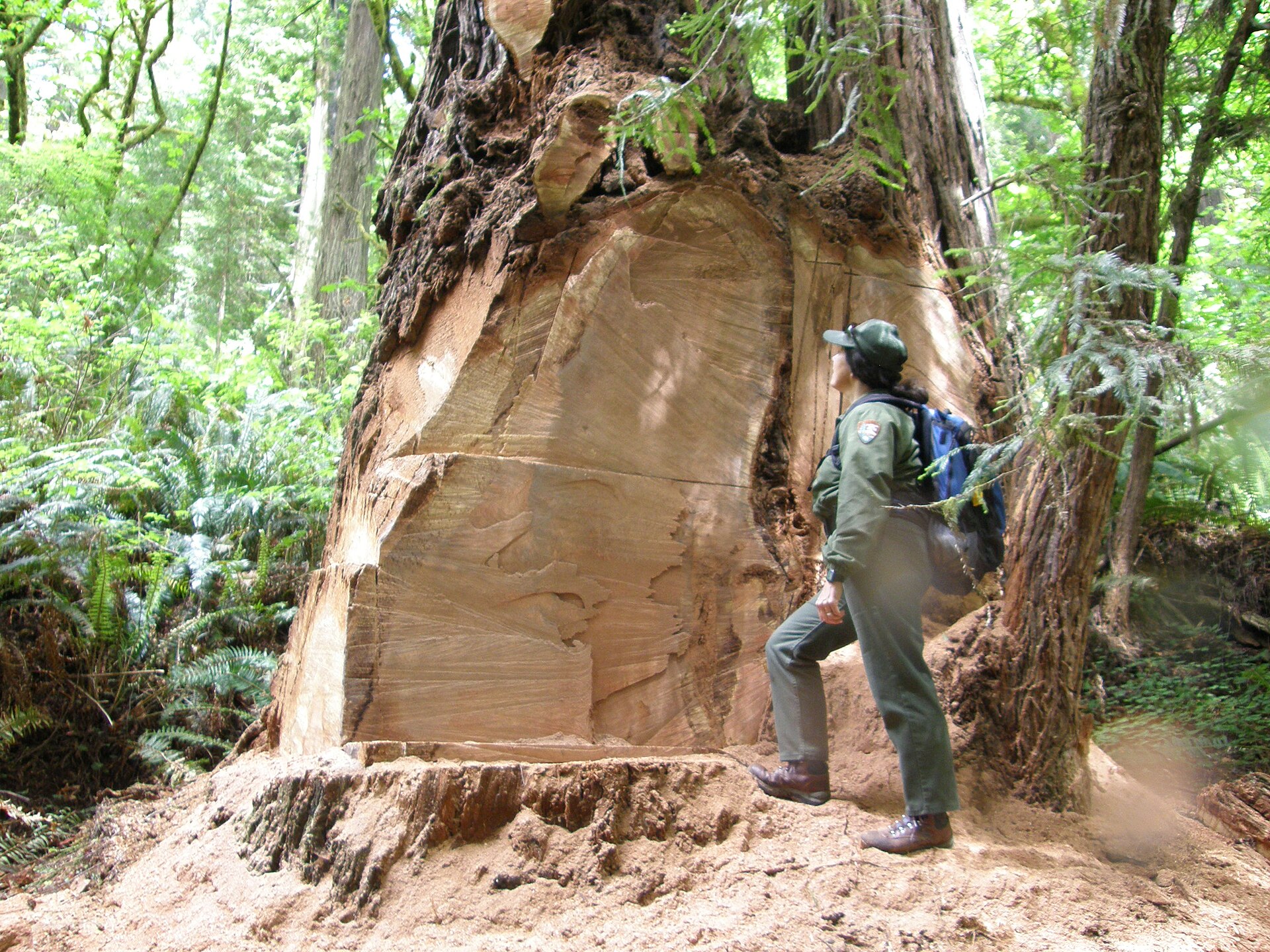
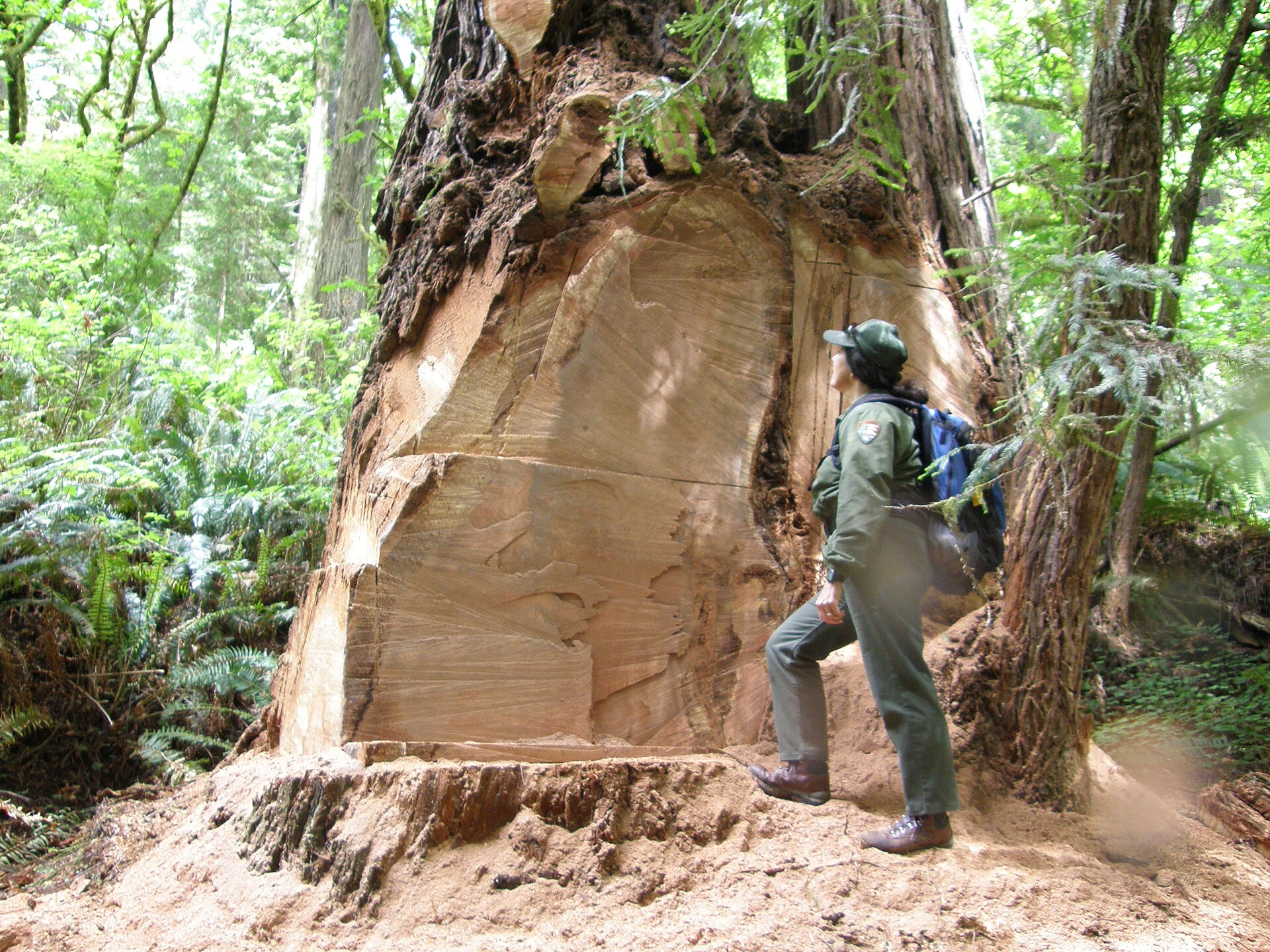
The bark of a mature tree may be up to about 35 cm (1.15 ft) thick, and the National Park Service cites a figure of about 12 in (30 cm). This thick bark, together with foliage held high above the ground, shields mature redwoods from all but the hottest fires. The wood itself lacks flammable pitch or resin, adding to the tree's resistance. Its high tannin content suppresses decay and repels pests, so that diseases of the coast redwood are virtually unknown and insect damage is insignificant. Because of these defenses, windthrow rather than fire or disease is the main cause of natural death in mature trees.
2. Roots, Water and Fog
The coast redwood anchors itself without a taproot. Its roots descend only a short distance before turning outward, spreading horizontally to interlace with the roots of neighbouring trees and forming a shared network that steadies the stand against wind and slope. Water reaches these trees by more than one route. Because lifting water through a column of great height is physiologically difficult, redwoods evolved the capacity to absorb moisture directly through their leaves and bark as well as through their roots. The forest floor itself is a demanding substrate: the subsoils are highly weathered and nutrient-poor, so the ecosystem depends on rapid nutrient cycling in the topsoil together with abundant rainfall and fog.
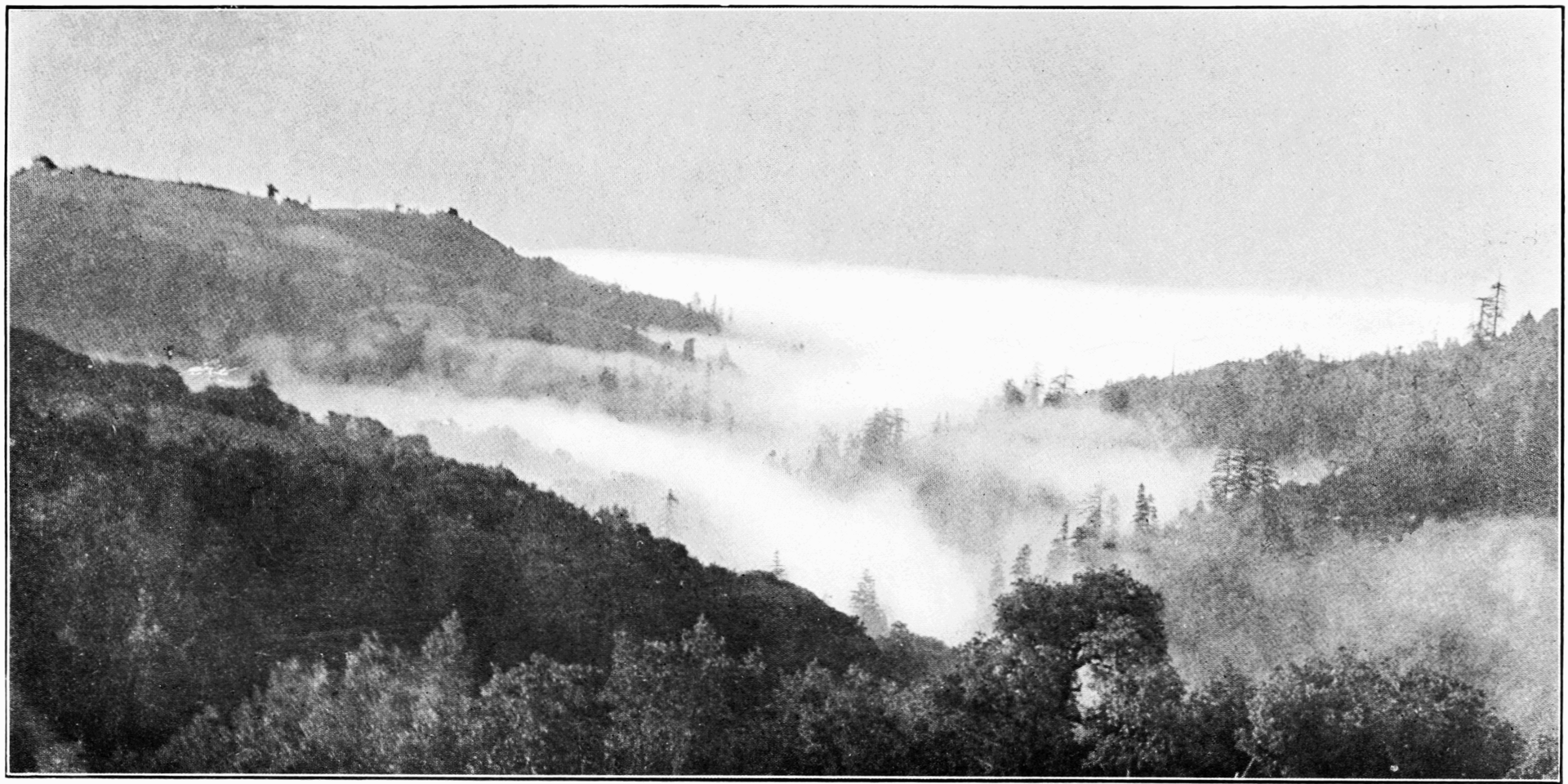
Fog is central to redwood ecology rather than incidental to it. Summer fog reduces evaporation from the trees and from the ground, and the drip it sheds raises soil moisture through the dry season. When fog condenses on redwood foliage part of the water is absorbed directly by the tree, while the remainder drips to the forest floor and is taken up by the roots. By stripping water directly from fog through stomata at every level of the canopy, redwoods obtain nearly 40 percent of their water uptake during the dry summer. Work by UC Berkeley ecologist Todd Dawson indicates that summer fog can supply 30 percent or more of the annual water intake of a coast redwood, the water that allows the species to grow past 300 feet.
The fog itself is a seasonal product of the coast. It forms from May through October when cold, upwelled ocean water meets warm moist air offshore, condensing vapour into droplets that inland valley heat then draws ashore. Dawson's data further show that continuous redwood forest makes its own weather: the trees cool and still the air and their drip raises humidity, so cleared land would be warmer and less foggy. The record of that fog is not stable. A 2010 study coauthored by Dawson found coastal fog fell 33 percent over the 1951 to 2008 period, and continuing work indicates a further 7 percent decline over the following 14 years. In warmer parts of the range with less fog, researchers have already observed redwood crowns thinning, unhealthy but not yet dying.
Height and water are bound together in the species' biology. The leading hypothesis for why trees stop growing taller is that water transport becomes constrained as height increases, which then cuts leaf photosynthesis. Height itself limits further height growth: gravity and the sheer path length of the water column raise leaf water stress enough to constrain leaf expansion and photosynthesis even where soil moisture is ample.
Water management in redwood country is also a matter of deliberate practice. The Yurok hold that burning brings more water, an empirical rule they have applied since time immemorial and now test with USGS soil-moisture sensors. By limiting excessive tree growth, prescribed burns reduce demand on the water table, which raises surface flow and keeps soil moisture longer into the dry season. Paired Yurok and USGS teams place soil moisture sensors that track how fast water evaporates, infiltrates or is taken up by plants in burned and unburned ground.
Age, Growth and Limits.
Maximum recorded age for coast redwood is about 2,000 years while mature trees average 500 to 700 years. Height growth is limited because gravity and water-column path length raise leaf water stress, constraining leaf expansion and photosynthesis. Regressions put the ceiling at 122–130 m absent mechanical damage.
The genome is hexaploid (2n = 66) at about 26.5 gigabases. Reproduction is largely asexual via basal burls that sprout new growth with its own root system. Windthrow, not fire or disease, is the main natural cause of death in mature trees.
Distribution and Remnant Forest.
The historic range of the coast redwood covered about 810,000 ha before the 1850s. What survives today forms a band roughly 750 km long and 8 to 75 km wide. The southernmost grove lies in Monterey County and the northernmost in extreme south-western Oregon.
Old-growth stands are now a small fraction of the whole. The National Park Service puts the remaining old growth at about 4 percent while Save the Redwoods League gives a figure of about 5 percent. Protection is unevenly distributed: about 75 percent of the remnant old growth is protected but only 29 percent of all redwood forest is protected. Second-growth stands grow so dense that thinning is used to restore the survivors.
3. Discovery and Measurement of the Tallest Trees
The tallest living tree known to science is Hyperion, which stands at 116.22 metres and was found in Redwood National Park in mid-2006 by Chris Atkins and Michael Taylor. Formal measurement and verification came two years later from Stephen Sillett, whose climb of the tree was held back for two weeks by a restriction protecting nesting marbled murrelets. The delay points to a methodological problem at the heart of the field: laser range finders are accurate devices, but they cannot always sight a tree's highest leaf from the ground. Laser figures therefore remain provisional until confirmed by climbing. The accurate method is to climb the tree and lower a tape.
Atkins, Sillett and Taylor set out to document every living redwood over 350 ft. The survey found 136 such trees, against about 25 known when the work began in the 1990s. Hyperion's position on a steep slope surprised researchers, since most giants root in creek bottoms. The tree stands in the Redwood Creek basin, which was thoroughly logged during the 1970s until the 1978 boundary expansion of Redwood National Park stopped the cutting.
4. Height Records and Measurement Figures
The tallest living coast redwood on record is Hyperion, measured at 116.22 metres1Sequoia sempervirens · Wikipedia ↗. The tree was found in Redwood National Park in mid-2006 by Chris Atkins and Michael Taylor1. A separate confirmation of the tree in 2006 placed its height at 379.1 ft (115.5 m)1. The Nature study recorded Hyperion in 2006 at 112.7 m3The limits to tree height · Nature (Koch et al., vol. 428) ↗.
The physical ceiling for redwood height has been estimated through regressions on how leaf traits change with height3. Absent mechanical damage, those regressions put the maximum at 122 to 130 m3. That figure sits close to the tallest trees recorded historically3.
By trunk volume the largest known living coast redwood is Grogan's Fault, found in Redwood National Park in 2014 by Chris Atkins and Mario Vaden1. Its trunk volume is at least 1,084.5 m³1.
Height records also extend to the animals that inhabit the canopy: the wandering salamander has been documented more than 150 ft above ground9Skydiving salamanders live in world's tallest trees · UC Berkeley News ↗.
| Figure | Value | Source note |
|---|---|---|
| Hyperion | 116.22 m (381.3 ft) | Tallest living coast redwood; found in Redwood National Park in mid-2006 by Chris Atkins and Michael Taylor1 |
| Hyperion, confirmed 2006 | 379.1 ft (115.5 m) | Separate 2006 confirmation of the tree's height1 |
| Hyperion, Nature study 2006 | 112.7 m | Height recorded in the Nature study3 |
| Theoretical maximum | 122–130 m | Regressions on leaf-trait change with height, absent mechanical damage3 |
| Grogan's Fault | at least 1,084.5 m³ trunk volume | Largest known living coast redwood by trunk volume; found in Redwood National Park in 2014 by Chris Atkins and Mario Vaden1 |
5. Ecology of the Canopy
The crown of an old-growth coast redwood is not empty air but a habitat in its own right. More than 70 plant species have been documented growing in the canopy, sharing the upper forest with wandering salamanders and flying squirrels. Stephen Sillett's first climbs brought back reports of soil accumulations hundreds of feet above the ground, with salamanders living inside them, and of ferns, shrubs and trees rooted on giant limbs like hanging gardens.
The wandering salamander (Aneides vagrans) is about 4 in (10 cm) long and spends its entire life in crowns more than 150 ft above ground. High-speed video shows the animal parachuting and gliding during falls, and wind-tunnel trials show arboreal salamanders manoeuvring in the air where ground-dwelling species merely flail. To study such animals biologists climb with ropes and ascenders, capturing, marking and tracking them among the limbs.
The canopy also draws birds from the sea. Marbled murrelets are primarily seabirds, yet they will fly up to 50 miles inland to lay a single egg on a large limb of an old-growth redwood.
The fertility of these forests rests on a narrow layer. Redwood forests depend on rapid nutrient cycling in the topsoil together with abundant rainfall and fog, because the subsoils beneath are highly weathered and nutrient-poor.
6. Fire, Disturbance and Cultural Burning
The coast redwood survives fire through structure as much as through luck. Thick bark and foliage held high on the trunk shield mature trees from all but the hottest fires, and basal burls resprout after fire, cutting or toppling. The regenerative capacity of the species was measured directly after the CZU fire: radiocarbon dating of post-fire sprouts showed Big Basin redwoods built new leaves on carbon reserves more than 50 years old, drawn from buds dormant under the bark for centuries. Species that cannot resprout fared far worse in the same event, with Douglas-fir suffering nearly 100 percent mortality.
The CZU Lightning Complex Fire began on 16 August 2020 and burned 35,009 ha (86,509 acres), destroying 1,450 structures before it was contained on 22 September 2020. It burned more than 97 percent of Big Basin's 7,366-hectare forest, a park founded in 1902, at an intensity not documented in most groves for at least a century. The unusual intensity of the fire, followed by two successive years of extreme drought and summer heat, severely damaged most of the old-growth trees in Big Basin Redwoods State Park.
Fire also returns as a deliberate practice. Tolowa Dee-ni' cultural burning came back to Peacock Bar on the Smith River inside Jedediah Smith Redwoods State Park on 21 October 2025, covering about 10 acres of oak woodland and mixed conifer. It was the first such burning since the removals of the 1850s and the park's creation in 1929, run by Tolowa staff and citizens with state and federal support. Seasonal burning promotes basket, medicine and food plants, keeps foraging space open and cuts catastrophic fire and pest risk.
The ecological effects of such burning are under formal study. USGS and Yurok Tribe scientists are jointly investigating how culturally prescribed fires change vegetation and soil moisture on Yurok ancestral lands in north-western California. The work tests the Yurok rule that burning brings more water, using soil-moisture sensors in burned and unburned ground. Limiting excessive tree growth reduces demand on the water table and keeps soil moisture longer into the dry season.
Redwood National and State Parks combines one national park and three California state parks across about 139,000 acres in Del Norte and Humboldt counties. The North Coast region around the parks is the most seismically active region of the United States, where three tectonic plates meet at the Mendocino triple junction.
Despite a destructive fire season elsewhere in northern California, Redwood National Park completed six prescribed fires covering 840 acres early in the 2019 fiscal year.
7. Chronology
- 1824First descriptionDavid Don describes the coast redwood as Taxodium sempervirens in a work on the genus Pinus.1
- 23 years laterGenus Sequoia erectedStephan Endlicher establishes the genus Sequoia.1
- 21 October 2025Tolowa fire practices returnTraditional burning returns to See-tr'ee-ghin-dvm-dvn (Peacock Bar) on the mainstem Smith River inside Jedediah Smith Redwoods State Park.13Tolowa Dee-ni' Nation and California State Parks Return Cultural Burning to See-tr'ee-ghin-dvm-dvn Jedediah Smith Redwoods SP · California Department of Parks and Recreation ↗
8. Dendrochronology
Reading the rings of coast redwood requires reaching wood high in the canopy rather than sampling only the base of the trunk. Researchers climbed standing trees and cored trunks at several heights across 14 old-growth sites, taking 1,466 series and 483,712 annual rings from 120 trees.
The resulting crossdated redwood chronologies now extend up to 1,685 years for coast redwood, compared with 1,538 years for giant sequoia at the sites studied. The comparison places the two species side by side in the same body of work, with the redwood record reaching further back in time than the sequoia record at these locations.
The difficulty of the species lies in its ring structure. Although the decay-resistant wood of giant sequoia helped establish dendrochronology, the rings of coast redwood have proved much harder to decipher, which limits long climate reconstructions from the species. The obstacle is not a shortage of material but the labor required to align ring sequences reliably from tree to tree.
9. Frequently Asked Questions
How tall is the tallest coast redwood?
How much of a redwood's water comes from fog?
Coastal fog supplies roughly 40 percent of a redwood's annual water intake14Redwood National and State Parks · Wikipedia ↗.
How much old-growth redwood forest survives?
Old-growth redwood forest once covered 2 million acres in California and only 4 percent of it remains, much of that inside Redwood National and State Parks4Coast Redwood · U.S. National Park Service, Klamath Inventory & Monitoring Network ↗.
How long have coast redwoods grown along the northern California coast?
The trees have grown along the northern California coast for at least 20 million years14.
10. Timeline
- 1824Redwood given its first scientific nameDavid Don describes the coast redwood as Taxodium sempervirens in Lambert's A description of the genus Pinus.
- 1847The genus Sequoia is erectedStephan Endlicher creates the genus Sequoia in Synopsis coniferarum, giving the species the binomial Sequoia sempervirens.
- c. 1850Industrial logging overtakes the forestCommercial logging and clearing spread through coastal California, beginning the removal of the redwood forests that had developed over millennia.
- 1902California's oldest state park createdBig Basin Redwoods State Park is established in the Santa Cruz Mountains, the first state park in California.
- 1920sState parks established to save the giantsThe Save the Redwoods League helps create Prairie Creek, Del Norte Coast and Jedediah Smith Redwoods State Parks, among others.
- 1929Jedediah Smith Redwoods State Park createdThe park is established on the Smith River in Del Norte County, on land from which Tolowa Dee-ni' people had been forcibly removed since the 1850s.
- 1951–2008Coastal fog begins a long declineSummer fog along the California coast falls by 33 percent over the period covered by the 2010 Dawson study.
- October 2, 1968Redwood National Park createdCongress creates Redwood National Park; the park is expanded by a further 48,000 acres signed by President Jimmy Carter in 1978.
- 1980UNESCO World Heritage designationThe United Nations designates Redwood National and State Parks a World Heritage Site in recognition of the rare ecosystem and cultural history.
- 1990sSystematic search for 350-foot redwoods beginsAtkins, Sillett and Taylor start documenting every living redwood over 350 feet tall, when only about 25 such trees were known.
- Since the early 1990sBald Hills burning programme establishedA long-term commitment to prescribed fire in the Bald Hills has treated 500 to 1,500 acres a year since the early 1990s, plus a shaded fuel break along Bald Hills Road.
- 1994Federal and state parks mergeThe National Park Service and California Department of Parks and Recreation combine the national park with the three adjoining state parks into one administrative unit.
- April 22, 2004The limits to tree height quantifiedKoch, Sillett, Jennings and Davis publish in Nature that leaf water stress caps redwood height at an estimated 122 to 130 m.
- 2006Hyperion discoveredChris Atkins and Michael Taylor find Hyperion in Redwood National Park; it measures 116.22 m and is now the tallest known living tree.
- 2011IUCN lists the coast redwood as endangeredThe International Union for Conservation of Nature names the coast redwood an endangered species.
- 2014Grogan's Fault measuredChris Atkins and Mario Vaden document Grogan's Fault in Redwood National Park, the largest living coast redwood by trunk volume at 1,084.5 m³.
- July 2014Millennium-scale redwood tree-ring chronologyCarroll and Sillett publish crossdated redwood chronologies reaching back up to 1,685 years, from cores taken by climbing 120 trees.
- October 2018Airstrip prescribed fires at Redwood National ParkPark and Forest Service crews complete six prescribed fires totalling 840 acres in the fiscal year that began with the October 2018 burns, including the 50-acre Lower Airstrip Redwood unit.
- August 16 – September 22, 2020CZU Lightning Complex burns Big BasinThe fire burns 35,009 ha (86,509 acres), destroys 1,450 structures and consumes more than 97 percent of Big Basin Redwoods State Park's forest.
- 2022Hyperion location protectedAfter documenting visitor damage to the tree, the Park Service announces fines of up to $5,000 and six months in jail for approaching Hyperion.
- May 23, 2022Wandering salamanders filmed parachutingUC Berkeley researchers publish wind-tunnel video showing arboreal salamanders gliding and parachuting from redwood canopy heights.
- December 1, 2023Ancient buds and old carbon explain fire recoverySave the Redwoods League and Northern Arizona University publish in Nature Plants that Big Basin redwoods resprouted from buds dormant for centuries using carbon reserves more than half a century old.
- October 21, 2025Tolowa cultural burning returns to the Smith RiverTolowa Dee-ni' Nation and California State Parks burn about 10 acres at Peacock Bar in Jedediah Smith Redwoods State Park, the first cultural burn there since the 1850s.
- October 21, 2025Cultural burning recorded on the Smith RiverThe burn at Peacock Bar covered Oregon white oak, tanoak, redwood and hazel used in Tolowa ceremony, under a plan written by park staff and Nation consultants.
11. Frequently asked questions
How long can a coast redwood live?
How much of a redwood's water comes from fog each year?
When was Redwood National and State Parks established, and what recognition has it received?
How much old-growth forest is protected within the parks?
Can a redwood be grown from a seed, and how large does it get?
A coast redwood can grow from a seed no bigger than a tomato seed to 367 feet (112 m) tall with a base 22 feet (7 m) across, the equivalent of a 35-storey skyscraper 5About the Trees · U.S. National Park Service, Redwood National and State Parks ↗. Fossil records show that relatives of today's coast redwoods thrived in the Jurassic, about 160 million years ago 5.
How much carbon does an old-growth redwood forest store?
Acre for acre, ancient coast redwood forest stores more carbon than any other type of forest on the planet 18Coast Redwoods (Sequoia sempervirens) · Save the Redwoods League ↗. Old-growth coast redwoods lock away more carbon per acre than any other forest on Earth, including the Amazon rainforest 10.
References (19)
- 1Sequoia sempervirens — Wikipedia Web↩View source
- 2HSU Prof Confirms World's Tallest Tree — Cal Poly Humboldt (Humboldt State University), News WebView source
- 3The limits to tree height — Nature (Koch et al., vol. 428) Journal↩View source
- 4Coast Redwood — U.S. National Park Service, Klamath Inventory & Monitoring Network Web↩View source
- 5About the Trees — U.S. National Park Service, Redwood National and State Parks Web↩View source
- 6The Science of Redwoods and Fog — Save the Redwoods League WebView source
- 7Natural Features & Ecosystems — U.S. National Park Service, Redwood National and State Parks WebView source
- 8Embers of Wisdom: The Yurok Tribe and USGS Partnership in Culturally Prescribed Fire Management — U.S. Geological Survey WebView source
- 9Skydiving salamanders live in world's tallest trees — UC Berkeley News 2022 Web↩View source
- 107 reasons redwoods are one of America's natural wonders — Save the Redwoods League Web↩View source
- 11Multi-year Research at Big Basin Redwoods State Park Reveals How Old-Growth Coast Redwoods Survive Extreme Wildfire Conditions — Save the Redwoods League (research news release) WebView source
- 12Impacts of the CZU Lightning Complex Fire of August 2020 on the forests of Big Basin Redwoods State Park — California Fish and Wildlife Journal 2020 WebView source
- 13Tolowa Dee-ni' Nation and California State Parks Return Cultural Burning to See-tr'ee-ghin-dvm-dvn Jedediah Smith Redwoods SP — California Department of Parks and Recreation Web↩View source
- 14Redwood National and State Parks — Wikipedia Web↩View source
- 15Redwood National Park - Managing a Landscape with Prescribed Fire in an Era of Increasing Wildland Fire Complexity — U.S. National Park Service, Redwood National Park WebView source
- 16Millennium-Scale Crossdating and Inter-Annual Climate Sensitivities of Standing California Redwoods — PLOS ONE WebView source
- 17NPS Geodiversity Atlas — Redwood National Park and State Parks, California — U.S. National Park Service, Geologic Resources Inventory Web↩View source
- 18Coast Redwoods (Sequoia sempervirens) — Save the Redwoods League Web↩View source
- 19FAQs — Save the Redwoods League WebView source