Bioluminescence
How living organisms make their own light, and why the deep ocean is full of it.
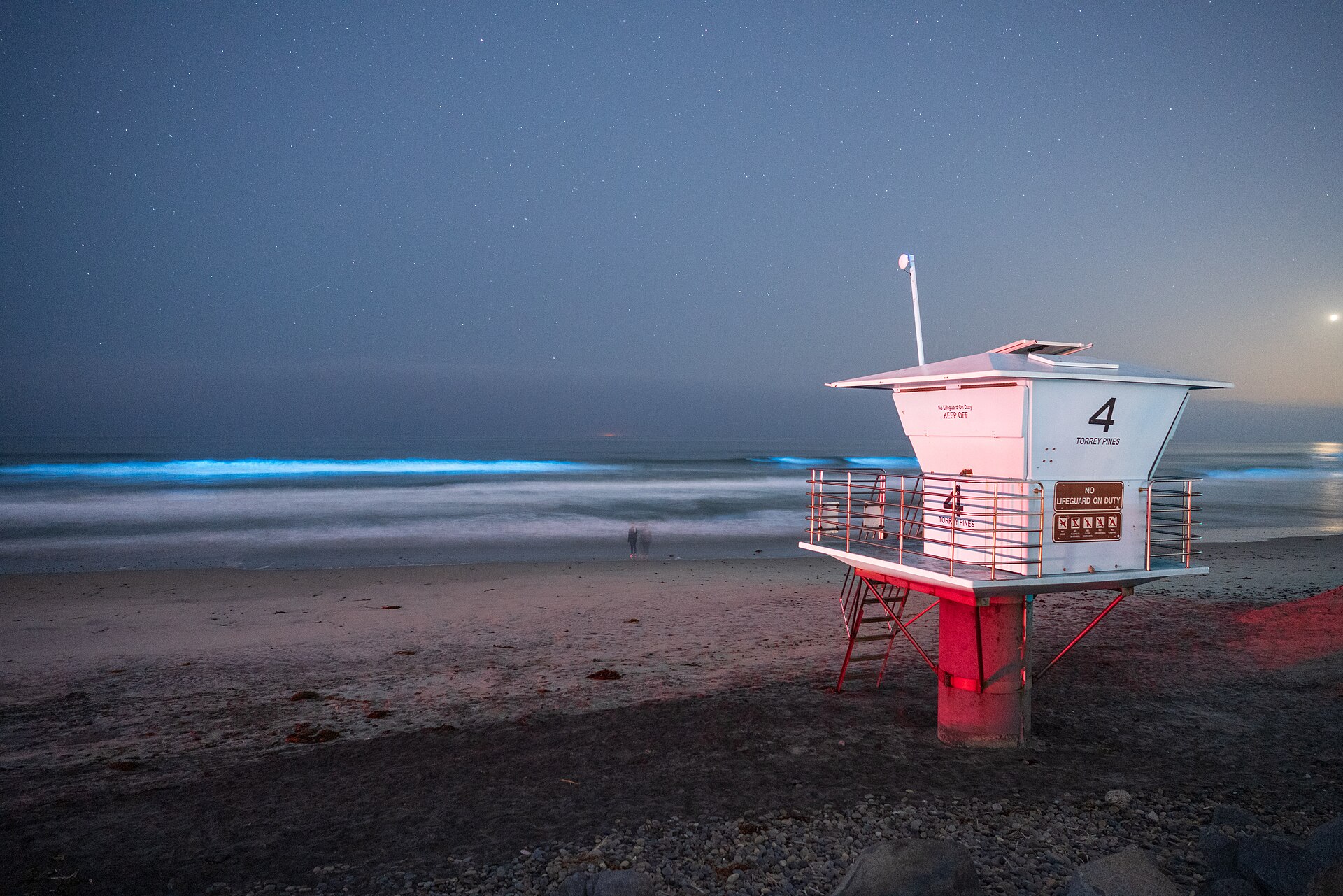
Bioluminescence is the production of light by a living organism through a chemical reaction, and it is the rule rather than the exception in the open ocean. Roughly three quarters of the animals observed in the water column of Monterey Bay can emit light, rising above 97 percent among cnidarians, while fewer than 2.5 percent of coastal species can. The reaction depends on a light-emitting pigment, a luciferin, oxidised by an enzyme, a luciferase, and it has evolved independently at least 94 times.
In this article
- 1Overview
- 2Prevalence in the Ocean
- 3The Monterey Bay Surveys
- 4Diversity and Evolutionary Origins
- 5Chemistry of Light Emission
- 6Luciferase Systems Compared
- 7Colour and Wavelength
- 8Ecological Functions and Symbioses
- 9Research History
- 10Frequently Asked Questions
- 11Timeline: from luciferin to the glowing genome
- 12Frequently asked questions
- 13Knowledge graph
Overview
Bioluminescence is the production and emission of light by a living organism through a chemical reaction. It differs from phosphorescence and fluorescence because it does not need prior absorption of sunlight or other radiation to emit light. The phenomenon is present in at least 14 phyla, most of which have marine species.
Light emission in darkness has been observed in about 10,000 species from 800 genera, and that figure may well be an underestimate. In some groups such as cnidarians nearly all described species produce light. More than 97 percent of cnidarians were bioluminescent, and 9 of the 13 taxonomic categories were bioluminescence-dominant.
The capacity has arisen repeatedly and independently: Lau and Oakley estimated in 2021 that bioluminescence evolved at least 94 times across all taxa and is present in at least 760 genera. It first appeared in octocorals some 540 million years ago. Among fishes about 1,500 species are known to be bioluminescent, a capability that evolved independently at least 27 times, and bioluminescence in fish began at least by the Cretaceous period.
Bioluminescence is very common in the open ocean, where 80 percent of the animals living between 200 and 1,000 metres depth are bioluminescent. It is thought to occur in about 80 percent of the eukaryotic life that inhabits the deep sea below 200 metres. MBARI researchers showed that three quarters of the animals in Monterey Bay waters between the surface and 4,000 metres deep can produce their own light, and seventeen years of video observations showed that 76 percent of observed individuals in the water column have bioluminescence capability.
The distribution is far from uniform across habitats. Fewer than 2.5 percent of coastal species are estimated to be bioluminescent, while the share in open pelagic environments is considerably higher. Between 30 and 41 percent of observed benthic organisms were capable of emitting light, a strong contrast with pelagic ecosystems.
The colours of emitted light vary with the chemistry involved. In most cases bacterial bioluminescence is blue at about 490 nanometres, but natural and engineered red-shifted versions also exist. All coelenterazine-dependent systems in nature emit blue light with maxima between 450 and 500 nanometres, and typically need no cofactor beyond oxygen. Fungi use a simple compound, 3-hydroxyhispidin, oxidised by an insoluble luciferase in a reaction needing only oxygen, emitting green light at about 520 nanometres.
In 2018 the biochemical pathway generating bioluminescence in fungi was described in full, the first genetically encodable pathway from eukaryotes. Distinctive bioluminescent signals have been hypothesised to aid speciation, with species recognition providing reproductive isolation between populations. The French pharmacologist Raphaël Dubois carried out work on bioluminescence in the late nineteenth century, and the most complete source of bioluminescence information for marine animals was a paper published in 1987, thirty years old at the time of the survey.
1. Prevalence in the Ocean
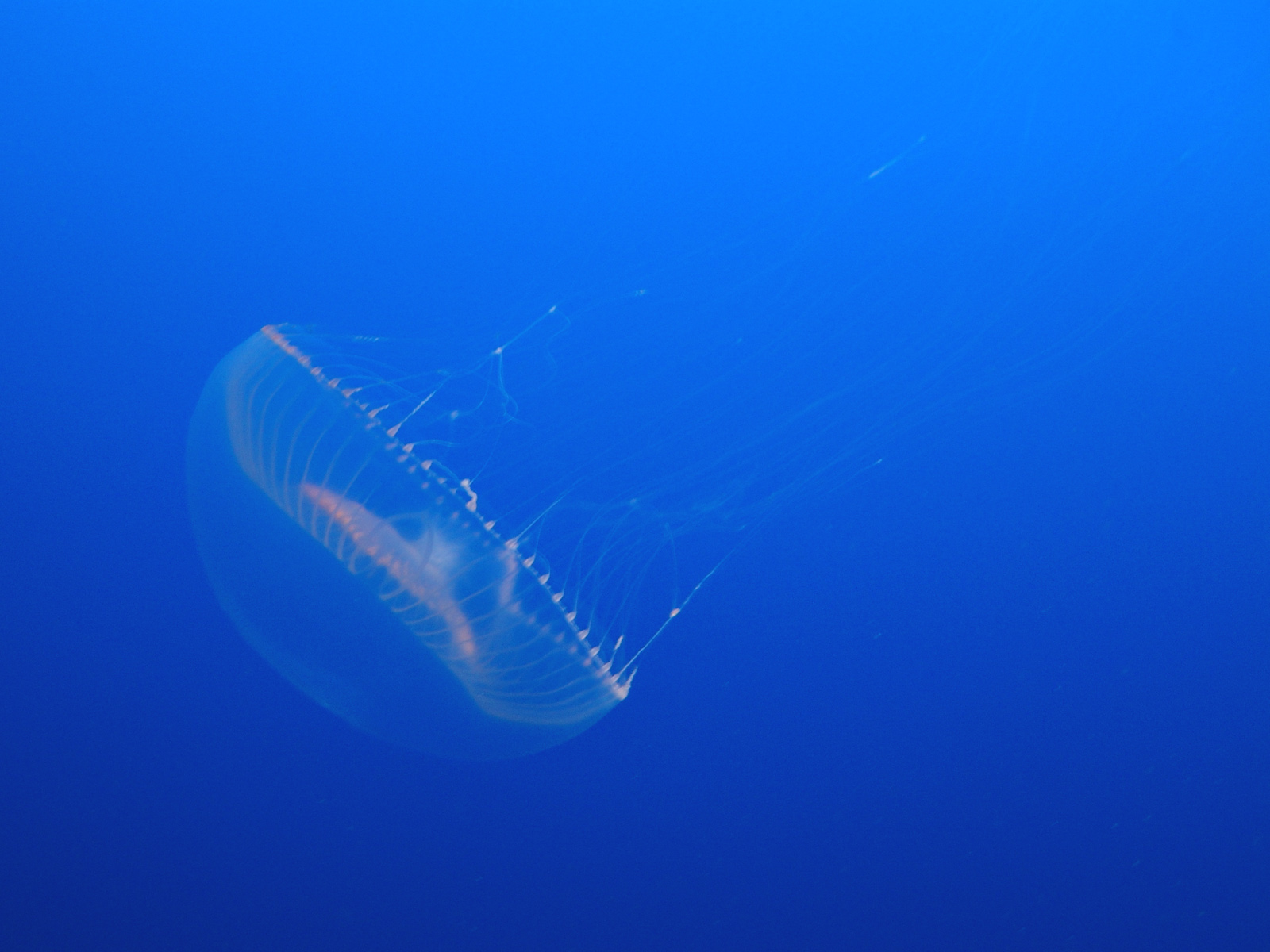
Light production is not a marginal curiosity in the open ocean but a dominant biological trait. Estimates place the share of deep-sea eukaryotes below 200 m that are bioluminescent at a large majority of species. The National Oceanic and Atmospheric Administration estimates that 80 percent of animals living between 200 and 1,000 m produce light. Coastal waters present a sharp contrast: there the proportion of species estimated to be luminous is less than 2.5%.
Among vertebrates the trait is even more strongly tied to depth, with more than 80 percent of luminous vertebrates confined to the deep sea. Roughly 1,500 fish species are known to be bioluminescent. Across all groups the phenomenon is widespread: about 10,000 species in 800 genera are luminous.
Quantitative surveys of the water column give a finer picture of how common light emission is among the animals actually present. In Monterey Bay 76% of observed water-column individuals were able to emit light, within a range of 69-78%. The figure rests on 350,536 water-column observations annotated from videos taken during 240 ROV dives between 1999 and 2016. Certain groups approach ubiquity: 99.7% of siphonophores in Monterey Bay can create their own light, and more than 97% of cnidarians are found to be bioluminescent.
The composition of the luminous community shifts with depth. From the surface down to 1,500 metres most of the glowing animals were jellyfish (medusae) or comb jellies. Between 1,500 and 2,250 metres depth worms were the most abundant glowing animals. Light is also cheap to produce at these levels, because below 300 metres the ocean is essentially pitch black and animals do not need to glow very brightly.
The deep seafloor has its own luminous fauna, documented by remotely operated vehicles over 621 dives between 1991 and 2016. That dataset covers animals observed in the water column and on the deep seafloor of Monterey Canyon, Guide and Davidson Seamounts and Sur Ridge, between the surface and 3,972 metres. Emission spectra differ between habitats: benthic animals emitted at longer wavelengths of 460 to 520 nanometres, against 440 to 500 nanometres for mesopelagic organisms. The setting itself is dim and turbid, since more than 90 percent of the deep-sea floor consists of silt and clay, with a nepheloid layer above and low visibility from suspended sediment.
Abundance in mid-water is concentrated in a few luminous fishes. Bristlemouths, overwhelmingly of the genus Cyclothone, account for more than 50 percent of total vertebrate abundance in mid-water habitats between 100 and 1,000 metres. Lanternfishes have diversified into 252 species, while only 21 species of bristlemouths have been described worldwide. Most luminous bacteria inhabit the sea, dominated by the genera Photobacterium and Vibrio.
The chemistry behind this abundance is narrower than the diversity of its users. Nine natural luciferins have been resolved from the more than 40 known bioluminescent systems. Coelenterazine is found in 11 different animal phyla, though in some of them the animals obtain it through their diet. Cypridina luciferin is found only in cypridinid ostracods and in the midshipman fish Porichthys that preys on them.
2. The Monterey Bay Surveys
The most extensive record of bioluminescence in the water column comes from remotely operated vehicle video gathered off the California coast between 1999 and 2016. Across 350,536 analysed observations the surveys documented which animals were present and which of them could produce light. The organisms recorded represent 553 phylogenetic concepts distributed across 13 broader taxonomic categories. Roughly three quarters of the animals observed inhabit the span between the surface and 4,000 m.
Light production is not evenly distributed across the fauna. More than 97% of cnidarians observed proved capable of emitting light, and within Monterey Bay siphonophores reached 99.7%. These figures place the gelatinous predators among the most consistently luminous groups in the surveyed waters.
The vertical structure of the counts is pronounced. Count rates climb from the surface to a maximum of 411 per hour at 350 m, then decline with depth to a minimum of 14 counts per hour at 3,650 m. Medusae and comb jellies dominate the assemblage from the surface down to 1,500 m, while worms are most abundant between 1,500 and 2,250 m. Below 300 m the ocean is pitch black, so the brightness seen nearer the surface is no longer needed.
A parallel benthic programme extended the survey to the seafloor. Between 30 and 41% of observed benthic organisms were able to emit light. The dataset spans Monterey Canyon, the Guide and Davidson Seamounts and Sur Ridge, reaching a deepest survey depth of 3,972 m across 621 dives between 1991 and 2016. More than 90 percent of the deep-sea floor is silt and clay, overlain by a nepheloid layer that leaves visibility low.
3. Diversity and Evolutionary Origins
Bioluminescence is not a single invention but a capacity arrived at repeatedly and independently across the tree of life. At least 94 independent origins have been counted across all taxa. The scale of the phenomenon is correspondingly large: roughly 10,000 luminous species are distributed among 800 genera, a figure that may well be an underestimate. A separate count places the number of luminous genera at no fewer than 760.
Among fishes the pattern is equally striking. At least 27 independent origins of light production are recognised within the group, and the trait was already present by the Cretaceous. The lanternfishes, with 252 species, stand in contrast to the 21 described species of bristlemouths. Yet it is the bristlemouths, chiefly of the genus Cyclothone, that account for more than 50 percent of vertebrate abundance between 100 and 1,000 m.
One leading hypothesis holds that the distinctive quality of a species' light signal assists speciation, functioning in species recognition and thereby in reproductive isolation.
4. Chemistry of Light Emission
Light emission in living organisms rests on a small set of reactive molecules. Nine natural luciferins have been resolved from more than 40 known systems. Each luciferin, when oxidised in a reaction mediated by its corresponding luciferase, emits a spectrum unique to that luciferin and its accessory proteins. The coelenterazine-dependent systems of nature all emit blue light with maxima between 450 and 500 nanometres and typically require no cofactor beyond oxygen.
The distribution of these substrates is uneven. Coelenterazine occurs across 11 animal phyla and in some organisms is obtained through the diet. Cypridina luciferin, by contrast, is restricted to cypridinid ostracods and to the midshipman fish Porichthys that preys on them. In some systems the reaction is gated by physical force: mechanical stimulation occurs when hydrodynamic forces such as waves, eddies or feeding currents exert local stress on the cell membrane, enabling an action potential and the light-emitting reaction.
Not every light-emitting protein is a luciferase. Aequorea victoria uses the photoprotein aequorin rather than a luciferase, and flashes when calcium ions are added.
5. Luciferase Systems Compared
A comparison across the best-characterised systems shows how wide that range is.4A brief review of bioluminescent systems · Current Genetics (Springer) ↗
| System | Mass | Emission | Notes |
|---|---|---|---|
| D-luciferin luciferases | about 60 kDa | — | reaction depends on ATP and magnesium4 |
| Renilla luciferase | 36 kDa | — | cytosolic, from a coral, steady signal4 |
| Gaussia luciferase | 20 kDa | — | secreted, from a copepod, high catalysis rate and thermostable4 |
| Bacterial luciferase | 75 kDa complex | — | two chains forming the complex, encoded in the lux operon4 |
| Click-beetle luciferases | — | green at 540 nm to orange-red at 593 nm | four types, from Pyrophorus plagiophthalamus2A Comprehensive Exploration of Bioluminescence Systems · PMC / NIH ↗ |
| Fungal system | — | green at about 520 nm | 3-hydroxyhispidin oxidised by an insoluble luciferase, needing only oxygen4 |
Among the ATP-dependent systems, the D-luciferin luciferases have a mass of about 60 kDa and require both ATP and magnesium for the light-emitting reaction. The Renilla enzyme is smaller at 36 kDa and cytosolic, derived from a coral, and it yields a steady signal. The Gaussia luciferase is smaller still at 20 kDa; it comes from a copepod, is secreted rather than retained, and combines a high catalysis rate with thermostability.4
Bacterial luciferases follow a different architectural logic: the enzyme consists of two polypeptide chains forming a 75-kilodalton complex, and the genes for these chains sit in the lux operon alongside the enzymes of luciferin biosynthesis.
The click beetles achieve colour variation within one group: four types of luciferase are known from Pyrophorus plagiophthalamus, spanning green at 540 nanometres to orange-red at 593 nanometres. The fungal system is chemically simpler, using 3-hydroxyhispidin oxidised by an insoluble luciferase in a reaction that needs only oxygen and emits green light at about 520 nanometres.24
6. Colour and Wavelength
The colour of emitted light is a defining property of bioluminescent systems, and it is measured in nanometres of wavelength. In most cases bacterial bioluminescence is blue at about 490 nanometres, but natural and engineered red-shifted versions also exist. The wavelength range recorded for benthic animals is longer than that of organisms living higher in the water column: benthic animals emitted at longer wavelengths of 460 to 520 nanometres, against 440 to 500 nanometres for mesopelagic organisms.
Among euphausiids light emission occurs in complex organs with specialised lenses able to focus. The exact ecological role of that adaptation is unclear.
7. Ecological Functions and Symbioses
Bioluminescence serves ecological ends that range from evasion to partnership. Among crustaceans, shrimps of the family Oplophoridae use their bioluminescence to startle the predator pursuing them.
The most widespread luminous organisms are bacteria, and most luminous bacteria inhabit the sea. This marine assemblage is dominated by the genera Photobacterium and Vibrio.
The clearest case of such an association is the bobtail squid Euprymna scolopes, in which the bacteria are an integral component of the animal's light organ.
8. Research History
- late nineteenth centuryLuciferin namedRaphaël Dubois names luciferin6Bioluminescence · Wikipedia ↗.
- 1961Aequorin and coelenterazine isolatedOsamu Shimomura isolates the photoprotein aequorin and its cofactor coelenterazine from Aequorea victoria6.
- 1962GFP first observedGreen fluorescent protein is first observed in Aequorea victoria10The Nobel Prize in Chemistry 2008 · NobelPrize.org ↗.
- 1987Marine reference paper publishedA paper appears that remains the most complete source of bioluminescence information for marine animals thirty years later8Three quarters of deep-sea animals make their own light · MBARI ↗.
- 2018Fungal pathway described in fullThe biochemical pathway generating bioluminescence in fungi is described in full, the first genetically encodable pathway from eukaryotes4.
9. Frequently Asked Questions
How does bioluminescence differ from fluorescence?
It does not need prior absorption of sunlight or other radiation to emit light2.
How many times has bioluminescence evolved?
At least 94 times, first appearing in octocorals some 540 million years ago6.
Which animals dominate the glow near the surface?
From the surface down to 1,500 metres, most of the glowing animals are jellyfish (medusae) or comb jellies8.
10. Timeline: from luciferin to the glowing genome
- late nineteenth centuryDubois names luciferinThe French pharmacologist Raphael Dubois shows that light emission results from the oxidation of a specific compound by an enzyme, and names that compound luciferin.
- 1961Shimomura isolates aequorinOsamu Shimomura isolates the photoprotein aequorin and its cofactor coelenterazine from the crystal jelly Aequorea victoria.
- 1962Green fluorescent protein observedThe brightly glowing green fluorescent protein, GFP, is first observed in the jellyfish Aequorea victoria.
- 1987Herring's catalogueThe most complete catalogue of bioluminescent marine animals is published and remains the standard reference for three decades.
- 2008Nobel Prize in ChemistryShimomura, Chalfie and Tsien win the Nobel Prize in Chemistry for the discovery and development of green fluorescent protein.
- 4 October 2017Three quarters of deep-sea animals glowMBARI researchers publish the analysis of 350,536 observations showing three quarters of Monterey Bay animals emit light.
- 2018Fungal pathway completedThe biochemical pathway generating bioluminescence in fungi is described in full, the first genetically encodable pathway from eukaryotes.
11. Frequently asked questions
How many ROV dives produced the Monterey Bay water-column dataset?
The 350,536 water-column observations were annotated from videos taken during 240 ROV dives between 1999 and 20165Quantification of bioluminescence from the surface to the deep sea · Scientific Reports (Nature) ↗.
When was green fluorescent protein first observed, and in which animal?
Green fluorescent protein, GFP, was first observed in the jellyfish Aequorea victoria in 196210.
Who isolated aequorin and its cofactor, and when?
Osamu Shimomura isolated the photoprotein aequorin and its cofactor coelenterazine from the crystal jelly Aequorea victoria in 19616.
What did Raphaël Dubois establish about the chemistry of light emission?
Dubois showed that light emission came from the oxidation of a specific compound by an enzyme, and named that compound luciferin6.
Which bacterium partners with the bobtail squid?
In the bobtail squid Euprymna scolopes, the bacteria are an integral component of the animal's light organ6.
Do all luminous systems rely on a luciferase enzyme?
Instead of a luciferase, the jellyfish Aequorea victoria uses a photoprotein, aequorin, which flashes rapidly when calcium ions are added6.
References (10)
- 1Species-specific bioluminescence facilitates speciation in the deep sea — Marine Biology (PMC) WebView source
- 2A Comprehensive Exploration of Bioluminescence Systems — PMC / NIH Web↩View source
- 3A review of mechanically stimulated bioluminescence of marine plankton — Frontiers in Marine Science 2023 JournalView source
- 4A brief review of bioluminescent systems — Current Genetics (Springer) Journal↩View source
- 5Quantification of bioluminescence from the surface to the deep sea — Scientific Reports (Nature) Journal↩View source
- 6Bioluminescence — Wikipedia Web↩View source
- 7What is bioluminescence? — NOAA Ocean Exploration WebView source
- 8Three quarters of deep-sea animals make their own light — MBARI Web↩View source
- 9Distribution and quantification of bioluminescence in deep-sea benthos — Scientific Reports (PMC) WebView source
- 10The Nobel Prize in Chemistry 2008 — NobelPrize.org 2008 Web↩View source