Çatalhöyük
A Neolithic town of 8,000 people with no streets.
In this article
Overview
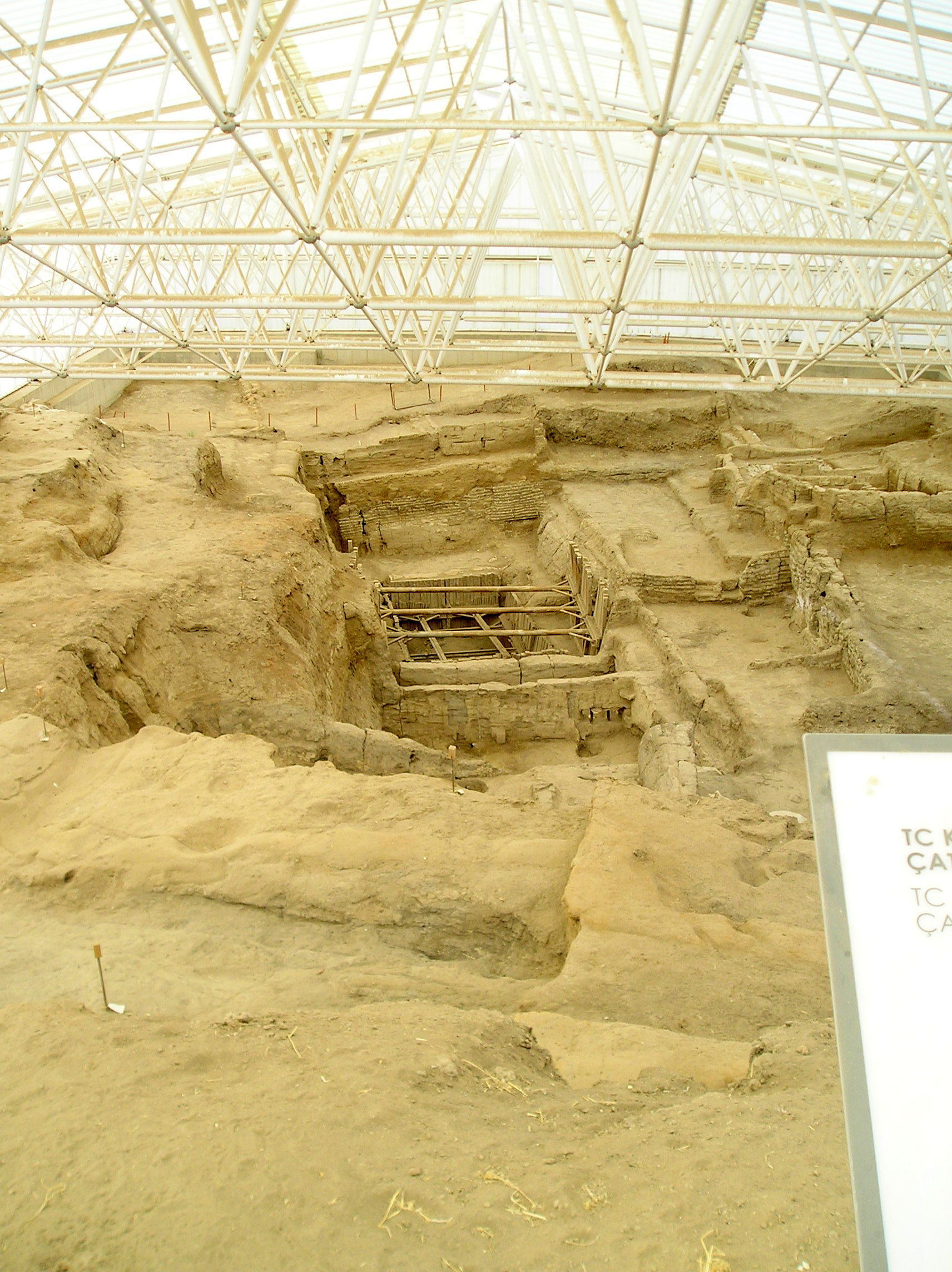
Çatalhöyük is a tell — a mounded accretion resulting from long-term human settlement — of a very large Neolithic and Chalcolithic proto-city settlement in southern Anatolia, which existed from around 7500 BC to 5600 BC and flourished around 7000 BC. The name derives from the Turkish çatal "fork" and höyük "tumulus", and the site also appears as Çatal Höyük and Çatal Hüyük. It overlooks the Konya Plain, southeast of the present-day city of Konya (ancient Iconium) in Turkey, around 140 km (87 mi) from the twin-coned volcano of Mount Hasan.
The site consists of two mounds separated by an extinct channel of the Çarşamba River. Çatalhöyük was composed entirely of domestic buildings with no obvious public buildings. Its spatial layout may be due to the close kin relations exhibited amongst the people.
Çatalhöyük has strong evidence of an egalitarian society, as no houses with distinctive features (belonging to royalty or religious hierarchy for example) have been found so far. A 2014 paper argues that the picture of Çatalhöyük is more complex and that while there seemed to have been an egalitarian distribution of certain resources the evidence is not uniform. In an article in the Turkish Daily News Hodder denied that Çatalhöyük was a matriarchal society, saying "When we look at what they eat and drink and at their social statues, we see that men and women had the same social status".
More recent work using revised ideas of the distribution of residential buildings, and employing archaeological and ethnographic data exploring building use, suggests that between 600 and 800 people would have lived at Çatalhöyük East during an average year during the Middle phase (6700–6500 BC). In the upper levels of the site it becomes apparent that the people of Çatalhöyük were honing skills in agriculture and the domestication of animals.
Hodder said in a September 2009 report on the discovery of around 2000 figurines that Çatalhöyük was excavated in the 1960s in a methodical way, but not using the full range of natural science techniques that are available to us today. According to Mickel, Hodder's Çatalhöyük Research Project (ÇRP) established itself as a site for progressive methodologies – in terms of adaptable and innovative approaches to excavation and interpretation.
The earliest occupation of the site belongs to the Neolithic period and left a thick layer of remains whose full extent cannot be determined because later deposits lie over it. After the Neolithic the settlement was abandoned, apart from a few stray Bronze Age graves, and was subsequently occupied in the Phrygian, Hellenistic, Roman, Byzantine and Ottoman periods.
Burial formed part of the ritual life of the community: the inhabitants buried their dead within the village itself. Female figurines are a recurring feature of the site, and the material has been judged a unique body of evidence that may compel a revision of how the nature of Çatalhöyük society and imagery is understood.
Interpretations of the settlement's social character remain contested. Noting the absence of hierarchy and economic inequality, the historian and anti-capitalist author Murray Bookchin argued that Çatalhöyük was an early example of anarcho-communism. The site's connections to other Anatolian settlements, including Bademağacı, existed, yet it did not then possess the close ties with central Anatolia that appear later.
1. Location and Setting
Çatalhöyük lies on the Konya Plain, a broad expanse of central Anatolia whose archaeology first came into focus through systematic regional survey. The site was discovered by James Mellaart in 1958 during a regional survey of the Konya Plain. Those excavations revealed this section of Anatolia as a centre of advanced culture in the Neolithic period.
Its initial occupation in the Neolithic period resulted in a thick layer of remains whose extent is uncertain due to overlying later remains. Finds at the site, from the Neolithic layers, included a number of textiles which are rarely preserved in early sites. A number of Neolithic skeletons were also recovered, many from intramural inhumations and in many cases secondary burials.
Abandoned after the Neolithic, aside from a few stray Bronze Age graves, it was later occupied in the Phrygian, Hellenistic, Roman, Byzantine, and Ottoman periods. This long sequence of later use bears directly on the setting: the superimposed deposits of subsequent centuries obscure the full horizontal reach of the earliest settlement.
The settlement is a tell, a mounded accretion built up by long-term human occupation, and it is classed among the very large Neolithic and Chalcolithic proto-city settlements of southern Anatolia. Its span runs from around 7500 BC to 5600 BC, with its floruit around 7000 BC. In physical terms the site comprises two mounds divided by an extinct channel of the Çarşamba River. It stands southeast of the present-day city of Konya, the ancient Iconium, and lies around 140 km (87 mi) from the twin-coned volcano of Mount Hasan.
The built fabric was entirely domestic, with no obvious public buildings identified. No houses with distinctive features, such as those that would belong to royalty or a religious hierarchy, have been found, which is taken as strong evidence of an egalitarian society. The spatial layout may reflect close kin relations among the inhabitants. Historian and anti-capitalist author Murray Bookchin, noting the absence of hierarchy and economic inequality, argued that the site was an early example of anarcho-communism.
Revised estimates of the distribution of residential buildings, combined with archaeological and ethnographic data on building use, suggest that between 600 and 800 people lived at Çatalhöyük East in an average year during the Middle phase of 6700–6500 BC. Burial took place within the village as part of ritual life. In the upper levels of the site it becomes apparent that the inhabitants were honing skills in agriculture and the domestication of animals.
Female figurines are a distinguishing feature of the site. On the question of social organization, Ian Hodder, writing in the Turkish Daily News, denied that Çatalhöyük was a matriarchal society, observing that diet and social status indicate men and women held the same social standing. Interpretation of the imagery remains open: whatever reading is adopted, the material is a unique piece that may force a revision of views on the nature of Çatalhöyük society and imagery.
2. Discovery and Excavation History
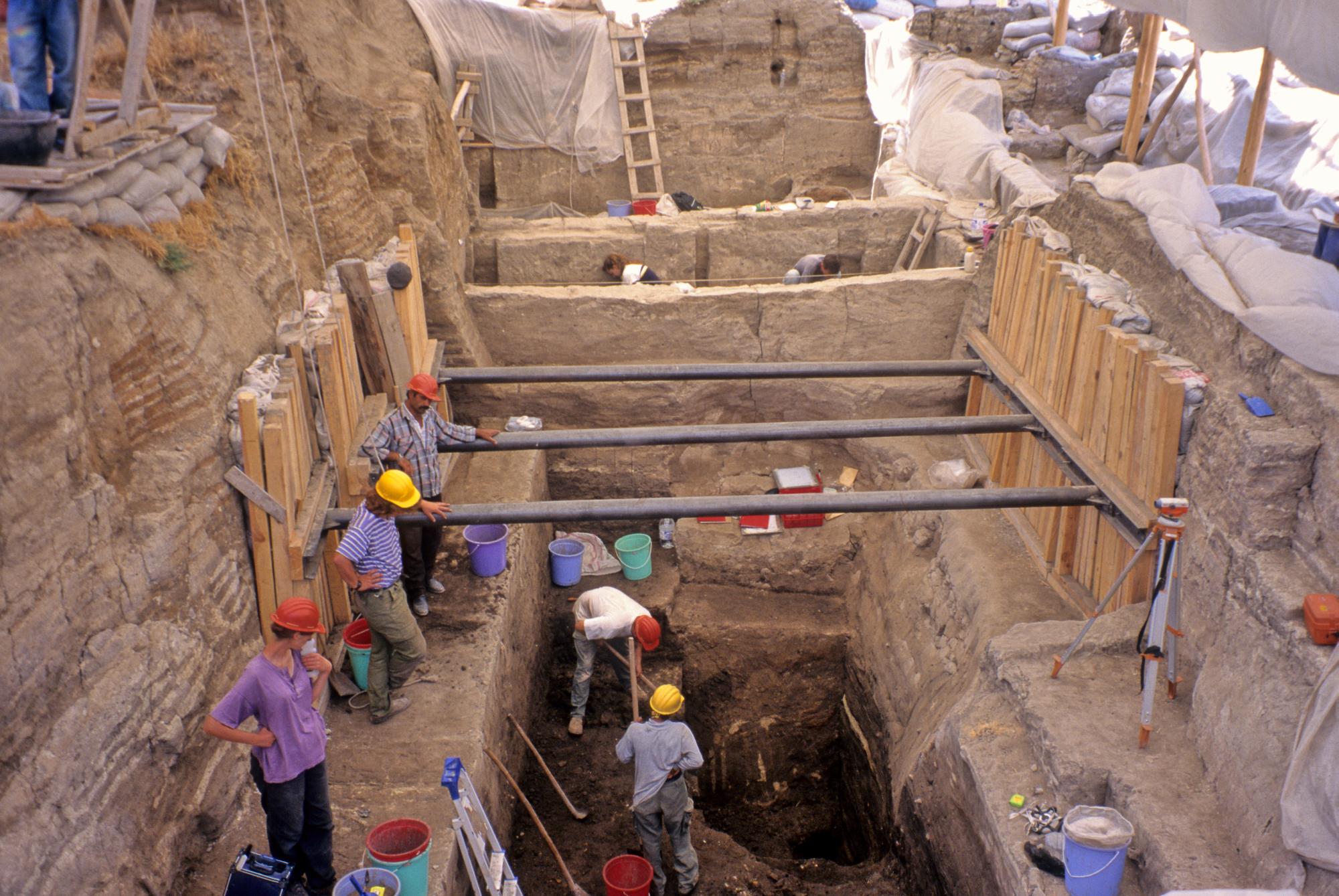
The site entered modern archaeology through James Mellaart, whose discovery of Çatalhöyük came in 1958 during a regional survey of the Konya Plain. Excavations followed in the 1960s and brought to light a Neolithic settlement of a kind then scarcely documented in Anatolia, reshaping scholarly understanding of the period. Hodder has characterised that early campaign as methodical in its conduct, while noting that it could not draw on the full range of natural science techniques that are available today.
Later research was organised under Hodder's Çatalhöyük Research Project. According to Mickel the project established itself as a site for progressive methodologies, in terms of adaptable and democratised recording, integration of computerised technologies, sampling strategies, and community involvement. Work also returned to the Western Mound, where Mellaart had opened only two trenches in 1961; Jonathan Last and Catriona Gibson excavated there in 1998.
The earliest campaigns at the site were conducted in the 1960s, and Hodder described that work in a September 2009 report as having proceeded in a methodical manner. The same assessment holds that the excavation did not employ the full range of natural science techniques now available. The report in which this judgement appears concerned the discovery of around 2000 figurines.
Those excavations established this part of Anatolia as a centre of advanced culture in the Neolithic period.
The settlement itself was built entirely of domestic structures, with no evident public buildings. Its female figurines are counted among its distinctive features.
3. Architecture and Settlement Layout
Çatalhöyük was composed entirely of domestic buildings with no obvious public buildings. The settlement therefore presents no evident civic or monumental architecture set apart from its houses.
The spatial layout of the settlement may be due to the close kin relations exhibited amongst the people. In this reading the arrangement of the built space reflects social proximity rather than any formal civic plan.
The site itself is not a single mound but two, divided by an extinct channel of the Çarşamba River. Its first occupation in the Neolithic left a thick layer of remains whose full extent cannot be fixed, since later deposits lie over it. After the Neolithic the place was abandoned apart from a few stray Bronze Age graves, and was subsequently occupied in the Phrygian, Hellenistic, Roman, Byzantine and Ottoman periods.
The absence of differentiated houses is read as evidence of a markedly egalitarian society: no dwellings with distinctive features, such as would belong to a royalty or a religious hierarchy, have been found. From this lack of hierarchy and economic inequality the historian and anti-capitalist author Murray Bookchin argued that Çatalhöyük was an early example of anarcho-communism.
Estimates of how many people the settlement held have been revised. Work drawing on revised ideas of how residential buildings were distributed, combined with archaeological and ethnographic data on building use, suggests that between 600 and 800 people lived at Çatalhöyük East in an average year of the Middle phase, 6700–6500 BC. Burial took place inside the village as part of ritual life.
The settlement lies on the Konya Plain, southeast of the present-day city of Konya (ancient Iconium) in Turkey, around 140 km (87 mi) from the twin-coned volcano of Mount Hasan. As a tell — a mounded accretion produced by long-term human settlement — it was a very large Neolithic and Chalcolithic proto-city of southern Anatolia, existing from around 7500 BC to 5600 BC and flourishing around 7000 BC.
In the upper levels it becomes apparent that the inhabitants were honing skills in agriculture and the domestication of animals. Among the site's notable material are its female figurines. On the question of social relations, Hodder, writing in the Turkish Daily News, denied that Çatalhöyük was a matriarchal society, observing that diet and social status indicate men and women held the same social status.
4. Population
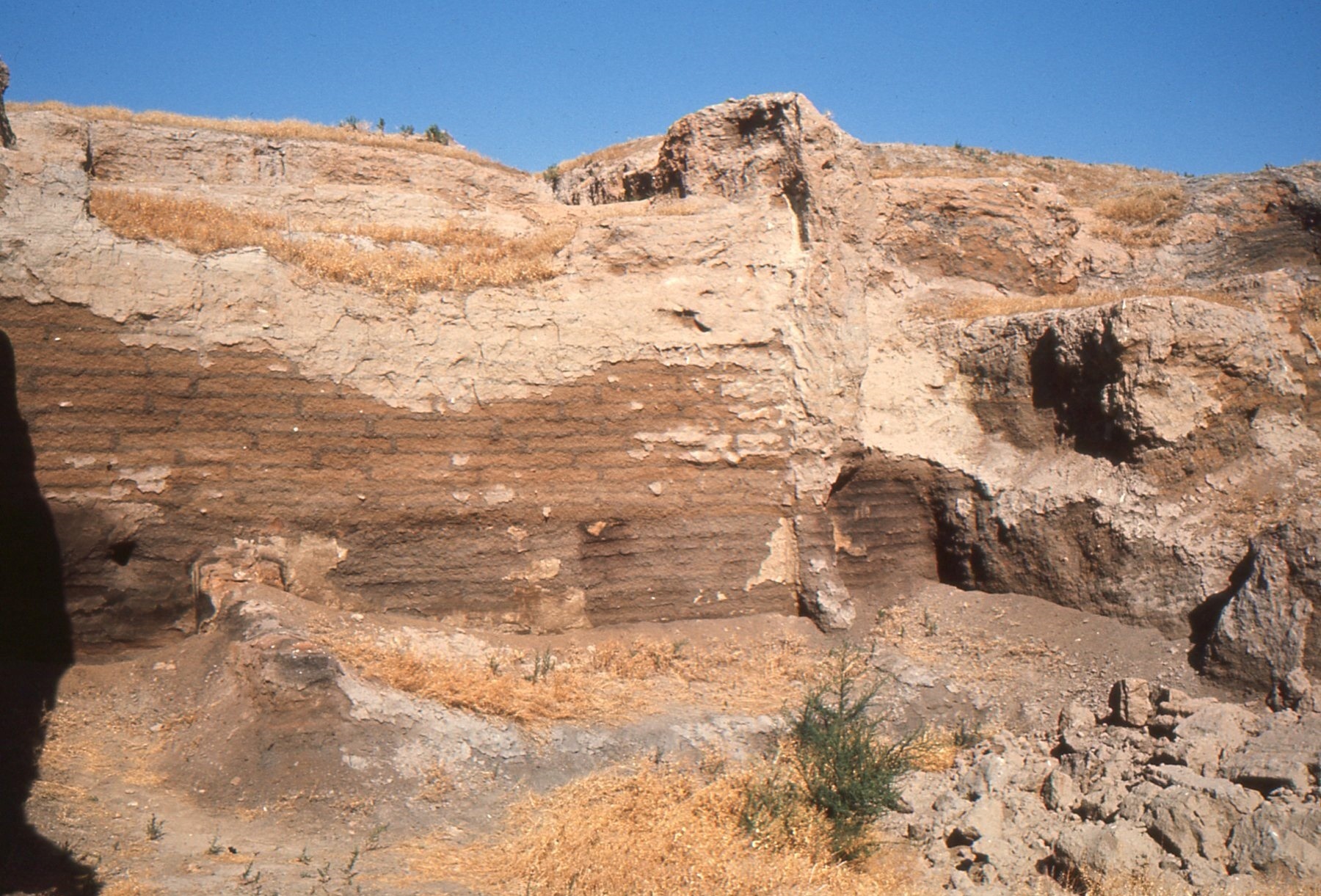
More recent work has revised the picture of how many people lived at Çatalhöyük East. These revised ideas rest on the distribution of residential buildings, together with archaeological and ethnographic data exploring how buildings were used. On that basis the settlement is thought to have housed between 600 and 800 people in an average year during the Middle phase (6700–6500 BC).
5. Social Organization and Equality
Çatalhöyük has strong evidence of an egalitarian society, as no houses with distinctive features belonging to royalty or religious hierarchy have been found so far. The absence of such differentiated dwellings is the basis on which the settlement is read as broadly levelled in its domestic arrangements.
That reading has not gone unchallenged. A 2014 paper argues that the picture of Çatalhöyük is more complex and that while there seemed to have been an egalitarian distribution of cooking tools and some stone tools, unbroken quern-stones and storage units were more unevenly distributed. The same argument holds that the distribution of cooking tools and some stone tools appeared egalitarian, whereas unbroken quern-stones and storage units were spread less evenly.
The absence of hierarchy and of economic inequality at the site led the historian and anti-capitalist author Murray Bookchin to characterise Çatalhöyük as an early example of anarcho-communism.
Questions of gender have been addressed directly by the excavator. In an article in the Turkish Daily News the archaeologist Hodder denied that Çatalhöyük was a matriarchal society, observing that the evidence of what inhabitants ate and drank and of their social statuses indicated that men and women held the same social status. The excavations have been presented as revealing gender equality in ancient settled life.
Status also left traces in the treatment of the dead: where an individual's social standing carried high importance at Çatalhöyük the body and the head were separated after death.
6. Burial and Ritual Life
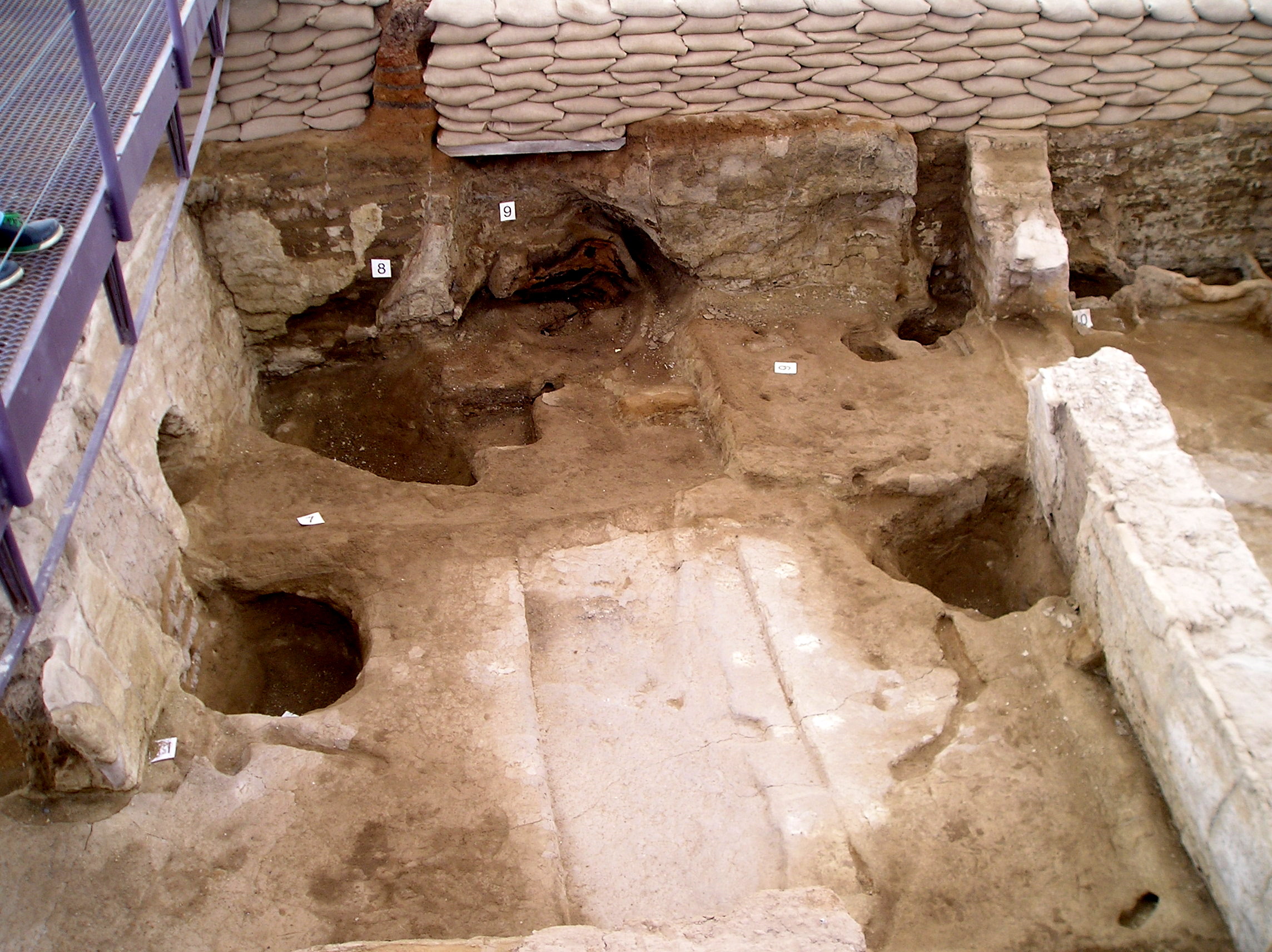
The people of Çatalhöyük buried their dead within the village, an arrangement that made the dead a continuing presence in the settlement rather than a community apart from it. This practice belonged to ritual life as a whole, joining the treatment of the body to the everyday spaces of the living. The archaeological record preserves the physical traces of these rites in the form of Neolithic skeletons.
Many of the recovered skeletons came from intramural inhumations, burials placed within the settlement itself. In many cases these were secondary burials, meaning the bones were deposited after the body had already undergone an earlier stage of treatment. The combination of burial inside the village and the rehandling of remains points to a deliberate and repeated engagement with the dead rather than a single act of disposal.
Some skulls were plastered and painted with ochre to recreate faces. This custom is more characteristic of Neolithic sites in Syria and Jericho than of sites closer by, which sets the practice at Çatalhöyük within a wider regional frame. The modelling of features onto the skull gave the dead a renewed human countenance, an act that belongs to the same ritual sphere as burial within the village.
The settlement itself was a tell, a mounded accretion produced by long-term human occupation, and it grew into a very large Neolithic and Chalcolithic proto-city in southern Anatolia. It existed from around 7500 BC to 5600 BC and flourished around 7000 BC. Its position overlooks the Konya Plain, southeast of the present-day city of Konya (ancient Iconium) in Turkey, around 140 km (87 mi) from the twin-coned volcano of Mount Hasan. The site consists of two mounds separated by an extinct channel of the Çarşamba River.
Initial occupation in the Neolithic period left a thick layer of remains whose extent is uncertain because later remains overlie it. After the Neolithic the place was abandoned, apart from a few stray Bronze Age graves, and was later occupied in the Phrygian, Hellenistic, Roman, Byzantine, and Ottoman periods.
The built fabric was entirely domestic, with no obvious public buildings. Social organisation appears strongly egalitarian, since no houses with distinctive features, such as those belonging to royalty or a religious hierarchy, have been found so far. The spatial layout may reflect close kin relations among the inhabitants. Revised estimates of residential building distribution, combined with archaeological and ethnographic data on building use, suggest that between 600 and 800 people lived at Çatalhöyük East in an average year during the Middle phase (6700–6500 BC).
Female figurines are a recognised feature of the site. On the question of gender, Hodder denied in an article in the Turkish Daily News that Çatalhöyük was a matriarchal society, saying that when diet and social status are examined men and women appear to have had the same social status. Noting the lack of hierarchy and economic inequality, the historian and anti-capitalist author Murray Bookchin argued that Çatalhöyük was an early example of anarcho-communism. Interpretation of the site's imagery remains open: whatever the specific reading, one piece is unique and may force a change in views of the nature of Çatalhöyük society and imagery.
In the upper levels of the site it becomes apparent that the inhabitants were honing skills in agriculture and the domestication of animals.
7. Religion and Figurines
No identifiable temples have been described at the site, yet the graves, murals and figurines recovered there point to a religion rich in symbols. Female figurines are among the most characteristic finds of the settlement. Distinctive clay figurines of women have been found in the upper levels of the site, most notably the Seated Woman of Çatalhöyük.
The mother goddess interpretation is perhaps what Çatalhöyük is best known for. The Estonian folklorist Uku Masing suggested as early as in 1976 that Çatalhöyük was probably a hunting and gathering religion and that the Mother Goddess figurine did not represent a female deity. In an article in the Turkish Daily News Hodder denied that Çatalhöyük was a matriarchal society.
When we look at what they eat and drink and at their social statues, we see that men and women had the same social status.
Ian Hodder, in the Turkish Daily News
A feature of the site is its female figurines. The Seated Woman of Çatalhöyük, a statue shown flanked by two leopards, is held in the Museum of Anatolian Civilisations, where a mural of Neolithic hunters attacking an aurochs is also kept.
In a September 2009 report on the discovery of around 2000 figurines Hodder observed that Çatalhöyük was excavated in the 1960s in a methodical way, but not using the full range of natural science techniques that are available to us today. Whatever the specific interpretation, the piece is a unique one that may force a change in views of the nature of Çatalhöyük society and imagery.
As a part of ritual life, the people of Çatalhöyük buried their dead within the village. The settlement was composed entirely of domestic buildings with no obvious public buildings. It has strong evidence of an egalitarian society, as no houses with distinctive features belonging to royalty or religious hierarchy have been found so far. Noting the lack of hierarchy and economic inequality, historian and anti-capitalist author Murray Bookchin argued that Çatalhöyük was an early example of anarcho-communism.
8. Agriculture and Subsistence
In the upper levels of the site it becomes apparent that the people of Çatalhöyük were honing skills in agriculture and the domestication of animals. The same observation is recorded for the upper levels in the site's archaeological reporting.
Finds at the site from the Neolithic layers included a number of textiles which are rarely preserved in early sites.
The site of Çatalhöyük consists of two mounds separated by an extinct channel of the Çarşamba River. Its initial occupation in the Neolithic period resulted in a thick layer of remains whose extent is uncertain due to overlying later remains. Abandoned after the Neolithic, aside from a few stray Bronze Age graves, it was later occupied in the Phrygian, Hellenistic, Roman, Byzantine, and Ottoman periods.
The settlement lay in southern Anatolia and existed from around 7500 BC to 5600 BC, flourishing around 7000 BC. It overlooks the Konya Plain, southeast of the present-day city of Konya (ancient Iconium) in Turkey, around 140 km (87 mi) from the twin-coned volcano of Mount Hasan.
Çatalhöyük was composed entirely of domestic buildings with no obvious public buildings. As a part of ritual life, the people of Çatalhöyük buried their dead within the village. More recent work using revised ideas of the distribution of residential buildings, and employing archaeological and ethnographic data exploring building use, suggests that between 600 and 800 people would have lived at Çatalhöyük East during an average year during the Middle phase (6700–6500 BC).
The site has strong evidence of an egalitarian society, as no houses with distinctive features (belonging to royalty or religious hierarchy for example) have been found so far. Its spatial layout may be due to the close kin relations exhibited amongst the people. Noting the lack of hierarchy and economic inequality, historian and anti-capitalist author Murray Bookchin has argued that Çatalhöyük was an early example of anarcho-communism.
A feature of Çatalhöyük are its female figurines. In an article in the Turkish Daily News, Hodder denied that Çatalhöyük was a matriarchal society, saying "When we look at what they eat and drink and at their social statues, we see that men and women had the same social status." Whatever the specific interpretation, this is a unique piece that may force us to change our views of the nature of Çatalhöyük society and imagery.
9. Later Occupation
After the Neolithic the site was abandoned, apart from a few stray Bronze Age graves. It was later occupied in the Phrygian, Hellenistic, Roman, Byzantine, and Ottoman periods.
The Neolithic occupation left a thick layer of remains whose extent is uncertain because later remains overlie it.
10. Key dates
- 1958The site was discovered by James Mellaart in 1958 during a regional survey of…The site was discovered by James Mellaart in 1958 during a regional survey of the Konya Plain .
- 1961According to Mickel, Hodder's Çatalhöyük Research Project (ÇRP) established it…According to Mickel, Hodder's Çatalhöyük Research Project (ÇRP) established itself as a site for progressive methodologies – in terms of adaptable and democratised recording, integration of computerised technologies, sampling strategies, and community involvement." At t
- 1976Estonian folklorist Uku Masing has suggested as early as in 1976, that Çatalhö…Estonian folklorist Uku Masing has suggested as early as in 1976, that Çatalhöyük was probably a hunting and gathering religion and the Mother Goddess figurine did not represent a female deity.
- 2000Hodder said in a September 2009 report on the discovery of around 2000 figurin…Hodder said in a September 2009 report on the discovery of around 2000 figurines: Çatalhöyük was excavated in the 1960s in a methodical way, but not using the full range of natural science techniques that are available to us today.
- 2014Conversely, a 2014 paper argues that the picture of Çatalhöyük is more complex…Conversely, a 2014 paper argues that the picture of Çatalhöyük is more complex and that while there seemed to have been an egalitarian distribution of cooking tools and some stone tools, unbroken quern-stones and storage units were more unevenly distributed.
11. Frequently asked questions
Where does the name Çatalhöyük come from?
How is Çatalhöyük pronounced in English?
What did the Çatalhöyük Research Project become known for, according to Mickel?
According to Mickel, Hodder's Çatalhöyük Research Project established itself as a site for progressive methodologies in terms of adaptable and democratised recording, integration of computerised technologies, sampling strategies, and community involvement2Çatalhöyük — sec1 · Wikipedia ↗.
Did anyone argue that Çatalhöyük was an early example of anarcho-communism?
Noting the lack of hierarchy and economic inequality, historian and anti-capitalist author Murray Bookchin argued that Çatalhöyük was an early example of anarcho-communism4Çatalhöyük — sec4 · Wikipedia ↗.
Was Çatalhöyük becoming less equal over time?
It has been suggested that Çatalhöyük was becoming less egalitarian, with greater inter-generational wealth transmission4.
What does the site's imagery suggest about how its society should be understood?
Whatever the specific interpretation, the distinctive piece in question is described as unique and as possibly forcing a change in views of the nature of Çatalhöyük society and imagery5Çatalhöyük — sec3 · Wikipedia ↗.
References (8)
- 1Çatalhöyük — wiki — Wikipedia Web↩View source
- 2Çatalhöyük — sec1 — Wikipedia Web↩View source
- 3Çatalhöyük — sec2 — Wikipedia WebView source
- 4Çatalhöyük — sec4 — Wikipedia Web↩View source
- 5Çatalhöyük — sec3 — Wikipedia Web↩View source
- 6Çatalhöyük — sec6 — Wikipedia WebView source
- 7Çatalhöyük — hisarlik — Reference WebView source
- 8Çatalhöyük — sec5 — Wikipedia WebView source