Qumran
The caves that held the Dead Sea Scrolls for 2,000 years.
In this article
Overview
Qumran is today best known as the settlement nearest to the Qumran Caves, the desert hiding place of the Dead Sea Scrolls, which lie in the sheer cliffs and beneath them in the marl terrace1Qumran — wiki · Wikipedia ↗. The site occupies a dry marl plateau about 1.5 km (1 mi) from the northwestern shore of the Dead Sea and about 10 km (6 mi) south of the historic city of Jericho, adjacent to the modern Israeli settlement and kibbutz of Kalya1.
Khirbet Qumran was familiar to European travellers long before its ruins drew scholarly attention, having been known to European explorers since the 19th century2Qumran — sec3 · Wikipedia ↗. Albert Isaacs, the British consul James Finn and the photographer James Graham visited the site in December 18562. The earliest digging there, undertaken before modern field methods existed, concerned the burials of the cemetery: Henry Poole worked in 1855 and Charles Clermont-Ganneau followed in 18732.
The scrolls themselves first came to light through bedouins of the Ta'amireh tribe3Qumran — sec5 · Wikipedia ↗. After the discovery of the Dead Sea Scrolls in 1947–1956 extensive excavations were carried out at Qumran4Qumran — sec1 · Wikipedia ↗. A cursory surface survey in the interim yielded nothing of interest, but continuing interest in the scrolls prompted a more substantial analysis of the ruins in 19513.
Roland de Vaux's campaign was thorough enough to remain the principal source of information on the settlement, yet further excavations and surveys followed his5Qumran — sec7 · Wikipedia ↗. Catherine Murphy records unpublished work at the site during the 1960s by John Allegro and by Solomon Steckoll5. Most of the small finds from de Vaux's excavations were sent back to Jerusalem for use in later reports, but his death halted those reports and the objects were left on museum shelves6Qumran — sec8 · Wikipedia ↗. In 2002 Minna and Kenneth Lönnqvist published archaeological and spatial studies that offered another reading of the settlement, including the astronomical orientations of some of its structures6.
A large cemetery was found to the east of the site7Qumran — sec2 · Wikipedia ↗. Beyond this primary burial ground lie three separate extensions, a north cemetery and a cemetery south of Wadi Qumran7.
De Vaux read his findings in the light of information drawn from the Dead Sea Scrolls, which continued to be found in the nearby caves throughout his excavations8Qumran — sec6 · Wikipedia ↗. He concluded that the remains had been left by a sectarian religious community8. The site is widely held to have been inhabited by a Jewish sect of the late Second Temple period, which most scholars identify with the Essenes, though other Jewish groups have also been proposed1.
The Israel Nature and Parks Authority took over the site after the 1967 war, when Israel occupied the West Bank and seized Qumran9Qumran — caves · Reference ↗. Israel has since invested heavily in the area to establish the Qumran caves as a site of what it terms uniquely Israeli Jewish heritage9.
1. Location and Setting
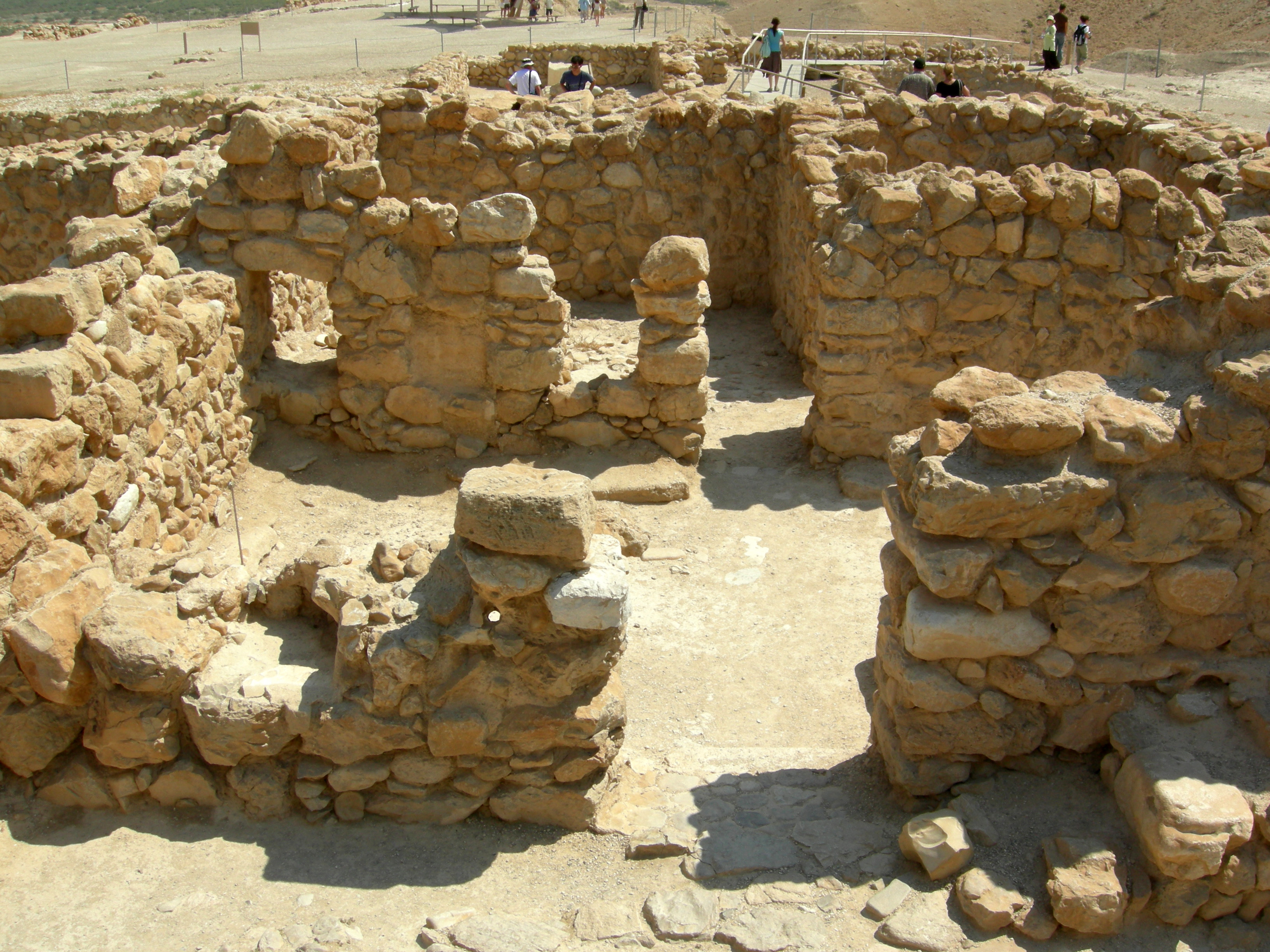
Qumran sits on a dry marl plateau above the shore of the Dead Sea, a position that early visitors judged to be commanding and well adapted for defensive operations2. The British consul James Finn, who came to the site with Albert Isaacs and the photographer James Graham in December 1856, later suggested that Qumran was some ancient fort with a cistern2. The British scholar Ernest William Gurney Masterman visited Qumran on several occasions between 1900 and 1901 and, observing the positioning of the ruins atop a plateau overlooking the ‘Ein Feshkha Springs, concluded that they may have very well been once a small fortress2.
The limestone cliffs above Qumran hold numerous caves that were used from the Chalcolithic period onward to the Arab period7. Artificial caves were also cut into the marl bluffs in connection with the settlement period7. A large cemetery was discovered to the east of the site7, and the first excavations at Qumran, prior to the development of modern methodology, were of burials in that cemetery, conducted by Henry Poole in 1855 followed by Charles Clermont-Ganneau in 18732.
The setting has shaped how the site is understood. Most scholars believe the location was home to a Jewish sect, probably the Essenes4, and one hypothesis holds that the original residents of the settlement were the Essenes, who established the site in the desert for religious purposes8. Roland de Vaux concluded that the remains at Qumran were left by a sectarian religious community8. The materials recovered point to trade connections in the area and provide evidence that Qumran may not have been in a vacuum in the Graeco-Roman period6.
The principal excavations at Qumran were conducted by Roland de Vaux in the 1950s, and several later digs have been carried out1. During the 1960s, according to Catherine Murphy, there were some unpublished excavations at Qumran by John Allegro and by Solomon Steckoll5. In 2002 archaeologists Minna and Kenneth Lönnqvist published their archaeological and spatial studies at Qumran bringing another view to the settlement6. A recent final publication of the French excavations by Jean-Baptist Humbert outlining evidence of a decorated frieze, opus sectile, fine columns etc. indicates a phase of a wealthier occupation, une grande maison, at Qumran6.
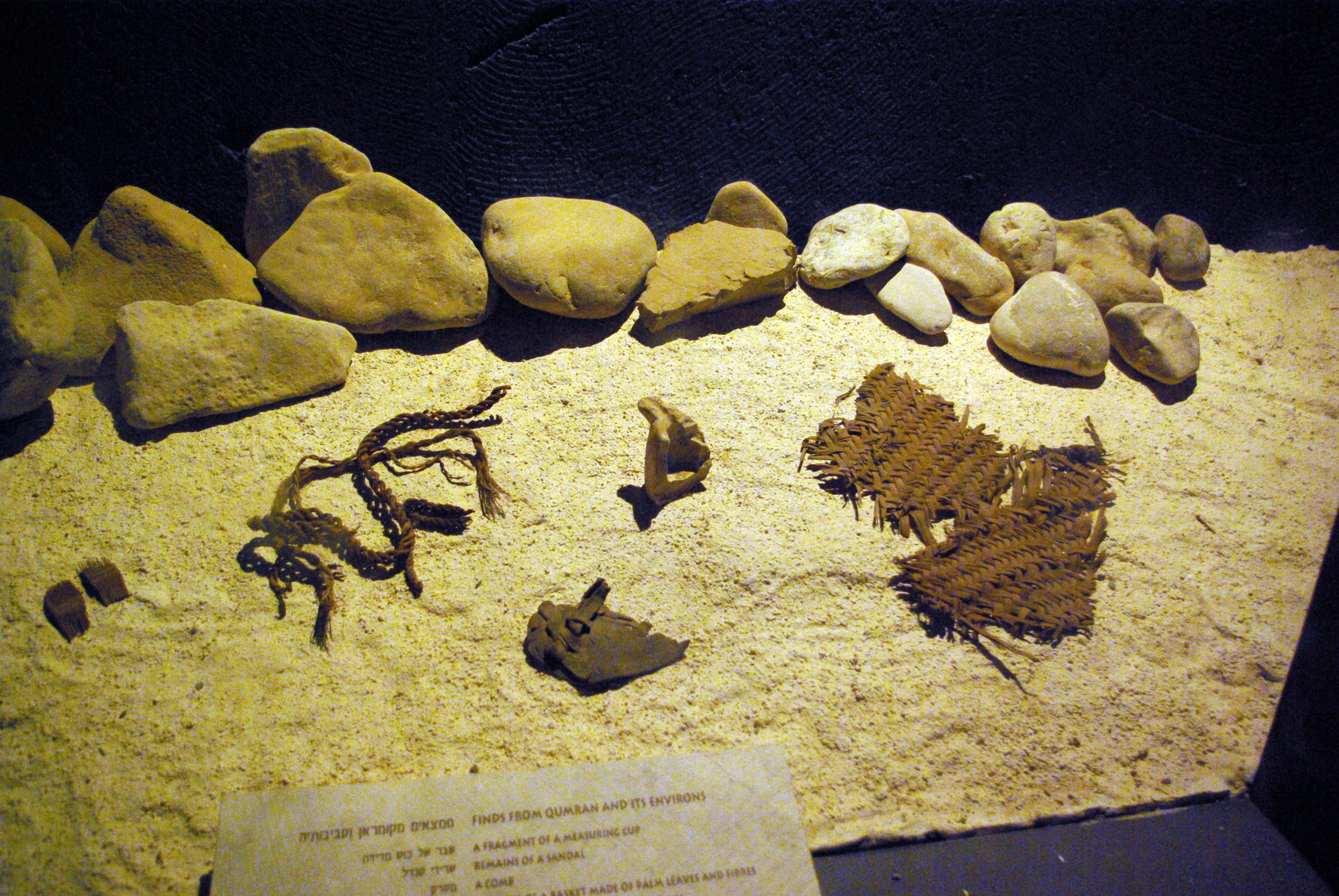
Most of the small finds from the de Vaux excavations were taken back to Jerusalem to be used in later excavation reports for Qumran, but the death of Roland de Vaux brought a halt to the reports and the small finds were left to gather dust on shelves in museum backrooms6. The most-prized find at Qumran up to this time were three small juglets containing over five-hundred silver coins, which were found in a room on the west side of the monastery3. The water works of Secacah that are described in the Copper Scroll are consistent with those of Qumran3.
The Israel Nature and Parks Authority took over the site following the end of the 1967 war, when Israel occupied the West Bank and seized Qumran9.
The site lies on a dry marl plateau about 1.5 km (1 mi) from the northwestern shore of the Dead Sea, about 10 km (6 mi) south of the historic city of Jericho, and adjacent to the modern Israeli settlement and kibbutz of Kalya1. Khirbet Qumran had been known to European explorers since the 19th century2.
Since the discovery of the Dead Sea Scrolls in 1947–1956 extensive excavations have taken place at Qumran4. The first Dead Sea scrolls were found by bedouins of the Ta'amireh tribe3. A cursory surface survey that year produced nothing of interest, but continued interest in the scrolls led to a more substantial analysis of the ruins at Qumran in 19513. De Vaux interpreted his findings at Qumran based at least in part upon information in the Dead Sea Scrolls, which continued to be discovered in the nearby caves throughout his excavations8. Although his excavations were quite exhaustive and thereby the most important source of information on the settlement, there have been several excavations since de Vaux finished his work5.
Qumran was inhabited by a Jewish sect of the late Second Temple period, which most scholars identify with the Essenes, though other Jewish groups were also suggested1. The Lönnqvist studies of 2002 also addressed the astronomical orientations of some structures at Qumran6.
Beyond the primary cemetery there are three separate extensions of it, as well as the north cemetery, about 10 minutes away from the primary, and a cemetery south of Wadi Qumran7. Israel has since invested heavily in the area to establish the Qumran caves as a site of "uniquely Israeli Jewish heritage"9.
2. Early Exploration and Site Analysis
A cursory surface survey conducted in that period produced nothing of interest, but continued interest in the scrolls led to a more substantial analysis of the ruins3.
The plateau of Khirbet Qumran had been familiar to European explorers since the 19th century2. Albert Isaacs, the British consul James Finn, and the photographer James Graham reached the site in December 18562. Finn read the ruins as a fortified position commanding the surrounding ground, provisioned by a cistern, and argued that an ancient fort had occupied the spot.
The British scholar Ernest William Gurney Masterman came to Qumran on several occasions between 1900 and 19012, extending the record of observations begun by the mid-century visitors.
A cursory surface survey carried out that year yielded nothing of interest, yet the continuing pull of the scrolls prompted a fuller examination of the ruins at Qumran in 19513. The modest Iron Age remains uncovered there, among them a LMLK seal, moved de Vaux to identify the site with the City of Salt named in Josh 15:623.
Working from his excavations together with textual sources — the Dead Sea Scrolls and the accounts of Pliny the Elder, Philo, and Flavius Josephus — de Vaux concluded that the inhabitants had been a sect of highly ritualistic Jews called the Essenes, a reading that became known as the "Qumran–Essene hypothesis"8. On this view the settlement's first residents were Essenes who established the site in the desert for religious purposes8.
The Israel Nature and Parks Authority took over the site after the 1967 war, when Israel occupied the West Bank and seized Qumran9, and Israel has since invested heavily in the area to establish the Qumran caves as a site of "uniquely Israeli Jewish heritage"9.
3. Discovery of the Dead Sea Scrolls
In late 1946 or early 1947 a Bedouin boy of the Ta'amireh tribe, Muhammid Ahmed el-Hamed, known as edh-Dhib (the wolf), came upon a cave while searching for a lost animal . The scrolls were recovered from a series of eleven caves clustered around the settlement, some of them reachable only by passing through the settlement itself . Since the discovery of the Dead Sea Scrolls in 1947–1956 extensive excavations have taken place at Qumran .
The site lies on a dry marl plateau about 1.5 km (1 mi) from the northwestern shore of the Dead Sea, about 10 km (6 mi) south of the historic city of Jericho, and adjacent to the modern Israeli settlement and kibbutz of Kalya . Today Qumran is best known as the settlement nearest to the Qumran Caves, where the Dead Sea Scrolls were hidden in caves in the sheer desert cliffs and beneath, in the marl terrace .
Khirbet Qumran had been known to European explorers since the 19th century . A cursory surface survey that year produced nothing of interest, but continued interest in the scrolls led to a more substantial analysis of the ruins at Qumran in 1951 . The Iron Age remains at the site, modest but including a LMLK seal, led de Vaux to identify Qumran as the City of Salt listed in Josh 15:62 .
De Vaux interpreted his findings at Qumran based at least in part upon information in the Dead Sea Scrolls, which continued to be discovered in the nearby caves throughout his excavations . Using his excavations as well as textual sources, including the Dead Sea Scrolls and the historical accounts recorded by Pliny the Elder, Philo, and Flavius Josephus, de Vaux concluded that the inhabitants of the site were a sect of highly ritualistic Jews called the Essenes, a conclusion that has come to be known as the "Qumran–Essene hypothesis" . He further concluded that this was the area where the Essenes could have written some of the Dead Sea Scrolls .
The interpretation of the caves themselves has been contested. One of Patrich's conclusions was that the caves "did not serve as habitations for the members of the Dead Sea Sect, but rather as stores and hiding places" .
4. Excavations and Surveys
A cursory surface survey produced nothing of interest, but continued interest in the scrolls led to a more substantial analysis of the ruins at Qumran in 1951 3. The most-prized find at Qumran up to this time were three small juglets containing over five-hundred silver coins, which were found in a room on the west side of the monastery 3.
From mid-November 1993 to January 1994 the Israel Antiquities Authority carried out works in the Qumran compound and nearby installations as part of "Operation Scroll" under the direction of Amir Drori and Yitzhak Magen 5.
The first excavations at Qumran, undertaken before the development of modern methodology, were of burials in the cemetery, conducted by Henry Poole in 1855 and followed by Charles Clermont-Ganneau in 1873 2. The principal excavations at the site were later conducted by Roland de Vaux in the 1950s, and several digs have been carried out since 1. Although de Vaux's work was quite exhaustive and remains the most important source of information on the settlement, further excavations followed the completion of his campaign 5. Since the discovery of the Dead Sea Scrolls in 1947–1956 extensive excavations have taken place at Qumran 4.
De Vaux interpreted his findings at least in part upon information drawn from the Dead Sea Scrolls, which continued to be discovered in the nearby caves throughout his excavations 8. Using his excavations together with textual sources, including the scrolls and the historical accounts recorded by Pliny the Elder, Philo and Flavius Josephus, he concluded that the inhabitants of the site were a sect of highly ritualistic Jews called the Essenes, a conclusion known as the "Qumran–Essene hypothesis" 8.
According to Catherine Murphy, some unpublished excavations at Qumran were carried out during the 1960s by John Allegro and by Solomon Steckoll 5. Most of the small finds from the de Vaux excavations were taken back to Jerusalem for use in later excavation reports, but the death of Roland de Vaux brought a halt to the reports and the small finds were left to gather dust on shelves in museum backrooms 6. A recent final publication of the French excavations by Jean-Baptist Humbert, outlining evidence of a decorated frieze, opus sectile and fine columns, indicates a phase of wealthier occupation, "une grande maison", at Qumran 6.
5. Cemeteries
A large cemetery was discovered east of the site7. Besides this primary cemetery there are also three separate extensions of it7. A north cemetery lies about 10 minutes away from the primary one7, and a further cemetery stands south of Wadi Qumran7.
The origin of the burials has been explained in competing ways4. One theory holds that the bodies were those of generations of sectarians4. Another theory proposes instead that they were brought to Qumran because burial was easier there than in the rockier surrounding areas4.
The cemetery was the first part of Qumran to be dug. Henry Poole excavated burials there in 1855 and Charles Clermont-Ganneau followed in 1873, both working before modern excavation methods had been developed2. The site of Khirbet Qumran itself had been known to European explorers since the 19th century10Qumran — sec4 · Wikipedia ↗, and Albert Isaacs, the British consul James Finn and the photographer James Graham visited it in December 18562.
Interest in the ruins revived after the Dead Sea Scrolls came to light between 1947 and 1956, when extensive excavations took place at Qumran4. The first scrolls were found by bedouins of the Ta'amireh tribe3. A cursory surface survey produced nothing of interest, but continued interest in the scrolls led to a more substantial analysis of the ruins in 19513. Roland de Vaux's excavations were quite exhaustive and remain the most important source of information on the settlement, yet several excavations have followed his work5. During the 1960s there were also some unpublished excavations by John Allegro and by Solomon Steckoll5.
De Vaux read his findings at least in part through the Dead Sea Scrolls, which continued to be discovered in the nearby caves throughout his excavations8. He concluded that the remains were left by a sectarian religious community8. Many scholars believe the location was home to a Jewish sect, probably the Essenes4, and the settlement is widely understood as inhabited by a Jewish sect of the late Second Temple period that most scholars identify with the Essenes, though other Jewish groups have also been suggested1.
Most of the small finds from the de Vaux excavations were taken back to Jerusalem for later excavation reports, but his death halted the reports and the finds were left on shelves in museum backrooms6. In 2002 the archaeologists Minna and Kenneth Lönnqvist published archaeological and spatial studies at Qumran that offered another view of the settlement interpretations, including the astronomical orientations of some structures6. The Israel Nature and Parks Authority took over the site after the 1967 war, when Israel occupied the West Bank and seized Qumran9.
6. Interpretations of the Settlement
The interpretation of the Qumran settlement rests largely on the reading of its excavator, whose conclusions were shaped by textual evidence as much as by the excavated remains. Using his excavations as well as textual sources, including the Dead Sea Scrolls and the historical accounts recorded by Pliny the Elder, Philo, and Flavius Josephus, de Vaux concluded that the inhabitants of the site were a sect of highly ritualistic Jews called the Essenes 8. This conclusion has come to be known as the "Qumran–Essene hypothesis" 8.
Qumran was inhabited by a Jewish sect of the late Second Temple period, which most scholars identify with the Essenes; however, other Jewish groups were also suggested 1. Some scholars believe that some of these texts describe the beliefs of the inhabitants of Qumran, who may have been Essenes, or the asylum for supporters of the traditional priestly family of the Zadokites against the Hasmonean priest/kings 7.
De Vaux's reading of the site drew at least in part on information contained in the Dead Sea Scrolls, which continued to be discovered in the nearby caves throughout the years of his excavations 8. On that reading the original residents of the settlement were the Essenes, who established the site in the desert for religious purposes 8.
Although de Vaux's excavations of Qumran were quite exhaustive and remain the most important source of information on the settlement, several excavations have taken place since his work was finished 5. Among these, the archaeological and spatial studies published in 2002 by Minna and Kenneth Lönnqvist brought another view to the interpretation of the settlement, including the astronomical orientations of some structures at Qumran 6.
The sectarian reading has also been questioned on the basis of the small finds. According to the Donceels, the range of pottery and glass and the high quantity of coins found at Qumran do not sit well in the context of a sectarian settlement 6.
7. Recent Research and Reassessment
In 2002 archaeologists Minna and Kenneth Lönnqvist published their archaeological and spatial studies at Qumran, bringing another view to the settlement interpretations, among them the astronomical orientations of some structures at Qumran6.
A final publication of the French excavations by Jean-Baptist Humbert outlines evidence of a decorated frieze, opus sectile and fine columns6. In Humbert's reading these remains indicate a phase of a wealthier occupation, described as "une grande maison", at Qumran6.
Most of the small finds from the de Vaux excavations were taken back to Jerusalem to be used in later excavation reports for Qumran6. The death of Roland de Vaux brought a halt to the reports, and the small finds were left to gather dust on shelves in museum backrooms6.
Knowledge of the site long predates the scrolls. European explorers had known Khirbet Qumran since the 19th century2, and in December 1856 Albert Isaacs, the British consul James Finn and the photographer James Graham visited it2. The first work on the ground was not architectural at all: burials in the cemetery were excavated by Henry Poole in 1855 and by Charles Clermont-Ganneau in 1873, before modern methodology existed2.
The modern campaign followed the scroll discoveries of 1947–1956, after which extensive excavations took place at Qumran4. The first scrolls were found by bedouins of the Ta'amireh tribe3, and although a cursory surface survey that year yielded nothing of interest, continued interest in the scrolls led to a more substantial analysis of the ruins in 19513. De Vaux's excavations were exhaustive and remain the most important source of information on the settlement, yet several excavations followed the completion of his work5; according to Catherine Murphy these included unpublished excavations during the 1960s by John Allegro and by Solomon Steckoll5.
De Vaux read his findings at least in part through the Dead Sea Scrolls, which continued to be discovered in the nearby caves throughout his excavations8, and he concluded that the remains were left by a sectarian religious community8. The site is widely understood as having been inhabited by a Jewish sect of the late Second Temple period, which most scholars identify with the Essenes, though other Jewish groups have also been suggested1. A large cemetery lay to the east of the site7, with three separate extensions, a north cemetery and a further cemetery south of Wadi Qumran7. The site itself stands on a dry marl plateau about 1.5 km (1 mi) from the northwestern shore of the Dead Sea, about 10 km (6 mi) south of Jericho and adjacent to the modern settlement and kibbutz of Kalya1. The Israel Nature and Parks Authority took over the site after the 1967 war, when Israel occupied the West Bank and seized Qumran9.
8. Administration and Heritage
The Israel Nature and Parks Authority took over the site following the end of the 1967 war, when Israel occupied the West Bank and seized Qumran9. Since the 1967 Six-Day War, Qumran has been managed by the Israel Nature and Parks Authority1. Israel has since invested heavily in the area to establish the Qumran caves as a site of "uniquely Israeli Jewish heritage"9.
The site of Khirbet Qumran had been known to European explorers since the 19th century2. The first excavations at Qumran, prior to the development of modern methodology, were of burials in the cemetery, conducted by Henry Poole in 1855 followed by Charles Clermont-Ganneau in 18732. Albert Isaacs, British counsel James Finn, and photographer James Graham visited Qumran in December 18562.
Since the discovery of the Dead Sea Scrolls in 1947–1956, extensive excavations have taken place in Qumran4. The discovery of the first Dead Sea scrolls was made by bedouins of the Ta'amireh tribe3. A cursory surface survey that year produced nothing of interest, but continued interest in the scrolls led to a more substantial analysis of the ruins at Qumran in 19513. Although de Vaux's excavations of Qumran were quite exhaustive, and thereby the most important source of information on the settlement, there have been several excavations since de Vaux finished his work5. During the 1960s, according to Catherine Murphy, there were some unpublished excavations at Qumran by John Allegro and by Solomon Steckoll5.
De Vaux interpreted his findings at Qumran based at least in part upon information in the Dead Sea Scrolls, which continued to be discovered in the nearby caves throughout his excavations8. He concluded that the remains at Qumran were left by a sectarian religious community8. Many scholars believe the location was home to a Jewish sect, probably the Essenes4. Qumran was inhabited by a Jewish sect of the late Second Temple period, which most scholars identify with the Essenes; however, other Jewish groups were also suggested1.
A large cemetery was discovered to the east of the site7. Besides this primary cemetery, there are also three separate extensions of it, as well as the north cemetery and a cemetery south of Wadi Qumran7. Most of the small finds from the de Vaux excavations were taken back to Jerusalem to be used in later excavation reports for Qumran, but the death of Roland de Vaux brought a halt to the reports and the small finds were left to gather dust on shelves in museum backrooms6. In 2002 archaeologists Minna and Kenneth Lönnqvist published their archaeological and spatial studies at Qumran bringing another view to the settlement interpretations including the astronomical orientations of some structures at Qumran6.
Qumran lies on a dry marl plateau about 1.5 km (1 mi) from the northwestern shore of the Dead Sea, about 10 km (6 mi) south of the historic city of Jericho, and adjacent to the modern Israeli settlement and kibbutz of Kalya1.
9. Key dates
- 1855In fact, the first excavations at Qumran (prior to the development of modern m…In fact, the first excavations at Qumran (prior to the development of modern methodology) were of burials in the cemetery, conducted by Henry Poole in 1855 followed by Charles Clermont-Ganneau in 1873.
- 1856Albert Isaacs , British counsel James Finn , and photographer James Graham vis…Albert Isaacs , British counsel James Finn , and photographer James Graham visited Qumran in December 1856.
- 1900The British scholar Ernest William Gurney Masterman visited Qumran on several…The British scholar Ernest William Gurney Masterman visited Qumran on several occasions between 1900 and 1901.
- 1942History Qumran and the surrounding area in a 1942 Survey of Palestine map Sinc…History Qumran and the surrounding area in a 1942 Survey of Palestine map Since the discovery of the Dead Sea Scrolls in 1947–1956, extensive excavations have taken place in Qumran.
- 1946== Dead Sea Scrolls == In late 1946 or early 1947, a Bedouin boy of the== Dead Sea Scrolls == In late 1946 or early 1947, a Bedouin boy of the Ta'amireh tribe, Muhammid Ahmed el-Hamed called edh-Dhib (the wolf), found a cave after searching for a lost animal.
- 1951A cursory surface survey that year produced nothing of interest, but continued…A cursory surface survey that year produced nothing of interest, but continued interest in the scrolls led to a more substantial analysis of the ruins at Qumran in 1951.
- 1967Israel Nature and Parks Authority took over the site following the end of the…Israel Nature and Parks Authority took over the site following the end of the 1967 war, when Israel occupied the West Bank and seized Qumran.
- 1984In 1984 and 1985 Joseph Patrich and Yigael Yadin carried out a systematic surv…In 1984 and 1985 Joseph Patrich and Yigael Yadin carried out a systematic survey of the caves and pathways around Qumran.
10. Frequently asked questions
When did European explorers first become aware of Khirbet Qumran?
The site of Khirbet Qumran had been known to European explorers since the 19th century2.
What did Josephus record about Narbata?
Josephus first describes Narbata as the place to which the Jews of Caesarea fled with their Torah scrolls after a conflict with gentiles in the city11Qumran — narbata · Reference ↗.
What did the Iron Age remains at Qumran lead de Vaux to conclude?
The Iron Age remains at the site, which were modest but included a LMLK seal, led de Vaux to identify Qumran as the City of Salt listed in Josh 15:623.
What did the survey by Joseph Patrich and Yigael Yadin conclude about the caves?
What did de Vaux believe about where the scrolls were written?
De Vaux concluded that this was the area where the Essenes could have written some of the Dead Sea Scrolls8.
Why do the Donceels question the sectarian reading of the settlement?
The range of pottery, glass and high quantity of coins found at Qumran do not sit well in the context of a sectarian settlement according to the Donceels6.
References (11)
- 1Qumran — wiki — Wikipedia Web↩View source
- 2Qumran — sec3 — Wikipedia Web↩View source
- 3Qumran — sec5 — Wikipedia Web↩View source
- 4Qumran — sec1 — Wikipedia Web↩View source
- 5Qumran — sec7 — Wikipedia Web↩View source
- 6Qumran — sec8 — Wikipedia Web↩View source
- 7Qumran — sec2 — Wikipedia Web↩View source
- 8Qumran — sec6 — Wikipedia Web↩View source
- 9Qumran — caves — Reference Web↩View source
- 10Qumran — sec4 — Wikipedia Web↩View source
- 11Qumran — narbata — Reference Web↩View source