Russian Revolution
The two revolutions of 1917 — from the February overthrow of the Romanov autocracy and dual power with the Petrograd Soviet to the Bolshevik seizure of power in October and the civil war that followed.
The Russian Revolution of 1917 was a pair of upheavals that ended more than three centuries of Romanov rule and created the first socialist state. The February Revolution toppled Tsar Nicholas II and installed a Provisional Government sharing power with the Petrograd Soviet; eight months later Lenin's Bolsheviks seized power in the October Revolution, issuing decrees on peace and land. The seizure of power triggered a civil war between Reds and Whites that the Bolsheviks won by 1920, at the cost of a devastated country.
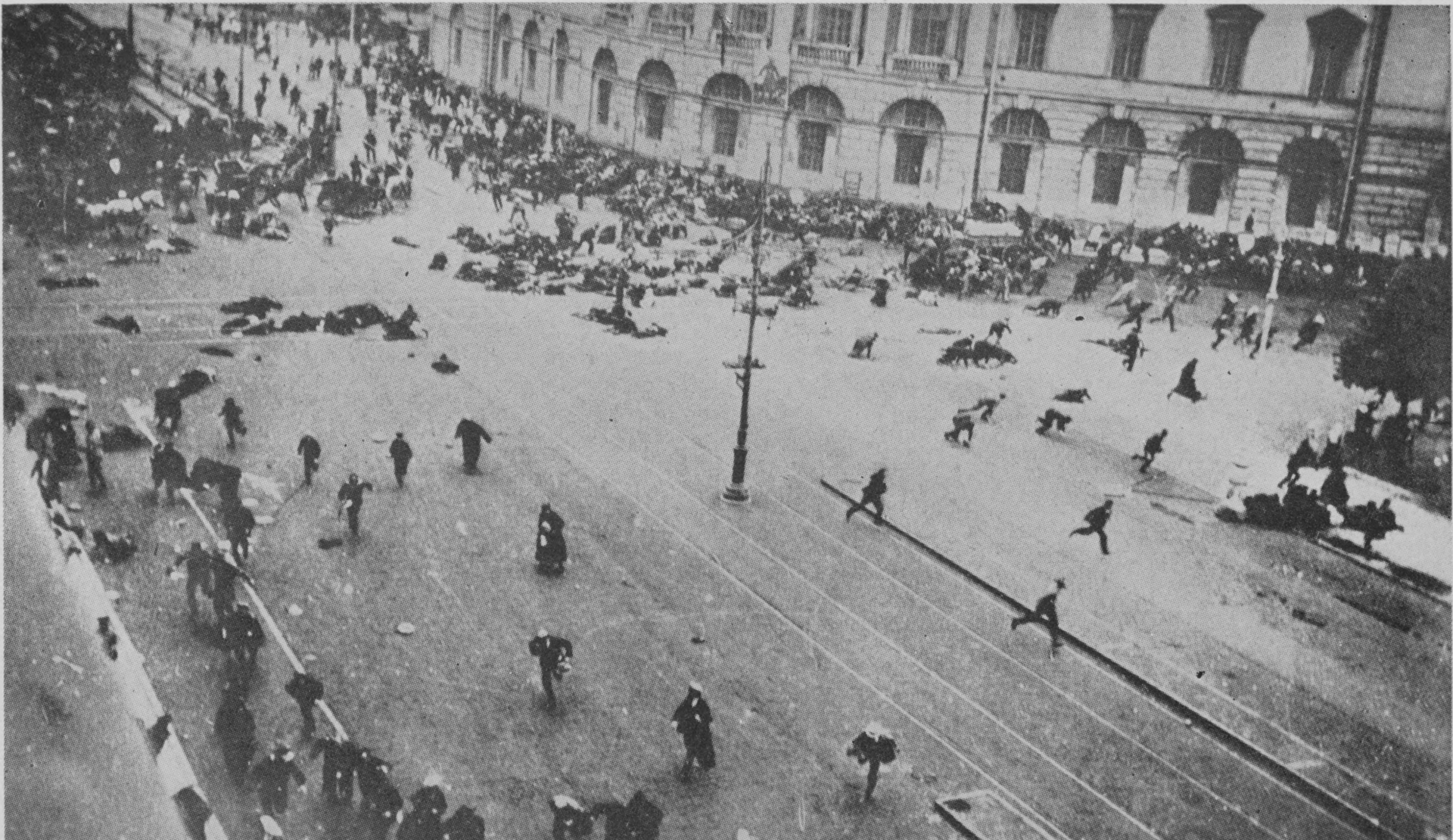

In this article
- 1Overview
- 2Background: The Romanov Autocracy and the First World War
- 3The February Revolution
- 4The Provisional Government and the Dual Power
- 5Lenin and the Bolsheviks
- 6The October Revolution
- 7The New Soviet Government and Initial Decrees
- 8Brest-Litovsk and the Exit from the War
- 9The Russian Civil War
- 10The Fate of the Romanovs
- 11Timeline: from the 1905 revolution to the end of the civil war
- 12Knowledge graph
Overview
The Russian Revolution, also called the Russian Revolution of 1917, consisted of two revolutions in that year.
Corruption and inefficiency were widespread in the imperial government, and ethnic minorities were eager to escape Russian domination, while peasants, workers and soldiers finally rose up after the enormous and largely pointless slaughter of World War I destroyed Russia's economy as well as its prestige as a European power. The February Revolution of 1917 was the second revolution in the Russian Empire after the Revolution of 1905.
1. Background: The Romanov Autocracy and the First World War
For more than three centuries the Romanov dynasty ruled Russia. Nicholas II, born May 6 [May 18, New Style] 1868 at Tsarskoye Selo, reigned as the last Russian emperor from 1894 to 1917. In 1894 he married Alexandra, a granddaughter of Queen Victoria; the couple had four daughters — Olga, Tatiana, Maria and Anastasia — and one son, Alexis. In 1913 the tsar celebrated the tercentenary of Romanov rule over an empire stretching from central Europe to the Pacific Ocean and from the Arctic to the borders of Afghanistan.
The First World War placed the autocracy under strains it could not contain, and the Russian Revolution stands among the most influential events to emerge from that conflict. Russia suffered a disastrous defeat at the Battle of Tannenberg in the first weeks of the war, with 78,000 Russian soldiers killed and wounded and 92,000 captured by the Germans. On September 5 1915 the emperor dismissed Grand Duke Nicholas and assumed supreme command himself; since he had no experience of war, almost all his ministers protested against the step as likely to impair the army's morale. The power vacuum left by the emperor's departure for the army was filled by Alexandra, who elevated unqualified favourites like Rasputin and disregarded signs of impending revolution.
On the night of December 16–17 (December 29–30, New Style) 1916, conservative nobles murdered Rasputin. The arch-monarchist chairman of the Council of Ministers, Ivan Goremykin, persuaded the tsar to reject the proposals of the Progressive Bloc; Goremykin and Nicholas II instead agreed to disband the Duma and institute more autocratic rule.
2. The February Revolution
The February Revolution unfolded between 22 February and 3 March 1917 by the Julian reckoning, corresponding to 8 through 16 March 1917 in the Gregorian calendar. Its setting was Petrograd, then the capital of the Russian Empire. The upheaval drew in the Bolsheviks, the Petrograd Soviet of Workers' and Soldiers' Deputies, the Provisional Government, and the Russian Army.
The collapse began amid declining wages and severe food shortages, which drove the populace of the capital into strikes and street demonstrations. On 22 February 1917 metal workers in Petrograd went on strike. The turning point came on 26 February, when troops sided with the crowds and fired on the police.
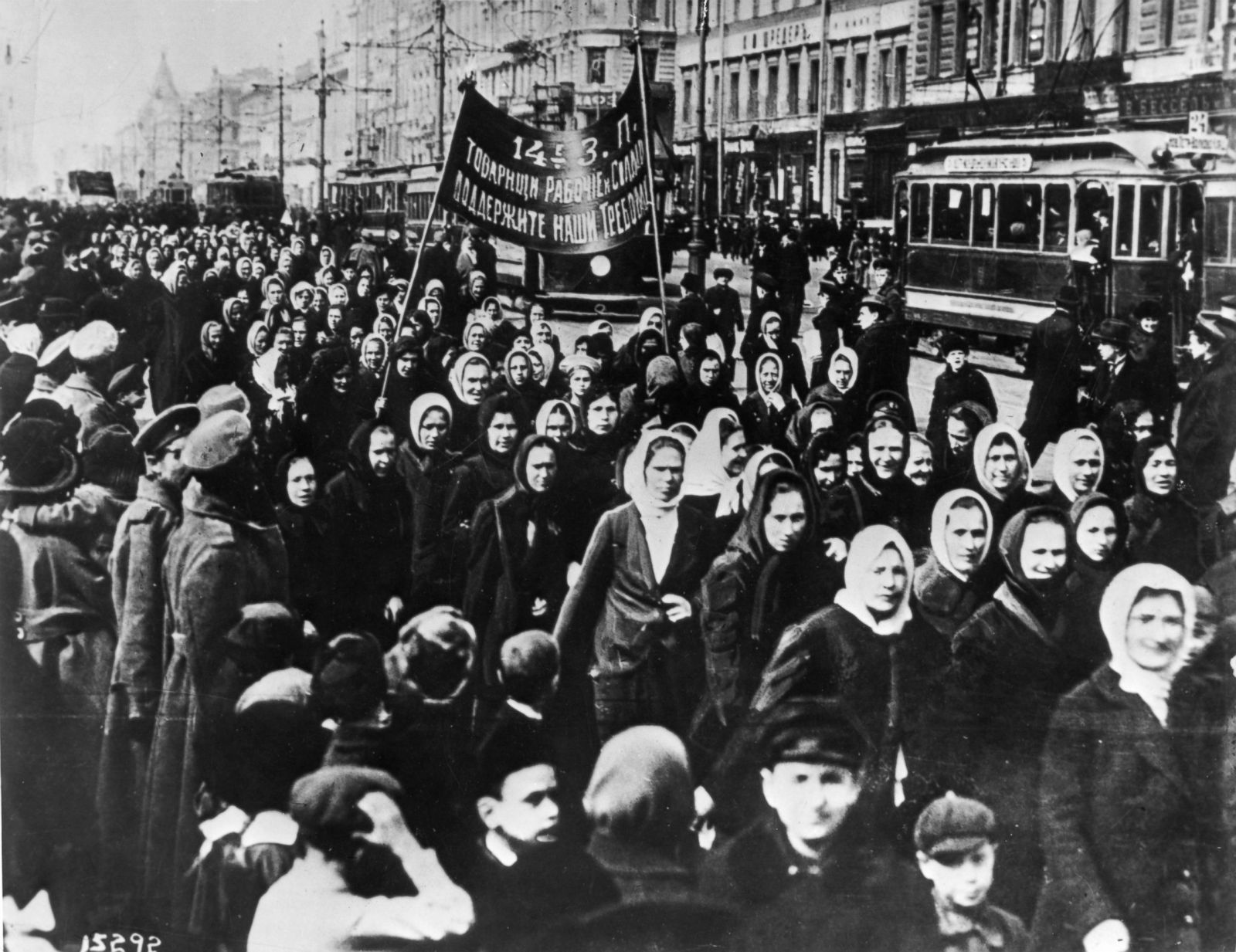

By 27 February, with Petrograd at a virtual standstill, key military units went over to the side of the crowds and seized arsenals of weapons, and the following day placed the tsarist ministers under arrest.
-
22 February 1917Metal workers strikeMetal workers in Petrograd went on strike 8The February Revolution in Russia in 1917 · Imperial War Museums ↗.
-
23 February 1917International Women's Day protestsFemale protesters marched against food rationing, and around 200,000 people filled the streets demanding the replacement of the tsar and an end to the war 8.
-
26 February 1917Troops side with the crowdsThe turning point came when troops sided with the crowds and fired on the police 5Revolutions (Russian Empire) · 1914-1918-online. International Encyclopedia of the First World War (Freie Universitat Berlin) ↗.
-
27 February 1917Key military units defectKey military units went over to the side of the crowds and seized arsenals of weapons 9February Revolution · Seventeen Moments in Soviet History, Michigan State University ↗.
3. The Provisional Government and the Dual Power
The first cabinet appointed by the Provisional Committee was led by Prince George E. L'vov as prime minister and minister of the interior, with Miliukov at foreign affairs, Guchkov at war and marine, and Kerenskii at justice. Its programme began with an immediate general amnesty for all political and religious offenses and with freedom of speech and press, extended to the army so far as war conditions permitted. The new government promised immediate preparation for a Constituent Assembly elected by universal and secret vote, which was to determine the form of government and draw up the constitution.
The Provisional Government had to share power with the Petrograd Soviet of Workers' and Soldiers' Deputies, an assembly of over 500 elected by ordinary people. Real power in Russia after the February Revolution lay with the socialist leaders of that Soviet, who were elected by popular mandate unlike the ministers of the Provisional Government.
Shortly after the February Revolution employers were forced to concede the eight-hour day and substantial wage rises. War production and inflation soon swallowed up the gains, leading to a new round of strikes.
4. Lenin and the Bolsheviks
Vladimir Lenin was born on April 10 (April 22, New Style) 1870 at Simbirsk and died on January 21, 1924, at Gorki. He was the founder of the Russian Communist Party (Bolsheviks), the leader of the Bolshevik Revolution, and the first head of the Soviet state, an office he held from 1917 until his death. As founder of the All-Russian Communist Party (Bolsheviks) and leader of the Bolshevik coup d'état of 1917, he created the Soviet Union and, along with Karl Marx, the communist worldview. He adopted the pseudonym Lenin in 1901, during his clandestine party work after exile in Siberia.
In the April Theses Lenin argued that the war under the new provisional government of Lvov unquestionably remained on Russia's part a predatory imperialist war. He held that not the slightest concession to revolutionary defencism was permissible. He further maintained that the masses must be made to see that the Soviets of Workers' Deputies were the only possible form of revolutionary government, and that state power should be transferred entirely to the Soviets.
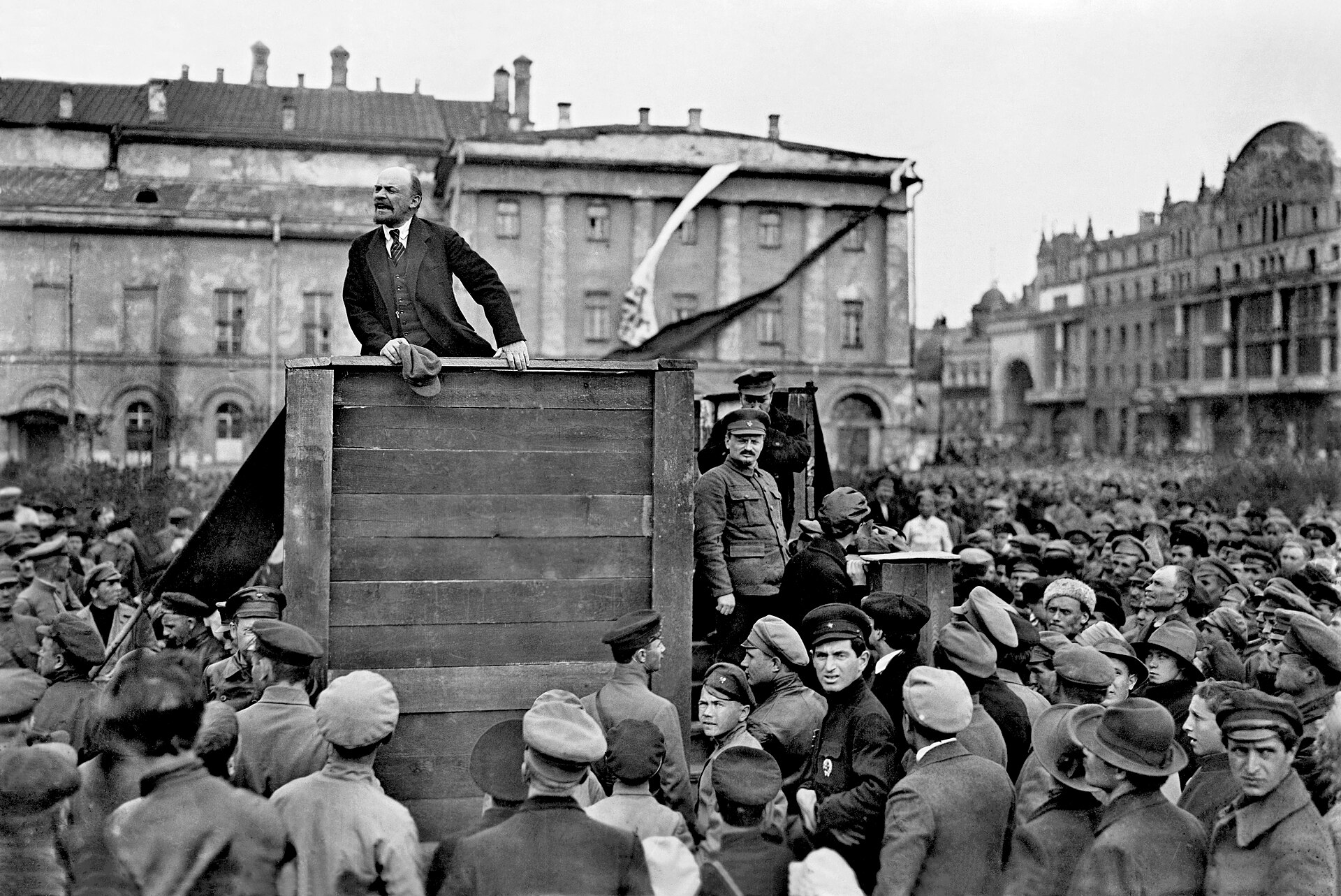

In September 1917 Lenin wrote to the Central Committee that the Bolsheviks, having obtained a majority in the Soviets of Workers' and Soldiers' Deputies of both capitals, could and must take state power into their own hands. He argued that it would be naive to wait for a formal majority for the Bolsheviks, since no revolution ever waits for that.
Lenin's party broke with democracy by ignoring the vote cast by 41 million Russians that gave a majority to the socialist revolutionaries in the Constituent Assembly — 370 out of 707 deputies against only 175 elected Bolsheviks.
5. The October Revolution
The events occurred in Petrograd, then the capital of the Russian Empire. The seizure of power came at the expense of more moderate social democrats, the Mensheviks, and of the conservative Whites.
The actual seizure of power was largely conducted by the Petrograd Soviet through its improvised Military Revolutionary Committee. Kerensky's ill-conceived decision to shut down the Bolsheviks' printing press turned out to be the impetus for the uprising, and on October 24 Red Guards and soldiers began to occupy key points in the city. On 24 October government troops took over the Bolshevik press in Petrograd, provoking Soviet countermeasures; later, on the evening of 25 October, Soviet forces infiltrated the Winter Palace and arrested the ministers. The battleship Aurora bombarded the Winter Palace with blank shells, the palace was stormed by Red Guards, and most of the Provisional Government's ministers waited there in anxious expectation.
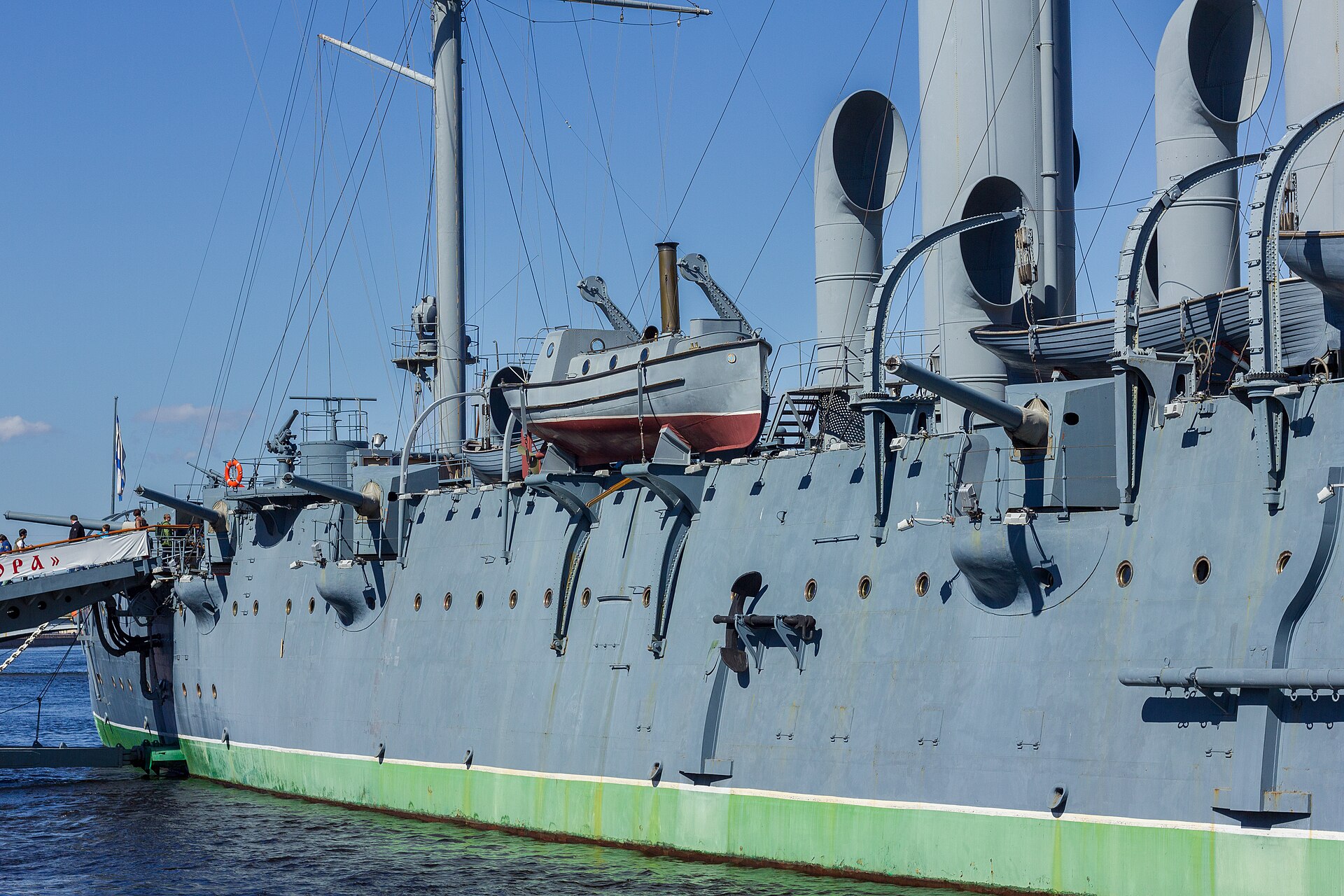
A proclamation issued at 10 a.m. on October 25 1917 announced that the Provisional Government had been deposed and that state power had passed into the hands of the Revolutionary Military Committee, which headed the Petrograd proletariat and the garrison. In the early hours of October 26 1917 the rump Second Congress of Soviets adopted a proclamation drafted by Lenin which laid out the new government's program. The Congress approved a new governing body, the Council of People's Commissars (Sovnarkom), consisting of all Bolsheviks, with Lenin as chairman and head of the government. As the Menshevik and Socialist Revolutionary delegates stormed out of the soviet congress in protest, Trotsky, the congress president, told them to join the rubbish heap of history. Lenin, Trotsky and their compatriots launched a successful coup that overthrew the Provisional Government, a coup which, remarkably, had been advertised ahead of time by the Bolsheviks' own newspaper.
-
24 October 1917The Bolshevik press is seizedGovernment troops took over the Bolshevik press in Petrograd, provoking Soviet countermeasures 5. Kerensky's decision to shut down the printing press turned out to be the impetus for the uprising, and Red Guards and soldiers began to occupy key points in the city 15The October Revolution · Seventeen Moments in Soviet History, Michigan State University ↗.
-
25 October 1917The Winter Palace is infiltratedOn the evening of 25 October, Soviet forces infiltrated the Winter Palace and arrested the ministers 5.
-
26 October 1917The Second Congress of Soviets actsIn the early hours of October 26 the rump Second Congress of Soviets adopted a proclamation drafted by Lenin which declared the Provisional Government overthrown and laid out the new government's program 17First Bolshevik Decrees: The Formation of the Soviet Government and Its First Acts · Seventeen Moments in Soviet History, Michigan State University ↗. The Congress approved the Council of People's Commissars, with Lenin as chairman and head of the government 17.
6. The New Soviet Government and Initial Decrees
Among the initial measures, the decree on peace called on the belligerent powers to cease hostilities and commit to no annexations or indemnities, appealing to workers in Britain, France and Germany to press their governments toward negotiations for a just peace. The land decree proclaimed that private ownership of land shall be abolished forever.
7. Brest-Litovsk and the Exit from the War
At Brest-Litovsk, from 22 December 1917 to 10 February 1918 (Julian calendar: 9 December to 28 January), Soviet representatives and the Central Powers negotiated a separate peace. The Soviet government's initial strategy, articulated by Trotsky, was neither war nor peace: he argued that the negotiations should be used for propaganda purposes. An armistice was signed on December 2 1917; a formal treaty followed only on March 3 (New Style) 1918 while military action continued for several months as the German army pushed into territories nominally under Soviet control. After the Germans resumed military operations on February 18 and presented stiffer demands that included an end to the Soviet presence in Ukraine and the Baltic provinces, Lenin achieved a majority in the Central Committee in favor of accepting the enemy's terms.
On 3 March 1918 — following the breakdown of the talks and a new German offensive — Lenin accepted the dictated peace that deprived Russia of eighteen provinces and nearly 30 percent of its pre-war population. The treaty was executed in quintuplicate at Brest-Litovsk on 3 March 1918 by the plenipotentiaries of both sides. The treaty's first article declared that the state of war between Germany, Austria-Hungary, Bulgaria and Turkey on the one part and Russia on the other had ceased. Within a few days of the German victory Finland, Estonia, Latvia, Lithuania, Poland, Ukraine and Belarus gained independence, and British and American troops landed in northern Russia.
8. The Russian Civil War
The Russian Civil War ran from June 1918 to 1920, a confrontation between the proponents of restoring the deposed old regime, known as the Whites, and those who defended the new socialist regime that emerged from the October Revolution, the Reds. It was a conflict in which the Red Army successfully defended the newly formed Bolshevik government led by Lenin against various Russian and interventionist anti-Bolshevik armies. Opponents of the Bolsheviks ranged from the Social Revolutionaries and Mensheviks to the rightist Whites, whose main asset was the Volunteer Army in the Kuban steppes, placed under General Denikin's command in April 1918 and turned into a fine fighting force. The Czechoslovak Legion, composed of Czech and Slovak deserters from the Austro-Hungarian army, was ordered by Trotsky in May 1918 to surrender its arms during its evacuation from Russia.
The ranks of the Red Army swelled from 360,000 men in July to 800,000 in November, 1.5 million in May 1919 and 5.5 million by late 1920, while desertion remained a big problem. In early 1921 the sailors of Kronstadt mutinied and joined workers and peasants in calling for an end to the Bolshevik dictatorship, free elections, freedom of speech and equality in rationing.
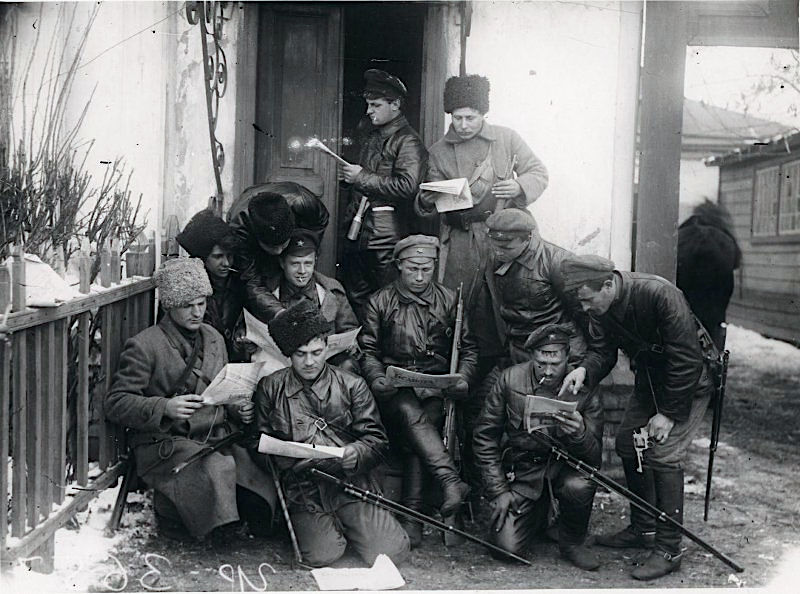

The Cheka's military detachments, tribunals and special prisons had begun to unleash the Red Terror on 31 August 1918, and many high-ranking Bolsheviks were strongly opposed to this state within the state.
9. The Fate of the Romanovs
The abdication left Russia without a sovereign for the first time since 1613, the year the Time of Troubles preceded the accession of Michael, founder of the Romanov dynasty. The tsar, his family and their loyal retainers were then detained by the provisional government and moved to Yekaterinburg. On 17 July 1918, when White army forces approached the area, the tsar and his entire family were slaughtered on Bolshevik orders to prevent their rescue.
Nicholas inserted a provision to leave the throne to his younger brother, Grand Duke Mikhail, but the soviets demanded "No more Romanovs! We want a Republic!". Mikhail was technically czar for a day before issuing his own abdication manifesto.
10. Timeline: from the 1905 revolution to the end of the civil war
- 1905Revolution of 1905 and the October ManifestoThe Revolution of 1905 compelled Nicholas II to issue the October Manifesto, which ostensibly transformed Russia from an unlimited autocracy into a constitutional monarchy.
- 1 August 1914Germany declares war on RussiaGermany declared war on Russia, turning the Third Balkan War into a continental and then world war; the pressures of the war would set the scene for revolution.
- December 1916Murder of RasputinRasputin was murdered by a group of conservative nobles, but by then the system was beyond salvation.
- 23 February 1917 (8 March New Style)February Revolution begins in PetrogradWorking-class women observing International Women's Day took to the streets against food shortages and high bread prices, and strikes spread across the capital.
- 2 March 1917 (15 March New Style)Abdication of Nicholas IIUnder the pressure of his generals and Duma politicians, the tsar abdicated for himself and his son and handed the succession to his brother, Grand Duke Michael Aleksandrovich.
- 2 March 1917Provisional Government formedThe provisional committee of the State Duma declared itself a Provisional Government under Prince L'vov, sharing power with the Petrograd Soviet of Workers' and Soldiers' Deputies.
- 3 April 1917 (16 April New Style)Lenin returns and issues the April ThesesLenin arrived in Petrograd from exile and read his theses rejecting support for the Provisional Government and calling for power to pass to the Soviets.
- 3–7 July 1917The July DaysArmed sailors from Kronstadt and their worker and soldier allies brought the Provisional Government to the brink; only the refusal of the left-wing parties to lead an overthrow saved it for the moment.
- Late August 1917The Kornilov affairKornilov moved troops towards Petrograd; Kerensky had him arrested and armed the Petrograd Soviet in response, discrediting the right and strengthening the Bolsheviks.
- 10 October 1917Bolshevik Central Committee votes for uprisingBy a vote of 10-2 the Central Committee made an armed uprising the order of the day.
- 25 October 1917 (7 November New Style)The October RevolutionRed Guards and soldiers occupied key points in Petrograd, the battleship Aurora fired blank shells at the Winter Palace and the ministers of the Provisional Government were arrested.
- 26 October 1917First Bolshevik decreesThe Second Congress of Soviets adopted decrees on peace and land and formed the Council of People's Commissars with Lenin as chairman.
- 3 March 1918Treaty of Brest-LitovskLenin accepted a dictated peace with the Central Powers after the breakdown of talks and a new German offensive, ending Russia's participation in the First World War.
- 17 July 1918Execution of the RomanovsAs anti-Bolshevik forces approached Yekaterinburg, Nicholas and his family were executed, almost certainly on the orders of Lenin.
- 1918–1920The Russian Civil WarThe Red Army successfully defended the newly formed Bolshevik government led by Lenin against various Russian and interventionist anti-Bolshevik armies.
- February–March 1921Kronstadt mutinyThe sailors of Kronstadt mutinied and joined workers and peasants in calling for an end to the Bolshevik dictatorship, free elections and freedom of speech.
References (24)
- 1Russian Revolution | Definition, Causes, Summary, History, & Facts — Encyclopaedia Britannica WebView source
- 2February Revolution of 1917 — Internet Encyclopedia of Ukraine, Canadian Institute of Ukrainian Studies 1917 WebView source
- 3Nicholas II | Biography, Wife, Abdication, Death, & Facts — Encyclopaedia Britannica WebView source
- 4War and Revolution in Russia 1914 - 1921 — BBC (Dr Jonathan Smele) 1914 WebView source
- 5Revolutions (Russian Empire) — 1914-1918-online. International Encyclopedia of the First World War (Freie Universitat Berlin) 1914 Web↩View source
- 6What You Need to Know First to Understand the Russian Revolution — Smithsonian Magazine WebView source
- 7Russian Empire — 1914-1918-online. International Encyclopedia of the First World War (Freie Universitat Berlin) 1914 WebView source
- 8The February Revolution in Russia in 1917 — Imperial War Museums 1917 Web↩View source
- 9February Revolution — Seventeen Moments in Soviet History, Michigan State University 1917 Web↩View source
- 10Formation of the Provisional Government — Seventeen Moments in Soviet History, Michigan State University 1917 WebView source
- 11Vladimir Lenin | Biography, Facts, & Ideology — Encyclopaedia Britannica WebView source
- 12The Tasks of the Proletariat in the Present Revolution (The April Theses) — Marxists Internet Archive (V. I. Lenin, Collected Works) 1917 WebView source
- 13The Bolsheviks Must Assume Power: A Letter to the Central Committee — Marxists Internet Archive (V. I. Lenin, Collected Works) 1917 WebView source
- 14Russian Civil War — 1914-1918-online. International Encyclopedia of the First World War (Freie Universitat Berlin) 1914 WebView source
- 15The October Revolution — Seventeen Moments in Soviet History, Michigan State University 1917 Web↩View source
- 16To the Citizens of Russia! — Marxists Internet Archive (V. I. Lenin, Collected Works) 1917 WebView source
- 17First Bolshevik Decrees: The Formation of the Soviet Government and Its First Acts — Seventeen Moments in Soviet History, Michigan State University 1917 Web↩View source
- 18Brest-Litovsk, Treaty of — 1914-1918-online. International Encyclopedia of the First World War (Freie Universitat Berlin) 1914 WebView source
- 19Treaty of Brest Litovsk — Seventeen Moments in Soviet History, Michigan State University 1917 WebView source
- 20The Peace Treaty of Brest-Litovsk, 3 March 1918 — The Avalon Project, Yale Law School 1918 WebView source
- 21Russian Civil War | Casualties, Causes, Combatants, & Outcome — Encyclopaedia Britannica WebView source
- 22The Abdication of Nicholas II Left Russia Without a Czar for the First Time in More Than 300 Years — Smithsonian Magazine WebView source
- 23BBC - History - Historic Figures: Nicholas II (1868-1918) — BBC 1868 WebView source
- 24Abdication Manifesto — Seventeen Moments in Soviet History, Michigan State University 1917 WebView source