Silk
The animal fibre first reeled in Neolithic China: how sericulture works, how silk travelled the Silk Road, and how Byzantium, Italy and France built silk industries of their own.
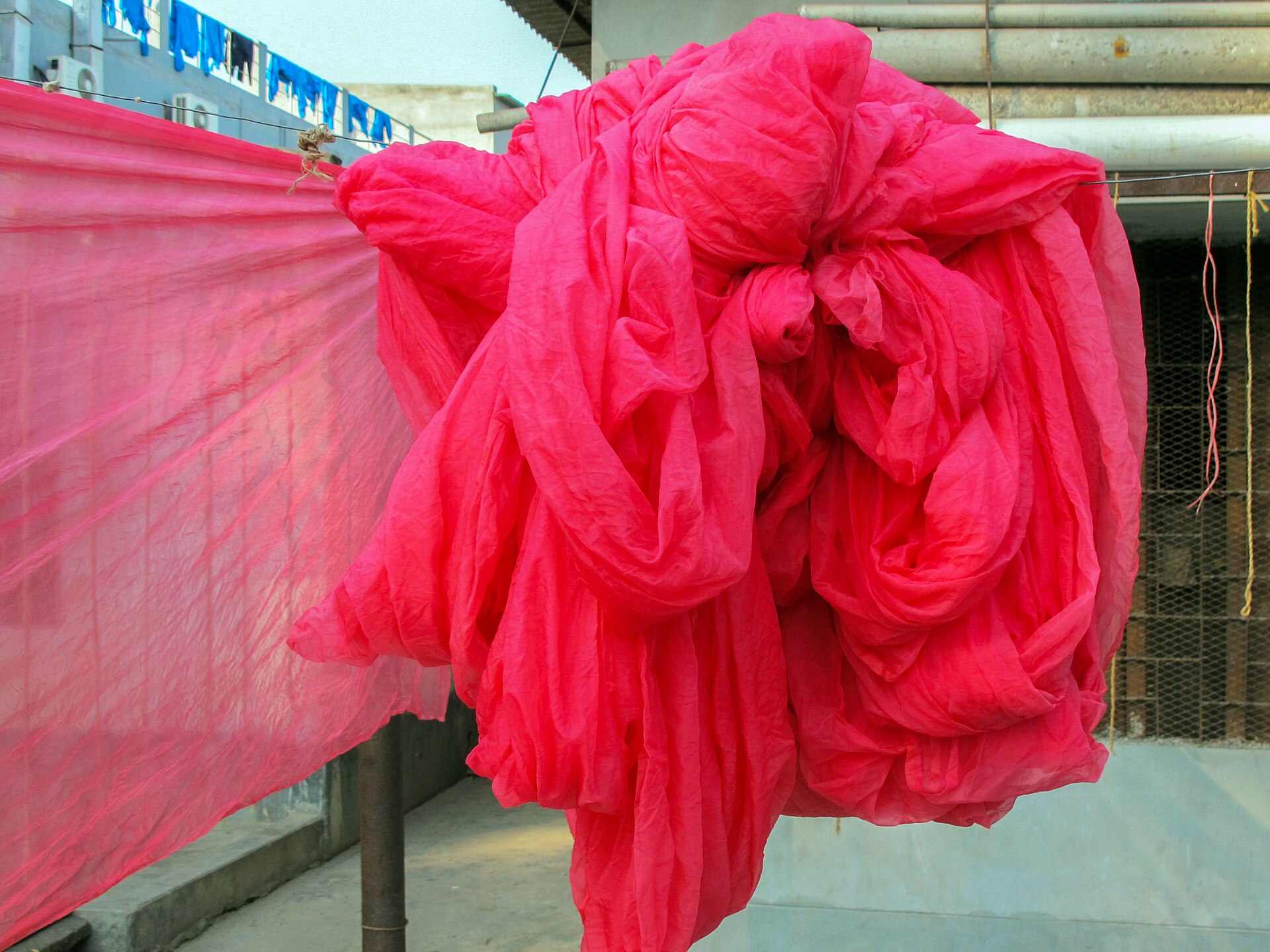
Silk is the continuous filament spun by the larvae of the domesticated silkworm, Bombyx mori, and reeled from its cocoon — a fibre first produced in Neolithic China, where the earliest examples of woven silk date to about 2700 BCE and silk protein traces have been found in 8,500-year-old tombs at Jiahu. For centuries silk was China's most important export and gave its name to the Silk Road, the caravan network that carried it west to Persia, Rome and Byzantium, where the industry took root in the sixth century CE. Byzantium, Italy, France and later Japan built their own silk trades, and the Jacquard loom developed for Lyon's weavers became a landmark of industrial technology.
In this article
- 1Overview
- 2The Silkworm and the Fibre
- 3Sericulture
- 4Origins and Early China
- 5The Silk Road
- 6Transmission to Byzantium and the Mediterranean
- 7European Silk Industries
- 8Japan and the Tomioka Silk Mill
- 9Production and Trade Today
- 10Silk in Language
- 11Key Dates
- 12Timeline: from Neolithic silk to the Jacquard loom
- 13Frequently asked questions
- 14Knowledge graph
Overview
Silk is an animal fibre produced by certain insects and arachnids for cocoons and webs; in commercial use it is almost entirely limited to filaments from the cocoons of domesticated silkworms of the genus Bombyx. The domesticated silkworm is Bombyx mori, of the genus Bombyx. Silk is a fabric first produced in Neolithic China from the filaments of the cocoon of the silkworm, and it became a staple source of income for small farmers and China's most important export for much of its history.
1. The Silkworm and the Fibre
The silkworm of sericulture is Bombyx mori, a domesticated insect whose larvae are caterpillars about 4 cm long including their horned tail, while the adults are moths with a 4 cm wingspan. Because they have been cultivated for so long for sericulture, Bombyx mori have lost an adaptation helpful to feeding in the wild and must be fed by humans. A single silkworm specimen can produce a 0.025 mm thick thread over 900 metres long, and several such filaments are twisted together to make a thread thick enough to weave.
Silk fibre is a polymer composed of sericin and fibroin, with fibroin built from a light chain of about 26 kDa and a heavy chain of about 390 kDa.
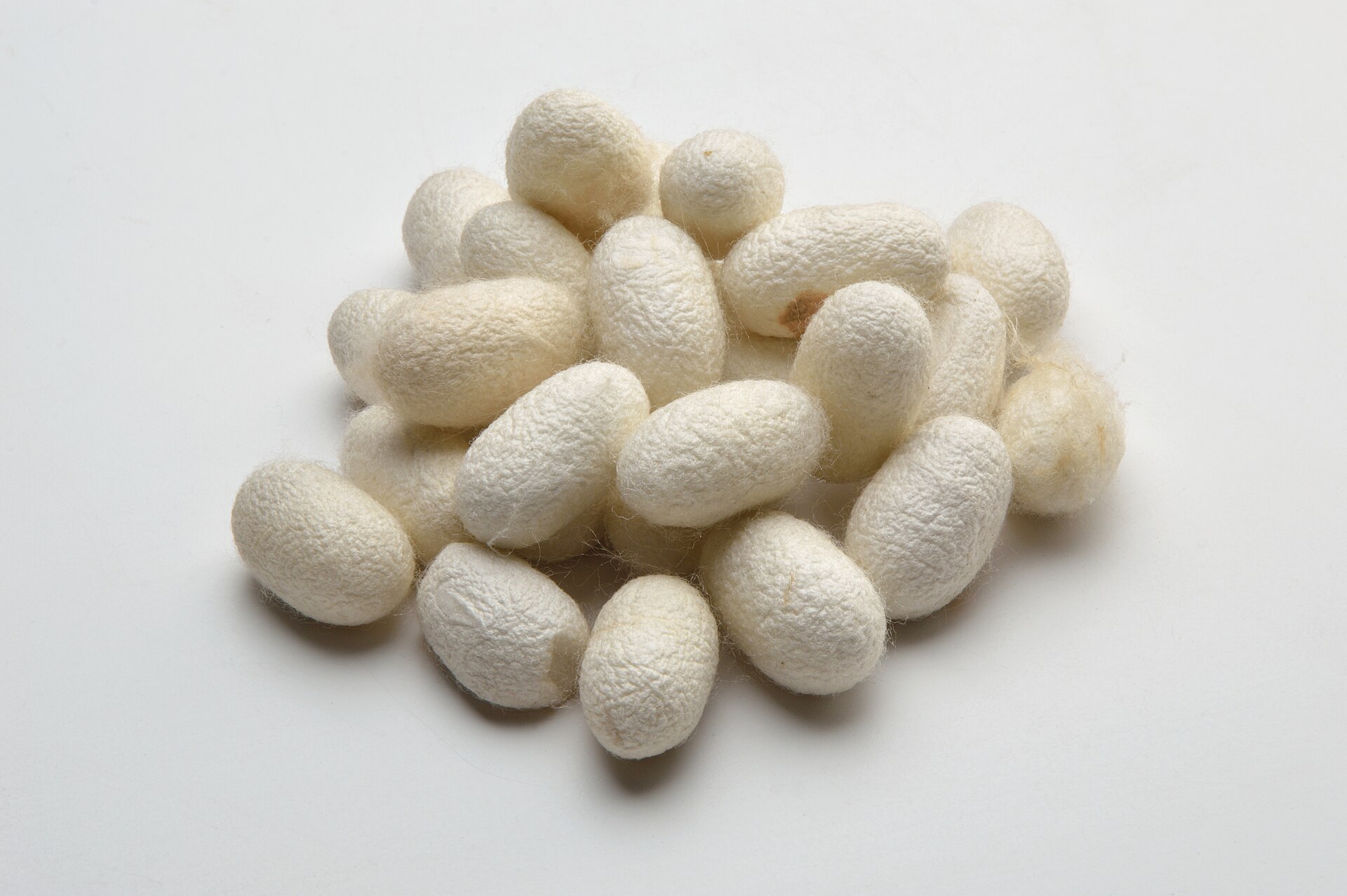
In just 30 to 32 days a silkworm grows from a birth weight of half a milligram to around five grams and 8 to 9 centimetres long, then spins its cocoon from one continuous filament up to 1,200 metres long. The cocoon yields a usable filament length of about 600 to 900 metres (2,000 to 3,000 feet) per cocoon.
2. Sericulture
Sericulture is the production of raw silk by raising caterpillars, particularly those of Bombyx mori, from the egg stage through to the cocoon, with mulberry trees cultivated to feed them. The work covers the cultivation of mulberry leaves, the tending of the worms, the gathering of the threads and the weaving of the finished cloth. The eggs are minute, and they must be kept at the correct temperature while the hatched worms are fed mulberry leaves around the clock.
Because a moth emerging from the cocoon would break the filament, the larva is killed by steam or hot air while it is still at the chrysalis stage. The cocoons are then placed in hot water so that the end of the filament can be found and reeled. Reeling unwinds the filaments of several cocoons into a single strand, while throwing twists strands together; short lengths taken from damaged cocoons are worked into spun silk.
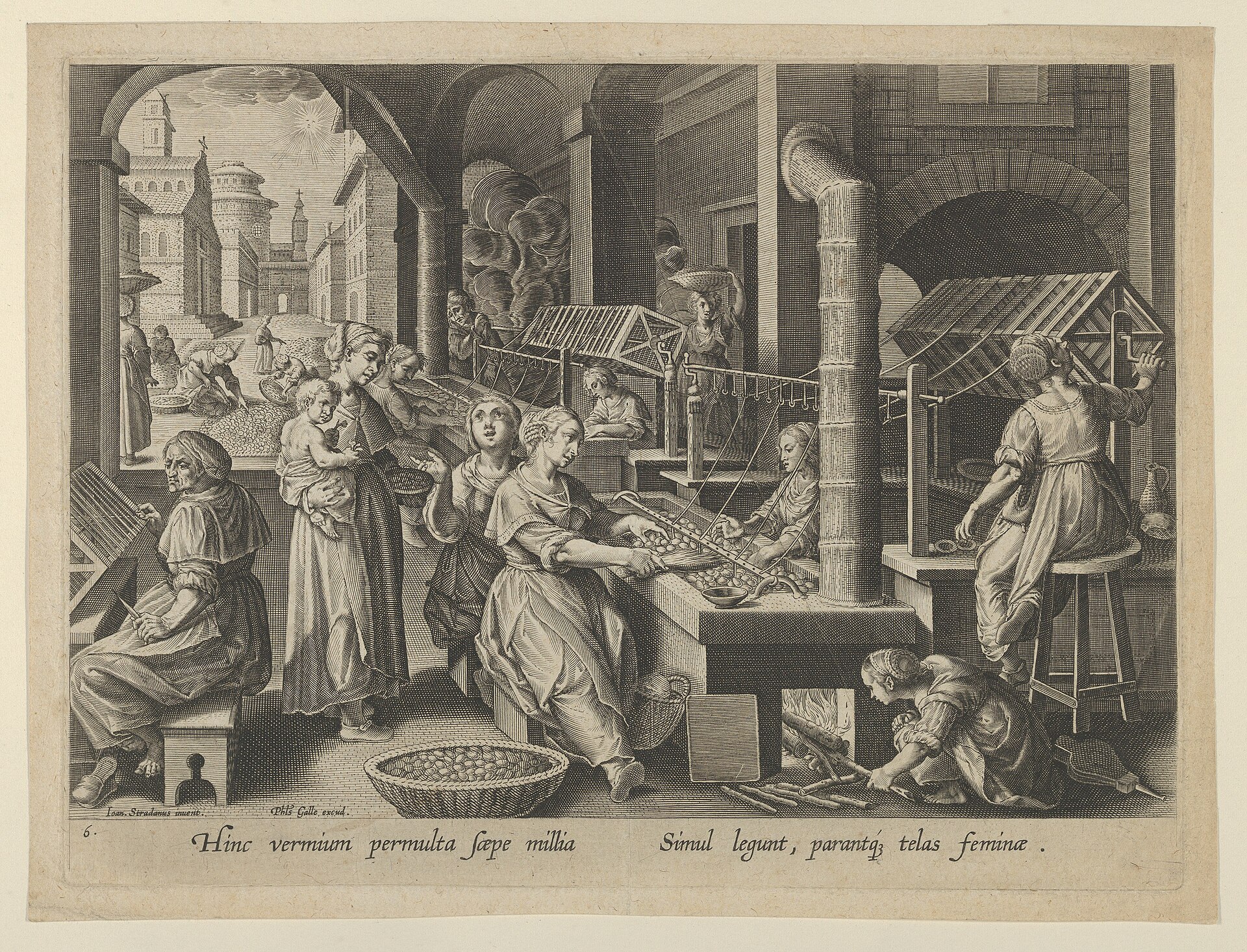
In the finished yarn, ten filaments make one thread, and a pound of silk requires 3,000 cocoons. The thickness of filament yarn is expressed in denier, the weight in grams per 9,000 metres.
3. Origins and Early China
The earliest biomolecular trace of silk comes from soil rather than cloth. Chinese scientists found evidence of silk dating back 8,500 years after testing soil samples from the Neolithic site of Jiahu in Henan province, research published in the journal PLOS ONE. The Jiahu site in Henan's Wuyang county had settlers as early as 7,000 BC, and researchers found evidence of prehistoric fibroin in soil samples collected from three tombs. Jiahu lies in the middle of Henan Province and is one of the most representative early Neolithic ruins in central China. The earliest known examples of woven silk date to about 2700 BCE and come from the site of Qianshanyang in Zhejiang, China. Under the Han dynasty silk became finer and stronger, with some pieces woven at 220 warp threads per centimetre, and from the 1st century CE cultivators adjusted the temperature of the worms' environment to speed up or slow their growth. Bolts of silk served as a form of currency in China — tribute, taxes, payments and even army wages were settled in silk — and in 25 BCE alone the Han gave 20,000 rolls of silk cloth as gifts. The weaving of damask probably existed in the Shang dynasty, and tombs of the 4th-3rd centuries BCE at Mashan near Jiangling, excavated in 1982 yielded outstanding brocade, gauze and embroidery as well as the first complete garments.
4. The Silk Road
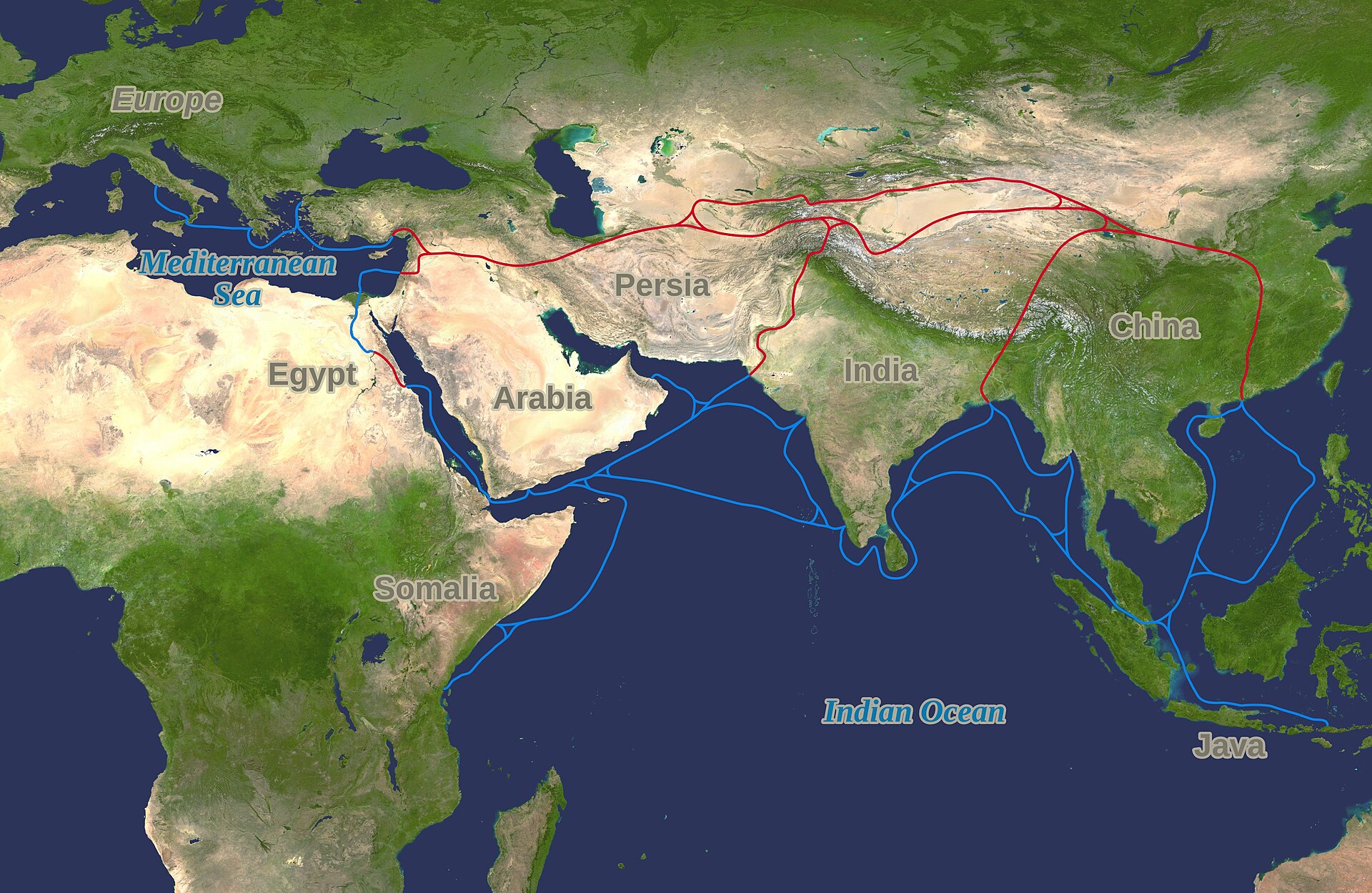
Land transport along the Silk Road relied on river craft and pack animals, notably the sturdy Bactrian camel, while sea travel depended on the Indian Ocean monsoons blowing from the southwest in summer and the northeast in autumn. The Chang'an-Tianshan Corridor, a 5,000 km section of the Silk Roads network, ran from Chang'an/Luoyang — capital of China in the Han and Tang dynasties — to the Zhetysu region of Central Asia. That corridor took shape between the 2nd century BC and 1st century AD and stayed in use until the 16th century. The Silk Roads were an interconnected web of routes linking the ancient societies of Asia, the Subcontinent, Central Asia, Western Asia and the Near East, stretching about 7,500 km as the crow flies but over 35,000 km along specific routes.
The 33 inscribed sites of the Tian-shan corridor include capital cities and palace complexes, trading settlements, Buddhist cave temples, ancient paths, posthouses, passes, beacon towers, sections of the Great Wall, fortifications, tombs and religious buildings.

5. Transmission to Byzantium and the Mediterranean
Silkworms were first brought from Asia to Byzantium around AD 550, and legend holds that two monks hid silkworm eggs inside a bamboo pole to smuggle them out of China, where they were guarded as closely as state secrets. The Byzantine emperor Justinian, weary of paying the exorbitant prices the Chinese demanded for silk, sent two emissaries disguised as monks to steal silkworms and smuggle them back to the west. The plan succeeded, and with it began the Byzantine silk industry. The art of sericulture reached Khotan through a political marriage in AD 440 when a Chinese princess smuggled silkworm eggs in her elaborate headdress as a wedding gift.
Procopius records that monks came from India to Justinian about 550 CE and promised that the Romans would no longer buy silk from the Persians, undertaking instead to provide the materials for making silk themselves.
6. European Silk Industries
In 1536 the Piedmontese merchants who settled in Lyon obtained royal letters patent from Francis I establishing the guild of workers in cloths of gold, silver and silk, exempt from taxes on condition that they worked within the city. By 1548 some 459 master craftsmen took part in the procession for King Henry II and between 800 and 1,000 people made a living from silk production in Lyon. Responding to a prize offered in 1801 for improving weaving looms, Joseph Marie Jacquard proposed a mechanism that allowed a single worker to create a complex fabric instead of several workers as before. The first mechanical loom was installed in Lyon only in 1843 and just 7,000 existed by 1875 while by 1866 there were 30,000 looms in Lyon and 95,000 in the surrounding countryside. Benjamin Franklin was one of the supporters of a Philadelphia filature, a silk reeling mill that opened in 1770 in the city.
Once the beating heart of the global silk trade, Macclesfield built a mighty industrial legacy, and its Paradise Mill holds the world's finest collection of historic Jacquard silk looms in their original setting.
Attempts to develop a US silk industry date to the early 1600s, when King James I encouraged settlers in Jamestown, Virginia, to abandon tobacco for sericulture, and German-Swiss immigrants brought sericulture to South Carolina and Georgia.
7. Japan and the Tomioka Silk Mill
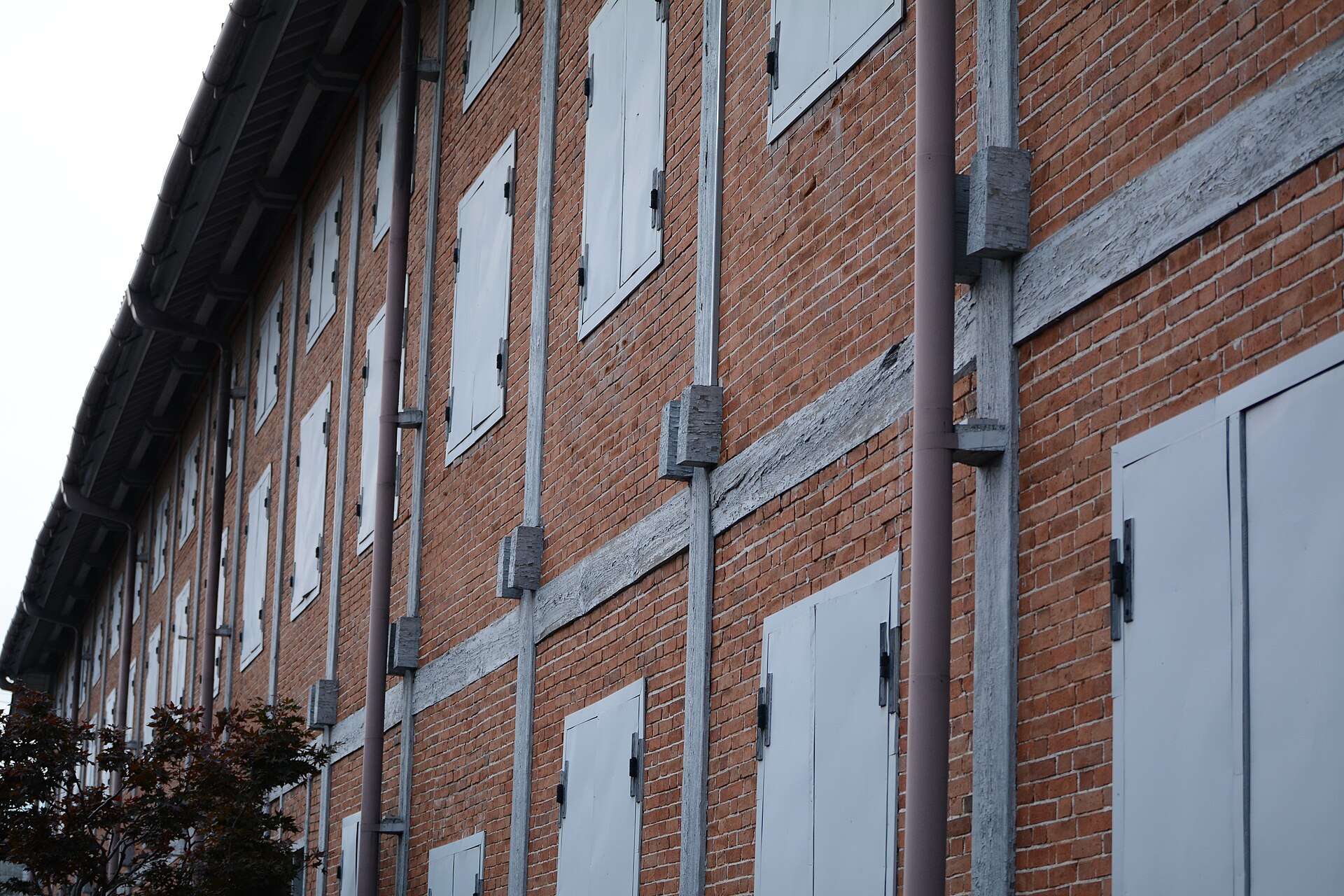
The Tomioka Silk Mill and Related Sites is a historic sericulture and silk mill complex established in the late 19th and early 20th century in Gunma prefecture, north-west of Tokyo.
The complex consists of four sites covering the stages of raw silk production: a reeling plant whose machinery and industrial expertise were imported from France, an experimental farm for cocoons, a sericulture school and a cold-storage facility for silkworm eggs. Tomioka illustrates Japan's desire to rapidly access the best mass production techniques and became a decisive element in the renewal of sericulture and the Japanese silk industry in the last quarter of the 19th century.
8. Production and Trade Today
The major silk producing countries are China, India, Uzbekistan, Brazil, Japan, the Republic of Korea, Thailand, Vietnam, DPR Korea and Iran. China and India stand first and second among them, with Uzbekistan, Brazil, Japan, Thailand, Vietnam and Iran also counted among the leading producers. Sericulture is labour-intensive: about 1 million workers are employed in the silk sector in China, the industry provides employment to 7.9 million people in India, and there are 20,000 weaving families in Thailand.
Silk accounts for less than 0.2 per cent of the global textile market, yet its production base is spread over 60 countries. Asia holds 90 per cent of mulberry production and almost 100 per cent of non-mulberry silk.
Silk remained China's number one export for centuries, until porcelain and tea rivalled it from the 15th century CE. By the 20th century Japan had replaced China as the world's largest silk producer.
9. Silk in Language
The Persian word for silk, abrīšam, has an etymology that remains uncertain, though it appears to be connected with New Persian reštan, meaning 'to spin'. The term travelled beyond Persian as a loanword, surfacing in Armenian as aprišum, in Syriac and Mandean as ʾbryšwm, and in Arabic as ebrīsam. Within Persian silk vocabulary, abrīšam is further linked to rēšma, meaning belt, to rīšm(ī) or rīšmān(ī), meaning silken, and to rīsmān, meaning cord or string. In East Iranian, by contrast, pīl(e) stands in place of abrīšam, corresponding to New Persian pīla, which denotes the silkworm or its cocoon.
10. Key Dates
-
8,500 years agoBiomolecular evidence at JiahuMass spectrometry and proteomics detected direct biomolecular evidence of silk fibroin in soils from 8,500-year-old tombs at Jiahu — the first finding of its kind — alongside rough weaving tools and bone needles.5Biomolecular Evidence of Silk from 8,500 Years Ago · PLOS ONE (Gong, Li, Gong, Yin & Zhang, 2016) ↗
-
around 3600 BCESericulture enters the archaeological recordSericulture — the cultivation of mulberry leaves, the tending of silkworms, the gathering of threads from their cocoons and the weaving of silk — first appears in the archaeological record of ancient China around 3600 BCE.3Silk in Antiquity · World History Encyclopedia (Mark Cartwright) ↗
-
2nd millennium BCELarge-scale production under the Shang and ZhouSilk production on a large scale and with more sophisticated weaving techniques appeared from the Chinese Shang and Zhou dynasties in the 2nd millennium BCE.3
11. Timeline: from Neolithic silk to the Jacquard loom
- c. 6500 BCE (about 8,500 years ago)Silk protein traces at JiahuMass spectrometry of soil from three tombs at Jiahu in Henan Province found silk fibroin in a tomb dating back 8,500 years, the earliest direct biomolecular evidence of silk.
- c. 3600 BCEFirst appearance of silk in ChinaSericulture — mulberry cultivation, tending silkworms, gathering threads and weaving — first appears in the archaeological record of ancient China, with Neolithic weaving tools and silk gauze found at Hemudu in Zhejiang.
- c. 2700 BCEEarliest known woven silkThe earliest known examples of woven silk come from the site of Qianshanyang in Zhejiang province, China.
- Shang dynasty, 2nd millennium BCESilk weaving in the Shang dynastyLarge-scale silk production with sophisticated weaving appears under the Shang and Zhou dynasties; the weaving of damask probably existed in the Shang dynasty, and Shang silk has been found in an Egyptian tomb.
- 138 BCEZhang Qian's mission to the westEmperor Wu of the Han sent his emissary Zhang Qian west to negotiate with the Yuezhi against the Xiongnu, opening contact between China and Central Asia.
- 130 BCEThe Silk Road formally openedAfter the Han defeated the Xiongnu with western horses from the Dayuan, Emperor Wu opened the Silk Road to trade with the west in 130 BCE.
- 25 BCESilk as imperial gift and currencyIn 25 BCE alone the Han gave 20,000 rolls of silk cloth as gifts; bolts of silk served as tribute, tax, payment and sometimes army wages.
- c. 60 CEThe west learns silk comes from wormsAround 60 CE the west became aware that silk was not grown on trees but spun by silkworms; the Chinese had kept the origin of silk secret and carefully guarded their worms.
- 542 CEPlague reaches ConstantinopleThe bubonic plague of 542 CE, thought to have arrived in Constantinople by way of the Silk Road, decimated the Byzantine Empire.
- c. 550 CESericulture reaches the Byzantine EmpireSilkworms were first brought from Asia to Byzantium around AD 550; legend has it that two monks hid silkworm eggs inside a bamboo pole to smuggle them out of China, and the eggs reached the emperor Justinian in Constantinople.
- 12th–13th centuriesSilk reaches ItalySilkworms reached Italy through Sicily in the 12th century, and by the 13th century sericulture had migrated north to the Po River Valley.
- 1453 CEThe Silk Road closesWhen the Byzantine Empire fell to the Turks in 1453 CE the Ottoman Empire closed the ancient routes of the Silk Road and cut ties with the west, pushing merchants to take to the sea.
- 1536The Lyon silk industry is foundedRoyal letters patent of King Francis I established the guild of workers in cloths of gold, silver and silk at Lyon, exempting Turquet, Naris and their workers from taxes on condition that they worked within the city.
- 1801Jacquard's loom mechanismJoseph Marie Jacquard proposed a mechanism that allowed a single worker to create a complex fabric; once perfected the number of machines rose from 41 in 1811 to 1,879 in 1820.
- 1866Peak of Lyon silk weavingThe first mechanical loom was installed in Lyon only in 1843 and just 7,000 existed by 1875, while by 1866 there were 30,000 looms in Lyon and 95,000 in the surrounding countryside.
12. Frequently asked questions
How long was the Silk Road, and when was it formally opened and closed?
When did the earliest woven silk appear, and where was it found?
The earliest woven silk dates to c. 2700 BCE and comes from Qianshanyang in Zhejiang province, China.3
Who is credited in legend with teaching the art of silk?
The wife of the mythological Yellow Emperor, Huangdi, is credited with teaching the art.1Silk | Definition & History · Encyclopaedia Britannica ↗
How many people work in silk production today?
About 1 million workers are employed in the silk sector in China, the industry provides employment to 7.9 million people in India, and there are 20,000 weaving families in Thailand.17Silk Industry Statistics · International Sericultural Commission ↗
When did the Lyon silk industry begin, and what privileges did it hold?
It was founded in 1536 under letters patent of Francis I, and from 1540 it held a monopoly on raw silk imports.13History of silk production in Lyon · Wikipedia ↗
When was the Tomioka Silk Mill inscribed on the World Heritage List, and how many sites does it comprise?
It was inscribed on the World Heritage List in 2014, and it comprises four sites in Gunma prefecture, Japan.16Tomioka Silk Mill and Related Sites · UNESCO World Heritage Centre ↗
References (19)
- 1Silk | Definition & History — Encyclopaedia Britannica Web↩View source
- 2Sericulture | Silk Production & Benefits of Silk Farming — Encyclopaedia Britannica WebView source
- 3Silk in Antiquity — World History Encyclopedia (Mark Cartwright) Web↩View source
- 4Bombyx mori — Animal Diversity Web, University of Michigan (Katie Clay) WebView source
- 5Biomolecular Evidence of Silk from 8,500 Years Ago — PLOS ONE (Gong, Li, Gong, Yin & Zhang, 2016) Journal↩View source
- 6Spin Cycle: The arduous task of silkworm cultivation — Smithsonian Magazine (Peter Ross Range) WebView source
- 7Prehistoric silk found in Henan — China.org.cn / China Daily 2016 WebView source
- 8Trade between the Romans and the Empires of Asia — The Metropolitan Museum of Art, Heilbrunn Timeline of Art History WebView source
- 9Silk Roads: the Routes Network of Chang'an-Tianshan Corridor — UNESCO World Heritage Centre WebView source
- 10Silk Road — World History Encyclopedia (Joshua J. Mark) Web↩View source
- 11Justinian and the International Silk Trade (Sino-Platonic Papers 194) — University of Pennsylvania (Heleanor B. Feltham) WebView source
- 12Procopius: The Roman Silk Industry, c. 550 — Internet Medieval Sourcebook, Fordham University WebView source
- 13History of silk production in Lyon — Wikipedia Web↩View source
- 14From hanging on by a thread, to buying a thread: the rise of the U.S. silk industry — National Museum of American History, Smithsonian Institution WebView source
- 15The Silk Museum, Macclesfield — The Silk Heritage Trust WebView source
- 16Tomioka Silk Mill and Related Sites — UNESCO World Heritage Centre Web↩View source
- 17Silk Industry Statistics — International Sericultural Commission Web↩View source
- 18SILK i. Etymology — Encyclopaedia Iranica (Wilhelm Eilers) WebView source
- 19Silk Road | Facts, History, & Map — Encyclopaedia Britannica Web↩View source