Silk Road
The network of land and maritime routes that carried silk, ideas, and religions between China and the Mediterranean for nearly two millennia.
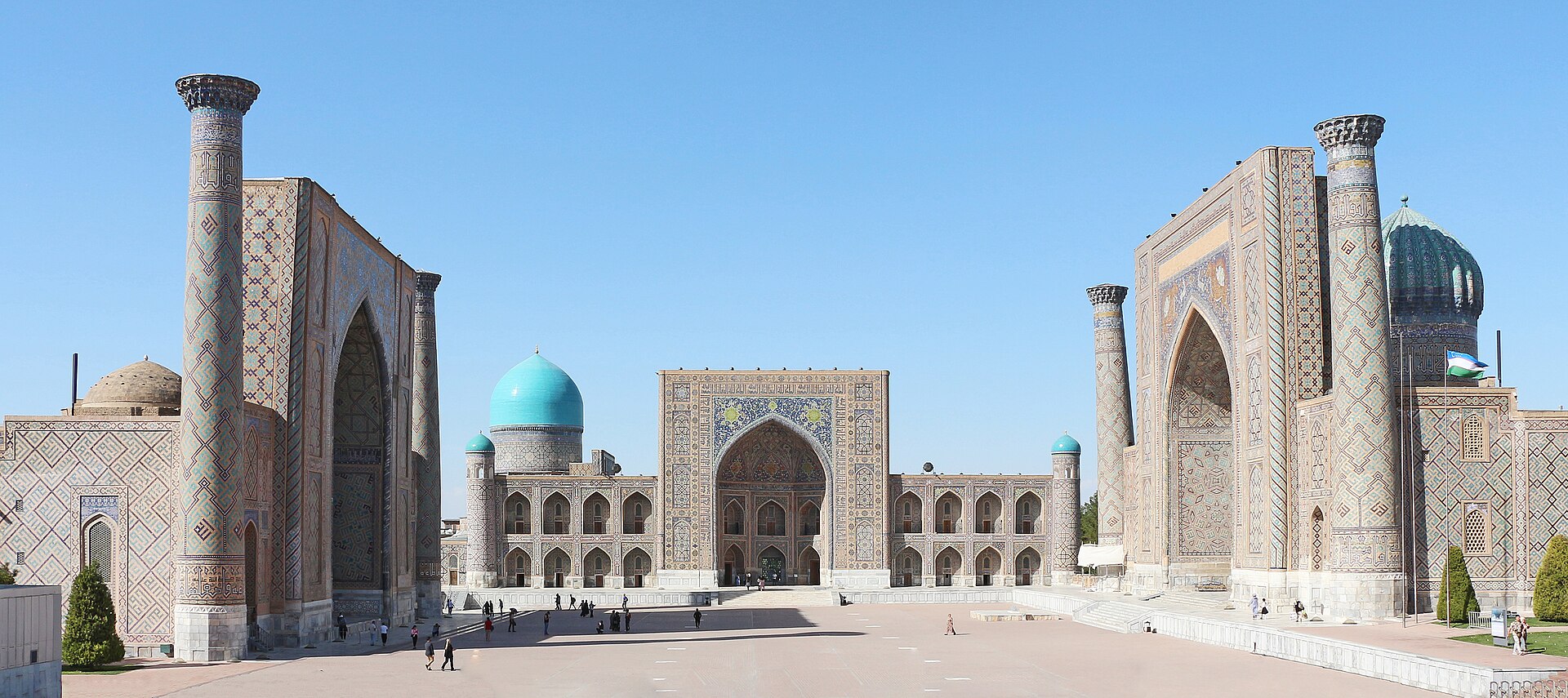

The Silk Road was not a single road but a vast network of overland and maritime trade routes that linked China with Central Asia, India, Persia, Arabia, and the Mediterranean world. Taking shape around the 2nd century BCE after the Han dynasty's missions to Central Asia and remaining in use into the 16th century, the network carried silk, paper, spices, and horses, and with them Buddhism, Christianity, Islam, and technologies such as papermaking. Its hubs — Chang'an, Samarkand, Merv, Dunhuang, Baghdad, and Antioch — became crossroads of civilizations, and its legacy is still invoked today, from the World Heritage corridors of UNESCO to China's Belt and Road Initiative.
What were the Silk Roads?
The Silk Roads were not a single road but networks of communication and trade routes crossing Eurasia, gradually connected into land and maritime routes.1 UNESCO describes them as an interconnected web of routes linking the ancient societies of Asia, the Subcontinent, Central Asia, Western Asia, and the Near East, which contributed to the development of many of the world's great civilizations.2 Maritime routes formed an essential part of this network, linking East and West by sea and used especially for the trade in spices, hence the name 'the spice routes'.1 It is misleading to think of the Silk Roads as land routes only, for maritime lanes joined the Gulf, the Indian Ocean, and the East and South China Seas to locations in the interior.3
The name itself is modern, and for most of their long history the ancient routes had no specific name.1 In the mid-19th century the German geographer Ferdinand von Richthofen designated the network of trade and communication as Die Seidenstrasse ('the Silk Road').1 The term, usually attributed to Richthofen, was used by 19th-century German historians exploring connections between the Roman Mediterranean and Han China.3
How the routes worked
Overland transport was accomplished using river craft and pack animals, notably the sturdy Bactrian camel, while travel by sea depended on the prevailing winds of the Indian Ocean, the monsoons.4 The trade routes did not follow a single itinerary: merchants had a wide range of routes at their disposal, crossing Eastern Europe, the Middle East, Central Asia, and the Far East, as well as maritime routes via the Indian Ocean.1
Across the land routes, caravanserais — large inns for itinerant merchants — were generally located about a day's journey apart, on average one every 30 to 40 kilometres in well-serviced regions.1 As trade routes developed and became more lucrative, caravanserai construction intensified across Central Asia from the 10th century onwards, resulting in a network of inns that stretched from China to Turkey and as far as North Africa, Russia, and Eastern Europe, many of which still stand today.1
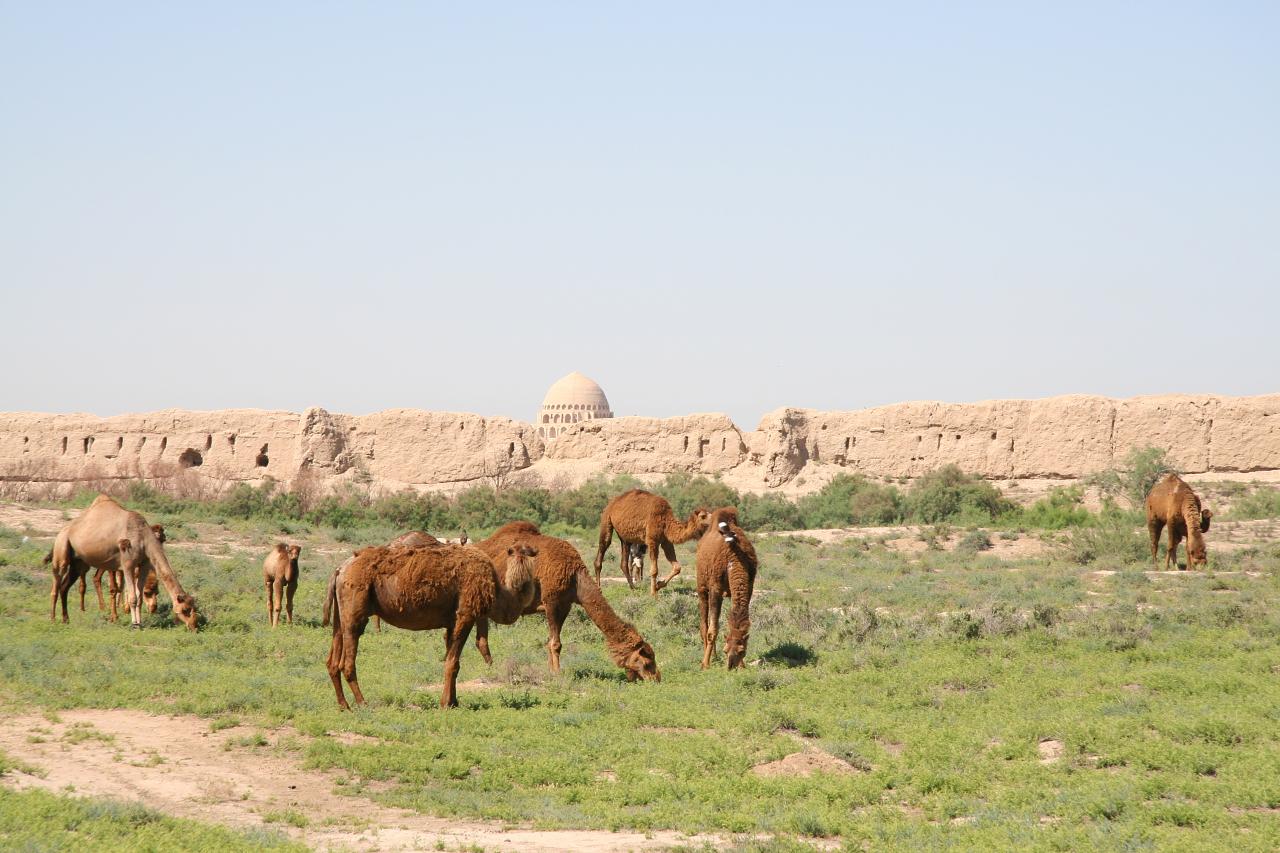

By the end of the 1st century BCE there was a great expansion of international trade involving five contiguous powers: the Roman empire, the Parthian empire, the Kushan empire, the nomadic confederation of the Xiongnu, and the Han empire.4 Successful Tang military campaigns ensured far-reaching and stable trade routes that provided a thoroughfare for goods and ideas between China, Central Asia, India, and Persia.5 Scholarship holds that exchange across the vast trans-Eurasian Silk Road network had no single driving force or instigator.6
Geography of the network
Originating at Chang'an (modern Xi'an), the 4,000-mile (6,400-km) road — actually a caravan tract — followed the Great Wall of China to the northwest, bypassed the Takla Makan Desert, climbed the Pamirs, crossed Afghanistan, and went on to the Levant; from there the merchandise was shipped across the Mediterranean Sea.7
The best-studied section of the network is the Chang'an–Tianshan corridor, which extended about 5,000 km and encompassed a complex network of trade routes extending to some 8,700 km, linking Chang'an in central China with the heartland of Central Asia between the 2nd century BC and the 1st century AD.2 It flourished between the 6th and 14th centuries AD.2 The corridor's geography falls to 154 metres below sea level and rises to 7,400 metres above sea level, touching great rivers, alpine lakes, crusty salt flats, vast deserts, and snow-capped mountains.2 Its thirty-three components include capital cities and palace complexes, trading settlements, Buddhist cave temples, ancient paths, posthouses, passes, beacon towers, sections of the Great Wall, fortifications, tombs, and religious buildings.2
Dunhuang, an oasis city in western Gansu, was the first trading town reached by foreign merchants entering Chinese-administered territory from the west.8 In ancient times it was the point at which the two branches of the Silk Road, running around the Tarim Basin on the north and on the south, converged.8 A Dunhuang commandery was established there in 111 BCE under the Han dynasty.8
Goods that traveled the routes
The routes served principally to transfer raw materials, foodstuffs, and luxury goods.2 Although the trade in silk was one of the earliest driving forces behind exchanges across Central Asia, silk was only one among many products circulating between East and West, including textiles, spices, cereals, fruits and vegetables, animal skins, tools, wood and metal objects, religious items, works of art, and precious stones.1 Some areas had a monopoly on certain goods: notably China, which supplied Central Asia, the Subcontinent, West Asia, and the Mediterranean world with silk.2 According to Chinese tradition, sericulture — the cultivation of silkworms for making silk — developed around 2,700 BCE, and the production technique was a fiercely guarded secret within China for some 3,000 years, with imperial decrees sentencing to death anyone who revealed the process to a foreigner.1 Knowledge of silk production eventually spread beyond China, first to India and Japan, then to the Persian Empire, and finally to the west in the 6th century CE.1
| Good | Direction | Source |
|---|---|---|
| Silk | China westward | Encyclopaedia Britannica 7 |
| Wools, gold, and silver | Eastward to China | Encyclopaedia Britannica 7 |
| Horses | From the west to China | The Metropolitan Museum of Art 5 |
| Paper | China westward | Encyclopaedia Britannica 9 |
| Spices | Along the maritime routes | UNESCO Silk Roads Programme 1 |
| Grapes and alfalfa | Introduced into China | Encyclopaedia Britannica 10 |
People of the Silk Roads
In the traditional narrative, the opening of the Silk Road trade network is dated to the end of the 2nd century BCE and specifically to Zhang Qian's first westward expedition around 138 BCE.6 Emperor Wudi of the Han dynasty dispatched Zhang Qian in 138 BCE to establish relations with the Yuezhi people, a Central Asian tribal group that spoke an Indo-European language.10 Captured by the Xiongnu and detained for 10 years, he nevertheless reached his destination and returned to China after an absence of 13 years.10 Zhang Qian, who died in 114 BCE, was the first man to bring back a reliable account of the lands of Central Asia to the court of China.10 UNESCO notes that the man often credited with opening the first route from China to the West was actually sent on a diplomatic mission rather than one motivated by trading.1
Perhaps more than any other people, the Sogdians capitalized on the opportunities of the Silk Roads, developing a merchant society that profited greatly from trade between China and other parts of Asia.11 The Sogdians were an Iranian people whose homeland, Sogdiana, lay at the center of several of those routes, in present-day Uzbekistan and Tajikistan.11 Sogdiana reached a peak of wealth and prominence from the 4th into the 8th centuries CE — the golden age of the Sogdians.11 In China, the rebellion of the Sogdian-Turkic general An Lushan (d. 757 CE) against the Tang emperor in the 750s led to a decline in the fortunes of Sogdian communities there.11
The expeditions of Marco Polo in the 13th century and Ibn Battuta in the 14th century exemplify what the Silk Roads represent: networks along which to travel, learn, inform, and exchange.3 Marco Polo (c. 1254–1324) was a Venetian merchant who traveled from Europe to Asia in 1271–95, remaining in China for 17 of those years; his account is known as Il milione, or the Travels of Marco Polo.12 The Chinese monk Xuanzang (c. 602–664) departed Chang'an in 629 and walked to India in defiance of an imperial prohibition, returning more than sixteen years later with sutras, statues, and relics.5 The Mongols, who built a vast empire that stretched from the Pacific to the Black Sea and the Mediterranean, were supremely gifted administrators of territories along the Silk Roads.3
Ideas, religions, and technologies
Many faiths coexisted along the corridor, including Zoroastrianism — the main religion of the Sogdians — Manichaeism, Nestorian Christianity, and Islam.2 The series of Buddhist pagodas and cave temples extending from Kucha in the west to Luoyang in the east record the eastward transmission of Buddhism from India.2 China received Nestorian Christianity and Buddhism (from India) via the Silk Road.7 Buddhist art and shrines spread along the Silk Roads as far apart as Bamiyan in Afghanistan, Mount Wutai in China, and Borobudur in Indonesia.1
One of the most famous technical innovations disseminated along the Silk Roads was the manufacture of paper, followed by the development of printing techniques.1 The oldest fragment of paper — a map recovered from a tomb in Fangmatan, Gansu Province, in 1986 — dates to the second century BCE, and the first records of a formal papermaking process appeared in China around 105 CE.9 Paper and papermaking reached Central Asia by 751 and Baghdad by 793, and by the 14th century there were paper mills in several parts of Europe.9 Under the Mongols in the 13th and 14th centuries, Chinese workmen set up a papermaking establishment in Samarkand, and paper soon supplanted other writing materials in most of western Eurasia.13 According to the 6th-century historian Procopius, silk production began in the Roman Empire around 550 CE after monks brought silkworm eggs to Byzantium.1
There came from India certain monks; and when they had satisfied Emperor Justinian Augustus that the Romans should no longer buy silk from the Persians, they promised the emperor in an interview that they would provide the materials for making silk so that never should the Romans seek business of this kind from their enemy the Persians, or from any other people whatsoever.
Procopius, 6th-century historian, on the monks who brought silkworm eggs to Byzantium around 550 CE (as quoted by the UNESCO Silk Roads Programme)
The maritime routes
The maritime routes formed an essential part of the Silk Roads network, linking East and West by sea, and were used in particular for the trade in spices, hence their name 'the spice routes'.1 A web of maritime routes connected Chinese seaports such as Guangzhou in the south to India, the Persian Gulf, and from there to the east coast of Africa.5
The history of these maritime routes can be traced back thousands of years, to links between the Arabian Peninsula, Mesopotamia, and the Indus Valley Civilization.1 Maritime trading links were established between Arabia and China from as early as the 8th century CE.1 The overland Silk Road connected Europe and Central Asia with northern China across the Eurasian Steppe, while the Maritime Silk Road linked southern China with Southeast Asia, the Indian subcontinent, and as far as the Arabian peninsula and Europe.14
Lively coastal cities grew around the most frequented ports of the maritime routes, such as Zanzibar, Alexandria, Muscat, and Goa, which became wealthy centres for the exchange of goods, ideas, languages, and beliefs.1 Hinduism and subsequently Islam were introduced into Indonesia and Malaysia by Silk Roads merchants traveling the maritime trade routes from the Indian Subcontinent and the Arabian Peninsula.1
Cities of the Silk Roads
At the center of the Tang network stood Chang'an (present-day Xi'an), the most populous city in the world at the time and the seat of power for the Tang imperial court.5 From the Greco-Roman metropolis of Antioch, routes crossed the Syrian Desert via Palmyra to Ctesiphon and Seleucia on the Tigris, then led east across the Zagros Mountains to the cities of Ecbatana and Merv, where one branch turned north via Bukhara and Ferghana and the other led into Bactria.4 Paper and papermaking reached Baghdad by 793.9
The historic town of Samarkand, in the valley of the Zerafshan River in north-eastern Uzbekistan, is considered the crossroads of world cultures, with a history of over two and a half millennia.15 Evidence of settlement there goes back to 1500 BC, and its most significant development came in the Temurid period, from the 14th to the 15th centuries, when it was capital of the Temurid realm.15 Known as Maracanda in the 4th century BCE, the city was captured by Alexander the Great in 329 BCE.16 Its monuments include the Bībī-Khānom mosque (1399–1404), the Gūr-e Amīr mausoleum of Timur (c. 1405), and Rīgestān Square with its madrasahs; in 2001 the city was designated a UNESCO World Heritage site.16
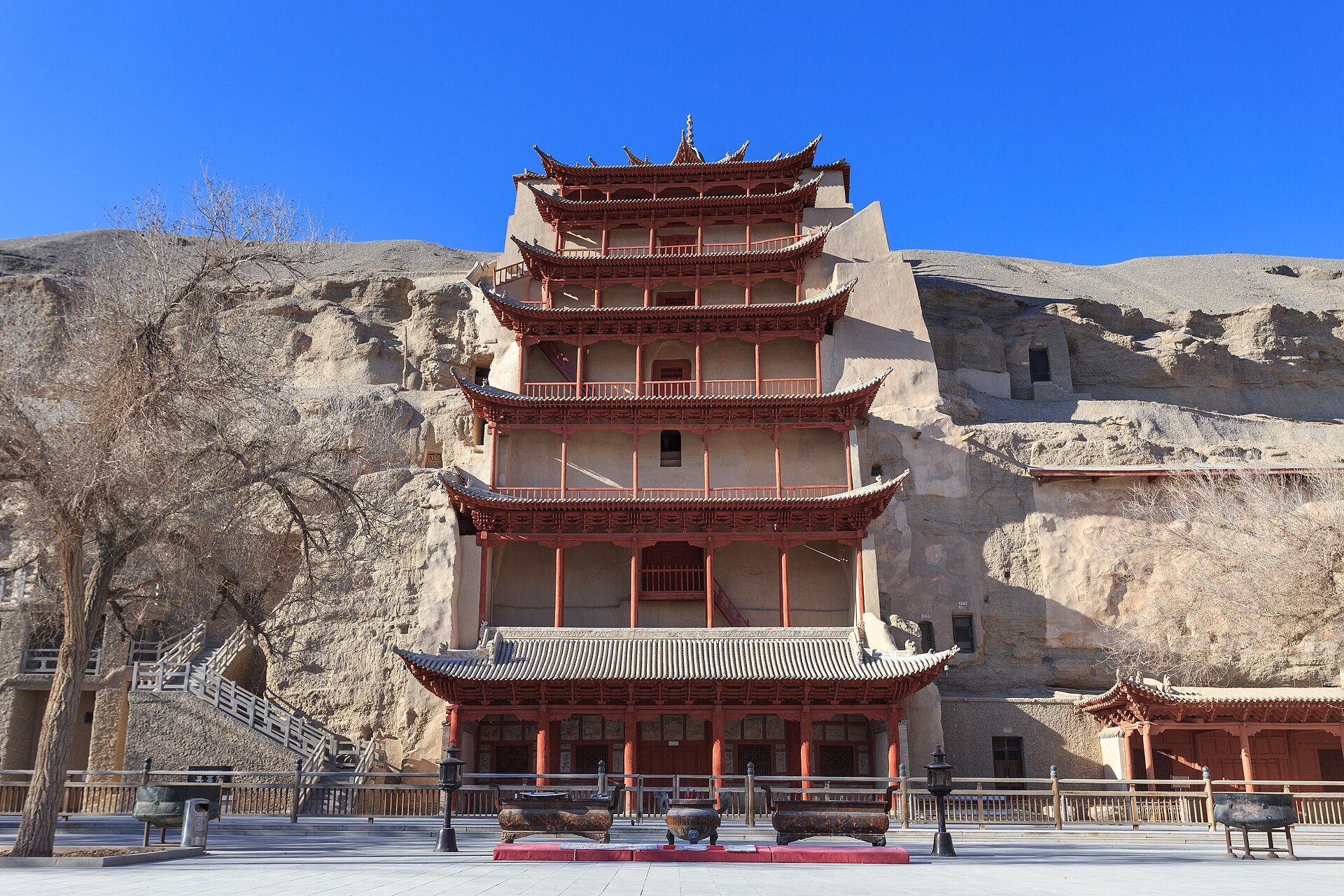

The 492 cells and cave sanctuaries of Mogao stand at a strategic point along the Silk Route, at the crossroads of trade as well as religious, cultural, and intellectual influences, and are famous for statues and wall paintings spanning 1,000 years of Buddhist art.17 Carved into the cliffs above the Dachuan River near the Dunhuang oasis, they comprise the largest, most richly endowed, and longest used treasure house of Buddhist art in the world, first constructed in 366 CE.17 The 492 preserved caves house about 45,000 square metres of murals and more than 2,000 painted sculptures.17 The discovery of the Library Cave at the Mogao Caves in 1900, with its tens of thousands of manuscripts and relics, has been acclaimed as the world's greatest discovery of ancient Oriental culture.17
Disease, decline, and revival
The Black Death ravaged Europe between 1347 and 1351, taking a proportionately greater toll of life than any other known epidemic or war up to that time; it is estimated that 25 million people died.18 The Black Death is widely believed to have been the result of plague, caused by infection with the bacterium Yersinia pestis.18 The plague that caused the Black Death originated in China in the early to mid-1300s and spread along trade routes westward to the Mediterranean and northern Africa.18
With the gradual loss of Roman territory in Asia and the rise of Arabian power in the Levant, the Silk Road became increasingly unsafe and untraveled.7 In the 13th and 14th centuries the route was revived under the Mongols, and at that time the Venetian Marco Polo used it to travel to Cathay (China).7 The Chang'an–Tianshan corridor remained in use as a major trade route until the 16th century.2 The Silk Road trade network was arguably the most important network of global exchange and interaction prior to the fifteenth century.6
Legacy
The material remains of the network are now protected as world heritage: the Chang'an–Tianshan corridor — a section extending about 5,000 km whose thirty-three components lie in China, Kazakhstan, and Kyrgyzstan — was inscribed on the UNESCO World Heritage List in 2014.2 The historic town of Samarkand was designated a UNESCO World Heritage site in 2001.16 Many of the caravanserais built across Central Asia from the 10th century onwards still stand today.1
Part of the Silk Road still exists, in the form of a paved highway connecting Pakistan and the Xinjiang Uyghur Autonomous Region of China.7 The road inspired cellist Yo-Yo Ma to found the Silk Road Project in 1999, which explored cultural traditions along its route and beyond as a means for connecting arts worldwide across cultures.7
China's Belt and Road Initiative was announced in Astana in September 2013, explicitly reviving the Silk Roads as a frame for Eurasian connectivity.3 Ferdinand von Richthofen, the geographer who gave the network its name, visited virtually every part of China gathering material for his great work China, Ergebnisse eigener Reisen und darauf gegründeter Studien, published in five volumes and an atlas from 1877 to 1912.19
Timeline of the Silk Roads
Sericulture begins in China
According to Chinese tradition, the cultivation of silkworms for making silk (sericulture) developed around 2700 BCE.
Oldest surviving paper
The oldest known fragment of paper, a map recovered from a tomb at Fangmatan in Gansu Province in 1986, dates to the 2nd century BCE.
Zhang Qian rides west
Han Emperor Wudi dispatched Zhang Qian in 138 BCE to seek an alliance with the Yuezhi; captured by the Xiongnu and detained for 10 years, he returned to China after 13 years with the first reliable account of Central Asia.
Dunhuang commandery established
A Dunhuang commandery was established in 111 BCE, bringing the oasis where the two branches of the Silk Road converged under Han control.
Mogao Caves begun
The first cave sanctuary at Mogao, near Dunhuang, was constructed in 366 CE — the beginning of a thousand years of Buddhist art.
Silk's secret crosses west
According to the historian Procopius, monks brought silkworm eggs to Byzantium around 550 CE, beginning silk production in the Roman Empire.
Xuanzang's pilgrimage
The Buddhist monk Xuanzang traveled from Chang'an through Central Asia to India and back (629-654); his journey later inspired the novel Journey to the West.
Marco Polo's journey
Marco Polo, his father, and his uncle set out from Venice in 1271 and reached China in 1275; the Polos spent a total of 17 years in China.
The Black Death
The Black Death ravaged Europe between 1347 and 1351; the plague originated in China in the early to mid-1300s and spread along trade routes westward.
The name 'Silk Road' appears
The first volume of Richthofen's China appeared in 1877 — the work in which he designated the network 'Die Seidenstrasse' ('the Silk Road').
Library Cave discovered
The sealed Library Cave at the Mogao Caves was discovered in 1900, containing tens of thousands of manuscripts and relics.
World Heritage inscription
The Silk Roads: the Routes Network of Chang'an-Tianshan Corridor — a 5,000 km section across China, Kazakhstan, and Kyrgyzstan — was inscribed on the UNESCO World Heritage List.
Frequently asked questions
Was the Silk Road a single road?
No. The Silk Roads were not a single road but networks of communication and trade routes crossing Eurasia, gradually connected into land and maritime routes.1 Merchants had a wide range of routes at their disposal, crossing Eastern Europe, the Middle East, Central Asia, and the Far East, as well as maritime routes via the Indian Ocean.1
Who gave the Silk Road its name?
In the mid-19th century the German geographer Ferdinand von Richthofen designated the network of trade and communication as Die Seidenstrasse ('the Silk Road'); for most of their long history the ancient routes had no specific name.1 The term was used by 19th-century German historians exploring connections between the Roman Mediterranean and Han China.3
How long was the Silk Road network?
The Silk Roads network stretched about 7,500 km as the crow flies and more than 35,000 km along specific routes.2 The Chang'an–Tianshan corridor alone extended about 5,000 km, encompassing a complex network of trade routes extending to some 8,700 km.2
What goods moved along the Silk Roads?
The routes served principally to transfer raw materials, foodstuffs, and luxury goods, with China holding a monopoly on the supply of silk to Central Asia, the Subcontinent, West Asia, and the Mediterranean.2 Silk went westward, and wools, gold, and silver went east.7 Zhang Qian's mission led to the introduction into China of a superior breed of horses and new plants, such as grapes and alfalfa.10
Who was Zhang Qian?
Zhang Qian (died 114 BCE) was a Chinese explorer, the first man to bring back a reliable account of the lands of Central Asia to the court of China.10 Emperor Wudi dispatched him in 138 BCE to establish relations with the Yuezhi people; captured by the Xiongnu and detained for 10 years, he returned to China after an absence of 13 years.10
How did religions travel the Silk Roads?
Buddhist pagodas and cave temples extending from Kucha in the west to Luoyang in the east record the eastward transmission of Buddhism from India.2 Zoroastrianism, Manichaeism, Nestorian Christianity, and Islam coexisted along the corridor.2 Hinduism and subsequently Islam were introduced into Indonesia and Malaysia by Silk Roads merchants traveling the maritime routes from the Indian Subcontinent and the Arabian Peninsula.1
Did the Silk Road spread the Black Death?
It is widely thought that the Silk Road was one of the main ways that plague bacteria responsible for the Black Death moved westward from Asia.7 The plague that caused the Black Death originated in China in the early to mid-1300s and spread along trade routes westward to the Mediterranean and northern Africa.18
What remains of the Silk Road today?
Part of the Silk Road still exists, in the form of a paved highway connecting Pakistan and the Xinjiang Uyghur Autonomous Region of China.7 China's Belt and Road Initiative was announced in Astana in September 2013, explicitly reviving the Silk Roads as a frame for Eurasian connectivity.3
Knowledge graph
Sources & citations
Every factual claim in this article is drawn from the sources below. Bracketed numbers in the text link to the corresponding source.
- 1
- 2
- 3
- 4
- 5
- 6
- 7
- 8
- 9
- 10
- 11
- 12
- 13
- 14
- 15
- 16
- 17
- 18
- 19