James Webb Space Telescope
The largest space telescope ever launched: a 6.5-meter golden mirror orbiting 1.5 million km from Earth to read the infrared history of the universe.

The James Webb Space Telescope (JWST) is a space-based infrared observatory launched on 25 December 2021 by NASA, ESA, and CSA. From its orbit around the second Sun-Earth Lagrange point, 1.5 million kilometers from Earth, its 6.5-meter segmented gold-coated mirror and five-layer sunshield let it peer back more than 13.5 billion years to the first galaxies, probe the atmospheres of distant exoplanets, and watch stars and planets being born inside dusty clouds. Webb released its first full-color images on 12 July 2022 and has since set records that include the most distant known galaxy, JADES-GS-z14-0.
Overview
The James Webb Space Telescope — known as Webb or JWST — is the premier observatory of the next decade, serving thousands of astronomers worldwide, and NASA's infrared flagship observatory12. It studies every phase in the history of our Universe, from the search for the first galaxies formed after the Big Bang to the evolution of galaxies, the lifecycle of stars, and other worlds including our own Solar System3. It is the next great space science observatory following Hubble, designed to answer outstanding questions about the Universe and make breakthrough discoveries in all fields of astronomy4. Following the technical and scientific legacy of observatories such as Hubble, Spitzer, and Herschel, JWST offers orders-of-magnitude improvements in sensitivity and spatial resolution2. One of its main goals is to detect the very first star formation, thought to occur between redshift 15 and 30 — 100 to 250 million years after the Big Bang5.
Webb is an international partnership between NASA, the European Space Agency (ESA), and the Canadian Space Agency (CSA)4. It launched on 25 December 2021 at 12:20 UTC aboard an Ariane 5 ECA rocket from Europe's Spaceport near Kourou, French Guiana35. Rather than circling Earth just above the atmosphere like Hubble, Webb orbits the Sun about 1.5 million kilometers from Earth around the second Lagrange point, or L26.
Webb carries a folding mirror: the 6.5-meter primary is so large that it could not fit in the launch shrouds of available rockets, so it unfolds in space5. A five-layer sunshield protects the telescope from the infrared radiation of the Sun, Earth, and Moon — like having sun protection of SPF 1 million1. As the largest, most technically advanced telescope ever built, its infrared views let it peer back over 13.5 billion years, witnessing the first stars and galaxies forming out of the darkness of the early universe6.
A telescope named for James E. Webb
The telescope was originally called the Next Generation Space Telescope (NGST) — "Next Generation" because it builds on and continues the science exploration started by the Hubble Space Telescope5. On 10 September 2002 it was named in honor of James E. Webb, NASA's second administrator5. The name is apt in an engineering sense as well: Webb introduces new technologies such as the lightweight, deployable primary mirror that will pave the way for future missions5.
James E. Webb (1906–1992) is best known for leading Apollo, the series of lunar exploration programs that landed the first humans on the Moon5. During his tenure as NASA's second administrator he also initiated a vigorous space science program that was responsible for more than 75 launches, including America's first interplanetary explorers5. The telescope's name thus honors a leader associated with both the Moon landings and a broad scientific legacy5.
Design: a folding gold mirror
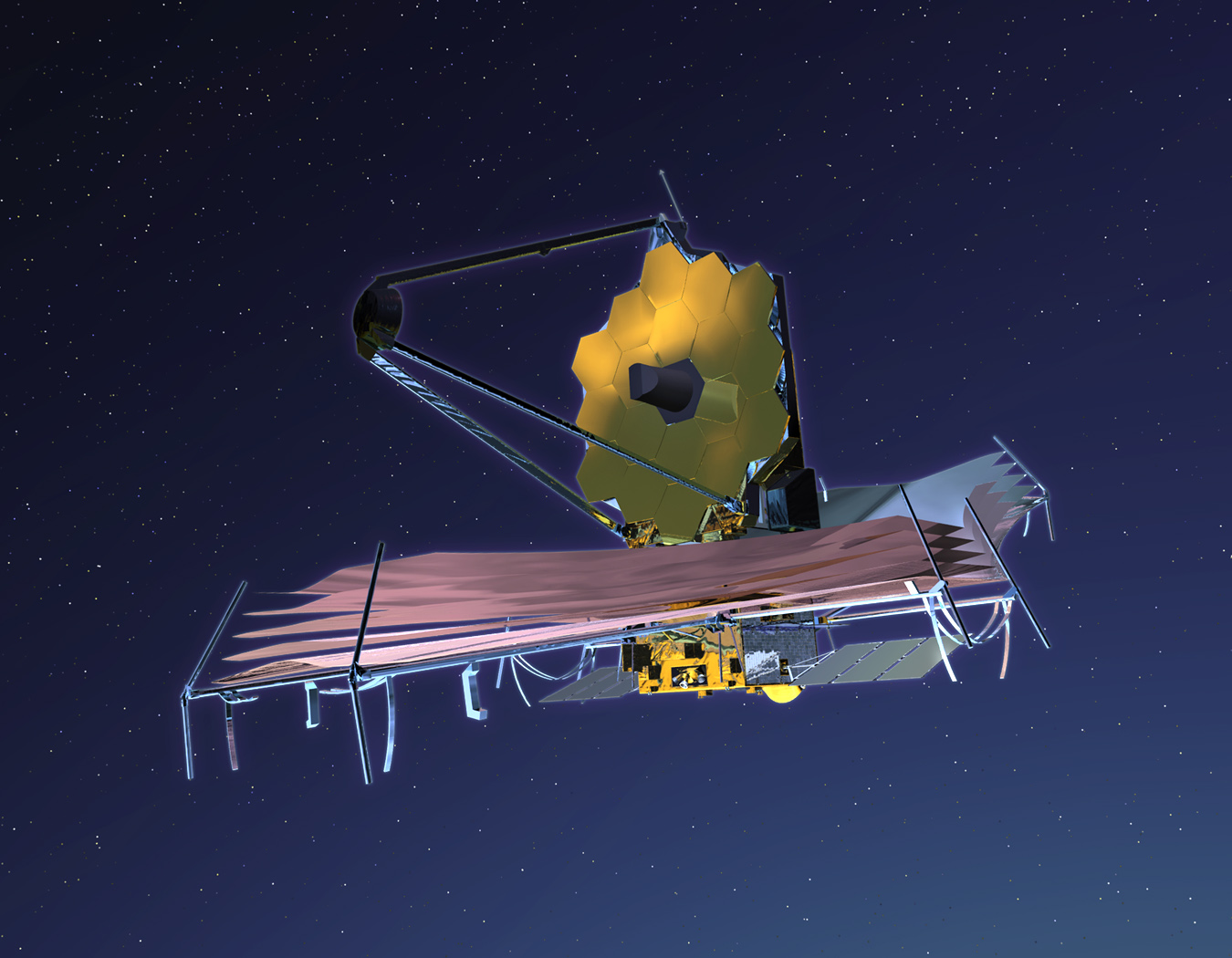
Webb's primary mirror is 6.5 m (21.3 ft) in diameter, with a clear aperture of 25 m² and a total mirror mass of 705 kg, and the observatory's total payload mass is approximately 6,200 kg3. The mirror consists of 18 hexagonal beryllium segments, each bare segment massing 20.1 kg43. Beryllium was chosen for its light weight, stiffness, and stability at very cold temperatures5. The segments are coated with gold — a layer 1,000 angstroms thick over 25 m², using about 48.25 grams of gold, roughly the mass of a golf ball5. Because the mirror is so large it could not fit in the launch shrouds of available rockets, it was designed to unfold; designing, building, and operating a mirror that unfolds is one of the major technological developments of Webb5.
Webb's sunshield measures 21.197 m × 14.162 m (69.5 ft × 46.5 ft) — a tennis-court-sized structure of five thin layers of Kapton E with aluminum and doped-silicon coatings that reflect the Sun's heat back into space3. The sunshade is Webb's largest structure, and it must be able to shield the deployed primary mirror and the tower that holds the secondary mirror5. Across its five layers the sunshield reduces the temperature between the hot and cold sides of the spacecraft by almost 600 °F, from about 185 °F (85 °C) on the hot side to about −388 °F (−233 °C) on the cold side3.

Instruments
Webb carries four scientific instruments: the Near Infrared Camera (NIRCam), the Near-Infrared Spectrograph (NIRSpec), the Mid-Infrared Instrument (MIRI), and the Fine Guidance Sensor/Near InfraRed Imager and Slitless Spectrograph (FGS-NIRISS)5. NIRSpec was provided by ESA, while MIRI was provided by a consortium of European countries together with ESA and NASA's Jet Propulsion Laboratory, and NIRISS by the Canadian Space Agency5. NIRCam was built by the University of Arizona working with Lockheed-Martin5.
The near-infrared instruments — NIRCam, NIRSpec, and FGS/NIRISS — work at about 39 K through a passive cooling system, while the mid-infrared instrument MIRI works at 7 K using a helium refrigerator, or cryocooler5. MIRI's detectors need to be at a temperature of less than 7 kelvin to operate properly, which is not possible by passive means alone3. Such cold operation is essential because infrared is heat radiation, and a warm telescope would swamp the faint astronomical signals Webb was built to capture5.
Why infrared, why L2
Webb observes primarily the infrared light from faint and very distant objects, a band in which it complements and extends the discoveries of Hubble with longer wavelength coverage and greatly improved sensitivity5. Infrared is heat radiation, so all warm things — including telescopes — emit it; to avoid swamping the very faint astronomical signals with radiation from the telescope itself, the telescope and its instruments must be very cold, and Webb's operating temperature is below 50 kelvin (−223 °C or −370 °F)5. Webb's infrared vision cuts through the dust and gas of massive clouds where stars and planetary systems form6.
Webb orbits the Sun about 1.5 million km from Earth around the second Lagrange point, where the Sun, Earth, and Moon always stay in the same part of the sky, allowing the enormous sunshield to block their light and keep the telescope cool6. At roughly one million miles from Earth — four times farther from Earth than the Moon — there is no current servicing capability or plan for Webb, and the telescope's design does not rely on servicing missions6. By contrast, because Hubble circles just above Earth's atmosphere, astronaut servicing missions were part of its long-term plan6.
Webb's deeper infrared vision spans 0.6 to 28.5 microns, while Hubble was optimized for shorter ultraviolet and visible wavelengths from 0.1 to 2.5 microns6. Webb can detect objects ten billion times fainter than the faintest stars visible without a telescope — 10 to 100 times fainter than Hubble can see5. Its angular resolution is somewhat better than 0.1 arc-seconds at 2 micrometers: details the size of a US penny at 40 km, or a soccer ball at 550 km5.
Launch and deployment
Webb launched on 25 December 2021 at 07:20 EST (12:20 UTC) on an Ariane 5 ECA rocket3. The launch took place from Arianespace's ELA-3 complex at Europe's Spaceport near Kourou, French Guiana5. ESA provided the launch vehicle and associated services on a no-exchange-of-funds basis; in exchange, NASA guaranteed European scientists roughly 15 percent of Webb's observing time5.
Webb's deployment was planned over a roughly two-week period and involved hundreds of individual steps, monitored in real time and human-controlled rather than an automatic hands-off sequence5. The first deployment — the solar array — came approximately 30 minutes after launch, and all major deployments were completed on 8 January 20225. The trip to L2 took about a month, with Webb arriving at its orbit around the second Lagrange point on 24 January 202251. Check-out procedures then continued until six months after launch, when routine scientific operations began5.
Webb is expected to be operational for at least 5 years, with a goal of 10, and carries enough propellant for more than 20 years of operation25. It is a general observatory, accessible to the worldwide community through regular calls for observing proposals that are peer-reviewed and selected by an external time allocation committee2. In May 2022 the telescope took a larger-than-expected micrometeoroid strike on a particularly sensitive part of the mirror and structure; the team determined it was a statistically rare event, and the telescope is still performing at a level that exceeds all mission requirements5.
First images: July 2022
On 12 July 2022, NASA revealed the first five full-color images and spectrographic data from Webb at a live event streamed from the agency's Goddard Space Flight Center in Greenbelt, Maryland7. The five targets were the galaxy cluster SMACS 0723, the exoplanet WASP-96 b, the Southern Ring Nebula, the compact galaxy group Stephan's Quintet, and the Carina Nebula7. The release kicked off Webb's science operations, open to astronomers around the world7.
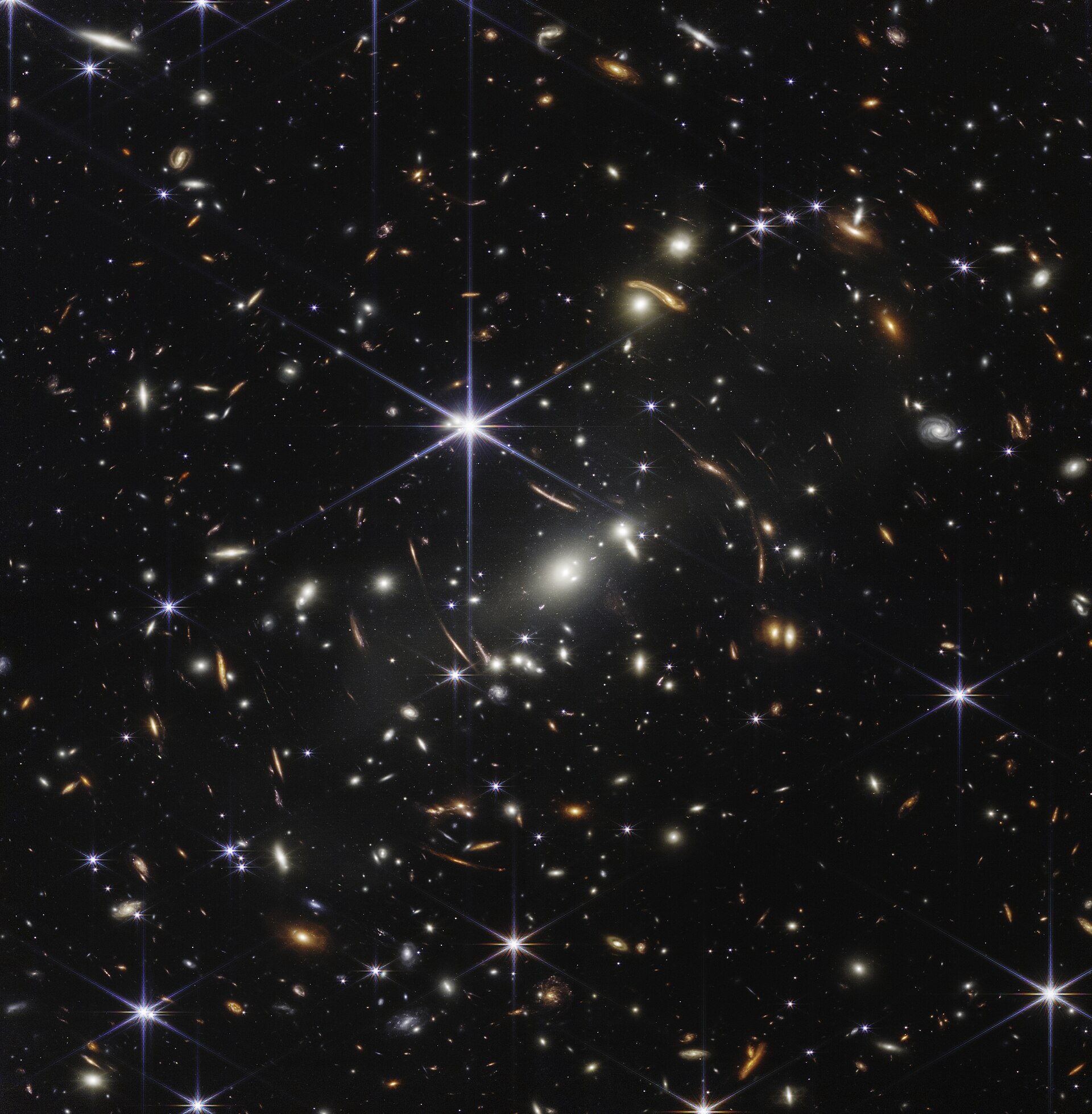
Webb's First Deep Field — the galaxy cluster SMACS 0723 — delivered the deepest and sharpest infrared image of the distant universe so far, in only 12.5 hours7. The image is teeming with thousands of galaxies, including the faintest objects ever observed in the infrared, in a slice of sky approximately the size of a grain of sand held at arm's length8. Webb's detailed observation of the hot, puffy exoplanet WASP-96 b revealed the clear signature of water along with evidence of haze and clouds that previous studies had not detected — Webb's first detection of water in the atmosphere of an exoplanet7.

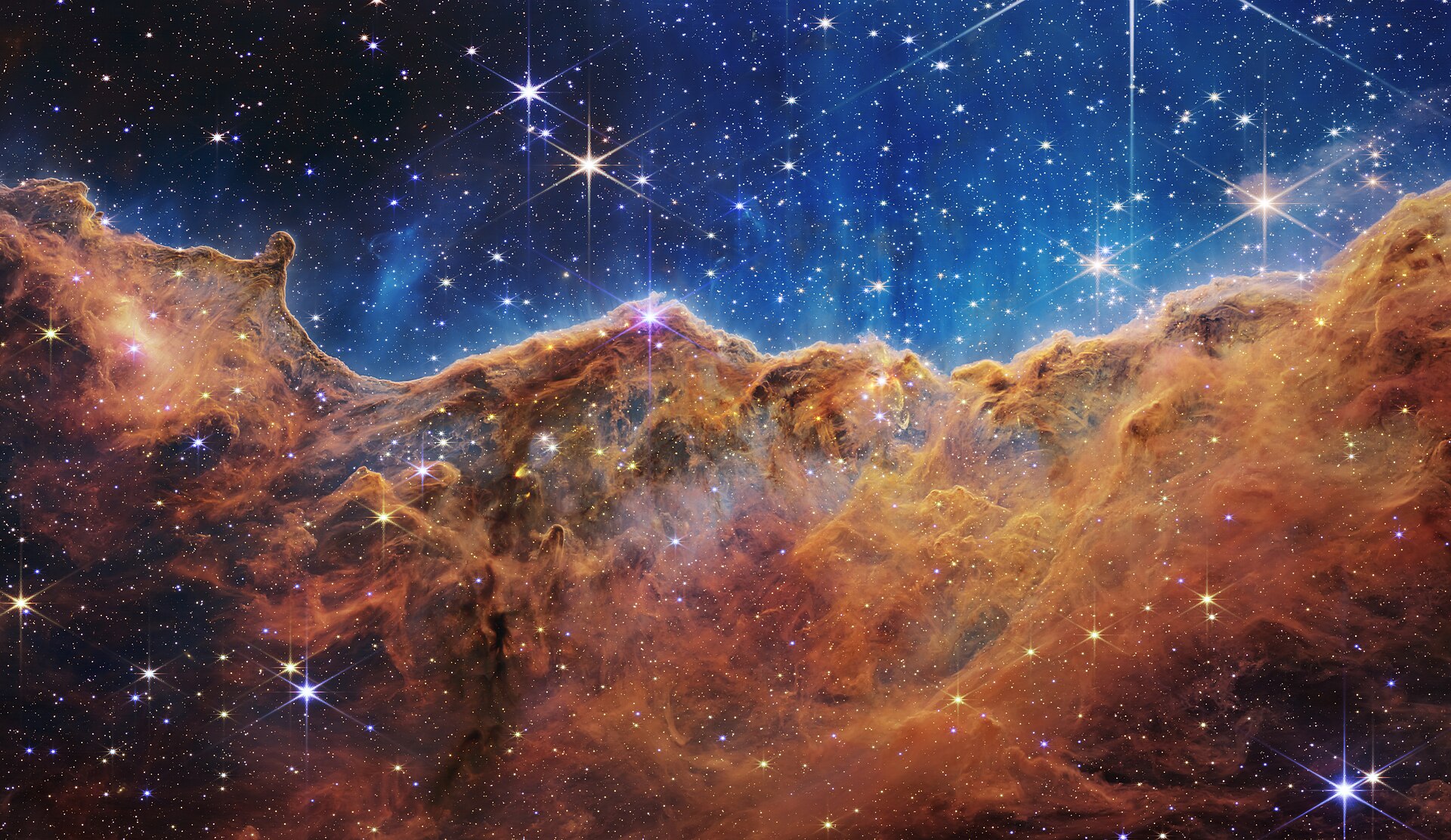
Webb's look at the 'Cosmic Cliffs' in the Carina Nebula unveils the earliest, rapid phases of star formation that were previously hidden.7
NASA, first images release — Carina Nebula
This enormous mosaic is Webb's largest image to date, covering about one-fifth of the Moon's diameter. It contains over 150 million pixels and is constructed from almost 1,000 separate image files.8
STScI — Webb's mosaic of Stephan's Quintet
The dimmer star at the center of this scene has been sending out rings of gas and dust for thousands of years in all directions, and NASA's James Webb Space Telescope has revealed for the first time that this star is cloaked in dust.8
STScI — the Southern Ring Nebula (NGC 3132), about 2,500 light-years away
Webb and Hubble compared
| Property | Webb | Hubble |
|---|---|---|
| Launch date | December 25, 2021 3 | 1990 6 |
| Primary mirror diameter | 6.5 m (21.3 ft) 3 | 2.4 m (7.9 ft) 6 |
| Mirror mass | About 625 kg — 18 beryllium segments including the backing frame 5 | About 1,000 kg — a thick, solid glass mirror 5 |
| Orbit | Sun–Earth L2, about 1.5 million km from Earth 6 | Low Earth orbit, about 483 km above Earth 6 |
| Wavelength range | 0.6–28.5 microns (infrared) 6 | 0.1–2.5 microns (optimized for ultraviolet and visible light) 6 |
| Operating temperature | Below 50 K (−370 °F) 3 | — |
| Servicing | No current servicing capability or plan; the design does not rely on servicing missions 6 | Astronaut servicing missions in orbit were part of Hubble's long-term plan 6 |
| Key discoveries | Confirmed the most distant known galaxy, JADES-GS-z14-0, at redshift 14.32 9 | Confirmed black holes in galaxy cores; measured exoplanet atmosphere compositions; verified the accelerating expansion of the universe — a 2011 Nobel Prize-winning discovery in physics 6 |
Science results
In October 2023 and January 2024, the JWST Advanced Deep Extragalactic Survey (JADES) program used Webb's NIRSpec to obtain a spectrum of a record-breaking galaxy observed only 290 million years after the Big Bang, at a redshift of about 149. That galaxy, JADES-GS-z14-0, was determined to be at a redshift of 14.32, making it the current record-holder for the most distant known galaxy — seen less than 300 million years after the Big Bang and shattering the previous record of z = 13.2, held by JADES-GS-z13-09. The source is over 1,600 light-years across, and its light comes mostly from young stars rather than from emission near a growing supermassive black hole, implying a mass of several hundred million times that of the Sun9. The presence of oxygen so early in the galaxy's life is a surprise, suggesting that multiple generations of very massive stars had already lived and died before we observed it9. Above all, JADES-GS-z14-0 is not like the types of galaxies that theoretical models and computer simulations predict for the very early universe9.
Webb also mapped the weather on the hot gas-giant exoplanet WASP-43 b, a Jupiter-sized planet roughly 280 light-years away in the constellation Sextans that orbits its star every 19.5 hours and is probably tidally locked10. The measurements show a dayside averaging nearly 1,250 °C — hot enough to forge iron — and a nightside at 600 °C, with supersonic winds shifting the hottest spot eastward of the point that receives the most stellar radiation10. They also suggest thick high clouds on the nightside, clear skies on the dayside, and equatorial winds upwards of 5,000 miles per hour mixing atmospheric gases around the planet10. Earlier, in Webb's first science release, its spectrum of WASP-96 b had revealed the clear signature of water along with evidence of haze and clouds7.
In the cluster NGC 346 in the Small Magellanic Cloud, Webb found planet-forming disks that are longer-lived than those seen around young stars in our Milky Way galaxy11. Hubble had revealed many stars there about 20 to 30 million years old that still had planet-forming disks, contradicting the conventional belief that such disks dissipate after 2 or 3 million years11. The massive star cluster NGC 346 has only about ten percent of the heavier elements present in the chemical composition of our Sun11. In other young systems, Webb's MIRI revealed the richest hydrocarbon chemistry seen to date in a protoplanetary disk — 13 carbon-bearing molecules up to benzene, including the first extrasolar detection of ethane, plus the first disk detections of ethylene, propyne, and the methyl radical CH312. And in early-stage protostars, where planets have not yet formed, Webb discovered molecules ranging from methane to acetic acid and ethanol — key ingredients for making potentially habitable worlds; the low-mass protostar IRAS 2A may resemble the primordial stages of our own Solar System, so the chemicals identified there may have been delivered to the primitive Earth13.
Webb's light-echo images near the supernova remnant Cassiopeia A are allowing astronomers to map the true 3D structure of interstellar dust and gas — the interstellar medium — for the first time14. The images reveal tightly packed sheets and filaments on remarkably small scales of about 400 astronomical units, less than one-hundredth of a light-year14. Armin Rest of the Space Telescope Science Institute compared the three-epoch observation to a medical CT scan, with three slices taken at three different times that reveal the true 3D structure of the interstellar medium14. On the expansion of the universe, Webb confirmed that Hubble's measurements of the expansion rate were right all along, erasing lingering doubt about them15. The Hubble Tension — the persistent difference between the Hubble constant measured with a wide range of independent distance indicators and its value predicted from the afterglow of the Big Bang — persists, and the two telescopes' tag-team measurements strengthen the case that something other than measurement errors is influencing the expansion rate15.
Mission timeline
Named for James E. Webb
The Next Generation Space Telescope was officially named in honor of James E. Webb, NASA's second administrator.5
Launch
Webb launched at 12:20 UTC on an Ariane 5 ECA from Europe's Spaceport near Kourou, French Guiana; its solar array deployed about 30 minutes later.5
Deployment complete
All major deployments — sunshield, secondary mirror, and primary mirror wings — were completed after hundreds of individual steps over roughly two weeks.5
Arrival at L2
Webb arrived at its orbit around the second Lagrange point, 1.5 million km from Earth, about a month after launch.1
First images released
NASA revealed Webb's first five full-color images and spectra — SMACS 0723, WASP-96 b, the Southern Ring Nebula, Stephan's Quintet, and the Carina Nebula — after six months of commissioning.7
Hubble Tension confirmed
Webb confirmed Hubble's measurements of the universe's expansion rate, erasing lingering doubt while the Hubble Tension between local and early-universe values persists.15
Weather map of WASP-43 b
Webb mapped the weather of a hot Jupiter 280 light-years away: dayside near 1,250 °C, nightside 600 °C, and equatorial winds above 5,000 mph.10
Most distant known galaxy
JADES-GS-z14-0 was confirmed at redshift 14.32, seen less than 300 million years after the Big Bang — a new record for the most distant known galaxy.9
Disks live longer in the early universe
Webb showed that planet-forming disks around 20–30-million-year-old stars in NGC 346 persist far longer than the 2–3 million years previously expected.11
3D map of the interstellar medium
Webb captured light echoes near the supernova remnant Cassiopeia A, mapping the true 3D structure of interstellar dust and gas for the first time.14
Frequently asked questions
What is the James Webb Space Telescope?
Webb is the premier space observatory of the next decade, serving thousands of astronomers worldwide, and NASA's infrared flagship observatory12. It studies every phase in the history of our Universe, and it is designed to answer outstanding questions about the Universe and make breakthrough discoveries in all fields of astronomy4.
Who built Webb, and who operates it?
Webb is an international partnership between NASA, ESA, and CSA, with NASA as the lead partner and Northrop Grumman as the main industrial contractor for the telescope, spacecraft bus, and sunshield45. Fourteen countries were involved in building it: Austria, Belgium, Canada, Denmark, France, Germany, Ireland, Italy, the Netherlands, Spain, Sweden, Switzerland, the United Kingdom, and the United States5. Its Science and Operations Center is located at the Space Telescope Science Institute5.
Why does Webb observe in infrared?
Webb is optimized for infrared wavelengths, which cut through the dust and gas of massive clouds where stars and planetary systems form56. Because infrared is heat radiation, all warm things — including telescopes — emit it, so the telescope and its instruments must be very cold; Webb's operating temperature is below 50 kelvin (−370 °F)5.
Why is Webb stationed 1.5 million kilometers from Earth?
Webb orbits the Sun around the second Lagrange point, about 1.5 million km from Earth, where the Sun, Earth, and Moon always stay in the same part of the sky, letting its sunshield block their light and keep the telescope cool6. At roughly one million miles from Earth — four times farther than the Moon — there is no current servicing capability or plan for Webb, so its design does not rely on servicing missions6.
How does Webb compare with Hubble?
Webb's primary mirror is 2.7 times larger in diameter — about 6 times larger in area — than Hubble's, giving it more light-gathering power and longer, more sensitive infrared coverage5. Webb observes from 0.6 to 28.5 microns, while Hubble was optimized for ultraviolet and visible light from 0.1 to 2.5 microns6. Despite its larger mirror, Webb delivers about the same resolution in near-infrared light as Hubble attains in visible light, so the two telescopes can double-team their observations6.
How much gold covers Webb's mirror?
Webb's 6.5-meter primary mirror is made of 18 hexagonal beryllium segments coated with gold4. The gold coating is 1,000 angstroms thick over 25 m², using about 48.25 grams of gold — roughly the mass of a golf ball5.
How far back in time can Webb see?
Webb's infrared views let it peer back over 13.5 billion years to the first stars and galaxies6. One of its main goals is to detect the very first star formation, thought to occur between redshift 15 and 30 — 100 to 250 million years after the Big Bang — in a Universe now 13.8 billion years old5. Its current record is JADES-GS-z14-0, seen less than 300 million years after the Big Bang at a redshift of 14.329.
What are Webb's most notable results so far?
Webb mapped the weather on WASP-43 b: a dayside averaging nearly 1,250 °C, a nightside at 600 °C, and equatorial winds upwards of 5,000 miles per hour10. Its light-echo images near Cassiopeia A are mapping the true 3D structure of interstellar dust and gas for the first time14. It also confirmed that Hubble's measurements of the universe's expansion rate were right all along, even as the Hubble Tension persists15.
Knowledge graph
Sources & citations
Every factual claim in this article is drawn from the sources below. Bracketed numbers in the text link to the corresponding source.
- 1
- 2
- 3
- 4
- 5
- 6
- 7
- 8
- 9
- 10
- 11
- 12
- 13
- 14
- 15