The Internet
The global network of networks: from the first two letters sent over ARPANET to six billion users — and how it differs from the World Wide Web.
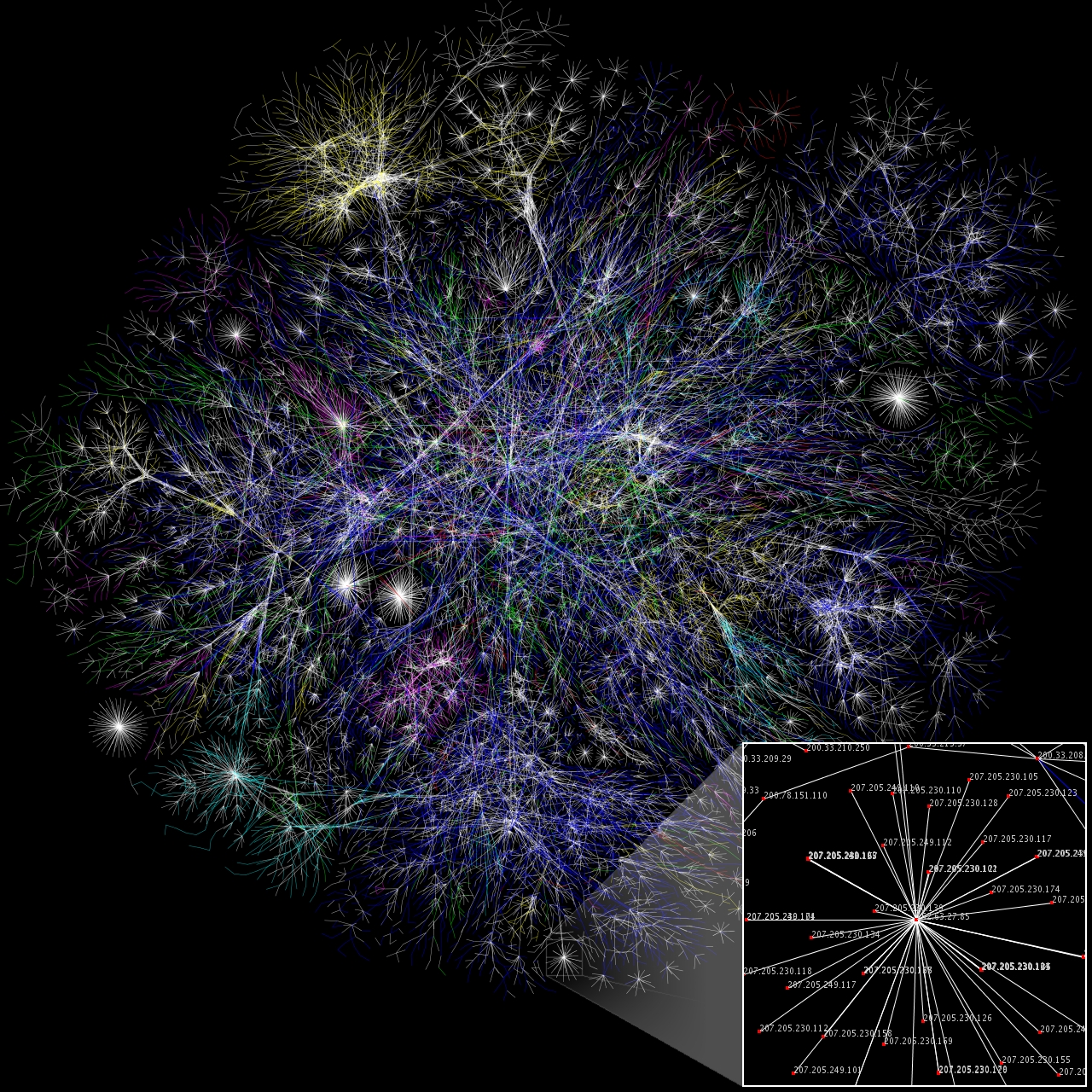
The Internet is the worldwide network of interconnected computer networks that exchange data using the TCP/IP protocol suite. It grew out of ARPANET, a U.S. research network whose first host-to-host message — the truncated word “lo” — was sent on 29 October 1969, and it expanded through packet switching, the Cerf–Kahn TCP protocols, the Domain Name System, and open standards bodies such as the IETF. Running on top of it is the World Wide Web, the hypertext information system invented by Tim Berners-Lee at CERN in 1989–1991 — a distinction this article keeps front and centre. By ITU estimates, about 6 billion people, or 74% of the world's population, were using the Internet in 2025.
Overview: what the Internet is
The Internet is simultaneously a global broadcasting medium, a mechanism for spreading information, and a space in which individuals and their computers collaborate and interact1. It began with ARPANET, a single pioneering packet-switching network, and grew into a worldwide system of many independent networks joined by open-architecture networking1. At the technical level it is a network of networks: the Internet Protocol was designed for interconnected systems of packet-switched computer communication networks, carrying blocks of data called datagrams between hosts identified by fixed-length addresses2.
The network also has a formal definition1. On 24 October 1995 the Federal Networking Council of the United States unanimously adopted a resolution defining the term1. Under that resolution the Internet is the global information system joined by a globally unique address space built on the Internet Protocol, capable of carrying TCP/IP communications, and offering high-level services layered on top of that infrastructure1.
Crucially, the Internet was designed as a general-purpose infrastructure rather than for one application1. Its generality is what made later inventions possible: electronic mail arrived on the ARPANET in 1972 and remained the largest network application for over a decade1, and the World Wide Web emerged on top of the same foundation years afterwards1.
The Internet vs the World Wide Web
Early visions and packet switching
The idea of networked computers predates the hardware, and it began with two strands of work1. In August 1962 J.C.R. Licklider of MIT wrote the first recorded memos describing his 'Galactic Network' concept — a globally interconnected set of computers through which anyone could quickly reach data and programs from any site, in spirit very much like today's Internet1. He became the first head of DARPA's computer research program in October 19621. The theory was being worked out at the same time: Leonard Kleinrock at MIT published the first paper on packet switching theory in July 1961 and the first book on the subject in 19641.
In 1965, working with Thomas Merrill, Lawrence Roberts connected the TX-2 computer in Massachusetts to the Q-32 in California over a low-speed dial-up telephone line, creating the first — however small — wide-area computer network ever built1. Paul Baran's group at RAND wrote a paper on packet switching networks for secure voice in 19641. The work at MIT (1961–1967), RAND (1962–1965) and the National Physical Laboratory in Britain (1964–1967) proceeded in parallel without the researchers knowing about each other's work1.
The word 'packet' itself was adopted from the work of Donald Davies at the NPL, and the proposed ARPANET line speed was raised from 2.4 kbps to 50 kbps1. In late 1966 Roberts moved to DARPA to develop the computer network concept and published his plan for the 'ARPANET' in 19671. That plan set out the packet-switched network that DARPA and the funded research community would refine into specifications1.
ARPANET: the network goes live
In August 1968 DARPA released a request for quotations for the ARPANET's packet switches, the Interface Message Processors (IMPs)1. The contract was won in December 1968 by a group headed by Frank Heart at Bolt Beranek and Newman (BBN)1. In September 1969 BBN installed the first IMP at UCLA and connected the first host computer1. By the end of 1969 four host computers formed the initial ARPANET1.
The first real test came on 29 October 1969, when a team led by UCLA computer scientist Leonard Kleinrock tried to send a message from a computer at UCLA to one at the Stanford Research Institute7. Graduate student Charley Kline typed the first two letters of the word 'login' before the network crashed — hence the message 'Lo'7. Two computers, several hundred miles apart, had communicated, a moment many now consider the beginning of the Internet7. Switched on in late October 1969, the ARPANET was the first large-scale, general-purpose computer network to connect different kinds of computers together4. Kleinrock later recalled typing the first two letters, 'Lo' for 'Login', from the UCLA computer room before the crash8.
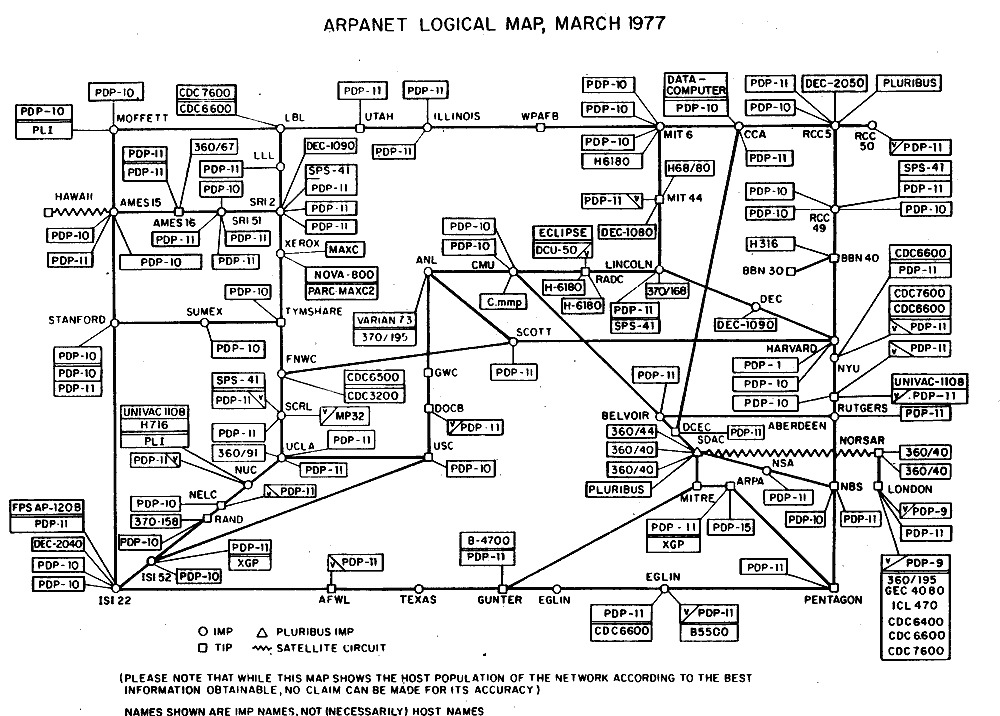

In 1969 Steve Crocker, then at UCLA, established the Request for Comments (RFC) series as an informal, fast way to share ideas among network researchers1. In December 1970 the Network Working Group under Crocker finished the initial host-to-host protocol, the Network Control Protocol (NCP)1. In October 1972 Bob Kahn organized a large, very successful demonstration of the ARPANET at the International Computer Communication Conference — the first public demonstration of the new network technology1.
Electronic mail arrived the same year: in March 1972 Ray Tomlinson at BBN wrote the basic send-and-read software1, and for his networked email protocol on the ARPANET he chose the now-iconic '@' sign4. Email took off as the largest network application for over a decade1. By 1973 well over 50% of traffic on the research-oriented network was email4.
TCP/IP, the DNS, and the network of networks
The step from one network to a network of networks came from Bob Kahn, who introduced the idea of open-architecture networking shortly after arriving at DARPA in 1972, under a program then called 'Internetting'1. In the spring of 1973 he asked Vint Cerf, then at Stanford, to work with him on the detailed design of the protocol1. The first written version of their approach was distributed as INWG#39 at a special meeting of the International Network Working Group at Sussex University in September 19731. In Kahn's early design, black boxes — later called gateways and routers — would connect the networks while retaining no information about the individual flows of packets passing through them1.
The refined Cerf–Kahn paper, 'A protocol for packet network intercommunication', was published in May 1974 in IEEE Transactions on Communications1. RFC 675, the specification of the Internet Transmission Control Program by Vinton Cerf, Yogen Dalal and Carl Sunshine, followed in December 19749. The original TCP was later reorganized into two protocols — a simple IP for addressing and forwarding individual packets, and TCP for flow control and recovery from lost packets — with the User Datagram Protocol (UDP) added for applications that did not want TCP's services1. In 1977 Cerf and Kahn linked the ARPANET, the Packet Radio Network and the Satellite Network and proved the efficacy of TCP/IP in a round-the-world transmission from a moving vehicle, the SRI Packet Radio Research van4. The Internet Protocol specification, RFC 791, was published in September 1981, defining a protocol for interconnected systems of packet-switched networks that carries blocks of data called datagrams between hosts identified by fixed-length addresses2.
The ARPANET switched from NCP to TCP/IP on 1 January 1983 in a 'flag-day' transition that required all hosts to convert simultaneously; it went surprisingly smoothly and produced buttons reading 'I survived the TCP/IP transition'1. TCP/IP had been adopted as a U.S. defense standard in 1980, and the transition allowed the network to be split into MILNET for military use and ARPANET for research1. The incorporation of TCP/IP into the Unix BSD system releases proved a critical element in spreading the protocols through the research community1.
The Domain Name System (DNS) was invented by Paul Mockapetris of USC/ISI as a scalable distributed mechanism for resolving hierarchical host names into Internet addresses1. It was introduced by RFC 882, published in November 198310. From 1986 to 1995 NSFNET carried the network forward with $200 million of funding, and by the time the ARPANET was finally decommissioned in 1990, TCP/IP had supplanted or marginalized most other wide-area network protocols worldwide1.
Alongside the protocols, the institutions of the modern Internet took shape11. The Internet Engineering Task Force (IETF), founded in 1986, is the premier standards development organization for the Internet: it makes voluntary standards but in no way controls or patrols the network11. There is no membership in the IETF — anyone can participate — and over 7,000 people actively take part in its work in any one year11. Its technical documentation is published as RFCs, which describe the Internet's technical foundations such as addressing, routing and transport technologies11. The Internet Society was formed in 1991, and ICANN was founded in 1998 out of a U.S. Government commitment to transfer the policy and technical management of the DNS to a non-profit corporation with global participation15; the IANA Stewardship Transition was completed in October 20165.
The World Wide Web arrives
The hypertext idea had a long prehistory: in 1945 Vannevar Bush wrote an article describing the Memex, a photo-electrical-mechanical device for memory extension that could make and follow links between documents on microfiche12. In the 1960s Doug Engelbart prototyped the 'oNLine System' (NLS) for hypertext browsing, editing and email, inventing the mouse for that purpose12. At CERN itself, Tim Berners-Lee created Enquire, a networked hypertext system used for project management, in 19804. He wrote the first proposal for the World Wide Web in March 1989 and a second in May 1990, and together with Belgian systems engineer Robert Cailliau formalised it as a management proposal in November 19906. Neither proposal was approved, but Berners-Lee proceeded anyway, and by Christmas 1990 he had prototyped 'WorldWideWeb' in three months on a NeXT computer — featuring a server, HTML, URLs and the first browser4.
By the end of 1990 the first Web server and browser were up and running at CERN, with the server code developed on a NeXT computer6. To keep it from being switched off, the machine bore a hand-written label in red ink warning that it was a server and must not be powered down6. info.cern.ch was the address of the world's first website and Web server, and the first Web page address was http://info.cern.ch/hypertext/WWW/TheProject.html6. That first page introduced the project as an initiative for retrieving information across a wide area, built on hypermedia and aiming to give universal access to a large universe of documents13. Because few users had NeXT computers, a simpler line-mode browser that could run on any system was written by Nicola Pellow during her student work placement at CERN6.
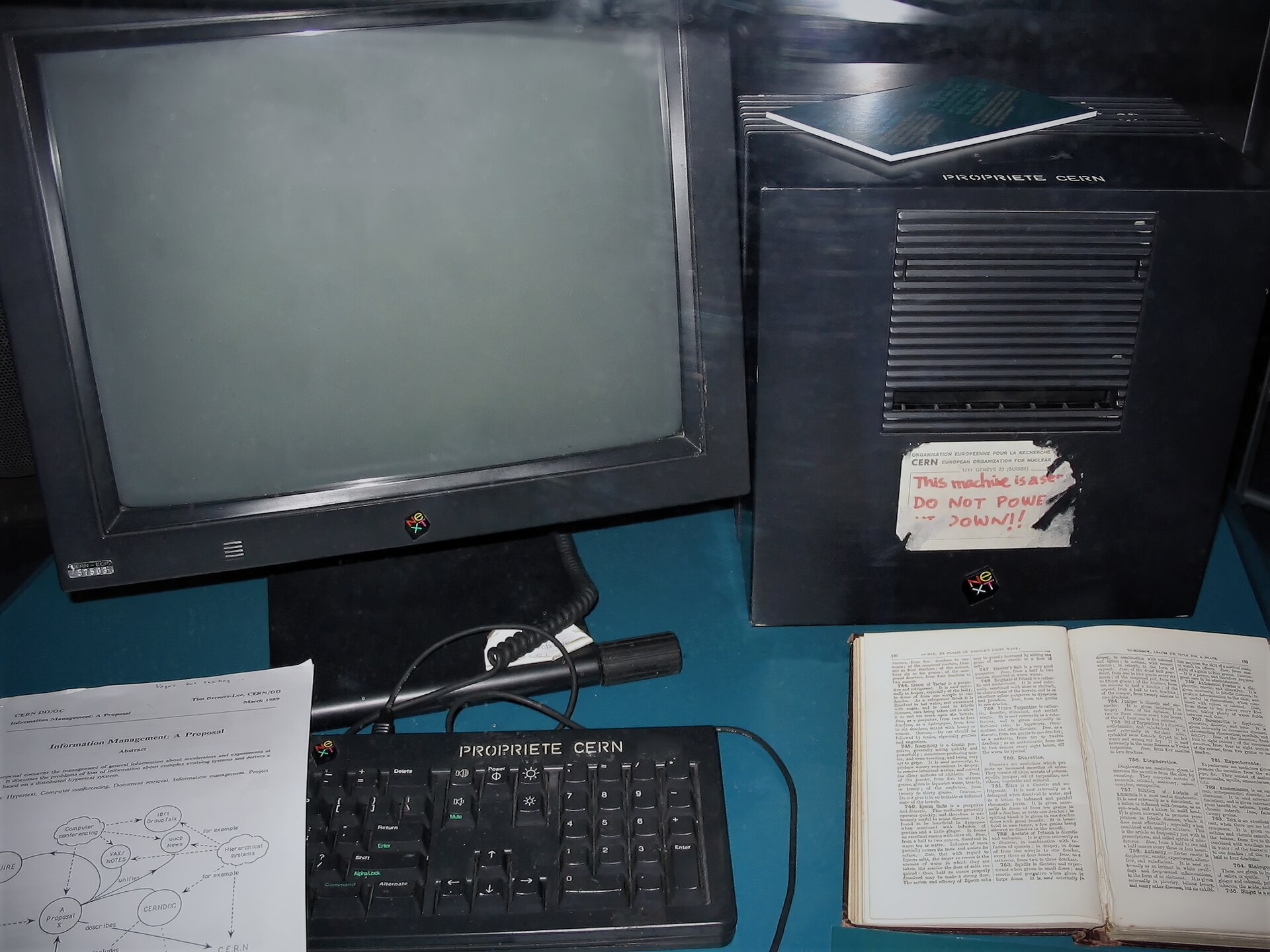
Berners-Lee released the WWW software in 1991: the line-mode browser, Web server software and a library for developers6. It became available to colleagues using CERN computers in March 1991, and on 6 August 1991 the files were posted to the alt.hypertext newsgroup, marking the Web's public introduction as interest spread around the world612. Thanks to Paul Kunz and Louise Addis, the first Web server in the United States came online in December 1991 at the Stanford Linear Accelerator Center (SLAC) in California6.
Early in 1993 the National Center for Supercomputing Applications (NCSA) at the University of Illinois released the first version of its Mosaic browser for the X Window System, with PC and Macintosh versions following shortly afterwards6. Written by student Marc Andreessen and UNIX expert Eric Bina, Mosaic was the first browser supported by a major institution and started the Web on the road from research project to blockbuster success4. On 30 April 1993 CERN put the World Wide Web software in the public domain, declaring that the technology would be freely usable by anyone with no fees payable to CERN — actions that allowed the web to flourish312. By late 1993 there were over 500 known Web servers, and the WWW accounted for 1% of internet traffic6.
1994 was the 'Year of the Web': the First International World Wide Web conference, initiated by Robert Cailliau, was held at CERN in May and attended by 380 users and developers, and was hailed as the 'Woodstock of the Web'6. By the end of 1994 the Web had 10,000 servers — 2,000 of them commercial — and 10 million users, with traffic equivalent to shipping the entire collected works of Shakespeare every second6. That year Berners-Lee left CERN to join MIT and founded the World Wide Web Consortium (W3C), established on 1 October 1994612.
The Internet today
ITU estimates that approximately 6 billion people — 74 per cent of the world's population — were using the Internet in 202514. That is up from 60 per cent of the world population in 2020, with an estimated 1.3 billion people coming online during that period14. Still, 2.2 billion people remain offline14.
The network today still runs on protocol foundations laid decades earlier: the Internet Protocol of RFC 791 (IPv4) was specified in September 19812, and its successor, IPv6 — also known as IP Next Generation — was specified by RFC 2460, published in December 1998 by S. Deering and R. Hinden15. The RFCs remain the Internet's technical foundations, describing addressing, routing and transport technologies, and the IETF that publishes them remains open to anyone who wants to participate11.
Key dates and numbers
| Milestone | Date | Source |
|---|---|---|
| First host-to-host ARPANET message — 'Lo' (UCLA to SRI) | 29 October 1969 | UC Newsroom 7 |
| TCP/IP 'flag-day' switch from NCP across the ARPANET | 1 January 1983 | Internet Society 1 |
| Domain Name System introduced (RFC 882, P. Mockapetris) | November 1983 | RFC 882 10 |
| Internet Engineering Task Force (IETF) founded | 1986 | IETF 11 |
| First World Wide Web proposal written (Tim Berners-Lee at CERN) | March 1989 | CERN 6 |
| First website (info.cern.ch) | 1991 | CERN 6 |
| WWW software released royalty-free by CERN | 30 April 1993 | CERN 6 |
| World Wide Web Consortium (W3C) founded | 1 October 1994 | W3C 12 |
| ICANN founded | 1998 | ICANN 5 |
| IPv6 specified (RFC 2460) | December 1998 | RFC 2460 15 |
| Internet users worldwide | 2025 (≈6 billion) | ITU 14 |
Timeline: from ARPANET to the Web
Licklider's “Galactic Network”
J.C.R. Licklider of MIT wrote the first recorded memos describing a globally interconnected set of computers — his “Galactic Network” concept, in spirit very much like today's Internet.1
The first message: “Lo”
A team led by Leonard Kleinrock at UCLA sent the first host-to-host message to the Stanford Research Institute over ARPANET; Charley Kline typed two letters of “login” before the network crashed — hence “Lo”.7
ARPANET goes public; email arrives
Bob Kahn organized the first public demonstration of the ARPANET at the ICCC, and Ray Tomlinson's email software made electronic mail the network's “hot” application.1
Cerf and Kahn publish the TCP paper
Vint Cerf and Bob Kahn published “A protocol for packet network intercommunication” in IEEE Transactions on Communications — the design that became TCP/IP.1
The TCP/IP flag day
The ARPANET switched from NCP to TCP/IP in a “flag-day” transition requiring all hosts to convert simultaneously — remembered by buttons reading “I survived the TCP/IP transition”.1
The IETF is founded
The Internet Engineering Task Force was founded as the premier standards development organization for the Internet — open to anyone, making voluntary standards.11
Berners-Lee proposes the Web
Tim Berners-Lee wrote his first proposal for the World Wide Web at CERN, followed by a second proposal in May 1990 formalised with Robert Cailliau in November 1990.6
First Web server and browser
By the end of 1990 Berners-Lee had the first Web server and browser running at CERN on a NeXT computer bearing the label “This machine is a server. DO NOT POWER IT DOWN!!”.6
The Web goes public
The WWW files were posted to the alt.hypertext newsgroup on 6 August 1991, and interest in the project spread around the world.12
CERN sets the Web free
CERN declared that WWW technology would be freely usable by anyone with no fees payable to CERN — putting the software in the public domain and allowing the web to flourish.3
The W3C is founded
The World Wide Web Consortium was founded after Berners-Lee left CERN to join MIT, keeping the Web an open standard for all.12
ICANN is founded
ICANN was founded out of a U.S. Government commitment to transfer the policy and technical management of the DNS to a non-profit corporation with global participation.5
Frequently asked questions
What is the Internet?
The Internet is simultaneously a global broadcasting medium, a mechanism for spreading information, and a space for collaboration between individuals and their computers1. Formally, the U.S. Federal Networking Council defined it in October 1995 as the global information system joined by a globally unique address space built on the Internet Protocol, capable of carrying TCP/IP communications and offering high-level services layered on that infrastructure1.
Are the Internet and the World Wide Web the same thing?
They are not: the Web is a different thing from the Internet itself — a hypertext information system invented by British scientist Tim Berners-Lee in 1989 while working at CERN3. The Internet is the general-purpose network on which the Web runs as one of its applications1.
What was the first message ever sent over the Internet?
On 29 October 1969, graduate student Charley Kline typed the first two letters of the word 'login' at UCLA before the network crashed, so the first message sent between the two computers was simply 'Lo'7.
Who invented TCP/IP?
Bob Kahn introduced the idea of open-architecture networking at DARPA in 1972, and in the spring of 1973 he asked Vint Cerf, then at Stanford, to work with him on the detailed design of the protocol1. Their refined paper was published in May 1974 in IEEE Transactions on Communications1.
What is the Domain Name System and who invented it?
The DNS resolves hierarchical host names into Internet addresses, and was invented by Paul Mockapetris of USC/ISI as a scalable distributed mechanism1. It was introduced by RFC 882, published in November 198310.
Who runs the Internet?
The IETF, founded in 1986, makes voluntary standards adopted by users, network operators and equipment vendors, yet it does not control or patrol the network, and there is no membership — anyone can participate11. ICANN, founded in 1998, handles the policy and technical management of the DNS as a non-profit corporation with global participation5.
Knowledge graph
Sources & citations
Every factual claim in this article is drawn from the sources below. Bracketed numbers in the text link to the corresponding source.
- 1
- 2
- 3
- 4
- 5
- 6
- 7
- 8
- 9
- 10
- 11
- 12
- 13
- 14
- 15