Muhammad Ali
The boxer who shook up the world — from a stolen bicycle in Louisville and Olympic gold in Rome to three heavyweight championships, draft resistance and a unanimous Supreme Court reversal; the dated fight record, the words he left behind, and where the sources disagree.
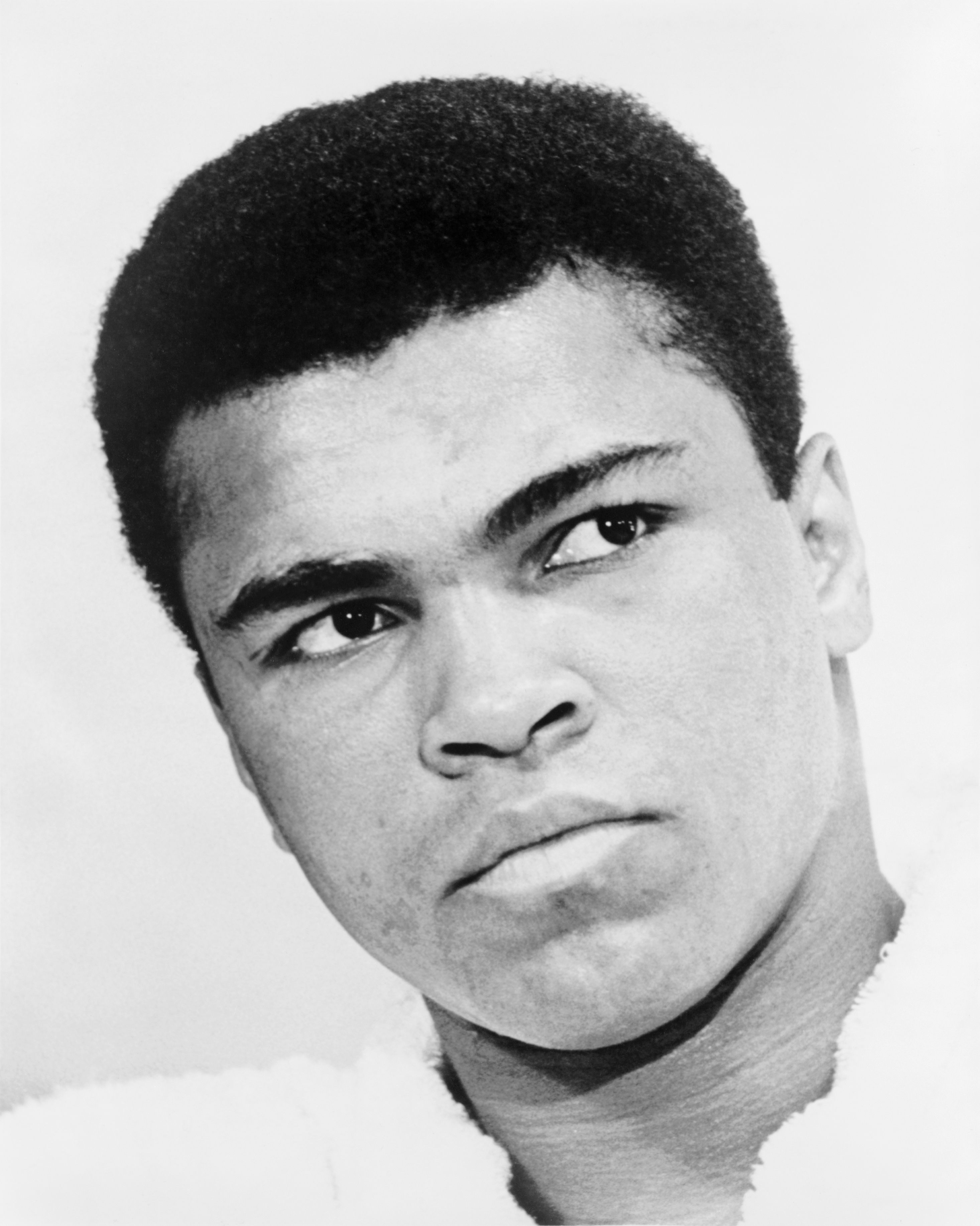

Muhammad Ali was born Cassius Marcellus Clay Jr. in Louisville, Kentucky, on January 17 1942 and died in Scottsdale, Arizona, on June 3 2016 at the age of 74. He took up boxing at 12 under the Louisville policeman Joe Martin and won the light-heavyweight gold medal at the Rome Olympics in 1960, turning professional weeks later. On February 25 1964 he upset Sonny Liston for the heavyweight championship; days after the fight he announced his membership in the Nation of Islam and, on March 6 1964, he was given the name Muhammad Ali by Elijah Muhammad. After defending the title — Britannica counts 19 successful defenses of the heavyweight title across his career — he refused induction into the U.S. Army on April 28 1967 on religious grounds at the height of the Vietnam War, was stripped of his titles and boxing licenses, convicted of draft evasion on June 20 1967, and barred from the ring for three and a half years. He returned in October 1970; on March 8 1971 he lost the Fight of the Century to Joe Frazier by unanimous decision, and on June 28 1971 the Supreme Court unanimously reversed his conviction in Clay v. United States. He regained the heavyweight title by knocking out George Foreman in the eighth round in Kinshasa on October 30 1974 (the Rumble in the Jungle), beat Frazier again in the Thrilla in Manila on October 1 1975, lost the title to Leon Spinks in February 1978 and became the first three-time heavyweight champion by beating Spinks on September 15 1978. After two further defeats — Larry Holmes in 1980 and Trevor Berbick on December 11 1981 — he retired with a record of 56-5 and 37 knockouts. Diagnosed with Parkinson syndrome in 1984, he lit the Olympic cauldron in Atlanta on July 19 1996 and devoted his last decades to humanitarian work; an estimated 100,000 people lined the streets of Louisville at his funeral in June 2016.
Louisville: the bicycle, the policeman, and the boy who would not be ordinary (1942–1959)
Muhammad Ali was born on January 17 1942 in Louisville, Kentucky1. He was born Cassius Marcellus Clay, the son of Odessa Clay and Cassius Clay Sr., at Louisville General Hospital in South Louisville; a brother, Rudy — later Rahaman Ali — was born two years afterwards, and the family soon moved into the Parkland neighborhood2. Britannica records him as an American professional boxer and social activist1. He died on June 3 2016 in Scottsdale, Arizona, at the age of 742.
On October 11 1954 the red Schwinn bicycle of the twelve-year-old Clay was stolen outside the annual Louisville Home Show2. Reporting the theft to a nearby policeman, Joe Martin, the boy declared what he would do to the culprit; Martin, who trained young boxers, told him he should learn how to fight first2. Britannica dates the start of his boxing education to the age of twelve, under Martin’s tutelage1. AP records that he weighed only 89 pounds at the time and that he had vowed to punish the person who took the bicycle3.
His amateur career took shape in the national tournaments: the Golden Gloves championship in 1959, repeated in 1960 and joined by the AAU title and the Olympic light-heavyweight crown4. The Library of Congress, which documents his first newspaper coverage at seventeen, remembers him as a boxer, activist and poet from Louisville5. He was raised Baptist by his mother, in a household where his father was a Methodist, and it was not until 1959, in Chicago for the Golden Gloves tournament, that he first met a representative of the Nation of Islam6. That encounter began a connection that would define his public life within a few years6.
Rome 1960: Olympic gold, and a professional bargain
The light-heavyweight boxing tournament at the Rome Games ran from August 26 to September 5 1960 at the Palazzo dello Sport — a single-elimination event of nineteen boxers from nineteen countries7. Clay opened against Yvon Becaus, and the bout ended in a technical knockout for him; unanimous decisions over Gennady Shatkov and Tony Madigan took him to the final against Zbigniew Pietrzykowski7. Told by his seconds that he needed a knockout to win, he took over the last round against the Pole; Pietrzykowski stayed upright, but the judges gave Clay another unanimous decision and with it the gold medal7.
According to his first trainer, Joe Martin, he was afraid to fly to Rome and said he would not go unless he could travel by boat8. The story goes that he bought an army surplus parachute and wore it for the entire flight to the Games8. He had gone to Rome three months out of high school and came back with the light-heavyweight gold, having beaten Pietrzykowski of Poland in the final2.
Clay turned professional just weeks after the Games and fought his first professional fight on October 29 1960 against Tunney Hunsaker, a police officer from Fayetteville, West Virginia9. The proceeds went to Kosair Children’s Hospital in Louisville9. He had signed with the Louisville Sponsoring Group, a syndicate of eleven wealthy white men, and in the early professional bouts he drew attention at least as much for charm and personality as for ring skill1. He raised interest in his fights by reciting childlike poetry and coining self-descriptive phrases for himself1.
“I shook up the world”: Liston, the title, and the Nation of Islam (1964)
On February 25 1964 at Miami Beach, Clay faced the champion Sonny Liston as a 7-1 underdog, with 43 of 46 writers predicting a Liston victory10. Liston did not come out for the seventh round, the failure afterwards attributed to a shoulder injury10. The Ali Center’s record enters the ending as a technical knockout in six rounds; the two accounts describe the same event, the champion’s abandonment of the fight before the seventh9. The result counts among the most stunning upsets in the history of sport, and Clay was the new heavyweight champion of the world1.
At the weigh-in a commission doctor reported the challenger scared to death and emotionally unstable — a scene ESPN records as a piece of theatre, part of a plan to make Liston think he faced a madman11. The morning after the fight he told reporters that he did not have to be what they wanted him to be, and that he was free to be who he wanted3. His membership in the Nation of Islam became public in those same days, days after the title win1. On March 6 1964 his spiritual mentor, Elijah Muhammad, gave him the name Muhammad Ali1.
I’m the greatest! I shook up the world!
Muhammad Ali, after beating Sonny Liston, February 1964 (Muhammad Ali Center)
The crowd did not dream when they lay down their money that they would see a total eclipse of the Sonny
Muhammad Ali at the weigh-in for the Liston fight (Associated Press)
I am the greatest
Muhammad Ali, the refrain of his career (Associated Press)
Vietnam, conscience, and the draft (1965–1967)
He had filed for conscientious objector status in Louisville on March 9 1966, and the claim was denied6. Late in 1966 he moved to Houston and filed again on the advice of his lawyer, and in March 1967 that second request was refused6. The law recognised only those opposed to war in any form, and he was not eligible for the exemption, because he acknowledged that he would be willing to take part in an Islamic holy war1. The refusal of induction came at the end of a legal campaign that had already been lost twice6.
On April 28 1967, citing his religious beliefs, he refused induction into the United States Army at Houston, at the height of the war in Vietnam1. When the officer called his name he would not step forward, and the warning he received was that he was committing a felony punishable by five years in prison and a fine of ten thousand dollars10. The Ali Center’s record counts two refusals to step forward, made as a minister in what the record calls the non-violent religion of Islam2. He was stripped of his heavyweight title and his boxing licences the same day2.
The blunt sentence about the Vietcong, spoken fourteen months earlier, had already made his case a public one1. On May 6 1967 he joined Martin Luther King in Louisville at a rally for fair housing practices2. In June, Jim Brown organised a summit of twelve leading Black athletes, among them Kareem Abdul-Jabbar and Bill Russell, to discuss his position; most arrived intending to change his mind and left expressing support for him2. On June 20 1967 he was convicted of draft evasion and sentenced to five years in prison and a ten thousand dollar fine; his lawyers filed an appeal immediately and posted bail, and he avoided jail6.
Three and a half years in the wilderness (1967–1970)
He was stripped of the championship and precluded from fighting by every state athletic commission in the United States for three and a half years1. He remained free on bail while the conviction went up on appeal, and through those years he was barred from the ring1. He would not fight again until he was allowed back into boxing, and the return came in October 1970 in Atlanta12.
The opponent at the comeback was Jerry Quarry, and the Atlanta crowd was a sell-out of more than five thousand people12. He won by technical knockout in the third round12. The event carried more than a sporting meaning: in the judgment of the activist Julian Bond, it established Atlanta as the political capital of Black America12.
His next great opponent was Joe Frazier, who had become the heavyweight champion during his absence from the ring1. Two undefeated heavyweights met at Madison Square Garden on March 8 1971 in a fight billed as the Fight of the Century; each was guaranteed a then-record 2.5 million dollars10. Frazier decked him with a sweeping left hook in the fifteenth round and won a unanimous decision, the first defeat of Ali’s career10.
Clay v. United States: the 1971 Supreme Court decision
The case was docketed as number 783 and reached the Supreme Court on certiorari from the Court of Appeals for the Fifth Circuit; it was argued on April 19 197113. The hearing officer, Judge Lawrence Grauman, found the registrant sincere in his objection on religious grounds and recommended that the conscientious objector claim be sustained13. The Department of Justice overruled its own hearing officer and advised the Appeal Board that the claim should be denied, and the Board denied it without stating reasons13. By the time the case was argued, the Government no longer questioned the sincerity of the petitioner’s beliefs13.
He had said, when told of the decision, that he had done his celebrating already and had prayed to Allah3. His passport was returned and he was officially a free man2. In January 1972 he made his first pilgrimage to Mecca2. The fighting career continued in parallel with the legal one: Ken Norton broke his jaw in March 1973 and handed him the second loss of his career9.
The fight record: a dated career in twelve bouts
| Opponent | Date | Venue | Result | Note |
|---|---|---|---|---|
| Tunney Hunsaker | October 29 19609 | Louisville9 | Win, unanimous decision in 69 | professional debut; proceeds to Kosair Children’s Hospital9 |
| Sonny Liston | February 25 19649 | Miami Beach9 | Win, technical knockout in 6 (Liston does not rise for round seven)9 | wins the heavyweight championship9 |
| Sonny Liston | May 25 196510 | Lewiston, Maine10 | Win, knockout in 1 (2:12)9 | briefest of the Liston fights; the anchor punch9 |
| Zora Folley | March 22 19679 | New York, Madison Square Garden9 | Win, knockout in 79 | the last fight before the exile9 |
| Joe Frazier | March 8 197110 | New York, Madison Square Garden9 | Loss, unanimous decision in 151 | the Fight of the Century; his first defeat10 |
| Ken Norton | March 31 19739 | San Diego9 | Loss, split decision in 129 | the jaw broken in the second round9 |
| George Foreman | October 30 19749 | Kinshasa, Zaire9 | Win, knockout in 89 | the title retaken in the fight he called the Rumble in the Jungle1 |
| Joe Frazier | October 1 19759 | Quezon City, Philippines9 | Win, technical knockout in 149 | the Thrilla in Manila1 |
| Leon Spinks | February 15 19789 | Las Vegas9 | Loss, split decision in 159 | Spinks’s eighth professional bout; the first to take the title from him in the ring9 |
| Leon Spinks | September 15 19783 | New Orleans, Superdome3 | Win, unanimous decision in 153 | the first three-time heavyweight champion1 |
| Larry Holmes | October 2 19809 | Las Vegas, Caesars Palace9 | Loss, retired in the corner after 10 rounds9 | the trainer stops it before the eleventh round9 |
| Trevor Berbick | December 11 19819 | Nassau, Bahamas9 | Loss, unanimous decision in 109 | the sixty-first and final professional fight9 |
The professional record closed at 56 wins, 5 losses and 37 knockouts1. Britannica credits nineteen successful defences of the heavyweight championship and places him first among fighters to win that title on three separate occasions1. The rows above keep the dates and the outcomes as the Ali Center’s boxing timeline records them9.
Rumble in the Jungle: Kinshasa, 1974
The Rumble in the Jungle was fought in the pre-dawn hours of October 30 1974 in Kinshasa, Zaire, and Ali entered the ring a 7-1 underdog against George Foreman10. The strategy that won it became known as the rope-a-dope: he leaned back against the ropes and covered up while the champion threw everything he had10. By the eighth round the previously unbeaten Foreman was exhausted, and Ali knocked him out, becoming the second heavyweight after Floyd Patterson to regain the championship10. He had predicted the shock in advance, telling the world to wait and see what happened when he took on Foreman after the resignation of a president3.
The fight drew 60,000 spectators in Kinshasa3. The victory made him champion for the second time1. The decade had reversed the picture: an athlete denounced as anti-America in 1967 was by 1974 being invited to the White House10.
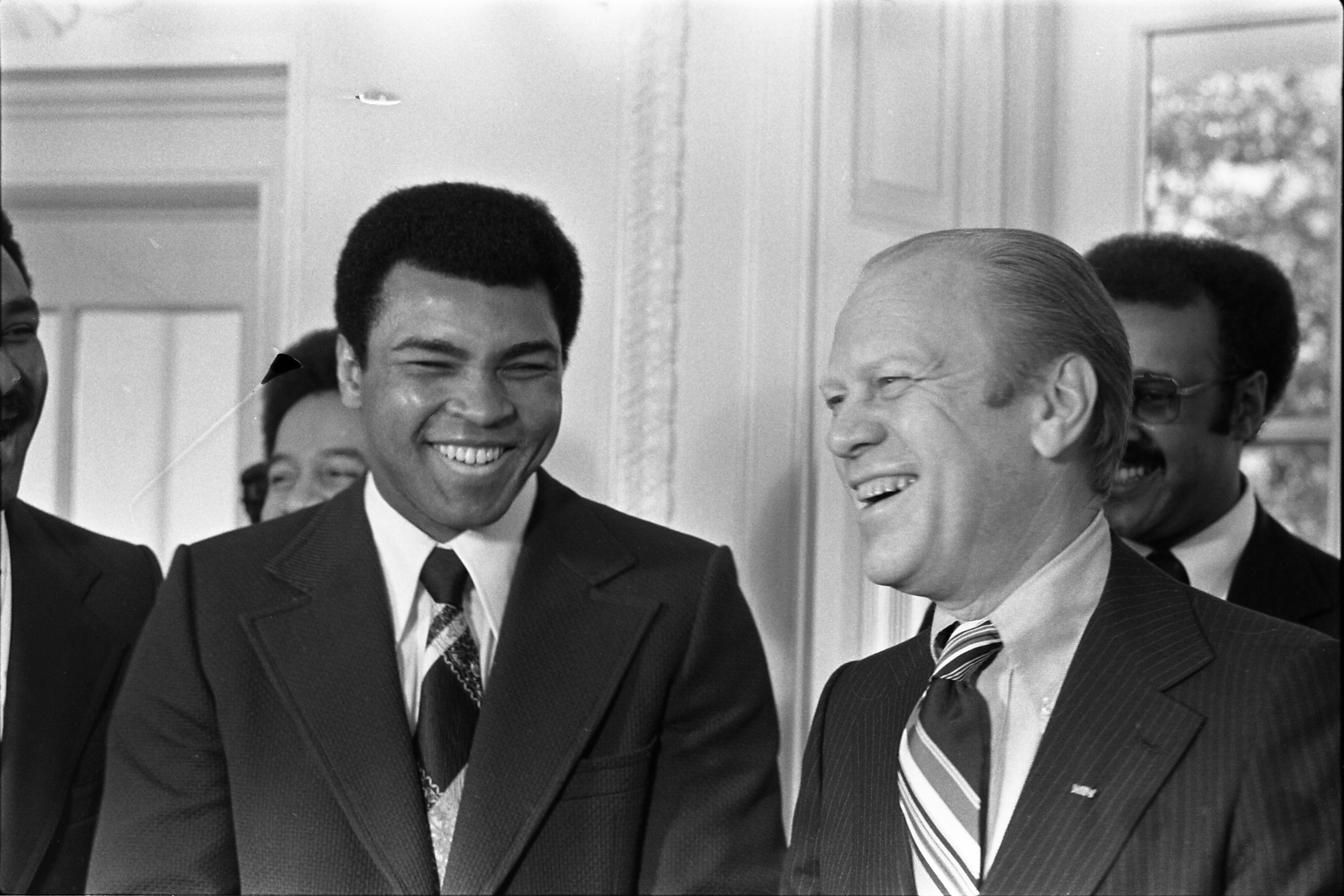

On December 10 1974 he made his first visit to the White House, where President Gerald Ford received him2. Ford later said that he had wanted to meet him not only out of interest in sports but as part of an effort to heal the wounds of racial division, Vietnam and Watergate2. It began a long list: he would meet seven presidents over the course of his lifetime2.
Thrilla in Manila and a third championship (1975–1978)
The third Ali-Frazier fight took place on October 1 1975 outside Manila, and it is regarded by many as the greatest prizefight of all time1. Ali was declared the victor when Frazier’s corner halted the bout after fourteen brutal rounds1. It stands among the epic struggles between the two men, often considered the greatest heavyweight bout ever fought4. Ali said afterwards that it was like death, the closest thing to dying he had known; the words of both men are in the quotation bank below11.
In February 1978, in Las Vegas, the title passed to Leon Spinks, who took it by split decision over fifteen rounds in only his eighth professional bout9. On September 15 1978, before some 70,000 people at the Superdome in New Orleans, he won it back with a unanimous decision3. It was the third time he had won the world heavyweight championship, a first in the history of boxing3. He announced his retirement the following year3.
He returned on October 2 1980 against Larry Holmes at Caesars Palace in Las Vegas, taking thyroid medication to lose weight, and the trainer Angelo Dundee ended the fight before the eleventh round9. The last fight came on December 11 1981 against Trevor Berbick in Nassau — the sixty-first and final bout of his career; he began it trying to look like his former self, but by the sixth round he was tiring9. After Berbick was declared the winner, he retired officially9.
In his own words
From the childlike poetry of the early professional bouts to the reflections of the last years, this is his voice as the sources record it1.
float like a butterfly, sting like a bee
Muhammad Ali, the phrase of his early professional bouts (Encyclopaedia Britannica)
I am the greatest
Muhammad Ali, a refrain recorded by the Associated Press
I ain’t got no quarrel with them Vietcong.
Muhammad Ali, fourteen months before his induction refusal (Encyclopaedia Britannica)
I’m the greatest! I shook up the world!
Muhammad Ali, after beating Sonny Liston (Muhammad Ali Center)
I don’t have to be what you want me to be
Muhammad Ali, the morning after beating Liston (Associated Press)
I’m free to be who I want.
Muhammad Ali, the morning after beating Liston (Associated Press)
You think the world was shocked when Nixon resigned
Muhammad Ali, before the Rumble in the Jungle (Associated Press)
Wait till I whup George Foreman’s behind.
Muhammad Ali, before the Rumble in the Jungle (Associated Press)
It was like death. Closest thing to dying that I know of.
Muhammad Ali, after the Thrilla in Manila (ESPN)
Lawdy, lawdy, he’s a great champion.
Joe Frazier, after the Thrilla in Manila (ESPN)
I’ve done my celebrating already
Muhammad Ali, told of the Supreme Court decision, June 1971 (Associated Press)
I said a prayer to Allah.
Muhammad Ali, told of the Supreme Court decision, June 1971 (Associated Press)
Islam is a religion of peace. Islam does not promote terrorism or the killing of people.
Muhammad Ali, in New York nine days after the September 11 attacks (Muhammad Ali Center)
It was after I retired from boxing that my true work began.
Muhammad Ali (Muhammad Ali Center)
I’m always going to be one black one who got big on your white televisions and 100% stayed with representing my people.
Muhammad Ali (Smithsonian National Museum of African American History and Culture)
After boxing: Parkinson syndrome, the torch, and the last decades (1978–2016)
In September 1984, after his health had deteriorated since retirement, he checked himself into Columbia Presbyterian Hospital in New York and was diagnosed with Parkinson’s disease — a brain disorder marked by trembling, stiffness, difficulty with walking, and problems of balance and coordination2. The condition stayed with him for more than three decades, and during the final illness Reuters noted that he had kept a low profile in recent years14. He once calculated that he had taken 29,000 punches to the head and made 57 million dollars in his professional career3.
On July 19 1996 he lit the Olympic cauldron at the Atlanta Games, a moment the Ali Center records as captivating 3.5 billion viewers worldwide2. He had waited out of sight until the swimmer Janet Evans carried the flame to the top of the stairs, then stepped out of the shadows to light his torch while the crowd took up his name8. On August 4 1996, at halftime of the men’s basketball final, the president of the International Olympic Committee, Juan Antonio Samaranch, gave him a replacement gold medal for the one he had won in 19608.
Stories had grown around the first medal: he told at least once of throwing it from the Jefferson County Bridge in Louisville after being refused service at a restaurant8. AP reports that the story may be apocryphal and that he later told friends he had simply misplaced the medal3. In November 1990, despite warnings, he travelled to Baghdad, met Saddam Hussein for nearly an hour, and secured the release of fifteen United States hostages taken during the invasion of Kuwait2.
In January 1981 he had talked a distressed man down from a ninth-floor window in Los Angeles, telling him that he was a brother and that he loved him2. In 1984 he carried the Olympic flame through the streets of Louisville in the torch relay for the Los Angeles Games8. In 2005 Lonnie and Muhammad Ali founded the Muhammad Ali Center in their hometown of Louisville as a place of inspiration and reflection15. He died late in the evening of June 3 2016 in Scottsdale, Arizona, of respiratory complications; he was 742. Louisville became the centre of a public memorial for seven days, and hundreds of thousands came to mourn2.
Reading the legend: where the sources agree, and where they differ
The record is not seamless; on five points the sources disagree among themselves, and this entry keeps their versions side by side1.
Timeline
Born Cassius Clay Jr. in Louisville
Cassius Clay Jr. is born to Odessa and Cassius Clay Sr. at Louisville General Hospital in South Louisville; brother Rudy (later Rahaman Ali) is born two years later and the family moves into the Parkland neighborhood.
Olympic gold in Rome
Three months out of high school, Clay wins the light-heavyweight gold medal at the Rome Olympics, beating Zbigniew Pietrzykowski of Poland in the final; he had travelled with an army surplus parachute because he was afraid of flying.
The Liston upset — heavyweight champion
In one of the most stunning upsets in sports history, the 7-1 underdog Clay defeats Sonny Liston at Miami Beach; Liston does not answer the bell for the seventh round and Clay becomes the new champion.
The name Muhammad Ali
Days after the title win Clay announces he has accepted the teachings of the Nation of Islam; on 6 March 1964 Elijah Muhammad gives him the name Muhammad Ali, which the champion keeps for the rest of his life.
Refusal of induction — and conviction
Citing his religious beliefs, Ali refuses induction into the U.S. Army at Houston at the height of the war in Vietnam; he is stripped of his titles and licences the same day, and on June 20 1967 he is convicted of refusing induction and sentenced to five years in prison; he remains free on bail.
Return to the ring in Atlanta
Allowed back into boxing, Ali stops Jerry Quarry in three rounds in Atlanta before a sell-out crowd of more than 5,000, an event that made Atlanta, in Julian Bond's phrase, 'the black political capital of America'.
Fight of the Century
Two undefeated fighters meet at Madison Square Garden with each guaranteed a then-record $2.5 million; Frazier floors Ali with a left hook in the 15th round and wins a unanimous decision — Ali's first defeat.
Supreme Court reverses the conviction
In a unanimous ruling the Supreme Court reverses Ali's draft-evasion conviction because the Appeal Board gave no reasons and two of the three grounds offered were invalid; Ali, told of the decision, says: 'I said a prayer to Allah.'
Rumble in the Jungle — champion again
In Kinshasa, before 60,000 spectators, Ali uses the rope-a-dope to exhaust the previously unbeaten George Foreman and knocks him out in the eighth round to regain the heavyweight title.
Thrilla in Manila
The third Ali-Frazier fight, regarded by many as the greatest prizefight of all time, is stopped when Frazier's corner calls a halt after fourteen brutal rounds; Ali calls it 'the closest thing to dying' he has experienced.
A third heavyweight championship
Before 70,000 people at the Superdome in New Orleans, Ali scores a unanimous decision over Leon Spinks to take the world heavyweight championship for a third time — a first in boxing history; he announces his retirement the following year.
Diagnosed with Parkinson's disease
After retiring, Ali's health deteriorates and, at Columbia Presbyterian Hospital in New York, he is diagnosed with Parkinson's disease, a brain disorder causing shaking, stiffness, difficulty walking and loss of balance and coordination.
Lighting the Olympic cauldron
In an opening-ceremony surprise at the Atlanta Games, Ali emerges from the shadows to light the Olympic cauldron; the site records that the moment captivated 3.5 billion viewers worldwide.
Death in Scottsdale
Muhammad Ali dies late in the evening in Scottsdale, Arizona, due to respiratory complications; he is 74. For seven days Louisville becomes the centre of a public memorial and hundreds of thousands come to mourn.
Frequently asked questions
Who was Muhammad Ali?
Muhammad Ali was an American professional boxer and social activist, born Cassius Clay in Louisville, Kentucky, on January 17 1942 and dead in Scottsdale, Arizona, on June 3 20161. He was the first fighter to win the world heavyweight championship on three separate occasions, and he defended the title nineteen times1.
How did he come to boxing?
He began boxing at the age of twelve under the tutelage of the Louisville policeman Joe Martin1. The prompt was the theft of his bicycle on October 11 1954 and his resolve to settle accounts with the person who had taken it2.
Why did he refuse induction into the Army, and what happened to him?
On April 28 1967, citing his religious beliefs, he refused induction into the United States Army at the height of the war in Vietnam1. He was convicted of draft evasion and stripped of his heavyweight title and boxing licences, then precluded from fighting for three and a half years2. He was not eligible for a conscientious objector exemption because he acknowledged that he would be willing to take part in an Islamic holy war1.
What did the Supreme Court decide in 1971?
The Court reversed his conviction on June 28 1971, for the reason that the Appeal Board had given no reason for its denial and it was impossible to determine which of the three grounds it had relied on13. The reversal was reported as an 8-0 vote, with Justice Marshall taking no part3.
What was the Rumble in the Jungle?
At Kinshasa in Zaire on October 30 1974 he knocked out George Foreman in the eighth round to regain the heavyweight championship1. He had gone in as a 7-1 underdog and used the rope-a-dope to exhaust the previously unbeaten champion10.
What happened in the Thrilla in Manila?
Their third fight, on October 1 1975 outside Manila, is regarded by many as the greatest prizefight of all time1. Ali was declared the victor when Frazier’s corner halted the bout after fourteen rounds1.
How many fights did he have, and what was his record?
His professional record closed at 56 wins, 5 losses and 37 knockouts1. His last fight, the sixty-first of his career, was a loss to Trevor Berbick in Nassau on December 11 19819.
What did he do in the last decades of his life?
He was diagnosed with Parkinson’s disease in September 19842. In November 1990 he travelled to Baghdad and secured the release of fifteen United States hostages taken during the invasion of Kuwait2. On July 19 1996 he lit the Olympic cauldron at the Atlanta Games, a moment recorded as captivating 3.5 billion viewers worldwide2.
Knowledge graph
Sources & citations
Every factual claim in this article is drawn from the sources below. Bracketed numbers in the text link to the corresponding source.
- 1
- 2
- 3
- 4
- 5
- 6
- 7
- 8
- 9
- 10
- 11
- 12
- 13
- 14
- 15