Mahatma Gandhi
Lawyer, anti-colonial leader, and the architect of mass nonviolent resistance — from a Durban train platform to the Salt March and the last fasts of partition.
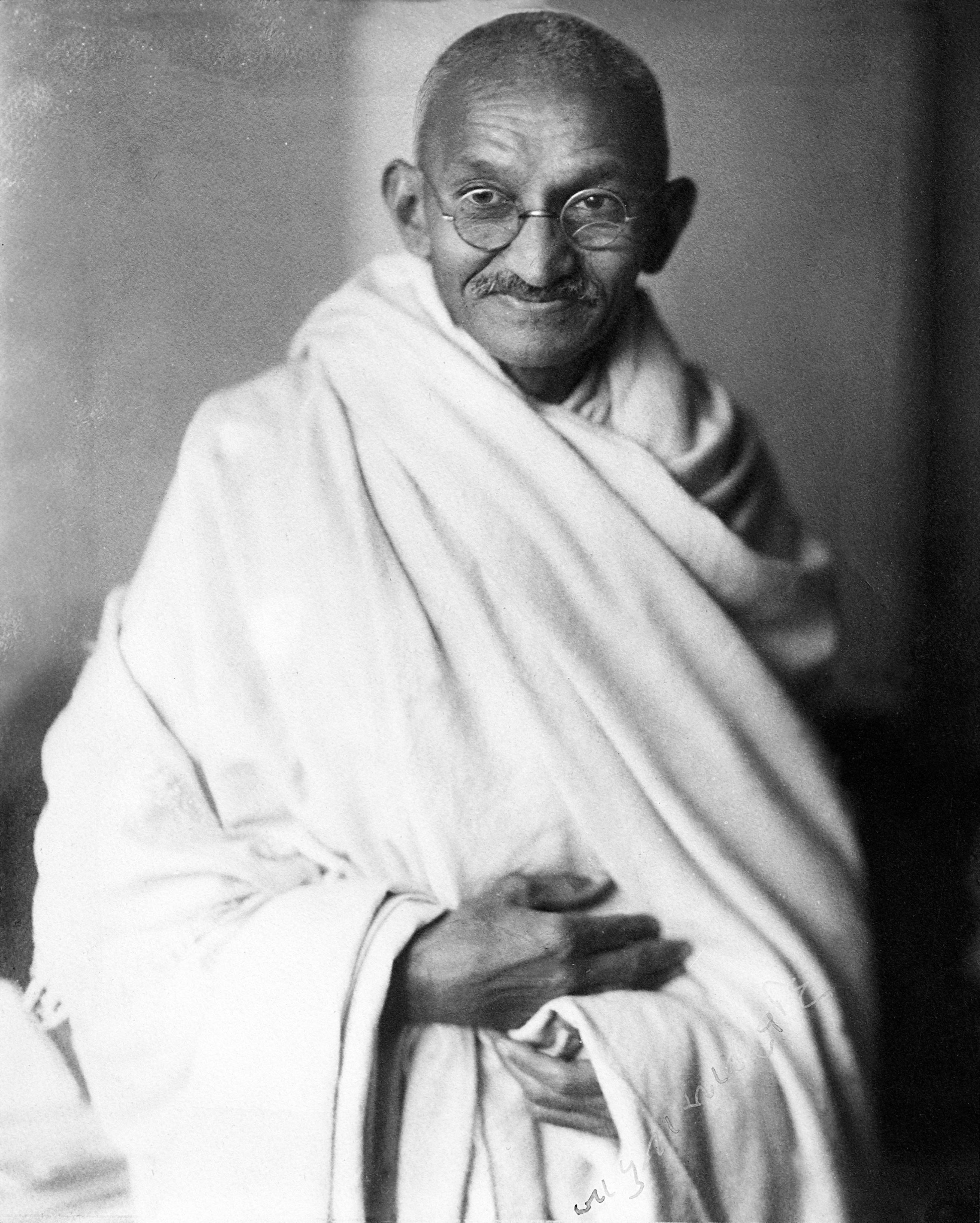

Mohandas Karamchand Gandhi (1869–1948) was an Indian lawyer who became the leader of the Indian Independence Movement against British rule and the twentieth century's best-known practitioner of nonviolent resistance, satyagraha. Thrown off a first-class carriage in Pietermaritzburg in 1893, he spent two decades in South Africa organising the Indian community before returning to India in 1915. He led the Champaran and Kheda satyagrahas, the Rowlatt protests of 1919, the noncooperation movement of 1920–22, the Salt March of 1930, and the Quit India Movement of 1942, spending years in prison and fasting to end communal violence. He was never awarded the Nobel Peace Prize despite twelve nominations, and was assassinated by Nathuram Godse on 30 January 1948, months after India won independence through a partition he opposed. Gandhi Jayanti, his 2 October birthday, is a national holiday in India and the UN's International Day of Non-Violence.
The man and the Mahatma
Mohandas Karamchand Gandhi was born on 2 October 1869 in Porbandar, India, and died on 30 January 1948 in Delhi.1 In the eyes of millions of his fellow Indians he was the Mahatma — the “Great Soul”.1 He was an Indian lawyer, politician, social activist, and writer who became the leader of the Indian Independence Movement against British rule, and he came to be considered “the father of the nation”.1
His chosen method was satyagraha.2 The term, which he adopted in preference to “passive resistance” because the struggle had to be conducted without anger, means literally “truth force”.2 He arrived at it in South Africa, not in India.2 In 1893 he went to Natal, where he was employed by an Indian trading company, and he reached Durban to serve as legal counsel to a merchant, Dada Abdulla.32
The documented record of his life is a record of campaigns, imprisonments, newspapers, and fasts.2 He was nominated for the Nobel Peace Prize in twelve nominations and was never awarded it.4 He was shot down on 30 January 1948 while on his way to an evening prayer meeting in Delhi, and India remembers him every 2 October, his birthday.5
Youth: Porbandar, marriage, and London
Gandhi’s father, Karamchand Gandhi, was the dewan — chief minister — of Porbandar, the capital of a small principality in western India under British suzerainty.1 His mother, Putlibai, was completely absorbed in religion, fasted frequently, and wore herself out in days and nights of nursing whenever there was sickness in the family.1 Mohandas grew up in a home steeped in Vaishnavism with a strong tinge of Jainism, and came to take for granted ahimsa, vegetarianism, fasting for self-purification, and mutual tolerance between adherents of various creeds and sects.1 He married his wife, Kasturba, when he was 13 years old, and together they had five children; their firstborn died shortly after birth.1
In September 1888 he disregarded his subcaste’s ban and sailed for England, where, ten days after arriving, he joined the Inner Temple, one of London’s four law colleges.1 He successfully completed his degree at the Inner Temple and was called to the Bar on 10 June 1891.2
South Africa: the making of satyagraha (1893–1914)
Gandhi arrived in Durban, Natal, in 1893 to serve as legal counsel to a merchant, Dada Abdulla.2 In June of that year, on a rail trip to Pretoria, he was ordered out of the first-class compartment at Pietermaritzburg, despite having purchased a first-class ticket.2 He was instrumental in the formation of the Natal Indian Congress on 22 August 1894, the first permanent political organisation to strive to maintain and protect the rights of Indians in South Africa.2 In June 1903 he established the newspaper Indian Opinion, and in June 1904 he moved it and its workers to the Phoenix Settlement just outside Durban, an experiment in communal living and full equality.2
In late 1906 the resistance acquired its name.2 Needing a new term for the Indian resistance, Gandhi chose satyagraha, which literally means “truth force”.2 In 1910 he withdrew to Tolstoy, a farm he had purchased to support the families of jailed passive resisters.2 It was illegal for Indians to cross the border from the Transvaal into Natal without a permit; Indian women from the Tolstoy Ashram crossed without permits, persuaded the Indian miners of Newcastle to strike, and were arrested.2 In July 1914 he sailed with his wife for England, and when World War I broke out during the journey he decided to stay in England; he sailed to India in January 1915, his struggles and triumphs in South Africa already reported in the worldwide press.2
Return to India: Champaran, Ahmedabad, Kheda
He returned to India in January 1915 as a national hero, his South African struggles and triumphs already known around the world.2 His first ashram in India was established in the Kochrab area of Ahmedabad on 25 May 1915, and it was later shifted to the Sabarmati.6 The move, on 17 June 1917, took the community to a piece of open land on the banks of the river Sabarmati.6 Sabarmati — also known as Harijan Ashram — was home to Gandhi from 1917 until 1930 and served as one of the main centres of the Indian freedom struggle.6 He chose the site partly because it lies between a jail and a crematorium, as he believed that a satyagrahi has to invariably go to either place.6
In 1917 he led nonviolent campaigns against the oppression of peasants by the British government in the indigo plantations of Champaran, Bihar.5 In 1918 he undertook a hunger strike and protest against poor working conditions in the textile mills of Ahmedabad, and a second protest, the Kheda Satyagraha, against the taxes imposed by the British on peasants despite repeated famines.5
Rowlatt, Amritsar, and the turn to noncooperation
In 1919 Gandhi led satyagraha against the Rowlatt Act, a set of measures to clamp down on the nationalist movement.5 He called for a countrywide hartal (strike) on 6 April, marking the beginning of the Rowlatt Satyagraha, or nonviolent resistance against the act.7 Heeding the call, Indians voluntarily closed shops and offices, observed a day of fasting, and held public meetings demanding the scrapping of the act.7 The violent outbreak that followed included the Jallianwala Bagh Massacre, the killing by British-led soldiers of nearly 400 Indians who were gathered in an open space in Amritsar, in the Punjab region.5
By the autumn of 1920 Gandhi was the dominant figure on the political stage, commanding an influence never before attained by any political leader in India, and he refashioned the 35-year-old Indian National Congress into a mass organization with its roots in small towns and villages.5 In 1920 he launched the noncooperation movement, a large-scale civil disobedience movement to protest the Rowlatt Act and the massacre in Jallianwala Bagh.5 It was an unsuccessful attempt, spanning 1920–22, to induce the British government of India to grant self-government, or swaraj.8
Table: major movements and campaigns, 1917–1942
The table records the major movements and campaigns as the fact base documents them, from the indigo fields of Champaran to the “Do or Die” summer of 1942.59
| Movement / campaign | Year(s) | Method | Outcome |
|---|---|---|---|
| Champaran | 1917 5 | Nonviolent campaigns against the oppression of peasants by the British government in the indigo plantations of Champaran, Bihar. 5 | — |
| Ahmedabad mill strike and Kheda satyagraha | 1918 5 | A hunger strike and protest against poor working conditions in the textile mills of Ahmedabad, and the Kheda Satyagraha against the taxes imposed by the British on peasants despite repeated famines. 5 | — |
| Rowlatt satyagraha | 1919 5 | Satyagraha against the Rowlatt Act, the measures to clamp down on the nationalist movement, opened by a countrywide hartal on 6 April. 57 | The ensuing upheaval included the Jallianwala Bagh Massacre, in which British-led soldiers killed nearly 400 Indians in Amritsar. 5 |
| Noncooperation movement | 1920–22 8 | A large-scale civil disobedience movement to protest the Rowlatt Act and the massacre in Jallianwala Bagh, seeking self-government, or swaraj. 58 | Unsuccessful; Gandhi called it off after an angry mob murdered police officers at Chauri Chaura in February 1922, and he was arrested the next month. 8 |
| Salt March (Dandi March) | 1930 5 | A satyagraha against the British-imposed tax on salt, which affected the poorest section of the community; Gandhi set out on foot on 12 March and picked up salt at Dandi on 6 April. 510 | One of the most spectacular and successful campaigns in his nonviolent war against the British raj; more than 60,000 people were imprisoned. 5 |
| Civil disobedience and the Gandhi-Irwin Pact | 1930–31 5 | The Salt March opened an even-larger campaign of civil disobedience that extended into early 1931. 10 | After talks with the viceroy, Lord Irwin, Gandhi accepted a truce, called off civil disobedience, and attended the Round Table Conference in London as the sole representative of the Indian National Congress. 5 |
| Poona Pact fast | 1932 11 | While still a prisoner, Gandhi began a fast unto death on 18 September 1932 against the British government’s decision to allot the so-called “untouchables” separate electorates in the new constitution. 115 | The Poona Pact of 24 September 1932 declined separate electorates but gave increased representation to the Dalits within the Hindu electorate for a 10-year period. 11 |
| Quit India Movement | 1942 9 | Launched as a nonviolent action on 8 August 1942 by Gandhi and his followers, demanding an immediate end to British rule; Gandhi’s mantra was “Do or Die”. 9 | At least 1,000 Indians died and roughly 60,000 arrests had been made by the end of 1943; Gandhi was confined in the Aga Khan’s summer palace in Pune. 9 |
Trial at Ahmedabad: the Great Trial of 1922
In February 1922 an angry mob murdered police officers in the village of Chauri Chaura, and Gandhi called off the movement; the next month he was arrested without incident.8 He was arrested on 10 March 1922, tried for sedition, and sentenced to six years’ imprisonment.5 The trial of Gandhi and Banker commenced at the Circuit House at Shahi Bag in Ahmedabad on 18 March 1922, and both accused were undefended.12 The charge in each case was that of bringing or attempting to bring into hatred or contempt, or exciting disaffection towards, His Majesty’s Government established by law in British India — over three articles Gandhi had written in Young India.12
Salt March, Round Table, and the Poona Pact
In March 1930 Gandhi launched the Salt March, also called the Dandi March, a satyagraha against the British-imposed tax on salt, which affected the poorest section of the community.5 It was the first act of an even-larger campaign of civil disobedience that extended into early 1931.10 He set out on foot on 12 March 1930 accompanied by several dozen followers; after each day’s march the group stopped in a different village, where increasingly larger crowds gathered.10 On 5 April the entourage reached Dandi after a journey of some 240 miles (385 km), and on the morning of 6 April Gandhi and his followers picked up handfuls of salt along the shore, thus technically “producing” salt and breaking the law.10 He announced on 24 April a planned nonviolent raid on the salt works at Dharasana, just 25 miles south of Dandi, and was arrested on the night of 4 May 1930, a few days before the action was to take place.13 The march on the saltworks went ahead as planned on 21 May 1930 under the leadership of the poet Sarojini Naidu, and many of the some 2,500 peaceful marchers were attacked and beaten by police.10 The British colonial government arrested and imprisoned over 60,000 people.13
In 1931, after talks with the viceroy, Lord Irwin, Gandhi accepted a truce — the Gandhi-Irwin Pact — called off civil disobedience, and agreed to attend the Round Table Conference in London as the sole representative of the Indian National Congress.5 When he returned to India in December 1931 he found his party facing an all-out offensive from Lord Willingdon, who unleashed the sternest repression in the history of the nationalist movement, and Gandhi was once more imprisoned.5
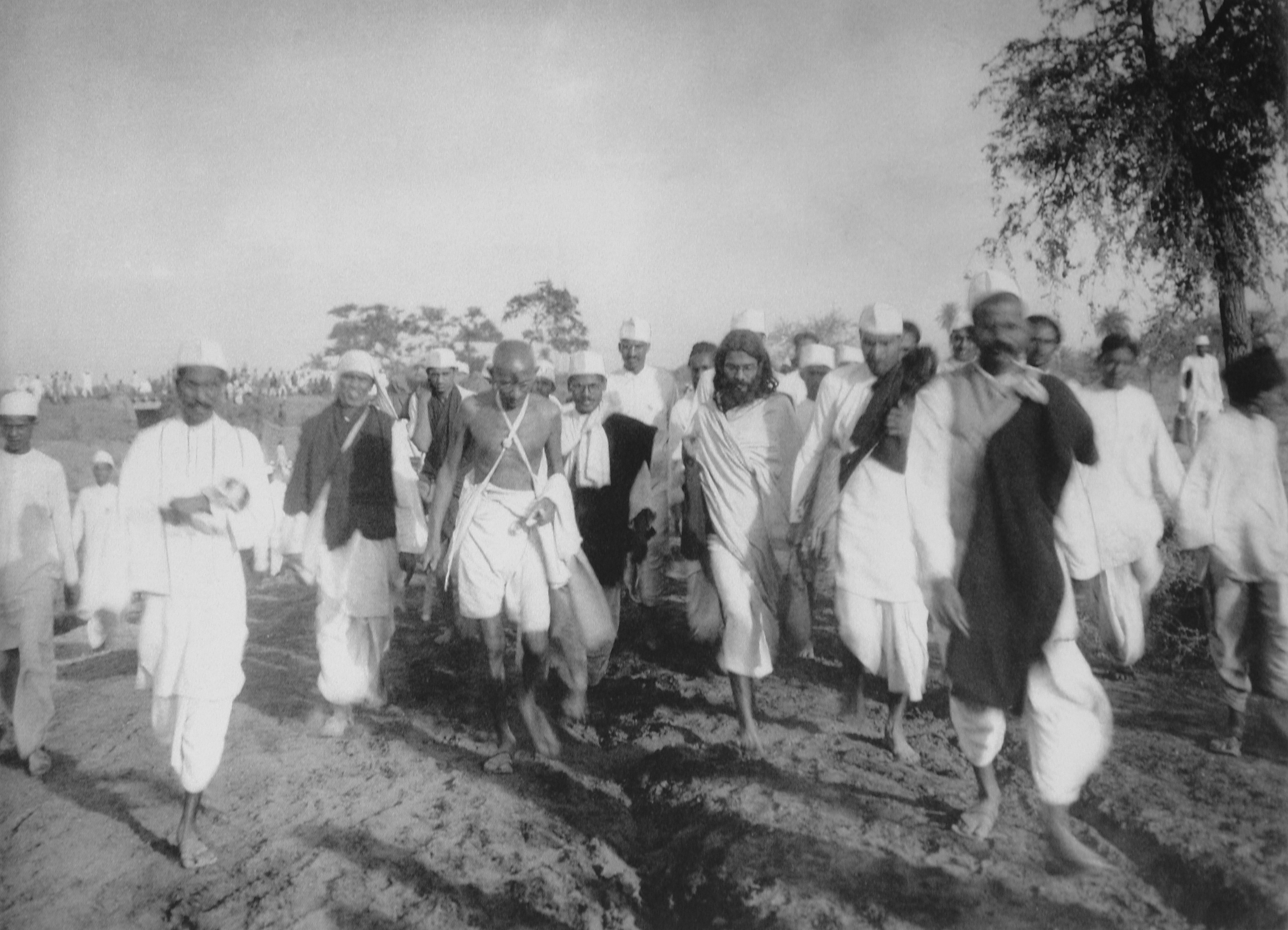

In September 1932, while still a prisoner, he embarked on a fast to protest against the British government’s decision to segregate the so-called “untouchables” by allotting them separate electorates in the new constitution.5 It was a fast unto death, begun on 18 September.11 Ambedkar refused to abandon his support for separate electorates until Gandhi was near death; the resulting pact of 24 September 1932 declined separate electorates but gave increased representation to the Dalits within the Hindu electorate for a 10-year period.11 Ambedkar complained of blackmail, but the pact marked the start of the movement against “untouchability” within the Indian nationalist movement.11
Quit India, partition, and the last fasts
The failure of Sir Stafford Cripps’s mission, the British equivocation on the transfer of power, and official encouragement of communal forces impelled Gandhi in the summer of 1942 to demand an immediate British withdrawal from India.5 The Cripps offer of March 1942 included an “opt-out” clause allowing certain provinces to choose not to be part of a united India — a provision received positively by Mohammed Ali Jinnah, whose Muslim League desired the creation of a separate Muslim-majority nation to be called Pakistan, and negatively by Gandhi and Congress, who opposed any potential partition of India.9 Gandhi called the offer “a post-dated cheque on a bank that was failing”.9 He demanded of the British in his magazine Harijan on 24 May 1942: “Leave India to God. If that is too much leave her to anarchy.”9
On 14 July 1942 the Congress Party passed its “Quit India” resolution, calling for an immediate end to British rule in India and authorizing Gandhi to lead a mass nonviolent protest movement if independence was not granted.9 The movement was launched as a nonviolent action on 8 August 1942 by Gandhi and his followers, and in his “Do or Die” speech he declared that they would either free India or die in the attempt.9 Several nationalist leaders, including Gandhi, Jawaharlal Nehru, Abul Kalam Azad, and Vallabhbhai Patel, were arrested, and Gandhi was confined in the Aga Khan’s summer palace in Pune along with his wife, Kasturba.9 At least 1,000 Indians died in the ensuing turmoil, and roughly 60,000 arrests had been made by the end of 1943.9
Before the British colonial officials left India in 1947 the subcontinent was divided into two different nations: India and Pakistan.14 It was one of the greatest disappointments of Gandhi’s life that Indian freedom was realized without Indian unity.5 He threw himself into healing the scars of the communal conflict, touring the riot-torn areas in Bengal and Bihar, admonishing the bigots, consoling the victims, and trying to rehabilitate the refugees.5 When persuasion failed, he went on a fast; in September 1947 his fasting stopped the rioting in Calcutta, and in January 1948 he shamed the city of Delhi into a communal truce.5
Assassination and remembrance
A few days later, on 30 January 1948, while he was on his way to his evening prayer meeting in Delhi, Gandhi was shot down by Nathuram Godse, a young Hindu fanatic.5 He was aged 78.1 The timing entered the Nobel record too: he had been nominated days before his death, two days before the closing date for that year’s nominations.3
In his memory, January 30 is observed as Martyrs’ Day in India, when senior officeholders pay tribute at Raj Ghat, a memorial dedicated to Mahatma Gandhi in New Delhi.5 India observes his birth anniversary on October 2 as Gandhi Jayanti, a national holiday, and the United Nations has declared the day the International Day of Non-Violence in his honor.1
In his own words
Four dated thoughts from November 1944, the slogans of 1942, and the statement at the 1922 trial preserve the voice behind the record.15912
Innumerable are the names of God; but if a choice were to be made of one, it would be Sat or Satya, that is, Truth. Hence verily Truth is God.15
Thought of 20 November 1944 — Collected Works (CWMG), vol. LXXVIII, p. 390
Realization of Truth is not at all possible without ahimsa. That is why it has been said that ahimsa is the supreme dharma.15
Thought of 21 November 1944 — CWMG, vol. LXXVIII, p. 390
Let us respect other religions even as we respect our own. Mere tolerance thereof is not enough.15
Thought of 27 November 1944 — CWMG, vol. LXXVIII, p. 391
Removal of untouchability means not merely touching the Harijans, but also looking upon them as our own kith and kin; in other words, treating them in the same way as we would our own brothers and sisters. None is high, none low.15
Thought of 28 November 1944
The mantra is “Do or Die.” We shall either free India or die in the attempt; we shall not live to see the perpetuation of our slavery.9
Mahatma Gandhi, “Do or Die” speech, Bombay, 8 August 1942
Leave India to God. If that is too much leave her to anarchy.9
Mahatma Gandhi, Harijan magazine, 24 May 1942
I am here to invite and cheerfully submit to the highest penalty that can be inflicted upon me for what in law is a deliberate crime and what appears to me to be the highest duty of a citizen.12
Mahatma Gandhi, statement at the Great Trial, Ahmedabad, 18 March 1922
Legacy and the missing Nobel
The Nobel record is among the best-documented ironies of his life.3 Gandhi was nominated in 1937, 1938, 1939 and 1947, and finally a few days before he was murdered in January 1948.3 The nomination archive records him as a nominee in 12 nominations, among them 1937 by Ole Colbjørnsen and 1948 by the American Friends Service Committee.4 In 1937 he was selected as one of thirteen candidates on the Norwegian Nobel Committee’s short list.3 The committee’s adviser, professor Jacob Worm-Müller, judged him “undoubtedly, a good, noble and ascetic person” — and, in the same assessment, “a freedom fighter and a dictator, an idealist and a nationalist”.3
When the vote was taken for the 1947 prize, three of five members were against awarding it to Gandhi, and the committee unanimously decided to award it to the Quakers.3 Its chairman, Gunnar Jahn, recorded the difficulty — that Gandhi was “not only an apostle for peace; he is first and foremost a patriot”.3 On 18 November 1948 the committee decided to make no award that year; no Nobel Prize was awarded in 1948.316 It is widely held, in retrospect, that he should have been the very man selected.3 When the Dalai Lama was awarded the Peace Prize in 1989, the chairman of the committee said that this was “in part a tribute to the memory of Mahatma Gandhi”.3
The International Day of Non-Violence is observed on 2 October, the birthday of Mahatma Gandhi, leader of the Indian independence movement and pioneer of the philosophy and strategy of non-violence.17 According to General Assembly resolution A/RES/61/271 of 15 June 2007 the International Day is an occasion to “disseminate the message of non-violence, including through education and public awareness”.17 Quoting Gandhi’s own words, India’s Minister of State for External Affairs said that non-violence is “the greatest force at the disposal of mankind”, mightier than the mightiest weapon of destruction devised by the ingenuity of man.17 At his birth anniversary, prayer meetings are held across India and people pay tribute at Raj Ghat in New Delhi, where he was cremated.1
Timeline: the documented life
Born at Porbandar
Mohandas Karamchand Gandhi is born in Porbandar, the capital of a small principality in what is today the Indian state of Gujarat, where his father is chief minister.
Sails for England to study law
Mohandas disregards his subcaste's ban, sails for England in September 1888, and ten days after arriving joins the Inner Temple, one of London's four law colleges.
Called to the Bar
Gandhi successfully completes his degree at the Inner Temple and is called to the Bar on 10 June 1891.
Ejected from a first-class carriage at Pietermaritzburg
Arriving in Durban in 1893 to serve as legal counsel to the merchant Dada Abdulla, Gandhi is ordered out of a first-class compartment at Pietermaritzburg despite holding a first-class ticket.
Natal Indian Congress founded
Gandhi is instrumental in forming the Natal Indian Congress, the first permanent political organisation to strive to maintain and protect the rights of Indians in South Africa.
Phoenix Settlement established
Inspired by John Ruskin's Unto This Last, Gandhi establishes the Phoenix Settlement near Durban, an experiment in communal living to which he moves his newspaper, Indian Opinion, established in June 1903.
Satyagraha conceived in South Africa
Gandhi develops the concept of satyagraha, seeking a term truer than 'passive resistance' for a resistance that must not be conducted in anger.
Return to India as a national hero
Gandhi sails to India in January 1915; by the time he reaches home his South African struggles and triumphs are known worldwide and he is received as a national hero.
Sabarmati Ashram moves to the river bank
The ashram first established at Kochrab on 25 May 1915 is shifted to open land on the banks of the Sabarmati, becoming home to Gandhi from 1917 until 1930.
Rowlatt satyagraha and the Amritsar massacre
After the Rowlatt Acts are pushed through, Gandhi calls a countrywide hartal on April 6; the ensuing upheaval includes the Jallianwala Bagh Massacre, in which British-led soldiers kill nearly 400 Indians in Amritsar.
The Great Trial at Ahmedabad
Arrested on March 10 after Chauri Chaura, Gandhi is tried at Shahi Bag and sentenced to two years' simple imprisonment on each count, six years in all.
The Salt March to Dandi
Gandhi sets out on foot on March 12 with several dozen followers; after some 240 miles (385 km), on April 6 he and his followers pick up handfuls of salt along the shore at Dandi, breaking the law.
The Poona Pact
Following Gandhi's fast unto death begun on September 18, Hindu leaders and Dalit leaders agree to the pact, which declines separate electorates but gives increased Dalit representation within the Hindu electorate for a 10-year period.
'Do or Die': the Quit India Movement
The Congress Party votes in Bombay for the Quit India Movement and Gandhi delivers his 'Do or Die' speech; the British arrest the entire Congress leadership the next day.
Independence and partition
British rule ends and the two new dominions of India and Pakistan are formed amid communal violence; Gandhi tours riot-torn areas and in September 1947 fasts to stop the rioting in Calcutta.
Assassination in Delhi
On his way to his evening prayer meeting in Delhi, Gandhi is shot down by Nathuram Godse, a young Hindu fanatic; January 30 is observed as Martyrs' Day in India.
Questions and answers
Who was Mahatma Gandhi?
He was Mohandas Karamchand Gandhi, an Indian lawyer, politician, social activist, and writer who became the leader of the Indian Independence Movement against British rule.1 He was born on 2 October 1869 in Porbandar, India, and died on 30 January 1948 in Delhi.1
What is satyagraha?
Satyagraha is the term Gandhi chose for the Indian resistance — literally, “truth force”.2 He developed the concept in late 1906, seeking a term truer than “passive resistance” for a resistance that must not be conducted in anger.2
Why was Gandhi forced out of the train at Pietermaritzburg?
In June 1893, on a rail trip to Pretoria, he was ordered out of the first-class compartment at Pietermaritzburg even though he had purchased a first-class ticket.2 He had arrived in Durban that year to serve as legal counsel to a merchant, Dada Abdulla.2
What did Gandhi do in Champaran, Ahmedabad, and Kheda?
In 1917 he led nonviolent campaigns against the oppression of peasants by the British government in the indigo plantations of Champaran, Bihar.5 In 1918 he undertook a hunger strike and protest against poor working conditions in the textile mills of Ahmedabad, and the Kheda Satyagraha against the taxes imposed on peasants despite repeated famines.5
What was the Salt March?
It was a satyagraha launched in March 1930 against the British-imposed tax on salt, which affected the poorest section of the community.5 After setting out on foot on 12 March with several dozen followers, Gandhi reached Dandi on 5 April after some 240 miles (385 km), and on the morning of 6 April he and his followers picked up handfuls of salt along the shore, breaking the law.10 The campaign resulted in the imprisonment of more than 60,000 people.5
Why did Gandhi fast in September 1932?
While still a prisoner, he began a fast unto death on 18 September 1932 to protest against the British government’s decision to allot the so-called “untouchables” separate electorates in the new constitution.11 The Poona Pact of 24 September 1932 declined separate electorates but gave increased representation to the Dalits within the Hindu electorate for a 10-year period.11
What was the Quit India Movement?
It was a mass protest movement during 1942–43 against the colonial British raj’s political and military control of India, launched as a nonviolent action on 8 August 1942 by Gandhi and his followers.9 At least 1,000 Indians died in the turmoil, and roughly 60,000 arrests had been made by the end of 1943.9
How many times was Gandhi nominated for the Nobel Peace Prize?
The Nobel nomination archive records Gandhi as a nominee in 12 nominations, among them 1937 by Ole Colbjørnsen and 1948 by the American Friends Service Committee.4 He was never awarded the prize; on 18 November 1948 the Norwegian Nobel Committee decided to make no award that year.3
Gandhi by the numbers
Sources & citations
Every factual claim in this article is drawn from the sources below. Bracketed numbers in the text link to the corresponding source.
- 1
- 2
- 3
- 4
- 5
- 6
- 7
- 8
- 9
- 10
- 11
- 12
- 13
- 14
- 15
- 16
- 17