Ada Lovelace
The Victorian mathematician whose 1843 Notes on Babbage's Analytical Engine contain the first published computer algorithm — and the 'first programmer' debate.
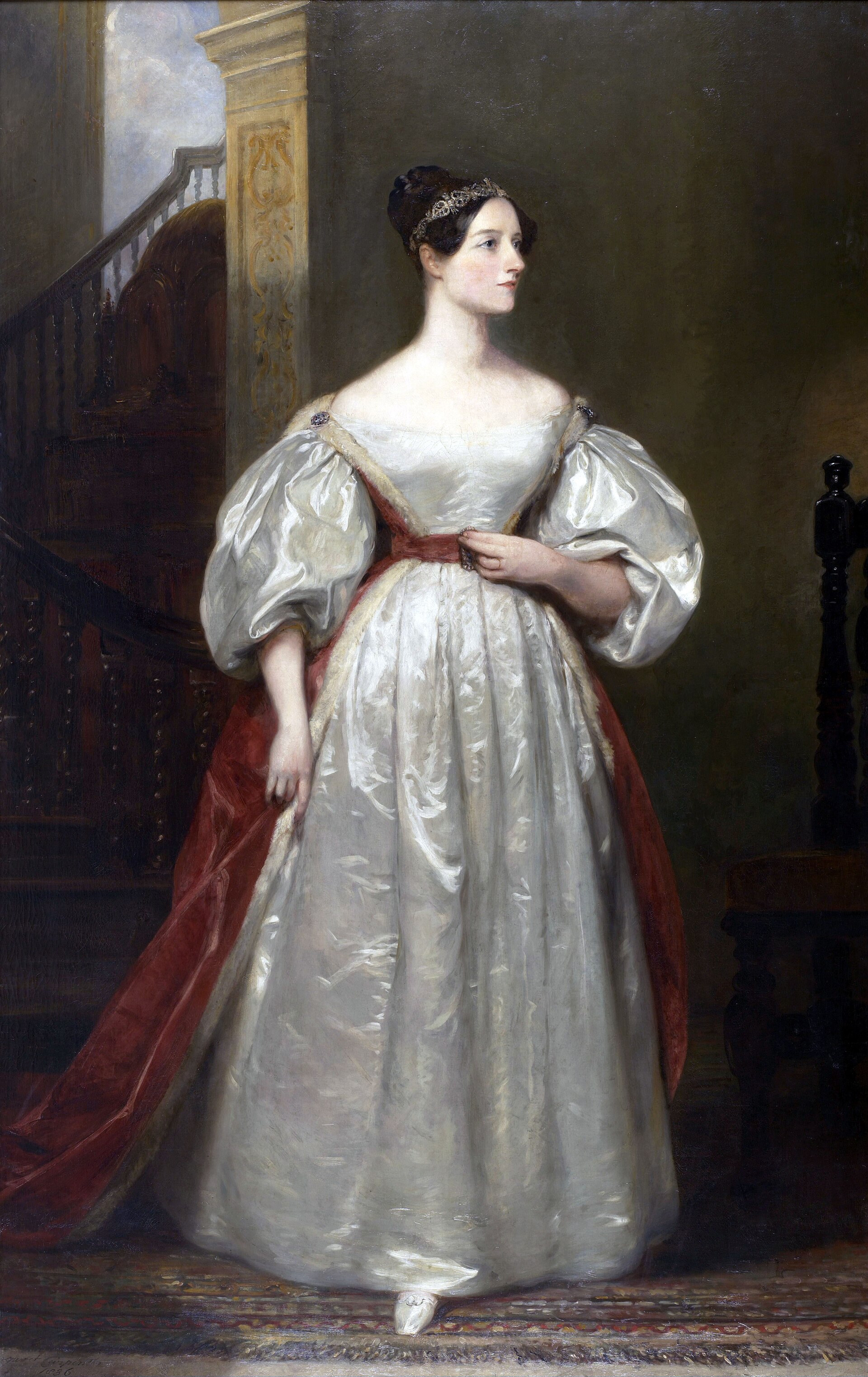

Ada Lovelace (1815–1852), born Augusta Ada Byron, was an English mathematician and the only legitimate daughter of the poet Lord Byron. After meeting Charles Babbage in 1833, she became the closest intellectual partner of his work on the Analytical Engine, a general-purpose programmable computer designed in the 1830s but never built. In 1843 she published her translation of Luigi Menabrea's account of the Engine together with extensive Notes of her own — including Note G, an algorithm for computing Bernoulli numbers that is widely regarded as the first published computer program, though the extent and originality of her contribution remain debated. She married William King in 1835, becoming Countess of Lovelace in 1838, and died of cancer in 1852 at the age of 36. The programming language Ada, standardized for the U.S. Department of Defense as MIL-STD-1815, is named after her.
Childhood: the poet's daughter
Ada Lovelace was born Augusta Ada Byron on December 10, 1815, at Piccadilly Terrace, Middlesex — now in London — and died on November 27, 1852 at Marylebone, London.1 She was the only legitimate child of Annabella Milbanke and the poet Lord Byron.2 Her parents legally separated two months after her birth; her father then left Britain forever, and his daughter never knew him personally.1
Her mother, Lady Byron, had mathematical training — Byron called her his 'Princess of Parallelograms' — and insisted that Ada, who was tutored privately, study mathematics too, an unusual education for a woman.2 Ada was educated privately by tutors and then self-educated, but was helped in her advanced studies by the mathematician-logician Augustus De Morgan, the first professor of mathematics at the University of London.1
Meeting Babbage and the Analytical Engine
Ada first met Babbage at a party in 1833, when she was seventeen, and was entranced as Babbage demonstrated the small working section of the Difference Engine.2 She became interested in Babbage's machines as early as 1833, when she was introduced to him by their mutual friend, the author Mary Somerville.1 Her mother, Lady Byron, had introduced the teenage Ada to the engineer Charles Babbage, who showed them part of his first planned calculating machine, the Difference Engine; Ada was inspired and called it the 'gem of all mechanism.'3 At seventeen, becoming increasingly involved in scientific society, she urged her mother to find out all she could about everything curious, mysterious, marvellous and electrical.3
Babbage was Lucasian Professor of Mathematics at Cambridge University from 1828 to 1839, a post formerly held by Isaac Newton.4 His proposed Difference Engine was a special-purpose digital computing machine for the automatic production of mathematical tables, such as logarithm tables, tide tables, and astronomical tables.4 In 1834, with the Difference Engine project stalled, Babbage conceived a new, more ambitious machine, later called the Analytical Engine: a general-purpose programmable computing machine.5 The Analytical Engine was to have had a memory store and a central processing unit, or 'mill,' and would have been able to choose among alternative actions depending on the outcome of its previous actions — a facility now known as conditional branching.4 The behavior of the Engine would have been controlled by a program of instructions contained on punched cards connected together with ribbons — an idea Babbage had adopted from the Jacquard weaving loom.4 The Analytical Engine features many essential principles found in the modern digital computer, and its conception marks the transition from mechanized arithmetic to fully-fledged general purpose computation.5
The 1843 translation and Notes
In 1840, Italian scientists invited Babbage to Turin, where he lectured on the principles of the Engine; in the audience was Luigi Menabrea, who in October 1842 published the first account of the Engine, in French, based on Babbage's lectures.6 Another scientific friend, Charles Wheatstone, asked Ada to translate Menabrea's article, and Babbage suggested she expand it with a number of appendices.6 The article she translated and annotated was 'Notions sur la machine analytique de Charles Babbage' (1842), by the Italian mathematician and engineer Luigi Federico Menabrea.1
The resulting paper appeared in Taylor's Scientific Memoirs in August 1843, after several months of joint effort, signed only with her initials, A.A.L.6 Of its sixty-six pages, forty-one make up her appendices.6 Her notes ran to three times the length of the host article.5
Babbage, for his part, continued to speak admiringly of Lovelace, writing to Michael Faraday that she had thrown her magical spell around the most abstract of Sciences and grasped it with a force that few masculine intellects, in their own country at least, could have exerted over it.6 The two worked on the paper together by letter; as they exchanged versions of the table for the Bernoulli numbers, they lost track of Note G, and Babbage wrote 'Where is it gone?'6
Note G: the Bernoulli numbers algorithm
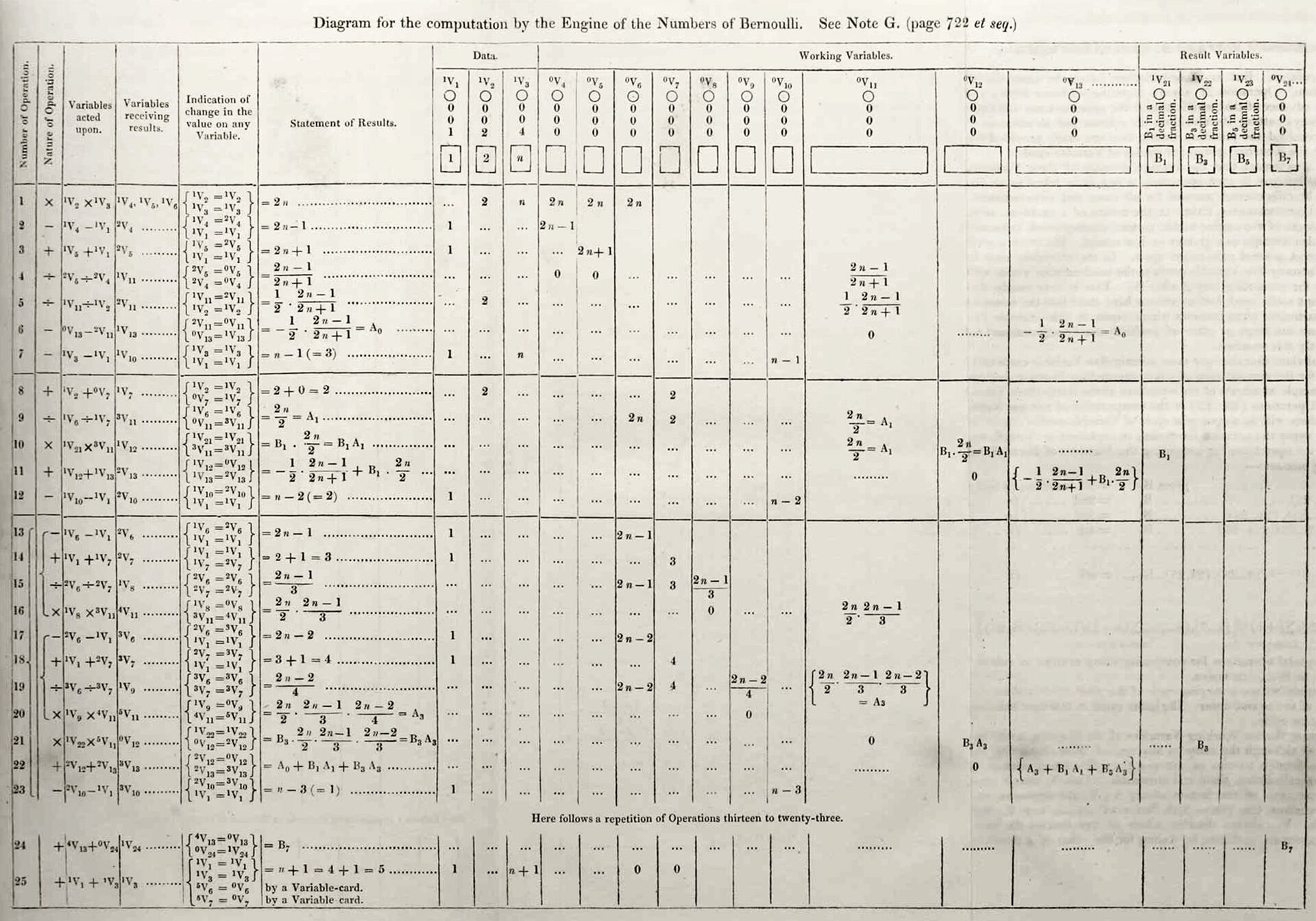
The paper is most famous for its final appendix, Note G, which demonstrates the operation of the machine by giving the example of the calculation of the Bernoulli numbers, which crop up in many places in modern mathematics.6 The Bernoulli numbers are particularly amenable to machine calculation because they are defined recursively: the first may be used to determine the second, the second the third, and so on.6 There are several different ways of calculating these numbers, and Lovelace did not choose the simplest; she noted instead that the 'object is not simplicity or facility of computation, but the illustration of the powers of the engine.'6
The machine she was illustrating was itself remarkable: the Analytical Engine is now recognised as a steam-powered programmable computer, designed by Charles Babbage but never built.6 Babbage began work on the Analytical Engine in the mid-1830s, aiming at a machine that could 'eat its own tail' — by which he meant that it could modify its calculation while it was running.6 The parts he envisaged, and their scale, are set out below.6

| Part of the engine | Description and scale |
|---|---|
| Mill (central processing unit) | Fifteen feet (4.5 m) tall6 |
| Store (memory) | Twenty feet (6 m) long, holding a hundred 50-digit numbers6 |
| Control | A program of instructions on punched cards connected together with ribbons, an idea adopted from the Jacquard weaving loom4 |
| Speed of calculation | About three minutes to multiply two 20-digit numbers6 |
| Power | Steam power would have been required for a machine of this size6 |
Was she the 'first computer programmer'?
The Notes included the first published description of a stepwise sequence of operations for solving certain mathematical problems, and Ada is often referred to as 'the first programmer.'2 They described the steps the engine would take in solving certain mathematical problems — procedures we would now call programs — the first published descriptions of the kind.5 Lovelace's resulting article on the Analytical Engine included the first published algorithm for the machine.3 Britannica records that her detailed annotations — especially her description of how the proposed Analytical Engine could be programmed to compute Bernoulli numbers — were excellent, and concludes that she is considered the first computer programmer: although she wrote about a machine that was never built, she realized that it could follow a series of simple instructions, a program, to perform a complex calculation.1 UNESCO likewise describes the Notes as containing what history now regards as the first published computer program: an algorithm designed for the Analytical Engine to compute Bernoulli numbers.7
The case for the title is not settled, however.2 Babbage had already sketched out similar algorithms for the machine in his own notebooks — a point made in the Science Museum's 2015 exhibition.3 The collaboration with Babbage was close, and biographers debate the extent and originality of Ada's contribution.2 She refused to let Babbage add to the paper a strong criticism of the British government, and Babbage turned down her offer to become further involved in organising the building of the engine.6 The famous table is often described as 'the first computer program,' though Lovelace wrote, more accurately, that it 'presents a complete simultaneous view of all the successive changes' in the components of the machine — what computer scientists would now call an 'execution trace.'6 The 'program,' had the idea existed at the time, would have been the deck of punched cards that caused those successive changes; because Babbage's designs were unclear about aspects of how the cards would be manipulated, the exact program is hard to reconstruct.6
A machine for more than numbers
'Supposing, for instance, that the fundamental relations of pitched sounds in the science of harmony and of musical composition were susceptible of such expression and adaptations, the engine might compose elaborate and scientific pieces of music of any degree of complexity or extent.'3
Ada Lovelace, 'Notes upon L. F. Menabrea's Sketch of the Analytical Engine Invented by Charles Babbage', 1843
The engine 'weaves algebraical patterns just as the Jacquard loom weaves flowers and leaves.'6
Ada Lovelace, Notes (1843)
'The Analytical Engine has no pretensions to originate anything. It can do whatever we know how to order it to perform.'8
Ada Lovelace, as cited in the Stanford Encyclopedia of Philosophy
These words are not merely elegant: Babbage's interest was number crunching, but Lovelace made a leap of imagination, seeing the Analytical Engine as a general-purpose machine that could manipulate not just numbers, but numbers representing abstract items such as symbols and musical notes.3 She speculated that the machine might go beyond numbers to manipulate symbols in accordance with rules, and saw that numbers could represent entities other than quantity — letters of the alphabet, notes of music — a prophetic notion that Babbage appears not to have envisioned with any clarity.5 The idea of a machine that could manipulate symbols in accordance with rules, and that number could represent entities other than quantity, marks the fundamental transition from calculation to computation; Ada was the first to explicitly articulate this notion, and in this she appears to have seen further than Babbage.2
She has been referred to as 'prophet of the computer age.'2 She was also clear about the machine's limits, remarking that it could only do whatever we know how to order it to perform — the remark behind what Turing called 'Lady Lovelace's objection.'8 The physicist and computing pioneer Douglas R. Hartree, writing about a century after Lovelace, noted that the technology available to her at the time could not have led her to infer that machines might be creative.1 Alan Turing disagreed: in his paper 'Computing machinery and intelligence' he challenged the objection by suggesting that we can 'order' the machine to be original, by programming it to produce answers that we cannot predict.6
Marriage, illness, and death
On July 8, 1835, she married William King, 8th Baron King, and when he was created an earl in 1838 she became countess of Lovelace.1 Her full name in later life was Ada King, countess of Lovelace, though she had been born Augusta Ada Byron.1 The Royal Society's person record lists her as Augusta Ada Countess of Lovelace King (1815–1852), British, with mathematics as her field of interest and mathematician as her occupation.9 Among Royal Society Fellows she most frequently corresponded with John Frederick William Herschel — five letters are recorded.9 When her portrait was painted in 1835, she joked that her jaw appeared so large that the word 'Mathematics' could be written upon it.3
The Royal Society Archives hold one of those letters: a thirteen-page manuscript from Augusta Ada King, Lady Lovelace to Sir John Herschel, dated 12 October 1848 at Ashley-Combe, Somerset.10 In it she quotes a passage of A. E. P. Gasparin comparing Herschel's actinometer to other instruments, seeks Herschel's opinion of Adolphe Quetelet's hypothesis of heat, and asks about photographic chemicals and 'calorific rays.'10 In the last year of her life, Babbage accompanied the now frail Lovelace to the Great Exhibition, encouraging her to 'put on worsted stockings, cork soles and every other thing which can keep you warm.'6 She went to multiple doctors in her mid-thirties with persistent health issues, learned she had uterine cancer, and passed away at 36, having tried the crude techniques of the time including bloodletting.1 She died on November 27, 1852 at Marylebone, London1 and was buried, at her request, beside Lord Byron in the Byron family vault.11
The Ada language and her legacy
In 1979, Jack Cooper of the Navy Materiel Command proposed naming the new language 'Ada', and the name was widely accepted by the High Order Language Working Group, honoring Countess Augusta Ada Lovelace.11 The choice was evidently inspired by Bertram V. Bowden's 1950s computer book 'Faster Than Thought,' which dealt with the work of Babbage and the countess.11 The HOLWG obtained permission for the name from Ada's descendant, the Earl of Lytton, a retired lieutenant colonel of the British army, who was immediately enthusiastic, pointing out that the letters 'Ada' stood 'right in the middle of "radar."'11 The name 'Ada' is not an acronym; it was chosen in honor of Augusta Ada Lovelace, a mathematician sometimes regarded as the world's first programmer because of her work with Charles Babbage.12 The language's military standard, MIL-STD-1815, was approved 10 December 1980.11 The American National Standard Reference Manual for the Ada Programming Language, sponsored by the United States Department of Defense, was approved February 17, 1983 as ANSI/MIL-STD-1815A-1983, and the language was later revised in the early 1990s under Tucker Taft of Intermetrics; the resulting Ada 95 was the first internationally standardized (ISO) object-oriented language.1312
| Year | Milestone |
|---|---|
| 1974 | The U.S. Department of Defense's common high order language program began13 |
| 1979 | Jack Cooper of the Navy Materiel Command proposed the name 'Ada'; the HOLWG accepted it, honoring Countess Augusta Ada Lovelace11 |
| 1980 | The Ada language military standard MIL-STD-1815 was approved on 10 December11 |
| 1983 | ANSI/MIL-STD-1815A-1983, the American National Standard Reference Manual sponsored by the U.S. Department of Defense, was approved on 17 February13 |
| 1995 | Ada 95 became the first internationally standardized (ISO) object-oriented language12 |
| Annual | Ada Lovelace Day is traditionally celebrated on the second Tuesday of October, honoring women in science, technology, engineering, and mathematics1 |
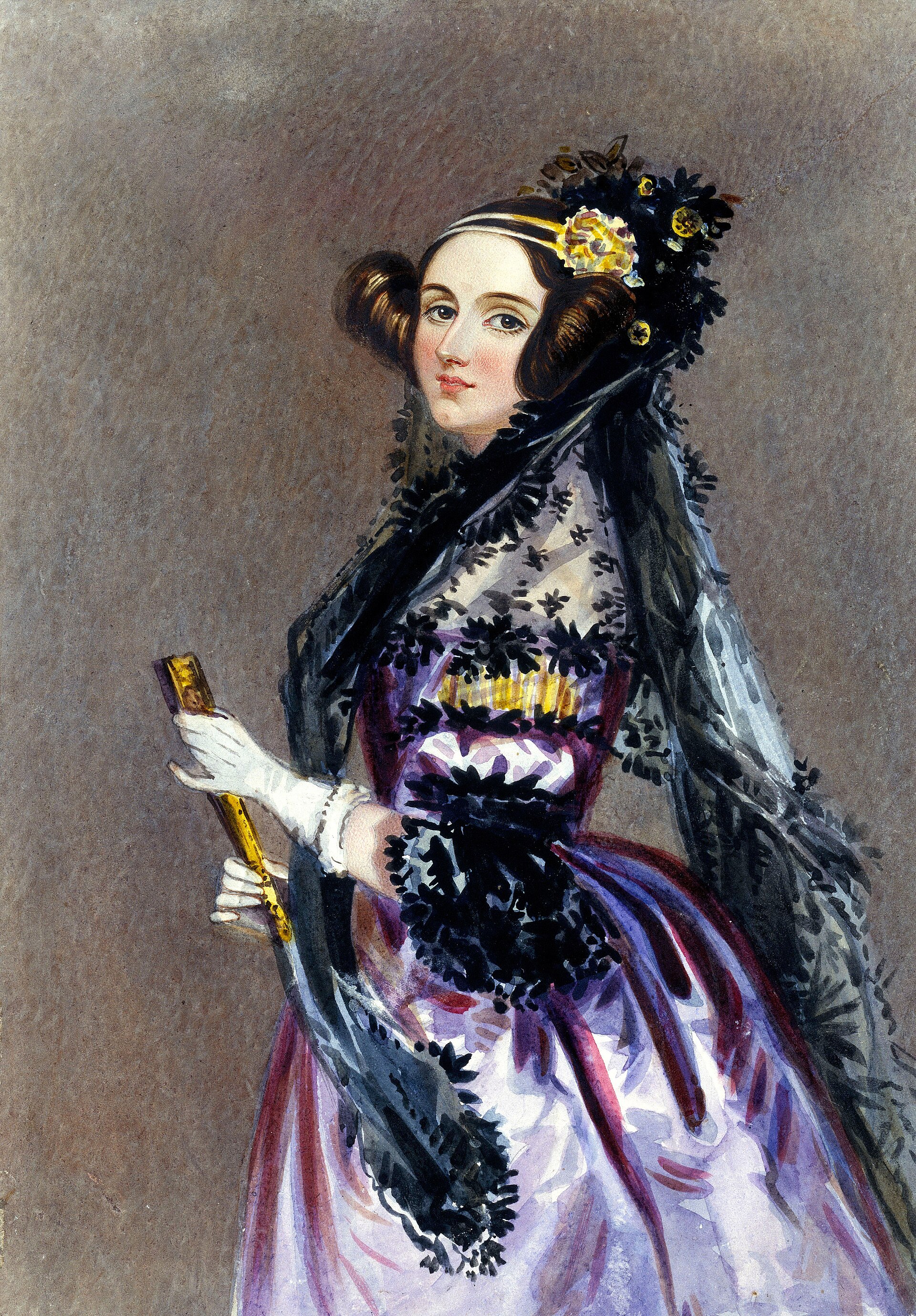

Her work received little recognition in her lifetime, but resurfaced in the mid-20th century with the rise of electronic computers, earning her a central place in the history of computer science.7 Today her legacy lives on in the programming language Ada, in research institutions and universities that bear her name, and in the generations of scientists and engineers inspired by her vision.7 The second Tuesday of October is traditionally celebrated as Ada Lovelace Day, during which women's contributions to science, technology, engineering, and mathematics are honored.1 The Science Museum's Ada Lovelace exhibition celebrated the bicentenary of her birth (10 December 1815), opened on Ada Lovelace Day, and ran until the end of March 2016, showing a portion of the Difference Engine that Ada herself saw and a section of the Analytical Engine.3 In 1990, Babbage's Difference Engine No. 2 was finally built from his designs and is on display at the London Science Museum.4 That same design was finally built and completed in 2002 — the first of Babbage's engine designs to be realized in its entirety.5
Timeline
Born Augusta Ada Byron
Ada Lovelace was born at Piccadilly Terrace, Middlesex (now in London), the daughter of the poet Lord Byron and Annabella Milbanke.1
Meets Charles Babbage
At 17, introduced by their mutual friend Mary Somerville, Ada met Babbage at a party and was entranced by the working section of his Difference Engine.2
Marriage to William King
She married William King, 8th Baron King; when he was created an earl in 1838 she became countess of Lovelace.1
Menabrea's article appears
Luigi Menabrea published the first account of the Analytical Engine, in French, based on Babbage's 1840 Turin lectures.6
The Notes are published
Her translation of Menabrea with her own Notes — signed A.A.L., 66 pages of which 41 are hers — appeared in Taylor's Scientific Memoirs, including Note G and the Bernoulli numbers algorithm.6
Letter to Sir John Herschel
A 13-page letter from Ashley-Combe, Somerset, held in the Royal Society Archives, discusses instruments and meteorology with the astronomer.10
Death at 36
Ada Lovelace died of uterine cancer in Marylebone, London, aged 36, and was buried beside her father in the Byron family vault.1
A language named Ada
Jack Cooper of the Navy Materiel Command proposed the name 'Ada' for the DoD's common high order language; the HOLWG accepted it, honoring the Countess of Lovelace, with permission from the Earl of Lytton.11
MIL-STD-1815 approved
The Ada language was standardized for the U.S. Department of Defense as MIL-STD-1815.11
ANSI/MIL-STD-1815A
The American National Standard Reference Manual for the Ada Programming Language, sponsored by the U.S. Department of Defense, was approved.13
Science Museum bicentenary exhibition
The Science Museum opened its Ada Lovelace exhibition for the bicentenary of her birth on Ada Lovelace Day; it ran until the end of March 2016.3
Frequently asked questions
Who was Ada Lovelace?
Ada Lovelace (1815–1852) was an English mathematician and an associate of Charles Babbage.1 Born Augusta Ada Byron, she was the only legitimate child of Annabella Milbanke and the poet Lord Byron.2
Why is Ada Lovelace called the first computer programmer?
Her 1843 Notes on Babbage's Analytical Engine included the first published description of a stepwise sequence of operations for solving certain mathematical problems.2 Britannica concludes that she is considered the first computer programmer because she realized that the computer could follow a series of simple instructions, a program, to perform a complex calculation.1
What was the Analytical Engine?
The Analytical Engine was a general-purpose programmable computing machine conceived by Charles Babbage in 1834.5 It is now recognised as a steam-powered programmable computer that was never built6; it was to have had a memory store and a central processing unit, or 'mill,' with conditional branching, controlled by punched cards.4
What is Note G?
Note G is the final appendix of Lovelace's 1843 Notes, demonstrating the operation of the Analytical Engine through the calculation of the Bernoulli numbers.6 UNESCO describes it as what history now regards as the first published computer program: an algorithm designed for the Analytical Engine to compute Bernoulli numbers.7
Was she really the first programmer?
It is debated.2 Lovelace's article included the first published algorithm for the machine3, but Babbage had already sketched out similar algorithms for the machine in his own notebooks3, and biographers debate the extent and originality of Ada's contribution.2
What did Lovelace foresee about the machine beyond arithmetic?
She saw the Analytical Engine as a general-purpose machine that could manipulate numbers representing abstract items such as symbols and musical notes, and speculated that it might compose elaborate and scientific pieces of music.3 She saw that numbers could represent entities other than quantity — a notion that Babbage appears not to have envisioned with any clarity5 — and Ada was the first to explicitly articulate the transition from calculation to computation.2
Why is the programming language called Ada?
In 1979, Jack Cooper of the Navy Materiel Command proposed naming the language 'Ada', which the High Order Language Working Group accepted in honor of Countess Augusta Ada Lovelace, with permission from her descendant, the Earl of Lytton.11 The name 'Ada' is not an acronym.12
How did Ada Lovelace die?
She went to multiple doctors in her mid-thirties with persistent health issues, learned she had uterine cancer, and passed away at the age of 36.1 She died on November 27, 1852 at Marylebone, London, and was buried, at her request, beside Lord Byron in the Byron family vault.11
Knowledge graph
Sources & citations
Every factual claim in this article is drawn from the sources below. Bracketed numbers in the text link to the corresponding source.
- 1
- 2
- 3
- 4
- 5
- 6
- 7
- 8
- 9
- 10
- 11
- 12
- 13