Computer
The machine that automates calculation and information processing — from Babbage's mechanical engines and Turing's theory to ENIAC, the stored-program computer, the microprocessor and the networked age.
A computer is a programmable machine that stores and processes information, executing sequences of operations automatically at electronic speeds. Its lineage runs from Charles Babbage's Analytical Engine and Ada Lovelace's notes through Alan Turing's universal machine, the wartime Colossus and ENIAC, the stored-program EDVAC design and the Manchester Baby, the transistor and the integrated circuit, mainframes such as the IBM System/360, the Intel 4004 microprocessor, the home and personal computers of the late 1970s and 1980s, and the network technologies — ARPANET and the World Wide Web — that followed.
In this article
- 1Definition and Naming
- 2Prehistory: Calculation Before Electronics
- 3Babbage and Lovelace
- 4Theoretical Foundations: Turing and Computability
- 5Wartime Machines and the First Electronic Computers
- 6The Stored-Program Revolution
- 7Commercialization and the Mainframe Era
- 8Transistors, Integrated Circuits and Moore's Law
- 9The Microprocessor and the Personal Computer
- 10Networking and the World Wide Web
- 11Timeline of Milestones
- 12Timeline: from Babbage's engines to the World Wide Web
- 13Knowledge graph
Definition and Naming
A computer is a programmable machine that performs sequences of calculations and data handling automatically at electronic speeds, with the program itself stored and accessed electronically. Since their commercial introduction in 1951, such devices have dramatically changed the world.
The word did not begin with the machine. It first meant a human calculator: teams of clerks, often women, who reduced experimental data with mechanical calculators were called "computers", and the name was transferred to the electronic machine when it was invented in the 1940s precisely to replace the work they were doing. Around 1945 people started redefining such new machines as "computers".
A computer is a machine that can store and process information. Most computers rely on a binary system whose two values, zero and one, complete tasks such as storing data, calculating algorithms and displaying information.
The computer as it emerged in the late 1940s and early 1950s was more than an extension of earlier machines: it was programmable, able to perform sequences of operations that could themselves be modified based on the outcome of an earlier calculation. The second defining difference was speed: a computer operates at electronic speeds, orders of magnitude faster than the electromechanical devices of the pre-World-War-II era. Only when calculation, storage, programmability and high speeds were combined did one have a true computer.
1. Prehistory: Calculation Before Electronics
Long before machines took over the work, engineers, mathematicians, astronomers, bankers and others who needed calculation depended on printed numerical tables, which were calculated, copied, checked and typeset by hand. The labor was exacting, and some feared that undetected errors were disasters in waiting.
An information-processing industry based on punched cards began in the 1890s, when Herman Hollerith developed the punched card and a suite of tabulating machines for the U.S. His Tabulating Machine Company was combined with others in 1911 to form the Computing-Tabulating-Recording Company, which in 1924 was renamed the International Business Machines Corporation, today's IBM.
The Harvard Mark I was designed in 1937 by Harvard graduate student Howard H. Aiken to solve advanced mathematical physics problems encountered in his research, using modified commercially-available technologies coordinated by a central control system. It was a room-sized relay-based calculator with a fifty-foot camshaft and 3,500 relays. When Mark I was delivered to Harvard in 1944 it was operated by the U.S. Navy Bureau of Ships for military purposes, solving mathematical problems that until then required large teams of human "computers". Mark I was in operation between 1944 and 1959.
The modern era of digital computers began in the late 1930s and early 1940s in the United States, Britain and Germany. The first devices used switches operated by electromagnets, or relays, while their programs were stored on punched paper tape or cards and they had limited internal data storage.
2. Babbage and Lovelace
Charles Babbage was Lucasian Professor of Mathematics at Cambridge University from 1828 to 1839, a post formerly held by Isaac Newton. His proposed Difference Engine was a special-purpose digital computing machine for the automatic production of mathematical tables such as logarithm, tide and astronomical tables. Babbage designed two classes of engine: Difference Engines were strictly calculators that crunch numbers by repeated addition according to the method of finite differences, while the Analytical Engine marked the progression from the mechanized arithmetic of calculation to fully-fledged general-purpose computation.
With the Difference Engine project stalled, Babbage conceived in 1834 a new more ambitious machine, later called the Analytical Engine — a general-purpose programmable computing machine whose design ranks as one of the startling intellectual achievements of the century. It was programmable using punched cards, an idea Babbage borrowed from the Jacquard loom used for weaving complex patterns in textiles. The engine had many essential features found in the modern digital computer: a 'Store' where numbers and intermediate results were held, a separate 'Mill' where arithmetic processing was performed, direct multiplication and division, and capabilities for conditional branching, looping and microprogramming, though Babbage nowhere used these terms.
The logical structure of the Analytical Engine was essentially the same as that which has dominated computer design in the electronic era: separation of the memory, the Store, from the central processor, the Mill, serial operation using a fetch-execute cycle, and facilities for inputting and outputting data and instructions. Between 1847 and 1849 Babbage completed the design of his Difference Engine No. 2 — a machine that calculates with numbers thirty-one digits long and can tabulate any polynomial up to the seventh order while requiring only about a third of the parts called for in the original Difference Engine. Aside from a few partially complete mechanical assemblies and test models, none of Babbage's designs was physically realized in its entirety in his lifetime; a small experimental piece of the Analytical Engine was under construction at the time of his death, and many small experimental assemblies survived along with a comprehensive archive of his drawings and notebooks.
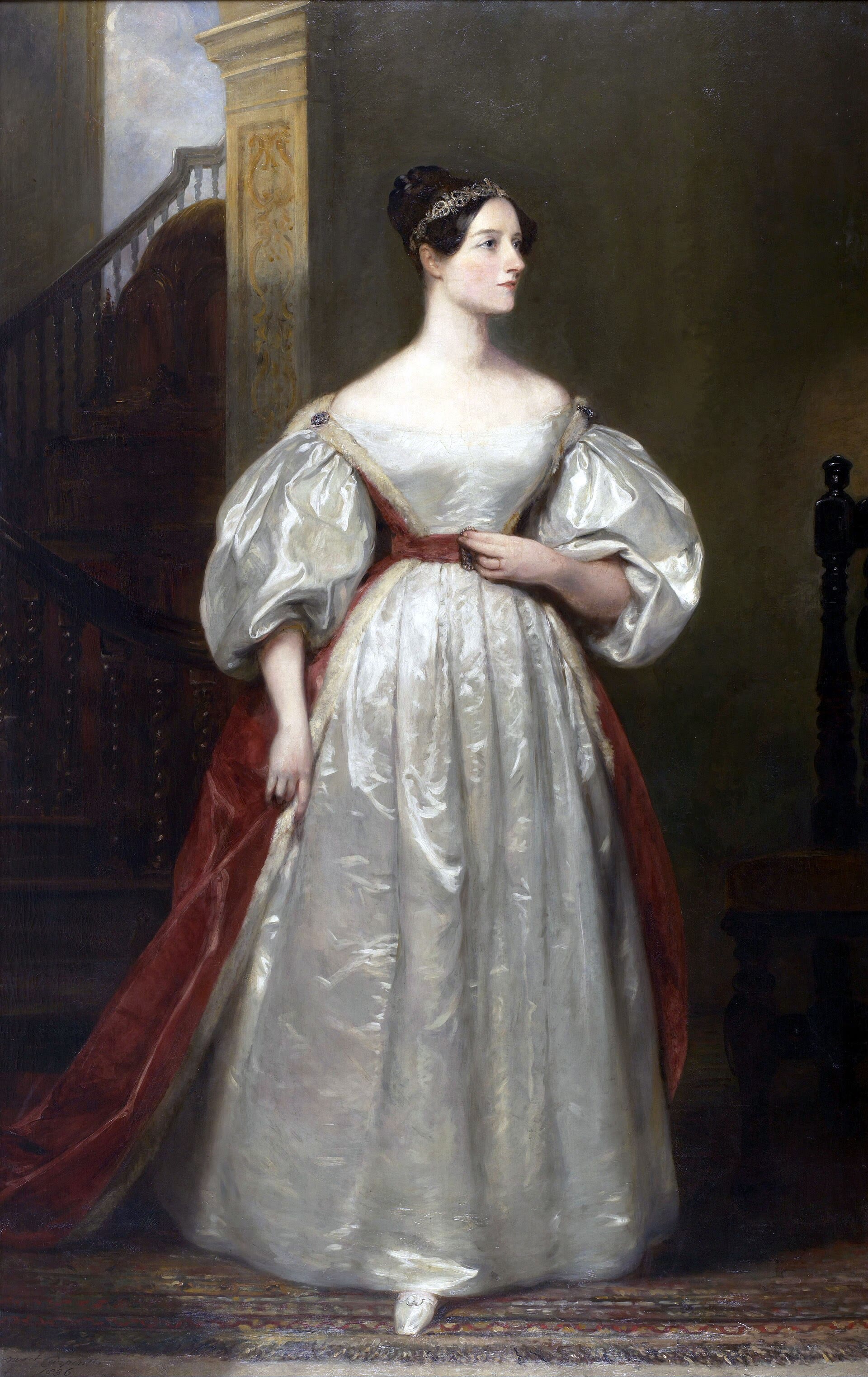
In 1843 Ada Lovelace published a translation of an article by the Italian engineer Luigi Menabrea and appended extensive notes of her own that ran to three times the length of the host article, including the first published descriptions of the steps the engine would take in solving mathematical problems, procedures we would now call programs. She speculated that the machine might go beyond numbers and manipulate symbols in accordance with rules, seeing that numbers could represent letters of the alphabet or notes of music and that computing machines could extend their powers beyond the world of mathematics. Babbage worked closely with Lovelace, daughter of the poet Byron, after whom the modern programming language Ada is named; she foresaw the possibility of using the Analytical Engine for non-numeric computation, suggesting that the engine might even be capable of composing elaborate pieces of music.
3. Theoretical Foundations: Turing and Computability
In 1936 at Cambridge University, Turing invented the principle of the modern computer: an abstract digital computing machine with a limitless memory and a scanner that moves back and forth reading and writing symbols, its actions dictated by a program stored in the memory — the stored-program concept — and this machine is now known simply as the universal Turing machine. A stored-program computer in the formal sense is a general-purpose machine which holds both instructions and data in a read/write memory, a definition of the modern computer following the theoretical principles first conceived by Alan Turing in his famous 1937 paper.
A Turing machine, or computing machine as Turing called it, is a theoretical machine that can be in a finite number of configurations, supplied with a one-way infinite tape divided into squares each capable of carrying exactly one symbol. Two assumptions about the abstract machine keep the definition of computation from being too narrow: the machine's tape is infinite, corresponding to infinite memory, and a function is Turing computable if some set of instructions makes a Turing machine compute it regardless of the time taken, assuming potentially infinite time to complete the computation.
Turing introduced Turing machines in the context of research into the foundations of mathematics, using these abstract devices to prove that no effective general method can solve every instance of the Entscheidungsproblem, and to give a formalized notion of an effective procedure. He began his 1936 paper by describing the computable numbers as the real numbers whose expressions as a decimal are calculable by finite means. In his definition a number is computable if its decimal can be written down by a machine.
Computers also have theoretical limitations: because no universal algorithmic method can exist to identify undecidable propositions, a computer asked to obtain the truth of such a proposition will, unless forcibly interrupted, continue indefinitely — a condition known as the halting problem.
4. Wartime Machines and the First Electronic Computers
John Vincent Atanasoff conceived basic design principles for the first electronic-digital computer in the winter of 1937 and, assisted by his graduate student Clifford E. Berry, constructed a prototype in October 1939 that used binary numbers, direct logic for calculation and a regenerative memory — concepts central to the future development of computers. The final ABC was the size of a desk, weighed seven hundred pounds, had more than three hundred vacuum tubes and contained a mile of wire, calculating about one operation every fifteen seconds. After the proof-of-concept prototype, Atanasoff received funds to build a full-scale machine at Iowa State College.
The ABC stood at the center of a patent dispute resolved in 1973, when it was shown that ENIAC co-designer John Mauchly had seen the ABC shortly after it became functional.
The Z3 was an early computer built by German engineer Konrad Zuse working in isolation from developments elsewhere; it used 2,300 relays, performed floating point binary arithmetic and had a 22-bit word length. It was used for aerodynamic calculations and destroyed in a bombing raid on Berlin in late 1943. A reconstruction supervised by Zuse in the 1960s is now on display at the Deutsches Museum in Munich.
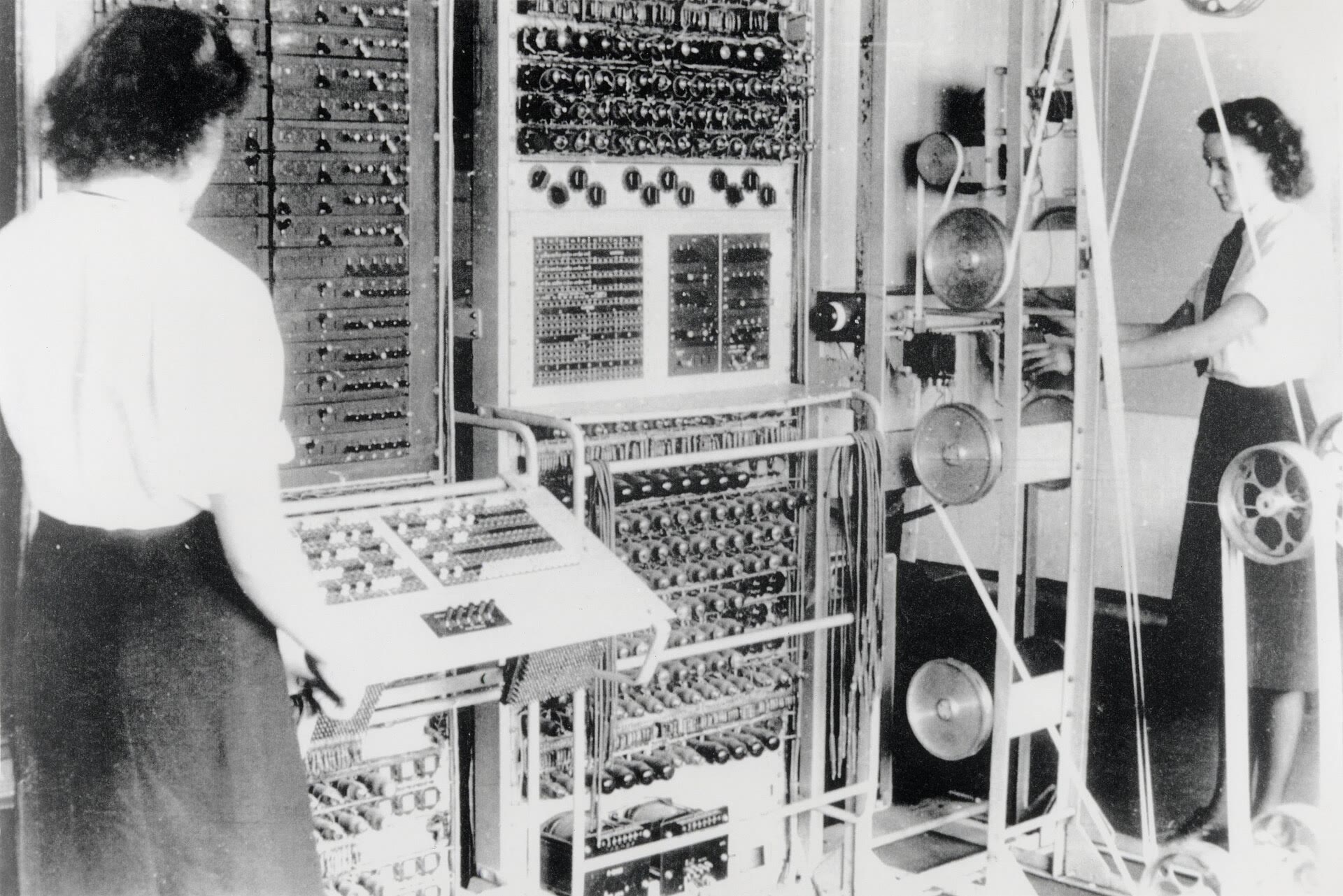
The Colossus, designed by British engineer Tommy Flowers to break the complex Lorenz ciphers used by the Nazis, reduced the time needed to break Lorenz messages from weeks to hours, and the machine's existence was not made public until the 1970s. It was the first fully functioning electronic digital computer, in use by Bletchley Park cryptanalysts from February 1944.
The British Bombe, conceived of by Alan Turing and Harold Keen of the British Tabulating Machine Company, was an electro-mechanical means of decrypting Nazi Enigma-based military communications, built so that hundreds of Allied bombes could determine the daily rotor start positions of Enigma cipher machines. In 1939 Turing took up a full-time role at Bletchley Park in Buckinghamshire, where top secret work was carried out to decipher the military codes used by Germany and its allies.
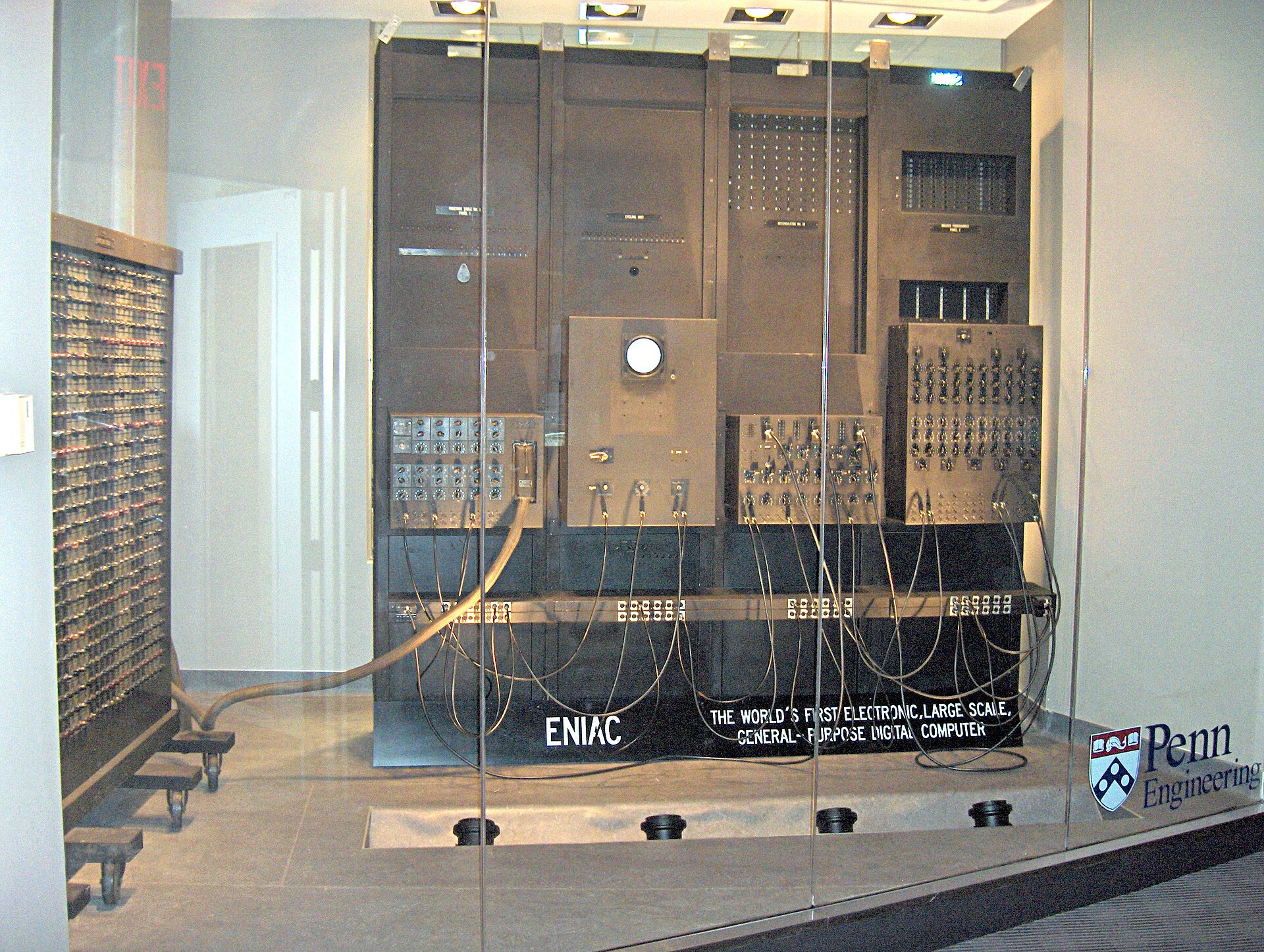
ENIAC, built in the years 1943 to 1946 at the University of Pennsylvania, is widely regarded as the first general-purpose electronic digital computer. When the United States entered World War II, the Moore School of Electrical Engineering undertook the building of an electronic computing machine for the Ballistic Research Laboratory; the principal designers were J. Presper Eckert, an electrical engineer, and John Mauchly, a physicist who had become interested in calculating devices from his efforts to apply statistical methods to meteorological data. On February 15 1946 the existence of the previously classified ENIAC became front-page news in The New York Times; to many this marks the start of the electronic computer age.
When fully operational, ENIAC occupied a room 30 by 50 feet and weighed 30 tons; its 40 panels measured 80 feet long at the front, and its 18,000 vacuum tubes were more than 20 times as many as those aboard a wartime B-29 bomber, with 500,000 soldered joints, 70,000 resistors, 10,000 capacitors and 150 kilowatts of electricity. A ballistics calculation that previously took 12 hours on a hand calculator could be done in just 30 seconds on ENIAC, some 1,440 times faster.
ENIAC was not a stored-program computer, and setting it up for a new job involved reconfiguring the machine by means of plugs and switches. It lost one vacuum tube roughly every day or two; with almost 18,000 tubes, locating and replacing the failed one was challenging, but over time the maintenance team developed the skill to fix a problem in just 15 minutes.
When ENIAC was unveiled at Penn in February 1946 two women had created the test run that wowed the media, but their work and that of four other women was literally erased, with articles and pictures published at the time featuring only men. At Penn Engineering the Differential Analyser was operated by secret human "computors", women during World War II who were employed at the Moore School doing ballistics calculations for the war effort, and it is considered by many to be ENIAC's closest relative.
5. The Stored-Program Revolution
The stored-program principle was conceived while addressing the shortcomings of ENIAC and, combined with the invention of high-speed memory devices, provided a practical alternative to ENIAC's cumbersome plugboard programming. Storing a program and data in a common high-speed memory meant programs could also be operated on as if they were data. In a widely circulated paper, John von Neumann outlined the architecture of a stored-program computer, including electronic storage of programming information and data, which eliminated the need for more clumsy methods of programming such as plugboards, punched cards and paper.
In 1945, while ENIAC was still under construction, von Neumann produced a draft report setting out the ENIAC group's ideas for an electronic stored-program general-purpose digital computer, the EDVAC. The EDVAC was completed six years later but not by its originators, who left the Moore School to build computers elsewhere. Lectures held at the Moore School in 1946 on the proposed EDVAC contributed greatly to the dissemination of the new ideas. Von Neumann composed the First Draft of a Report on the EDVAC in May 1945; it contained little engineering detail, in particular concerning electronic hardware.
Calling these computers "von Neumann machines" is a misnomer, since the report did not fully credit those on the ENIAC team who contributed to the concept. Turing's Proposed Electronic Calculator supplied detailed circuit designs, specimen programs in machine code and even an estimate of the cost of building the machine at 11,200 pounds. Working at the National Physical Laboratory, Turing worked on the ACE (Automatic Computing Engine), which was the first detailed design of a stored-program computer.
University of Manchester researchers Frederic Williams, Tom Kilburn and Geoff Toothill developed the Small-Scale Experimental Machine, better known as the Manchester Baby, to test a new memory technology soon known as the Williams Tube. Their first program, consisting of seventeen instructions written by Kilburn, ran on June 21st 1948 and was the first program in history to run on a digital, electronic, stored-program computer. On the morning of 21st June 1948 the Small-Scale Experimental Machine, more familiarly called the Manchester Baby, was the first electronic stored program digital computer to run a program, completing a factoring run of about 52 minutes' duration that executed some 3.5 million operations.
Max Newman, who in 1936 was Turing's tutor at Cambridge and had led the Colossus group at Bletchley Park, described the Manchester Baby as the first of these automatic general-purpose computing machines to have actually worked. The Cambridge EDSAC ran a program on 6th May 1949; it was a much more capable and polished machine with paper tape input/output, but it is not considered to have been the first stored-program computer.
EDSAC, built at Cambridge University using vacuum tubes and mercury delay lines for memory, was the first practical stored-program computer to provide a regular computing service, and its project led by Maurice Wilkes introduced a library of short programs called subroutines stored on punched paper tape. The following year, under the direction of Maurice Wilkes in Cambridge, England, a computer called EDSAC was completed and began operation; unlike the Manchester Baby it was a fully-functional and useful stored-program computer.
The Manchester Mark I, built by a team led by Frederick Williams and Tom Kilburn, served as the prototype for Ferranti's first computer — the Ferranti Mark 1 — and its Williams-Kilburn tube memory system was later adopted by several other early computer systems around the world. Working with Max Newman, Turing led a team that produced Britain's first general-purpose stored programme computer, the Manchester Mark 1 and then the first commercial computer (the Ferranti Mark 1). On 21 June 1948 the Manchester Baby became the first computer to execute a program stored in addressable read-write electronic memory; it validated Williams-Kilburn Tube random-access memories, later widely used, and led to the 1949 Manchester Mark I, while in February 1951 Ferranti Ltd's commercial derivative became the first electronic computer marketed as a standard product delivered to a customer.
An inspiring summer school on computing at the University of Pennsylvania's Moore School of Electrical Engineering stimulated construction of stored-program computers in the US, France, the UK and Germany, and this free public set of lectures inspired the EDSAC, BINAC and later IAS machine clones like the AVIDAC.
6. Commercialization and the Mainframe Era
The first commercial stored-program computer to be placed into production was UNIVAC, the UNIVersal Automatic Computer, which used magnetic tape rather than punch cards to input and store data. The first UNIVAC was accepted by the U.S. Census Bureau in 1951, with the contract signed on 31 March 1951 and a dedication ceremony held in June 1951. It was built for general commercial use, a machine conceived and marketed for any application one could program it to perform.
Presper Eckert, the chief engineer, designed UNIVAC conservatively, making it surprisingly reliable in spite of its vacuum tubes. Sales were modest, but the technological breakthrough of a commercial, stored-program electronic computer was large, and in 1950 Eckert and Mauchly's company was absorbed by Remington Rand, ending its independent life. UNIVAC I was soon used to tabulate part of the 1950 population census and the entire 1954 economic census, and throughout the 1950s it played a key role in several monthly economic surveys, excelling at the repetitive but intricate mathematics involved in weighting and sampling.
During the 1950s and 1960s large, expensive computers of increasing power came to be called mainframes. They were characterized by large storage capabilities, fast components and powerful computational abilities, and were sometimes designed with redundant components so they could survive partial failures. The IBM 1401 mainframe replaced earlier vacuum tube technology with smaller, more reliable transistors; demand called for more than 12,000 of the machines, and by the mid-1960s nearly half of all computers in the world were IBM 1401s.
On 7 April 1964 IBM publicly announced the IBM System/360, replacing all five of its computer product lines with one strictly compatible family that used a new hybrid-integrated-circuit technology and a new 8-bit-byte architecture, with six processor models offering a 50-fold performance range and 54 peripheral devices. The number 360, the number of degrees in a circle, was chosen to represent the ability of each computer to handle all types of applications. The family generated in excess of $100 billion in revenue for IBM.
The gamble behind System/360 was enormous: IBM's revenue in 1962 was $2.5 billion, and developing the system cost twice that, with company president Tom Watson, Jr. literally betting the company on it. Well over one thousand orders were received during the first four weeks. Throughout most of the 1960s the System/360's success gave IBM a 65% market share, prompting observers to term the industry Snow White (IBM) and the Seven Dwarfs. Clear, consistent, readily available specifications for System/360 components nourished a thriving market of third-party peripherals, as varied plug-compatible devices easily substituted for IBM devices, often performing better at lower cost.
Author Jim Collins ranked the IBM System/360 as one of the top three business accomplishments of all time alongside Ford's Model T and Boeing's first jetliner (the 707) because it ushered in an era in which computers were no longer thought of as collections of individual components but rather as platforms. It established the first platform business model: before it, anyone buying a new computer system had to scrap their existing programs and start from scratch, but for the first time software written for one machine could run on any other machine in the line.
7. Transistors, Integrated Circuits and Moore's Law
From 17 November to 23 December 1947 at Bell Telephone Laboratories, Walter H. Brattain and John A. Bardeen, working under the direction of William B. Shockley, discovered the transistor effect and developed and demonstrated a point-contact germanium transistor. Their work led directly to developments in solid-state devices that revolutionized the electronics industry. The transistor marked the beginning of solid state electronics, which quickly reduced the size and power requirements of existing tube-based electronic devices and eventually ushered in the information age through small, low power electronic devices and low cost integrated circuits. Earlier, Julius Edgar Lilienfeld had patented field-effect transistor configurations starting in 1925, but there is no indication that he ever produced working models.
An integrated circuit is a thin slice of silicon, or sometimes another material, specially processed so that a tiny electric circuit is etched on its surface. That circuit can contain many millions of microscopic elements, including transistors, resistors, capacitors and conductors, all electrically connected to perform some useful function. The idea occurred to a number of inventors at the same time, but the first to accomplish it were Jack Kilby of Texas Instruments and Robert Noyce of Fairchild Semiconductor. In 1958 Kilby produced a microcircuit with both active and passive components fabricated from semiconductor material, and in 1959 Noyce built on Jean Hoerni's planar process to patent a monolithic integrated circuit structure that could be manufactured in high volume.
Moore, co-founder of Fairchild and Intel, began his work in silicon microelectronics at Shockley Semiconductor Laboratory in 1956. His 1965 prediction at Fairchild Semiconductor, subsequently known as Moore's Law, held that the number of components on an integrated circuit will increase exponentially with time while cost per function decreases, and it guided the industry for more than fifty years. On April 19 1965 Electronics magazine published an article by Moore, then Director of the Fairchild Semiconductor Research and Development Laboratories, projecting the growth in the complexity of integrated circuits, popularly called microchips, over the next ten years. Drawing a line through just five data points, he projected that with unit cost falling as the number of components per circuit rises, economics might by 1975 dictate squeezing as many as 65,000 components on a single silicon chip — a doubling every 12 months. In 1975 Moore modified the trend, reducing his estimate of the future rate of increase in complexity to a doubling every two years rather than every year.
After Caltech electrical engineering professor Carver Mead dubbed the projection Moore's Law, industry technologists and managers were challenged with delivering annual breakthroughs in optics, materials science, wafer processing, circuit design, software, manufacturing and test equipment to ensure compliance with its projections. Demand for integrated circuits grew so fast that by the beginning of the twenty-first century the Intel Pentium chip had over 100 million transistors on it, with the total number of components, including resistors, capacitors and conductors, being even larger.
8. The Microprocessor and the Personal Computer
A microprocessor is a type of integrated circuit, or chip, and serves as the heart of every computer; at the time of its invention, engineers imagined that the microprocessor would amount to an entire computer on a chip. The Intel 4004, introduced in 1971, carried 2300 transistors and could perform 60,000 calculations per second. Its origins lay in a request from the Japanese calculator maker Busicom for a set of chips for a new calculator, which led Intel engineers Marcian "Ted" Hoff, Federico Faggin and Stan Mazor to draw up the plans for a powerful new chip they would eventually name the microprocessor.
The introduction of the 1 KB Intel 1103 memory chip marked both the beginning of the end for magnetic core memory and the start of the semiconductor dynamic random-access memory integrated circuit memory. Earlier, MIT's Whirlwind project for a bomber-crew flight simulator, completed in 1951, had produced Jay Forrester's perfection of magnetic core memory, which became the dominant form of high-speed random access memory for computers until the mid-1970s.
In 1977 the Apple II, the Commodore PET and the Tandy TRS-80 brought fully assembled personal computers to homes and schools. Connected to a color television set, the Apple II produced brilliant color graphics for the time; millions of Apple IIs were sold between 1977 and 1993, making it one of the longest-lived lines of personal computers, and Apple gave away thousands of Apple IIs to schools, giving a new generation their first access to personal computers. The Commodore PET, one of the first personal computers released in 1977, came fully assembled with 4 or 8 KB of memory, a built-in cassette tape drive and a chiclet keyboard, and it used a MOS Technologies 6502 microprocessor running at 1 MHz. Tandy Radio Shack's first desktop computer, the TRS-80, sold 10,000 units in its first month, far better than the company projection of 3,000 units for the first year; priced at $599.95, it included a Z80 microprocessor, video display, 4 KB of memory, a built-in BASIC interpreter and cassette storage.
MITS co-founder Ed Roberts invented the Altair 8800 and coined the term "personal computer"; the machine sold for $297 or $395 with a case and came with 256 bytes of memory, expandable to 64 KB, and an open bus structure that evolved into the S-100 standard widely used in hobbyist and personal computers of the era.
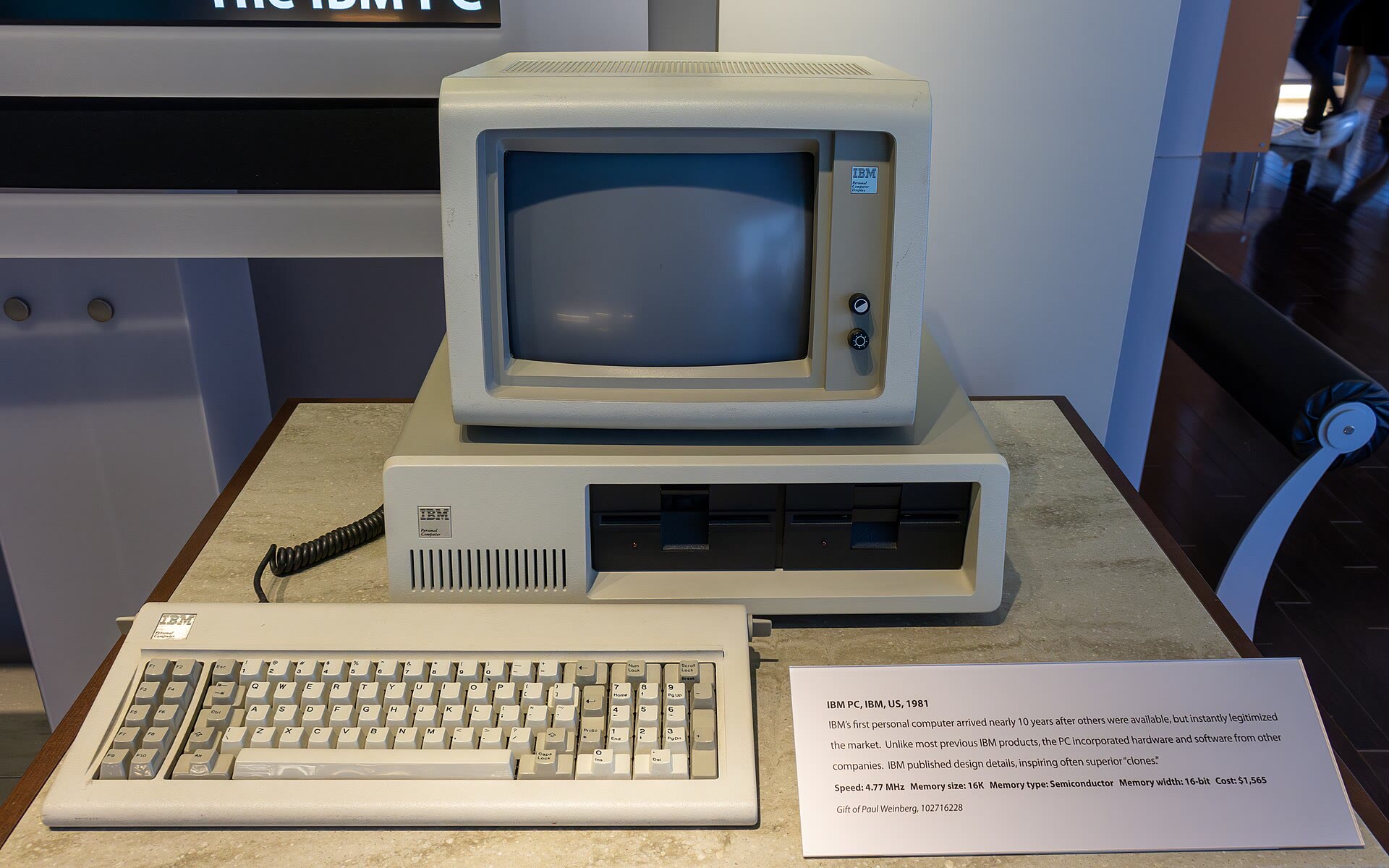
IBM announced its Personal Computer, the IBM Model 5150, on 12 August 1981, running with a 4.77 MHz Intel 8088 microprocessor and using Microsoft's MS-DOS operating system. IBM's brand recognition and a massive marketing campaign ignited the fast growth of the personal computer market with the announcement of the IBM Personal Computer; the IBM PC was widely cloned and led to the creation of a vast ecosystem of software, peripherals and other commodities. MS-DOS, the basic software for the newly released IBM PC, was the start of a long partnership between IBM and Microsoft, which Bill Gates and Paul Allen had founded only six years earlier.
The Macintosh was launched in January 1984 as the first successful mouse-driven computer with a graphical user interface, priced at $2,500. As part of the Macintosh rollout Apple commissioned director Ridley Scott to direct a one-minute commercial that cost at least three hundred thousand dollars, was based partly on George Orwell's novel 1984 and, shown only once, is considered a major turning point in the marketing of computers.
9. Networking and the World Wide Web
In January 1969 the Advanced Research Projects Agency of the Department of Defense awarded a contract to Bolt, Beranek and Newman to design and construct a communications network. By the end of 1969 an experimental ARPANET was operational between four university nodes: Leonard Kleinrock's lab at the University of California-Los Angeles, the Stanford Research Institute, the University of California-Santa Barbara and the University of Utah. This system was the forerunner of the Internet.
Packet switching was developed independently by RAND researcher Paul Baran and British scientist Donald Davies as a communication method that took all kinds of data, queued it up and packaged it into blocks that were sent together as a stream.
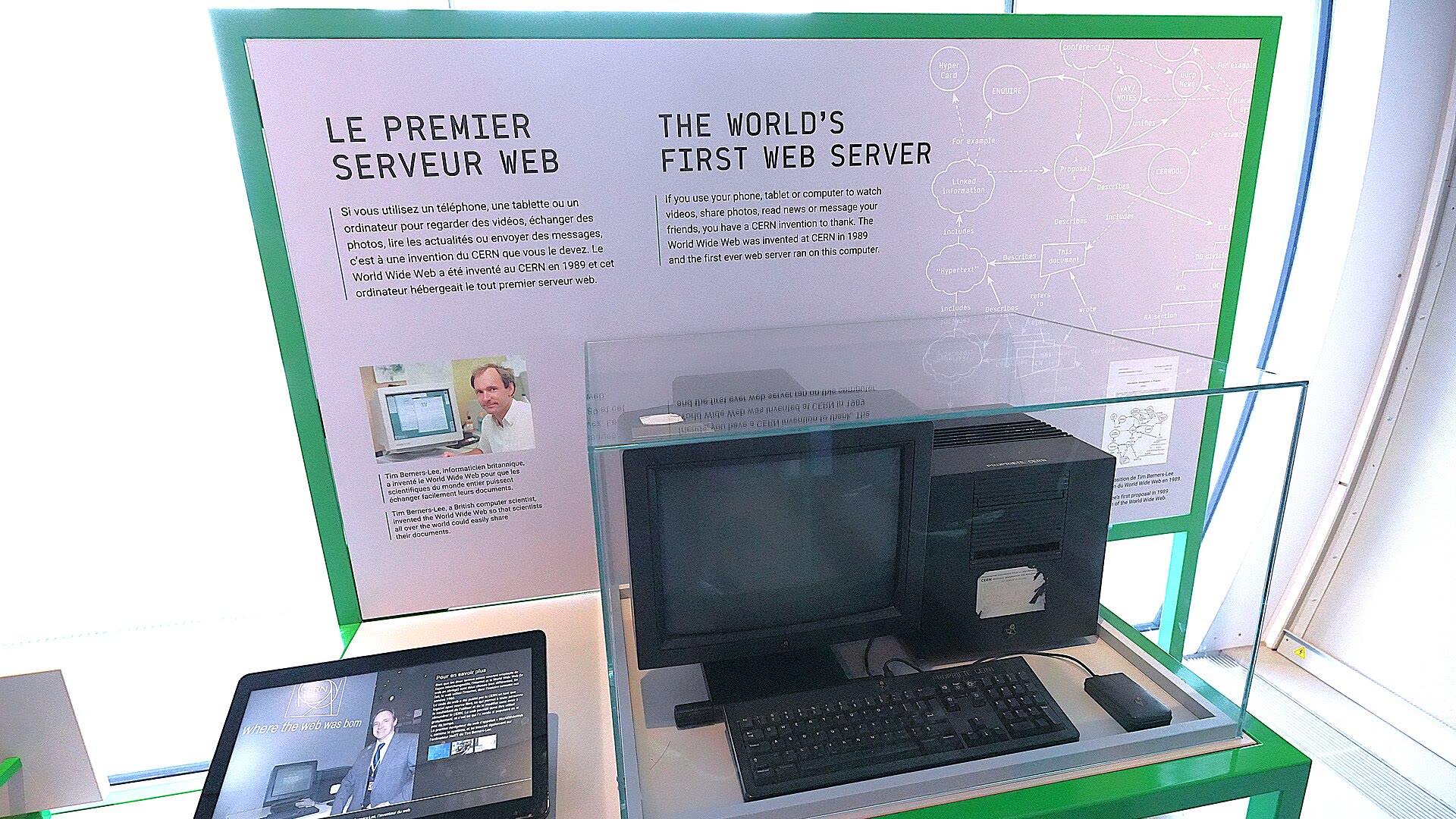
The World Wide Web was invented at CERN by Tim Berners-Lee, a British scientist, in 1989. The Web was originally conceived and developed to meet the demand for automated information-sharing between scientists in universities and institutes around the world. By the end of 1990 Berners-Lee had the first Web server and browser up and running at CERN, developing code directly on the NeXT computer hosting the first web server.
To prevent the first web server being accidentally switched off, the computer had a hand-written label in red ink: "This machine is a server. DO NOT POWER IT DOWN!!" In 1991 Berners-Lee released his WWW software, which included the line-mode browser, Web server software and a library for developers.
10. Timeline of Milestones
-
1843Ada Lovelace's notesAda Lovelace published a translation of an article by the Italian engineer Luigi Menabrea and appended extensive notes of her own.4The Babbage Engine: A Brief History · Computer History Museum ↗
-
6 May 1949EDSAC runs a programThe Cambridge EDSAC ran a program on 6 May 1949; it was a more capable and polished machine with paper tape input and output, but it is not considered to have been the first stored-program computer.8Milestones: Manchester University "Baby" Computer and its Derivatives, 1948-1951 · Engineering and Technology History Wiki (IEEE) ↗
-
January 1984Macintosh launchedThe Macintosh launched as the first successful mouse-driven computer with a graphical user interface, at a price of $2,500.321984 | Timeline of Computer History · Computer History Museum ↗
11. Timeline: from Babbage's engines to the World Wide Web
- 1822Babbage exhibits a working modelCharles Babbage exhibits a small working model of his Difference Engine, designed to produce mathematical tables automatically.
- 1834Babbage conceives the Analytical EngineWith the Difference Engine project stalled, Babbage conceives a general-purpose programmable computing machine he calls the Analytical Engine.
- 1843Lovelace publishes her NotesAda Lovelace's appended notes to her translation of Menabrea's article include the first published descriptions of the steps the engine would take in solving problems — programs.
- 1936Turing publishes 'On Computable Numbers'Alan Turing describes an abstract computing machine with limitless memory whose actions are dictated by a program stored in the machine's memory — the stored-program concept.
- October 1939Atanasoff and Berry complete the ABC prototypeJohn Vincent Atanasoff and Clifford E. Berry construct a prototype electronic-digital computer using binary numbers, direct logic and a regenerative memory.
- February 1944Colossus goes into serviceThe first fully functioning electronic digital computer, Colossus, is used by the Bletchley Park cryptanalysts to break the complex Lorenz ciphers.
- May 1945Von Neumann drafts the EDVAC reportWhile ENIAC is still under construction, John von Neumann sets out the ENIAC group's ideas for an electronic stored-program general-purpose digital computer, the EDVAC.
- 17 November – 23 December 1947The transistor is inventedAt Bell Telephone Laboratories, Walter Brattain and John Bardeen, under the direction of William Shockley, discover the transistor effect and demonstrate a point-contact germanium transistor.
- 21 June 1948The Manchester Baby runs the first stored programThe Small-Scale Experimental Machine runs the first program in history on a digital, electronic, stored-program computer, a factoring run of about 52 minutes.
- March – June 1951UNIVAC I is delivered to the Census BureauThe first UNIVAC is accepted by the U.S. Census Bureau, the first commercial stored-program computer to be placed into production.
- 1958Kilby demonstrates the first integrated circuitJack Kilby of Texas Instruments produces a microcircuit with both active and passive components fabricated from semiconductor material; Robert Noyce patents a monolithic form in 1959.
- 7 April 1964IBM announces System/360IBM announces its System 360 mainframe architecture, embodied in five new models with one unified software-compatible architecture.
- October 1969ARPANET comes onlineAn experimental ARPANET becomes operational between four university nodes, a system that was the forerunner of the Internet.
- 1971Intel introduces the 4004 microprocessorThe first advertisement for a microprocessor, the Intel 4004, appears in Electronic News; developed for the Japanese calculator maker Busicom.
- 1977The home-computer wave beginsThe first of several personal computers released in 1977, the Commodore PET, arrives fully assembled alongside the Apple II and the Tandy TRS-80.
- 12 August 1981IBM enters the personal computer marketIBM introduces its Personal Computer, also known as the IBM Model 5150, lending legitimacy to microprocessor-based computers.
- January 1984Apple launches the MacintoshThe Macintosh arrives as the first successful mouse-driven computer with a graphical user interface, based on the Motorola 68000 microprocessor.
- 1991The World Wide Web software is releasedTim Berners-Lee, who invented the World Wide Web at CERN in 1989, releases his WWW software including the line-mode browser and Web server software.
References (34)
- 1Inventing the Computer — Engineering and Technology History Wiki (IEEE) WebView source
- 2Harvard IBM Mark I - About — Collection of Historical Scientific Instruments, Harvard University BookView source
- 3Computer — Encyclopaedia Britannica WebView source
- 4The Babbage Engine: A Brief History — Computer History Museum Web↩View source
- 5Timeline of Computer History: Computers — Computer History Museum WebView source
- 6The Modern History of Computing — Stanford Encyclopedia of Philosophy WebView source
- 7The Babbage Engine: The Engines — Computer History Museum WebView source
- 8Milestones: Manchester University "Baby" Computer and its Derivatives, 1948-1951 — Engineering and Technology History Wiki (IEEE) 1948 Web↩View source
- 9Turing Machines — Stanford Encyclopedia of Philosophy WebView source
- 10On Computable Numbers, with an Application to the Entscheidungsproblem (1936) — A. M. Turing — hosted by the University of Virginia 1936 WebView source
- 11Milestones: Atanasoff-Berry Computer, 1939 — Engineering and Technology History Wiki (IEEE) 1939 WebView source
- 12How Alan Turing Cracked The Enigma Code — Imperial War Museums WebView source
- 13ENIAC — Engineering and Technology History Wiki (IEEE) WebView source
- 14ENIAC — CHM Revolution — Computer History Museum WebView source
- 15ENIAC — Penn Engineering, University of Pennsylvania WebView source
- 16Alan Turing — GCHQ (UK Government Communications Headquarters) WebView source
- 17UNIVAC — Engineering and Technology History Wiki (IEEE) WebView source
- 18UNIVAC I — United States Census Bureau WebView source
- 19IBM System/360 — Engineering and Technology History Wiki (IEEE) WebView source
- 20April 7: IBM Announces "System 360" Computer Family — Computer History Museum WebView source
- 21IBM System/360 — CHM Revolution — Computer History Museum WebView source
- 22The IBM System/360 — IBM WebView source
- 23Milestones: Invention of the First Transistor at Bell Telephone Laboratories, Inc., 1947 — Engineering and Technology History Wiki (IEEE) 1947 WebView source
- 24Integrated Circuits — Engineering and Technology History Wiki (IEEE) WebView source
- 25The Silicon Engine: Timeline — Computer History Museum WebView source
- 26Milestones: Moore's Law, 1965 — Engineering and Technology History Wiki (IEEE) 1965 WebView source
- 27Early Microprocessors — Engineering and Technology History Wiki (IEEE) WebView source
- 281971 | Timeline of Computer History — Computer History Museum 1971 WebView source
- 291977 | Timeline of Computer History — Computer History Museum 1977 WebView source
- 30August 12: IBM Introduces Personal Computer — Computer History Museum WebView source
- 311981 | Timeline of Computer History — Computer History Museum 1981 WebView source
- 321984 | Timeline of Computer History — Computer History Museum 1984 Web↩View source
- 33ARPANET — Engineering and Technology History Wiki (IEEE) WebView source
- 34A short history of the Web — CERN WebView source
 William Shakespeare
 Steve Jobs
 Artificial Intelligence