William Shakespeare
The Stratford documentary record, the London playhouses, and the 1623 First Folio — what the parish registers, the will PROB 1/4, and four centuries of textual scholarship actually show about the man from Stratford-upon-Avon.
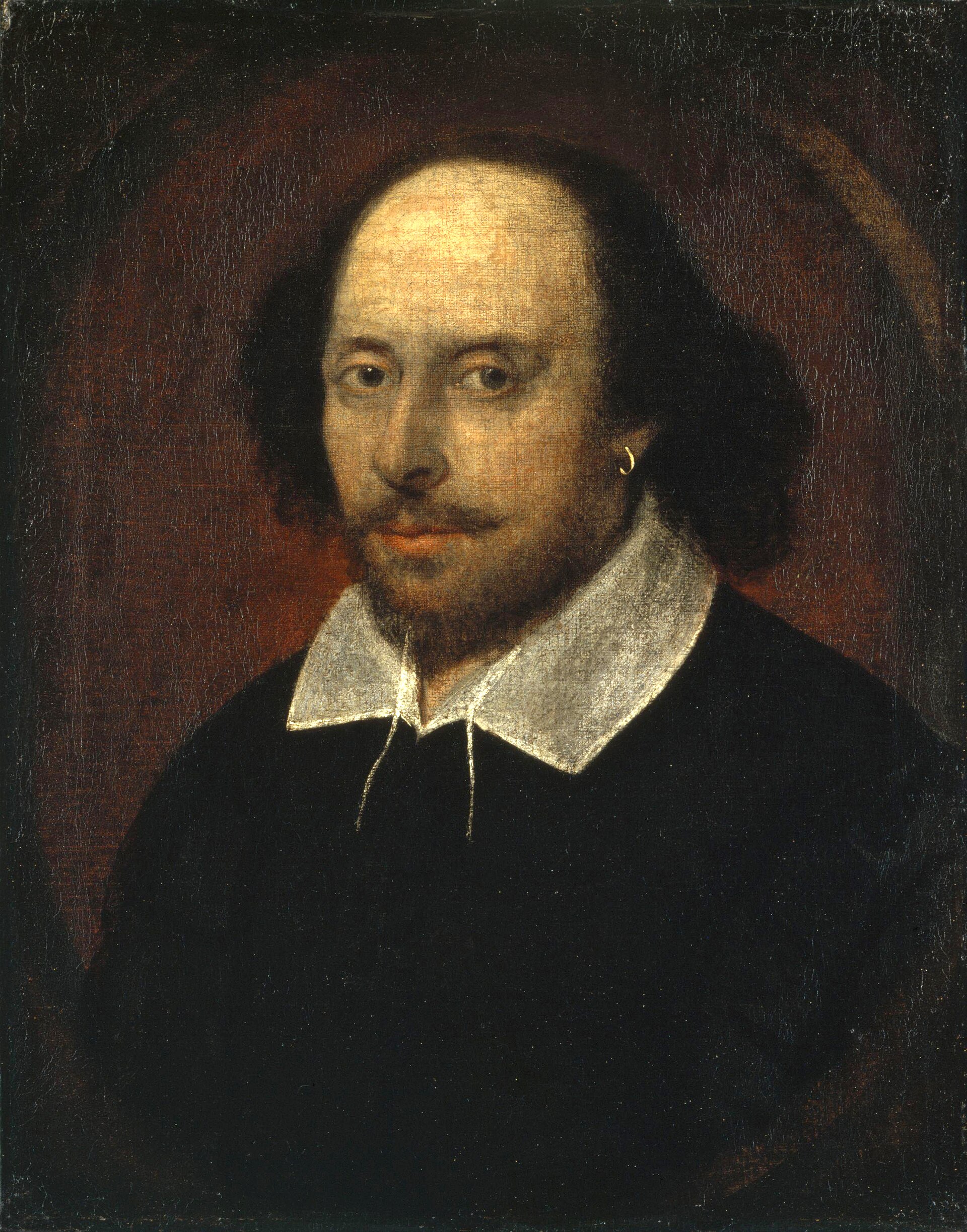

William Shakespeare (baptised 26 April 1564 at Stratford-upon-Avon; died there 23 April 1616) was an English poet, playwright, and actor. The documentary record — the Holy Trinity parish register, the 1616 will held by The National Archives as PROB 1/4, land and tax records, and the printed quartos — documents his baptism, his marriage to Anne Hathaway in November 1582, three children, and a London career that is first mentioned in print in 1592, when he is mocked as a 'Shake-scene'. He became an actor, playwright, and sharer in the Lord Chamberlain's Men, renamed the King's Men in 1603, and a co-owner of the Globe playhouse, built in 1599 from the timbers of The Theatre and rebuilt in 1614 after a cannon misfired during a performance of Henry VIII. Besides roughly 38 plays, he published two narrative poems — Venus and Adonis (1593) and The Rape of Lucrece (1594) — and a quarto of 154 sonnets (1609). No manuscripts survive; about half of the plays, including Julius Caesar, Macbeth, and The Tempest, first appeared in the First Folio of 1623, assembled by his fellow actors John Heminge and Henry Condell. The Folger Shakespeare Library holds the largest collection of First Folios in the world, and The National Archives holds more than 120 documents of his life, about 40 of them on the UNESCO Memory of the World Register. Scholarly consensus, based on that record, is that the man from Stratford wrote the works published under his name; the 'authorship question' is a debate that began in the Victorian period, not in his lifetime.
Baptised at Stratford: the documentary record begins (1564)
The written record of William Shakespeare begins with a baptism: he was baptised on 26 April 1564 at Holy Trinity Church in Stratford-upon-Avon, and that entry in the parish register is the earliest reference to him.1 The entry reads 'Guilielmus filius Johannes Shakspere' — in English, 'William, son of John Shakespeare'.1 No document records the exact day of his birth; the date traditionally given for it is 23 April 1564.2 His funeral monument records that he died on 23 April 1616 in the 53rd year of his age, which places his birth no later than 23 April 1564.1
What survives is a copy rather than an original: like every entry before September 1600, the baptism is written in the hand of a professional copyist who transferred it from an earlier register that no longer survives.1 The copying complied with a 1598 regulation that parish authorities should acquire new parchment registers and copy all existing entries into them.1
He was the oldest surviving child of John and Mary Shakespeare; their first two children, both girls, did not live beyond infancy.2 His father John was a leatherworker who specialised in the soft white leather used for gloves.2 He had married Mary Arden, of the prominent Arden family, and rose through local offices in Stratford, becoming an alderman and, when William was five, the town bailiff — much like a mayor.2
The town was in crisis in his first summer: a plague outbreak that began in June 1564 saw more than 200 inhabitants, one seventh of Stratford's population, buried in the second half of the year.1 Beside a burial entry of 11 June 1564 the register carries the note 'Hic incepit pestis' — 'Here began the plague'.1 As the son of a leading Stratford citizen he almost certainly attended the town's grammar school, whose curriculum emphasised the Latin classics — memorisation, writing, and acting classic Latin plays — most likely until about age 15.2
Family and marriage: Anne Hathaway and the Stratford household
A few years after he left school, in late 1582, William Shakespeare married Anne Hathaway.2 She was already expecting their first-born child, Susanna.2 When they married, Anne was 26 and William was 18.2 The proceedings were sped up by a licence from the Bishop's Court in Worcester, which also authorised the marriage to take place outside the parish of normal residence; two documents in the diocesan archives there establish the marriage in November 1582.3
Susanna was their first child; in early 1585 the twins Judith and Hamnet completed the family.2 Hamnet, Shakespeare's only son, died in 1596 at the age of 11 and was buried on 11 August 1596.2 His older daughter Susanna later married a well-to-do Stratford doctor, John Hall, and their daughter Elizabeth — Shakespeare's first grandchild — was born in 1608.2 In 1616, months before his death, Judith married Thomas Quiney, a Stratford vintner, and the family subsequently died out, leaving no direct descendants.2
Shakespeare prospered financially from his partnership in the Lord Chamberlain's Men, later the King's Men, and in 1597 bought New Place, the second-largest house in town.2 The purchase is documented in the records of the Court of Common Pleas by a foot of fine, CP 25/2/237/39ELIZIEASTER, now held by The National Archives.4
The lost years and the London stage
For several years after the birth of Judith and Hamnet in 1585, nothing is known for certain of Shakespeare's activities: how he earned a living, when he moved from Stratford, or how he got his start in the theatre.2 The years between the twins' baptism and 1592 are the 'lost years', for which no documentary evidence of his life survives.2 The first definite mention of him comes in 1592, as an established London actor and playwright mocked by a contemporary as a 'Shake-scene'.2 The same writer alludes to Henry VI, Part 3, which must already have been performed.2
It is not known exactly when he started writing plays, but they were probably being performed in London by 1592.5 In 1593 he published a long poem, Venus and Adonis; the first quarto editions of his early plays appeared in 1594.2 The Rape of Lucrece followed in 1594.6
The playhouses: from The Theatre to the Globe
From its inception in 1594, the Lord Chamberlain's Men performed at The Theatre, a playhouse located in Shoreditch.7 On 28 December 1598, after leasing a new site in Southwark, Cuthbert and Richard Burbage led the company in taking the building down timber by timber and carrying it across the Thames on barges.7 The timbers became the frame of a new playhouse on the south bank.7
By May 1599 the new theatre was ready, and Burbage named it the Globe after the figure of Hercules carrying the globe — the actors had carried the Globe's framework on their backs across the Thames.7 A flag of Hercules with the globe was raised above the theatre with the Latin motto 'totus mundus agit histrionem', or 'all the world's a playhouse'.7 The first Shakespeare play performed there is thought to have been Julius Caesar, in 1599; other playwrights, including Ben Jonson, Thomas Dekker and John Fletcher, wrote for the Globe too.8
During the performance of Henry VIII on 29 June 1613 — a play co-written with John Fletcher — the cannon announcing the king's arrival at the end of the first act set fire to the thatched roof, and within an hour the Globe burned to the ground.7 Everyone escaped safely, save for one man whose breeches reportedly caught fire.7 The Globe was rebuilt by February 1614, more extravagantly decorated and with a tiled roof instead of thatch.7 In 1642 parliament ordered the closure of the London theatres, and in 1644-45 the Globe was destroyed and the land sold for building.7
In 1609 Shakespeare's company started performing in the indoor Blackfriars playhouse as well as the Globe, and it was here that he conceived his final great plays, including The Tempest.8 In 1970 the American actor and director Samuel Wanamaker set up the Shakespeare's Globe Trust, and after almost 30 years of work the reconstructed Globe opened in 1997, one street away from where the original stood.7
| Venue | Location | What the record shows |
|---|---|---|
| The Theatre | Shoreditch | Used by the company from 1594; dismantled on 28 December 1598 and carried across the Thames.7 |
| The Globe | Bankside, Southwark | Opened by May 1599; burned on 29 June 1613; rebuilt by February 1614; destroyed in 1644-45.7 |
| Blackfriars | Indoor playhouse, London | Performed in from 1609 as well as the Globe.8 |
| Shakespeare's Globe | Bankside, London | Reconstruction opened in 1997, one street from the original; holds 1,570 people, 700 standing.78 |
The canon: comedies, histories, tragedies — and collaborators
Altogether Shakespeare's works include 38 plays, 2 narrative poems, 154 sonnets, and a variety of other poems; no original manuscripts of the plays are known to exist today.6 There is some dispute about how many plays he wrote, but the general consensus is 37.9
Playwrights in Shakespeare's day often collaborated: besides the 36 plays in the First Folio, Shakespeare wrote Pericles and The Two Noble Kinsmen, the latter with John Fletcher, and a 39th play, Cardenio, has been lost.10 Henry VIII, the play being staged when the Globe burned, was itself co-written with John Fletcher.7
In the First Folio the plays are grouped into comedies, histories, and tragedies — a division made for the first time in that book.10
The Sonnets (1609) and the narrative poems
Besides the plays, two narrative poems belong to the canon: Venus and Adonis, published in 1593 and dedicated to Henry Wriothesley, Earl of Southampton, and The Rape of Lucrece, which followed in 1594.6 Venus and Adonis became one of the most popular poems of the age.6
The Sonnets were first printed in 1609 in a quarto published by Thomas Thorpe.13 That edition is generally considered the authoritative text, and modern editors usually follow it as their source.13 Shakespeare published a quarto of 154 sonnets in 1609, and wrote the poems throughout his career.5
Two of them, Sonnets 138 and 144, had already appeared in the 1599 collection The Passionate Pilgrim; although the volume was attributed to Shakespeare, it is in fact a miscellany of poems by different authors.13 The most famous include Sonnet 18, with the opening line 'Shall I compare thee to a summer's day?', and Sonnet 130, which begins 'My mistress' eyes are nothing like the sun.'9
Shall I compare thee to a summer’s day? Thou art more lovely and more temperate. Rough winds do shake the darling buds of May,
Sonnet 18 (Folger edition)
Let me not to the marriage of true minds Admit impediments. Love is not love Which alters when it alteration finds
Sonnet 116 (Folger edition)
The First Folio (1623): the book that gave us Shakespeare
The First Folio of Shakespeare, published in 1623, is the first published collection of his plays, produced seven years after his death.10 Its title is Mr. William Shakespeare's Comedies, Histories & Tragedies, and it groups his plays into those categories for the first time.10 His friends and former colleagues John Heminge and Henry Condell, partners in the King's Men acting company, brought the plays together.10
About half of Shakespeare's plays had never previously appeared in print, including As You Like It, Julius Caesar, Macbeth, The Tempest, and many more.10 Without the First Folio, 18 plays might have been lost forever.10 Before 1623, about half of the plays had been published in quartos — small, one-play books made by folding sheets of paper twice, to create eight pages per sheet.10
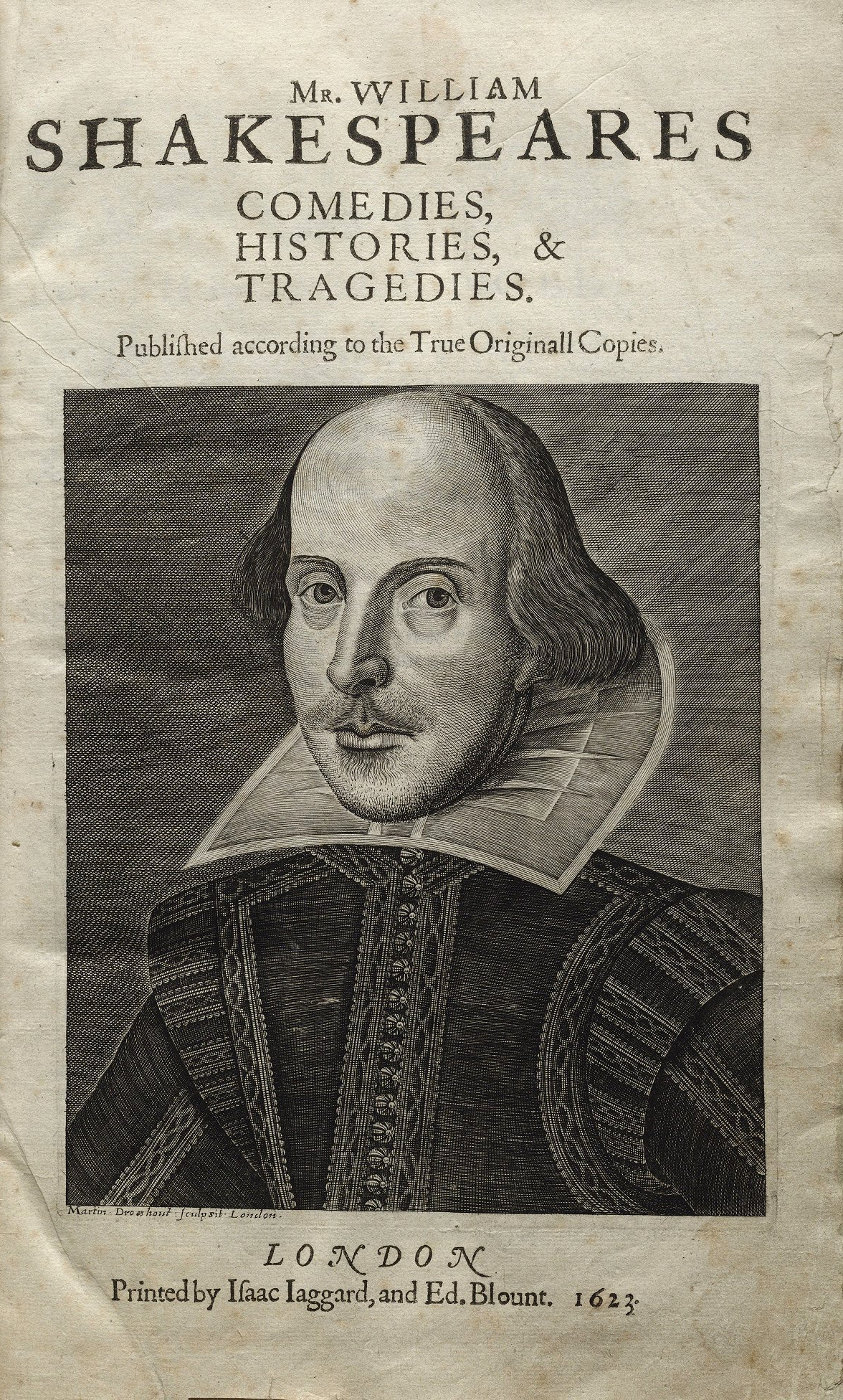

It was the first folio ever published in England devoted exclusively to plays, a format usually reserved for history, religion, and other weighty subjects.10 Out of the 36 plays included, 18 had never been published before, among them All's Well That Ends Well, Cymbeline, Measure for Measure, Twelfth Night, and The Winter's Tale.10 It also preserved the first good texts of The Merry Wives of Windsor, Henry V, and Henry VI Part 2 and Part 3.11
Researchers think that about 750 copies were printed, which was a typical print run at the time.10 A total of 235 First Folios are currently known to survive, including two that were discovered in 2016.10 The scholar Peter Blayney suggests that an unbound copy cost 15 shillings and a copy with a plain calf binding cost a pound — about $200 today.10
Sweet Swan of Avon
Ben Jonson, First Folio (1623)
was not of an age, but for all time
Ben Jonson, quoted in Britannica
His mind and hand went together: And what he thought, he uttered with that easiness, that we have scarce received from him a blot in his papers.
Heminge and Condell, First Folio (1623)
The documentary record: wills, taxes, and litigation
Britannica observes that the factual knowledge about Shakespeare is mostly gleaned from documents of an official character: dates of baptisms, marriages, deaths, and burials; wills, conveyances, legal processes, and payments by the court.9 The National Archives holds over 120 documents which contain evidence of his life as a playwright, actor and property owner — about 40 of them listed on the UNESCO Memory of the World Register.4
His fragile last will and testament from 1616 contains three of the six surviving examples of his signature.4 It was made on 25 March 1616 and proved on 22 June 1616, and it opens in the first person: William Shakespeare of Stratford upon Avon, gentleman, 'in perfect health and memory, God be praised'.14 He left a gift of £10 to the poor of Stratford, and 26 shillings and 8 pence each to his theatrical fellows Richard Burbage, John Heminges, and Henry Condell, among others, to buy mourning rings.14
Shakespeare's wife Anne is only mentioned once in the will, receiving the 'infamous bequest of the second-best bed'.4 Scholars have often noted that the mention reads as an afterthought — an interlineal insertion on the last leaf, where he bequeaths her the 'second best bed with the furniture'.14 The bequest was not unusual, and likely not a snub: the best bed was usually the heirloom piece passed to the heir, and it is probable that it was reserved for guests, making the 'second best' the bed William and Anne shared.2
Scholars have suggested that the will was drafted in January and revised on March 25 after Judith's marriage to Thomas Quiney on February 10; at the top of the first leaf January is crossed out and replaced with March.14 He left the bulk of his property to his two daughters: Susanna Hall, his first child, and Judith Quiney.14 Five surviving documents record him as a taxpayer in the London parish of St Helen's Bishopsgate, and show he failed to pay amounts of 5 shillings and 13 shillings 4 pence when they were due.4
The case of Bellot v Mountjoy, over the payment of a dowry, was heard in the Court of Requests in 1612; the documents include 24 mentions of his name and, on his deposition, the earliest known example of his signature.4 The Master of the Revels accounts of 1604-05 describe him as 'Shaxberd', one of the poets whose plays were presented before the royal court.4
| Record | Reference | What it documents |
|---|---|---|
| Last will and testament | PROB 1/4 | Made 25 March 1616, proved 22 June 1616; three of the six surviving signatures.144 |
| Foot of fine for New Place | CP 25/2/237/39ELIZIEASTER | The 1597 purchase, recorded in the Court of Common Pleas.4 |
| Tax-default list, St Helen's Bishopsgate | E 179/146/369 | Amounts of 5 shillings and 13 shillings 4 pence unpaid when due.4 |
| Deposition in Bellot v Mountjoy | REQ 4/1/4/1 | The 1612 dowry case; 24 mentions of his name and his earliest known signature.4 |
| Master of the Revels accounts | AO 3/908 | Describes him in 1604-05 as 'Shaxberd'.4 |
Death, burial, and the monument
He died on April 23, 1616 — the traditional date of his birthday, though his precise birthdate is unknown — and we do not know the cause of his death.2 Shakespeare's burial is recorded in Stratford's parish register on 25 April 1616.15 On his monument, still standing inside Holy Trinity Church in Stratford-upon-Avon, we read that he died on 23 April.15 The gravestone below it, believed from at least 1656 to be his, reads: 'Good friend for Jesus sake forbeare, To digg the dust encloased heare, Blest by the man that spares these stones, And curst be he that moves my bones.'15
Britannica notes that no writer's living reputation can compare to Shakespeare's, and that Ben Jonson's prophecy — that Shakespeare 'was not of an age, but for all time' — has been fulfilled.9 It is thanks to a group of actors from his company that we have about half of the plays at all: they collected them for publication after he died, and these writings were brought together in the First Folio, which contained 36 of his plays but none of his poetry.6 To this day, editors examine passages from the earlier quarto editions and the First Folio as they produce modern Shakespeare editions.10
The scholarly tradition continues in journals such as Shakespeare Quarterly — a leading, peer-reviewed journal in Shakespeare studies published for the Folger Shakespeare Library by Oxford University Press.16 The reconstructed Globe opened in 1997, one street away from where the original stood.7
The authorship question: what the evidence shows
For over 200 years after Shakespeare's death, nobody questioned that Shakespeare, the man from Stratford, Shakespeare the player, was Shakespeare the writer.17 In the Shakespeare Birthplace Trust's presentation of the evidence, there is ample evidence that William Shakespeare, a man from Stratford-upon-Avon, became an actor, became a playwright, and eventually returned to Stratford and died.17 Asked whether it was the man from Stratford, Professor Jonathan Bate answers that the evidence ties the actor, the playwright, and the man from Stratford into one person.17
The earliest testimony is contemporary: Francis Meres's 1598 book Wits Commonwealth, published quite early in Shakespeare's career, places Shakespeare among the writers of the age and names his plays.17 Marlowe, Bacon, and the Earl of Oxford have all been proposed as the true author; but Meres mentions Christopher Marlowe, Francis Bacon, and the Earl of Oxford elsewhere in the same book as writers, distinct from Shakespeare.17
The first doubts appeared in the Victorian period, when the American Delia Bacon became convinced that Shakespeare could not have been Shakespeare and proposed Francis Bacon.17 In the early twentieth century the schoolmaster Thomas Looney proposed Edward de Vere, the Earl of Oxford, arguing that a grammar-school boy from the provinces could not have known so much about courts and aristocracy.17 The controversy re-emerged with the advent of the internet.17 The Trust's account concludes, on the evidence, that the matter is settled.17
In Shakespeare's words: lines and quotations
The lines below are given as the sources collected here preserve them — the Folger Shakespeare Library's editions of the plays and the sonnets, and the prefatory poems of the 1623 First Folio.10
To be or not to be—that is the question
Hamlet, Act 3, scene 1 (Folger edition)
Shall I compare thee to a summer’s day? Thou art more lovely and more temperate. Rough winds do shake the darling buds of May,
Sonnet 18 (Folger edition)
Let me not to the marriage of true minds Admit impediments. Love is not love Which alters when it alteration finds
Sonnet 116 (Folger edition)
Sweet Swan of Avon
Ben Jonson, First Folio (1623)
all the world's a playhouse
Motto on the flag of the Globe Theatre
Good friend for Jesus sake forbeare, To digg the dust encloased heare, Blest by the man that spares these stones, And curst be he that moves my bones.
Inscription on Shakespeare's gravestone, Holy Trinity Church
Item I gyve unto my wiefe my second best bed with the furniture
Shakespeare's last will and testament, 25 March 1616
Timeline
Baptism at Holy Trinity Church, Stratford-upon-Avon
The parish register records the baptism of 'Guilielmus filius Johannes Shakspere' — William, son of John Shakespeare. The entry gives the first documentary reference to Shakespeare; the family had lost two infant daughters before him, and a plague outbreak followed three months later.
Marriage to Anne Hathaway
Shakespeare, then 18, marries Anne Hathaway of Shottery, then 26 and pregnant with their first child. Two documents in the diocesan archives of Worcester establish the marriage took place in November 1582, outside the usual parish.
Twins Judith and Hamnet baptised
The couple's twins, Judith and Hamnet, are baptised, completing the family of three children. The years between this baptism and 1592 are the 'lost years', for which no documentary evidence of Shakespeare's life survives.
First mention as a London playwright
Following the gap in the record after 1585, the first definite mention of Shakespeare is in 1592, as an established London actor and playwright mocked by a rival as a 'Shake-scene'. His earliest history plays were already being performed.
Venus and Adonis published
Shakespeare publishes the narrative poem Venus and Adonis, dedicated to Henry Wriothesley, Earl of Southampton; it becomes one of the most popular poems of the age. The Rape of Lucrece follows in 1594.
Hamnet Shakespeare dies; the coat of arms
Shakespeare's only son, Hamnet, dies at the age of eleven and is buried on 11 August 1596. The same year, Shakespeare's father John is granted a coat of arms, a step towards the family's status as gentlemen.
Purchase of New Place, Stratford
Prosperous from his share in the Lord Chamberlain's Men, Shakespeare buys New Place in Stratford-upon-Avon. The purchase is documented in the records of the Court of Common Pleas by a 'foot of fine' (CP 25/2/237/39ELIZIEASTER) now held by The National Archives.
The Globe opens at Bankside
After the Lord Chamberlain's Men dismantle The Theatre timber by timber in December 1598, the new playhouse rises on the south bank of the Thames. The Globe opens by May 1599; Julius Caesar is thought to be the first Shakespeare play performed there.
The King's Men and the accession of James I
At the accession of James I, the Lord Chamberlain's Men become the King's Men under royal patronage. Several records refer to the appointment, with the proviso that they could only perform 'when the infection of the plague shall decrease'.
Shakespeare's Sonnets printed
A quarto of 154 sonnets is published by Thomas Thorpe — the edition that modern editors generally follow. The same year, Shakespeare's company begins performing at the indoor Blackfriars playhouse as well as the Globe.
The Globe burns down during Henry VIII
During a performance of Henry VIII — co-written with John Fletcher — a cannon misfires and sets the thatched roof alight; the theatre burns to the ground within about an hour, and no one is killed. The Globe is rebuilt by February 1614 with a tiled roof.
Death and burial at Stratford
Shakespeare makes his will on 25 March 1616 and dies on 23 April, the day traditionally given as his birthday. His burial is recorded in the Stratford parish register on 25 April; the cause of death is unknown.
The First Folio is published
Seven years after his death, his fellow actors John Heminge and Henry Condell bring together 36 plays as Mr. William Shakespeares Comedies, Histories & Tragedies. Half of the plays — including Julius Caesar, Macbeth and The Tempest — had never before appeared in print.
Frequently asked questions
When was Shakespeare born, and when was he baptised?
He was baptised on 26 April 1564 at Holy Trinity Church in Stratford-upon-Avon, in the entry that is the earliest reference to him.1 The exact day of his birth is not recorded; the date traditionally given for it, and celebrated, is 23 April 1564.2
Did Shakespeare have children or descendants?
He had three children: Susanna, and the twins Judith and Hamnet, who completed the family in early 1585.2 His only son Hamnet died in 1596 at the age of 11, and the family subsequently died out, leaving no direct descendants.2
What are the 'lost years'?
They are the years between the twins' baptism in 1585 and 1592, for which nothing is known for certain of Shakespeare's activities: how he earned a living, when he moved from Stratford, or how he got his start in the theatre.2 The first definite mention of him comes in 1592, as an established London actor and playwright.2
How many plays did Shakespeare write?
The Shakespeare Birthplace Trust counts 38 plays, 2 narrative poems, and 154 sonnets among his works, and notes that no original manuscripts of the plays are known to exist today.6 Britannica records some dispute about the number of plays, with a general consensus of 37.9
Why is the First Folio important?
Published in 1623, seven years after Shakespeare's death, it is the first published collection of his plays, assembled by his friends and former colleagues John Heminge and Henry Condell.10 About half of the plays had never before appeared in print, and without the book 18 of them might have been lost forever.10
What happened to the Globe Theatre?
The Globe opened by May 1599; it burned to the ground on 29 June 1613 after a cannon set the thatched roof alight during Henry VIII, and it was rebuilt by February 1614 with a tiled roof.7 Parliament ordered the theatres closed in 1642, the Globe was destroyed in 1644-45, and the reconstruction opened in 1997, one street from the original site.7
Why did Shakespeare leave his wife the 'second best bed'?
The bequest was not unusual and was probably not a snub: the best bed was usually the heirloom piece passed to the heir, and it is probable that it was reserved for guests — meaning the 'second best' was the bed that William and Anne shared.2 Anne is mentioned only once in the will, in what scholars have often read as an afterthought.14
Did someone else write Shakespeare's plays?
The scholarly consensus, based on the documentary record, is that the man from Stratford wrote the works published under his name: the evidence ties the actor, the playwright, and the man from Stratford into one person.17 For over 200 years after his death nobody questioned that the man from Stratford, the player, was the writer; the first doubts appeared in the Victorian period, and Christopher Marlowe, Francis Bacon, and the Earl of Oxford were among those proposed later as the true author.17
Knowledge graph
Sources & citations
Every factual claim in this article is drawn from the sources below. Bracketed numbers in the text link to the corresponding source.
- 1
- 2
- 3
- 4
- 5
- 6
- 7
- 8
- 9
- 10
- 11
- 12
- 13
- 14
- 15
- 16
- 17