Martin Luther King Jr.
Baptist minister and civil-rights leader — from the Montgomery bus boycott and the Letter from Birmingham Jail to the March on Washington, the Nobel Peace Prize of 1964, the Civil Rights and Voting Rights Acts, Memphis 1968, and the national holiday that bears his name.
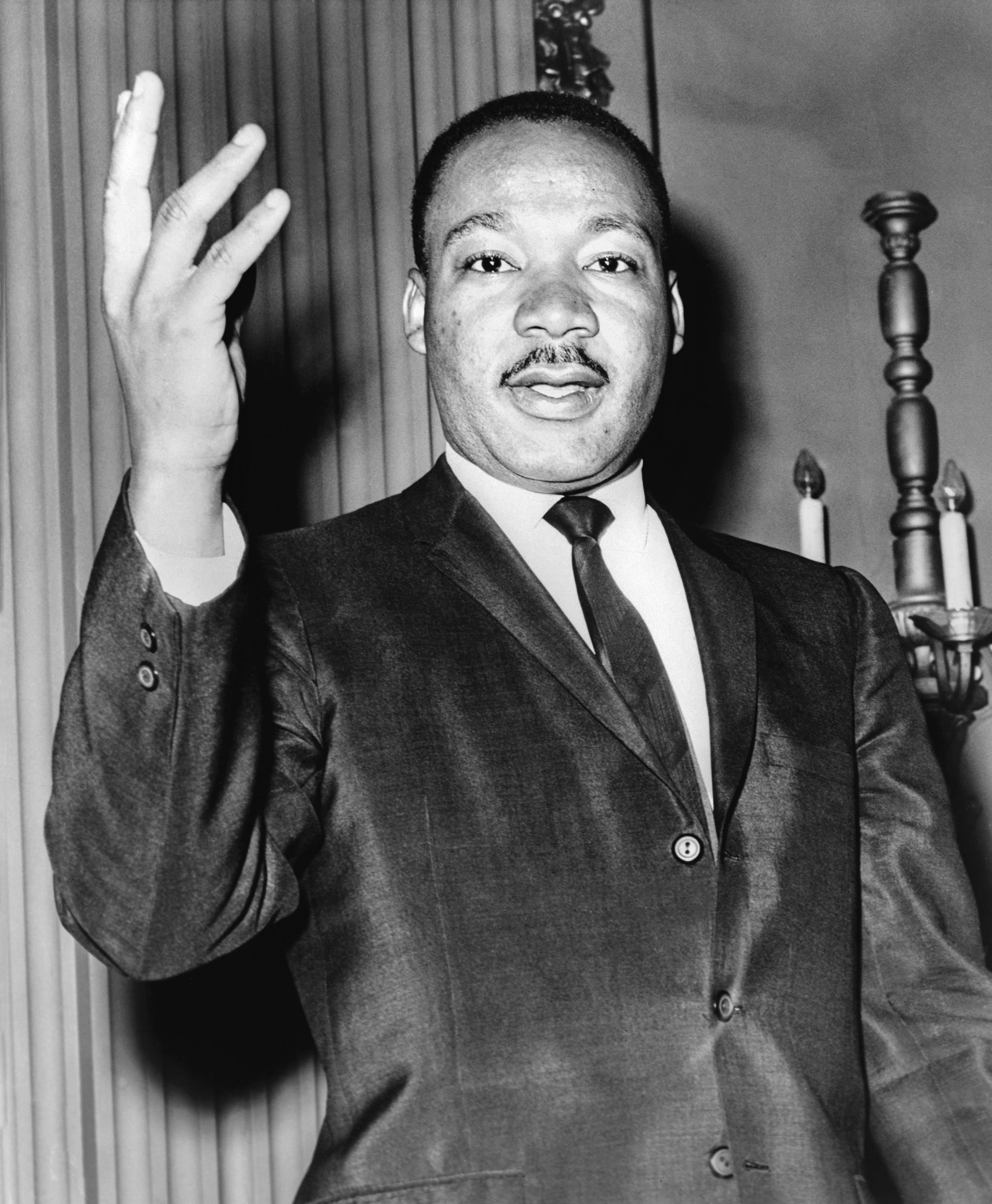

Martin Luther King Jr. (15 January 1929 – 4 April 1968) was a Baptist minister who led the modern American civil-rights movement from December 1955 until his assassination in Memphis. He directed the 385-day Montgomery bus boycott, co-founded the Southern Christian Leadership Conference, led the Birmingham campaign that produced the "Letter from Birmingham Jail," and spoke to more than 200,000 people at the March on Washington, where he delivered "I Have a Dream." His campaigns helped force passage of the Civil Rights Act of 1964 and the Voting Rights Act of 1965; he received the Nobel Peace Prize in 1964. In 1968 he was shot at the Lorraine Motel while supporting striking sanitation workers in Memphis.
The man and the movement
Martin Luther King Jr. was born on 15 January 1929 at 501 Auburn Avenue in Atlanta, Georgia.1 He was a Baptist minister and a civil-rights leader.2 He led the modern American civil-rights movement from December 1955 until his assassination in April 1968.3
More than 200,000 people gathered at the Lincoln Memorial on 28 August 1963 for the March on Washington for Jobs and Freedom, where King delivered “I Have a Dream.”4 He won the Nobel Peace Prize in 1964 and, at the time, was the youngest person to have done so.2 Four years later he was shot dead while standing on the balcony outside his second-floor room at the Lorraine Motel in Memphis, Tennessee.5
Early life and education (1929–1954)
In 1944, at age 15, King entered Morehouse College in Atlanta under a special wartime program intended to boost enrollment by admitting promising high-school students like him.2 He was ordained on 25 February 1948 and appointed assistant pastor at Ebenezer Baptist Church in Atlanta.1 On 8 June 1948 he received his bachelor of arts degree in sociology from Morehouse College.1
He graduated from Crozer Theological Seminary with a bachelor of divinity degree in May 1951, delivering the valedictory address at commencement.1 Two years later, on 18 June 1953, he married Coretta Scott at the Scott home near Marion, Alabama.1 On 5 June 1955 Boston University awarded him a doctorate in systematic theology.1
The couple had four children: Yolanda, Martin Luther III, Dexter Scott, and Bernice.2 On 1 September 1954 King began his pastorate at Dexter Avenue Baptist Church in Montgomery, Alabama.1
Montgomery: the 13-month bus boycott (1955–1956)
Rosa Parks was arrested on 1 December 1955 for refusing to vacate her seat and move to the rear of a city bus in Montgomery to make way for a white passenger.1 Jo Ann Robinson and other Women's Political Council members mimeographed thousands of leaflets calling for a one-day boycott of the city's buses on Monday, 5 December.1 On 5 December, 90 percent of Montgomery's black citizens stayed off the buses.6 At a mass meeting at Holt Street Baptist Church that day, the Montgomery Improvement Association was formed, and King became its president.1 After unsuccessful talks with city commissioners and bus company officials, the MIA issued a formal list of demands on 8 December, including courteous treatment by bus operators, first-come, first-served seating, and black bus operators on predominately black routes.6
After the city began to penalize black taxi drivers for aiding the boycotters, the MIA organized a carpool; following the advice of T. J. Jemison, who had organized a carpool during a 1953 bus boycott in Baton Rouge, it developed an intricate carpool system of about 300 cars.6 City officials obtained injunctions against the boycott in February 1956 and indicted over 80 boycott leaders under a 1921 law prohibiting conspiracies that interfered with lawful business.6 King was tried and convicted on the charge and ordered to pay $500 or serve 386 days in jail in the case State of Alabama v. M. L. King, Jr.6
On 5 June 1956 the federal district court ruled in Browder v. Gayle that bus segregation was unconstitutional.6 On 13 November the U.S. Supreme Court affirmed the lower court's opinion in that case, declaring Montgomery and Alabama bus segregation laws unconstitutional.1 On 20 December 1956 King called for the end of the boycott, and the next morning he boarded an integrated bus with Ralph Abernathy, E. D. Nixon, and Glenn Smiley.6
SCLC and the nonviolent campaign across the South (1957–1962)
With the stated goal of redeeming the soul of America through nonviolent resistance, the Southern Christian Leadership Conference was established in 1957 to coordinate the action of local protest groups throughout the South.7 Southern black ministers met in Atlanta on 10-11 January 1957 and named King chairman of the Southern Negro Leaders Conference on Transportation and Nonviolent Integration, later known as the Southern Christian Leadership Conference.1 SCLC operated as an umbrella organization of affiliates rather than seeking individual members, coordinating with local organizations like the Montgomery Improvement Association and the Nashville Christian Leadership Council.7
Its first major campaign, the Crusade for Citizenship, began in late 1957, sparked by a civil rights bill then pending in Congress.7 At the Lincoln Memorial on 17 May 1957 King delivered his first national address, “Give Us The Ballot,” at the Prayer Pilgrimage for Freedom.1 In 1958 his first book, Stride Toward Freedom: The Montgomery Story, was published.1
On 20 September 1958, during a book signing at Blumstein's Department Store in Harlem, King was stabbed by Izola Ware Curry; a team of doctors at Harlem Hospital removed a seven-inch letter opener from his chest.1 In 1959 he spent a month visiting India, where he met Prime Minister Jawaharlal Nehru and many followers of Mahatma Gandhi.1 On 1 February 1960 he moved from Montgomery to Atlanta to devote more time to SCLC and the freedom struggle, becoming assistant pastor to his father at Ebenezer Baptist Church.1
Birmingham 1963 and the Letter from Birmingham Jail
In April 1963 King and SCLC joined Birmingham's existing local movement, the Alabama Christian Movement for Human Rights, in a massive direct action campaign to attack the city's segregation system.8 The campaign put pressure on Birmingham's merchants during the Easter season, the second biggest shopping season of the year.8 It had been postponed until 2 April, when the relatively moderate Albert Boutwell defeated the segregationist commissioner of public safety, Eugene “Bull” Connor, in a run-off mayoral election.8 On 10 April the city government obtained a state circuit court injunction against the protests, and after heavy debate campaign leaders decided to disobey the court order.8
On Good Friday, 12 April, King was arrested after violating the anti-protest injunction and was kept in solitary confinement.8 During that time he penned the “Letter from Birmingham Jail” on the margins of the Birmingham News, in reaction to a statement published in that newspaper by eight Birmingham clergymen who condemned the protests.8 The letter is dated 16 April 1963, and King composed it from his prison cell in response to local religious leaders' criticisms of the campaign.9 The clergymen had called the campaign's direct action strategy unwise and untimely.9
“For years now, I have heard the word ‘Wait!’ … This ‘Wait’ has almost always meant ‘Never’”9
Martin Luther King Jr., “Letter from Birmingham Jail,” 16 April 1963
…collection of the facts to determine whether injustices exist; negotiation; self-purification; and direct action9
Martin Luther King Jr., “Letter from Birmingham Jail,” 16 April 1963 — the “four basic steps” of a nonviolent campaign
On 2 May more than 1,000 African American students attempted to march into downtown Birmingham, and hundreds were arrested; images of children being blasted by high-pressure fire hoses, clubbed by police officers, and attacked by police dogs appeared on television and in newspapers, triggering international outrage.8 By 10 May negotiators had reached an agreement including the removal of “Whites Only” and “Blacks Only” signs in restrooms and on drinking fountains, a plan to desegregate lunch counters, and the release of jailed protesters on bond.8 Four months later, on 15 September, Ku Klux Klan members bombed Birmingham's Sixteenth Street Baptist Church, killing four young girls.8 King delivered the eulogy at the 18 September joint funeral of three of the victims.8
The March on Washington and "I Have a Dream" (1963)
In the summer of 1941 A. Philip Randolph, founder of the Brotherhood of Sleeping Car Porters, called for a march on Washington to draw attention to the exclusion of African Americans from positions in the national defense industry.4 The threat of 100,000 marchers pushed President Franklin D. Roosevelt to issue Executive Order 8802, which mandated the formation of the Fair Employment Practices Commission to investigate racial discrimination charges against defense firms.4 The stated goals of the 1963 protest included a comprehensive civil rights bill that would do away with segregated public accommodations, protection of the right to vote, desegregation of all public schools in 1963, and a Federal Fair Employment Practices Act barring discrimination in all employment.4
On 28 August 1963, more than 200,000 demonstrators took part in the March on Washington for Jobs and Freedom in the nation's capital.4 King recalled that he did not finish the complete text of his speech until 3:30 A.M. on the morning of 28 August.10 PBS's American Experience records that a thirty-four-year-old minister gave the speech to a crowd of more than two hundred thousand people at Washington's Lincoln Memorial, with millions more watching on television.11 King later said that at that point he turned aside from the manuscript altogether and did not come back to it.10 Afterward he met with President Kennedy and Vice President Johnson at the White House.4
…will one day live in a nation where they will not be judged by the color of their skin but by the content of their character. I have a dream today!11
Martin Luther King Jr., “I Have a Dream,” Lincoln Memorial, 28 August 1963
…we will be able to speed up that day when all of God's children, black men and white men, Jews and Gentiles, Protestants and Catholics will be able to join hands and sing in the words of the old Negro spiritual “Free at last, free at last, thank God Almighty we are free at last.”11
Martin Luther King Jr., “I Have a Dream,” Lincoln Memorial, 28 August 1963
Triumph in law: the Civil Rights Act of 1964
In a nationally televised address on 6 June 1963, President John F. Kennedy urged the nation to take action toward guaranteeing equal treatment of every American regardless of race.12 Soon after, Kennedy proposed that Congress consider civil rights legislation that would address voting rights, public accommodations, school desegregation, nondiscrimination in federally assisted programs, and more.12 When the compromise bill was finally put to a vote in the Senate, it passed 73 to 27.12
The Civil Rights Act of 1964 was signed into law by President Lyndon Johnson on 2 July 1964.12 It prohibited discrimination in public places, provided for the integration of schools and other public facilities, and made employment discrimination illegal.12 Title VII of the act created the Equal Employment Opportunity Commission (EEOC) to implement the law.12
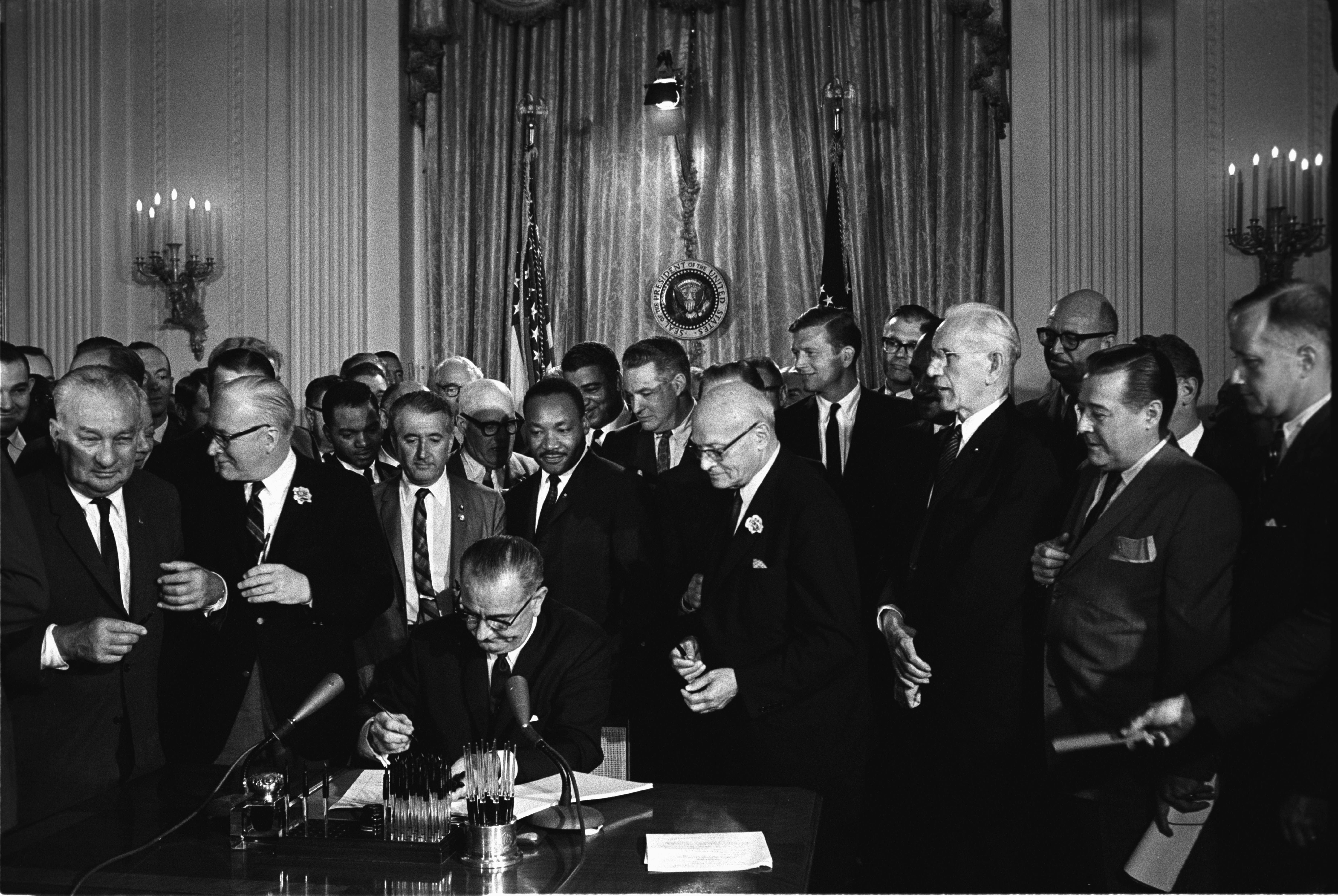

The National Archives calls it the most sweeping civil rights legislation since Reconstruction.12 The Library of Congress exhibition on the act calls it the most significant piece of civil rights legislation since Reconstruction.13 It prohibits discrimination on the basis of race, color, religion, sex, or national origin in voting, public accommodations, public facilities, public education, federally funded programs, and employment.13
Selma and the Voting Rights Act of 1965
On 2 January 1965 King and SCLC joined SNCC, the Dallas County Voters League, and other local African American activists in a voting rights campaign in Selma, Alabama, where in spite of repeated registration attempts by local blacks only two percent were on the voting rolls.14 On the night of 18 February, Alabama state troopers joined local police in breaking up an evening march in Marion, and a state trooper shot Jimmie Lee Jackson, a 26-year-old church deacon, as he attempted to protect his mother from the trooper's nightstick.14 Jackson died eight days later in a Selma hospital.14 In response to Jackson's death, activists in Selma and Marion set out on 7 March to march from Selma to the state capitol in Montgomery.14
The marchers made their way across the Edmund Pettus Bridge, where they faced a blockade of state troopers and local lawmen who attacked the crowd with clubs and tear gas; television coverage of “Bloody Sunday,” as the event became known, triggered national outrage.14 The federally sanctioned march left Selma on 21 March; protected by hundreds of federalized Alabama National Guardsmen and Federal Bureau of Investigation agents, the demonstrators covered between 7 to 17 miles per day, and the number swelled on the last day to 25,000.14 That night, while ferrying Selma demonstrators back home from Montgomery, Viola Liuzzo, a housewife from Michigan who had come to Alabama to volunteer, was shot and killed by four members of the Ku Klux Klan.14
| Law | Signed | Core provisions | Enforcement mechanism |
|---|---|---|---|
| Civil Rights Act of 1964 | 2 July 196412 | Prohibited discrimination in public places, provided for the integration of schools and other public facilities, and made employment discrimination illegal.12 | Title VII created the Equal Employment Opportunity Commission (EEOC) to implement the law.12 |
| Voting Rights Act of 1965 | 6 August 196515 | Outlawed the discriminatory voting practices adopted in many southern states after the Civil War, including literacy tests as a prerequisite to voting.15 | Section 5 required covered jurisdictions to obtain “preclearance” from the District Court for the District of Columbia or the U.S. Attorney General for any new voting practices and procedures.15 |
The Voting Rights Act was signed into law on 6 August 1965 by President Lyndon Johnson.15 It outlawed the discriminatory voting practices adopted in many southern states after the Civil War, including literacy tests as a prerequisite to voting.15 In his annual address to SCLC a few days later, King noted that Montgomery led to the Civil Rights Act of 1957 and 1960, that Birmingham inspired the Civil Rights Act of 1964, and that Selma produced the voting rights legislation of 1965.14
The Nobel Peace Prize and the widening struggle (1964–1968)
On the morning of 14 October 1964 King was awakened by a phone call from his wife, Coretta Scott King, telling him that he had been awarded the Nobel Prize for Peace.16 The prize citation recognized him for his non-violent struggle for civil rights for the Afro-American population.17 At the time he was the youngest person to have won the prize.2
King accepted the prize in Oslo on 10 December, in the name of the thousands of people in the civil rights movement who constituted what he termed a “mighty army of love.”16 He shared the $54,000 monetary prize with leading civil rights groups, giving $25,000 to the Gandhi Society for Human Rights and $12,000 to SCLC.16 The remainder was split among the Congress of Racial Equality, the National Association for the Advancement of Colored People (NAACP), the NAACP Legal Defense and Educational Fund, the National Council of Negro Women, the National Urban League, and the Student Nonviolent Coordinating Committee.16
On 4 April 1967 King delivered “Beyond Vietnam” to a gathering of Clergy and Laymen Concerned About Vietnam at Riverside Church in New York City, demanding that the U.S. take new initiatives to end the war.1 In these years his books charted the widening agenda: Why We Can't Wait appeared in 1964, and Where Do We Go from Here in 1967.1 On 4 December 1967 he publicly revealed plans for a mass civil-disobedience campaign in Washington, D.C., to force the government to end poverty.1
Memphis and the assassination (1968)
On 1 February 1968 two Memphis garbage collectors, Echol Cole and Robert Walker, were crushed to death by a malfunctioning truck.18 Eleven days later, frustrated by the city's response to a long pattern of neglect and abuse of its black employees, 1,300 black men from the Memphis Department of Public Works went on strike.18 The sanitation workers, led by garbage-collector-turned-union-organizer T. O. Jones and supported by the president of the American Federation of State, County, and Municipal Employees (AFSCME), Jerry Wurf, demanded recognition of their union, better safety standards, and a decent wage.18 Conditions had worsened when Henry Loeb became mayor in January 1968; he refused to take dilapidated trucks out of service or pay overtime when men were forced to work late-night shifts, and sanitation workers earned wages so low that many were on welfare and hundreds relied on food stamps to feed their families.18 Meeting in a church basement on 24 February, 150 local ministers formed Community on the Move for Equality (COME) under the leadership of King's longtime ally, local minister James Lawson.18
When the day arrived, a massive snowstorm blanketed the region, preventing King from reaching Memphis and causing the organizers to reschedule the march for 28 March.18 That march erupted in violence; in the chaos downtown shops were looted, and a 16-year-old was shot and killed by a police officer.18 On 3 April 1968, speaking to an overflowing crowd in Memphis where the city's sanitation workers were striking, King delivered what proved to be his final speech, telling the crowd that he had been to the mountaintop and had seen the Promised Land.19 At 6:05 P.M. on Thursday 4 April 1968 he was shot dead while standing on a balcony outside his second-floor room at the Lorraine Motel in Memphis, Tennessee.5 An ambulance rushed him to St. Joseph's Hospital, where doctors pronounced him dead at 7:05 P.M.5
News of King's assassination prompted major outbreaks of racial violence, resulting in more than 40 deaths nationwide and extensive property damage in over 100 American cities.5 On 8 April an estimated 42,000 people led by Coretta Scott King, SCLC, and union leaders silently marched through Memphis in honor of King.18 Morehouse College President Benjamin Mays delivered the eulogy, and over 100,000 mourners followed two mules pulling King's coffin through the streets of Atlanta.5 SCLC resumed plans for the Washington demonstration as a tribute to King; under its new president, Ralph Abernathy, 3,000 people camped in Washington from 13 May to 24 June 1968.7
Legacy: the King holiday and historical memory
Legislation to recognize Martin Luther King Jr. Day was first introduced just four days after his assassination in April 1968.20 It would take 15 years of persistence by civil rights activists for the holiday to be approved by the federal government, and an additional 17 years for it to be recognized in all 50 states.20 In 1979, on the 50th anniversary of King's birth, the bill finally came to a vote in the House and was rejected by five votes, even with a petition of 300,000 signatures in support, the backing of President Jimmy Carter, and testimonials from King's widow, Coretta Scott King.20
When the bill again made it to the House floor in 1983, support was overwhelming; Coretta Scott King, the Congressional Black Caucus, and Stevie Wonder had worked together to amass a six million signature petition in favor of the holiday.20 The bill easily passed in the House with a vote of 338 to 90.20 After two days of debate, it passed in the Senate.20 On 2 November 1983 President Ronald Reagan signed the King Holiday Bill into law, designating the third Monday in January a federal holiday in observance of Dr. Martin Luther King, Jr.20
The holiday was first observed as a federal holiday in 1986 and is observed on the third Monday of January every year.2 On 23 August 1994 the King Holiday and Service Act was signed into law by President Bill Clinton.20 The King Center notes that he is the only non-president to have a national holiday dedicated in his honor and the only non-president memorialized on the Great Mall in the nation's capital.3 The King Center's assessment of those less than 13 years, from December 1955 until April 1968, is that African Americans achieved more genuine progress toward racial equality than the previous 350 years had produced.3
In his own words
“We came to see that, in the long run, it is more honorable to walk in dignity than ride in humiliation. So … we decided to substitute tired feet for tired souls, and walk the streets of Montgomery”6
Martin Luther King Jr. on the Montgomery bus boycott, 1955–1956
“For years now, I have heard the word ‘Wait!’ … This ‘Wait’ has almost always meant ‘Never’”9
Martin Luther King Jr., “Letter from Birmingham Jail,” 16 April 1963
…will one day live in a nation where they will not be judged by the color of their skin but by the content of their character. I have a dream today!11
Martin Luther King Jr., “I Have a Dream,” Lincoln Memorial, 28 August 1963
…in the name of the thousands of people in the civil rights movement who constituted what he termed a “mighty army of love”16
Record of the Nobel Peace Prize ceremony, Oslo, 10 December 1964
…because I've been to the mountaintop … I've seen the Promised Land. I may not get there with you. But I want you to know tonight, that we, as a people, will get to the Promised Land19
Martin Luther King Jr., “I've Been to the Mountaintop,” Memphis, 3 April 1968
We cannot in all good conscience obey such an injunction which is an unjust, undemocratic and unconstitutional misuse of the legal process8
Martin Luther King Jr. on the Birmingham injunction, April 1963
…the martyred heroines of a holy crusade for freedom and human dignity8
Martin Luther King Jr., eulogy for the victims of the Sixteenth Street Baptist Church bombing, 18 September 1963
Montgomery led to the Civil Rights Act of 1957 and 1960; Birmingham inspired the Civil Rights Act of 1964; and Selma produced the voting rights legislation of 196514
Martin Luther King Jr., annual address to SCLC, 1965
…I used it, and at that point I just turned aside from the manuscript altogether. I didn't come back to it10
Martin Luther King Jr., recalling the delivery of “I Have a Dream”
Timeline
Birth in Atlanta
Michael King, later known as Martin Luther King, Jr., is born at 501 Auburn Avenue in Atlanta, Georgia.
The Montgomery bus boycott begins
After Rosa Parks's arrest on 1 December, 90 percent of Montgomery's black citizens stay off the buses; the Montgomery Improvement Association is formed at Holt Street Baptist Church and elects King its president.
Supreme Court strikes down bus segregation
The U.S. Supreme Court affirms Browder v. Gayle, declaring Montgomery and Alabama bus segregation laws unconstitutional; on 20 December King calls for the end of the boycott and rides an integrated bus the next morning.
SCLC is founded in Atlanta
Southern black ministers meet in Atlanta and name King chairman of the Southern Negro Leaders Conference on Transportation and Nonviolent Integration, later known as the Southern Christian Leadership Conference.
The Birmingham campaign opens
King and SCLC join the Alabama Christian Movement for Human Rights in a direct-action campaign against Birmingham's segregation system, targeting the Easter shopping season.
"Letter from Birmingham Jail"
Arrested on Good Friday (12 April), King writes from his cell in response to eight clergymen who called the campaign "unwise and untimely."
March on Washington and "I Have a Dream"
More than 200,000 demonstrators gather at the Lincoln Memorial; King delivers "I Have a Dream," then meets with President Kennedy and Vice President Johnson at the White House.
Bombing of the Sixteenth Street Baptist Church
Ku Klux Klan members bomb the Birmingham church, killing four young girls; King delivers the eulogy at the joint funeral of three of the victims on 18 September.
Civil Rights Act signed into law
President Lyndon Johnson signs the Civil Rights Act, which banned discrimination in public places, provided for the integration of schools and other public facilities, and made employment discrimination illegal.
Nobel Peace Prize ceremony in Oslo
King accepts the Nobel Peace Prize, awarded on 14 October, in the name of the civil-rights movement's "mighty army of love," and shares the $54,000 award with civil-rights organizations.
"Bloody Sunday" at the Edmund Pettus Bridge
Marchers bound for Montgomery are attacked with clubs and tear gas by state troopers and local lawmen in Selma; television coverage triggers national outrage.
Voting Rights Act signed into law
President Johnson signs the Voting Rights Act, which outlawed literacy tests and provided for federal examiners and Section 5 preclearance for covered jurisdictions.
Poor People's Campaign announced
King publicly reveals plans for a mass civil-disobedience campaign in Washington, D.C., to force the government to end poverty.
"I've Been to the Mountaintop"
At Mason Temple in Memphis, King delivers his final speech, telling the striking sanitation workers: "I've seen the Promised Land. I may not get there with you. But I want you to know tonight, that we, as a people, will get to the Promised Land."
Assassination at the Lorraine Motel
King is shot at 6:05 P.M. while standing on the balcony of the Lorraine Motel in Memphis and is pronounced dead at St. Joseph's Hospital at 7:05 P.M.; he is buried in Atlanta on 9 April.
Martin Luther King Jr. Day signed into law
President Ronald Reagan signs the King Holiday Bill, designating the third Monday in January a federal holiday; it is first observed in 1986 and recognized in all 50 states by 2000.
Frequently asked questions
Who was Martin Luther King Jr.?
Martin Luther King Jr. was a Baptist minister and civil-rights leader who led the modern American civil-rights movement from December 1955 until April 1968.3 He was born on 15 January 1929 in Atlanta, Georgia, and was shot dead in Memphis, Tennessee, on 4 April 1968.2
What was the Montgomery bus boycott?
It began after Rosa Parks's arrest on 1 December 1955, when 90 percent of Montgomery's black citizens stayed off the buses on 5 December and the Montgomery Improvement Association was formed with King as its president.6 After the Supreme Court affirmed Browder v. Gayle on 13 November 1956, King called for the boycott's end on 20 December.1
Why was King arrested in Birmingham in 1963?
On Good Friday, 12 April 1963, King was arrested after violating the anti-protest injunction and was kept in solitary confinement, and it was during that time that he wrote the “Letter from Birmingham Jail.”8 The letter is dated 16 April 1963 and answered eight local clergymen who had called the campaign “unwise and untimely.”9
What did King say at the March on Washington?
On 28 August 1963 he delivered “I Have a Dream” to more than 200,000 demonstrators at the Lincoln Memorial.4 In the speech he spoke of a nation where his children would not be judged by the color of their skin but by the content of their character.11
Which laws did King's campaigns help bring about?
The Civil Rights Act of 1964 was signed into law on 2 July 1964.12 The Voting Rights Act of 1965 was signed on 6 August 1965.15 King himself noted that Birmingham inspired the Civil Rights Act of 1964 and that Selma produced the voting rights legislation of 1965.14
Did King win the Nobel Peace Prize?
Yes: he was awarded the Nobel Prize for Peace in 1964 and accepted it in Oslo on 10 December, sharing the $54,000 award with leading civil-rights groups.16 He was, at the time, the youngest person ever to have won the prize.2
How did King die?
He was shot at 6:05 P.M. on 4 April 1968 while standing on the balcony outside his second-floor room at the Lorraine Motel in Memphis, and doctors pronounced him dead at St. Joseph's Hospital at 7:05 P.M.5 James Earl Ray later confessed to the crime and was sentenced to a 99-year prison term.5
Knowledge graph
Sources & citations
Every factual claim in this article is drawn from the sources below. Bracketed numbers in the text link to the corresponding source.
- 1
- 2
- 3
- 4
- 5
- 6
- 7
- 8
- 9
- 10
- 11
- 12
- 13
- 14
- 15
- 16
- 17
- 18
- 19
- 20