Hubble Space Telescope
The space telescope that repaired its own vision: a 2.4-meter mirror above the atmosphere that helped pin down the age of the universe and revealed its accelerating expansion.
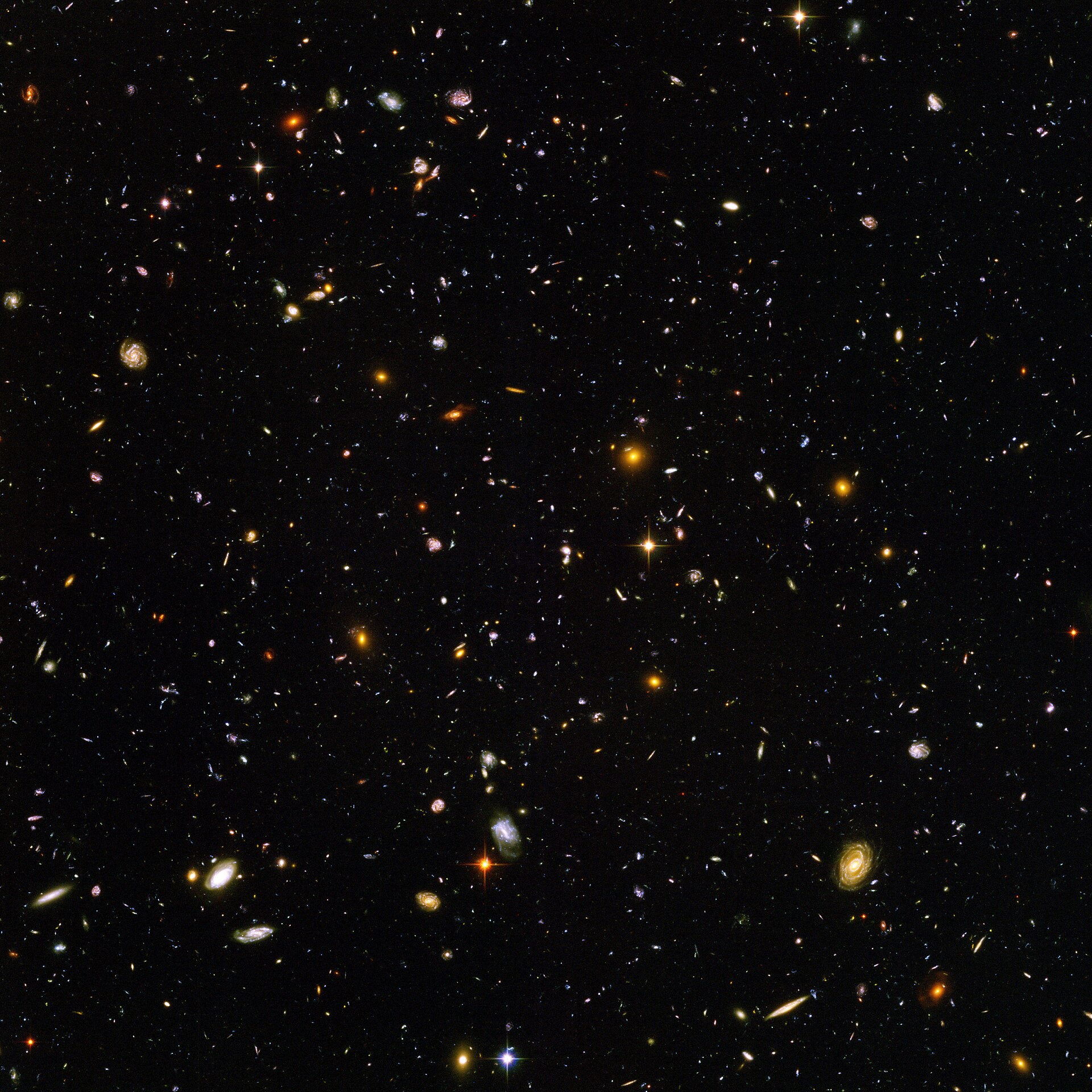

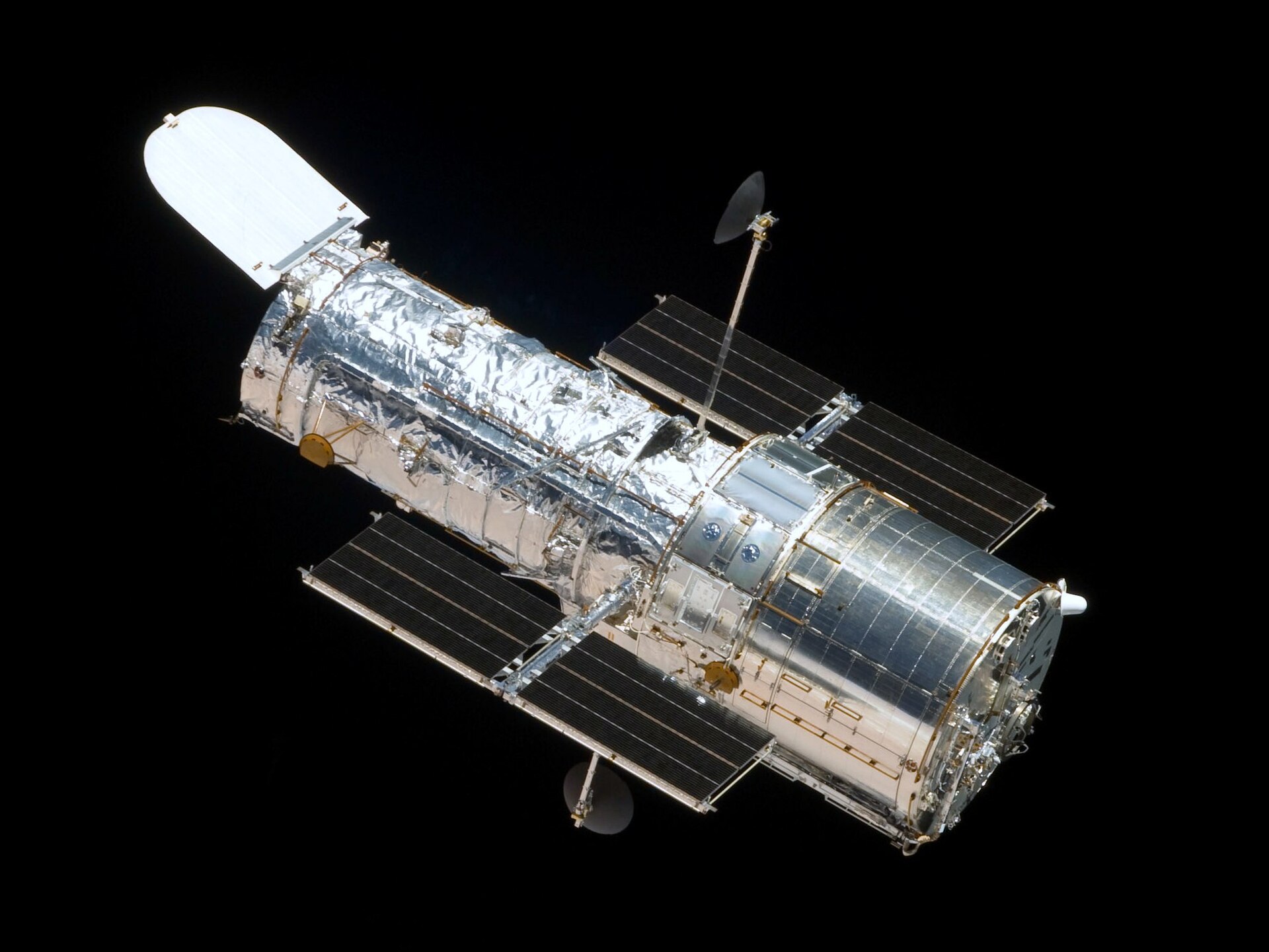
The Hubble Space Telescope is a NASA/ESA observatory launched on 24 April 1990 aboard the space shuttle Discovery. Orbiting about 483 km above Earth, its 2.4-meter mirror has made more than 1.7 million observations, from the deep fields that revealed thousands of galaxies to measurements that fixed the universe's expansion rate at near one percent precision. Astronauts serviced the telescope five times between 1993 and 2009 — the first mission correcting the spherical aberration that blurred its early images — and since June 2024 Hubble has operated in one-gyro mode, continuing its work alongside the James Webb Space Telescope.
Overview
The Hubble Space Telescope is a large, space-based observatory named in honor of the astronomer Edwin Hubble, and it has changed our understanding of the cosmos since its launch and deployment by the space shuttle Discovery in 1990.1 Its design, technology and serviceability have made it one of NASA's most transformative observatories, probing everything from the atmospheric composition of planets around other stars to the discovery of dark energy.2
Orbiting about 300 miles (483 km) above Earth's surface, Hubble avoids the distorting effects of the atmosphere, giving it a clear vision of the cosmos.1 Its domain extends from the ultraviolet through the visible and into the near-infrared — a range that has produced stunning images of stars, galaxies and other astronomical objects.1 The observatory is a long-term collaboration between ESA and NASA, and its observations are carried out in visible, infrared and ultraviolet light.3 Its hardware was built to fit snugly inside the space shuttle's cargo bay so that astronauts could repair and upgrade it in orbit.4
The scale of the science is unusual for a single machine: Hubble has made more than 1.7 million observations, over 23,000 peer-reviewed science papers have been published on its discoveries, and every current astronomy textbook includes contributions from the observatory.1 The telescope has tracked interstellar objects as they soared through the solar system, watched Comet Shoemaker-Levy 9 collide with Jupiter, and discovered moons around Pluto.1 It has also found dusty disks and stellar nurseries throughout the Milky Way that may one day become fully fledged planetary systems, and studied the atmospheres of planets that orbit other stars.1
A flawed start: spherical aberration and the 1993 repair
When Hubble began returning science data to Earth, astronomers did not see the crisp, point-like images of stars they had anticipated; instead, they saw stars surrounded by large, fuzzy halos of light.5 The edges of the primary mirror had been ground too flat by just a fraction of the width of a human hair, because of a flaw introduced into the test equipment used to evaluate the mirror's curvature prior to launch.5 Although perfectly smooth, the mirror could not focus light to a single point.5
The error was spherical aberration: flattened by a depth of 2.2 microns — roughly equal to one-fiftieth the thickness of a human hair — the outer edge of Hubble's main mirror was ground to the wrong specification by the contractors who built it.6 Instead of focusing incoming light to a single point, Hubble had multiple foci that made the telescope's first images look fuzzy.6 Because the primary mirror could not be replaced, the fix had to be built into new hardware.5
Engineers reworked the new Wide Field and Planetary Camera 2 with internal optics that brought light into focus, counteracting the mirror's flaw in a way similar to how eyeglasses correct vision.6 For Hubble's other instruments they devised COSTAR — the Corrective Optics Space Telescope Axial Replacement — a refrigerator-sized device that could deploy nickel- and quarter-sized corrective mirrors into the light paths of the telescope's other science instruments.5
Servicing Mission 1, from December 2 to 13, 1993, was the first opportunity to conduct planned maintenance: astronauts installed new instruments, including equipment that counteracted the flaw in Hubble's primary mirror.7 It took five back-to-back spacewalks totaling 35 hours and 28 minutes to complete the mission.6 On Dec. 18, 1993, astronomers gathered around a monitor at the Space Telescope Science Institute and cheered as the first WFPC2 image appeared, free of the blurriness that had plagued earlier pictures.5 Hubble was back in top form, and WFPC2 — its most used instrument for many years — went on to produce more than 135,000 images of the universe.6
Five servicing missions, 1993–2009
Hubble's capabilities grew immensely over more than 36 years of operation because new, cutting-edge scientific instruments were added over the course of five astronaut servicing missions; by replacing and upgrading aging parts, those missions greatly extended the telescope's lifetime.1 The visits were possible because Hubble was designed for them: it fit snugly inside the space shuttle's cargo bay, reflecting the dimensions of its launch and repair vehicle.4 Its systems allowed astronauts to perform repairs, replace parts and update its technology with new instruments while in orbit.6
Servicing Mission 1 installed corrective optics that counteracted the primary mirror's flaw, along with new instruments.6 The second servicing mission, February 11-21, 1997, extended the range of wavelengths Hubble can see with the installation of two new instruments and increased the observatory's efficiency and performance.7

What was originally conceived as a mission of preventive maintenance became more urgent on Nov. 13, 1999, when the fourth of Hubble's six gyros failed.7 Hubble required at least three of its stabilizing gyros to conduct science at that time, and it entered a state of dormancy called safe mode while the telescope awaited repairs.7 Servicing Mission 3A replaced all three Rate Sensor Units — each holding two gyroscopes — installed a computer 20 times faster than the old one, and returned Hubble to orbit.7 Then, in March 2002, astronauts on Servicing Mission 3B replaced the solar panels and installed the Advanced Camera for Surveys, which took the place of the Faint Object Camera, the telescope's last original instrument.7 NASA Administrator Sean O'Keefe cancelled Servicing Mission 4 in January 2004 due to safety concerns after the loss of the Space Shuttle Columbia.7
In May 2009, Servicing Mission 4 — the fifth and final visit — installed two new scientific instruments, the Cosmic Origins Spectrograph and Wide Field Camera 3.5 Astronauts also brought two failed instruments back to life with the first-ever on-orbit instrument repairs and replaced batteries, gyroscopes and the science computer to prolong Hubble's life.5 The mission left the observatory at the peak of its scientific capability, preparing it for many years of further scientific discovery.7 All told, six shuttle flights visited Hubble — one deployment and five servicing missions — carrying 32 astronauts who performed 23 days of spacewalks, 171 hours and 3 minutes in total.8 With the retirement of the space shuttle, there is today no capability to service the telescope.9
Engineering and orbit by the numbers
| Property | Value |
|---|---|
| Orbit altitude | About 300 miles (483 km) above Earth 8 (as of 2024) |
| Orbital period | About 95 minutes 8 |
| Orbital speed | About 17,000 mph (27,000 km/h) 8 |
| Primary mirror | 7.8 feet (2.4 m) 8 |
| Wavelength range | 0.1 to 2.5 microns — ultraviolet, visible and near-infrared 4 |
| Mass (after Servicing Mission 4) | 27,000 pounds (12,200 kg) 8 |
| Pointing stability | Equivalent to keeping a laser shining on a dime over 200 miles (320 km) away, up to 24 hours 10 |
| Observations to date | More than 1.7 million 8 (as of 2024) |
| Peer-reviewed science papers | Over 23,000 8 (as of 2024) |
| Farthest object observed | Galaxy GN-z11, about 13.4 billion light-years away 9 |
| Astronaut servicing missions | Five, between 1993 and 2009 1 |
| Design lifetime | 15 years planned; still operating 9 |
Behind those figures lies one of the most accurate pointing systems ever flown: its stability is equivalent to keeping a laser shining on a dime over 200 miles (320 km) away for however long Hubble takes a picture, up to 24 hours.10 Each of Hubble's six gyros holds a wheel spinning at a constant 19,200 revolutions per minute, and by measuring the displacement of the wheel's axis the telescope knows how fast and in what direction it is turning.10 To change pointing direction, Hubble spins four internal wheels weighing about 100 pounds (45 kg) each, and Newton's third law turns the spacecraft the other way.9 Its low orbit also carries it through the South Atlantic Anomaly — a dent in Earth's magnetic field that collects charged particles from the Sun — for 10 consecutive orbits each day, nearly 15 percent of its time.4
Where Hubble came from
In 1923, German scientist Hermann Oberth's book “Die Rakete zu den Planetenraumen” mentioned how a telescope could be propelled into Earth orbit by a rocket.5 In 1946, Princeton astrophysicist Lyman Spitzer wrote about the scientific benefits of a telescope in space, above Earth's turbulent atmosphere.5 In 1969, the National Academy of Sciences gave its approval for the Large Space Telescope project, and the hearings and feasibility studies continued.5 Ultimately, under budget pressure, the size of the main mirror was reduced from 120 inches to 94.5
The European Space Agency joined the project in 1975 and provided 15 percent of the funding through the contribution of the Faint Object Camera and the solar arrays; in return, NASA guaranteed at least 15 percent of telescope time to European astronomers.5 In 1977, Congress approved funding to build one of the most sophisticated satellites ever constructed.5 The project was renamed the Hubble Space Telescope after Edwin Hubble, who showed that other galaxies existed beyond our own and devised a classification scheme distinguishing galaxies by shape.5
In 1986, disaster struck: the Challenger accident forced NASA to ground the space shuttle fleet for two years, and the Hubble project used that time to perform additional work on the telescope.5 On April 24, 1990, the space shuttle Discovery carried Hubble aloft from the Kennedy Space Center with a five-astronaut crew aboard.11 The following day, the telescope was released into orbit.5
The deep fields: looking back in time
Ten percent of Hubble's observation time is set aside for discretionary purposes as decided by the director, and observations such as the Hubble deep fields and the Frontier Fields have come from that allocation.9 Taken over the course of 10 days in 1995, the Hubble Deep Field captured roughly 3,000 distant galaxies varying in their stages of evolution, in a patch of sky about the equivalent of holding a pinhead at arm's length.12 Most of those galaxies were so faint — four billion times fainter than the human eye can see — that they had never been observed before, even by the largest telescopes.12
The Deep Field South was observed in 1998.12 In 2004, Hubble captured a million-second-long exposure that contained 10,000 galaxies — the Hubble Ultra Deep Field — observing the first galaxies to emerge from the “dark ages,” a time just after the Big Bang.12 In 2009, Hubble captured near-infrared wavelengths in the same region as the Ultra Deep Field, revealing galaxies formed just 600 million years after the Big Bang.12 In 2012, astronomers combined 10 years of photographs taken of a region in the center of the original Ultra Deep Field; even with its smaller view, the eXtreme Deep Field still showed 5,500 galaxies.12
NASA's Great Observatories — Hubble, Spitzer and Chandra — teamed up in 2013 for the Frontier Fields, a multi-year campaign that provided 12 new deep field images and allowed astronomers to detect galaxies 100 times fainter than those they observed in the Hubble Ultra Deep Field.12 Hubble's data was then compiled for the Legacy Field: nearly 7,500 exposures representing 16 years of observations, 265,000 galaxies and 13.3 billion years — the largest collection of galaxies documented by Hubble.12 The deepest of those stares reached locations more than 13.4 billion light-years from Earth, capturing galaxies merging and probing the supermassive black holes that lurk in their depths.1 The farthest observation to date is the galaxy GN-z11, about 13.4 billion light-years away.9
The Hubble constant and the Hubble tension
Edwin Hubble, for whom the telescope is named, discovered cosmic expansion in 1929, observing that the farther away a galaxy is from Earth, the faster it appears to be receding from us.13 Observations by the Hubble Space Telescope later pinned the Hubble Constant down with unprecedented precision, to an accuracy of almost one percent.13 Before Hubble's launch and its refinement of the constant, the age of the universe was estimated at anywhere from 9.7 billion years to 19.5 billion years; afterward, astronomers using Hubble's observations were able to pin it down to 13.8 billion years.13
Today the Hubble Tension is still a mystery: something may be wrong with our understanding of the early universe, and exotic particles, alternative theories of gravity and early forms of dark energy are all proposed candidates for the difference.13 Lead researcher and Nobel laureate Adam Riess has called the tension between the early and late universe possibly the most exciting development in cosmology in decades.14
In 2023, to try to eliminate the possibility of measurement errors, researchers used NASA's James Webb Space Telescope to test their Hubble results.17 Those observations confirmed Hubble's results, leading some scientists to suggest that something else — not measurement error — is influencing the expansion rate.17
Dark energy and a Nobel Prize
Hubble observations, along with those of ground-based observatories, surprised astronomers by revealing that the universe is not just expanding but accelerating.17 That discovery won the 2011 Nobel Prize in Physics.17 Hubble's observations have helped build a better understanding of the history of the expanding universe.1
From these observations, scientists estimate that dark energy is about 68 percent of the entire universe and dark matter about 27 percent, while normal matter and energy are only about 5 percent.17 Those estimates rest on the same observations that revealed the accelerating universe.17
The result crowned more than three decades of precision work: teams using Hubble's extraordinary capabilities have measured the expansion rate to a precision of just over 1 percent — about eight times more precise than they originally anticipated.17 That value for the Hubble Constant puts the age of the universe at about 13.8 billion years.17
Hubble and James Webb compared
| Property | Hubble | James Webb |
|---|---|---|
| Launch year | 1990, aboard the space shuttle Discovery 5 | — |
| Primary mirror | 7.8 feet (2.4 m) 8 | 21.3 feet (6.5 m) 4 |
| Light-collecting area | — | More than six times Hubble's 4 |
| Wavelength range | 0.1 to 2.5 microns; optimized for ultraviolet and visible light 4 | Observes in near-infrared light 4 |
| Faintest objects | — | Up to 100 times fainter than Hubble can see 4 |
| Resolution | — | About the same in near-infrared light as Hubble attains in visible light 4 |
| Orbit | About 300 miles (483 km) above Earth 4 | Orbits the Sun with Earth around the second Lagrange point (L2), roughly one million miles away 4 |
| Servicing | Designed to be serviced; fits inside the space shuttle's cargo bay 4 | No current servicing capability or plan 4 |
Webb is not a replacement for Hubble: the two telescopes have different capabilities, and the goal is for both to operate at the same time and conduct joint observations for several years.9 Webb's larger primary mirror gathers more of the redshifted and dim light, providing views of objects up to 100 times fainter than Hubble can see; despite its larger size, it delivers about the same resolution in near-infrared light as Hubble attains in visible light.4 Together they make a formidable pair of observatories that cover a broad wavelength range.4
Hubble today: one-gyro operations
Hubble went into safe mode on May 24, 2024, due to an ongoing issue with one of its gyroscopes, which measure the telescope's slew rates and are part of the system that determines and controls the direction the telescope is pointed.18 That gyro had been increasingly returning faulty readings over the past six months, suspending science operations multiple times.18 This led the Hubble team to transition from a three-gyro operating mode to observing with only one gyro, enabling more consistent science observations and keeping another operational gyro available for future use.18 NASA then returned the spacecraft to daily science operations, with the telescope and its instruments stable and functioning normally.18
One-gyro mode substitutes magnetometers, sun sensors and star trackers for the failed gyros, positioning Hubble closer and closer to a target based on the accuracy of its sensors.10 The mode has limits: roughly a 12 percent decrease in efficiency because of the added time required to slew and lock the telescope onto a science target, an overall productivity decrease of roughly 20 to 25 percent, and restrictions such as the inability to track moving objects closer to Earth than the orbit of Mars.10
The telescope has long outlived its design: Hubble launched in 1990 with an expected lifespan of about 15 years, and largely because of five successful servicing missions, all indications are that it will continue operating into the next decade.9 Because atmospheric drag is slowly lowering its orbit, Hubble is not expected to re-enter Earth's atmosphere until the mid-2030s at the earliest.9 Meanwhile, Hubble and the James Webb Space Telescope are meant to operate at the same time and conduct joint observations for several years.9
In their own words
The chief contribution of such a radically new and more powerful instrument would be, not to supplement our present ideas of the universe we live in, but rather to uncover new phenomena not yet imagined, and perhaps to modify profoundly our basic concepts of space and time.
Lyman Spitzer, Princeton astrophysicist
Hubble is not just a satellite. It’s a symbol of humanity’s quest for knowledge.
John Grunsfeld, Hubble servicing-mission astronaut
“As the images have come up on our screens, we have not been able to keep from wondering if we might somehow be seeing our own origins in all of this,” Williams said at the time. “These past 10 days have been an unbelievable experience.”
Robert Williams, on the Hubble Deep Field
Mission timeline
A telescope in orbit is imagined
In his 1923 book “Die Rakete zu den Planetenraumen” (“The Rocket into Planetary Space”), Hermann Oberth — one of the founders of modern rocketry — mentioned how a telescope could be propelled into Earth orbit by a rocket.5
Spitzer makes the scientific case
Princeton astrophysicist Lyman Spitzer wrote about the scientific benefits of a telescope in space, above Earth’s turbulent atmosphere — an idea that would become a driving focus of his long career.5
Approvals, partners and funding
In 1969 the National Academy of Sciences approved the Large Space Telescope project; in 1975 the European Space Agency joined, providing 15 percent of the funding through the Faint Object Camera and the solar arrays in exchange for at least 15 percent of telescope time for European astronomers; and in 1977 Congress approved funding to build the telescope.5
Challenger grounds the shuttle fleet
The Challenger accident forced NASA to ground the space shuttle fleet for two years; the Hubble project used the pause to improve the solar panels, ease instrument replacement in the aft shroud, and upgrade computers and communications.5
Launch and deployment
The space shuttle Discovery lifted off on April 24, 1990 with Hubble secured in its payload bay, and the following day the telescope was released into orbit.5
Servicing Mission 1 repairs Hubble's vision
Five spacewalks totaling 35 hours and 28 minutes installed the Wide Field and Planetary Camera 2 and COSTAR to counter the flawed primary mirror. On Dec. 18, 1993, astronomers gathered around a monitor at the Space Telescope Science Institute and cheered as the first WFPC2 image appeared, free of the blurriness that had plagued earlier pictures.5
The Hubble Deep Field
A 10-day stare at a seemingly empty patch of sky near the handle of the Big Dipper, assembled from 342 separate exposures, captured roughly 3,000 distant galaxies at different stages of evolution in an area the size of a pinhead held at arm's length.12
Servicing Mission 2 extends Hubble's reach
Astronauts installed two new instruments — the Space Telescope Imaging Spectrograph and the Near Infrared Camera and Multi-Object Spectrometer — extending Hubble's range into the near infrared and increasing the observatory's efficiency and performance.7
A gyro failure, a safe mode, and a rescue mission
On Nov. 13, 1999 the fourth of Hubble's six gyroscopes failed and the telescope entered safe mode, unable to do science without three working gyros. Servicing Mission 3A (December 19–27) replaced all three Rate Sensor Units — each holding two gyroscopes — installed a computer 20 times faster than the old one, and returned Hubble to orbit.7
Servicing Mission 3B: a new camera for a new century
During SM3B, astronauts replaced Hubble's solar panels and installed the Advanced Camera for Surveys, which took the place of the Faint Object Camera — the telescope's last original instrument.7
The Hubble Ultra Deep Field
A million-second-long exposure containing 10,000 galaxies — the Hubble Ultra Deep Field — observed the first galaxies to emerge from the “dark ages” just after the Big Bang.12
Servicing Mission 4 — the final visit
Astronauts installed two new instruments, the Cosmic Origins Spectrograph and Wide Field Camera 3, brought two failed instruments back to life with the first-ever on-orbit instrument repairs, and replaced batteries, gyroscopes and the science computer.5
The Hubble tension crosses a threshold
New Hubble data lowered the probability that the expansion-rate discrepancy was a fluke to 1 in 100,000 — a significant gain from the earlier estimate of 1 in 3,000 — while the team's estimate of the Hubble constant stood at 74 km/s/Mpc.14
One-gyro operations begin
After entering safe mode on May 24, 2024 due to a gyroscope returning faulty readings, Hubble transitioned to an alternate mode using a single gyro and returned to daily science operations in June 2024, with the telescope and its instruments stable and functioning normally.18
Frequently asked questions
When was Hubble launched, and how did it reach orbit?
Hubble launched on 24 April 1990 aboard the space shuttle Discovery (STS-31).5 It was released into orbit the following day.5
How far above Earth does Hubble orbit?
About 300 miles (483 km) above Earth's surface, where it avoids the distorting effects of the atmosphere and gains its clear vision of the cosmos.1
What was wrong with Hubble's mirror, and how was it fixed?
Its outer edge had been ground too flat by 2.2 microns — roughly one-fiftieth the thickness of a human hair — an error called spherical aberration.6 The first servicing mission installed the Wide Field and Planetary Camera 2, whose internal optics brought light into focus much as eyeglasses correct vision, and COSTAR, which deployed corrective mirrors into the light paths of Hubble's other science instruments.5
How many servicing missions visited Hubble?
Five astronaut servicing missions, between 1993 and 2009, added new instruments and replaced aging parts, greatly extending the telescope's lifetime.1
Can Hubble be serviced again?
No — with the retirement of the space shuttle, there is currently no capability to service Hubble.9
What is the Hubble tension?
Space-telescope measurements find an expansion rate of around 70-76 kilometers per second per megaparsec, while measurements derived from studying the cosmic microwave background provide about 67-68 — a discrepancy scientists call the Hubble Tension.13 The candidates proposed to explain it include exotic particles, alternative theories of gravity and early forms of dark energy.13
Is the James Webb Space Telescope replacing Hubble?
No — Webb has different capabilities than Hubble, and the goal is for both telescopes to operate at the same time to conduct joint observations for several years.9
Knowledge graph
Sources & citations
Every factual claim in this article is drawn from the sources below. Bracketed numbers in the text link to the corresponding source.
- 1
- 2
- 3
- 4
- 5
- 6
- 7
- 8
- 9
- 10
- 11
- 12
- 13
- 14
- 15
- 16
- 17
- 18