Black Holes
Regions of spacetime where gravity is so strong that nothing — not even light — can escape: from Einstein's equations to the first photographs.
A black hole is a region of spacetime whose gravity is so strong that nothing, not even light, can escape past its boundary, the event horizon. First imagined as 'dark stars' in the 18th century and predicted by Einstein's general relativity in 1915, black holes were long considered unobservable. Today they are studied through gravitational waves, X-ray binaries, and the orbits of stars — and were photographed directly for the first time by the Event Horizon Telescope in 2019 (M87*) and 2022 (Sagittarius A*).
What is a black hole?
A black hole is an astronomical object whose gravity is so strong that nothing, not even light, can escape it.1 In truth it is not a hole at all: it is a huge concentration of matter packed into a very tiny space, so dense that gravity just beneath its surface prevents even light from escaping.1 Black holes neither emit nor reflect light, making them effectively invisible to telescopes, so scientists detect and study them by how they affect their surroundings.1
The boundary that defines a black hole is the event horizon. The event horizon is not a surface like Earth's or the Sun's; it is a boundary that contains all the matter that makes up the black hole.1 Inside this boundary, the velocity needed to escape exceeds the speed of light, so whatever passes in is doomed to stay inside — even light; this is what makes a black hole black.2 The scale of the difference is instructive: Earth's escape velocity is about 11 kilometres per second, while a black hole's escape velocity is greater than the speed of light.3
Two common images of black holes are misleading. They are not wormholes — they provide no shortcuts between different points in space, and no portals to other dimensions or universes — and they are not cosmic vacuum cleaners.1 From far enough away, their gravitational effects are just like those of other objects of the same mass: if the Sun were replaced by a black hole of the same mass, the planets would stay in their orbits, though the solar system would get a lot colder.1
How black holes form
One type of black hole is born when massive stars run out of fuel and explode in supernovae.1 When a star with more than eight times the Sun's mass runs out of fuel, its core collapses, rebounds, and explodes as a supernova; if the star had around 20 times the Sun's mass or more, the core collapses into a stellar-mass black hole.4 After the blast, if the compact core that remains is more than three times the mass of the Sun, it is crushed until a point is reached where even light cannot travel fast enough to escape — this is a black hole.3
Black holes grow by consuming matter — a process scientists call accretion — and by merging with other black holes.2 The accretion of matter onto supermassive black holes powers some of the most energetic objects in the Universe, including quasars and blazars.3 Cosmologists suspect a fourth formation channel: primordial black holes, theorized to have formed in the first second after the birth of the universe — though 13.8 billion years later, no definitive proof of their existence has been found.4
The largest members of the family grew at the hearts of galaxies. Most Milky Way-sized galaxies have monster black holes at their centres, and ours, Sagittarius A*, is 4 million times the Sun's mass.1 Astronomers tracked the orbits of several stars near the centre of the Milky Way to prove it houses a supermassive black hole — a discovery that won the 2020 Nobel Prize.1
From 'dark stars' to general relativity
The idea of an object from which light cannot escape is older than modern physics. In 1784 John Michell argued that light should be influenced by gravity and predicted that a star 500 times wider than the Sun would have a gravitational field so strong that even light could not escape; he called these objects 'dark stars'.3 Michell, in 1783, and the French polymath Pierre-Simon Laplace, in works from 1796 and 1799, were the first scientists to discuss dark objects with an escape velocity larger than the speed of light.5 Black holes were predicted by Einstein through his general theory of relativity in 1915, but the idea is much older; they remained a theoretical curiosity for almost three centuries until space telescopes could probe the X-ray emission from matter near these extreme objects.3
The mathematics arrived quickly. On 13 January 1916, less than two months after Einstein completed general relativity on 18 November 1915, the German astronomer Karl Schwarzschild published a solution describing the curved space-time around a spherically symmetric, non-rotating mass.5 In 1939 Robert Oppenheimer and his student Hartland Snyder studied the collapse of a spherical cloud of matter and first realized the full importance of the Schwarzschild radius, which they correctly identified with the presence of a horizon.5 In 1963 Roy Kerr generalized the Schwarzschild solution to describe a rotating black hole, adding angular momentum to mass and electric charge as the principal physical parameters describing black holes.5
Belief lagged behind the mathematics. Einstein himself did not believe that black holes really exist.6 In January 1965, ten years after Einstein's death, Roger Penrose proved that black holes really can form; at their heart lies a singularity in which all the known laws of nature cease.6 The name itself is recent: the American physicist Robert Dicke was the first to use the term 'black hole', during lectures at Princeton in 1960, and John Wheeler later helped make it popular.5 The 2020 Nobel Prize in Physics recognized Penrose for the discovery that black hole formation is a robust prediction of general relativity, and jointly recognized Reinhard Genzel and Andrea Ghez for the discovery of a supermassive compact object at the centre of our galaxy.6
Observation vs. theory
Types and sizes
Astronomers divide black holes into three categories by mass — stellar-mass, supermassive, and intermediate-mass — and suspect a fourth type, primordial black holes formed during the birth of the universe, may also lurk undetected in the cosmos.4 Almost every large galaxy, including the Milky Way, has a supermassive black hole at its centre with hundreds of thousands to billions of times the Sun's mass.4 Sagittarius A*, at 4 million solar masses, is relatively small compared with those in some other galaxies.4
Intermediate-mass black holes, ranging from around one hundred to hundreds of thousands of solar masses, are the 'missing link' between stellar-mass and supermassive black holes; numerous candidates have been identified but proven difficult to confirm.4 In X-ray binaries, a black hole pulls gas off a companion star into a disk that heats up enough to produce X-rays; such binaries have revealed around 50 suspected or confirmed stellar-mass black holes in the Milky Way, though there may be as many as 100 million in our galaxy.4
The records span the whole scale. The most massive black hole observed, TON 618, tips the scales at 66 billion times the Sun's mass,1 while the black hole at the centre of the galaxy Holmberg 15A holds at least 40 billion solar masses.4 The nearest known black hole, Gaia BH1, is about 1,500 light-years away, and the most distant detected, at the centre of a galaxy called QSO J0313-1806, is around 13 billion light-years away.1 All black holes spin, and the fastest known, GRS 1915+105, clocks in at over 1,000 rotations per second.1
Anatomy of a black hole
A black hole's structure is a set of concentric features. The main light source from a black hole is not the black hole itself but its accretion disk.2 Black holes can be surrounded by rings of gas and dust — the accretion disk — that emit light across many wavelengths, including X-rays.1 The capture of light by the horizon and the bending of light by gravity together produce a dark zone that astronomers call the event horizon shadow, which is roughly twice as big as the black hole's actual surface.2
At the edge of the black hole shadow, thin rings of light appear that are really multiple, highly distorted images of the accretion disk: light from the disk orbits the black hole multiple times before escaping to us.2 Some material heading toward a black hole is rerouted into a pair of jets that blast away in opposite directions, firing particles at close to the speed of light.2 The jets from supermassive black holes can reach lengths of hundreds of thousands of light-years.2
General relativity predicts that the very centre of a black hole contains a point where matter is crushed to infinite density — the singularity.2 Astronomers do not yet know whether the singularity is a physical structure or a purely mathematical one.2 Matter that gets too close suffers a fate with a name of its own: spaghettification — squeezed horizontally and stretched vertically until it resembles a noodle.1
Gravitational waves: hearing mergers
On 14 September 2015 the universe's gravitational waves were observed for the very first time; the waves came from a collision between two black holes and took 1.3 billion years to reach the LIGO detector in the USA.9 Gravitational waves are ripples in the fabric of spacetime: they spread at the speed of light and are created whenever a mass accelerates, for example when a pair of black holes rotate around each other.9 The signal, later named GW150914, was detected at 5:51 a.m. EDT (09:51 UTC) by both LIGO detectors, in Livingston, Louisiana, and Hanford, Washington.12
Each LIGO observatory uses a 4-km-long L-shaped laser interferometer that can detect changes in arm length smaller than one-ten-thousandth the diameter of a proton.12 LIGO is the world's largest gravitational wave observatory, comprising two enormous laser interferometers located 3,000 kilometers apart.13 LIGO was proposed in the 1980s by Rainer Weiss of MIT and Kip Thorne and Ronald Drever of Caltech.12 Einstein was convinced gravitational waves could never be measured; LIGO succeeded by measuring a change thousands of times smaller than an atomic nucleus as the wave passed the Earth.9
The GW150914 black holes were about 29 and 36 times the mass of the Sun; the event took place 1.3 billion years ago, and about 3 solar masses were converted into gravitational waves in a fraction of a second, with a peak power output about 50 times that of the whole visible universe.12 On 11 February 2016 scientists announced the first direct observation of gravitational waves, confirming a major prediction of Einstein's 1915 general theory of relativity.12 The existence of gravitational waves had been demonstrated indirectly decades earlier through the shrinking orbit of the Hulse–Taylor pulsar; Hulse and Taylor received the 1993 Nobel Prize in Physics.12 For their decisive contributions to the LIGO detector and the observation of gravitational waves, the 2017 Nobel Prize in Physics went one half to Rainer Weiss and the other half jointly to Barry C. Barish and Kip S. Thorne.9
Photographing the invisible: the EHT
The Event Horizon Telescope (EHT) is a planet-scale array of eight ground-based radio telescopes forged through international collaboration.7 It takes its name from the event horizon, the boundary of the black hole beyond which no light can escape.8 The EHT observations use very-long-baseline interferometry (VLBI) at a wavelength of 1.3 mm, achieving an angular resolution of 20 micro-arcseconds — enough to read a newspaper in New York from a sidewalk café in Paris.7
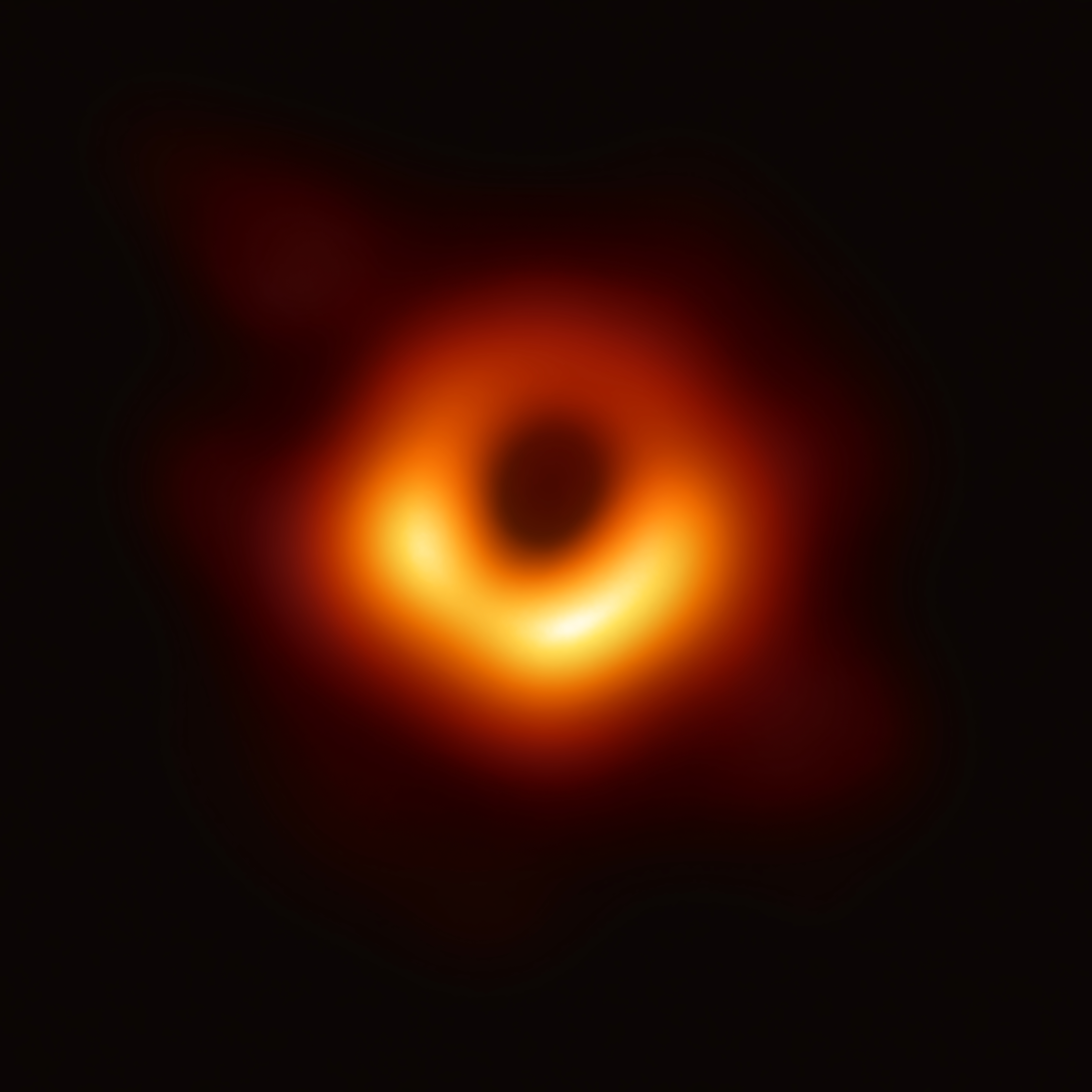
On 10 April 2019, EHT researchers unveiled the first direct visual evidence of a supermassive black hole and its shadow, in a series of six papers published in a special issue of The Astrophysical Journal Letters.7 The imaged black hole resides 55 million light-years from Earth and has a mass 6.5 billion times that of the Sun.7 It lies at the centre of Messier 87, a massive galaxy in the nearby Virgo galaxy cluster, and appears as a bright ring formed as light bends in the intense gravity around it.7 Multiple calibration and imaging methods revealed a ring-like structure with a dark central region — the black hole's shadow — that persisted over multiple independent EHT observations.7
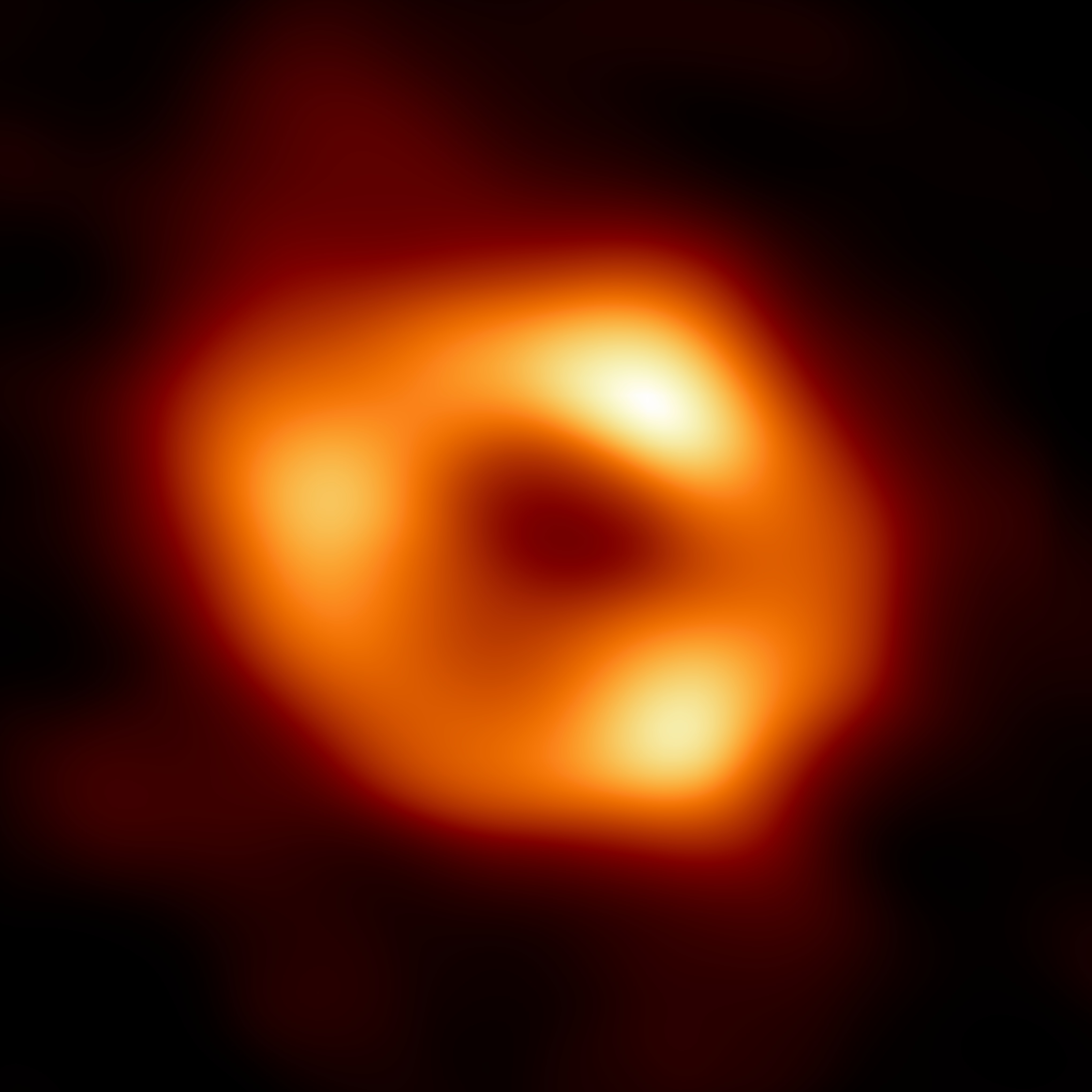
The data behind the image were colossal: each telescope produced roughly 350 terabytes per day during the 2017 campaign, stored on helium-filled hard drives and flown to correlator supercomputers at the Max Planck Institute for Radio Astronomy and MIT Haystack Observatory.7 On 24 March 2021 the EHT revealed the M87* black hole in polarised light — the first time astronomers had measured polarisation, a signature of magnetic fields, this close to the edge of a black hole.14 On 12 May 2022 astronomers unveiled the first image of the supermassive black hole at the centre of the Milky Way, providing overwhelming evidence that the object is indeed a black hole.8
Sagittarius A* (Sgr A*, pronounced 'sadge-ay-star') is about 27,000 light-years from Earth and about four million times more massive than the Sun; it appears about the same size in the sky as a donut on the Moon.8 The EHT Collaboration consists of more than 300 researchers from 80 institutes, and the team worked for five years to combine and analyse the Sgr A* data.8
Voices from the frontier
The scientists who produced these images described the moment in their own words.
We have taken the first picture of a black hole. This is an extraordinary scientific feat accomplished by a team of more than 200 researchers.
Sheperd S. Doeleman, EHT project director
We have two completely different types of galaxies and two very different black hole masses, but close to the edge of these black holes they look amazingly similar. This tells us that General Relativity governs these objects up close, and any differences we see further away must be due to differences in the material that surrounds the black holes.
Sera Markoff, Co-chair of the EHT Science Council
The gas in the vicinity of the black holes moves at the same speed — nearly as fast as light — around both Sgr A* and M87*. But where gas takes days to weeks to orbit the larger M87*, in the much smaller Sgr A* it completes an orbit in mere minutes. This means the brightness and pattern of the gas around Sgr A* was changing rapidly as the EHT Collaboration was observing it — a bit like trying to take a clear picture of a puppy quickly chasing its tail.
Chan (EHT Collaboration)
M87* and Sgr A* compared
The two black holes photographed by the EHT are profoundly different in scale: Sgr A* is more than a thousand times smaller and less massive than M87*.8 Yet the two look remarkably similar — evidence that general relativity governs both objects up close.8 Black holes are the only objects known where mass scales with size: a black hole a thousand times smaller than another is also a thousand times less massive.8
| Property | M87* | Sgr A* |
|---|---|---|
| Galaxy | Messier 87, a massive galaxy in the nearby Virgo galaxy cluster7 | The Milky Way8 |
| Distance from Earth | 55 million light-years7 | About 27,000 light-years8 |
| Mass | 6.5 billion times the Sun's mass7 | About 4 million times the Sun's mass8 |
| Event horizon size | Around 2.5 times smaller than the shadow it casts; just under 40 billion km across7 | More than a thousand times smaller than M87*'s8 |
| Gas orbit timescale | Days to weeks8 | Mere minutes8 |
| Image released | 10 April 20197 | 12 May 20228 |
Timeline
Michell's 'dark stars'
The English natural philosopher John Michell predicted that a star 500 times wider than the Sun would have gravity so strong that even light could not escape; he called such objects 'dark stars'.3
Einstein completes general relativity
Albert Einstein completed his theory of general relativity on 18 November 1915, the theory from which black holes later emerged as a prediction.5
The Schwarzschild solution
Karl Schwarzschild published the first exact solution of Einstein's field equations, describing the curved space-time around a spherically symmetric, non-rotating mass.5
Kerr's rotating black hole
Roy Kerr generalized the Schwarzschild solution to describe a rotating black hole, adding angular momentum to mass and electric charge as the principal physical parameters of black holes.5
Penrose proves black holes form
Roger Penrose proved that black holes really can form, showing that at their heart lies a singularity in which all the known laws of nature cease.6
GW150914: first gravitational waves
LIGO's twin detectors in Livingston, Louisiana, and Hanford, Washington, recorded gravitational waves from the merger of two black holes of about 29 and 36 solar masses, 1.3 billion light-years away.12
The discovery is announced
Scientists announced that gravitational waves had been observed for the first time, confirming a major prediction of Einstein's 1915 general theory of relativity.12
Nobel Prize for LIGO
The Nobel Prize in Physics went to Rainer Weiss, Barry C. Barish and Kip S. Thorne 'for decisive contributions to the LIGO detector and the observation of gravitational waves'.9
First image of a black hole
The Event Horizon Telescope revealed the first direct visual evidence of a supermassive black hole and its shadow: M87*, 55 million light-years away, with a mass 6.5 billion times that of the Sun.7
Nobel Prize for black holes
The Nobel Prize in Physics went to Roger Penrose for proving black hole formation is a robust prediction of general relativity, and to Reinhard Genzel and Andrea Ghez for discovering the supermassive compact object at the centre of our galaxy.6
M87* in polarised light
The EHT revealed the M87 black hole in polarised light, the first measurement of polarisation — a signature of magnetic fields — that close to the edge of a black hole.14
First image of Sagittarius A*
The EHT unveiled the first image of Sagittarius A*, the supermassive black hole at the centre of the Milky Way, about 27,000 light-years away and four million times more massive than the Sun.8
Frequently asked questions
What is a black hole?
A black hole is an extremely dense object whose gravity is so strong that nothing, not even light, can escape it.3
Why is a black hole black?
Inside the event horizon, the velocity needed to escape exceeds the speed of light, so whatever passes in is doomed to stay inside — even light; this is what makes a black hole black.2
Is a black hole a cosmic vacuum cleaner that sucks in everything?
No. From far enough away, a black hole's gravitational effects are just like those of other objects of the same mass, and if the Sun were replaced by a black hole of the same mass the planets would stay in their orbits.1
How do black holes form?
When a star with more than eight times the Sun's mass runs out of fuel, its core collapses, rebounds, and explodes as a supernova; if the star had around 20 times the Sun's mass or more, the core collapses into a stellar-mass black hole.4
What does the first photograph of a black hole show?
The image shows a bright ring formed as light bends in the intense gravity around the black hole at the centre of the galaxy Messier 87, an object 6.5 billion times more massive than the Sun.7
How far away and how massive is the black hole at the centre of our galaxy?
Sagittarius A* is about 27,000 light-years from Earth and about four million times more massive than the Sun.8
Will black holes eventually evaporate?
Stephen Hawking's theory of Hawking radiation holds that a slow leak of radiation would, over time, cause a black hole to simply evaporate.11
How were gravitational waves first detected?
On 14 September 2015 the universe's gravitational waves were observed for the very first time by LIGO's twin detectors in the USA; the waves came from a collision between two black holes and took 1.3 billion years to arrive.9
Knowledge graph
Sources & citations
Every factual claim in this article is drawn from the sources below. Bracketed numbers in the text link to the corresponding source.
- 1
- 2
- 3
- 4
- 5
- 6
- 7
- 8
- 9
- 10
- 11
- 12
- 13
- 14