The Moon
Earth's only natural satellite — a world of ancient lava plains, impact craters, and the first celestial body visited by humans.
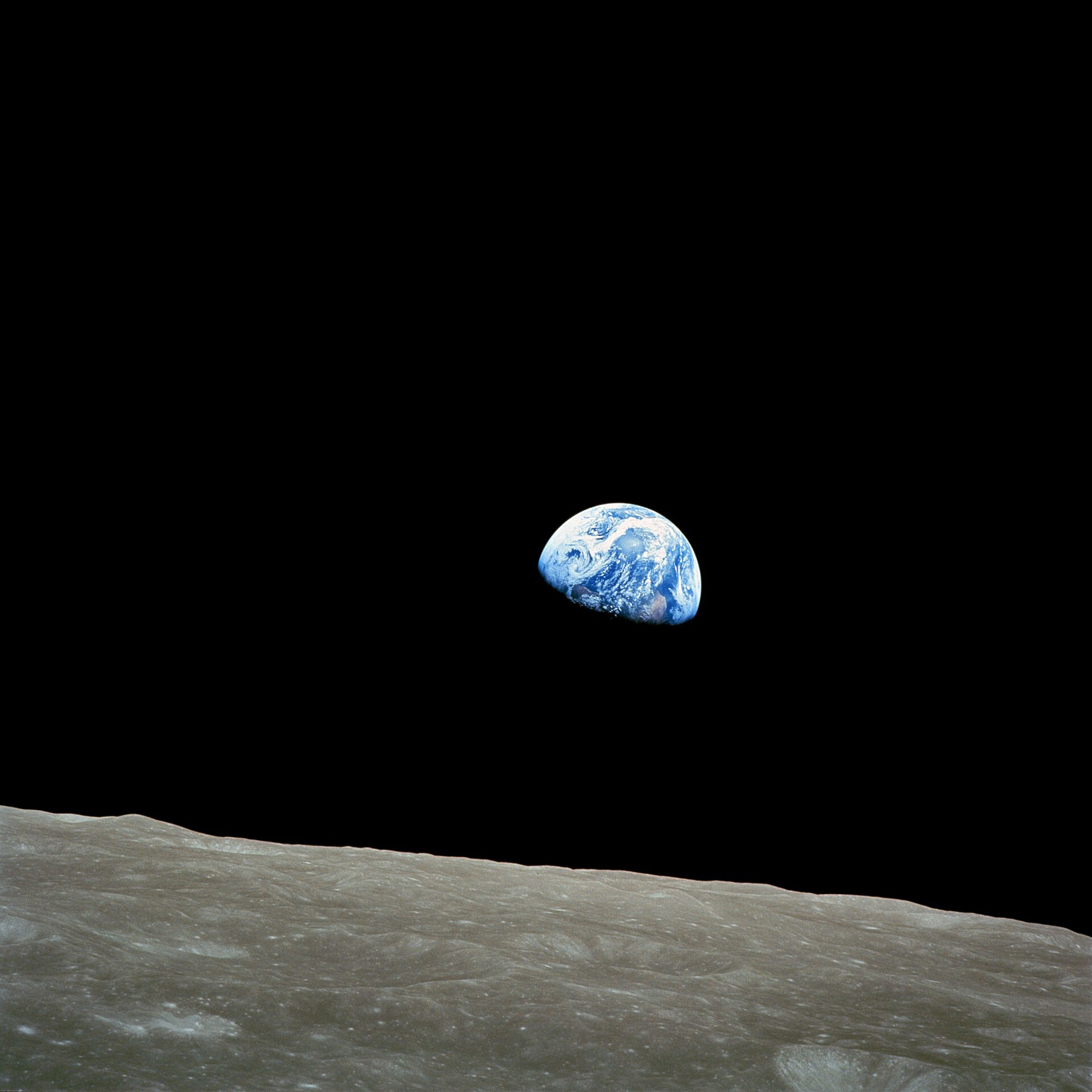

The Moon is Earth's only natural satellite, orbiting at an average distance of 384,400 kilometers. It is tidally locked to Earth, so the same hemisphere always faces us. Its surface records billions of years of impacts and ancient volcanic plains, and its polar craters harbor water ice. On July 20, 1969, Apollo 11's astronauts became the first humans to walk on its surface.
Overview
The Moon is Earth's only natural satellite.1 It goes around the Earth at a distance of about 385,000 kilometers (239,000 miles).1 The average separation is 384,400 kilometers (238,855 miles) — a gap wide enough that 30 Earth-sized planets could fit in between.1 The Earth and Moon are tidally locked, with their rotations in such close sync that only one side of the Moon ever faces us.1 Known since prehistoric times, it is the brightest object in the sky after the Sun.2
Our Moon shares its name with all moons simply because people did not know other moons existed until Galileo Galilei discovered four moons orbiting Jupiter in 1610.1 In Latin the Moon was called Luna, the root of the word lunar.1 The lunar far side stayed hidden from human eyes until a Soviet spacecraft flew past it in 1959.1
As the Moon orbits Earth, different parts of it are in sunlight or darkness at different times, and the changing illumination is why the Moon goes through phases.1 During a full moon the hemisphere we see from Earth is fully illuminated by the Sun.1 The light areas of the Moon are known as the highlands.1 The dark features, called maria — Latin for seas — are impact basins that were filled with lava between 4.2 and 1.2 billion years ago.1
More than 105 robotic spacecraft have been launched to explore the Moon, and it remains the only celestial body beyond Earth visited by human beings.1 Apollo astronauts brought back 382 kilograms (842 pounds) of lunar rocks and soil, and scientists are still studying them.1 What those expeditions and later missions gathered has produced a knowledge of the Moon that surpasses that of any other cosmic body except Earth itself.2
Size, distance and orbit
With a radius of about 1,740 kilometers (1,080 miles), the Moon is less than a third of the width of Earth.1 If Earth were the size of a nickel, the Moon would be about as big as a coffee bean.1 Set a single green pea next to a U.S. nickel and you have a fair picture of the comparison.1
The Moon makes a complete orbit around Earth in 27 Earth days, rotating at the same rate — a condition called synchronous rotation — so the same hemisphere faces Earth all the time.1 Because Earth is moving as well, from our perspective the Moon appears to orbit us every 29 days.1 That changing view is the cycle of lunar phases.1
The path the Moon takes as it orbits our planet is not quite a perfect circle.3 During every 27-day orbit around Earth, the Moon reaches its perigee, about 226,000 miles (363,300 km) from Earth, and its farthest point, or apogee, about 251,000 miles (405,500 km).3 When a full Moon coincides with perigee, that is a supermoon.3
The Moon started out much closer to Earth and has been slowly drifting outward at about 1.5 inches (3.8 cm) per year.4 It will be another 600-million-plus years before the Moon appears too small from Earth to cover the Sun.4
Structure and surface
Earth's Moon has a core, mantle, and crust.1 Its core is proportionally smaller than other terrestrial bodies' cores.1 The solid, iron-rich inner core is 240 kilometers (149 miles) in radius, surrounded by a liquid iron shell 90 kilometers (56 miles) thick.1 Like Earth, the Moon consists of these three main layers; billions of years ago it was a molten world, and as it solidified the heaviest materials such as iron sank toward its center while lighter rocks rose toward the surface.5
The crust is about 25 miles (40 kilometers) thick on the near-side hemisphere and up to about 37 miles (60 kilometers) thick on the far side, and it is made of oxygen, silicon, magnesium, iron, calcium, and aluminum with small amounts of other elements.1 Long ago the Moon had active volcanoes, but today they are all dormant and have not erupted for millions of years.1 The craters themselves have been preserved for billions of years and provide an impact history for the Moon and other bodies in the inner solar system.1
The Moon has been cooling since it first formed nearly 4.5 billion years ago, and some moonquakes are caused by its shrinking as it cools.6 Seismometers that Apollo astronauts placed on the surface revealed that the Moon experiences moonquakes.6 These quakes originate at depths of 20 to 30 kilometers, can register up to 5.5 on the Richter scale, and can last for more than 10 minutes.6 In the last several hundred million years, the diameter of the Moon has gotten about 150 feet (50 meters) smaller.6
How the Moon formed
Earth's Moon is thought to have formed in a tremendous collision.7 A massive object — named Theia after the mythological Greek Titan who was the mother of Selene, goddess of the Moon — smashed into Earth, flinging material into space that became the Moon.7
The age of the Moon's rock samples indicated that it formed around 60 million years after the solar system began to form.7 Their type and composition showed that the Moon had been molten during its formation and was covered with a deep ocean of magma for tens of millions to hundreds of millions of years.7
Apollo mission lunar sample 60639, a light-colored mineral, is thought to have floated to the top of that magma ocean and formed the Moon's first crust around 4.4 billion years ago.7
Previous concepts — that the Moon was an object captured by Earth's gravity as it sailed by, or that it formed alongside Earth from the same debris — fell out of favor after the Apollo missions brought back data and 842 pounds (382 kilograms) of lunar samples to Earth.7 Visiting the Moon with the Apollo missions in the late 1960s and early 1970s revolutionized our understanding of the Moon's origins.7
Atmosphere and temperature
The Moon has a very thin and tenuous atmosphere called an exosphere.1 It is not breathable.1 It does not provide any protection from the Sun's radiation or impacts from meteoroids.1
The temperature on the Moon reaches about 127 degrees Celsius (260 degrees Fahrenheit) when in full Sun, but in darkness the temperature plummets to about −173 degrees Celsius (−280 degrees Fahrenheit).1 On the surface, the gravity is one-sixth of Earth's, which is why in footage of moonwalks astronauts appear to almost bounce across the surface.1
Water and life
During the initial exploration of the Moon, and the analysis of the samples returned by the Apollo and Luna missions, scientists believed the lunar surface was dry.1 The first definitive discovery of water was made in 2008 by the Indian mission Chandrayaan-1, which detected hydroxyl molecules spread across the lunar surface and concentrated at the poles.1 The discovery that the Moon harbors water ice, with the highest concentrations within darkened craters at the poles, makes the Moon a little more hospitable for future human colonists.1
NASA's LCROSS was launched with the Lunar Reconnaissance Orbiter to determine whether water-ice exists in a permanently shadowed crater at the Moon's south pole.8 As planned, LCROSS and its Centaur stage impacted the Moon on 9 October 2009.8 On 13 November 2009, NASA formally announced that data from LCROSS indicated that the mission had successfully uncovered water near the Moon's south pole.8
In October 2020, NASA's Stratospheric Observatory for Infrared Astronomy (SOFIA) confirmed, for the first time, water on the sunlit surface of the Moon, detecting water molecules in Clavius Crater.1 That discovery indicated that water may be distributed across the lunar surface, not limited to cold, shadowed places.1 Even so, the many missions that have explored the Moon have found no evidence to suggest it has its own living things.1
Apollo 11 and the first humans
Apollo 11 launched from Cape Kennedy on July 16, 1969, carrying Commander Neil Armstrong, Command Module Pilot Michael Collins, and Lunar Module Pilot Edwin “Buzz” Aldrin.9 On July 20, 1969, an estimated 650 million people watched Armstrong on television and heard his voice as he stepped onto the lunar surface.9
Partially piloted manually by Armstrong, the Eagle landed in the Sea of Tranquility at 0 degrees, 41 minutes, 15 seconds north latitude and 23 degrees, 26 minutes east longitude.9 About 20 minutes after Armstrong stepped onto the Moon, Aldrin followed him, and half an hour later President Nixon spoke by telephone link with the astronauts.9 The entire EVA phase lasted more than two-and-a-half hours, and Armstrong and Aldrin spent 21 hours, 36 minutes on the Moon's surface.9
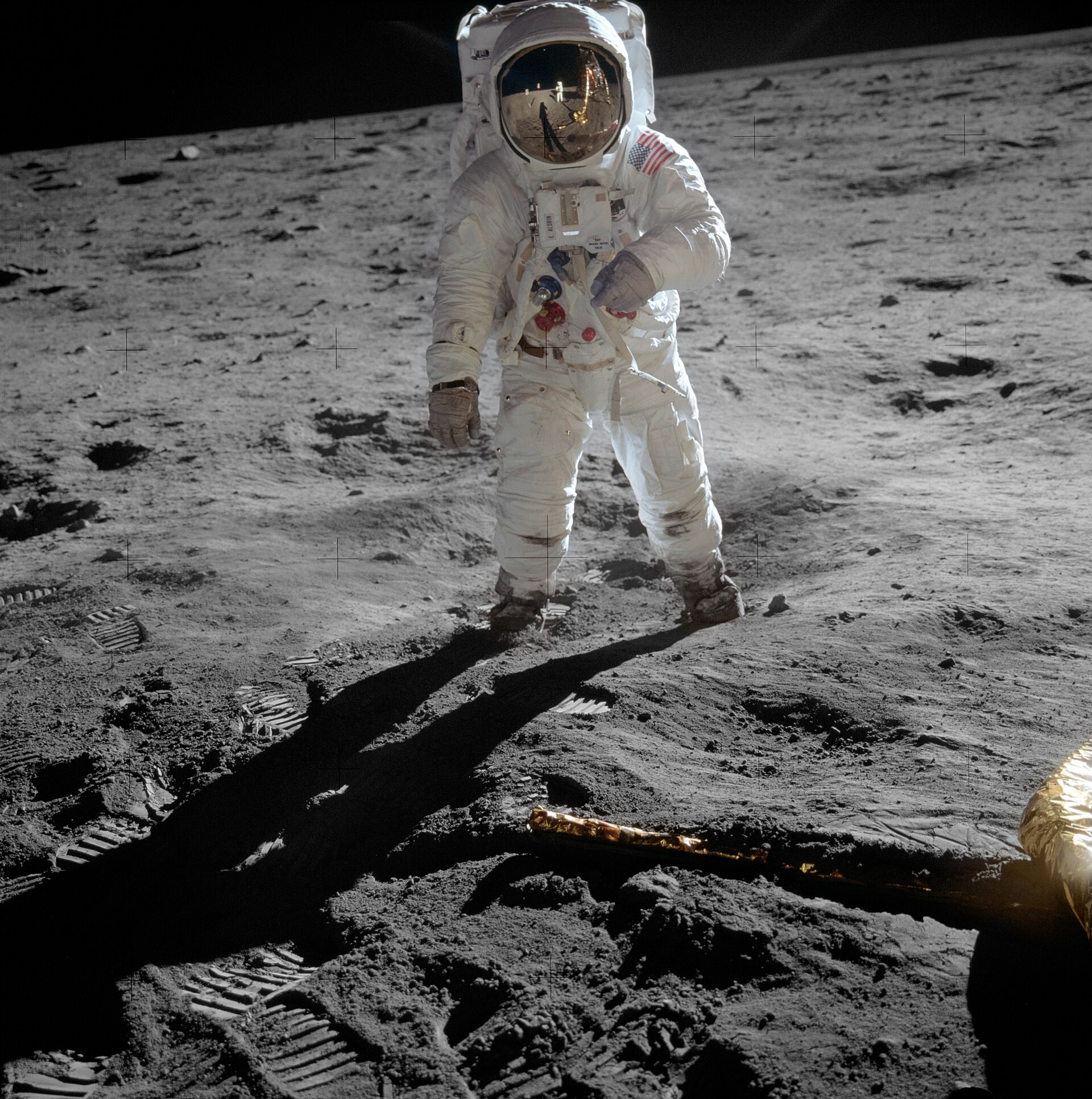

Apollo 11 splashed down in the Pacific Ocean on July 24, 1969, 13 miles from the recovery ship USS Hornet, after a flight of 195 hours, 18 minutes, 35 seconds.9 The lunar rocks and soil carried home by the crew remain under study by scientists on Earth.1
…one small step for a man, one giant leap for mankind
Neil Armstrong, Commander of Apollo 11, as he stepped onto the Moon on 20 July 1969
Exploring the Moon: robots and rovers
In 1959, the USSR's Luna 1 was the first spacecraft to fly by the Moon.10 Luna 9 achieved the first lunar soft landing on 3 February 1966 and returned the first picture from the lunar surface.11 As of January 2024, four nations had successfully landed on the Moon: the USSR, the United States, India, and China.10
Luna 16 achieved the first robotic sample return from beyond Earth in September 1970, and Lunokhod 1 became the first robotic rover to explore the surface of a world beyond Earth.11 An explosion on board forced Apollo 13 to circle the Moon without landing, but through the valiant efforts of the crew and ground team the astronauts safely returned to Earth.12 Apollo 15 was the fourth Apollo lunar landing and the first time the Lunar Roving Vehicle was driven on the Moon.12 The final Apollo mission, in December 1972, saw Eugene Cernan and Harrison Schmitt collect a record amount of lunar samples over three moonwalks.12 Cernan had the privilege and distinction of being the last person to leave his footprints on the surface of the Moon.13 Six pairs of astronauts landed on the Moon from 1969 through 1972.12
In 2009 NASA launched the Lunar Reconnaissance Orbiter together with LCROSS, and LRO has worked in lunar orbit ever since — the longest-lived lunar orbiting mission ever.14 Europe's first mission to the Moon, SMART-1, arrived in lunar orbit on 15 November 2004 and ended through a lunar impact on 3 September 2006.15 For the first time, the entire lunar surface has been completely mapped and uniformly classified by scientists from the USGS Astrogeology Science Center, in collaboration with NASA.16 The resulting “Unified Geologic Map of the Moon” helps explain the 4.5-billion-year-old history of the Moon.16
China's Chang'e 4 and its Yutu 2 rover made the first lunar far-side landing on 3 January 2019.11 Chang'e 6 made the first sample return from the lunar far side, landing on 1 June 2024.11 India's Chandrayaan-3 was the first spacecraft to soft land near the lunar South Pole.11 Japan's SLIM lander touched down on the lunar surface on 20 January 2024.17
Missions to the Moon
Robotic and crewed missions have mapped, sampled, and explored the Moon; the table below lists milestones of that exploration.11
| Mission | Nation | Year | Milestone |
|---|---|---|---|
| Luna 9 | USSR | 1966 | First lunar soft landing and first picture from the lunar surface 11 |
| Apollo 8 | USA | 1968 | First humans to orbit the Moon 18 |
| Apollo 11 | USA | 1969 | First humans to land on the Moon 9 |
| Luna 16 | USSR | 1970 | First robotic sample return from beyond Earth 11 |
| Lunokhod 1 | USSR | 1970 | First robotic rover on the surface of another world 11 |
| Apollo 17 | USA | 1972 | Final Apollo landing and first scientist on the Moon 13 |
| SMART-1 | Europe (ESA) | 2004 | Europe's first mission to the Moon 15 |
| Lunar Reconnaissance Orbiter | USA | 2009 | Longest-lived lunar orbiting mission 14 |
| LCROSS | USA | 2009 | Impact at a shadowed south-polar crater; water soon confirmed 8 |
| Chang'e 4 | China | 2019 | First landing on the lunar far side 11 |
| Artemis I | USA | 2022 | First flight test of the Orion spacecraft and SLS rocket 11 |
| Chandrayaan-3 | India | 2023 | First spacecraft to soft land near the lunar South Pole 11 |
| Chang'e 6 | China | 2024 | First sample return from the lunar far side 11 |
| SLIM | Japan | 2024 | JAXA lander touches down on the lunar surface 17 |
| Artemis II | USA | 2026 | Four astronauts around the far side of the Moon 11 |
Artemis: the return of humans
In March 2019, NASA announced plans to send U.S. astronauts back to the surface of the Moon with the Artemis missions.10 In November 2022, Artemis I successfully conducted the first integrated flight test of the Orion spacecraft and the Space Launch System rocket.10
Artemis II carried four astronauts around the far side of the Moon and safely back to Earth in April 2026.10 The crew were NASA astronauts Reid Wiseman, Victor Glover, and Christina Koch, and Canadian Space Agency astronaut Jeremy Hansen.19 No crew had traveled farther from Earth or closer to the Moon than these astronauts in more than half a century.5
Along the way, the Artemis II crew conducted a lunar observation campaign and contributed to a suite of biological and physical science experiments.11 The flight tested systems and workflows for future missions.11
Eclipses and tides
Anywhere from four to seven times a year, Earth, Moon, and Sun line up just right to create an eclipse.4 The Moon's orbit around Earth is tilted relative to Earth's orbit around the Sun, and that tilt is the reason we have occasional eclipses instead of eclipses every month.4
Lunar eclipses occur at the full Moon phase, when Earth is positioned precisely between the Moon and Sun; each lunar eclipse is visible from half of Earth.4 During one, the lunar surface can turn a striking red, because colors with shorter wavelengths — the blues and violets — scatter more easily than longer wavelengths like red and orange.4 NASA also turns eclipses into science: during lunar eclipses, controllers shut down most instruments on the solar-powered Lunar Reconnaissance Orbiter to save power, leaving active one instrument — Diviner — to watch how the surface responds to the rapid temperature change.4
During a solar eclipse, the Moon's shadow on Earth's surface is only about 300 miles (480 km) wide, with an umbra where the Sun is completely blocked and a penumbra where it is partially obscured.4 That the Moon can almost perfectly block the Sun is a coincidence of scale: the Sun's diameter is about 400 times the Moon's, but the Moon is roughly 400 times closer to Earth.4
On Earth, the Moon's gravitational pull causes the oceans to bulge out on both the side closest to the Moon and the side farthest from the Moon, and these bulges create high tides.20 Twice a month, when the Earth, Sun, and Moon line up, their gravitational power combines to make exceptionally high spring tides; about a week later, when the Sun and Moon are at right angles, the moderate neap tides follow.20 The link between the Moon and the tides has been understood since Sir Isaac Newton's 1687 discovery.21
Timeline
The far side is seen for the first time
A Soviet spacecraft flew past the Moon, giving humans the first view of the lunar far side.1
Apollo 11 launches
Apollo 11 lifted off from Cape Kennedy carrying Armstrong, Collins, and Aldrin.9
First humans on the Moon
The Eagle landed in the Sea of Tranquility; Armstrong and Aldrin walked on the surface for more than two-and-a-half hours, spending 21 hours and 36 minutes on the Moon.9
Return to Earth
Apollo 11 splashed down in the Pacific Ocean, 13 miles from the USS Hornet, after a flight of 195 hours, 18 minutes, 35 seconds.9
First soft landing on the Moon
The Soviet Luna 9 lander achieved the first lunar soft landing and returned the first picture from the lunar surface.11
Humans orbit the Moon for the first time
Apollo 8 was the first crewed launch of the Saturn V rocket; on Christmas Eve, Frank Borman, Jim Lovell, and Bill Anders became the first humans to orbit the Moon and the first to see an Earthrise above its surface.18
Robotic sample return and the first lunar rover
Luna 16 achieved the first robotic sample return from beyond Earth, and Lunokhod 1 became the first robotic rover to explore the surface of a world beyond Earth.11
The last Apollo landing
The final Apollo mission took place in December 1972, when Eugene Cernan and Harrison Schmitt collected a record amount of lunar samples over three moonwalks; Cernan was the last person to leave footprints on the Moon.13
Water confirmed at the lunar south pole
LCROSS and its Centaur stage impacted the Moon on 9 October 2009; on 13 November 2009, NASA announced that the mission had successfully uncovered water near the Moon's south pole.8
First landing on the lunar far side
China's Chang'e 4 and its Yutu 2 rover made the first lunar far-side landing.11
New firsts for India and China
Chandrayaan-3 became the first spacecraft to soft land near the lunar South Pole, and Chang'e 6 made the first sample return from the lunar far side.11
The Artemis era begins
After Artemis I conducted the first integrated flight test of the Orion spacecraft and the Space Launch System rocket in November 2022, Artemis II carried four astronauts around the far side of the Moon and safely back to Earth in April 2026.10
Frequently asked questions
Why do we only ever see one side of the Moon?
The Earth and Moon are tidally locked, and their rotations are so in sync that we only see one side of the Moon.1 The Moon rotates at the same rate that it revolves around Earth, a condition called synchronous rotation, so the same hemisphere faces Earth all the time.1
How far is the Moon from Earth?
The Moon is an average of 384,400 kilometers (238,855 miles) away, which means 30 Earth-sized planets could fit in between Earth and the Moon.1 Its orbit is elliptical: the Moon comes as close as about 226,000 miles (363,300 km) at perigee and reaches about 251,000 miles (405,500 km) at apogee.3
Why does the Moon go through phases?
As the Moon orbits Earth, different parts of it are in sunlight or darkness at different times.1 The changing illumination is why, from our perspective, the Moon goes through phases, and during a full moon the hemisphere we see is fully illuminated by the Sun.1
How did the Moon form?
Earth's Moon is thought to have formed in a tremendous collision: a massive object named Theia smashed into Earth, flinging material into space that became the Moon.7 Lunar samples indicate the Moon formed around 60 million years after the solar system began to form, and that it was covered with a deep ocean of magma for tens of millions to hundreds of millions of years.7
Is there water on the Moon?
Yes. The first definitive discovery of water was made in 2008 by the Indian mission Chandrayaan-1, which detected hydroxyl molecules concentrated at the poles.1 NASA's LCROSS later impacted a permanently shadowed crater at the south pole and, on 13 November 2009, NASA announced that the mission had successfully uncovered water there.8
Can people breathe on the Moon?
No. The Moon has a very thin and tenuous atmosphere called an exosphere, and it is not breathable.1 It provides no protection from the Sun's radiation or from impacts by meteoroids.1
How many people have walked on the Moon?
Neil Armstrong and Edwin “Buzz” Aldrin were the first of 12 human beings to walk on the Moon, and four of America's moonwalkers are still alive.19 The most recent humans to travel to the Moon were Artemis II's four astronauts, who flew around the far side of the Moon in April 2026 without landing.11
Why don't we have a lunar eclipse every month?
The Moon's orbit around Earth is tilted relative to Earth's orbit around the Sun, and that tilt is the reason why we have occasional eclipses instead of eclipses every month.4 Anywhere from four to seven times a year, Earth, Moon and Sun line up just right to create an eclipse.4
Knowledge graph
Sources & citations
Every factual claim in this article is drawn from the sources below. Bracketed numbers in the text link to the corresponding source.
- 1
- 2
- 3
- 4
- 5
- 6
- 7
- 8
- 9
- 10
- 11
- 12
- 13
- 14
- 15
- 16
- 17
- 18
- 19
- 20
- 21