Solar Eclipse
The astronomical event in which the Moon blocks the Sun from view on Earth — its geometry, its four types, the cycles that predict it, and the science and safety rules that surround it.
A solar eclipse occurs when the Moon passes between the Sun and Earth and casts its shadow onto Earth, hiding all or part of the Sun for observers inside that shadow. The alignment is possible only when the new moon happens near one of the Moon's nodes during an eclipse season, and because the Moon's distance varies, eclipses appear as total, annular, partial or hybrid. Eclipses made the corona visible to science, provided the 1919 test of general relativity, and still drive solar and atmospheric research and public safety rules.
In this article
- 1Overview
- 2Types of Solar Eclipse
- 3Geometry and the Moon's Shadow
- 4Why Eclipses Are Periodic
- 5Frequency and Recurrence
- 6The Saros Cycle
- 7Duration and Extremes
- 8The Corona and the Sun's Atmosphere
- 9Viewing Phenomena
- 10Eye Safety
- 11Scientific Value
- 12The 1919 Eclipse and General Relativity
- 13Historical Observations
- 14Notable Eclipses
- 15Recent and Upcoming Eclipses
- 16Research During Eclipses
- 17Timeline: from ancient records to the 2027 eclipse
- 18Knowledge graph
Overview
A solar eclipse happens when the Moon passes between the Sun and Earth and casts a shadow on Earth that hides the Sun fully or partially for observers in some areas.
A solar eclipse, especially a total one, can be seen from only a limited part of Earth, while an eclipsed Moon can be seen wherever it is above the horizon.
1. Types of Solar Eclipse
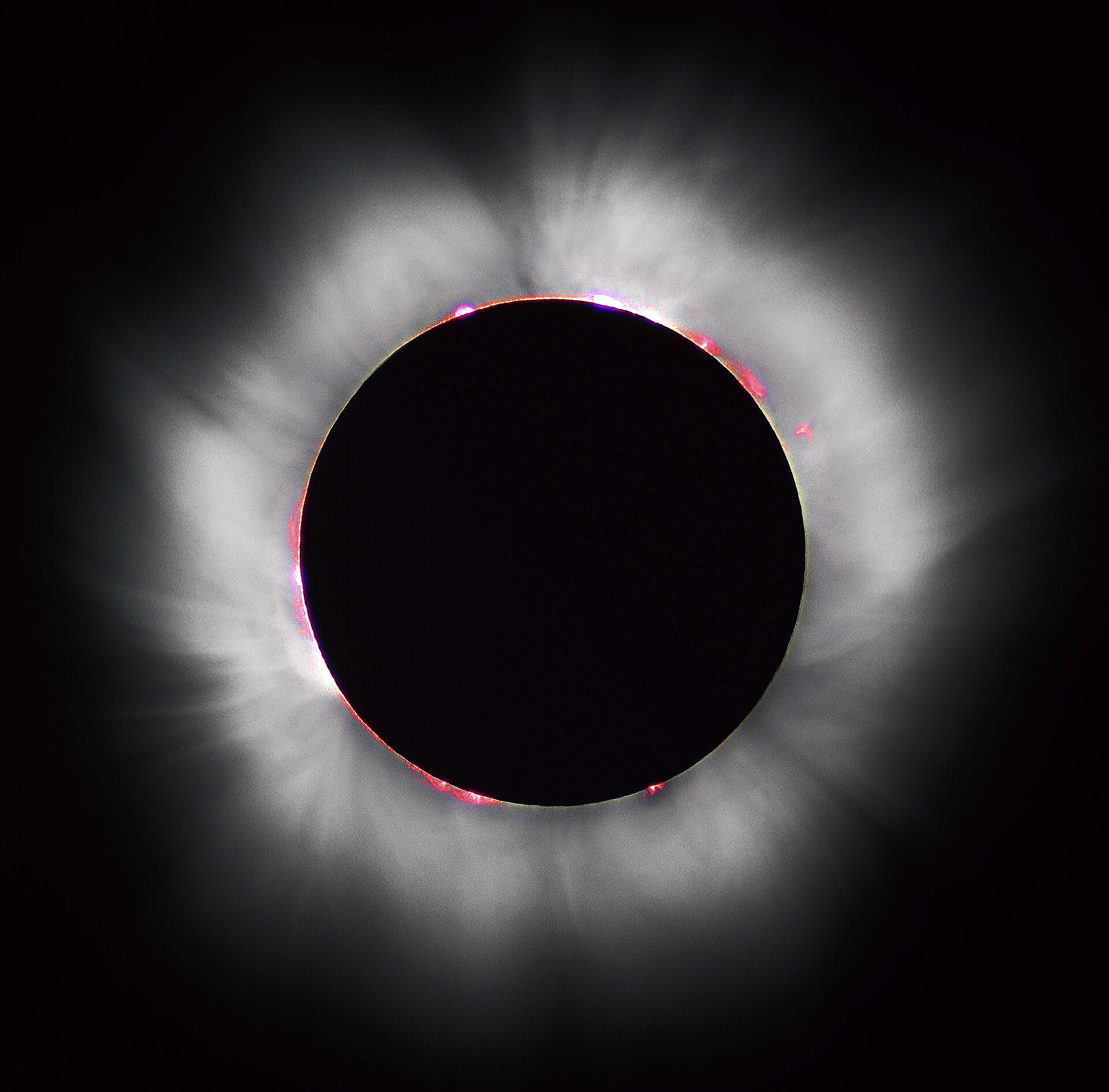
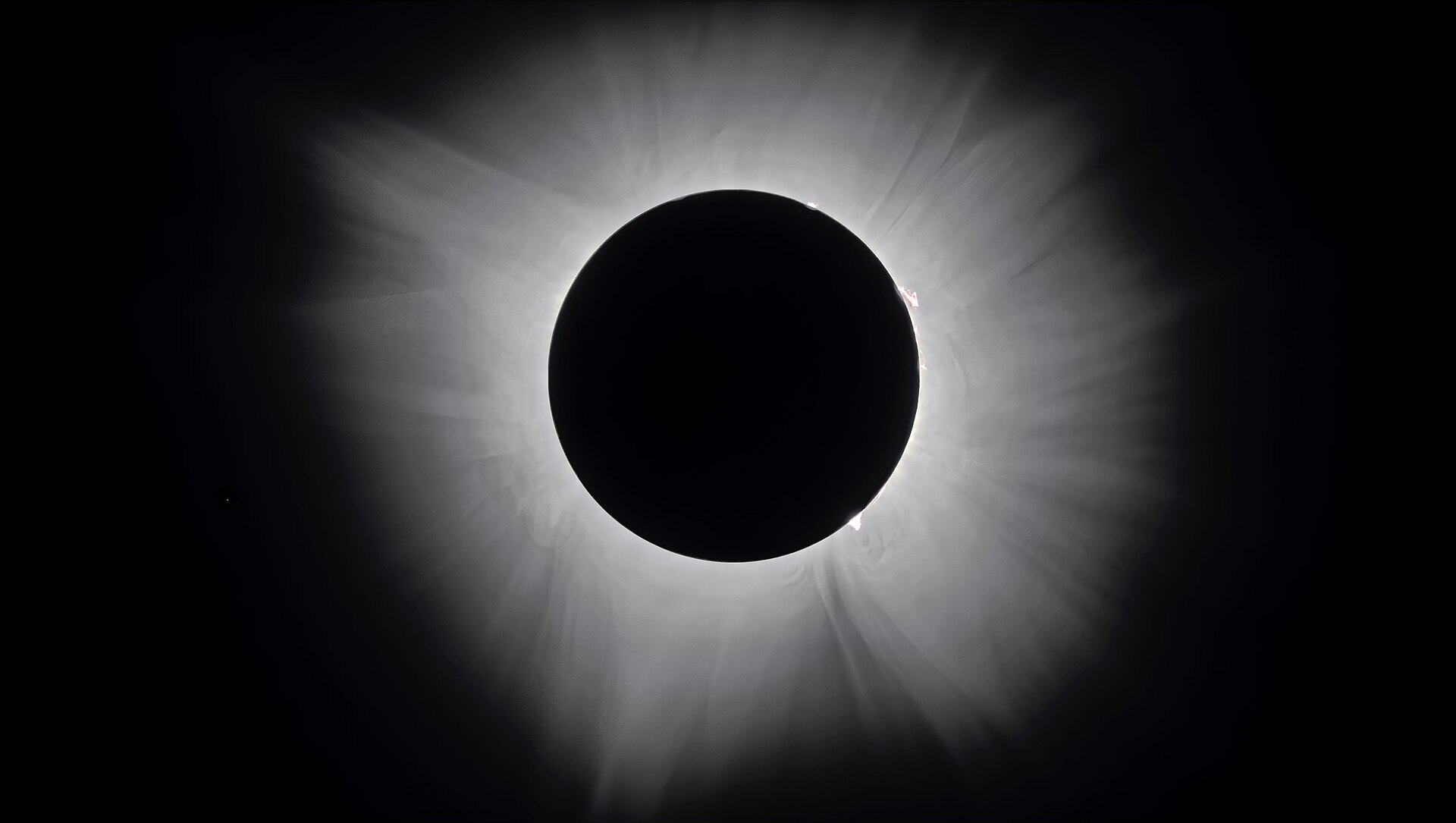
A total solar eclipse occurs when the Moon completely blocks the face of the Sun, and people in the center of the Moon's shadow experience totality. During totality the Moon moves directly in front of the Sun and barely covers the solar disk, letting observers in the center of the shadow briefly see the corona.
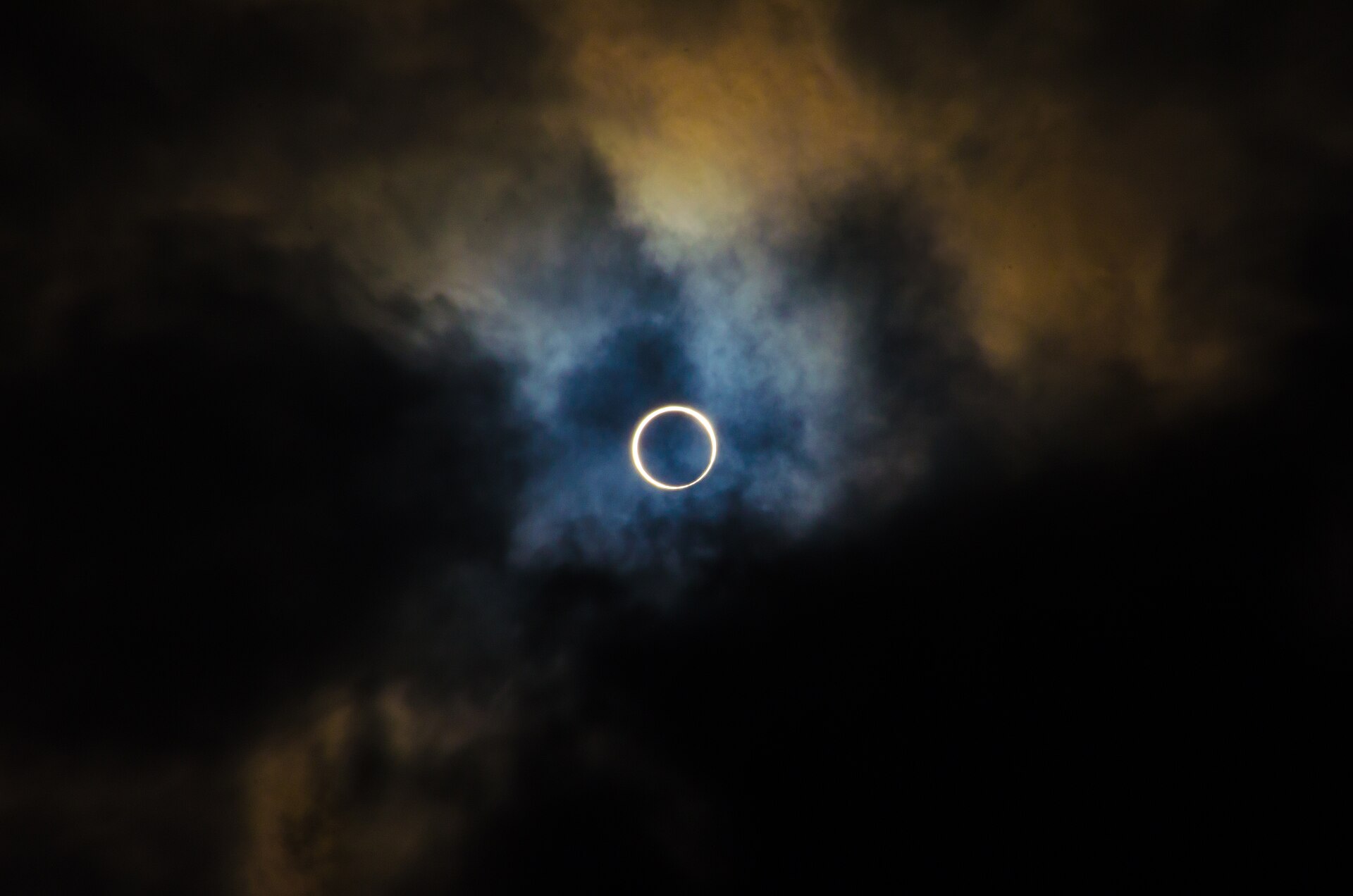
An annular eclipse happens when the Moon is at or near its farthest point from Earth, so it appears smaller than the Sun and leaves a ring of light visible around it; total and annular eclipses are both called central.
A partial solar eclipse is seen when the Sun, Moon and Earth are not perfectly lined up, so the Moon covers only part of the Sun and the Sun takes a crescent shape. In a partial eclipse, the centre of the Moon's disk does not pass across the centre of the Sun's.
Because Earth's surface is curved, some eclipses shift between annular and total as the Moon's shadow travels across the globe, and these are called hybrid eclipses.
2. Geometry and the Moon's Shadow
The Moon's shadow comprises two concentric cones: a dark inner shadow called the umbra and a lighter outer shadow called the penumbra. An observer inside the umbra sees the Sun completely blocked, while an observer in the penumbra witnesses a partial eclipse with only part of the Sun covered. Total eclipses are visible from within the Moon's umbral shadow, while annular eclipses are seen within the antumbral shadow.
A typical umbral path is less than 50 miles wide, while the penumbral zone can span a thousand miles or more.
The Moon's shadow sweeps across the face of Earth in four to five hours.
A total solar eclipse is visible only from inside a long, narrow path called the path of totality, usually less than 150 miles wide.
The Sun is about 400 times bigger than the Moon and about 400 times farther away, a coincidence of size and distance that lets the Moon barely cover the solar disk during totality.
3. Why Eclipses Are Periodic
Solar eclipses do not occur every month because the Moon does not orbit in the same plane as the Sun and Earth. Alignments of the Sun, Moon and Earth are therefore occasional rather than continuous, and the periods when they are possible are called eclipse seasons, which occur twice a year.
In each 34.5-day window when the Sun crosses an eclipse zone, there is always one and possibly two solar eclipses; these windows are the eclipse seasons. An eclipse season starts 19 days before the Sun passes through a lunar node and ends 19 days after. The midpoints of the two yearly eclipse seasons lie about 173.3 days apart.
Because a new moon occurs every month, each eclipse season brings at least one solar eclipse and occasionally two, and some calendar years contain a fifth eclipse. Five solar eclipses in a single year is exceptional. After five eclipses in 1935, the next such year will be 2206 in the pattern of eclipse seasons.
4. Frequency and Recurrence
Solar eclipses occur two to five times a year. For Earth as a whole, the average number of total solar eclipses in a century is about 66, roughly two every three years.
A total solar eclipse recurs somewhere on Earth about every 18 months on average, but at any given place only about every 360 to 410 years.
Modern computers make it possible to predict solar eclipses several years ahead with high accuracy, and the same methods can predict eclipses backward in time. Current eclipse forecasts are accurate to less than a minute in time over a span of hundreds of years.
5. The Saros Cycle
The Saros cycle governs the periodicity and recurrence of eclipses, lasting approximately 6,585.3 days, or 18 years 11 days 8 hours. One Saros equals 223 synodic months, and also 239 anomalistic months and 242 draconic months to within a couple of hours. The Saros was known to the Chaldeans as a period when lunar eclipses repeat, and the cycle applies to solar eclipses as well.
Because the Saros is not a whole number of days, successive eclipses are visible from different parts of the globe, with each path shifted about 120 degrees westward. A Saros series returns to about the same geographic region every three saroses, an interval of 54 years and 34 days. A Saros series spans 1,226 to 1,550 years and contains 69 to 87 eclipses. A Saros series lasts 12 to 15 centuries, while an Inex series typically lasts about 225 centuries and contains roughly 780 eclipses.
With two to five solar eclipses every year, roughly forty different Saros series are in progress at any one time. Saros 136 is currently producing the longest total eclipses of the 20th and 21st centuries.
Approximately 6,585.3211 days after one eclipse, the Sun, Earth and Moon return to nearly the same relative geometry and a nearly identical eclipse occurs.
6. Duration and Extremes
A total solar eclipse lasts anywhere from 10 seconds to about 7.5 minutes. At present, the maximum possible duration of totality is about 7 minutes 32 seconds. This ceiling follows from the geometry of the alignment: the Moon's umbral cone is narrow where it meets Earth, so a total eclipse is visible only within a narrow strip, and its maximum duration is about 7 1/2 minutes.
Over the 12,000 years from 4000 BCE to 8000 CE, the longest total solar eclipse will occur on 16 July 2186 and will last 7 minutes 29 seconds.
The last eclipse with totality longer than seven minutes occurred on 30 June 1973, when a Concorde stretched totality to about 74 minutes by flying along the Moon's umbra.
Tidal acceleration moves the Moon about 3.8 cm farther from Earth each year, and in the distant future the Moon will be too far away to fully cover the Sun, ending total eclipses.
Because the Moon's umbra sweeps eastward across Earth at over 1,700 km/h, totality lasts only minutes at any single location.
7. The Corona and the Sun's Atmosphere
The corona is the hot, gaseous outer region of the Sun's atmosphere, threaded by intense magnetic fields that extend from the surface.
The Sun's surface temperature is about 5,500 °C (9,940 °F), while the corona reaches about 1 million °C when quiescent, and its active regions reach 4 million kelvin. Wave heating is thought to be one of the mechanisms responsible.
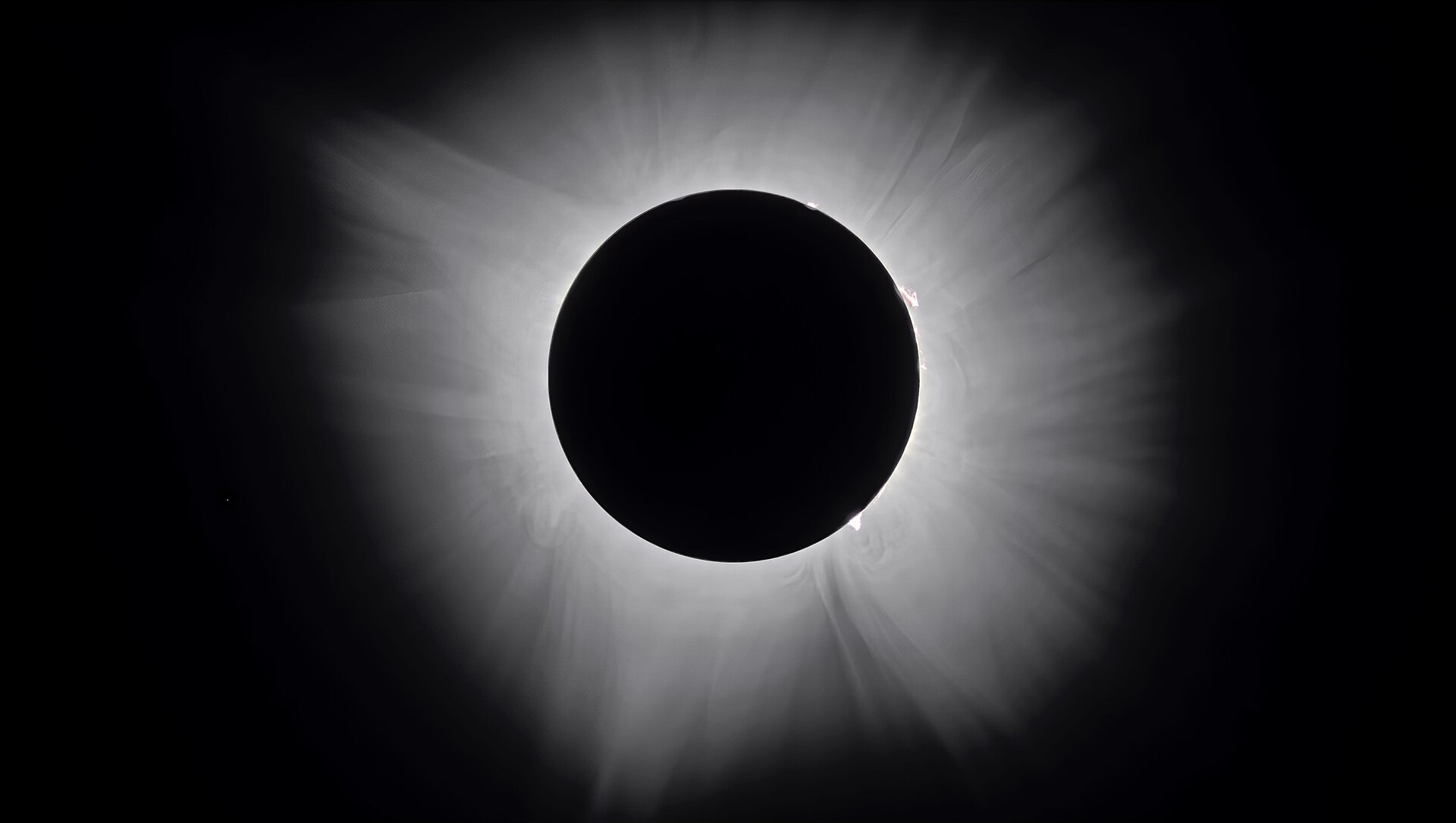
Scientists call the question of how the Sun heats its atmosphere the coronal heating problem, one of the greatest unanswered questions in astrophysics. Most of what science knows about the corona is rooted in total solar eclipses, which were the only way to study it from Earth before modern instruments and spacecraft.
The corona is where space weather originates, where the solar wind speeds up and coronal mass ejections arise, and space weather can disrupt satellites, communications and power grids.
8. Viewing Phenomena
Just before totality, beads of light shine on the Moon's edge where sunlight passes through lunar valleys, and a final flash known as the diamond ring effect begins totality. In 1715 Edmund Halley was the first to record what would later be called Baily's beads and the diamond ring effect, caused by sunlight passing through lunar valleys and craters.
At totality the sky darkens, white streaks of the corona extend in all directions and bright red prominences cling close to the Sun's surface.
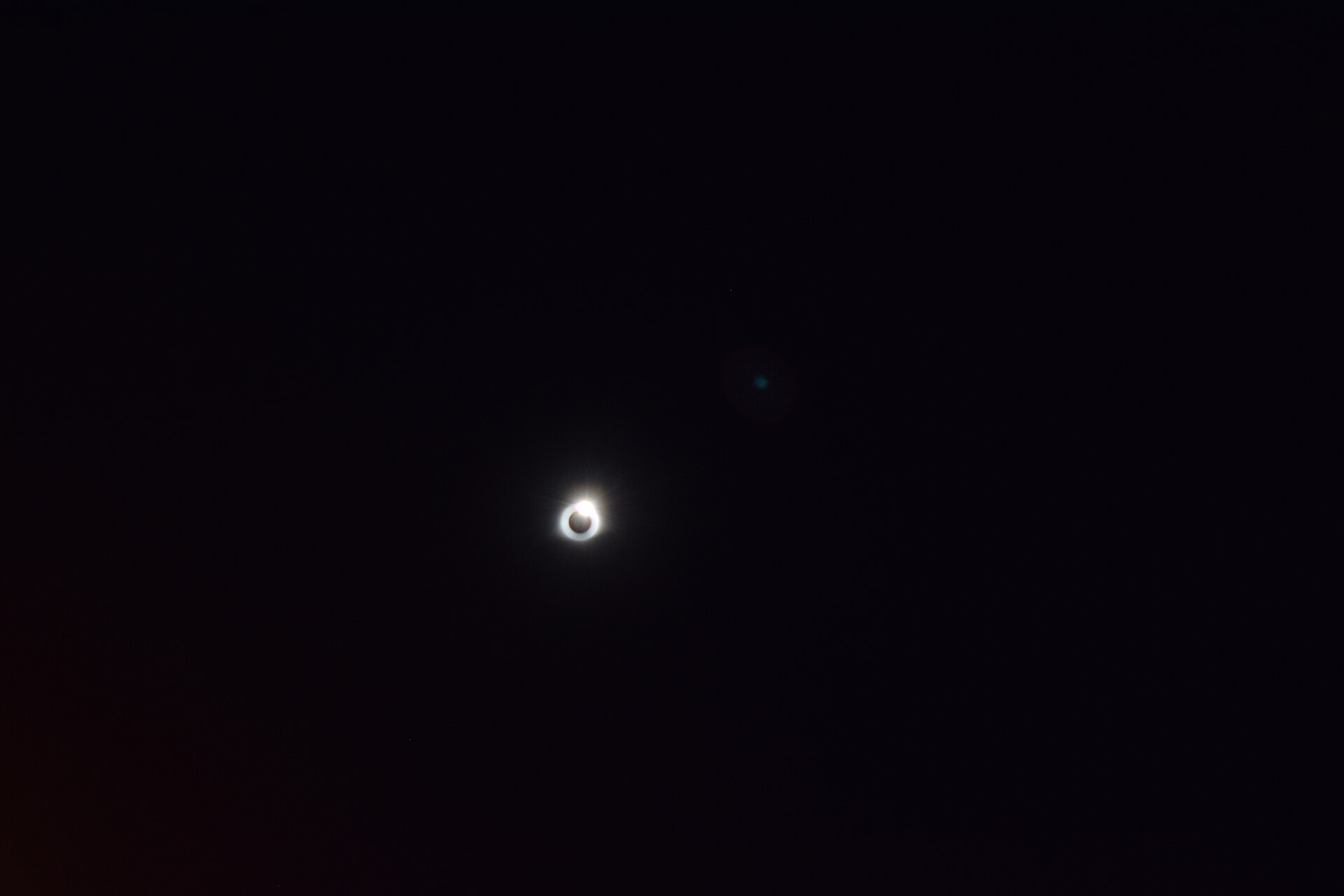
Shadow bands, also called flying shadows, appear just before and after totality, when a narrow solar crescent acts as an anisotropic light source.
At totality, nocturnal wildlife may wake up as if it were night, while animals active by day may settle as if it were time to sleep.
9. Eye Safety
Looking directly at the Sun during a total solar eclipse is unsafe except during the brief total phase called totality, which happens only within the narrow path of totality and only for a few minutes. Outside that brief total phase, it is not safe to look directly at the Sun without specialized eye protection designed for solar viewing.
Partial and annular eclipses differ from total eclipses in having no period of totality, so looking at them directly is never safe without proper eye protection. The only safe way to look directly at the uneclipsed, partially eclipsed or annularly eclipsed Sun is through special-purpose solar filters such as eclipse glasses.
Looking directly at the Sun's photosphere even for just a few seconds can cause permanent retina damage through intense visible and invisible radiation, up to and including blindness. Looking at any part of the bright Sun through a camera lens, binoculars or a telescope without a solar filter secured over the optics will instantly cause severe eye injury. Do not look at the Sun through a camera, telescope or binoculars while wearing eclipse glasses, because the concentrated solar rays can burn through the filter and injure the eye.
Eclipse glasses are not regular sunglasses; ordinary sunglasses, however dark, are not safe for viewing the Sun. Safe solar viewers are thousands of times darker than ordinary sunglasses and ought to comply with the ISO 12312-2 international standard. The international safety standard for solar viewers is ISO 12312-2:2015 and it covers filters for direct observation of the Sun. ISO 12312-2 applies only to nonmagnifying, nonfocusing viewers used with the unaided eyes, not to optics such as cameras and telescopes, and its transmittance limits match welding filters of shades twelve to fifteen, the same darkness that eclipse glasses must provide.
Solar viewers should be inspected before use and discarded if torn, scratched or damaged, and children using solar viewers should always be supervised. Eclipse glasses and viewers that are less than 10 years old, tested to the ISO 12312-2 standard and undamaged may be reused. An indirect method such as a pinhole projector, which lets sunlight through a small opening and projects an image of the Sun onto a nearby surface, is a safe way to watch the eclipse.
10. Scientific Value
Eclipses turn into a natural laboratory, revealing details about the Sun's outer layers, the Moon's surface and the Universe itself. Because the Moon's shadow blocks solar energy over a small region, total eclipses help scientists study the ionosphere, the charged layer of Earth's upper atmosphere.
Solar eclipses played a part in the discovery of helium and provided possibly the first observation of a coronal mass ejection. The coronal heating story begins with a green spectral line observed during an 1869 total eclipse, and spectrometers can analyze such light to identify the Sun's composition.
SOHO and Solar Orbiter coronagraphs see the corona down to about 350,000 km from the Sun's surface, and coronagraphs can never see as close as a natural eclipse allows.
ESA's Proba-3 mission creates artificial eclipses with two satellites flying 150 metres apart and operating as a single spacecraft. The Occulter spacecraft eclipses the Sun for the Coronagraph spacecraft, whose ASPIICS instrument captures images of the corona for hours at a time.
11. The 1919 Eclipse and General Relativity
The eclipse of 1919 offered an ideal test of general relativity because the Hyades star cluster lay near the solar limb and totality would last almost seven minutes. One of the most famous measurements in 20th-century astronomy was made that year, when teams from Greenwich and Cambridge observed the eclipse from Brazil and western Africa.
General relativity predicted about twice the shift in stellar positions compared with Newtonian theory, roughly 1.75 arcseconds at the limb of the Sun. Astronomer Royal Frank Dyson argued the eclipse was an unprecedented chance for an ample verification, or the contrary, of Einstein's theory.

Dyson coordinated from England while Eddington travelled to Príncipe off West Africa with clockmaker Edwin Turner Cottingham, and Davidson and Crommelin went to Sobral in northeastern Brazil.
Reporting to Dyson, Royal Society assistant secretary Robert Harrison wrote that the results from Sobral and Príncipe could leave little doubt that light was deflected near the Sun by the amount Einstein's theory demanded. Many physicists and historians have questioned whether the 1919 measurements were accurate enough to decide between Einstein's and Newton's theories of gravity.
12. Historical Observations
One of the oldest recorded eclipses comes from a clay tablet found at Ugarit in modern Syria, with two proposed dates of 1375 BCE and 1223 BCE. An eclipse on 15 June 763 BCE mentioned in an Assyrian text is a key anchor for the chronology of the ancient Near East.
Chinese legend holds that two astronomers, Hsi and Ho, were beheaded for failing to predict an eclipse in 2137 BCE. Herodotus wrote that Thales of Miletus predicted the eclipse during a battle between the Medes and the Lydians, and both sides declared peace as a result.
The corona was identified as part of the Sun's atmosphere in 1842, while the first photograph of a total eclipse followed on 28 July 1851 using the daguerreotype process. Spectroscope observations of the eclipse on 18 August 1868 helped determine the chemical composition of the Sun.
13. Notable Eclipses
On the Monday of 21 August 2017 all of North America saw an eclipse of the Sun, and anyone inside the path of totality could see a total solar eclipse. For the first time since 1918 the Moon's shadow swept coast to coast across the United States in 2017, when 14 states lay in the path of totality and a partial eclipse was visible in all 50 states. The 2017 eclipse offered scientists the first coast-to-coast total eclipse in nearly a century and a rare chance to study the Sun and Earth in uncommon ways.
The total solar eclipse of April 8 2024 crossed North America, passing over Mexico, the United States and Canada. After entering the United States in Texas, the 2024 path crossed Oklahoma, Arkansas, Missouri, Illinois, Kentucky, Indiana, Ohio, Pennsylvania, New York, Vermont, New Hampshire and Maine. The eclipse left continental North America on the Atlantic coast of Newfoundland in Canada. In the 115-mile-wide path of totality in 2024 people saw day turn to night as the Moon concealed the Sun, and satellites captured the Moon's shadow racing eastward over North America.
An annular eclipse will be seen on 26 January 2028 from South America, Portugal and Spain.
The umbral path stretched from Salem, Oregon to Charleston, South Carolina, making it the first total solar eclipse visible in the contiguous United States in 38 years.
14. Recent and Upcoming Eclipses
After the 2024 eclipse the next total solar eclipse visible from the contiguous United States occurs in 2044.
NASA's WB-57F research jet flew at 50,000 feet through the eclipse shadow to lengthen its time in the eclipse and capture the corona in several wavelengths. Student teams in Iceland and Spain launched scientific balloons that captured images of the eclipse shadow and studied its effects on the atmosphere.
On 2 August 2027, the southern tip of Spain, North Africa and the Middle East will experience a super long totality, dubbed the eclipse of the century.
On 12 August 2026 Europe witnessed its first total solar eclipse in over two decades as the Moon covered the Sun and revealed the outer atmosphere for millions of people.
15. Research During Eclipses
During the 2024 broadcast NASA scientist Michael Kirk noted that the spiky and asymmetrical corona signaled an active magnetic field approaching solar maximum.
A team led by Nat Gopalswamy of NASA's Goddard Space Flight Center imaged the corona in multiple wavelengths of polarized light during the 2017 eclipse using a novel detector.
In December 2021 NASA's Parker Solar Probe became the first spacecraft to encounter and sample the corona, at a distance of 8.2 million miles from the Sun's surface.
16. Timeline: from ancient records to the 2027 eclipse
- 22 October 2137 BCELegendary Chinese eclipseChinese tradition holds that two astronomers, Hsi and Ho, failed to predict an eclipse and were beheaded for the lapse — a founding legend of eclipse prediction as a matter of state.
- 5 March 1223 BCEThe Ugarit tabletA clay tablet found at Ugarit in modern Syria records one of the oldest known solar eclipses; most recent authors favor the 1223 BCE date.
- 15 June 763 BCEAn Assyrian eclipse fixes chronologyA solar eclipse mentioned in an Assyrian text is important for dating the chronology of the ancient Near East.
- 28 May 585 BCEThales and the battle of the HalysHerodotus reports that Thales of Miletus predicted the eclipse that interrupted a battle between the Medes and the Lydians; both sides laid down their weapons and made peace.
- 968 CEFirst recorded corona observationThe first recorded observation of the Sun's corona was made in Constantinople, centuries before the corona was understood as part of the solar atmosphere.
- 3 May 1715Halley records Baily's beadsEdmund Halley was the first to record what would later be called Baily's beads and the diamond ring effect, during the eclipse of 3 May 1715.
- 1842The corona identifiedThe corona was identified as part of the Sun's atmosphere in 1842; the first photograph of a total eclipse followed on 28 July 1851.
- 18 August 1868Spectroscope at the eclipseSpectroscope observations during the eclipse of 18 August 1868 helped determine the chemical composition of the Sun.
- 29 May 1919Eddington's eclipse expeditionsBritish teams observed the eclipse from Príncipe and Sobral to measure the deflection of starlight near the Sun and test Einstein's theory of general relativity.
- 6 November 1919Results announced in LondonDyson, Eddington and Crommelin presented their results at a joint meeting of the Royal Society and the Royal Astronomical Society; J J Thomson called the evidence the most important result in gravitation since Newton's day.
- 30 June 1973Concorde chases totalityObservers aboard a Concorde supersonic aircraft stretched totality for the eclipse of 30 June 1973 to about 74 minutes by flying along the Moon's umbra.
- 21 August 2017The Great American EclipseA total eclipse crossed the United States from Salem, Oregon to Charleston, South Carolina — the first coast-to-coast total eclipse since 1918 — with 14 states in the path of totality.
- 8 April 2024The North American eclipseThe total eclipse crossed Mexico, the United States and Canada along a 115-mile-wide path, and satellites captured the Moon's shadow from space.
- 12 August 2026Europe's first eclipse in two decadesA total eclipse swept across Greenland, Iceland, Spain and Portugal; ESA's broadcast captured 1 minute and 21 seconds of totality from Spain.
- 2 August 2027The 2027 eclipse of the centuryA long total eclipse will cross the southern tip of Spain, North Africa and the Middle East; Europe's next annular eclipse follows on 26 January 2028.
References (30)
- 1Types of Solar Eclipses — NASA Science WebView source
- 2Eclipse - The frequency of solar and lunar eclipses — Encyclopaedia Britannica WebView source
- 3Why Do Eclipses Happen? — NASA Science WebView source
- 4Solar eclipse — Encyclopaedia Britannica WebView source
- 5Five Millennium Catalog of Solar Eclipses — NASA Goddard Space Flight Center WebView source
- 6What to Expect: A Solar Eclipse Guide — NASA Science WebView source
- 7Periodicity of Solar Eclipses — NASA Goddard Space Flight Center WebView source
- 8Eclipse - Prediction and calculation of solar and lunar eclipses — Encyclopaedia Britannica WebView source
- 9Solar eclipse — Wikipedia WebView source
- 10Eclipses Frequently Asked Questions — NASA Science WebView source
- 11Eclipses and the Saros — NASA Goddard Space Flight Center WebView source
- 12Solving a Mystery of the Sun's Corona — Center for Astrophysics | Harvard & Smithsonian BookView source
- 13The Hidden Corona: Sun's Outer Atmosphere — UCAR Center for Science Education WebView source
- 14NASA's Parker Solar Probe and the Curious Case of the Hot Corona — NASA WebView source
- 15How ESA mimics and models the 2026 total solar eclipse — European Space Agency 2026 WebView source
- 16A look back at the 2026 total solar eclipse — European Space Agency 2026 WebView source
- 17The science of solar eclipses — European Space Agency WebView source
- 182024 Total Solar Eclipse — NASA Science 2024 WebView source
- 19How to View a Solar Eclipse Safely — American Astronomical Society WebView source
- 20Eclipse Viewing Safety — NASA Science WebView source
- 21About the ISO 12312-2 Standard for Solar Viewers — American Astronomical Society WebView source
- 22Observing general relativity — The Royal Society 2024 WebView source
- 23Testing relativity from the 1919 eclipse - a question of bias — Physics Today (AIP) 1919 WebView source
- 24Solar Eclipse — NOAA National Weather Service WebView source
- 25Solar Eclipse 2017 — NASA Scientific Visualization Studio 2017 WebView source
- 26Eclipse 2017 Shines Light on the Sun-Earth Connection — NASA 2017 WebView source
- 272024 Total Eclipse: Where & When — NASA Science 2024 WebView source
- 28Total Solar Eclipse Darkens North America — NASA Earth Observatory WebView source
- 29Solar eclipse: coming to Europe — European Space Agency 2026 WebView source
- 30NASA Shares Views of August Solar Eclipse from Ground, Air, Space — NASA WebView source