Photosynthesis
How plants, algae and cyanobacteria turn sunlight into food — the two-stage engine behind Earth's oxygen and the carbon at the base of every food web
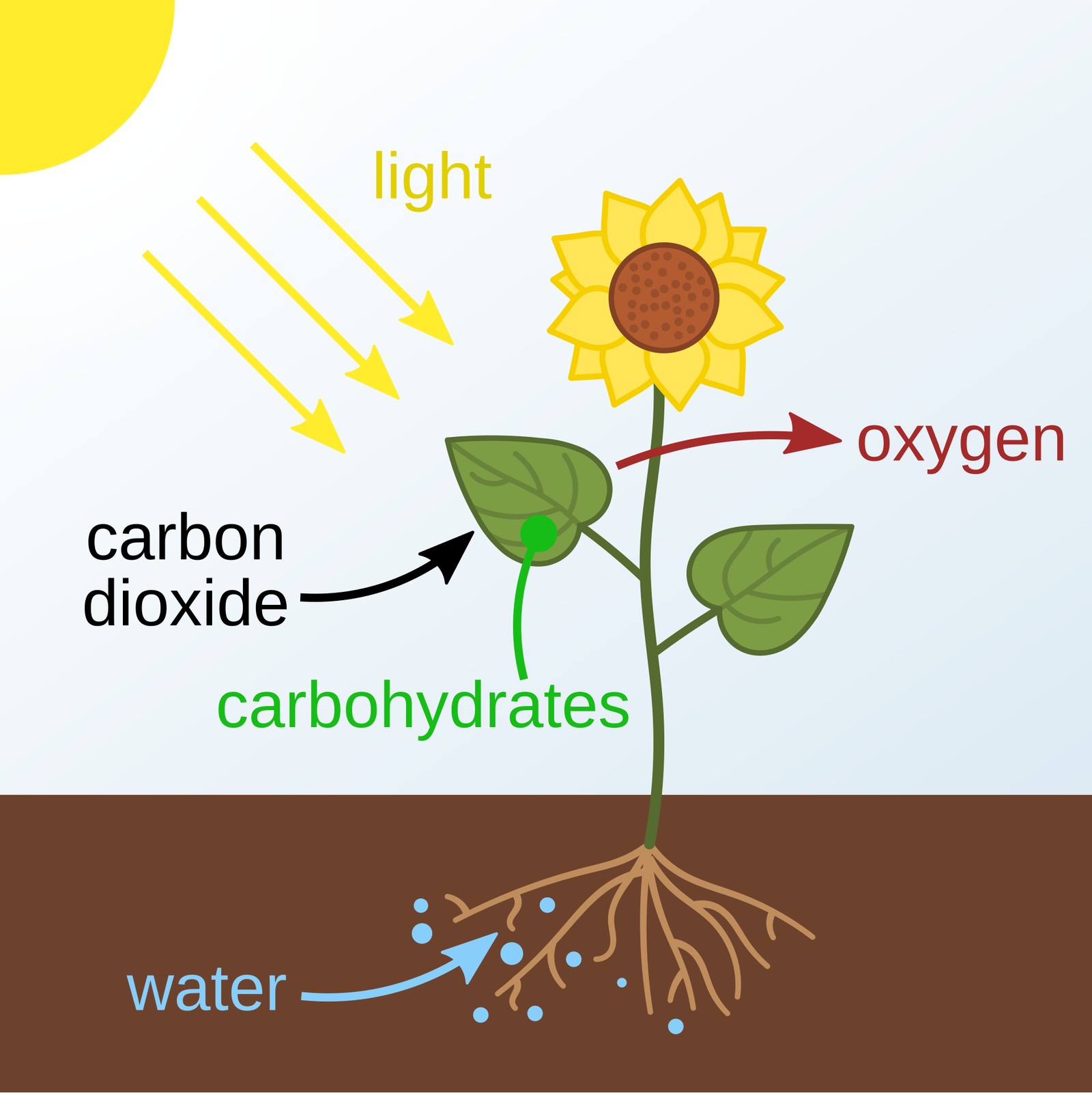
Photosynthesis is the process by which green plants, algae and cyanobacteria transform light energy into chemical energy, converting carbon dioxide and water into sugars and releasing oxygen. It runs in two linked stages: the light-dependent reactions in the thylakoid membrane, where water is split and sunlight drives electron transport that makes ATP and NADPH, and the Calvin–Benson cycle in the stroma, where the enzyme Rubisco fixes CO2 into sugars. The oxygen released comes from water, not carbon dioxide — a point settled with 18O-labelled water in 1941. Photosynthesizers split into oxygenic forms (plants, algae, cyanobacteria) and anoxygenic bacteria such as green and purple sulfur bacteria, which use hydrogen sulfide instead of water. Land plants add further strategies — C3, C4 (Hatch–Slack) and CAM — that differ in how they supply CO2 to Rubisco. Photosynthesis sets the scale of the biosphere: global net primary production is estimated at about 104.9 petagrams of carbon per year, and roughly half of Earth's oxygen production comes from the ocean. Efficiency figures vary with definition: the theoretical maximum conversion of solar energy to biomass is put at 4.6% for C3 and 6% for C4 photosynthesis, while realized field efficiencies are far lower.
What is photosynthesis?
Photosynthesis is the process by which green plants and certain other organisms transform light energy into chemical energy. 1 During photosynthesis in green plants, light energy is captured and used to convert water, carbon dioxide and minerals into oxygen and energy-rich organic compounds. 1 It is the only biological process that captures energy originating from sunlight and converts it into chemical compounds that organisms use to power their metabolism, and it is also a source of oxygen. 2 Photosynthesis is critical for the existence of the vast majority of life on Earth, and it is the way in which virtually all energy in the biosphere becomes available to living things. 1
In chemical terms, photosynthesis is a light-energized oxidation–reduction process. 1 The energy of light is used to drive the oxidation of water, producing oxygen gas, hydrogen ions and electrons; oxidation means the removal of electrons from a molecule, and reduction the gain of electrons by a molecule. 1 The overall transformation is commonly written as 6CO2 + 6H2O → C6H12O6 + 6O2 — six carbon dioxide molecules and six water molecules are converted, by light energy captured by chlorophyll, into a sugar molecule and six oxygen molecules. 1 Plants, algae and cyanobacteria use light energy to generate organic molecules such as glucose, sugars and starch from carbon dioxide and water, and they release molecular oxygen into the atmosphere. 3
Plants, algae and a group of bacteria called cyanobacteria are the only organisms capable of performing photosynthesis; because they use light to manufacture their own food, they are called photoautotrophs. 2 The ability to photosynthesize is found in both eukaryotic and prokaryotic organisms: plants and algae are the dominant group of eukaryotic photosynthesizers, while cyanobacteria and certain sulfur bacteria are the photosynthetic prokaryotes in whom photosynthesis evolved. 1 Within the plant cell, the work is done in the chloroplast, an organelle with an outer and an inner membrane that is ancestrally derived from ancient free-living cyanobacteria. 2 Embedded in the thylakoid membrane of that organelle is chlorophyll, the pigment responsible for the initial interaction between light and plant material. 2
Almost all the oxygen in the atmosphere is due to photosynthesis. 1 If photosynthesis ceased, there would soon be little food or other organic matter on Earth, most organisms would disappear, and the atmosphere would eventually become nearly devoid of gaseous oxygen. 1 Energy produced by photosynthesis in plants millions of years ago is responsible for the fossil fuels — coal, oil and gas — that power industrial society. 1
The two stages at a glance
Photosynthesis takes place in two sequential stages. 2 In the light-dependent reactions, energy from sunlight is absorbed by chlorophyll and converted into stored chemical energy; these reactions take place in the thylakoid membrane and use light energy to make ATP and NADPH. 2 The Calvin cycle, which takes place in the stroma, uses the energy derived from these compounds to make G3P from CO2. 2 The two stages are sequential in the strictest sense: the light-dependent reactions run first and supply the energy and reducing power that the Calvin cycle spends. 2
| Feature | Light-dependent reactions | Calvin–Benson cycle (light-independent) |
|---|---|---|
| Site | Thylakoid membrane of the chloroplast 2 | Stroma of the chloroplast 2 |
| Inputs | Light energy; water, which is split to supply electrons 4 | Carbon dioxide; ATP and NADPH from the light-dependent reactions 2 |
| Outputs | ATP and NADPH; oxygen gas released as a by-product 4 | G3P; six turns of the cycle are required to produce a glucose molecule 5 |
| Key catalysts | Photosystem II (P680) and photosystem I (P700) 6 | Rubisco, which catalyses the fixation of CO2 on RuBP 3 |
| Can it run without light? | No — the light-dependent reactions require a continuous supply of light energy 7 | No — although they are called the 'dark' reactions, they consume the NADPH and ATP formed in the light phase and are also light-dependent 3 |
Stage 1 — the light-dependent reactions
Two photosystems, PSII and PSI, are embedded in the thylakoid membrane. 4 The two complexes differ in what they oxidize — the source of their low-energy electrons — and in what they reduce, the place to which they deliver their energized electrons. 4 Their reaction-centre chlorophylls absorb best at different wavelengths: the PSII special pair absorbs best at 680 nm and the PSI special pair at 700 nm, which is why they are called P680 and P700. 6 Each photosystem has light-harvesting complexes that contain proteins, 300–400 chlorophylls and other pigments. 6 Oxygenic photosynthesis begins with light absorption, followed by excitation energy transfer to the reaction centres, primary photochemistry, electron and proton transport, and then the synthesis of NADPH and ATP. 3
In the PSII reaction centre, energy from sunlight is used to extract electrons from water. 4 Splitting one water molecule releases two electrons, two hydrogen atoms and one atom of oxygen, but splitting two molecules is required to form one molecule of diatomic O2 gas. 4 The oxygen-evolving complex that performs this chemistry must accumulate four positive charges in sequence, cycling through five redox states — the model known as Kok's oxygen clock. 3
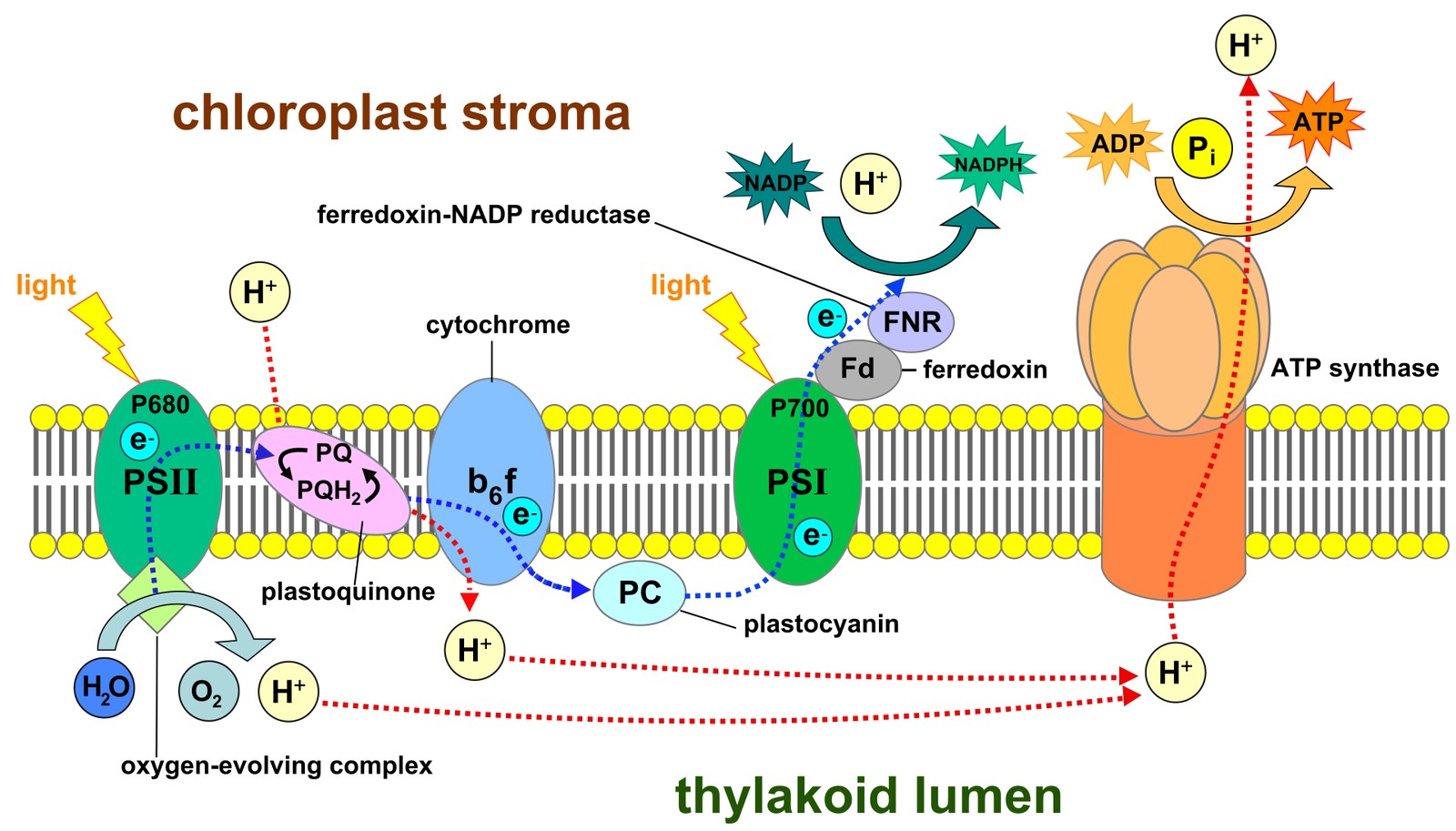
From PSII, the electrons travel through the chloroplast electron transport chain to PSI. 4 The chain moves protons across the thylakoid membrane into the lumen, so that the net result is a low pH in the thylakoid lumen and a high pH in the stroma. 4 ATP synthase uses this electrochemical gradient to make ATP, while PSI captures the energy to reduce NADP+ into NADPH. 4 The two photosystems work in concert, in part to guarantee that the production of NADPH roughly equals the production of ATP. 4
Stage 2 — the Calvin–Benson cycle
The second stage, the Calvin–Benson cycle, builds organic molecules from carbon dioxide. 5 Its key enzyme is Rubisco — ribulose 1,5-bisphosphate carboxylase/oxygenase — which catalyses the fixation of CO2 on the five-carbon compound RuBP. 3 Rubisco is probably the most abundant protein in the biosphere. 8 The cycle has three stages: RuBisCO incorporates carbon dioxide into the organic molecule 3-PGA; that molecule is then reduced using electrons supplied by NADPH; and RuBP, the molecule that starts the cycle, is regenerated so that the cycle can continue. 5
Only one carbon dioxide molecule is incorporated at a time, so the cycle must be completed three times to produce a single three-carbon G3P molecule, and six times to produce a six-carbon glucose molecule. 5 The products of the light-dependent reactions, ATP and NADPH, have lifespans in the range of millionths of seconds, whereas the products of the light-independent reactions — carbohydrates and other forms of reduced carbon — can survive almost indefinitely. 5 And because CO2 fixation uses the NADPH and ATP formed in the light phase, the so-called 'dark' reactions are in fact also light-dependent. 3
The major pathway of CO2 reduction was deciphered by Andrew Benson — who did most of the early pioneering work, using 14C — together with Melvin Calvin, James A. Bassham and co-workers. 3 Their tracing showed that ribulose 1,5-bisphosphate (RuBP), a five-carbon sugar, is the acceptor of CO2; that the first stable product of CO2 reduction is 3-phosphoglyceraldehyde (G3P); and that a cycle regenerates RuBP. 3 Melvin Calvin received the Nobel Prize in Chemistry in 1961 for his research on the carbon dioxide assimilation in plants. 9 The cycle is known as the Calvin–Benson cycle to credit the team. 3
Where the oxygen comes from
For a time, the popular theory held that oxygen was removed from carbon dioxide and that carbon then combined with water to form carbohydrate. 1 That theory was incorrect: in the 1930s van Niel proposed that hydrogen is transferred from hydrogen sulfide in bacteria, or from water in green plants, to an acceptor. 1 By analogy with photosynthetic bacteria, he suggested that the O2 released by plants is derived from H2O rather than CO2. 3 The matter was settled with isotope labelling: the oxygen molecules released into the atmosphere originate from water oxidation, not from carbon dioxide, as established using 18O-labelled water. 3 Plants that photosynthesized in the presence of water containing H218O produced oxygen gas containing 18O, while those that photosynthesized in normal water produced normal oxygen gas. 1
C3, C4 and CAM — three routes to fix carbon
In C3 photosynthesis, the route used by crops such as rice, CO2 is fixed through the Calvin cycle. 103 The pathway's weakness is its enzyme: Rubisco is known to have a low catalytic rate and a tendency to confuse its substrate, carbon dioxide, with oxygen. 8 When Rubisco adds O2 instead of CO2, the resulting photorespiration entails an extra energy investment and reduces the net photosynthetic rate. 8 Retrieving the carbons of 2-phosphoglycolate costs a net loss of CO2 — about one CO2 molecule per two captured O2 molecules. 8
| Feature | C3 | C4 | CAM |
|---|---|---|---|
| How CO2 reaches Rubisco | Fixed directly by Rubisco in the Calvin cycle 3 | Pumped via Kranz anatomy: Rubisco in bundle-sheath cells, PEP carboxylase in the mesophyll, and a gas-tight bundle sheath that lets C4 acids be decarboxylated to raise CO2 around Rubisco and inhibit its oxygenase activity 10 | Fixed at night into malic acid by PEP carboxylase, stored in large vacuoles, and decarboxylated by day to raise CO2 within leaves and stems 11 |
| First carbon product | 3-phosphoglycerate (3-PGA) 5 | A C4 acid 10 | Malic acid 11 |
| Examples | Rice 10 | Maize, sorghum, sugarcane, miscanthus, switchgrass 10 | Agave, pineapple, aloe and prickly pear cacti 11 |
| Water and nitrogen use | Lower yields and water and nitrogen use efficiency than C4 crops 10 | Higher yields and increased water and nitrogen use efficiency than C3 crops such as rice 10 | Stomata closed over much of the day, so transpiration is low and water-use efficiency is high 11 |
The C4 pathway was characterized biochemically by Hal Hatch and Roger Slack in 1966, when they used 14CO2 to trace the fate of CO2 assimilated by sugarcane and confirmed that the first carbon compound formed was a C4 acid. 10 That work defined the C4 dicarboxylic acid pathway, later abbreviated to C4 photosynthesis, and the plants employing it were termed C4 plants. 10 CAM photosynthesis tells an even wider story: it independently evolved over 60 times across vascular plants — one of the best examples of evolutionary convergence on a complex trait — and close to 18,000 species exhibit some degree of CAM. 11 Numerous CAM species are in cultivation, with a number of Agave species standing out as leading producers, along with pineapple, aloe and prickly pear cacti. 11
Oxygenic and anoxygenic photosynthesis
Plants carry out oxygenic photosynthesis: water molecules are split to provide a source of electrons for the electron transport chain, and oxygen gas is released as a by-product. 6 The same mode is characteristic of cyanobacteria, while anoxygenic photosynthesis is performed by anoxygenic phototrophs — especially green sulfur bacteria and purple sulfur bacteria. 12 The first photosynthesizing single-celled bacteria evolved over 3.5 billion years ago, and the subsequent rise in atmospheric oxygen — a by-product of photosynthesis — about a billion years later played a major role in shaping the evolution of life on Earth. 13
In anoxygenic photosynthesis, hydrogen sulfide is used as the main electron donor — unlike in plants and cyanobacteria, where water is the main source of electrons. 12 Purple sulfur bacteria carry out this water-free mode: water is not used as an electron source and oxygen gas is not produced. 6 Green sulfur bacteria oxidize H2S to elemental sulfur and possess special structures — chlorosomes — in which their photosynthetic pigments are located. 12
Chloroplasts, which carry out oxygenic photosynthesis in plant cells, have a double membrane envelope and are ancestrally derived from ancient free-living cyanobacteria. 2 Within the chloroplast, stacked, disc-shaped structures called thylakoids hold chlorophyll embedded in the thylakoid membrane, and the membrane encloses an internal space called the thylakoid lumen. 2 A stack of thylakoids is called a granum, and the liquid-filled space surrounding it is the stroma. 2
Discovery — from Priestley's mint to the Calvin cycle
The study of photosynthesis began in 1771 with observations made by the English clergyman and scientist Joseph Priestley: air in which a candle had burned out could again support combustion after a sprig of mint had grown in the sealed container, producing a substance later recognized as oxygen. 1 In 1779 Jan Ingenhousz showed that the plant had to be exposed to light for the combustible gas to be restored, and that the process required the plant's green tissues. 1 In 1782 it was demonstrated that the oxygen was formed at the expense of 'fixed air', which had been identified the year before as carbon dioxide; gas-exchange experiments in 1804 showed that the carbon gained by a growing plant came entirely from absorbed carbon dioxide and water taken up by the roots. 1 Nicolas Théodore de Saussure clearly showed, in 1804, that water was an essential reactant of photosynthesis. 3 Almost half a century passed before the concept of chemical energy had developed sufficiently to permit the discovery, in 1845, that light energy from the Sun is stored as chemical energy in the products formed during photosynthesis. 1
photosynthesis consists of two separate phases: a light-dependent phase (i.e. so-called 'light' reactions), and a temperature-dependent biochemical phase
Frederick Frost Blackman (1905), via Govindjee et al., Annals of Botany (2020)
These results provided definitive support for van Niel's theory that the oxygen gas produced during photosynthesis is derived from water.
Encyclopaedia Britannica, on the 1941 heavy-oxygen experiments
The Nobel Prize in Chemistry 1961 was awarded to Melvin Calvin "for his research on the carbon dioxide assimilation in plants"
The Nobel Foundation, Nobel Prize in Chemistry 1961
THE high affinity for oxygen possessed by muscle hæmoglobin suggested its use as a very sensitive spectroscopic method for detecting and measuring small quantities of oxygen
Robert Hill, 'Oxygen Evolved by Isolated Chloroplasts', Nature (1937)
Observations on different types of air
Joseph Priestley, paper held by the Royal Society Science in the Making archive
Theodor Engelmann (1882) provided the first action spectrum of photosynthesis, showing that red and blue light absorbed by chlorophyll produces oxygen. 3 By measuring photosynthesis as a function of light intensity, Frederick Frost Blackman (1905) suggested that the process consists of two separate phases — a light-dependent phase and a temperature-dependent biochemical phase. 3 Robert Hill (1937) found that the light phase can operate independently of the carbon reactions: isolated chloroplasts evolve O2 in the presence of artificial electron acceptors even without CO2 — the reaction known as the Hill reaction. 3
The idea of two light reactions began with the 1943 'red drop' experiments of Robert Emerson and Charleton Lewis on the quantum yield of photosynthesis, and with the 1957 'Emerson enhancement' effect, from which the Z-scheme of photosynthesis emerged. 3 In the same decades, the carbon pathway was traced: the 14C work of Andrew Benson, Melvin Calvin, James A. Bassham and co-workers deciphered the major pathway of CO2 reduction. 3 In 1966 Hal Hatch and Roger Slack characterized the C4 pathway, tracing 14CO2 in sugarcane and confirming that the first carbon compound formed is a C4 acid. 10
How efficient is photosynthesis?
The minimum quantum requirement for the evolution of one molecule of O2 was established as 8–10 photons. 3 About 2,400 chlorophyll molecules cooperate in a photosynthetic unit to evolve one O2. 3 The light energy absorbed by the pigment–protein antenna complexes of the photosystems is converted into redox chemical energy with very high efficiency; only a small part is dissipated as heat and as chlorophyll fluorescence, at 2–10%. 3
The enzyme that performs the fixation step, Rubisco, is known to have a low catalytic rate and a tendency to confuse its substrate, carbon dioxide, with oxygen. 8 When it adds O2 instead of CO2, the resulting photorespiration costs an extra energy investment and reduces the net photosynthetic rate. 8 The efficiency advantage of C4 over C3 photosynthesis will disappear as atmospheric CO2 approaches 700 ppm. 14
Photosynthesis and the planet
At the scale of the biosphere, integrating conceptually similar models of the growth of marine and terrestrial primary producers yields an estimated global net primary production of 104.9 petagrams of carbon per year, with roughly equal contributions from land and oceans. 16 Scientists estimate that roughly half of the oxygen production on Earth comes from the ocean, and the majority of this production is from oceanic plankton — drifting plants, algae and some bacteria that can photosynthesize. 17 One particular species, Prochlorococcus, is the smallest photosynthetic organism on Earth, yet it produces up to 20% of the oxygen in the entire biosphere — a higher percentage than all of the tropical rainforests on land combined. 17
Atmospheric oxygen from photosynthesis also forms the ozone layer. 13 The process is the way in which virtually all energy in the biosphere becomes available to living things. 1 Photosynthesis is essential to almost all life on Earth: both plants and animals depend on it. 2
C4 plants play a key role in world agriculture: crops such as maize and sorghum are major contributors to world food production in both developed and developing nations, and the C4 grasses sugarcane, miscanthus and switchgrass are the major plant sources of bioenergy. 10 The research frontier points the same way: the DOE Office of Science's Basic Energy Sciences program has been studying natural and artificial photosynthesis for more than 40 years and is one of the largest supporters of fundamental research into solar fuels. 18 One possible approach, artificial photosynthesis, could work similarly to natural photosynthesis by using only water, carbon dioxide and sunlight to generate fuel. 18
Timeline of discoveries
Priestley restores 'injured' air with a mint plant
The study of photosynthesis began in 1771 with Joseph Priestley's experiments: air in which a candle had burned out could again support combustion after a sprig of mint had grown in the sealed container — evidence of a gas later recognized as oxygen.
Ingenhousz shows that light is required
Jan Ingenhousz expanded on Priestley's work, showing that the plant had to be exposed to light for the combustible gas to be restored, and that the process required the plant's green tissues.
Senebier links the process to carbon dioxide
The role of CO2 in photosynthesis was shown by Jean Senebier (1782), and in the same period it was demonstrated that the oxygen formed comes at the expense of 'fixed air' — carbon dioxide.
de Saussure proves water is an essential reactant
Gas-exchange experiments in a weighed pot showed that a plant's gain in weight came from carbon taken entirely from absorbed carbon dioxide plus water taken up by the roots, with oxygen released back to the air; Nicolas Théodore de Saussure clearly showed that water was an essential reactant of photosynthesis.
Light energy recognized as stored chemical energy
Almost half a century passed before the concept of chemical energy had developed sufficiently to permit the discovery, in 1845, that light energy from the Sun is stored as chemical energy in the products formed during photosynthesis.
Engelmann measures the first action spectrum
Theodor Engelmann provided the first action spectrum of photosynthesis, showing that red and blue light, absorbed by chlorophyll, produce oxygen.
Blackman separates 'light' and 'dark' phases
By measuring photosynthesis as a function of light intensity, Frederick Frost Blackman suggested that photosynthesis consists of two separate phases: a light-dependent phase and a temperature-dependent biochemical phase — though because CO2 fixation consumes the NADPH and ATP made in the light, these 'dark' reactions are also light-dependent.
Hill's isolated chloroplasts evolve oxygen
Robert Hill found that the light phase of photosynthesis can operate independently of the carbon reactions: isolated chloroplasts evolve O2 in the presence of artificial electron acceptors even without CO2 — the 'Hill reaction', demonstrated with a sensitive haemoglobin method for measuring oxygen.
Heavy-oxygen water traces the origin of O2
Sam Ruben, Merle Randall, Martin Kamen and James Logan Hyde used 18O-labelled water and found that the oxygen released comes from water, not from carbon dioxide — confirming van Niel's proposal about the source of photosynthetic oxygen.
The 'red drop' hints at two light reactions
Robert Emerson and Charleton Lewis measured a 'red drop' in the action spectrum of the quantum yield of photosynthesis — the first clue that led, with later experiments, to the two-photosystem Z-scheme.
Tracing the path of carbon with 14C
Andrew Benson, Melvin Calvin, James A. Bassham and co-workers used radioactive 14C to decipher the major pathway of CO2 reduction: ribulose 1,5-bisphosphate (RuBP) was the CO2 acceptor, the first stable product was 3-phosphoglyceraldehyde (G3P), and a cycle regenerates RuBP — with the key enzyme later known as Rubisco catalysing the fixation step.
The Emerson enhancement effect
Emerson and colleagues found that the rate of photosynthesis with two light beams given together exceeded the sum of the rates with each beam separately — the 'Emerson enhancement' effect that helped establish the Z-scheme of two cooperating photosystems.
Nobel Prize in Chemistry awarded to Melvin Calvin
The Nobel Prize in Chemistry 1961 was awarded to Melvin Calvin 'for his research on the carbon dioxide assimilation in plants'.
Hatch and Slack describe the C4 pathway
Hal Hatch and Roger Slack traced 14CO2 in sugarcane and confirmed that the first carbon compound formed is a C4 acid — the C4 dicarboxylic acid pathway, which later underpinned the higher yields noted in crops such as maize and sorghum.
Frequently asked questions
What is the chemical equation of photosynthesis?
The process is commonly written as 6CO2 + 6H2O → C6H12O6 + 6O2, meaning that six carbon dioxide molecules and six water molecules are converted by light energy captured by chlorophyll into a sugar molecule and six oxygen molecules. 1
Where do the two stages of photosynthesis take place?
The light-dependent reactions take place in the thylakoid membrane and use light energy to make ATP and NADPH, while the Calvin cycle takes place in the stroma and uses energy from those compounds to make G3P from CO2. 2
Does the Calvin cycle really run in the dark?
Not on its own: because CO2 fixation uses the NADPH and ATP formed in the light phase, the so-called 'dark' reactions are also light-dependent. 3 Frederick Frost Blackman's 1905 measurements had separated the process into a light-dependent phase and a temperature-dependent biochemical phase. 3
Where does the oxygen released by photosynthesis come from?
From water, not from carbon dioxide: plants that photosynthesized in water containing H218O produced oxygen gas containing 18O, while those in normal water produced normal oxygen gas. 1 The conclusion was confirmed by Sam Ruben, Merle Randall, Martin Kamen and James Logan Hyde using 18O-labelled water. 3
Why is Rubisco described as both essential and imperfect?
Rubisco catalyses the fixation of CO2 on the five-carbon compound RuBP. 3 It is probably the most abundant protein in the biosphere, yet it has a low catalytic rate and a tendency to confuse its substrate, carbon dioxide, with oxygen. 8
How many photons does it take to release one oxygen molecule?
The minimum quantum requirement for the evolution of one O2 molecule was established as 8–10 photons. 3 About 2,400 chlorophyll molecules cooperate in a photosynthetic unit to evolve one O2. 3
How much of Earth's oxygen is produced in the ocean?
Scientists estimate that roughly half of the oxygen production on Earth comes from the ocean, the majority of it from oceanic plankton. 17 One species, Prochlorococcus, produces up to 20% of the oxygen in the entire biosphere — more than all tropical rainforests on land combined. 17
How efficient can photosynthesis be, and why do the numbers differ?
It depends on the definition: one analysis gives the maximum conversion efficiency of solar energy to biomass as 4.6% for C3 photosynthesis at 30 °C and 380 ppm CO2, and 6% for C4 photosynthesis. 14 Comparing photosynthesis with photovoltaics is not simple — they produce different products — and while photovoltaic-driven electrolysis is more efficient on an annual basis, short-term photosynthetic yields under optimal conditions come within a factor of 2 or 3 of that benchmark. 15
Key numbers at a glance
Sources & citations
Every factual claim in this article is drawn from the sources below. Bracketed numbers in the text link to the corresponding source.
- 1
- 2
- 3
- 4
- 5
- 6
- 7
- 8
- 9
- 10
- 11
- 12
- 13
- 14
- 15
- 16
- 17
- 18
- 19