Wolfgang Amadeus Mozart
The Salzburg prodigy, the Vienna years, and the catalogues that document them — Mozart's own thematic catalogue at the British Library, the Köchel numbers, the Vienna death register, and the documented record behind the Salieri story and the Requiem legend.
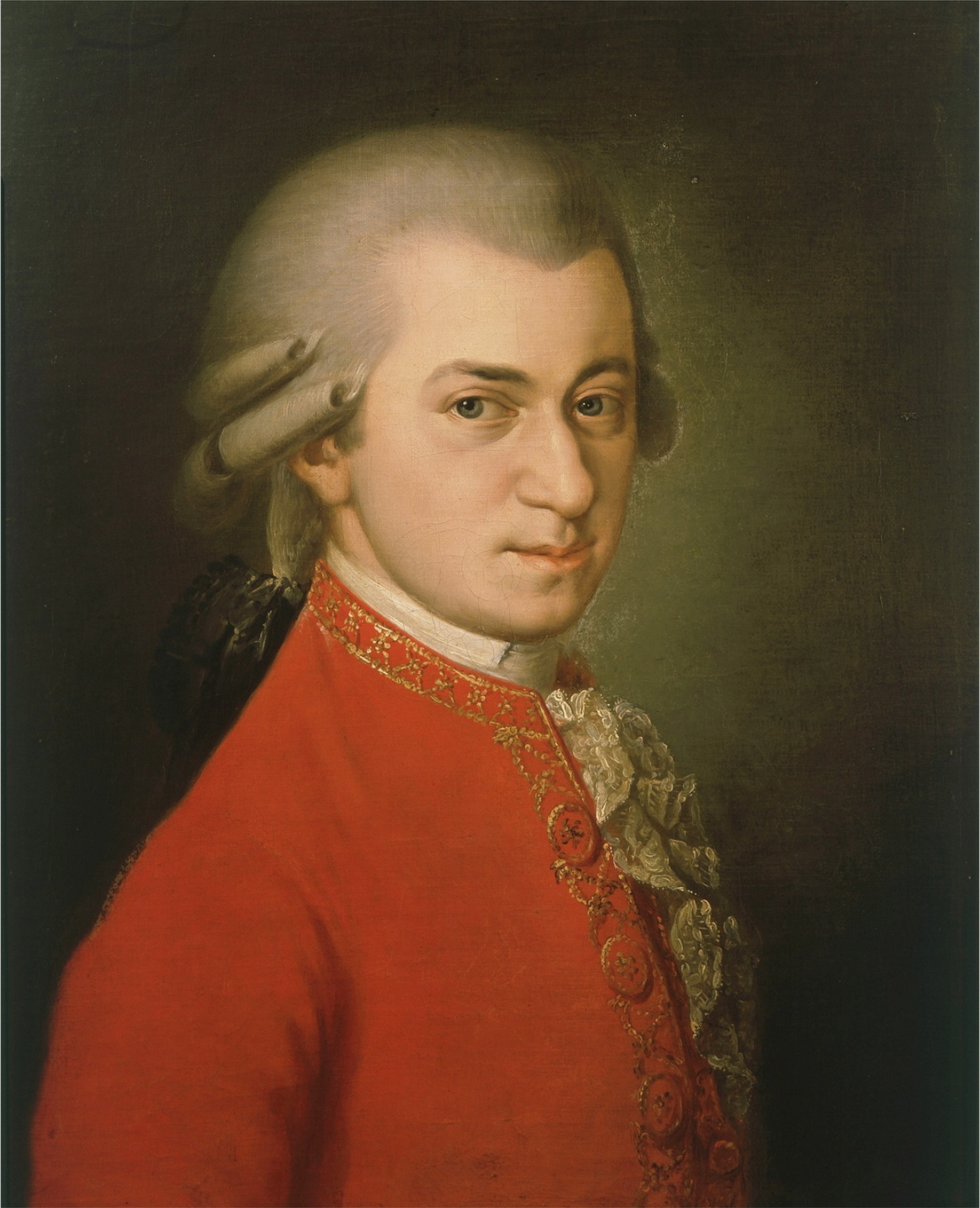
.jpg)
Wolfgang Amadeus Mozart (born 27 January 1756 in Salzburg; died 5 December 1791 in Vienna) was an Austrian composer, widely recognized as one of the greatest in the history of Western music. His father Leopold, a violinist and deputy Kapellmeister, taught him as a small child: Mozart composed his first piece in 1761, at five, and by six had performed before two imperial courts. From mid-1763 the family toured western Europe for three years; in London, under the influence of Johann Christian Bach, Mozart wrote his first symphonies (K 16, K 19, K 19a). In 1769 he was appointed honorary Konzertmeister at the Salzburg court and set out for Italy, where he heard and transcribed from memory Allegri's Miserere, was made a knight of the Golden Spur, and saw his opera Mitridate premiered in Milan on 26 December 1770. After breaking with Archbishop Colloredo in 1781 he settled in Vienna, where Figaro (1786), Don Giovanni (1787), Così fan tutte (1790) and The Magic Flute (1791) were staged and where he was appointed court Kammermusicus in 1787. He wrote more than 600 works, numbered since 1862 in Ludwig von Köchel's chronological catalogue; Mozart himself kept a thematic catalogue of his own works from February 1784, now held by the British Library. He died in December 1791 while the Requiem, K 626, was still unfinished; it was completed by his pupil Süssmayr. The Vienna register certified 'severe miliary fever'; Britannica states plainly that there is no evidence he was poisoned by Salieri or anyone else, and the film Amadeus is described by Britannica itself as largely fictionalized.
Born in Salzburg: the documented beginnings (1756)
Wolfgang Amadeus Mozart was born on 27 January 1756 in Salzburg and died on 5 December 1791 in Vienna; he was an Austrian composer, widely recognized as one of the greatest in the history of Western music.1 The house of his birth, at Getreidegasse 9, is now Mozart's Birthplace — one of the most visited museums in the world.2 A three-story exhibition there covers his family, his musical beginnings, his friends and patrons, and his passion for opera.2
His father was Leopold Mozart, a talented violinist who became deputy Kapellmeister at the prince-archbishop's court at Salzburg and wrote a famous violin-playing manual, published in the very year of Wolfgang's birth.1 His mother was Anna Maria Pertl.1 Wolfgang and his sister Maria Anna — known in the family as Nannerl — were the only two of their seven children to survive; she was, like her brother, highly talented.1
He was baptized Johannes Chrysostomus Wolfgangus Theophilus Mozart.1 In its fuller Latin form the name is given as Johann Chrysostom Wolfgang Amadeus Mozart.1 The International Mozarteum Foundation, the body that maintains the Mozart museums, today uses the form Wolfgang Amadé Mozart.3
The prodigy on tour (1761-1766)
Mozart was a child prodigy.1 His father, a talented violinist, taught him basic notes on the harpsichord.1 Mozart composed his first piece of music in 1761, at the age of five; by age six, he had performed before two imperial courts.1 Just before he was six, his father took him and Nannerl to Munich, and a few months later to Vienna, where they were heard at the imperial court and in noble houses.1
In mid-1763 Leopold obtained a leave of absence from his post as deputy Kapellmeister at the prince-archbishop's court, and the family set out on a prolonged tour.1 It took in the main musical centres of western Europe, including Munich, Augsburg, Stuttgart, Mannheim, Mainz, Frankfurt, Brussels and Paris, then London, where they spent 15 months.1 They returned through The Hague, Amsterdam, Lyon and Switzerland to Salzburg in November 1766.1 In Paris Mozart published his first piece of music.1
In London the Mozarts met, among others, Johann Christian Bach — Johann Sebastian Bach's youngest son and a leading figure in the city's musical life.1 Under his influence Mozart composed his first symphonies.1 Three survive: K 16, K 19 and K 19a — the K marking the work's place in the catalogue of Ludwig von Köchel.1
Italy and the making of an opera composer (1769-1773)
In 1769, 13-year-old Mozart was appointed honorary Konzertmeister at the Salzburg court.1 The first Italian tour, begun on 13 December 1769, lasted 15 months and took him and his father to all the main musical centres.1 In Verona he was put through stringent tests at the Accademia Filarmonica, and in Milan, after tests of his capacities in dramatic music, he was commissioned to write the first opera for the carnival season.1
In Rome during Holy Week Mozart heard the Sistine Choir sing the famous Miserere of Gregorio Allegri, which was considered the choir's exclusive preserve.1 He copied it out from memory.1 Returning through Rome, he had a papal audience and was made a knight of the order of the Golden Spur.1
Mitridate, rè di Ponto premiered at the Regio Ducal Teatro in Milan on 26 December and was a notable success; Mozart directed the first three of the 22 performances.1 Lucio Silla was given on 26 December 1772; after a difficult premiere — it began three hours late and lasted six — it proved even more successful, with 26 performances.1 Mozart followed it with the solo motet Exsultate, jubilate (K 165), written for its leading singer, the castrato Venanzio Rauzzini.1
By 1774 Mozart was a salaried court Konzertmeister at Salzburg.1 In 1777 he petitioned the archbishop for his release and, with his mother to watch over him, set out to find new opportunities.1 By mid-June 1778 his mother was seriously ill, and on 3 July she died.1
Salzburg to Vienna: the break with Colloredo (1779-1782)
Archbishop Colloredo, a progressive churchman, discouraged lavish music and set a severe time limit on mass settings.1 Mozart objected to the restriction but was obliged to observe it.1 Matters came to a head at an interview with the archbishop, who, according to Mozart, used unecclesiastical language.1
Mozart requested his discharge; it was eventually granted at a stormy meeting with the court steward on 9 June 1781.1 He settled in Vienna, where he soon lodged with the Weber family.1 In the summer of 1781 rumours reached Salzburg that he was contemplating marriage with Constanze, the third of the Weber daughters.1 By December he was asking his father's blessing on the marriage.1
His German opera for Joseph II's court theatre, Die Entführung aus dem Serail, reached the Burgtheater stage on 16 July 1782.1 It enjoyed immediate and continuing success and carried his reputation widely around the German-speaking countries.1 The opera was quickly taken up by travelling and provincial companies.1
Mozart's own catalogues: the thematic catalogue and the Köchel Verzeichnis
In February 1784 Mozart began to keep a catalogue of his own music — which Britannica reads as a new awareness of posterity and his place in it; his entries are sometimes misdated.1 He kept it until 1791; the manuscript, in German, is today held by the British Library.6 The library records its shelfmark as Zweig MS 63, with usage terms Public Domain.6
The catalogue served as a musical diary, carried on his travels; he noted instrumentation, movements, dedicatees, performers and performance dates.6 Each entry occupies two facing pages — the completion date and title on the left, the opening bars of the music on the right.6 The first entry is the Piano Concerto in E flat (K 449); among the last, The Magic Flute and La clemenza di Tito — the latter written for the coronation of the Emperor Leopold II.6
What began in 1862 as Ludwig von Köchel's original chronological and thematic catalogue of Mozart's compositions is now available in an updated online version.7 It was the first thematic scholarly catalogue of a major composer's oeuvre, and the model for most thematic catalogues since.8 Its numbering covered 626 works, ending with the unfinished Requiem.8 The September 2024 edition, the first since 1964, returns to the earliest number each authentic work ever had, so that 95 new numbers could be assigned, starting from KV 627.78
| Catalogue stage | What it documents |
|---|---|
| Mozart's thematic catalogue, 1784-1791 | Kept in his own hand as a musical diary and carried on his travels; the British Library holds the manuscript as Zweig MS 63.6 |
| Köchel catalogue, 1862 | Ludwig von Köchel's chronological and thematic catalogue of Mozart's compositions.7 |
| Revisions of 1905, 1937 and 1964 | The catalogue was substantially revised in these years.8 |
| Edition of September 2024 | The first new edition since 1964.7 95 new numbers could be assigned to compositions, starting from KV 627.8 |
The works: a table of masterworks
Mozart wrote in all the musical genres of his day and excelled in every one; with Haydn and Beethoven he brought to its height the achievement of the Viennese Classical school.1 In all he composed more than 600 pieces of music.1 The works below are those the sources document individually, from the first entry in his own catalogue to the Requiem left unfinished at his death.61
| Work | What the record notes |
|---|---|
| Piano Concerto in E flat, K 449 | The first entry in Mozart's own thematic catalogue.6 |
| The Marriage of Figaro (1786) | Reached the stage on 1 May 1786 and was warmly received: nine performances in 1786 and a further 26 when it was revived in 1789-90.1 |
| Don Giovanni (1787) | Commissioned for Prague; given on 29 October 1787 and warmly received.1 |
| Jupiter Symphony, K 551 (1788) | His last symphony and perhaps his most famous, completed in 1788, just three years before his death.1 |
| Così fan tutte (1790) | Given on 26 January 1790; its run was interrupted after five performances when theatres closed on the death of Joseph II.1 |
| The Magic Flute (1791) | Premiered at the rustic Theater auf der Wieden near Vienna on 30 September 1791, not long before Mozart's death on 5 December.9 |
| La clemenza di Tito (1791) | Written for the coronation festivities of Leopold II; Mozart's own catalogue notes it was written for the coronation of his Majesty the Emperor Leopold II.6 |
| Requiem in D minor, K 626 | Left unfinished at his death; completed by his pupil Süssmayr, whose version has remained the standard one.1 |
The Viennese years: quartets, concertos, and the Haydn friendship (1782-1788)
In one spell of little more than five weeks Mozart appeared at 22 concerts, mainly at the Esterházy and Galitzin houses but including five concerts of his own.1 The piano concertos were the central products of his concert activity.1 In 1782-83 he wrote three of them (K 413-415), published in 1785 with string and optional wind parts for domestic use, and described by Mozart as a happy medium between what is too easy and too difficult.1
The six string quartets on which he had embarked in 1782 were finished in the first days of 1785.1 Published later that year, they were dedicated to Haydn, by then a friend of Mozart's.1 In 1785 Haydn said to Leopold Mozart, on a visit to his son in Vienna: Your son is the greatest composer known to me in person or by name; he has taste, and what is more the greatest knowledge of composition.1
Figaro, on a libretto by Lorenzo Da Ponte, reached the stage on 1 May 1786 and was warmly received: nine performances that year, and 26 more in the 1789-90 revival.1 Its outstanding popularity in Prague brought an invitation to the Bohemian capital in January 1787, when he gave a new symphony there — the Prague (K 504).1 From these years come Eine kleine Nachtmusik, probably intended for solo strings, and the Musical Joke, a good-humoured parody of bad music.1 Leopold died in May 1787; Mozart, a Freemason since the end of 1784, had written him a letter of consolation setting out a view of death based on Masonic teachings.1
Don Giovanni, commissioned for Prague, was given on 29 October 1787 and warmly received.1 On his return from Prague in mid-November 1787, Mozart was at last appointed to a court post, as Kammermusicus, in place of Gluck.1 Largely a sinecure, it required dance music for court balls; the salary of 800 gulden did little to relieve the Mozarts' chronic financial troubles.1 In 1788 began a series of letters begging loans from a fellow Freemason, Michael Puchberg, who usually obliged and was generally repaid promptly.1 In the same period he worked on three symphonies — E flat (K 543), G minor (K 550) and C major (the Jupiter, K 551) — the summa of his orchestral output with the Prague Symphony.1
The final year: The Magic Flute, La clemenza di Tito, and the Requiem (1791)
In 1791 music was flowing again: for a concert in March Mozart completed a piano concerto (K 595) begun some years before.1 He reeled off numerous dances for the Redoutensaal and wrote two new string quintets, the one in D (K 593) being a work of particular refinement and subtlety.1 In April he applied successfully for the role of unpaid assistant to the elderly Kapellmeister of St. Stephen's Cathedral.1
Two commissions arrived that year: one, anonymously delivered, for a requiem, to be composed under conditions of secrecy.1 The other, probably in July, was an invitation to write the opera for Leopold II's coronation festivities in September.1 That opera was La clemenza di Tito, for which Mozart took to Prague his pupil Franz Xaver Süssmayr, who almost certainly composed its plain recitatives.1 In July Constanze gave birth to their sixth child, one of the two who survived.1
Mozart's clarinet concerto was finished by 29 September 1791, and the next day Die Zauberflöte had its premiere at the Theater auf der Wieden near Vienna.1 The opera, a singspiel in two acts with a German libretto by Emanuel Schikaneder, was Mozart's last.9 Early reactions were cautious, but it soon became the most loved of all his works for the stage.1 It is an allegory of the quest for wisdom and enlightenment through symbols of Freemasonry; Mozart and Schikaneder were both Freemasons.9 Its most obvious Masonic symbol is the number three — three boys, three ladies and three slaves among the cast, three chords in the music.9
Freemasonry ran through the final years: Mozart was received into the Vienna lodge Zur Wohltätigkeit on 14 December 1784, and in April 1785 he brought his father Leopold into the Wahre Eintracht as well.10 In November 1791 he wrote a Masonic cantata for his lodge and directed a performance of it on 18 November.1 Later that month he was ill and confined to bed; the apparent improvement on 3 December was not sustained, and on 5 December he died.1
Death, burial, and what the record says
Severe miliary fever was the certified cause of death; later, rheumatic inflammatory fever was named, and other diagnoses including Schönlein-Henoch syndrome have been put forward.1 Suggested causes have ranged from poisoning and renal failure to trichinosis.11 The 2009 study in Annals of Internal Medicine analysed 5,011 adult deaths (3,442 men, 1,569 women) recorded in Mozart's Vienna in November-December 1791 and January 1792 and the matching periods in 1790-91 and 1792-93.11 Its analysis is consistent with the last illness being due to a streptococcal infection leading to an acute nephritic syndrome caused by poststreptococcal glomerulonephritis.11
He was buried in a multiple grave, standard at the time in Vienna for a person of his social and financial situation.1 A small group of friends attended the funeral.1 What the record does not show is destitution: the household's debts were never large, and it continued to employ servants and keep a carriage.1
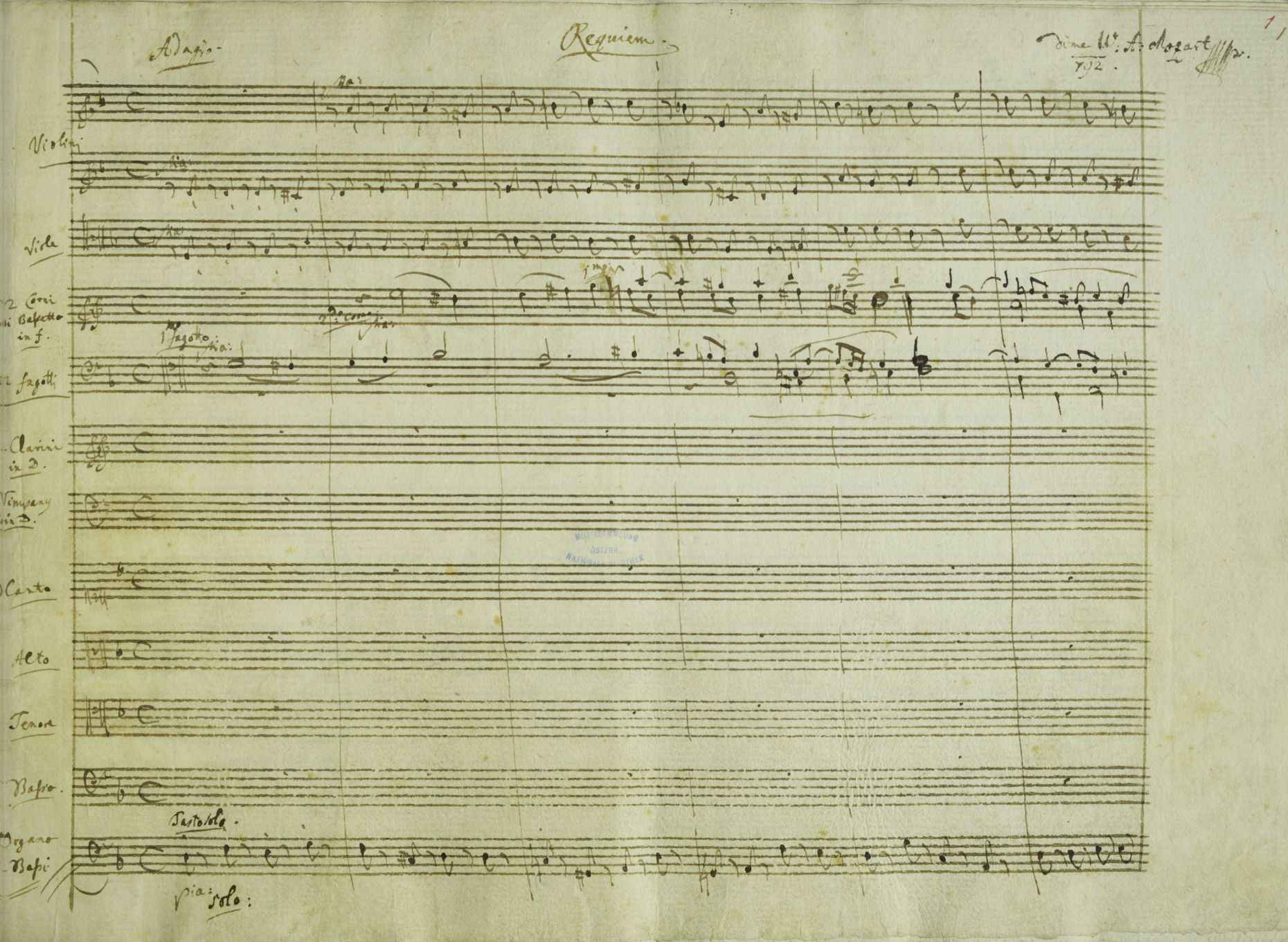

Constanze Mozart was anxious to have the requiem completed, as a fee was due.1 She handed it first to Joseph Eybler, who supplied some orchestration but was reluctant to do more, and then to Süssmayr, who produced a complete version, writing several movements himself.1 The completion has been criticised for egregious technical and expressive weaknesses, particularly in the Sanctus/Benedictus, yet it has remained the standard version of the work.1
The Salieri story and the Requiem legend: myth against the record
Britannica finds little evidence for Salieri's supposed intrigues and damaging remarks against Mozart.12 Mozart himself commented in a letter on Salieri's favourable reception of The Magic Flute.12 There is no foundation for the belief that Salieri tried to poison Mozart — a legend that was the basis of Rimsky-Korsakov's opera Mozart et Salieri of 1898, itself based on Pushkin's short story of 1830.12
Salieri was an Italian composer whose operas were acclaimed throughout Europe; the emperor made him court composer, and in 1788 he became Hofkapellmeister, a position he held for 36 years.12 Mozart knew that the Italian musical influence at court under the Kapellmeister was powerful and exclusive — even if he and Salieri were never on less than friendly terms personally.1 There is no evidence, Britannica states plainly, to support the tale that Mozart was poisoned by Salieri — a colleague and friend, hardly a real rival — or anyone else.1
The relationship received further speculative treatment in Peter Shaffer's play Amadeus (1980, filmed 1984).12 The play, its 1984 film directed by Miloš Forman, and the 2025 Netflix miniseries reinforced certain myths: Mozart as an inappropriately childish vessel for divinely inspired music, and his death as Salieri's doing.1 The film was a largely fictionalized account of the two men's relationship and won eight Academy Awards, among them best picture.13 Britannica's own film article states the record plainly: the bitter rivalry was fictional, in real life they were apparently friendly, and the Requiem was anonymously commissioned — but not by Salieri.13
In his own hand: documents and quotations
The record below is in their voices: Haydn's tribute of 1785, Mozart's own letters, his widow's certificate, and an eyewitness description from June 1765.152
Your son is the greatest composer known to me in person or by name; he has taste, and what is more the greatest knowledge of composition.1
Joseph Haydn to Leopold Mozart, Vienna, 1785 — Encyclopaedia Britannica
What annoys me most of all here is that these stupid Frenchmen seem to think I am still seven years old, because that was my age when they first saw me. This is perfectly true!5
Wolfgang Amadeus Mozart to his father, Paris, 1778 — Library of Congress Information Bulletin
last night between eleven and twelve; but in order to be able to finish it, I wrote out the violin accompaniment for Brunetti and retained my own part in my head.5
Mozart to his father, 8 April 1781, on the Sonata for Clavier and Violin K. 379 — Library of Congress Information Bulletin
My dear clavier, upon which Mozart played so often and composed Die Zauber[flöte]2
Certificate in Constanze Mozart's hand, inside Mozart's clavichord — International Mozarteum Foundation
After Mozart flawlessly completed the lawyer's tests, an overwhelmed Barrington described the boy as an eight-year-old (sic) who stood seven feet tall.5
Daines Barrington, handwritten notes of his afternoon with the Mozarts, June 1765 — Library of Congress
Legacy: the printed editions, the museums, and the archives
Today Mozart is widely considered one of the greatest composers in the history of Western music.1 With Haydn and Beethoven he brought to its height the achievement of the Viennese Classical school.1 Unlike any other composer in musical history, he wrote in all the musical genres of his day and excelled in every one.1
The institutional trail is correspondingly rich: the Library of Congress holds more than 10,000 Mozart items, from manuscripts and first editions to scores, letters and iconography.5 Its cornerstone is 12 autograph music manuscripts spanning his creative life, with three non-musical autographs including letters to Nannerl and Leopold.5 The Library also holds the joint diary fragment of 24 May 1780, verified by Mozart's widow in Salzburg in 1829.14 In Vienna, the Austrian National Library's Department of Music keeps Mozart's Requiem among its original manuscripts, alongside Haydn's Kaiserhymne and Beethoven's violin concerto.15 The Digital Mozart Edition takes as its reference text the New Mozart Edition, accessible online as the NMA since 2005.16
In 1996 UNESCO inscribed the Historic Centre of the City of Salzburg on the World Heritage List under criteria (ii), (iv) and (vi), describing the city as intimately associated with many important artists and musicians, preeminent among them Mozart.17 Approximately 80 Mozart associations worldwide share the goal of cultivating his musical heritage.4 The clavichord whose certificate is in Constanze's hand entered the Mozarteum Foundation's collection in 1844 and formed the basis of its collection of original Mozart instruments.2
Timeline
Born in Salzburg, in the Hagenauer house at Getreidegasse 9
Wolfgang Amadeus Mozart is born on 27 January 1756 in Salzburg. The house at Getreidegasse 9 where he was born is today Mozart's Birthplace, run by the International Mozarteum Foundation — one of the most visited museums in the world.
First piece of music, at the age of five
Mozart composes his first piece of music in 1761, aged five. By six he had performed before two imperial courts; at three he had been picking out chords on the harpsichord, and at four playing short pieces.
The great tour of western Europe begins
Leopold Mozart obtains leave from his post as deputy Kapellmeister at the Salzburg court and takes the family on a prolonged tour — Munich, Augsburg, Stuttgart, Mannheim, Mainz, Frankfurt, Brussels, Paris, then London, returning through The Hague, Amsterdam and Switzerland in November 1766.
London: the first symphonies
In London Mozart meets Johann Christian Bach, youngest son of J. S. Bach, and under his influence composes his first symphonies; three survive (K 16, K 19, K 19a — the K marking the work's place in the catalogue of Ludwig von Köchel).
Honorary Konzertmeister at the Salzburg court, aged 13
Mozart is appointed honorary Konzertmeister at the Salzburg court. Two months later he sets out with his father on the first Italian tour, which lasts 15 months and takes in Verona, Milan, Bologna, Florence, Rome and Naples.
Mitridate premiered in Milan; the Miserere transcribed in Rome
During the Italian tour Mozart heard the Sistine Choir sing Allegri's Miserere — the choir's exclusive preserve — and copied it out from memory; in Rome he had a papal audience and was made a knight of the order of the Golden Spur. He directed the first three of the 22 performances of Mitridate, rè di Ponto at Milan's Regio Ducal Teatro.
Discharge from the service of Archbishop Colloredo
Matters came to a head at an interview with Archbishop Colloredo, who, according to Mozart, used unecclesiastical language; Mozart requested his discharge, granted at a stormy meeting with the court steward on 9 June 1781. He settled in Vienna, where he soon lodged with the Weber family.
Begins his own thematic catalogue
In February 1784 Mozart begins to keep a catalogue of his own music — which Britannica reads as a new awareness of posterity and his place in it. The manuscript, continued until 1791, is now held by the British Library (Zweig MS 63).
Initiated into the Vienna Masonic lodge 'Zur Wohltätigkeit'
Mozart is received into the Vienna lodge 'Zur Wohltätigkeit' on 14 December 1784. In April 1785 he brought his father Leopold into the 'Wahre Eintracht' lodge; The Magic Flute is regarded as the great Masonic work of his final years.
Haydn's tribute and the 'Haydn' quartets
The six string quartets begun in 1782 are finished in the first days of 1785 and published that year, dedicated to Haydn. On a visit to Vienna, Haydn tells Leopold Mozart: 'Your son is the greatest composer known to me in person or by name; he has taste, and what is more the greatest knowledge of composition.'
The Marriage of Figaro reaches the stage
Figaro, on a libretto by Lorenzo Da Ponte after Beaumarchais, reaches the Burgtheater stage on 1 May 1786 and is warmly received: nine performances that year and 26 more in the 1789-90 revival. Its outstanding popularity in Prague leads to the invitation that produces the Prague Symphony and Don Giovanni.
Don Giovanni premiered in Prague
Mozart's chief occupation during 1787 is Don Giovanni, commissioned for Prague; it is given on 29 October and warmly received. In mid-November, back in Vienna, Mozart is at last appointed to a court post, as Kammermusicus, in place of Gluck, at a salary of 800 gulden.
The last three symphonies, including the 'Jupiter' (K 551)
During a period of depression — and of loans from his fellow Freemason Michael Puchberg — Mozart works on three symphonies in E-flat (K 543), G minor (K 550) and C major (the Jupiter, K 551), usually numbered 39, 40 and 41; with the Prague Symphony they represent, in Britannica's phrase, 'the summa of his orchestral output'.
The Magic Flute premiered near Vienna
The clarinet concerto is finished by 29 September, and the next day Die Zauberflöte — Mozart's last opera, a singspiel to a libretto by Emanuel Schikaneder — premieres at the Theater auf der Wieden near Vienna. Early reactions were cautious, but it soon became the most loved of all his stage works.
Death in Vienna; the Requiem left unfinished
Confined to bed in late November, Mozart dies on 5 December 1791. 'Severe miliary fever' is the certified cause; Britannica states there is no evidence he was poisoned by Salieri or anyone else, and he was buried in a multiple grave standard at the time for his social and financial situation. The Requiem, commissioned by Count von Walsegg-Stuppach, was completed by his pupil Süssmayr.
Köchel publishes his catalogue
Ludwig Ritter von Köchel publishes at Breitkopf & Härtel the first edition of his chronological and thematic catalogue of Mozart's works — a milestone in music research, covering 626 works and ending with the unfinished Requiem. It has been revised in 1905, 1937, 1964 and again in 2024.
Frequently asked questions
Where and when was Mozart born?
Mozart was born on 27 January 1756 in Salzburg and died on 5 December 1791 in Vienna.1 The house of his birth, at Getreidegasse 9, is today Mozart's Birthplace, run by the International Mozarteum Foundation and among the most visited museums in the world.2
What was Mozart's full name?
He was baptized Johannes Chrysostomus Wolfgangus Theophilus Mozart.1 In full the name is given as Johann Chrysostom Wolfgang Amadeus Mozart.1
Was Mozart poisoned by Salieri?
No: Britannica states that there is no evidence to support the tale that Mozart was poisoned by Salieri — a colleague and friend, hardly a real rival — or anyone else.1 The legend was the basis of Rimsky-Korsakov's opera Mozart et Salieri of 1898, itself based on Pushkin's short story of 1830.12
Who completed Mozart's Requiem?
The Requiem was left unfinished at his death.1 Constanze first engaged Joseph Eybler, who supplied some orchestration but was reluctant to do more, and then Süssmayr, whose complete version has remained the standard one.1
How many works did Mozart compose?
He composed more than 600 pieces of music, writing in all the musical genres of his day and excelling in every one.1 The Köchel numbering that organises them covered 626 works, ending with the unfinished Requiem.8
What is the Köchel catalogue?
It began in 1862 as Ludwig von Köchel's chronological and thematic catalogue of Mozart's compositions, and is now available in an updated online version.7 It was the first thematic scholarly catalogue of a major composer's oeuvre, and the 2024 edition — the first since 1964 — goes back to the earliest number each authentic work ever had, so that 95 new numbers could be assigned, starting from KV 627.8
Knowledge graph
Sources & citations
Every factual claim in this article is drawn from the sources below. Bracketed numbers in the text link to the corresponding source.
- 1
- 2
- 3
- 4
- 5
- 6
- 7
- 8
- 9
- 10
- 11
- 12
- 13
- 14
- 15
- 16
- 17