Nikola Tesla
The Serbian American engineer whose polyphase alternating-current system electrified the world — inventor of the induction motor, the Tesla coil and radio's fundamental circuits, and the audacious dreamer of Wardenclyffe — set against the documented record and the legends that grew around him.
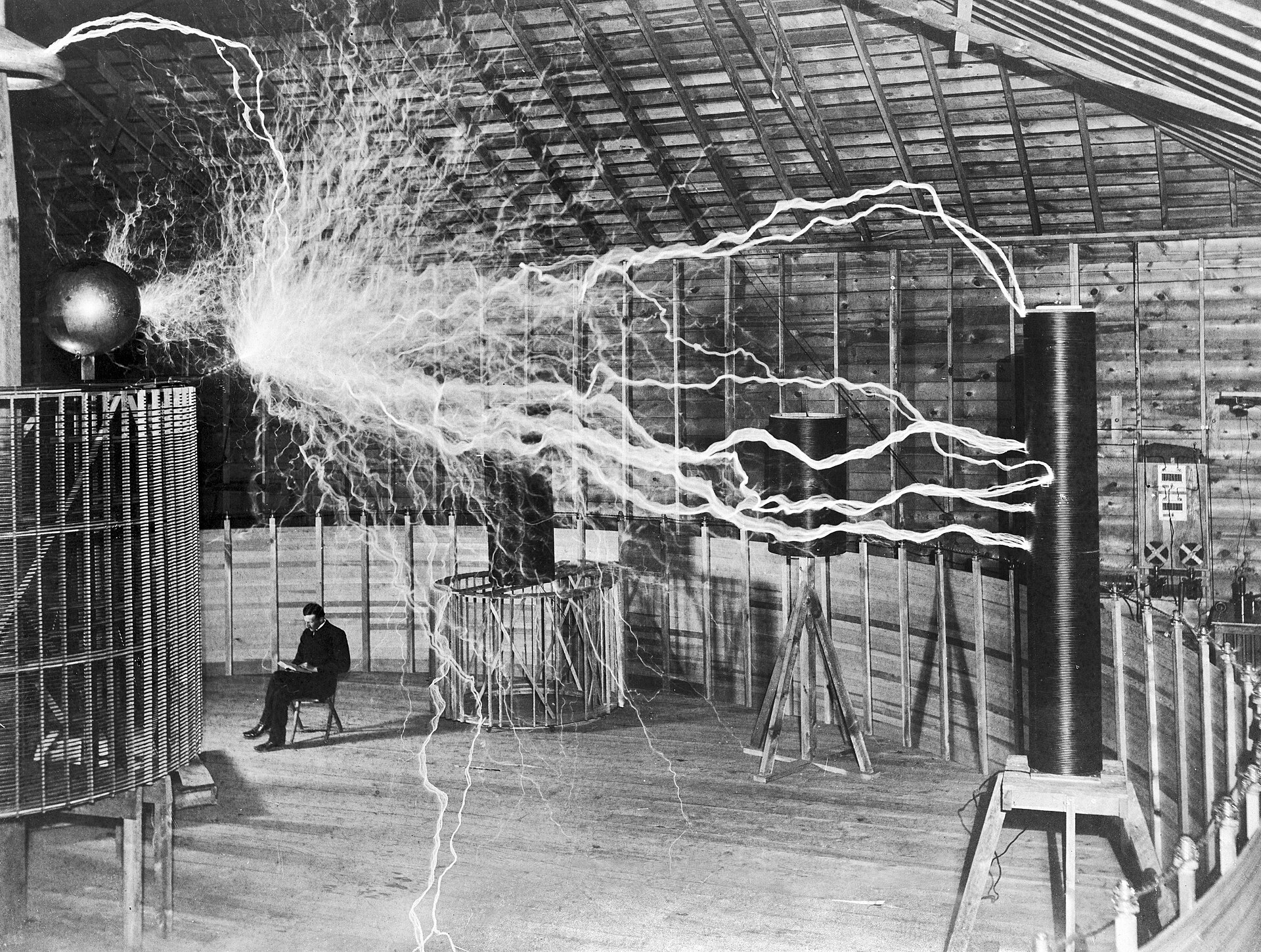

Nikola Tesla (1856–1943) was a Serbian American inventor and engineer, born in Smiljan to a Serbian family and educated at Graz and Prague. He discovered and patented the rotating magnetic field and developed the polyphase alternating-current system that George Westinghouse bought in 1888 — the system that lit the 1893 Chicago World's Fair and carried Niagara's power to Buffalo in 1896. He invented the Tesla coil (1891), held the radio patents that the U.S. Supreme Court upheld over Marconi in 1943, demonstrated the world's first radio-controlled vessel (1898), and conducted the Colorado Springs and Wardenclyffe experiments on wireless power. He died in New York in debt, and his archive — 163,911 call numbers — is preserved in the Nikola Tesla Museum in Belgrade, inscribed by UNESCO in the Memory of the World Register in 2003.
From Smiljan to the New World (1856–1884)
Nikola Tesla was born on 9/10 July 1856 in Smiljan, then in the Austrian Empire and today in Croatia1. His parents, Milutin and Djuka Tesla, were Serbian, and the family lived in the Lika, a mountainous Balkan region2. His father was an Orthodox priest and an intellectual who pushed his son toward unusual mental discipline3, while his mother, unschooled but highly intelligent, built time-saving devices for home and farm, including a mechanical eggbeater Tesla credited for his inventive instincts12.
An early sign of his gift was that he could perform integral calculus in his mind, which made his teachers think he was cheating2. As a boy he saw a steel engraving of Niagara Falls and told an uncle that he would go to America one day and capture the cataract's energy2.
By nineteen he was a star student of electrical engineering at the Imperial and Royal Technical College in Graz4. He dropped out in his third year in 1878, became addicted to gambling, lost all his tuition money and suffered a nervous breakdown4. He worked as a draftsman in Maribor, moved to Prague in 1880, and in 1881 reached Budapest, where Ferenc Puskás hired him to install an Edison telephone exchange3.
Budapest is where the idea came: walking in a park and reciting Goethe's Faust with his friend Antal Szigety, he drew a diagram in the dirt of a motor using rotating magnetic fields created by two or more alternating currents4. In 1882 he joined the Continental Edison Company in Paris, and on assignment to Strasbourg in 1883 he built his first induction motor after hours1.
In June 1884 Tesla sailed for New York, arriving with four cents in his pocket, a few poems, and calculations for a flying machine14. According to Tesla, Edison offered him $50,000 to improve the direct-current plants he favored, then refused to pay, telling him he would appreciate an American joke once he became a full-fledged American4. In 1886 he formed Tesla Electric Light & Manufacturing, and within two years he had applied for more than thirty patents on his system53.
The war of the currents (1887–1893)
In November and December of 1887 Tesla filed seven United States patents covering a complete polyphase system: generators, transformers, transmission lines, motors and lighting6. So original were the ideas that they were issued without a successful challenge, and they would prove the most valuable patents since the telephone6.
In May 1888 George Westinghouse, head of the Westinghouse Electric Company in Pittsburgh, bought the patent rights to Tesla's polyphase system of alternating-current dynamos, transformers and motors1. He purchased the patents for $60,000, including $5,000 in cash and 150 shares of Westinghouse stock, plus royalties on every horsepower of electrical capacity sold6. The sale precipitated a titanic power struggle between Edison's direct current and the Tesla–Westinghouse approach, which eventually won out1; Westinghouse won it at a steep cost in litigation for both sides4.
Edison launched a propaganda war against alternating current: Westinghouse recalled him telling audiences that direct current was like a river flowing peacefully to the sea, while alternating current was like a torrent rushing over a precipice6. To allay public fears, Tesla lit lamps by passing electricity through his own body in laboratory exhibitions1.
The Columbian Exposition opened on 1 May 1893, and when President Grover Cleveland pushed a button, a hundred thousand incandescent lamps lit the fairgrounds6. The City of Light was the work of Tesla, Westinghouse and twelve new thousand-horsepower alternating-current units, with the polyphase system displayed in the Great Hall of Electricity6. The twenty-seven million visitors saw the future plainly, and from then on more than 80 percent of all electrical devices ordered in the United States were for alternating current6.
The induction motor and polyphase power
The principle Tesla visualized in Budapest became the basis of most alternating-current machinery1. His own account places the insight on a park walk, with Goethe's Faust on his lips and a stick tracing the diagram in the dirt4. It was the beginning of the induction motor, his first step toward the successful use of alternating current1.
The paper that set it out — A New System of Alternate Current Motors and Transformers — was read before the American Institute of Electrical Engineers in New York in May 18887. It was written the night before the meeting, in pencil and very hastily, by an overworked and ill Tesla who had been reluctant to give it at all7.
The polyphase system was an architecture rather than a device: generators, transformers, transmission lines, motors and lighting, joined by three-phase transmission61. The Library of Congress dates the first usable alternating-current motor to 18885. In an 1892 London lecture Tesla argued that with oil insulation and alternate-current motors, power could be transmitted safely and on an industrial basis at distances of as much as a thousand miles8. UNESCO calls the system the cornerstone of the modern electro-energetic system9.
Harnessing Niagara (1893–1896)
Since childhood Tesla had dreamed of harnessing Niagara Falls, and in late 1893 the dream became real when Westinghouse was awarded the contract to create the powerhouse10. At the head of the international commission sat Lord Kelvin, as opposed to alternating current as Edison had been — until he attended the Chicago Exposition; converted, he and his commission asked Westinghouse to use alternating current at the falls10.
When the switch was thrown, the first power reached Buffalo at midnight on 16 November 189610. The Niagara Falls Gazette reported that a switch thrown in the big powerhouse had completed a circuit which caused the Niagara River to flow uphill10. The Library of Congress records that the first Niagara Falls hydroelectric plant opened in 1896, designed to convert the falls' energy into electricity5.
The boy who had promised an uncle that he would capture the falls' energy had made good2. Westinghouse pleaded for relief from the contract that granted Tesla generous royalties, and in a magnanimous and history-making gesture, Tesla tore up the contract10. Grateful to the one man who had believed in his invention, he accepted the cost, and recurring financial difficulties followed him for the rest of his life10.
High frequency, the Tesla coil, and the radio wars (1891–1943)
In 1891 Tesla invented the Tesla coil, an induction coil widely used in radio technology and still found in radio and television sets1. Before the turn of the century he had built a powerful coil generating high voltages and frequencies, leading to new forms of light such as neon and fluorescent, and to X-ray work4. Tuned to resonate at the same frequency, the coils could send and receive powerful radio signals, and by early 1895 Tesla was ready to transmit a signal 50 miles to West Point, New York — until a building fire consumed his laboratory and destroyed the work11.
Tesla filed his basic radio patent applications in 1897, beating Guglielmo Marconi to the punch, and they were granted in 1900114. Marconi's first application in America, filed on 10 November 1900, was turned down, and his revisions over the next three years were repeatedly rejected because of the priority of Tesla and other inventors11.
Then, on 12 December 1901, the world awoke to the news that Marconi had signalled the letter S across the Atlantic from Cornwall to Newfoundland12. Asked whether the Italian had got the jump on him, Tesla replied that Marconi was a good fellow and should continue — he was using seventeen of Tesla's patents11. In 1904 the United States Patent Office suddenly reversed its decisions and gave Marconi a patent for radio11. It was not until 1943, months after Tesla's death, that the United States Supreme Court upheld Tesla's patent 645,576, restoring his priority over Marconi11.
Radio control and the 'race of robots' (1898)
In 1898, at an electrical exhibition in the recently completed Madison Square Garden, Tesla demonstrated the world's first radio-controlled vessel13. The crowd saw a small, odd-looking iron-hulled boat scooting across an indoor pond, carrying what Tesla called a borrowed mind13. When skepticism was voiced, he proved his claims before a crowd in Madison Square Garden1.
The working model, the teleautomaton, responded to radio signals and was powered by an internal battery13. His United States patent number 613,809 describes the first device anywhere for wireless remote control13. The Library of Congress records the demonstration as the first remote control device5. When a New York Times writer suggested the boat could submerge and carry dynamite as a weapon, Tesla exploded with a correction: it was not a wireless torpedo but the first of a race of robots, mechanical men which would do the laborious work of the human race13.
Colorado Springs: lightning on the prairie (1899–1900)
With $30,000 from Colonel John Jacob Astor and help from his friend Leonard Curtis, Tesla built an experimental station on the prairie near Pikes Peak, staying from May 1899 until early 1900141. The laboratory was both wired and weird: a roof that rolled back to keep it from catching fire, a wooden tower soaring up eighty feet, and above it a 142-foot mast supporting a large copper ball14.
Bolts of man-made lightning more than a hundred feet long shot from the mast, and one night the experiment burned out the dynamo at the El Paso Electric Company — the entire city lost power14. Britannica records that he also lit 200 lamps without wires from 40 km (25 miles) away, and that his flashes measured 41 metres (135 feet)1. He regarded his most important discovery there to be terrestrial stationary waves: the Earth, he believed, could be used as a conductor and made to resonate at a certain frequency1.
Whether he actually transmitted wireless power at Pikes Peak has never been definitively answered14. He calculated that the resonant frequency of the space between the Earth's surface and the ionosphere was approximately 8 hertz, an idea taken seriously only in the 1950s, when researchers found it in that range14.
Wardenclyffe: the world wireless system (1900–1917)
Returning to New York, Tesla wrote a sensational Century Magazine article describing a means of tapping the sun's energy with an antenna, the control of weather by electrical energy, machines that would make war impossible, and a global system of wireless communications12. He told Morgan that when wireless was fully applied the earth would be converted into a huge brain, capable of response in every one of its parts12. Morgan offered $150,000 to build a transmission tower and power plant — a realistic budget would have been nearer a million — and Tesla went to work immediately12.
Britannica records that Tesla began construction on Long Island in 1900 with the $150,000 from Morgan, and that he claimed to have secured the loan by assigning 51 percent of his telephony and telegraphy patent rights to his backer1. He hired the architect Stanford White of McKim, Mead and White in New York4. By 1901 an enormous tower was rising 187 feet, topped by a fifty-five-ton steel sphere12. Beneath it a well-like shaft plunged 120 feet, and sixteen iron pipes were driven three hundred feet deeper to seize hold of the earth12.
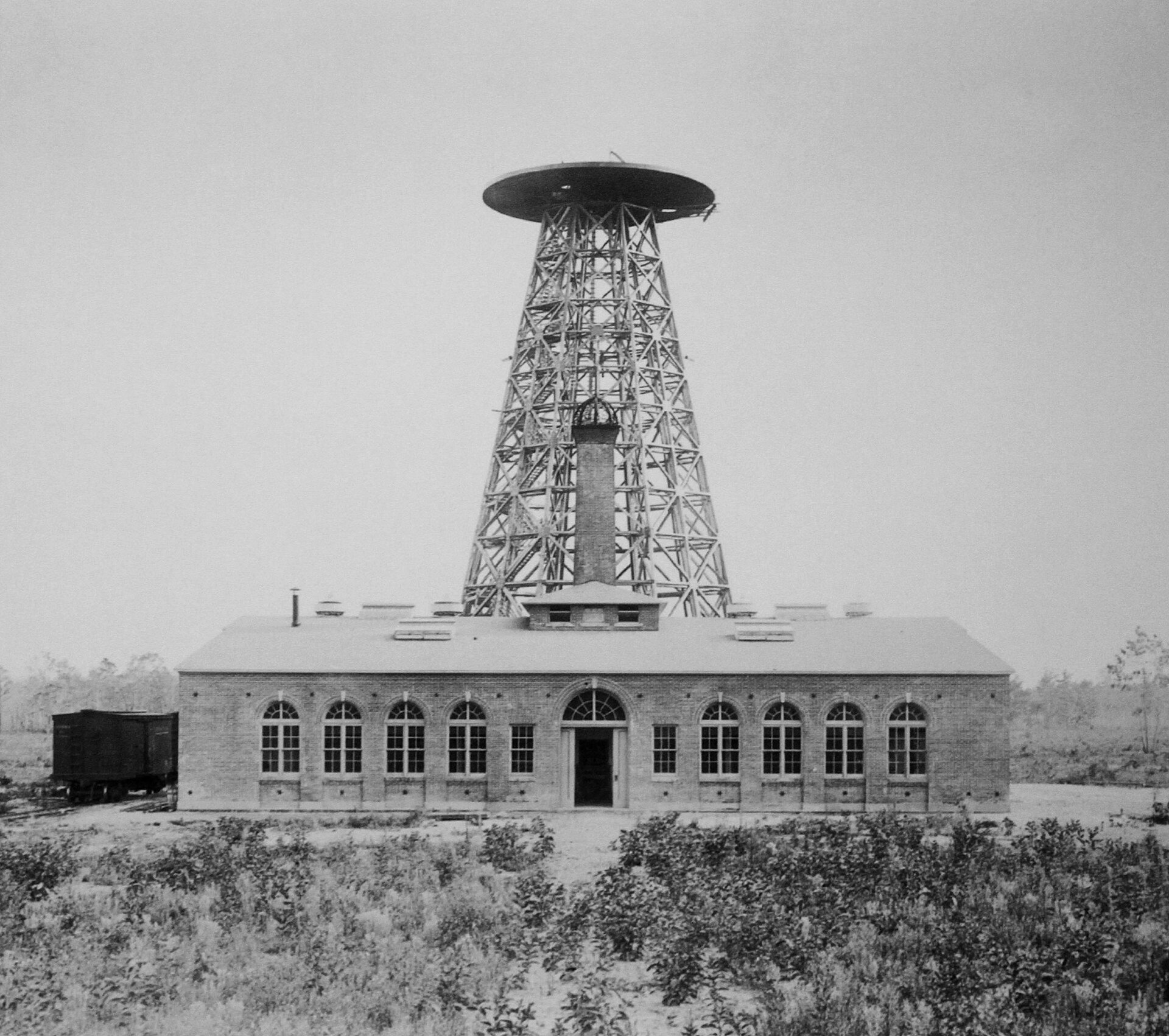

White designed Wardenclyffe Tower in 1901, but soon it became apparent that Tesla would run out of money too quickly, and an appeal to Morgan proved fruitless4. Then, on 12 December 1901, the world awoke to news that Marconi had signalled the letter S across the Atlantic12. Tesla, unruffled, said the Italian had used seventeen Tesla patents — but Morgan began to doubt him12.
In 1905, after some amazing electrical displays, Tesla's team abandoned Wardenclyffe forever, and newspapers called it Tesla's million dollar folly12. Humiliated, he suffered a complete nervous breakdown, protesting that it was not a dream but a simple feat of scientific electrical engineering, expensive only, and blaming a blind, faint-hearted, doubting world12. He lost the lease in 1915, and the tower was razed in 191754.
Tesla's patents: a select table
Tesla was granted more than 100 United States patents1. The table selects the ones that left the deepest mark, with what each is on the record for1.
| Patent | Year | What it is on the record for |
|---|---|---|
| Seven polyphase alternating-current patents | 18876 | A complete system of generators, transformers, transmission lines, motors and lighting; issued without a successful challenge and called the most valuable patents since the telephone6. |
| US 381,968 / 390,414 / 417,794 / 555,190 | — | The alternating-current motor and power-transmission patents that the PBS record links to the polyphase system6. |
| US 613,809 | 189813 | The first device anywhere for wireless remote control — the teleautomaton, which responded to radio signals and was powered by an internal battery13. |
| US 645,576 | 190011 | The radio patent upheld by the United States Supreme Court in 1943, months after Tesla's death, restoring his priority over Marconi11. |
| US 649,621 | 190011 | Cited with patent 645,576 in the United States Patent Office's 1903 rejection of Marconi's claims11. |
| Apparatus for Transmitting Electrical Energy | — | The patent associated with the Wardenclyffe tower, the wireless transmission project on Long Island12. |
| Apparatus for Aerial Transportation | 192815 | His last patent, for an aerial-transport design15. |
Edison and 'free energy': legend against the record
The Edison story is best told the way the record tells it: according to Tesla, Edison offered him $50,000 to improve the direct-current plants he favored, then refused to pay, calling it an American joke a full-fledged American would appreciate4. That version of the rift rests on Tesla's own telling4, and Britannica's sober line is that the two inventors were far apart in background and methods, their separation inevitable1.
Wireless power was Tesla's stated aim in the Century Magazine article that followed Colorado Springs12. What the experiments yielded is another matter: the Colorado results are not clear, and the central question — whether wireless power was actually transmitted at Pikes Peak — has never been definitively answered14. In 1943 the government's examiner John Trump concluded after a three-day investigation that Tesla's recent thinking was speculative, philosophical and promotional in character and offered no new, sound, workable principles or methods for realizing such results16.
The late claims are where the legend thickened: in 1934 the New York Times reported that Tesla was working on a Death Beam capable of knocking 10,000 enemy airplanes out of the sky and making war impossible4. The Soviet Union funded his beam-weapon investigations in 1939 to the tune of $25,000, but the project languished4. Britannica records the caustic criticism that greeted his speculations about other planets, his assertion that he could split the Earth like an apple, and his death-ray claim of 10,000 airplanes destroyed at 400 km (250 miles)1. In 1915 he was severely disappointed when a report that he and Edison would share the Nobel Prize proved erroneous1.
In his own words
Tesla's own sentences were as vivid as his apparatus, and the passages below are reproduced in the exact wording the sources record7. They trace the arc of the life: the flash of insight in Budapest, the wireless earth, the robots, the doubting world12.
An “idea came like a lightning flash.”
Tesla on the Budapest park walk, recorded by Smithsonian Magazine
“When wireless is fully applied the earth will be converted into a huge brain, capable of response in every one of its parts,”
Tesla to Morgan — PBS, Tower of Dreams
“It is not a dream,” he protested. “It is a simple feat of scientific electrical engineering, only expensive... blind, faint-hearted, doubting world.”
Tesla on the loss of Wardenclyffe — PBS, Tower of Dreams
“You do not see there a wireless torpedo, you see there the first of a race of robots, mechanical men which will do the laborious work of the human race.”
Tesla correcting a New York Times reporter, 1898 — PBS, Race of Robots
“Marconi is a good fellow. Let him continue. He is using seventeen of my patents.”
Tesla after Marconi's transatlantic signal, 1901 — PBS, Who Invented Radio?
We are whirling through endless space with an inconceivable speed, all around us everything is spinning, everything is moving, everywhere is energy.
Tesla on drawing energy from the medium — The Inventions, Researches and Writings of Nikola Tesla (Martin, 1894)
He would not stop to reason where it was most likely to be, but would proceed at once, with the feverish diligence of a bee, to examine straw after straw until he found the object of his search.
Tesla on Thomas Edison — Smithsonian Magazine
“The turning of a switch in the big powerhouse at Niagara completed a circuit which caused the Niagara River to flow uphill.”
Niagara Falls Gazette, November 1896 — PBS, Harnessing Niagara
Legacy: the archive, the unit, and the name
Tesla died in New York City on 7 January 1943, alone in a room at the New Yorker Hotel, increasingly reclusive and eccentric3. By the end he was penniless, spending his days in a park among pigeons and working out his inventions in his head, a habit that would confound scholars for years after his death4. After his death the custodian of alien property impounded his trunks — his papers, diplomas and other honors, his letters and his laboratory notes — and these were eventually inherited by his nephew Sava Kosanovich and housed in the Nikola Tesla Museum in Belgrade1.
In 1952 the remaining papers and possessions were released to Sava Kosanovic and returned to Belgrade, where a museum was created in the inventor's honor16. The museum's greatest treasure is Tesla's personal archive — documents, manuscripts, scientific notes, calculations, diagrams, drawings and letters from 1856 to 1943 — amounting to 163,911 call numbers in 548 boxes, catalogued in seven units by subject17. UNESCO calls the collection unique and indispensable to studying the history of electrification of the globe9.
The name persists in units, companies and classrooms: the tesla, the SI unit of magnetic flux density, was named in his honor in 19603. In 2003 the American entrepreneurs Martin Eberhard and Marc Tarpenning founded Tesla Inc., the manufacturer of electric automobiles, solar panels and batteries, in honor of the inventor1. The Library of Congress calls him a genuine poet of electricity, crediting his alternating-current system, his artificial daylight and his interplanetary theories with paving the way for breakthroughs5. As early as 1895, Nature's reviewer called him a young man whose career had been somewhat romantic, and whose ingenuity ranked him very high among the electrical workers and discoverers of the day18.
Timeline
Born in Smiljan
Nikola Tesla is born in Smiljan, then in the Austrian Empire and today in Croatia, to Serbian parents; Britannica records his birth date as July 9/10, 1856.
The rotating-field idea in a Budapest park
Moved to Budapest to work as a draftsman; while walking through a park reciting Goethe's Faust with his friend Antal Szigety, an "idea came like a lightning flash" and Tesla drew a crude diagram in the dirt — a motor using rotating magnetic fields created by two or more alternating currents.
Sails for New York
Tesla sails for New York City, arriving with four cents in his pocket and a letter of recommendation from Charles Batchelor to Edison — and is hired by the Edison works.
Seven polyphase patents filed
Tesla files seven U.S. patents in the field of polyphase AC motors and power transmission — a complete system of generators, transformers, transmission lines, motors and lighting, issued without a successful challenge and later called the most valuable patents since the telephone.
Westinghouse buys the polyphase system
George Westinghouse, head of the Westinghouse Electric Company in Pittsburgh, buys the patent rights to Tesla's polyphase system of alternating-current dynamos, transformers, and motors — precipitating the 'War of the Currents' between Edison's DC and the Tesla–Westinghouse AC approach, which eventually won out.
The Chicago World's Fair lights up on AC
The Columbian Exposition opens: President Grover Cleveland pushes a button and a hundred thousand incandescent lamps illuminate the fairgrounds — the 'City of Light' built by Tesla, Westinghouse and twelve new thousand-horsepower AC generation units. More than 80 percent of all electrical devices ordered in the United States afterwards are for alternating current.
Niagara power reaches Buffalo
When the switch is thrown, the first power from the Niagara Falls project reaches Buffalo at midnight; the Niagara Falls Gazette writes that 'the turning of a switch in the big powerhouse at Niagara completed a circuit which caused the Niagara River to flow uphill.'
The first radio-controlled vessel
At an electrical exhibition in Madison Square Garden, Tesla demonstrates the world's first radio-controlled vessel — an iron boat he described as having 'a borrowed mind' — and patents it under U.S. patent 613,809, the first device anywhere for wireless remote control.
Colorado Springs experimental station
With $30,000 from Colonel John Jacob Astor and help from his friend Leonard E. Curtis, Tesla builds an experimental station near Pikes Peak: a laboratory with a roll-back roof, an eighty-foot wooden tower and a 142-foot mast. His experiments produce man-made lightning more than a hundred feet long and burn out the dynamo at the El Paso Electric Company, blacking out the city.
Wardenclyffe rises; Marconi spans the Atlantic
Construction of the Wardenclyffe tower — 187 feet high, topped by a fifty-five-ton steel sphere — proceeds on Long Island with $150,000 from J. P. Morgan. On 12 December, Marconi signals the letter 'S' across the Atlantic; Tesla explains that the Italian is using seventeen of his patents, but Morgan begins to doubt.
Wardenclyffe abandoned — 'Tesla's million dollar folly'
After some amazing electrical displays, Tesla and his team abandon the Wardenclyffe project forever; newspapers call it 'Tesla's million dollar folly.' Humiliated and defeated, he suffers a complete nervous breakdown: 'It is not a dream,' he protests. 'It is a simple feat of scientific electrical engineering, only expensive... blind, faint-hearted, doubting world.'
The Nobel rumor
Tesla is severely disappointed when a report that he and Edison were to share the Nobel Prize proves erroneous — a story Britannica records as one of the myths attached to his later years.
The Edison Medal
Tesla is the recipient of the Edison Medal, the highest honor that the American Institute of Electrical Engineers could bestow, for his early original work in polyphase and high-frequency electrical currents.
The 'Death Beam'
The New York Times reports that Tesla is working on a 'Death Beam' capable of knocking 10,000 enemy airplanes out of the sky; Tesla says that when put in operation, this latest invention of his would make war impossible, surrounding countries like an impenetrable, invisible wall.
Death in New York
Tesla dies in New York City. After his death the custodian of alien property impounds his trunks — papers, diplomas, letters and laboratory notes — which are eventually inherited by his nephew Sava Kosanovich and later housed in the Nikola Tesla Museum in Belgrade.
The Supreme Court upholds his radio patent
A few months after Tesla's death, the U.S. Supreme Court upholds Tesla's radio patent number 645,576 — the Marconi Company had been suing the United States Government over its patents, and the Court avoided the action by restoring the priority of Tesla's patent over Marconi's.
Frequently asked questions
Where and when was Nikola Tesla born?
Tesla was born on 9/10 July 1856 in Smiljan, then a village of the Austrian Empire and today part of Croatia1. His parents, Milutin and Djuka Tesla, were Serbian, and the family lived in the Lika region of the Balkan Peninsula2.
What did Tesla discover that made his name?
He discovered and patented the rotating magnetic field, the basis of most alternating-current machinery1. He also developed the three-phase system of electric power transmission, which UNESCO calls the cornerstone of the modern electro-energetic system19.
Why did Tesla and Edison fall out?
According to Tesla, Edison promised him $50,000 for improving the direct-current generation plants he favored and then refused to pay, calling it an American joke a full-fledged American would appreciate4. Britannica adds a deeper reason: the two inventors were far apart in background and methods, and their separation was inevitable1.
Who won the war of the currents?
Alternating current, and with it the Tesla–Westinghouse approach, eventually won out1. After the Chicago World's Fair of 1893, more than 80 percent of all electrical devices ordered in the United States were for alternating current6.
Did Marconi really invent radio?
Tesla filed his basic radio patent applications in 1897 and they were granted in 1900, while Marconi's first application in America was turned down and his revisions were repeatedly rejected because of Tesla's priority11. In 1943, a few months after Tesla's death, the United States Supreme Court upheld Tesla's radio patent number 645,576, restoring his priority over Marconi11.
Did Tesla really transmit wireless power?
The question has never been definitively answered: PBS records that though he kept a detailed day-to-day diary at Colorado Springs, the results of his experiments are not clear14. A 1943 examination of his seized papers found no new, sound, workable principles or methods for realizing wireless power16.
Was Tesla ever awarded a Nobel Prize?
No: in 1915 he was severely disappointed when a report that he and Edison were to share the Nobel Prize proved erroneous1. He was the recipient of the Edison Medal, the highest honor that the American Institute of Electrical Engineers could bestow1.
What happened to Tesla's papers after his death?
They were impounded by the custodian of alien property, inherited by his nephew Sava Kosanovich, and eventually housed in the Nikola Tesla Museum in Belgrade1. In 1952 the remaining papers and possessions were returned to Belgrade, where the museum was created in his honor16. The archive holds 163,911 call numbers in 548 boxes, inscribed by UNESCO in the Memory of the World Register in 2003179.
Knowledge graph
Sources & citations
Every factual claim in this article is drawn from the sources below. Bracketed numbers in the text link to the corresponding source.
- 1
- 2
- 3
- 4
- 5
- 6
- 7
- 8
- 9
- 10
- 11
- 12
- 13
- 14
- 15
- 16
- 17
- 18