Nelson Mandela
Anti-apartheid leader, prisoner for 27 years, Nobel laureate and South Africa's first democratically elected president — the documented arc from Mvezo to the Union Buildings.
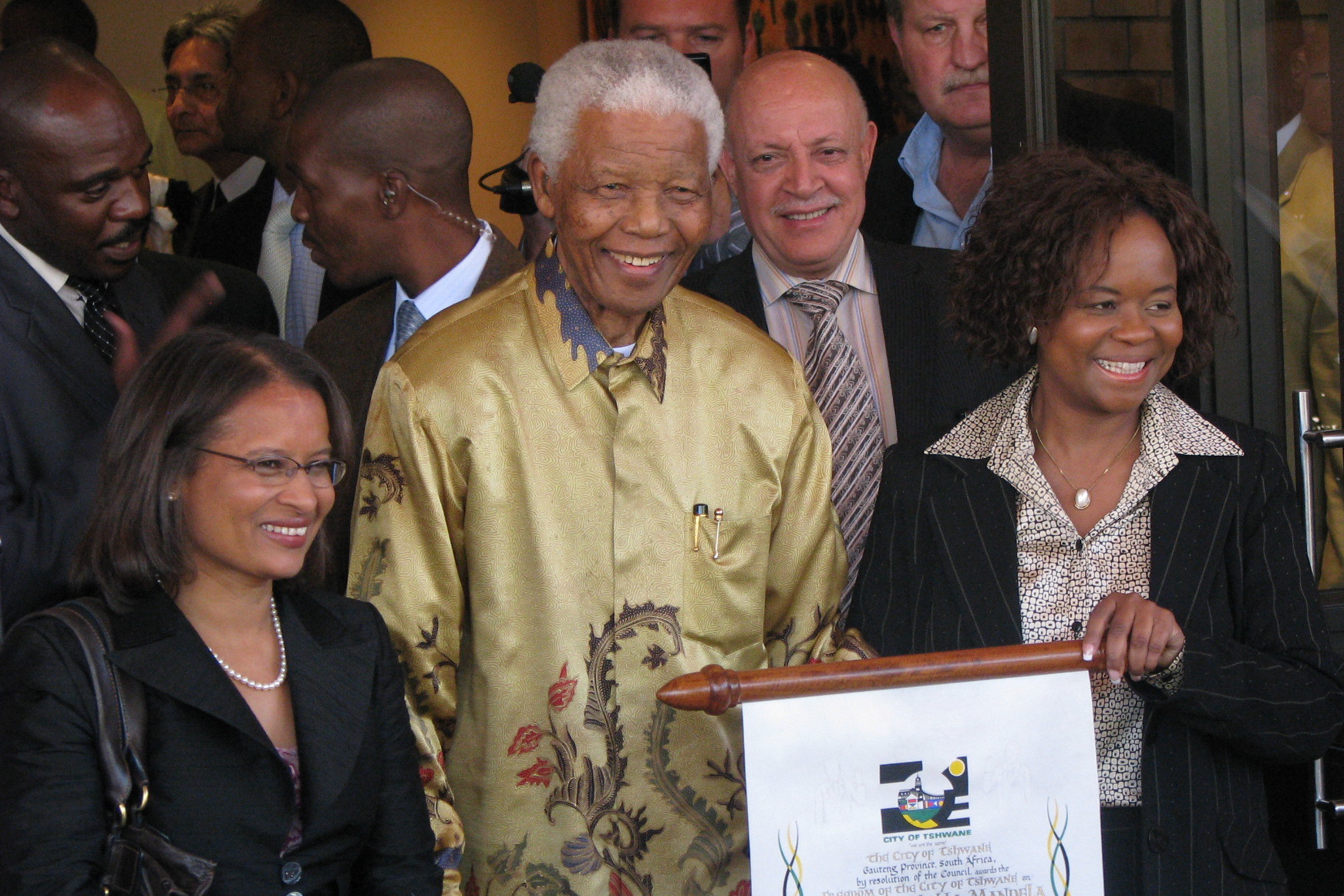
Nelson Mandela (18 July 1918 – 5 December 2013) was a South African anti-apartheid leader, a prisoner for more than 27 years, and the first Black president of South Africa (1994–99). Born into the Madiba clan at Mvezo in the Eastern Cape, he was expelled from Fort Hare after a student protest, joined the ANC in 1944, helped found its Youth League and, with Oliver Tambo, South Africa's first Black law firm. After the Sharpeville massacre of 1960 and the banning of the ANC, he helped establish the armed wing Umkhonto we Sizwe, went underground, and was sentenced to life imprisonment at the Rivonia Trial in 1964. Released on 11 February 1990, he negotiated the end of apartheid with President F.W. de Klerk; the two shared the 1993 Nobel Peace Prize. He voted for the first time in his life in April 1994, was inaugurated on 10 May 1994, stepped down in 1999, and died at his home in Johannesburg on 5 December 2013.
From Mvezo to the world stage
Nelson Mandela was born on July 18, 1918, in Mvezo, South Africa, and died on December 5, 2013, in Johannesburg.1 He was 95 years old at his death.2 He was a Black nationalist and the first Black president of South Africa (1994–99).1 In the early 1990s his negotiations with President F.W. de Klerk helped end the country’s apartheid system of racial segregation and ushered in a peaceful transition to majority rule, and the two men were jointly awarded the Nobel Prize for Peace in 1993.1
Mandela is perhaps best known for leading the resistance to apartheid in the 20th century, during which he was incarcerated at Robben Island Prison (1964–82).1 During his imprisonment he became a rallying point for South Africa’s oppressed and the world’s most famous political prisoner.3 He was arrested on several occasions, stood trial four times, and spent over 27 years in prison.4 He was one of the founders of Umkhonto we Sizwe, the military wing of the ANC.1
In 1952, in Johannesburg, he and fellow ANC leader Oliver Tambo established South Africa’s first Black law practice, specializing in cases resulting from the post-1948 apartheid legislation.1 His speech from the dock was published as I Am Prepared to Die, and his books include the memoir Long Walk to Freedom (1994) and Dare Not Linger: The Presidential Years (2017, completed by Mandla Langa).1
Early life and education: the Madiba clan and Fort Hare
Rolihlahla Mandela was born into the Madiba clan in the village of Mvezo, in the Eastern Cape, on 18 July 1918.5 His mother was Nonqaphi Nosekeni, and his father was Nkosi Mphakanyiswa Gadla Mandela, principal counsellor to the acting king of the Thembu, Jongintaba Dalindyebo.5 At primary school in Qunu his teacher, Miss Mdingane, gave him the name Nelson, following the custom of giving schoolchildren Christian names.5
In 1930, when he was 12 years old, his father died, and the young Rolihlahla became a ward of Jongintaba at the Great Place in Mqhekezweni.5 Raised by the regent Jongintaba after his father’s death, he renounced his claim to the chieftainship in order to become a lawyer.1 The Nobel record describes him as the son of a chief who studied law and became one of South Africa’s first black lawyers.3
He began a Bachelor of Arts degree at the University College of Fort Hare but did not complete it there, as he was expelled for joining a student protest.5 Nelson Mandela University’s record dates the expulsion to 1940 and notes that he met Oliver Tambo at Fort Hare and became involved in student politics there.6 Fort Hare’s own history counts him among politically active alumni who have impacted their nations, alongside Oliver Tambo, Govan Mbeki, Robert Sobukwe and Mangosuthu Buthelezi.7 He ran away to Johannesburg with his cousin, arriving there in 1941.5
He attended the South African Native College — later the University of Fort Hare — and studied law at the University of the Witwatersrand, later passing the qualification exam to become a lawyer.1 The Nobel Foundation’s biographical record likewise notes his education at University College of Fort Hare and the University of Witwatersrand, where he studied law.8 The full degree came only in 1989: while in the last months of his imprisonment he obtained an LLB through the University of South Africa and graduated in absentia at a ceremony in Cape Town.5
Joining the struggle: the ANC and the Youth League
Mandela was increasingly politically involved from 1942, and in 1944 he joined the African National Congress when he helped to form the ANC Youth League.5 He became a leader of that Youth League.1 That same year he married Walter Sisulu’s cousin, Evelyn Mase, a nurse.5
They had two sons, Thembekile “Thembi” and Makgatho, and two daughters both called Makaziwe, the first of whom died in infancy.5 He and his wife divorced in 1958.5 After 1948 he engaged in resistance against the ruling National Party’s apartheid policies.8
In Johannesburg, where he had arrived in 1941, he met the estate agent Walter Sisulu, who introduced him to Lazer Sidelsky.5 He then did his articles through the firm of attorneys Witkin, Eidelman and Sidelsky.5 In 1943, as South Africa’s government history records, the launch of the ANC Youth League was a development that was to foster the leadership of people such as Nelson Rolihlahla Mandela, Oliver Tambo and Walter Sisulu.2
Defiance, banning and the Treason Trial
In 1952 Mandela was chosen as the National Volunteer-in-Chief of the Defiance Campaign, a campaign of civil disobedience against six unjust laws run jointly by the ANC and the South African Indian Congress.5 He played an important role in launching the defiance against the pass laws, which required nonwhites to carry documents authorizing their presence in areas the government deemed restricted.1 He and 19 others were charged under the Suppression of Communism Act for their part in the campaign and sentenced to nine months of hard labour, suspended for two years.5
In August 1952 he and Oliver Tambo established Mandela & Tambo, South Africa’s first black-owned law firm in the 1950s.5 At the end of 1952 he was banned for the first time.5 As a restricted person he was only permitted to watch in secret as the Freedom Charter was adopted in Kliptown on 26 June 1955.5
On 5 December 1956 Mandela was arrested in a countrywide police swoop, which led to the 1956 Treason Trial.5 Men and women of all races were in the dock in a trial that only ended when the last 28 accused, including Mandela, were acquitted on 29 March 1961.5 The Nobel biography records that he went on trial for treason in 1956–1961 and was acquitted in 1961.8 During the trial he married the social worker Winnie Madikizela, on 14 June 1958.5
On 21 March 1960 police killed 69 unarmed people in a protest in Sharpeville against the pass laws.5 This led to the country’s first state of emergency and the banning of the ANC and the Pan Africanist Congress (PAC) on 8 April.5 After the massacre and the banning of the ANC, Mandela abandoned his nonviolent stance and began advocating acts of sabotage against the South African regime.1
The turn to armed struggle and the Rivonia Trial
When South Africa’s white minority government prohibited the ANC in 1960, Mandela became convinced that armed struggle was inevitable.3 Inspired by the guerrilla wars in Algeria and Cuba, he organized a military underground movement that engaged in sabotage.3 He went underground, during which time he became known as the Black Pimpernel for his ability to evade capture.1 He was one of the founders of Umkhonto we Sizwe, the military wing of the ANC.1
In June 1961 the ANC executive considered his proposal on the use of violent tactics and agreed that those members who wished to involve themselves in his campaign would not be stopped from doing so by the ANC; this led to the formation of Umkhonto we Sizwe.8 Asked to lead the armed struggle, he helped to establish the organization.5 Umkhonto weSizwe launched on 16 December 1961 with a series of explosions.5
On 11 January 1962, using the adopted name David Motsamayi, Mandela secretly left South Africa, travelled around Africa and visited England to gain support for the armed struggle.5 He received military training in Morocco and Ethiopia and returned to South Africa in July 1962.5 He was arrested in a police roadblock outside Howick on 5 August while returning from KwaZulu-Natal, where he had briefed ANC President Chief Albert Luthuli about his trip.5 He was subsequently sentenced to five years in prison.1
In October 1963 the imprisoned Mandela and several other men were tried for sabotage, treason and violent conspiracy in the Rivonia Trial, named after a Johannesburg suburb where raiding police had discovered quantities of arms and equipment at the headquarters of the underground Umkhonto we Sizwe.1 He had joined 10 others on trial for sabotage on 9 October 1963, after police raided Liliesleaf, a secret hideout in Rivonia used by ANC and Communist Party activists.5 On 11 June 1964 Mandela and seven other accused were convicted, and the next day they were sentenced to life imprisonment.5 He narrowly escaped the death penalty.1 Among the seven were Walter Sisulu, Ahmed Kathrada, Govan Mbeki, Raymond Mhlaba, Denis Goldberg, Elias Motsoaledi and Andrew Mlangeni; Goldberg was sent to Pretoria Prison because he was white, while the others went to Robben Island.5
The speech from the dock
Facing the death penalty at the Rivonia Trial, Mandela delivered his famous speech from the dock on 20 April 1964.5 In it he admitted the truth of some of the charges made against him; the address was received as a classic defense of liberty against tyranny that gained international attention and was published later that year as I Am Prepared to Die.1
I have fought against white domination, and I have fought against black domination. I have cherished the ideal of a democratic and free society in which all persons live together in harmony and with equal opportunities. It is an ideal which I hope to live for and to achieve. But if needs be, it is an ideal for which I am prepared to die.5
Speech from the dock, Rivonia Trial, 20 April 1964
It is easy to break down and destroy. The heroes are those who make peace and build.9
Nelson Mandela, quoted by the United Nations
Fort Hare…was a beacon for African scholars from all over Southern, Central and Eastern Africa. For young black South Africans like myself, it was Oxford and Cambridge, Harvard and Yale, all rolled into one.7
Nelson Mandela, Long Walk to Freedom, quoted in the University of Fort Hare’s history
Twenty-seven years: Robben Island to Victor Verster
From 1964 to 1982 Mandela was confined to Robben Island, together with several other resistance leaders, and was then moved to prison on the mainland.3 He spent 18 years on the island.10 On 31 March 1982 he was transferred to Pollsmoor Prison in Cape Town with Sisulu, Mhlaba and Mlangeni, and Kathrada joined them in October.5
While at Pollsmoor Prison in Cape Town in 1985 he had to go to hospital, and a visit from Justice Minister Kobie Coetsee gave him the idea to see whether the government wanted to talk about one day meeting with the ANC.10 On 12 August 1988 he was taken to hospital, where he was diagnosed with tuberculosis.5 After more than three months in two hospitals he was transferred on 7 December 1988 to a house at Victor Verster Prison near Paarl, where he spent his last 14 months of imprisonment.5
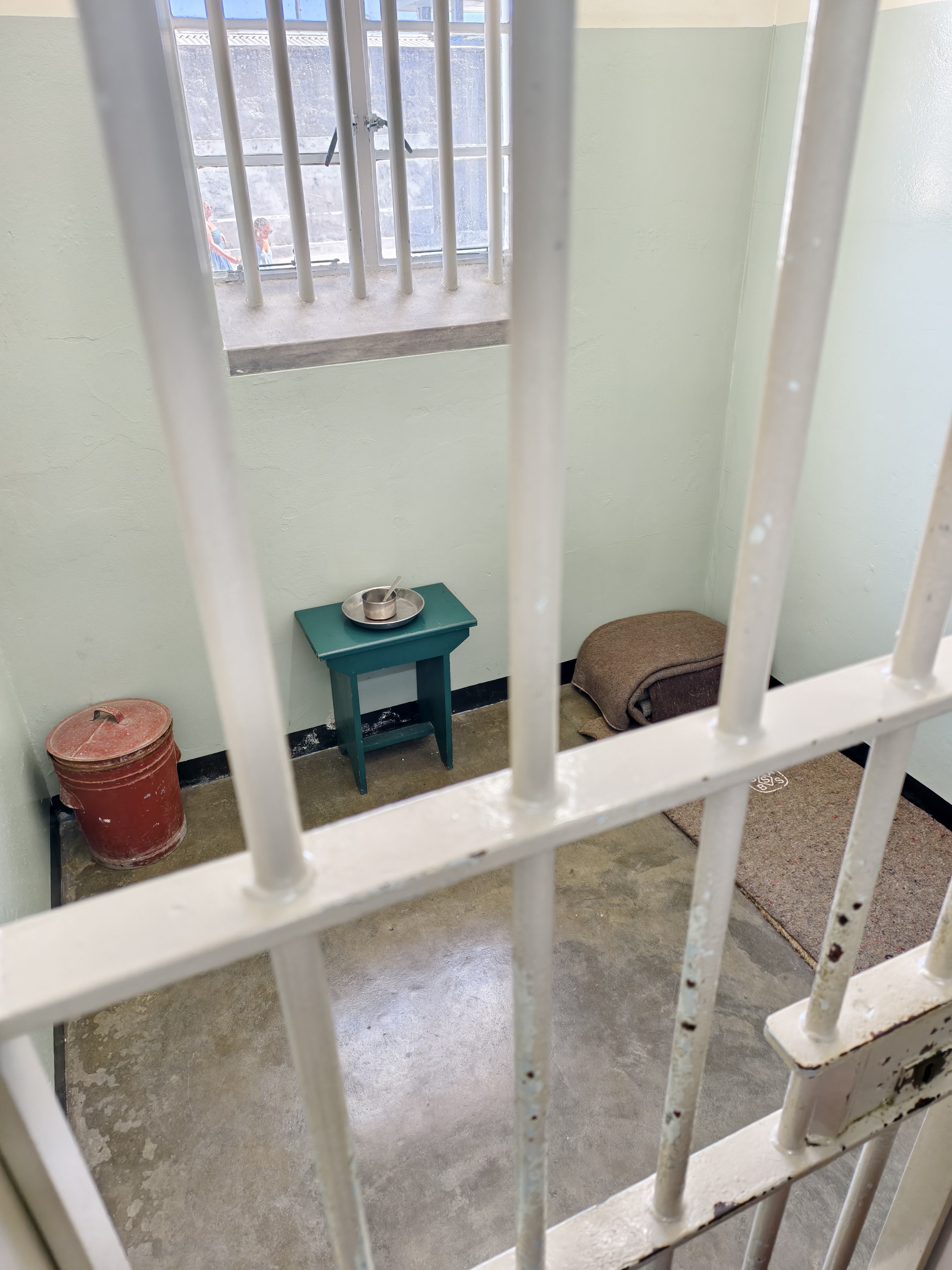
Prison also carried personal costs: his mother died in 1968 and his eldest son, Thembi, in 1969, and he was not allowed to attend their funerals.5 He consistently refused to compromise his political position to obtain his freedom.8 Throughout his imprisonment he had rejected at least three conditional offers of release.5
Release and the negotiated transition, 1990–1994
Mandela was released on 11 February 1990.8 After his release he immersed himself in official talks to end white minority rule, and in 1991 he was elected ANC President, replacing his ailing friend Oliver Tambo.5 He was elected at the first national conference of the ANC held inside South Africa after the organization had been banned in 1960, while Oliver Tambo became the organization’s National Chairperson.8
Mandela shared the 1993 Peace Prize with the man who had released him, President Frederik Willem de Klerk, because they had agreed on a peaceful transition to majority rule.35 The Norwegian Nobel Committee awarded the prize to the two men for their work for the peaceful termination of the apartheid regime, and for laying the foundations for a new democratic South Africa.11 From their different points of departure, they had reached agreement on principles for a transition to a new political order based on the tenet of one man–one vote.11 By looking ahead to South African reconciliation instead of back at the deep wounds of the past, the committee said, they had shown personal integrity and great political courage.11
South Africa held its first democratic election in April 1994 under an interim Constitution.2 The ANC emerged with a 62% majority, and under the interim Constitution the NP and Inkatha Freedom Party participated in a government of national unity under President Mandela, South Africa’s first democratically elected president.2 The negotiated path was contested from within: the scholar Shireen Hassim writes that Winnie Madikizela-Mandela exemplified the radical rejection of political negotiations in South Africa and supported an accelerated and, if necessary, violent confrontation with the apartheid government.12
Nobel Peace Prize 1993: the Oslo lecture
The Nobel Peace Prize 1993 was awarded jointly to Nelson Mandela and Frederik Willem de Klerk, each with a prize share of one half.13 Mandela held his Nobel Lecture on 10 December 1993, in the Oslo City Hall, Norway.14 In the lecture he paid tribute to the previous Nobel laureates Albert Lutuli and Desmond Tutu, who had made important contributions to progress towards racial equality in South Africa.11
We stand here today as nothing more than a representative of the millions of our people who dared to rise up against a social system whose very essence is war, violence, racism, oppression, repression and the impoverishment of an entire people.14
Nobel Lecture, Oslo City Hall, 10 December 1993
In it he said the children must, at last, play in the open veld, no longer tortured by hunger or ravaged by disease.14 He appealed to those who govern Burma to release his fellow Nobel Peace Prize laureate Aung San Suu Kyi and engage her and those she represents in serious dialogue.14 He paid tribute to his joint laureate: de Klerk, he said, had had the courage to admit that a terrible wrong had been done to the country and its people through the imposition of the system of apartheid.14
President of South Africa, 1994–1999
On 10 May 1994 Mandela was inaugurated as South Africa’s first democratically elected president.5 True to his promise, he stepped down in 1999 after one term as President.5 He continued to work with the Nelson Mandela Children’s Fund he had set up in 1995, and he established the Nelson Mandela Foundation and the Mandela Rhodes Foundation.5
The scholar Willie J. Breytenbach assesses the South African transition after the dismantling of apartheid and the negotiations for a new constitution.15 He points out that the process was pact-driven and that one of the principal compromises was the consensus about the desirability of a post-apartheid market economy.15 His analysis finds the positives outweighing the negatives from a consolidation point of view — most notably the stable transition and remarkable reconciliation, an independent judiciary and media freedom.15
The longer view is one of exemplary significance: as well as being a remarkable statesman and one of the world’s longest-detained political prisoners, Mandela became an exemplary figure of non-racialism and democracy.16 His faith, spiritual development and noble purpose have been read through the lens of Ubuntu, the African ethic of community, unity, humanity and harmony.17 One study argues that he dedicated his life to fighting for the freedom of his South African kin of all colors against apartheid, spending twenty-seven years fighting from within prison and gaining his freedom only when his fellow South Africans could claim it as well.17
Retirement, death and legacy
On his 80th birthday in 1998 he married Graça Machel, his third wife.5 She was the widow of Samora Machel, former president of Mozambique, and was Mandela’s wife at the time of his death in 2013.1 Mandela had three wives: Evelyn Ntoko Mase (1944–58), Winnie Madikizela-Mandela (1958–96), and Graça Machel (1998–2013).1
Mandela died at his home in Johannesburg on 5 December 2013, at the age of 95.2 His body lay in state at the Union Buildings from 11 to 13 December, and he was buried in his home town of Qunu in the Eastern Cape on 15 December 2013.2 Numerous memorial services were held, including one by the South African government on December 10.1
In November 2009 the UN General Assembly declared 18 July “Nelson Mandela International Day”, in recognition of his contribution to the culture of peace and freedom.9 Resolution A/RES/64/13 recognized his values and his dedication to the service of humanity in conflict resolution, race relations, human rights, reconciliation, gender equality and the rights of children, the fight against poverty and the promotion of social justice.9
In December 2015 the UN General Assembly adopted the revised United Nations Standard Minimum Rules for the Treatment of Prisoners and approved that they should be known as “the Nelson Mandela Rules”, to honour the late president who spent 27 years in prison.18 The 122 provisions of the Nelson Mandela Rules represent the universally acknowledged blueprint for prison management in the 21st century.19 In 2024 the University of Fort Hare was inscribed as a UNESCO World Heritage Site — the first higher education institution in Africa on the list — as part of 14 sites in South Africa known as the “Nelson Mandela Legacy Sites”.7 The United Nations describes Mandela as a man who devoted his life to the service of humanity, as a human rights lawyer, a prisoner of conscience, an international peacemaker and the first democratically elected president of a free South Africa.9
Timeline: the life in dated milestones
The table records the documented milestones of Mandela’s life as the fact base dates them, from the Madiba clan’s Mvezo of 1918 to the funeral at Qunu in 2013.52
| Date | Milestone |
|---|---|
| 18 July 1918 | Rolihlahla Mandela is born into the Madiba clan in Mvezo, in the Eastern Cape. 5 |
| 1940 | He is expelled from Fort Hare University College after participating in a student protest, having met Oliver Tambo there. 6 |
| 1944 | He joins the ANC when he helps form the ANC Youth League, and marries the nurse Evelyn Mase. 5 |
| 1952 | National Volunteer-in-Chief of the Defiance Campaign; in August he and Oliver Tambo establish Mandela & Tambo; at the end of the year he is banned for the first time. 5 |
| 5 December 1956 | Arrested in a countrywide police swoop, opening the Treason Trial; the last 28 accused, including Mandela, are acquitted on 29 March 1961. 5 |
| 16 December 1961 | Umkhonto weSizwe launches with a series of explosions, after he is asked in June 1961 to lead the armed struggle. 5 |
| 5 August 1962 | Arrested at a police roadblock outside Howick after military training in Morocco and Ethiopia and a secret journey abroad as David Motsamayi. 5 |
| 9 October 1963 | Joins 10 others on trial for sabotage — the start of the Rivonia Trial — after the police raid on Liliesleaf. 5 |
| 20 April 1964 | Delivers his speech from the dock, saying he had cherished the ideal of a democratic and free society and was prepared to die for it if necessary. 5 |
| 12 June 1964 | Sentenced to life imprisonment the day after being convicted with seven co-accused, narrowly escaping the death penalty. 1 |
| 31 March 1982 | Transferred to Pollsmoor Prison in Cape Town with Walter Sisulu, Raymond Mhlaba and Andrew Mlangeni, after 18 years on Robben Island. 5 |
| 7 December 1988 | Moved to a house at Victor Verster Prison near Paarl, where he spends his last 14 months of imprisonment. 5 |
| 11 February 1990 | Released, nine days after the unbanning of the ANC and the PAC and nearly four months after the release of his remaining Rivonia comrades. 5 |
| 10 December 1993 | Shares the Nobel Peace Prize with F.W. de Klerk and delivers his Nobel Lecture in the Oslo City Hall. 14 |
| 10 May 1994 | Inaugurated as South Africa’s first democratically elected president, after voting for the first time in his life on 27 April. 5 |
| 5 December 2013 | Dies at his home in Johannesburg at the age of 95; his body lies in state at the Union Buildings from 11 to 13 December and is buried at Qunu on 15 December. 2 |
Timeline
Birth at Mvezo
Rolihlahla Mandela is born into the Madiba clan in Mvezo, Eastern Cape; his teacher Miss Mdingane later gives him the name Nelson at primary school in Qunu.
Expelled from Fort Hare
Mandela studies at Fort Hare University College, meets Oliver Tambo, becomes involved in student politics and is expelled in 1940 after a student protest.
Joins the ANC and helps found the Youth League
Mandela joins the African National Congress when he helps form the ANC Youth League; that year he marries the nurse Evelyn Mase.
Defiance Campaign, Mandela & Tambo, and first banning
Mandela serves as National Volunteer-in-Chief of the Defiance Campaign and is sentenced to a suspended term; in August he and Oliver Tambo establish Mandela & Tambo; at the end of the year he is banned for the first time.
Arrested; the Treason Trial opens
A countrywide police swoop leads to the Treason Trial; the last 28 accused, including Mandela, are acquitted on 29 March 1961.
Umkhonto weSizwe launches
Asked in June 1961 to lead the armed struggle, Mandela helps establish Umkhonto weSizwe, which launches with a series of explosions on 16 December 1961.
Arrested outside Howick
After military training in Morocco and Ethiopia and a secret journey abroad as 'David Motsamayi', Mandela is arrested at a police roadblock outside Howick while returning from KwaZulu-Natal.
The Rivonia Trial begins
After the police raid on Liliesleaf farm, Mandela joins 10 others on trial for sabotage in what became known as the Rivonia Trial.
Speech from the dock
Facing the death penalty, Mandela delivers his famous speech from the dock, saying he had cherished the ideal of a democratic and free society and was prepared to die for it if necessary.
Sentenced to life imprisonment
Convicted on 11 June with seven co-accused, Mandela is sentenced the next day to life imprisonment, narrowly escaping the death penalty.
Transferred to Pollsmoor Prison
After 18 years on Robben Island, Mandela is transferred to Pollsmoor Prison in Cape Town with Walter Sisulu, Raymond Mhlaba and Andrew Mlangeni.
Moved to Victor Verster Prison
Diagnosed with tuberculosis in August, Mandela spends more than three months in two hospitals and is moved to a house at Victor Verster Prison near Paarl, where he spends his last 14 months of imprisonment.
Released from prison
Mandela walks free from Victor Verster, nine days after the unbanning of the ANC and the PAC and nearly four months after the release of his remaining Rivonia comrades.
Nobel Peace Prize ceremony
Mandela shares the Nobel Peace Prize with F.W. de Klerk and delivers his Nobel Lecture in the Oslo City Hall.
Inaugurated as president
After voting for the first time in his life on 27 April, Mandela is inaugurated as South Africa's first democratically elected president.
Death in Johannesburg
Mandela dies at his home in Johannesburg at the age of 95; he lies in state at the Union Buildings from 11 to 13 December and is buried at Qunu on 15 December.
Frequently asked questions
Who was Nelson Mandela?
He was a Black nationalist and the first Black president of South Africa, serving from 1994 to 1999.1 He was one of the founders of Umkhonto we Sizwe, the military wing of the ANC, and was incarcerated at Robben Island Prison from 1964 to 1982.1
When and where was Nelson Mandela born?
Rolihlahla Mandela was born into the Madiba clan in the village of Mvezo, in the Eastern Cape, on 18 July 1918.5 He died on 5 December 2013 in Johannesburg, at the age of 95.12
How long was Nelson Mandela in prison?
He was arrested on several occasions, stood trial four times, and spent over 27 years in prison.4 He spent 18 years on Robben Island.10
Why was Mandela arrested in 1962?
He was arrested in a police roadblock outside Howick on 5 August, while returning from KwaZulu-Natal, where he had briefed ANC President Chief Albert Luthuli about his trip.5 He was subsequently sentenced to five years in prison.1
What was the Rivonia Trial?
In October 1963 the imprisoned Mandela and several other men were tried for sabotage, treason and violent conspiracy in the Rivonia Trial, named after a Johannesburg suburb where raiding police had discovered quantities of arms and equipment at the headquarters of the underground Umkhonto we Sizwe.1 He was sentenced to life imprisonment on 12 June 1964, narrowly escaping the death penalty.1
Why did Mandela and de Klerk win the Nobel Peace Prize?
The Norwegian Nobel Committee awarded the 1993 Peace Prize to them for their work for the peaceful termination of the apartheid regime, and for laying the foundations for a new democratic South Africa.11 From their different points of departure, the two men had reached agreement on principles for a transition to a new political order based on the tenet of one man–one vote.11
When was Mandela released, and when did he become president?
He was released on 11 February 1990, nine days after the unbanning of the ANC and the PAC.5 He was inaugurated on 10 May 1994 as South Africa’s first democratically elected president.5
What are the Nelson Mandela Rules?
In December 2015 the UN General Assembly adopted the revised United Nations Standard Minimum Rules for the Treatment of Prisoners and approved that they should be known as “the Nelson Mandela Rules”, to honour the late president who spent 27 years in prison.18 Their 122 provisions represent the universally acknowledged blueprint for prison management in the 21st century.19
Knowledge graph
Sources & citations
Every factual claim in this article is drawn from the sources below. Bracketed numbers in the text link to the corresponding source.
- 1
- 2
- 3
- 4
- 5
- 6
- 7
- 8
- 9
- 10
- 11
- 12
- 13
- 14
- 15
- 16
- 17
- 18
- 19