Amelia Earhart
First woman to fly solo across the Atlantic, record-setter of the 1930s — and the 1937 Pacific disappearance that archives, not speculation, must explain.
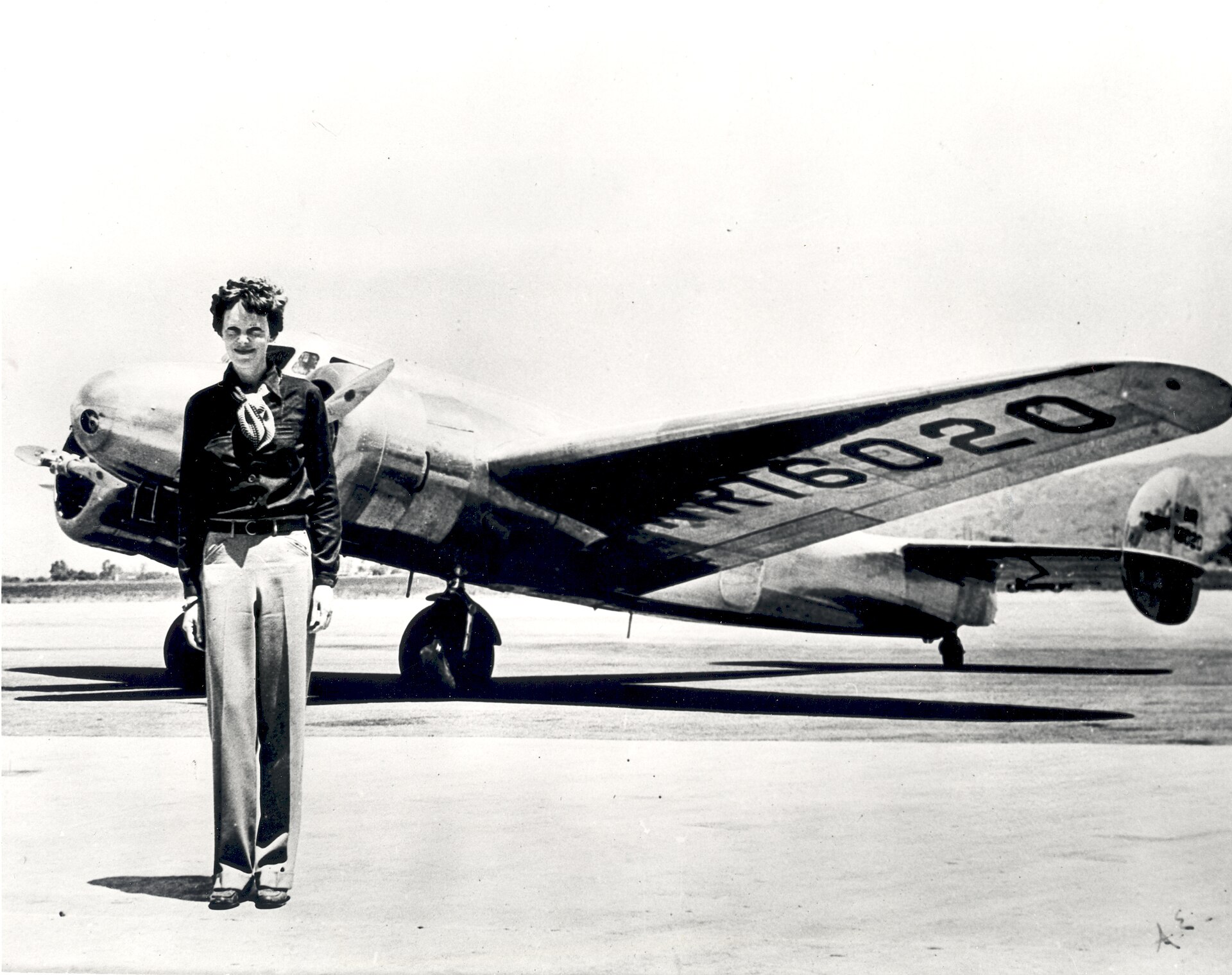

Amelia Earhart (1897–1937) was an American aviator and one of the most celebrated pilots of the 20th century. She became the first woman to fly across the Atlantic by air in 1928 (as a passenger), then the first woman to fly solo nonstop across the Atlantic in 1932, and the first person to fly solo from Hawaii to the U.S. mainland in 1935. She set record after record in her red Lockheed Vega, helped found the Ninety-Nines, taught at Purdue University — which helped fund her Lockheed Electra — and in 1937 set out with navigator Fred Noonan to circle the globe at the equator. On July 2, 1937, their Electra vanished near Howland Island after a final radio message to the Coast Guard cutter Itasca. The U.S. Navy and Coast Guard conducted one of the great air-sea searches of the era; no trace was ever found. The documentary record — including recently declassified files at the National Archives — is the reliable guide to both the flight and the mystery.
Amelia Earhart: a life in flight
Amelia Earhart was born on July 24, 1897, in Atchison, Kansas, and disappeared on July 2, 1937, near Howland Island in the central Pacific Ocean while attempting a flight around the world.1 She was the first woman to fly solo across the Atlantic Ocean, and her loss became an enduring mystery that fuelled much speculation.1 No physical evidence of the flyers or their plane was ever found.2 Her aim, as one biographer wrote, was to be “the first to do,” to set new records and to prove that women could try things as men have tried.3
Her disappearance in July 1937 during an attempt to circumnavigate the globe at the equator remains unresolved, as the Library of Congress observes today.4 Federal records of the flight and the search are held by the National Archives, whose holdings include the Navy search report and the Itasca radio log.5 Her personal papers are preserved at Purdue University as the George Palmer Putnam Collection of Amelia Earhart Papers.6 Her bright red Lockheed 5B Vega, flown on two of her record flights, is held by the Smithsonian.7 The sources behind this account are museums, archives, government agencies and peer-reviewed research.8
Childhood and the first taste of flight
Amelia Mary Earhart was born in Atchison, Kansas, to Amy Otis Earhart and Edwin Stanton Earhart, and her sister Muriel followed two and a half years later.9 She grew up in a family that moved often and faced financial strain.1 After high school in Chicago in 1916, she attended the Ogontz School.9
In February 1918 she left Ogontz and moved to Toronto, where she served as a Voluntary Aid Detachment nurse at the Spadina Military Convalescent Hospital.9 She began visiting a local airfield and watched her first flying exhibition while she was there.9 After the war she entered a pre-medical program at Columbia University in New York City, but left in 1920 to live with her parents in California.1 There, in December 1920, she paid $10 for a brief flight in Los Angeles piloted by air racer Frank Hawks.10 By the time the plane had climbed two or three hundred feet, she said later, she already knew that she had to fly.10 Her first instructor was Anita “Neta” Snook, who gave her lessons in a Curtiss Jenny.11 To pay for the lessons she worked as a telephone company clerk and a photographer, soloing in 1921 and buying her first airplane, a Kinner Airster.11
She bought a chromium yellow Kinner Airster nicknamed “The Canary,” and in 1922 she set her first world record for a woman pilot, flying at an altitude of 14,000 feet.10 In 1923 she became the 16th woman to receive an official Fédération Aéronautique Internationale pilot license.11 In the mid-1920s she moved to Massachusetts and worked as a social worker at Denison House, a settlement home for immigrants in Boston, while continuing to pursue aviation.1
The Friendship crossing, 1928
In April 1928, while working one day at Denison House, she received a call from Hilton Railey asking whether she would like to be the first woman to cross the Atlantic by air.9 In the account of the flight she published in 1928, she recalled being asked whether she was interested in doing something aeronautic that might be hazardous.12 She accepted, and joined pilot Wilmer Stultz and mechanic Louis “Slim” Gordon on the Friendship.9
On June 17, 1928, she departed Trepassey, Newfoundland, as a passenger aboard a seaplane piloted by Stultz and Gordon.1 After landing at Burry Port, Wales, on June 18, she became an international celebrity.1 Her own account of the voyage ends with the landing at Burry Port on the morning of June 18, in rain.12 A book and a lecture tour followed, with publisher George Palmer Putnam as her manager.9
1932: solo across the Atlantic
On May 20–21, 1932, Earhart crossed the Atlantic alone, flying her Lockheed Vega from Harbour Grace, Newfoundland, to Londonderry, Northern Ireland, in a record time of 14 hours 56 minutes.1 Mechanical difficulties and inclement weather prevented her from landing at her scheduled destination, Paris.1 Flying the bright red Lockheed 5B Vega she had bought in 1930, she took off from Harbour Grace and landed 15 hours and 2,026 miles later in a field near Londonderry — becoming the first woman, and the only person since Charles Lindbergh, to fly nonstop and alone across the Atlantic.7 With the flight she became the first person to cross the Atlantic twice by air nonstop, setting a record for the fastest Atlantic crossing and the longest distance flown by a woman.9
For the 1932 crossing she received the Distinguished Flying Cross from Congress, the Cross of Knight of the Legion of Honor from France, and the Gold Medal of the National Geographic Society, presented by President Hoover.2 By 1932 she was known as the first woman to fly an autogiro and as a competitive air racer.10
On August 24–25, 1932, she flew the Vega to another record: the first solo, nonstop flight by a woman across the United States, from Los Angeles to Newark, New Jersey.7 The flight covered 2,447 miles and lasted about 19 hours.7 The Vega that made both records measures 41 feet in wingspan and 27 feet 6 inches in length.7 After a nose-over accident in 1930, the fuselage had been replaced and strengthened to carry extra fuel tanks, and three types of compasses, a drift indicator and a more powerful engine were installed.7 She sold the 5B Vega to Philadelphia's Franklin Institute in 1933 after buying a new Lockheed 5C Vega; the Smithsonian acquired it in 1966.7
The record flights at a glance
Two of Earhart's records were flown in her bright red Lockheed 5B Vega.7 With the January 1935 flight from Hawaii to California she became the first person to fly solo across the Pacific Ocean and the first person who had flown solo across both the Atlantic and Pacific Oceans.9 That flight followed a route that had already claimed several lives, and Earhart hoped it would pave the way for air travel to Hawaii.11
| Date | Flight | Aircraft | Significance |
|---|---|---|---|
| June 17–18, 19281 | First woman across the Atlantic by air1 | Friendship, as a passenger1 | The crossing made her an international celebrity.1 |
| 19309 | Women's flying speed record9 | Lockheed 5B Vega7 | 181.18 mph; the same year she acquired her transport pilot's license.9 |
| 193111 | Altitude record in an autogiro11 | Autogiro11 | 18,415 feet, after learning to fly the type in 15 minutes of instruction.11 |
| May 20–21, 19321 | First solo nonstop crossing of the Atlantic by a woman1 | Lockheed 5B Vega7 | 2,026 miles in 15 hours; the only person since Charles Lindbergh to fly nonstop and alone across the Atlantic.7 |
| August 24–25, 19327 | First solo nonstop flight across the United States by a woman7 | Lockheed 5B Vega7 | Los Angeles to Newark: 2,447 miles in about 19 hours.7 |
| January 11–12, 19351 | First solo flight from Hawaii to California1 | Lockheed 5C Vega11 | 2,408 miles from Honolulu to Oakland in 17 hours 7 minutes.1 |
| 19351 | First solo flight from Los Angeles to Mexico City1 | — | The first solo flight on the route.1 |
| 19372 | Round-the-world flight attempt at the equator2 | Lockheed Model 10-E Electra9 | A 29,000-mile equatorial route; the aircraft was lost near Howland Island on July 2.2 |
Fame, the Ninety-Nines, and business ventures
In August 1929 she helped organize the first transcontinental air race for women and finished third.11 After the race, the women who had participated formed an organization to support one another.11 Of the 285 licensed United States female pilots at the time, 99 became charter members of the Ninety-Nines, and Earhart became their first president.11 The growth of women in aviation had been slow: Harriet Quimby became the first woman to receive a pilot's license in 1911, and by 1930 there were still only 200 female pilots.13 By 1935 between 700 and 800 women had pilot's licenses.13
In 1930 she acquired her transport pilot's license, became the first woman to fly an autogiro in the United States, and became vice president of Ludington Lines, a commercial airline.9 She learned to fly the autogiro after only 15 minutes of instruction, set an altitude record of 18,415 feet, and twice flew an autogiro across the country.11 In February 1931 she married publisher George Palmer Putnam in Noank, Connecticut, and continued her career under her maiden name.9
In 1933 she debuted a functional clothing line designed “for the woman who lives actively.”1 She expanded into business beyond clothing: a line of luggage remained in production into the 1990s, and she lobbied for aviation legislation and birth control rights.1 Earhart and First Lady Eleanor Roosevelt once left a dinner at the White House to take a night flight together, and the two women became friends.11 She wrote books about her flights and career, including 20 Hours and 40 Minutes, The Fun of It and Last Flight, which was published after her disappearance.11 Her speech “On the Future of Women in Flying” is preserved in the Library of Congress's American English Dialect Recordings collection.14
Purdue University and the “Flying Laboratory”
In the fall of 1935 Earhart joined the faculty of Purdue University, serving as a counselor in the study of careers for women and an adviser in aeronautics.9 She lectured and advised women students as a visiting professor.9 In July 1936 she acquired a new Lockheed Electra airplane she called her “Flying Laboratory,” purchased with funds from the Purdue Research Foundation.9 It was acquired as the aircraft for a planned flight around the world at the equator.9
The 1937 world flight
Her globe-circling flight would not be the first, but it would be the longest — 29,000 miles, following an equatorial route.2 In March 1937 she made her first attempt to circumnavigate the globe at the equator, flying westward from Oakland to Hawaii.9
On March 17, 1937, she flew the first leg from Oakland, California, to Honolulu, Hawaii.2 When the flight resumed three days later, a tire blew on takeoff and she ground-looped the plane.2 Severely damaged, the aircraft had to be shipped back to California for repairs, and the flight was called off.2 The National Archives holds the 56-page proceedings of the board of officers that investigated the crash at Luke Field on March 20, 1937, and a report of July 27, 1937, on the search for her plane.5
| Leg | Date | Detail |
|---|---|---|
| Miami departure, flying west to east2 | June 1, 19372 | The second attempt began at Miami, with Fred Noonan, a former Pan Am pilot, as navigator and sole companion in flight.2 |
| Arrival at Lae, New Guinea2 | June 29, 19372 | About 22,000 miles flown since the start.2 |
| Final leg toward Howland Island2 | July 2, 19372 | Takeoff at 0000 GMT; the island lay 2,556 miles away.2 |
2 July 1937: Lae to Howland
Earhart and Noonan took off from Lae on July 2, 1937, at 0000 GMT, bound for Howland Island — a tiny piece of land a few miles long, 20 feet high, and 2,556 miles away.2 To help with navigation, two brightly lit ships were stationed to mark the route.1 The Coast Guard cutter Itasca was on station near Howland, assigned on short notice to communicate with the plane and guide it to the island.2 Their last positive position report and sighting were over the Nukumanu Islands, about 800 miles into the flight.2
| Time | Log entry |
|---|---|
| 2:45 a.m.15 | The cutter was in contact with the Earhart plane and intermittently thereafter; early reception was poor.15 |
| 6:14 a.m.15 | The plane reported its position as 200 miles out of Howland.15 |
| 6:45 a.m.15 | The plane reported its position 100 miles out.15 |
| 7:42 a.m.15 | The plane reported apparently being over the island with gas running low, but as yet not sighting land.15 |
| 7:58 a.m.15 | The plane was circling and asked for 7500 kcs.15 |
| 8:00 a.m.15 | Signals were received, but no minimum for a bearing was available.15 |
| 8:43 a.m.15 | The plane reported being on line 157-337 and running north and south; reception was excellent.15 |
| 10:40 a.m.15 | It was assumed the plane was down, and the cutter got under way at full speed to search the area.15 |
Britannica records that late in the journey Earhart radioed that the plane was running out of fuel.1 About an hour later she announced, “We are running north and south” — the last transmission received by the Itasca.1 In Briand's reconstruction, her final words came at 8:45 a.m., when she broke in on 3,105 kilocycles with the line-of-position message.3 The cutter's log recorded the same position message at 8:43 a.m.15 The two records of the final transmission differ by two minutes.3
The search: Navy, Coast Guard, and the records
When efforts to contact the airplane from the cutter proved fruitless, the Itasca got underway, commencing one of the greatest air-sea searches in history, which quickly involved the Navy.16 Lieutenant Warren Harvey and his crew flew a PBY Catalina from Hawaii toward Howland Island, but adverse weather conditions forced them to abort their search efforts and return to Pearl Harbor.16 The Navy ordered the battleship Colorado — over 1,600 miles from Honolulu — to the vicinity of Howland Island, where it joined the seaplane tender Swan.16 The aircraft carrier Lexington, carrying sixty-three aircraft, made a high-speed run to the search area and assumed control of the search on July 12.16 Three days after the Lexington took over the search, with carrier aircraft having covered thousands of square miles, search efforts were suspended.16
Colorado carried three O3U Corsair observation floatplanes, which began aerial searches on July 7 and ended on July 12, having flown 21.2 hours and 1,908 miles each.16 All told, the ship and her planes covered an area of 25,490 square miles within the radius of visibility.16 The most logical area of search lay in a sector between forty and two hundred miles off Howland Island and between bearings 337 degrees and 45 degrees true from it.15 From July 4 to July 16 the Itasca searched as far west as Tarawa Island, as far north as 5.6 degrees north, and as far south as Arorai Island.15 On July 5 the Naval Radio Station at Wailupe intercepted a message that began “281 North Howland Call KHAQQ” and ended “Above Water Shut Off.”15 The plane was believed to have gone down some 100 miles from the island.1 On July 18 the government abandoned its search, although George Putnam continued to finance his own search until October 1937.9 Britannica dates the calling off of the operation to July 19, 1937, when the pair was declared lost at sea.1
The National Archives holds a 96-page Navy report of the search for July 2–18, 1937.5 Coast Guard records there include a 106-page copy of the radio log of the Itasca for June 9–July 16, 1937, with official remarks and opinions.5 The deck logs of the Colorado, Ontario and Swan — 71 pages of entries for July 1–19, 1937 — record the vessels that searched near the Howland and Phoenix Islands.5 An Office of Naval Intelligence file of 170 pages of correspondence and reports includes a report dated January 7, 1939, on information that Earhart was a prisoner in the Marshall Islands.5 Records of the Federal Aviation Administration include correspondence files relating to Earhart totaling 329 pages.5 The Naval History and Heritage Command's collection on the loss of Earhart gathered files from the Naval Investigative Service, the Coast Guard, the Hydrographic Office, the Chief of Naval Operations and the Secretary of the Navy, and has been transferred to the National Archives.17 Microfilm reel NRS-246-A carries the basic Earhart search report of the Fourteenth Naval District for July 2–18, 1937, and reel NRS-246-C carries 505 pages of Coast Guard records, including the transcript of the Itasca log.17 The George Palmer Putnam Collection of Amelia Earhart Papers at Purdue University — 1785–1948, 16.5 cubic feet in seven series — documents her personal life, aviation career and business activities.6 Government documents relating to the disappearance are also available digitally through the Internet Archive.18
What the evidence shows — and what it does not
Modern analysis indicates that after passing the Nukumanu Islands, Earhart began to vector off course, unwittingly heading for a point about 100 miles north-northwest of Howland.2 A few hours before the estimated arrival time Noonan calculated a “sun line,” but without a successful radio-frequency range calculation a precise fix on the plane's location could not be established.2 Researchers generally believe that the plane ran out of fuel and that Earhart and Noonan perished at sea.2 Britannica reports that most experts believe the plane crashed in the Pacific near Howland after running out of fuel, and that no definitive evidence was found for competing claims.1
Some believed that she and Noonan had crashed on a different island after failing to locate Howland, and others posited that they had been captured by the Japanese; no definitive evidence was found for such claims.1 One of the most tantalizing clues involves skeletal remains found on Nikumaroro Island in 1940, which some dismissed as Earhart's because they were assessed as male by Hoodless.19 A 2018 peer-reviewed study by Richard Jantz concluded that Hoodless's methods were inadequate to his task and that Earhart is more similar to the Nikumaroro bones than 99 percent of individuals in a large reference sample.19 The question remains disputed: the same paper notes that Cross and Wright argued in 2015 that Hoodless's methods were sound and that his sex estimate was likely correct.19
On September 26, 2025, the president directed that government records related to Amelia Earhart, her final trip and “everything else about her” be declassified and released.8 Releases posted by the National Archives include 4,624 pages on November 14, 2025; 3,715 pages on November 25, 2025; and 1,810 pages on December 17, 2025.8 Further releases are ongoing, and some material remains redacted under the Freedom of Information Act.8 The records, not the theories, are the primary material for the last flight.8 Amelia Earhart was declared legally dead in Superior Court in Los Angeles in 1939, and the whereabouts of Earhart and Noonan remain a mystery and the subject of much speculation.9
In her own words
Her own words survive in letters, books, poems and radio messages.13
As soon as I left the ground, I knew I myself had to fly
Amelia Earhart, 1920 — Smithsonian National Air and Space Museum
Like previous flights, I am undertaking this one solely because I want to, and because I feel that women now and then have to do things to show what women can do
Amelia Earhart in a letter to President Franklin D. Roosevelt, 1936 — U.S. National Archives
The most difficult thing is the decision to act. The rest is merely tenacity. The fears are paper tigers
Amelia Earhart — U.S. Federal Aviation Administration
Adventure is worthwhile in itself
Amelia Earhart — Purdue University Libraries
Courage is the price that Life exacts for granting peace
From Earhart's poem “Courage,” as quoted in Daughter of the Sky by Paul L. Briand, Jr.
Timeline of Amelia Earhart’s life and flights
Born in Atchison, Kansas
Amelia Mary Earhart is born in Atchison, Kansas; she grows up in a family that moves often and faces financial strain.
Nurse's aide in Toronto; first flying exhibition
She leaves Ogontz School and works as a Voluntary Aid Detachment nurse at the Spadina Military Convalescent Hospital in Toronto, where she begins visiting a local airfield.
First flight, lessons, and a first record
In December 1920 she takes her first airplane ride with pilot Frank Hawks; in January 1921 she begins lessons with Anita "Neta" Snook and later buys a Kinner Airster In 1922 she sets her first record for a woman pilot — an altitude of 14,000 feet.
Pilot license
Earhart becomes the 16th woman to receive an official Federation Aeronautique Internationale pilot license.
First woman across the Atlantic by air
She departs Trepassey, Newfoundland, as a passenger in the Friendship with pilots Wilmer Stultz and Louis Gordon, landing at Burry Port, Wales, on June 18 and becoming an international celebrity.
Women's Air Derby and the Ninety-Nines
She helps organize the first transcontinental air race for women and finishes third; of 285 licensed U.S. women pilots, 99 found the Ninety-Nines, with Earhart as first president.
The "Little Red Bus" Vega and a speed record
She buys the red Lockheed 5B Vega she calls her "Little Red Bus," and sets a women’s flying speed record of 181.18 mph.
Marriage to George Palmer Putnam
She marries publisher George Palmer Putnam in Noank, Connecticut, and continues her flying career under her maiden name.
Solo across the Atlantic
Flying her red Vega from Harbour Grace, Newfoundland, she lands near Londonderry, Northern Ireland, 15 hours and 2,026 miles later - the first woman, and the first person since Lindbergh, to fly nonstop and alone across the Atlantic.
First solo nonstop flight across the United States
From Los Angeles to Newark, New Jersey: the first solo, nonstop flight by a woman across the United States, 2,447 miles in about 19 hours.
Hawaii to California; the Pacific first
She flies 2,408 miles from Honolulu to Oakland in 17 hours 7 minutes - the first solo flight from Hawaii to California, and later in 1935 she becomes the first person to fly solo from Los Angeles to Mexico City.
The "Flying Laboratory" Electra
She acquires a Lockheed Electra purchased with Purdue Research Foundation funds and calls it her "Flying Laboratory," then begins planning a world flight at the equator.
First world-flight attempt ends at Luke Field
She flies the first leg from Oakland to Honolulu; when the flight resumes three days later a tire blows on takeoff and she ground-loops the plane, which is badly damaged and shipped back to California for repairs.
Second attempt: Miami to Lae, then Howland
Departing Miami west-to-east with navigator Fred Noonan, they reach Lae, New Guinea, on June 29 after about 22,000 miles; on July 2 at 0000 GMT they take off for Howland Island, 2,556 miles away.
Lost near Howland Island
The Itasca tracks intermittent radio contact through the night; the 8:43 a.m. report places the plane on line 157-337 running north and south. At 10:40 a.m., with no sign of the plane, the cutter begins to search at full speed; the U.S. Navy and Coast Guard search until July 18 without finding any trace.
Declared legally dead
Amelia Earhart is declared legally dead in Superior Court in Los Angeles; her whereabouts and Noonan’s remain a mystery.
Frequently asked questions
Who was Amelia Earhart?
Amelia Earhart was an American aviator, one of the world's most celebrated, and the first woman to fly solo across the Atlantic Ocean.1 She was born on July 24, 1897, in Atchison, Kansas, and disappeared on July 2, 1937, near Howland Island in the central Pacific Ocean.1
What were Amelia Earhart's most famous flights?
She became the first woman to cross the Atlantic by air in 1928, the first woman to fly solo nonstop across the Atlantic in 1932, and the first person to fly solo from Hawaii to the American mainland in 1935.1 Two of her records were flown in her bright red Lockheed 5B Vega.7
What happened on the 1937 world flight?
With navigator Fred Noonan, a former Pan Am pilot, she left Miami flying west to east and reached Lae, New Guinea, on June 29 after about 22,000 miles.2 On July 2 they took off from Lae for Howland Island, 2,556 miles away, and never arrived.2
How long did Amelia Earhart's solo Atlantic flight take?
She crossed on May 20–21, 1932, in a record time of 14 hours 56 minutes, from Harbour Grace, Newfoundland, to Londonderry, Northern Ireland.1 Mechanical difficulties and inclement weather prevented her from landing at her scheduled destination, Paris.1
Was any trace of Earhart's plane ever found?
A coordinated search by the Navy and Coast Guard was organized, and no physical evidence of the flyers or their plane was ever found.2 On July 18, 1937, the government abandoned its search, although George Putnam continued to finance his own search until October 1937.9
What do researchers believe happened to Earhart and Noonan?
Researchers generally believe that the plane ran out of fuel and that Earhart and Noonan perished at sea.2 Most experts believe the plane crashed in the Pacific near Howland after running out of fuel, and no definitive evidence was found for competing claims.1
What is the dispute over the Nikumaroro bones?
Skeletal remains found on Nikumaroro Island in 1940 were assessed as male by Hoodless, and some dismissed them as Earhart's on that basis.19 A 2018 study by Richard Jantz concluded that Hoodless's methods were inadequate and that Earhart is more similar to the bones than 99 percent of individuals in a large reference sample, while the paper notes that Cross and Wright argue the methods were sound.19
What records about Earhart has the government released?
After a presidential directive of September 26, 2025, the National Archives began releasing government records related to Earhart and her final trip.8 The releases include 4,624 pages on November 14, 2025, 3,715 pages on November 25, 2025, and 1,810 pages on December 17, 2025.8
Key flights and their distances
Sources & citations
Every factual claim in this article is drawn from the sources below. Bracketed numbers in the text link to the corresponding source.
- 1
- 2
- 3
- 4
- 5
- 6
- 7
- 8
- 9
- 10
- 11
- 12
- 13
- 14
- 15
- 16
- 17
- 18
- 19