DNA
Deoxyribonucleic acid: the double-helix molecule that stores the instructions for life — discovered by many hands, from Miescher's "nuclein" in 1869 to the complete human genome of 2022.
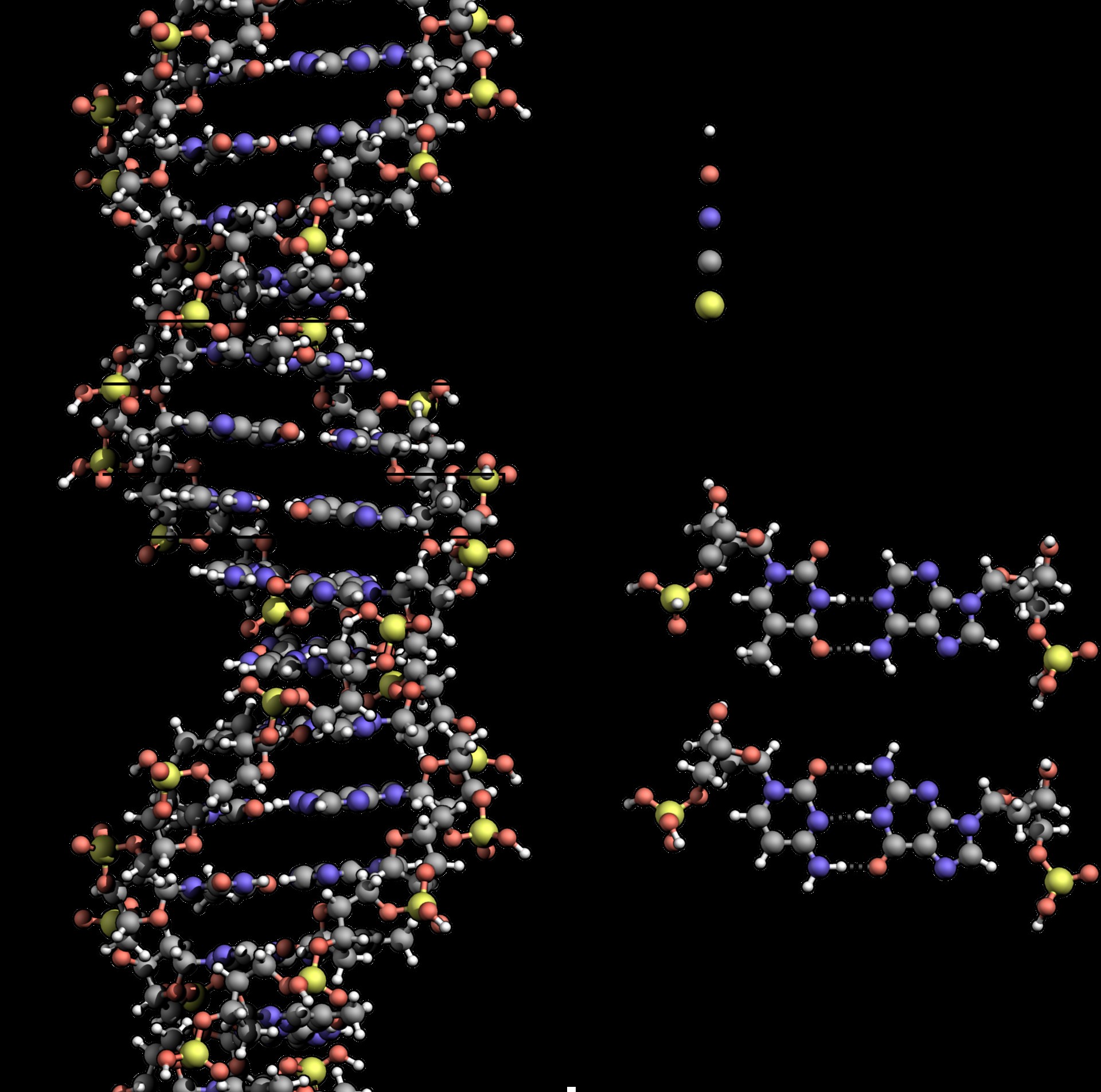
DNA (deoxyribonucleic acid) is the hereditary material of humans and almost all other organisms — a long molecule of two interwound strands whose four chemical bases, adenine, guanine, cytosine and thymine, encode the instructions for building and maintaining life. Its structure was not the work of one team: Friedrich Miescher isolated "nuclein" in 1869, Phoebus Levene mapped the nucleotide building blocks, Erwin Chargaff found the pairing regularities, Rosalind Franklin and Maurice Wilkins captured the crucial X-ray images, and James Watson and Francis Crick assembled the double-helix model published in Nature on 25 April 1953. Meselson and Stahl later proved replication semiconservative, Nirenberg cracked the genetic code, and the Human Genome Project (1990–2003) read the roughly 3 billion bases of the human genome, completed without gaps by the T2T consortium in 2022.
What is DNA?
DNA, or deoxyribonucleic acid, is the hereditary material in humans and almost all other organisms 1. Nearly every cell in a person's body has the same DNA 1. In the paper that announced the double helix in 1953, the substance was described as the salt of deoxyribose nucleic acid, abbreviated D.N.A. 2.
The information in DNA is stored as a code made up of four chemical bases: adenine (A), guanine (G), cytosine (C), and thymine (T) 1. The order, or sequence, of the bases determines the information available for building and maintaining an organism, similar to the way in which letters of the alphabet appear in a certain order to form words and sentences 1. Human DNA consists of about 3 billion bases, and more than 99 percent of those bases are the same in all people 1.
Most DNA is located in the cell nucleus, where it is called nuclear DNA, but a small amount is found in the mitochondria, where it is called mitochondrial DNA (mtDNA) 1. An important property of DNA is that it can replicate, or make copies of itself: each strand of the double helix can serve as a pattern for duplicating the sequence of bases 1. This is critical when cells divide because each new cell needs an exact copy of the DNA present in the old cell 1.
Chemical structure
Each base is attached to a sugar molecule and a phosphate molecule; together, a base, sugar, and phosphate are called a nucleotide 1. Russian biochemist Phoebus Levene was the first to discover the order of the three major components of a single nucleotide (phosphate–sugar–base) 3. There are two basic categories of nitrogenous bases: the purines (adenine and guanine), each with two fused rings, and the pyrimidines (cytosine, thymine, and uracil), each with a single ring 3. RNA contains only A, G, C, and U (no T), whereas DNA contains only A, G, C, and T (no U) 3.
In the Watson and Crick model, DNA is a double-stranded helix, with the two strands connected by hydrogen bonds; A bases are always paired with Ts, and Cs are always paired with Gs, which is consistent with and accounts for Chargaff's rule 3. Two hydrogen bonds connect T to A; three hydrogen bonds connect G to C 3. The DNA double helix is anti-parallel, which means that the 5' end of one strand is paired with the 3' end of its complementary strand (and vice versa) 3.
The double helix
The structure shows that two long strands of DNA run in opposite directions and spiral around one another in the shape of a double helix 4. The structure of the double helix is somewhat like a ladder, with the base pairs forming the ladder's rungs and the sugar and phosphate molecules forming the vertical sidepieces of the ladder 1. Four organic bases — adenine, thymine, cytosine and guanine — are paired in a specific manner between the two helices in such a way as to provide a natural scaffold for the two strands 4.
The most common conformation in most living cells — the one proposed by Watson and Crick — is known as B-DNA 3. A-DNA is a shorter and wider form that has been found in dehydrated samples of DNA 3. Most DNA double helices are right-handed; only one type of DNA, called Z-DNA, is left-handed 3. Z-DNA was first discovered in 1979 3.
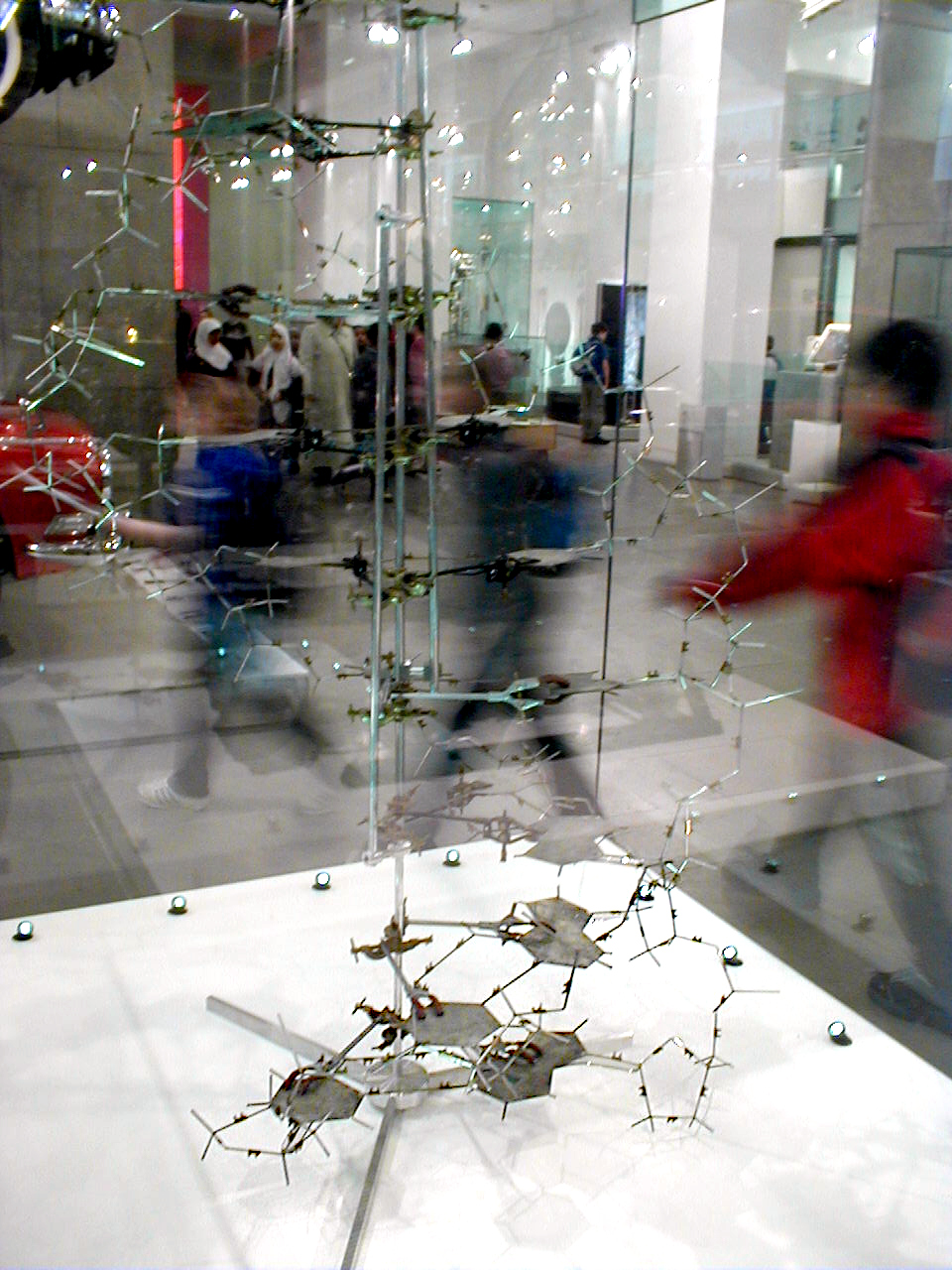

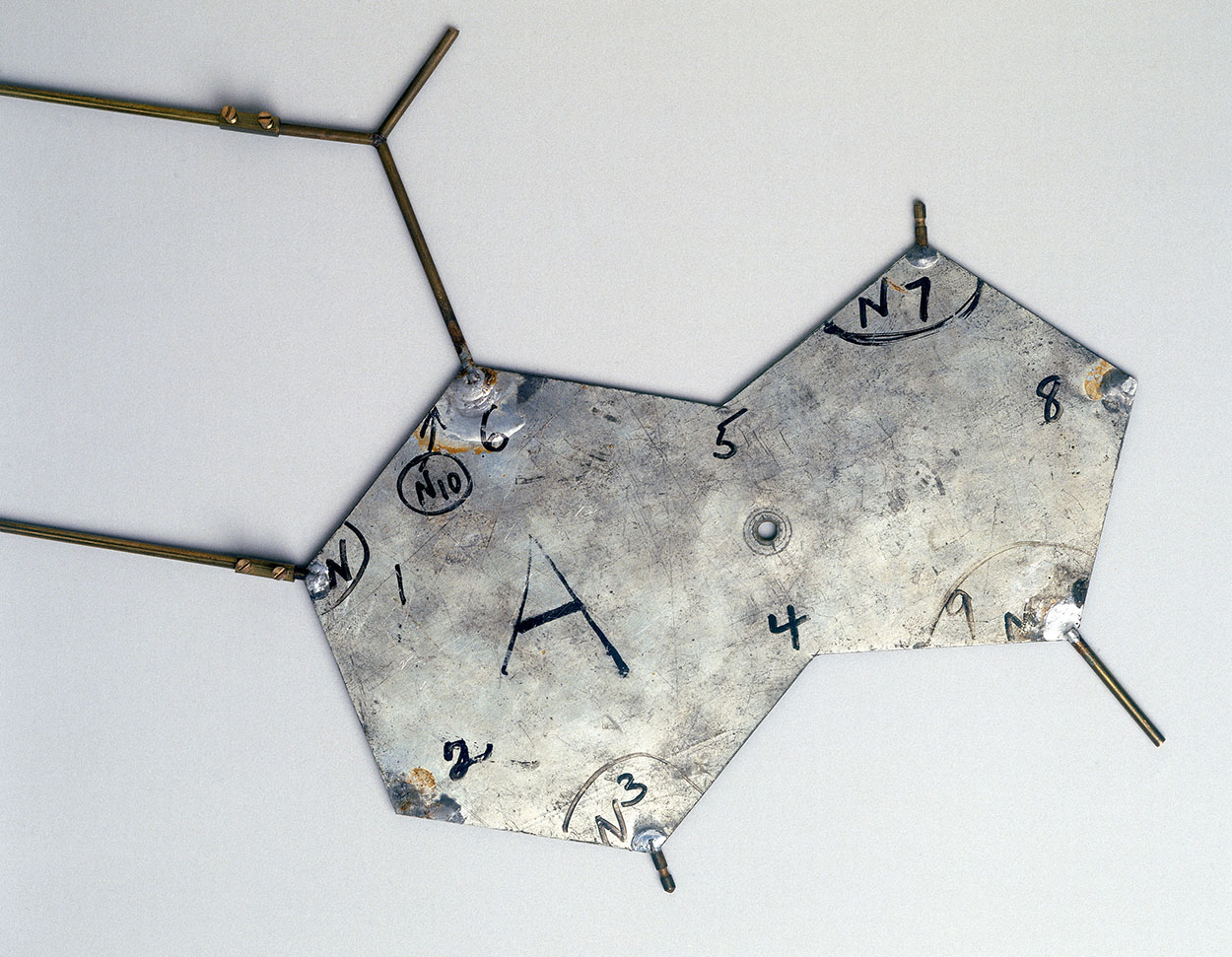
Using cardboard cutouts representing the individual chemical components of the four bases and other nucleotide subunits, Watson and Crick shifted molecules around on their desktops, as though putting together a puzzle 3. The model they assembled in 1953 survives today, on display in the National Science Museum of London . Among its remaining parts is an aluminium template representing the base thymine (T) .
How DNA replicates
The specific base pairing facilitates the perfect copying facility for heredity 4. DNA molecules can 'unzip' into two separate strands, and when the cell's machinery creates matching strands, the specific pairing between the bases ensures that you get two faithful copies where you had one before 4. Each strand of the double helix can serve as a pattern for duplicating the sequence of bases 1.
According to the semiconservative replication model, the two original DNA strands separate during replication and each strand then serves as a template for a new DNA strand, which means that each newly synthesized double helix is a combination of one old and one new DNA strand 5. In their 1958 experiment, Meselson and Stahl grew E. coli in 15N medium, transferred the cells to 14N medium, and used cesium chloride density-gradient centrifugation: after one round of replication the DNA appeared as a single band intermediate between 15N and 14N DNA, and after a second round as two bands — one hybrid and one containing only 14N 5. The distribution of original DNA and new DNA after each round of replication was consistent with a semiconservative model of replication 5. In humans, each parent cell must copy its entire six billion base pairs of DNA before undergoing mitosis 5.
The genetic code
Each gene's code uses the four nucleotide bases of DNA: adenine (A), cytosine (C), guanine (G) and thymine (T) — in various ways to spell out three-letter 'codons' that specify which amino acid is needed at each position within a protein 6. The specific order of bases forms the blueprint for the sequence of amino acids in a protein 4. Marshall Nirenberg reported his first results deciphering the genetic code in August 1961 7.
Nirenberg synthesized a very simple nucleic acid, composed of a chain of only a single repeating letter; using this nucleic acid the system produced a protein which also contained a single letter 7. Less than five years later all the details of the genetic code were established, mainly from the work of Nirenberg and Khorana 7. Nirenberg's investigations with H. Matthaei demonstrated that messenger RNA is required for protein synthesis and that synthetic messenger RNA preparations can be used to decipher various aspects of the genetic code 8. The Nobel Prize in Physiology or Medicine 1968 was awarded jointly to Robert W. Holley, Har Gobind Khorana and Marshall W. Nirenberg 'for their interpretation of the genetic code and its function in protein synthesis' 9.
Discovery: from nuclein to the double helix
DNA was first identified in the late 1860s by Swiss chemist Friedrich Miescher; 1869 was the year in which he first identified what he called 'nuclein' inside the nuclei of human white blood cells 3. Miescher made arrangements for a local surgical clinic to send him used, pus-coated patient bandages; he washed them, filtered out the leukocytes, and extracted and identified the various proteins within the white blood cells 3. The substance he came across in cell nuclei had chemical properties unlike any protein, including a much higher phosphorous content and resistance to proteolysis (protein digestion) 3. The term 'nuclein' was later changed to 'nucleic acid' and eventually to 'deoxyribonucleic acid,' or 'DNA' 3. More than 50 years passed before the significance of Miescher's discovery of nucleic acids was widely appreciated by the scientific community 3.
In 1919, Phoebus Levene proposed that nucleic acids were composed of a series of nucleotides, and that each nucleotide was composed of just one of four nitrogen-containing bases, a sugar molecule, and a phosphate group 3. Levene's proposed tetranucleotide structure, in which the nucleotides were always linked in the same order, proved overly simplistic: the order of nucleotides along a stretch of DNA is, in fact, highly variable 3. In 1944, researchers at the Rockefeller Institute for Medical Research demonstrated that it was DNA — not proteins or ribonucleic acid (RNA) — that caused bacteria to transform 10. Avery and his colleagues, including researchers Colin MacLeod and Maclyn McCarty, used a process of elimination to identify the transforming principle: encapsulated S cells appeared in all cultures except those whose S strain extract had been treated with DNAse, an enzyme that destroys DNA 11. In 1952, Alfred Hershey and Martha Chase used radioisotopes — 35S to label phage protein and 32P to label phage DNA — and discovered that almost all of the radioactive sulfur remained with the phage ghosts, while about one-third of the radioactive phosphate entered the bacterial cells and could later be recovered in the next generation of bacteriophages 11.
Erwin Chargaff concluded (1950) that the nucleotide composition of DNA varies among species: the same nucleotides do not repeat in the same order, as proposed by Levene 3. Maurice Wilkins and his student Raymond Gosling began studying DNA with X-ray diffraction crystallography at King's College London around 1950 10. Wilkins and Gosling obtained an especially pure sample of DNA from chemist Rudolf Signer in 1950; prepared from calf thymus, the Signer DNA could be stretched into very thin samples, which yielded remarkably clear X-ray diffraction patterns 10. In 1951, John T. Randall offered a position to Rosalind Franklin, a physical chemist with expertise in the X-ray analysis of coal 10. Wilkins showed Watson an especially clear diffraction image taken with a fully hydrated DNA molecule (the so-called 'B form') — an image known as Photo 51 that clearly showed two helices and allowed for very precise mathematical analyses of diffraction intensities 10.
Watson and Crick were worried that they would be 'scooped' by Linus Pauling, who proposed a different model for the three-dimensional structure of DNA just months before they did; in the end, Pauling's prediction was incorrect 3. Only upon the suggestion of American scientist Jerry Donohue did Watson make new cardboard cutouts of thymine and guanine; the complementary bases then fit together perfectly (A with T and C with G), with each pair held together by hydrogen bonds 3. A three-chain structure with phosphates near the fibre axis and bases on the outside had already been proposed by Pauling and Corey, and Watson and Crick considered it unsatisfactory 2. Watson and Crick's paper 'Molecular Structure of Nucleic Acids: A Structure for Deoxyribose Nucleic Acid' was published in Nature on 25 April 1953, in volume 171, pages 737–738 2.
After 1953
It has not escaped our notice that the specific pairing that we have postulated immediately suggests a possible copying mechanism for the genetic material.
James Watson and Francis Crick, Nature, 25 April 1953
Nine years after the double-helix paper, Watson, Crick, and Wilkins jointly received the Nobel Prize in Physiology or Medicine for their work on the mechanisms of heredity 10. The 1962 prize was awarded 'for their discoveries concerning the molecular structure of nucleic acids and its significance for information transfer in living material' 13. By tradition, Nobel Prizes were not awarded posthumously at that time; Franklin, who died of ovarian cancer in 1958, was not mentioned in the award 10.
Crick identified a process that came to be known as the 'central dogma' of molecular biology, the idea that genetic information flows irreversibly in one direction from DNA to RNA to proteins 10. Watson led the National Center for Human Genome Research at the U.S. National Institutes of Health from 1988 to 1992, becoming the founding director of the Human Genome Project in 1990 10. Watson's racist remarks about the intelligence of people of African descent in 2007 prompted Cold Spring Harbor Laboratory to revoke his chancellorship; when Watson doubled down on his racist views in a 2019 documentary, his honorary titles were revoked as well 10.
The Human Genome Project
The Human Genome Project was a large, well-organized, and highly collaborative international effort that generated the first sequence of the human genome and that of several additional well-studied organisms; carried out from 1990–2003, it was one of the most ambitious and important scientific endeavors in human history 14. Launched in October 1990 and completed in April 2003, the Human Genome Project's signature accomplishment — generating the first sequence of the human genome — provided fundamental information about the human blueprint, which has since accelerated the study of human biology and improved the practice of medicine 15. The project ultimately used one particular method for DNA sequencing, called Sanger DNA sequencing, but first greatly advanced this basic method through a series of major technical innovations 14. The initially projected cost for the Human Genome Project was $3 billion, based on its envisioned length of 15 years 14. The sequencing of the human genome involved researchers from 20 separate universities and research centers across the United States, United Kingdom, France, Germany, Japan and China; the groups in these countries became known as the International Human Genome Sequencing Consortium 14.
In June 2000, the International Human Genome Sequencing Consortium announced that it had produced a draft human genome sequence that accounted for 90% of the human genome, containing more than 150,000 areas where the DNA sequence was unknown 14. In April 2003 it announced an essentially complete sequence accounting for 92% of the human genome and less than 400 gaps 14. 70 percent of the original reference human genome sequence was generated from one individual's DNA of blended ancestry, with the remaining 30 percent coming from a combination of 19 other individuals of mostly European ancestry 14. A special committee of the U.S. National Academy of Sciences outlined the original goals for the Human Genome Project in 1988; the list of organisms eventually came to include the bacterium E. coli, baker's yeast, fruit fly, nematode and mouse 14.
On March 31, 2022, the Telomere-to-Telomere (T2T) consortium announced that it had filled in the remaining gaps and produced the first truly complete human genome sequence 14. Scientists have published the first complete, gapless sequence of a human genome, two decades after the Human Genome Project produced the first draft human genome sequence 16. That last 8% of the genome — unmapped after the Human Genome Project — includes numerous genes and repetitive DNA and is comparable in size to an entire chromosome 16. The Oxford Nanopore DNA sequencing method can read up to 1 million DNA letters in a single read with modest accuracy, while the PacBio HiFi DNA sequencing method can read about 20,000 letters with nearly perfect accuracy 16. The T2T consortium used the now-complete genome sequence as a reference to discover more than 2 million additional variants in the human genome, providing more accurate information about the genomic variants within 622 medically relevant genes 16.
Human Genome Project scientists made every part of the draft human genome sequence publicly available shortly after production, following the 'Bermuda Principles' agreed at two meetings in Bermuda in 1996 that set out the rules for the rapid release of sequence data 14. NHGRI established the Ethical, Legal, and Social Implications (ELSI) Research Program in 1990; the early appreciation of the value of this program later led the U.S. Congress to mandate that NHGRI dedicate at least 5% of its research budget to studying the ethical, legal and social implications of genomic advances 14. According to researchers, having a complete, gap-free sequence of the roughly 3 billion bases (or 'letters') in our DNA is critical for understanding the full spectrum of human genomic variation and for understanding the genetic contributions to certain diseases 16.
DNA compared with RNA
| Property | DNA | RNA |
|---|---|---|
| Sugar | Deoxyribose 3 | Ribose 3 |
| Bases | Adenine (A), guanine (G), cytosine (C), thymine (T) — no uracil 13 | Adenine (A), guanine (G), cytosine (C), uracil (U) — no thymine 3 |
| Hereditary role | Hereditary material in humans and almost all other organisms 1 | Messenger RNA is required for protein synthesis 8 |
| Protein synthesis | The specific order of bases forms the blueprint for the sequence of amino acids in a protein 4 | Synthetic messenger RNA preparations can be used to decipher various aspects of the genetic code 8 |
| Function | Can replicate, or make copies of itself: each strand of the double helix can serve as a pattern for duplicating the sequence of bases 1 | Genetic information flows irreversibly in one direction from DNA to RNA to proteins 10 |
Timeline: from nuclein to the complete human genome
Miescher isolates "nuclein"
Swiss physiological chemist Friedrich Miescher first identified what he called "nuclein" inside the nuclei of human white blood cells, recovered from pus-coated surgical bandages — the substance later renamed deoxyribonucleic acid.
Levene proposes the polynucleotide model
Phoebus Levene proposed that nucleic acids were composed of a series of nucleotides, each made of one of four nitrogen-containing bases, a sugar molecule, and a phosphate group — though his fixed-order tetranucleotide idea later proved wrong.
Avery shows DNA is the transforming principle
Avery, MacLeod and McCarty demonstrated that DNA — not protein or RNA — caused pneumococcal bacteria to transform, providing definitive proof that DNA is the hereditary material.
Chargaff formulates his rules
Erwin Chargaff reported that in DNA the amount of adenine approximates thymine and guanine approximates cytosine — the regularities later known as Chargaff's rules.
Hershey and Chase trace the phage's genetic material
Using radioactive 35S and 32P, Alfred Hershey and Martha Chase showed that bacteriophage DNA — not its protein coat — enters bacteria and is passed on to the next generation of phages.
Watson and Crick announce the double helix
Watson and Crick published "Molecular Structure of Nucleic Acids: A Structure for Deoxyribose Nucleic Acid" in Nature, proposing the double helix; Franklin & Gosling's and Wilkins et al.'s X-ray papers appeared in the same issue.
Meselson and Stahl prove semiconservative replication
Matthew Meselson and Franklin Stahl's 15N/14N density-gradient experiment in E. coli showed that each new DNA double helix contains one old and one new strand — replication is semiconservative.
Rosalind Franklin dies
Rosalind Franklin died of ovarian cancer; by tradition, Nobel Prizes were not awarded posthumously at that time, so she was not mentioned in the 1962 award.
Nirenberg cracks the first codon
Marshall Nirenberg reported his first results on the genetic code — using a synthetic nucleic acid of a single repeating letter to direct synthesis of a protein of a single repeating amino acid; within five years the details of the code were established.
Nobel Prize for the structure of DNA
Francis Crick, James Watson and Maurice Wilkins were jointly awarded the Nobel Prize in Physiology or Medicine "for their discoveries concerning the molecular structure of nucleic acids and its significance for information transfer in living material".
The Human Genome Project
Launched in October 1990 and completed in April 2003, the Human Genome Project generated the first sequence of the human genome — a draft covering 90% of the genome in 2000 and an essentially complete sequence (92%, fewer than 400 gaps) in April 2003.
First complete, gapless human genome
The Telomere-to-Telomere (T2T) consortium announced the first truly complete, gapless sequence of a human genome, covering the roughly 3 billion bases of human DNA.
Frequently asked questions
What exactly is DNA?
DNA, or deoxyribonucleic acid, is the hereditary material in humans and almost all other organisms 1. Nearly every cell in a person's body has the same DNA 1. Its information is stored as a code made up of four chemical bases — adenine, guanine, cytosine, and thymine 1.
Who discovered DNA?
DNA was first identified in the late 1860s by Swiss chemist Friedrich Miescher, who in 1869 first identified what he called 'nuclein' inside the nuclei of human white blood cells 3. The double-helix structure was proposed in 1953 by Watson and Crick, who used the key X-ray diffraction patterns provided by Maurice Wilkins and Rosalind Franklin 4.
Why did Rosalind Franklin not share the 1962 Nobel Prize?
The Nobel Prize in Physiology or Medicine 1962 was awarded jointly to Crick, Watson and Wilkins 'for their discoveries concerning the molecular structure of nucleic acids and its significance for information transfer in living material' 13. By tradition, Nobel Prizes were not awarded posthumously at that time; Franklin, who died of ovarian cancer in 1958, was not mentioned in the award 10.
How does DNA copy itself?
DNA molecules can 'unzip' into two separate strands, and when the cell's machinery creates matching strands, the specific pairing between the bases ensures that you get two faithful copies where you had one before 4. According to the semiconservative replication model, each newly synthesized double helix is a combination of one old and one new DNA strand 5.
What is the genetic code?
Each gene's code uses the four nucleotide bases of DNA — adenine (A), cytosine (C), guanine (G) and thymine (T) — to spell out three-letter 'codons' that specify which amino acid is needed at each position within a protein 6. Marshall Nirenberg reported his first results deciphering the genetic code in August 1961 7.
How similar is one person's DNA to another's?
Human DNA consists of about 3 billion bases, and more than 99 percent of those bases are the same in all people 1. The Telomere-to-Telomere (T2T) consortium used the now-complete genome sequence as a reference to discover more than 2 million additional variants in the human genome 16.
How much of the human genome has been sequenced?
In June 2000, the International Human Genome Sequencing Consortium produced a draft human genome sequence accounting for 90% of the human genome, with more than 150,000 areas of unknown sequence 14. In April 2003 it announced an essentially complete sequence accounting for 92% of the human genome and less than 400 gaps 14. On March 31, 2022, the Telomere-to-Telomere (T2T) consortium filled in the remaining gaps and produced the first truly complete human genome sequence 14.
What is the 'central dogma' of molecular biology?
Crick identified a process that came to be known as the 'central dogma' of molecular biology, the idea that genetic information flows irreversibly in one direction from DNA to RNA to proteins 10. Nirenberg's investigations with H. Matthaei demonstrated that messenger RNA is required for protein synthesis 8.
Knowledge graph
Sources & citations
Every factual claim in this article is drawn from the sources below. Bracketed numbers in the text link to the corresponding source.
- 1
- 2
- 3
- 4
- 5
- 6
- 7
- 8
- 9
- 10
- 11
- 12
- 13
- 14
- 15
- 16