The Periodic Table
From Mendeleev's 1869 arrangement of cards to a 118-element map of matter — how the table was built, corrected by atomic number, extended by nuclear physics, and named under IUPAC's rules.
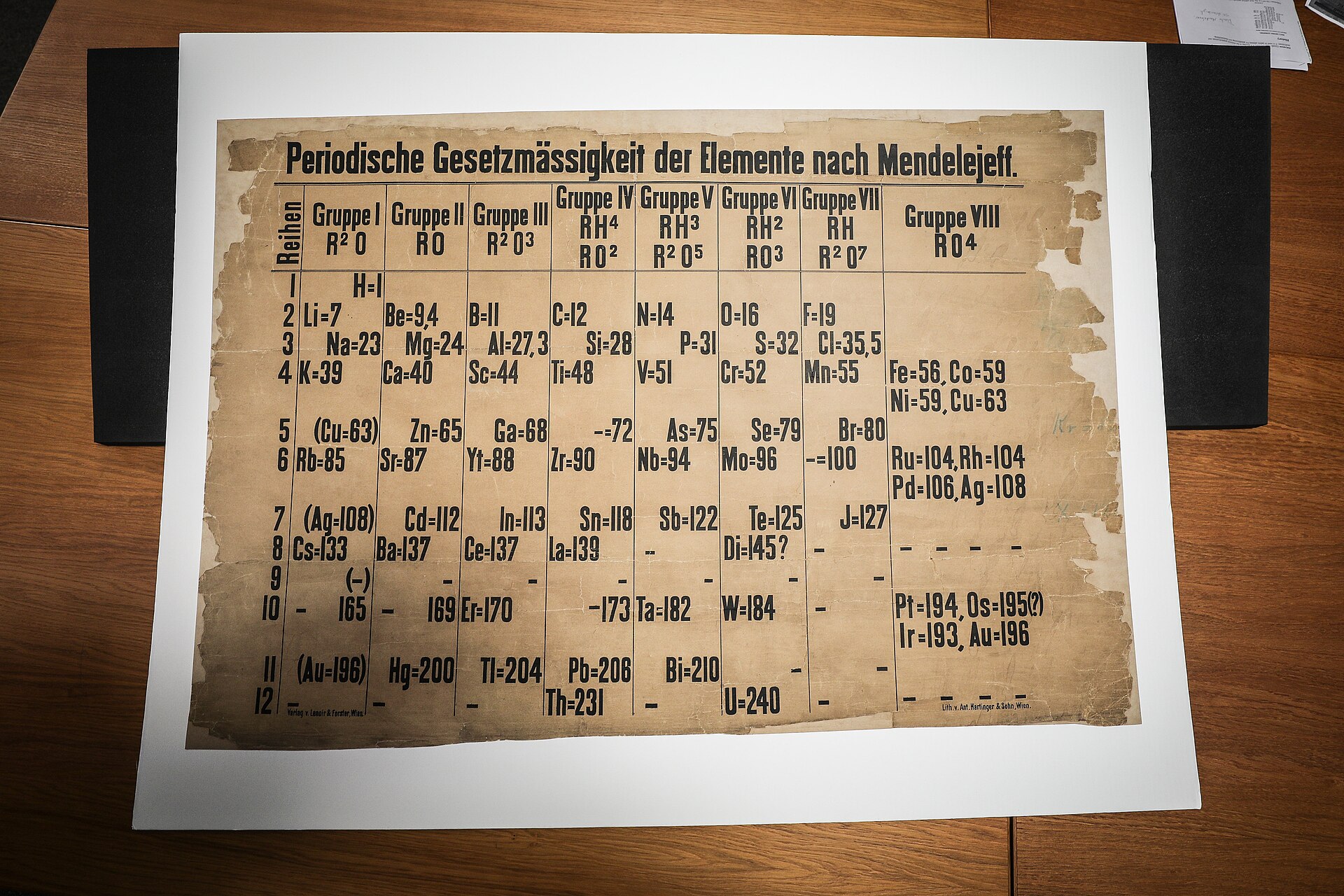

The periodic table is the organized array of the chemical elements in order of increasing atomic number — the number of protons in the nucleus — from hydrogen (1) to oganesson (118), with a recurring pattern of properties called the periodic law. Dmitri Mendeleev's table of 1869 arranged the 70 elements then known by atomic weight, left gaps for missing ones and famously foretold gallium, scandium and germanium. Henry Moseley's X-ray work of 1913 showed the true ordering principle was atomic number. IUPAC now maintains the table, its 18 groups and the standard atomic weights (latest revision 2024), and approves new names — nihonium, moscovium, tennessine and oganesson joined in 2016 to complete the seventh row. Today 118 elements are known, and researchers hunt for elements 119 and 120 and the long-predicted island of stability.
Overview
The periodic table is the organized array of all the chemical elements in order of increasing atomic number — the total number of protons in the atomic nucleus.1 When the elements are arranged that way, a recurring pattern called the periodic law appears: elements in the same vertical column, or group, share similar properties.1
It runs from hydrogen, with 1 proton, to oganesson, with 118.1 It is built from 18 groups, the numbered columns, and 7 periods, the rows.23 Beyond uranium, at atomic numbers greater than 92, lie the transuranium elements; twenty-six of them have been discovered and named or are awaiting confirmation of their discovery.4
The year 2019 marked the 150th anniversary of the table's creation by Mendeleev, and the United Nations General Assembly proclaimed it the International Year of the Periodic Table of Chemical Elements.5 UNESCO calls the table one of the most significant achievements in science and essentially a window on the universe.5
Before Mendeleev: the search for order
The earliest attempt to classify the elements came in 1789, when Antoine Lavoisier grouped them by their properties into gases, non-metals, metals and earths.6 In 1817 Johann Wolfgang Döbereiner noticed groupings of elements in threes, later called triads, in which the equivalent weight of the middle element was approximately the mean of the two flanking values.7
Real progress towards the modern table began only when a more accurate list of the atomic masses became available at a conference in Karlsruhe, Germany in 1860.6 There Stanislao Cannizzaro delivered a ground-breaking paper on atomic weights — a crucial step towards the periodic system, given the previous dispute over assigning atomic weights to the elements.8 Mendeleev attended that International Chemistry Congress and later especially remembered a paper circulated there by Cannizzaro that clarified the notion of atomic weights.9
In 1862 the French geologist Alexandre Béguyer de Chancourtois published the telluric screw, which plotted atomic weights on the outside of a cylinder so that one complete turn corresponded to an atomic weight increase of 16.6
In 1864 J.A.R. Newlands proposed classifying the elements by increasing atomic weight into seven groups related to the first seven elements then known — the law of octaves, by analogy with the musical scale.1 Newlands left no gaps and sometimes crammed two elements into one box, so the Chemical Society refused to publish his paper.6 That same decade, the 1864 first edition of Lothar Meyer's textbook Die modernen Theorien der Chemie arranged 28 elements into 6 families by atomic weights, leaving a blank for an as-yet-undiscovered element.10 Meyer's conceptual advance was seeing valence as the link among members of each family and as the pattern for the order of the families themselves.10 Doubters, including Bunsen, were gradually converted by the discovery of elements that fit the blanks.10
Mendeleev's table of 1869
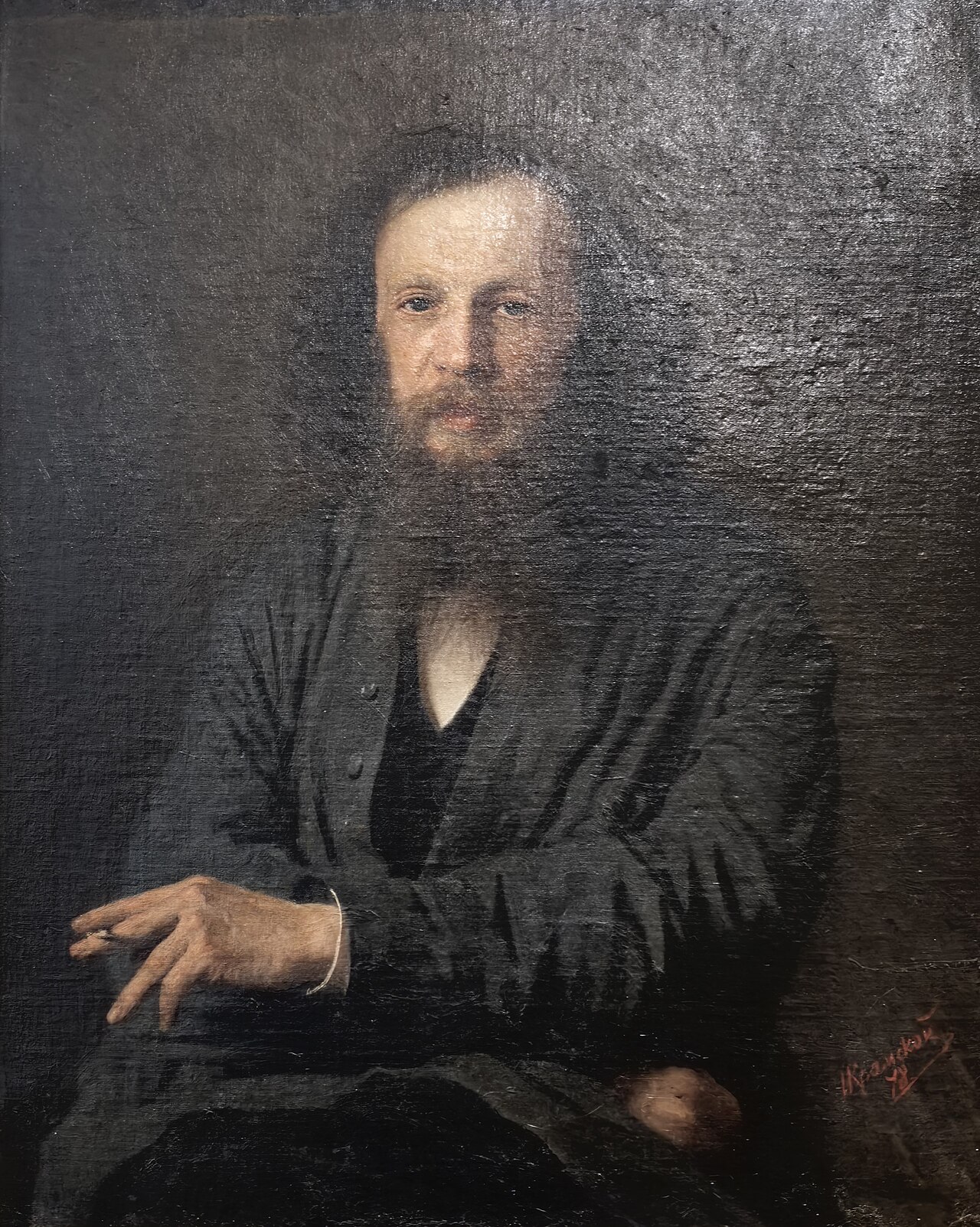
Dmitri Mendeleev was born on January 27 1834 in Tobolsk, Siberia, and died on January 20 1907 in St. Petersburg; the Russian chemist developed the periodic classification of the elements.9 While composing the chapter on the halogen elements, he compared their properties to those of the alkali metals such as sodium and found similarities in the progression of atomic weights; after studying the alkaline earths he established that the order of atomic weights could arrange both the elements within each group and the groups themselves.9
On 6 March 1869 the first rough sketch of his table was presented to the Russian Chemical Society, an organisation he had helped to found a few months previously.8 His newly formulated law was announced with the statement that elements arranged according to the value of their atomic weights present a clear periodicity of properties.9
The law allowed him to build up a systematic table of all the 70 elements then known.9 In his revised table of 1871 he left gaps where he believed unknown elements would find their place, and he predicted the likely properties of three of the potential elements.9 To make one anomaly fit he lowered the atomic weight of tellurium, making its neighbour iodine the heavier of the two — which allowed him to place iodine with the halogens and tellurium with sulfur and selenium.8
In 1906 he was nominated for the Nobel Prize, but the awards committee ruled that his discovery was not recent enough to qualify him for consideration although the chemistry panel supported his candidature.8 The nomination archive records 9 nominations in Chemistry in 1905 and 1906 and 1907.11 When Mendeleev died, students carried the periodic table in the funeral procession.10
The predictions that came true
| Property | Eka-aluminium (Mendeleev's prediction) | Gallium (as found) |
|---|---|---|
| Atomic weight | about 68 6 | 69.72 6 |
| Density of solid | 6.0 g/cm³ 6 | 5.9 g/cm³ 6 |
| Melting point | low 6 | 29.78°C 6 |
| Valency | 3 6 | 3 6 |
Gallium, the first of the predicted elements, was identified spectroscopically by the French chemist Paul Lecoq de Boisbaudran in 1875.8 All its properties matched Mendeleev's predictions except its specific gravity, which appeared first to be 4.7; after Mendeleev recommended fresh measurements it was found to be 5.9, virtually identical with his predicted figure.8 Scandium followed in 1879 and germanium in 1886, and with these discoveries the periodic system began to win wide acceptance.9
Mendeleev in his own words
Mendeleev's words still frame the periodic system: the March 1869 announcement to the Russian Chemical Society, his recollection of the cards on which the elements were written, and his insistence that the law could not be the result of chance.98
elements arranged according to the value of their atomic weights present a clear periodicity of properties.9
Dmitri Mendeleev, law announced before the Russian Chemical Society, March 1869
So I began to look about and write down the elements with their atomic weights and typical properties, analogous elements, and like atomic weights on separate cards, and this soon convinced me that the properties of the elements are in periodic dependence upon their atomic weights…8
Dmitri Mendeleev, recalling the making of the table, as quoted in Chemistry World
Although I have had my doubts about some obscure points, yet I have never once doubted the universality of this law, because it could not possibly be the result of chance.8
Dmitri Mendeleev, as quoted in Chemistry World
.jpg)
From atomic weight to atomic number
The table was arranged by atomic mass, which nearly always gives the same order as the atomic number — but there were exceptions, such as iodine and tellurium, that did not work; Mendeleev had seen that they needed to be swapped around, but it was Moseley who finally determined why.6 Henry Moseley, born in Weymouth, Dorset, England on November 23 1887, was an English physicist who experimentally demonstrated that the major properties of an element are determined by the atomic number, not by the atomic weight.12 In a paper published in 1913 he reported that the frequencies of corresponding lines in the X-ray spectra are proportional to the squares of whole numbers equal to the atomic number plus a constant — a relationship known as Moseley's law, a milestone in advancing knowledge of the atom.12 By plotting the square root of the frequency against atomic number he obtained a perfect straight line — a way to actually measure atomic number, six years after Mendeleev's death.6
In 1914 Moseley concluded that the atomic number is the number of positive charges in the atomic nucleus, and he stated that three unknown elements lay at atomic numbers 43 and 61 and 75.12 He was shot in the head by a Turkish sniper at the Battle of Suvla Bay; his death at the age of 27 deprived the world of one of its most promising experimental physicists.12
The arrangement of the elements comes from their electronic configuration, and because of the Pauli exclusion principle no more than two electrons can fill the same orbital.1 Elements in a group have very similar chemical properties, which arise from the number of valence electrons in the outermost shell of an atom.1
The modern table: periods, groups and families
IUPAC is directly involved with the table: establishing the criteria for a new element discovery, defining temporary names and symbols, assessing discovery claims, coordinating naming, defining Group 1-18 and collective names, determining which elements belong to Group 3, and regularly reviewing standard atomic weights.2 Since 1988 it has recommended that the groups, the columns, be simply numbered from 1 to 18.2 The question of which elements belong in Group 3 has been debated from time to time, and an IUPAC project was initiated to resolve whether Group 3 will consist of Sc, Y, Lu and Lr or of Sc, Y, La and Ac.2
| Group(s) | Collective name and notes |
|---|---|
| 1 | Alkali metals — the group that includes sodium 9 |
| 2 | Alkaline earths 9 |
| 3-12 | Transition metals 2 |
| 17 | Halogens — the group of chlorine and its analogs, with which iodine is placed 98 |
| 18 | Noble gases — the final group, into which the gases discovered in the 1890s fitted 6 |
| 57-71 | Lanthanoids, from lanthanum to lutetium 2 |
| 89-103 | Actinoids, from actinium to lawrencium; eleven transuranium elements, from neptunium through lawrencium, belong to this series 24 |
Two rows sit at the bottom of the table, containing the lanthanoid series, usually from 57 to 71, and the actinoid series, usually from 89 to 103; there is no scientific reason for this split — it is merely done to make the table more compact.1 New element names take endings that maintain historical and chemical consistency: “-ium” for groups 1 to 16, “-ine” for group 17 and “-on” for group 18.13 Before a discovery is validated and the element formally named, it carries a temporary name and symbol under the nomenclature set up in 1978 — which is how, in March 2016, element 113 was still called ununtrium, symbol Uut.2
Synthetic elements and the transuranium era
Transuranium elements are those that lie beyond uranium in the periodic table, with atomic numbers greater than 92; twenty-six of them have been discovered and named or are awaiting confirmation of their discovery.4 All are unstable, decaying radioactively with half-lives that range from tens of millions of years to mere fractions of a second.4 Not until 1940 was a transuranium element first positively produced and identified, when McMillan and Abelson at Berkeley exposed uranium oxide to neutrons from a cyclotron target: the element with atomic number 93, named neptunium.4 In 1941 Glenn T. Seaborg, Joseph W. Kennedy and Arthur C. Wahl produced and chemically identified element 94, named plutonium.4 Seaborg's discovery paper, submitted in March 1941, was quickly withdrawn when plutonium-239 was found able to undergo nuclear fission, making it useful in developing an atomic bomb.14
In 1944, after further discoveries, Seaborg hypothesized that a new actinoid series, akin to the lanthanoids of elements 58–71, was being produced and began with thorium at atomic number 90; thereafter discoveries were sought in accordance with this hypothesis.4 Two synthesis routes divided the work: the elements from seaborgium to copernicium were made by cold, or soft, fusion reactions, while the elements from 113 to 118 required hot fusion reactions, in which a relatively light projectile collides with a heavier actinoid.4 Mendelevium was first identified early in 1955, when Ghiorso, Harvey, Choppin, Thompson and Seaborg bombarded einsteinium-253 with helium ions in the Berkeley 60-inch cyclotron to produce mendelevium-256, synthesized on a one-atom-at-a-time basis.15
During World War II, researchers at ORNL's Graphite Reactor discovered promethium, element 61, but the Manhattan Project's secrecy kept the discovery unreported until 1947.16
Element 117 was the only missing element in row seven; on course to the island of stability, researchers initially skipped it due to the difficulty in obtaining the berkelium target material.17 On June 15 2009 ORNL sent 22 milligrams of berkelium-249 to the Joint Institute for Nuclear Research in Dubna, with the clock ticking away on the isotope's 327-day half-life.17 Eventually the detectors turned up six atoms of element 117, which then decayed into elements 115 and 113 and 111 and 109 and 107 and 105.17 The team announced its discovery in April 2010 in a Physical Review Letters publication with 33 authors from six institutions, and in May 2014 a group of 72 scientists from 16 institutions reported confirmation experiments that independently verified the discovery at the GSI Helmholtz Centre for Heavy Ion Research in Darmstadt, Germany.17 On 30 December 2015 a joint committee of IUPAP and IUPAC announced that the criteria for the discovery of element 117 had been met, confirming element 115 as its decay product.17
Naming the elements: rules and controversies
While reviewing the discovery profiles of the transfermium elements in the early 1990s, IUPAC and IUPAP set up criteria that must be satisfied for a discovery to be recognized.2 Once a discovery is validated, the laboratory it is assigned to is invited to propose a name and symbol; IUPAC reviews the proposal and, after an additional 5-month public review, formalizes the name.2 New elements can be named after a mythological concept or character, a mineral or similar substance, a place or geographical region, a property of the element, or a scientist.13 On 8 June 2016 IUPAC disclosed the proposed names for four new elements — nihonium (Nh) for 113, moscovium (Mc) for 115, tennessine (Ts) for 117 and oganesson (Og) for 118 — and they were approved on 28 November 2016.133
Comments from the public during the five-month review suggested other names, sometimes with petitions from large groups, but only discoverers have the right to propose names and symbols, so these could not be accepted.3 IUPAC President Natalia Tarasova said the names reflect the realities of our present time — the universality of science, honouring places from three continents where the elements were discovered: Japan, Russia and the United States.3 Nihonium takes its name from Nihon, one of the two ways to say Japan in Japanese; element 113 is the first element discovered in an Asian country.13
Moscovium honours the Moscow region and the Joint Institute for Nuclear Research at Dubna.13 Tennessine recognises the Tennessee region's contribution to superheavy element research, including Oak Ridge National Laboratory's production of actinide target materials at its High Flux Isotope Reactor and Radiochemical Engineering Development Center.13 Oganesson recognizes Professor Yuri Oganessian (born 1933) for pioneering contributions to transactinoid elements research, including experimental evidence for the “island of stability”.13
The table today
Standard atomic weights are maintained by the IUPAC Commission on Isotopic Abundances and Atomic Weights, established in 1899 and now operating under IUPAC's Inorganic Chemistry Division.2 Since 1902 the Commission has regularly published critical evaluations of the atomic weights of the elements; its most recent definitive table is the Standard Atomic Weights 2024.18 The latest release of the IUPAC periodic table, dated 4 May 2022, includes the most recent abridged standard atomic weight values, compiled as part of the Table of Standard Atomic Weights 2021.2 For elements that lack isotopes with a characteristic isotopic abundance in natural terrestrial samples, the mass number of the nuclide with the longest confirmed half-life is listed between square brackets.2
The table is a unique tool, enabling scientists to predict the appearance and properties of matter on Earth and in the rest of the universe.5 Plutonium shows the modern uses of its elements: plutonium-238 continues to be vital to space exploration, while plutonium-239 remains an important component of nuclear weapons and provides energy for civilian nuclear power plants in many nations.14
Beyond element 118
Since Mendeleev published his table 150 years ago, researchers have been adding elements to it at the average rate of one every two or three years.19 Having found all the elements that are stable enough to persist naturally, they started to create their own, and are now up to element 118 — oganesson.19 The pace at the frontier is slow: element 117 was obtained at one atom per week and element 118 at one atom per month, and Yuri Oganessian says there is no reason to believe the yield will increase for the still-unknown elements 119 and 120.19
The hunt is driven by a long-predicted prize: nuclear physicists theorize that an “island of stability” exists beyond the current periodic table, where new superheavy elements would exhibit longer lifetimes.17 A leading candidate for a stable superheavy element is the isotope flerovium-298, with 114 protons and 184 neutrons.19 Not every prediction cooperates: calculations suggest that oganesson might not be an unreactive noble gas like its homologues xenon and radon — its outermost electron orbits are smeared together, so it might be more reactive than its position in the periodic table seems to imply.19
Where the table ends is itself contested: IUPAC has reasserted that an element should persist at least for 10–14 seconds, though some chemists question whether atoms that do not have time to interact can be meaningfully assigned chemical properties and so qualify as an element.19
Timeline
Lavoisier classifies the elements
Antoine Lavoisier grouped the known elements by their properties into gases, non-metals, metals and earths — the earliest attempt to classify the elements.
Döbereiner's triads
Johann Wolfgang Döbereiner noticed groupings of elements in threes, later called triads, in which the equivalent weight of the middle element had the approximate mean of the two flanking values.
The Karlsruhe congress
The International Chemistry Congress in Karlsruhe tackled atomic weights, chemical symbols and formulas; Mendeleev would especially remember a paper circulated there by Stanislao Cannizzaro.
The telluric screw
Alexandre Béguyer de Chancourtois published a three-dimensional arrangement of the elements on a cylinder; one complete turn corresponded to an atomic weight increase of 16.
Newlands's law of octaves
J.A.R. Newlands arranged the elements by increasing atomic weight into seven groups whose properties related to the first seven known elements, calling the relationship the law of octaves, by analogy with the musical scale.
Mendeleev's first sketch
The first rough sketch of Mendeleev's table was presented to the Russian Chemical Society; his law held that elements arranged according to the value of their atomic weights present a clear periodicity of properties.
The table with gaps
Mendeleev's revised table of 1871 left gaps where he believed unknown elements would find their place, and predicted the likely properties of three of the missing elements.
Gallium found
Paul Lecoq de Boisbaudran identified gallium spectroscopically; its measured properties matched Mendeleev's predictions for eka-aluminium, including a specific gravity of 5.9.
Scandium discovered
Scandium was discovered and exhibited the properties Mendeleev had predicted for it, persuading more chemists of the value of his table.
Germanium, the third prediction
The discovery of germanium helped cement the reputation of Mendeleev's periodic table and brought him fame as the founder of the periodic law.
The noble gases
William Ramsay's discovery of the noble gases during the 1890s initially seemed to contradict Mendeleev's work, until he realised they were further proof of his system, fitting in as the final group.
Mendeleev dies
Mendeleev died in 1907, by then internationally recognised; when he died, students carried the periodic table in the funeral procession.
Moseley measures atomic number
Moseley found that plotting the square root of the X-ray frequency against atomic number gave a perfect straight line — a way to actually measure atomic number, six years after Mendeleev's death.
Neptunium, the first transuranium element
Edwin McMillan and Philip Abelson exposed uranium oxide to neutrons from a cyclotron target at Berkeley and identified element 93, named neptunium — the first transuranium element positively produced and identified.
Mendelevium synthesised
Ghiorso, Harvey, Choppin, Thompson and Seaborg bombarded einsteinium-253 with helium ions at Berkeley to produce mendelevium-256, synthesised on a one-atom-at-a-time basis.
The seventh row completed
IUPAC approved the names and symbols nihonium (Nh), moscovium (Mc), tennessine (Ts) and oganesson (Og) for the elements with atomic numbers 113 through 118 of the table.
Frequently asked questions
What is the periodic table?
It is the organized array of all the chemical elements in order of increasing atomic number — the total number of protons in the atomic nucleus.1 Arranged that way, a recurring pattern called the periodic law appears in their properties, with elements in the same column, or group, showing similar properties.1
How many elements are in the table today?
There are 118, from hydrogen, with 1 proton, to oganesson, with 118 — the highest atomic number in the table.1
Who created the periodic table?
Dmitri Mendeleev announced the periodic law before the Russian Chemical Society in March 1869, and his law allowed him to build a systematic table of all the 70 elements then known.9
How were Mendeleev's predictions confirmed?
With the discovery of the predicted elements — notably gallium in 1875, scandium in 1879 and germanium in 1886 — the periodic system began to win wide acceptance.9 Gallium matched his predicted properties, including a specific gravity found to be 5.9 after Mendeleev recommended fresh measurements.8
Why was Moseley's work important?
Moseley experimentally demonstrated that the major properties of an element are determined by the atomic number, not by the atomic weight.12 In 1914 he concluded that the atomic number is the number of positive charges in the atomic nucleus.12
Who maintains the table and its atomic weights today?
IUPAC is directly involved, defining Group 1-18 and collective names and regularly reviewing standard atomic weights.2 The IUPAC Commission on Isotopic Abundances and Atomic Weights, established in 1899, publishes critical evaluations of the atomic weights of the elements, and its most recent definitive table is the Standard Atomic Weights 2024.18
What are the transuranium elements?
They are the elements that lie beyond uranium in the periodic table, with atomic numbers greater than 92.4 Twenty-six of them have been discovered and named or are awaiting confirmation of their discovery, and all are unstable, decaying radioactively.4
What is the island of stability?
Nuclear physicists theorize that an “island of stability” exists beyond the current periodic table, where new superheavy elements would exhibit longer lifetimes.17 A leading candidate for a stable superheavy element is the isotope flerovium-298, with 114 protons and 184 neutrons.19
Knowledge graph
Sources & citations
Every factual claim in this article is drawn from the sources below. Bracketed numbers in the text link to the corresponding source.
- 1
- 2
- 3
- 4
- 5
- 6
- 7
- 8
- 9
- 10
- 11
- 12
- 13
- 14
- 15
- 16
- 17
- 18
- 19