The Sun
The star at the centre of the solar system — a 4.6-billion-year-old ball of plasma whose 11-year magnetic cycle drives sunspots, flares and space weather, observed from Galileo's telescope to Parker Solar Probe and Solar Orbiter.
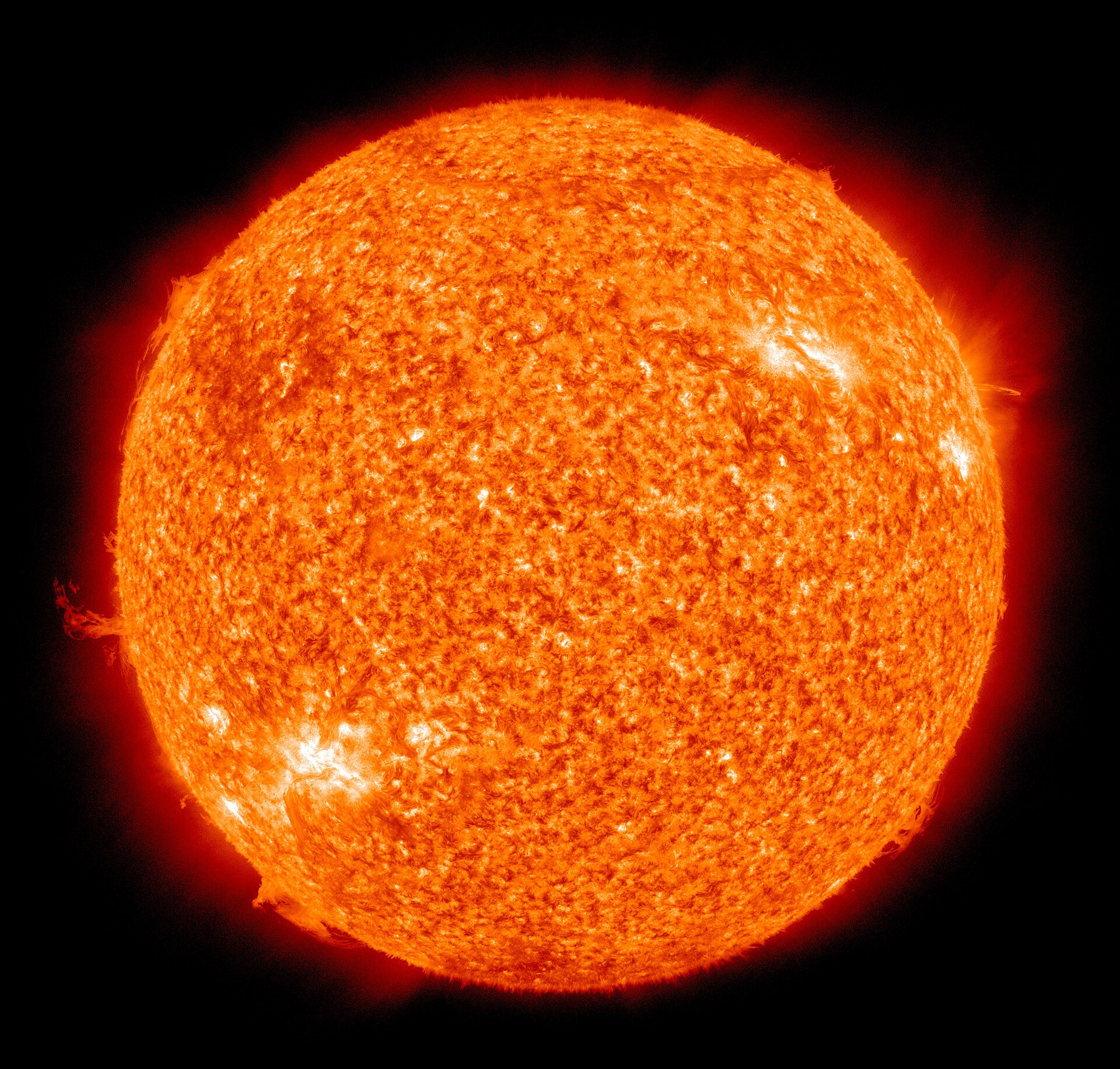
The Sun is the G2 V yellow-dwarf star that holds the solar system together, containing more than 99 percent of its mass. In its core, hydrogen fuses into helium at about 15 million °C; energy takes some 170,000 years to work its way out, and the visible photosphere glows at about 5,500 °C. Around it, an 11-year cycle of magnetic activity rhythmically builds and clears the sunspots, tracked as a numbered series since Solar Cycle 1 in 1755 and now observed by NOAA's Space Weather Prediction Center. Cycle 25 began in December 2019; the 2019 prediction panel expected a peak of 115 sunspots in July 2025, while the smoothed sunspot number has already peaked so far at 160.9 in October 2024. The record of human observation stretches back to the first telescope drawings of 1610, through Schwabe's patient 43-year register and Carrington's 1859 flare, to a fleet of spacecraft — SDO, SOHO, STEREO, Hinode and Wind — joined by Parker Solar Probe, which touched the corona in 2021 and flew within 6.1 million kilometres of the surface on 24 December 2024, and ESA's Solar Orbiter, which returned the first close-up images of the Sun's poles in June 2025. This fact base collects the numbers, dates and quoted evidence behind that story.
Overview
The Sun is the star at the centre of the solar system — a hot, glowing ball of hydrogen and helium about 93 million miles (150 million kilometres) from Earth, and the system's only star.1 It formed about 4.6 billion years ago in a giant, spinning cloud of gas and dust called the solar nebula.1 Astronomers classify it as a G2 V star — a main-sequence dwarf with a surface temperature of about 5,800 kelvins.2 It is an average-sized star; stars up to 100 times larger have been found.1
The Sun is the dominant body of the solar system, constituting more than 99 percent of its entire mass.2 It is about 100 times wider than Earth and about 10 times wider than Jupiter, the biggest planet, with a diameter of roughly 1.4 million kilometres (865,000 miles).1 It has no moons of its own, but it is orbited by eight planets, at least five dwarf planets, tens of thousands of asteroids and perhaps three trillion comets and icy bodies.1 Because the Sun is made of plasma that rotates at different speeds, a day on the Sun is complicated: one rotation takes 25 Earth days at the equator but 36 Earth days at the poles.1
Studying the Sun and its influence throughout the solar system is called heliophysics.1 The connection and interactions between the Sun and Earth drive the seasons, ocean currents, weather, climate, radiation belts and auroras.3 The solar system also travels: moving at an average velocity of about 720,000 kilometres per hour, the Sun still takes some 230 million years to complete one trip around the centre of the Milky Way.1
From core to corona: the layered Sun
The Sun has no solid surface: it is a ball of plasma, and the part we see from Earth — the part we call the surface — is the photosphere.1 Its interior regions are the core, the radiative zone and the convection zone; moving outward come the photosphere, the chromosphere, the transition zone and then the corona, the Sun's expansive outer atmosphere.1 Above the surface lie the thin chromosphere and the huge corona, where solar prominences, flares and coronal mass ejections are seen — the last two being giant explosions of energy and particles that can reach Earth.1 Once material leaves the corona at supersonic speeds it becomes the solar wind, which forms a huge magnetic bubble around the Sun called the heliosphere.1 Because the Sun rotates, its magnetic field spins out into a large rotating spiral known as the Parker spiral.1
| Layer | Depth or extent | Temperature | What happens there |
|---|---|---|---|
| Core | The innermost region, roughly 138,000 kilometres thick.1 | About 15 million °C (27 million °F).1 | Hydrogen fuses into helium; the core is hot enough to sustain nuclear fusion, creating outward pressure that supports the star's mass.1 |
| Radiative zone | The region between the core and the convection zone.1 | — | Energy bounces back and forth through the zone, taking about 170,000 years to get from the core to the top of the convection zone.1 |
| Convection zone | The outermost region of the interior, below the photosphere.1 | Below 3.5 million °F (2 million °C).1 | Large bubbles of hot plasma move upward toward the photosphere.1 |
| Photosphere | About 250 miles thick; the visible surface.1 | About 10,000 °F (5,500 °C).1 | The layer we see from Earth; it emits the visible light the Sun is known for.1 |
| Chromosphere | About 7,000 kilometres high, above the photosphere.1 | About 8,000 K.1 | A thin layer seen as a red rim at eclipses; prominences, flares and coronal mass ejections appear in and above it.1 |
| Transition zone | The narrow layer between the chromosphere and the corona.1 | — | Marks the passage from the chromosphere into the corona.1 |
| Corona | The Sun's expansive outer atmosphere, reaching far past the planets.2 | Up to 3.5 million °F (2 million °C) — far hotter than the photosphere.1 | The source of the solar wind: beyond five solar radii the corona flows outward at about 400 kilometres per second near Earth.2 |
The solar furnace: energy and output
The Sun produces energy through nuclear fusion, primarily by converting hydrogen into helium in the proton-proton chain reaction.2 That process runs in the core, where extreme pressure and density enable nuclei to overcome electrostatic repulsion.2 The temperature there is about 27 million degrees Fahrenheit (15 million degrees Celsius) — hot enough to sustain fusion, and the outward pressure this creates supports the star's gigantic mass and keeps it from collapsing.1 About 0.7 percent of the mass involved is converted into energy in the process, in line with the relation E=mc².2 The core's density is about 100 times that of water — roughly six times the density at the centre of Earth.2
The Sun is a very stable source of energy: its radiative output, called the solar constant, is 1.366 kilowatts per square metre at Earth and varies by no more than 0.1 percent.2 The visible surface it emerges from is a relatively cool 10,000 °F (5,500 °C).1 Energy from a solar flare travels at the speed of light, reaching Earth about 8 minutes after the flare happens.4
Sunspots, flares and the active Sun
Sunspots are created where bits of the Sun's magnetic field poke out from the interior into the Sun's atmosphere.1 At the photosphere they become apparent as dark areas where intense magnetic flux pushes up from within the solar interior.5 The magnetic fields there produce cooler (about 7000 °F), less dense and darker areas than the surrounding photosphere (about 10,000 °F).5 The darkest part of a sunspot is the umbra; as the spot matures, a less dark, outlying area of fibril-like structure called the penumbra develops around it.5 Sunspots last from days to months and range in size from 1,000 to 100,000 miles (1,600 to 160,900 kilometres).1 The largest sunspot groups can be many times the size of Earth, and clearly visible groups are assigned a NOAA/SWPC 4-digit region number.5
Solar flares are by far the most powerful explosions in the solar system, with energy releases comparable to billions of hydrogen bombs.1 Flares are classified according to intensity — A (the weakest), B, C, M, and X (the strongest) — and each higher class is a 10-fold increase in energy, much like the Richter scale for earthquakes.4 The most powerful flare ever measured was in 2003, recorded as an X28 before sensors were overwhelmed.4 Coronal mass ejections are immense clouds of magnetized particles blasted into space at over a million miles per hour, often following after a solar flare.1 A prominence is a snakelike structure of cooler, denser solar material suspended above the surface by a strong local magnetic field; viewed against the disk, it is called a filament.1
When a CME is directed at Earth it can produce geomagnetic disturbances that ignite bright auroras, short-circuit satellites and power grids, and at worst endanger astronauts in orbit.1 Harmful radiation from a flare does not physically affect people on the ground, who are shielded by Earth's atmosphere and magnetic field, but strong flares can disrupt radio communications and affect satellites and spacecraft.4 The solar cycle matters for satellite lifetimes in low-Earth orbit: atmospheric drag correlates with the cycle, especially as represented by the F10.7 cm radio flux, so a higher solar maximum decreases satellite life.6 NOAA's Space Weather Prediction Center monitors active regions on the Sun and issues watches, warnings and alerts for hazardous space weather events.1
The solar cycle
The 11-year cycle is characterized by the rise and fall in the numbers and surface area of sunspots, with many other indicators varying in association — among them the 10.7 cm radio flux, total solar irradiance, flares and coronal mass ejections, geomagnetic activity and galactic cosmic ray fluxes.7 The sunspot index exists in two principal forms: the International Sunspot Number initiated by Wolf in 1849, and the Group Number constructed by Hoyt and Schatten.8 Official daily and monthly sunspot numbers are determined by the World Data Center WDC-SILSO at the Royal Observatory of Belgium.5 Individual solar cycles are characterized by their maxima and minima, cycle periods and amplitudes, cycle shape and other features; cycle-to-cycle variability includes the Maunder Minimum, the Gleissberg Cycle and the Gnevyshev-Ohl (even-odd) Rule.7
Flares, CMEs and space weather history
On 1 September 1859 the astronomer Richard Carrington observed a white-light solar flare, and the resulting geomagnetic storm — the strongest on record — threw telegraph systems worldwide into chaos and sent auroras into the tropics.1 The outburst lasted five minutes — from 11.18 to 11.23 A.M., Greenwich time — and during those five minutes it had traversed a space estimated at 35,000 miles.9 From 28 August to 4 September 1859, a magnetic storm of unparalleled intensity, extent and duration was in progress over the entire globe.9
Telegraphic communication was everywhere interrupted, yet in some cases it was found practicable to work the lines without batteries, by the agency of the earth-currents alone; sparks issued from the wires, and gorgeous aurorae draped the skies in crimson over both hemispheres, even within the tropics.9 The photographic apparatus at Kew registered a marked disturbance of all three magnetic elements at the very instant of the outburst, and shortly after the ensuing midnight the electric agitation lit up the atmosphere from pole to pole.9 Reportedly the auroras were brilliant enough that newspapers could be read as easily as in daylight, and they were visible as far south as Cuba, the Bahamas, Jamaica, El Salvador and Hawaii.1
The record of damage is pointed: a solar flare on 13 March 1989 caused geomagnetic storms that disrupted electric power transmission from the Hydro Québec generating station in Canada, plunging 6 million people into darkness for 9 hours.1 In December 2005, X-rays from a solar storm disrupted satellite-to-ground communications and GPS navigation signals for about 10 minutes.1 Magnetic storms can generate electric fields in the Earth that interfere with electric power transmission grids.10 The USGS monitors Earth's magnetic field with ground-based observatories, providing continuous records of magnetic field variations and research for hazard mitigation.10
Watching the Sun from space
Solar-watching has grown into a standing fleet: SDO, SOHO, STEREO, Hinode and Wind are among the spacecraft that have kept the Sun under observation, joined by Parker Solar Probe and Solar Orbiter.3 SDO, NASA's Solar Dynamics Observatory, launched on 11 February 2010 to study how solar activity is created and drives space weather by monitoring the Sun's interior, atmosphere, magnetic field and energy output.11 SOHO, the joint ESA-NASA Solar and Heliospheric Observatory, launched on 2 December 1995 and was designed to study the Sun inside out; though its mission was scheduled to run until only 1998, it has continued collecting data and has made many discoveries, including more than 5,000 comets.12 It was placed in an elliptical Lissajous orbit around the L1 libration point, 932,000 miles (1.5 million kilometres) from Earth, and returned its first image on 19 December 1995.12 Skylab, America's first space station, launched on 14 May 1973 with the Apollo Telescope Mount aboard and served as the greatest solar observatory of its time.13
Parker Solar Probe launched on 12 August 2018 to fly through the Sun's corona.14 It is protected by a 4.5-inch-thick carbon-composite shield that can withstand temperatures reaching nearly 2,500 degrees Fahrenheit (1,377 °C).14 On 14 December 2021 NASA announced that Parker had flown through the Sun's upper atmosphere — the corona — and sampled particles and magnetic fields there, the first time in history a spacecraft had touched the Sun.14 The probe carries four instrument suites designed to study magnetic fields, plasma and energetic particles, and to image the solar wind.14 At closest approach it hurtles around the Sun at approximately 430,000 mph (700,000 kph).14 On 24 December 2024 it flew just 3.8 million miles (around 6.1 million kilometres) from the surface of the Sun — no human-made object had ever passed closer to a star.15 The mission is named for the late Eugene Parker, who pioneered our modern understanding of the Sun and, as a young professor at the University of Chicago in the mid-1950s, developed a mathematical theory that predicted the solar wind.14
ESA's Solar Orbiter launched in February 2020, returned its first images in July 2020 and began routine science operations in November 2021.16 ESA calls it the most complex scientific laboratory ever sent to the Sun: it carries ten instruments and is the first spacecraft to look at the Sun's polar regions.16 Its closest distance to the Sun is 42 million kilometres; it flies 33° above the solar equator and had a launch mass of 1,720 kilograms.16 On 11 June 2025 it returned the first-ever close-up images of the Sun's polar regions, a view impossible from Earth, while continuing the closest-ever imaging of the Sun.16
Observing the Sun: a four-century record
The discovery of sunspots in 1610 by Fabricius and Galileo first opened a way for inquiry into the solar constitution.9 A drawing by Father Scheiner shows the motion of two sunspots observed by him in March 1627 across successive days of that month.17 Our knowledge of the long-term evolution of solar activity and of its 11-year cycle depends largely on a single direct observational record: the visual sunspot counts that retrace the last four centuries, since the invention of the astronomical telescope.8
In 1826 Schwabe, a German astronomer, began a regular register of the number of spots visible on the Sun.17 He never failed, weather and health permitting, to bring in his daily report, the information obtained being recorded day by day on a simple and unvarying system.9 After watching them for seventeen years he was able to announce that the number of spots seemed to fluctuate from year to year, with a period of about ten years.17 In 1843 he made his first announcement of a probable decennial period.9 Sabine was the first to note the coincidence between this unlooked-for result and Schwabe's sunspot period: the two cycles of change agreed perfectly both in duration and phase, maximum corresponding to maximum, minimum to minimum.9 Wolf corrected Schwabe's loosely-indicated decennial period to one of slightly over eleven (11.11) years, which fell in with the ebb and flow of magnetic change even better.9
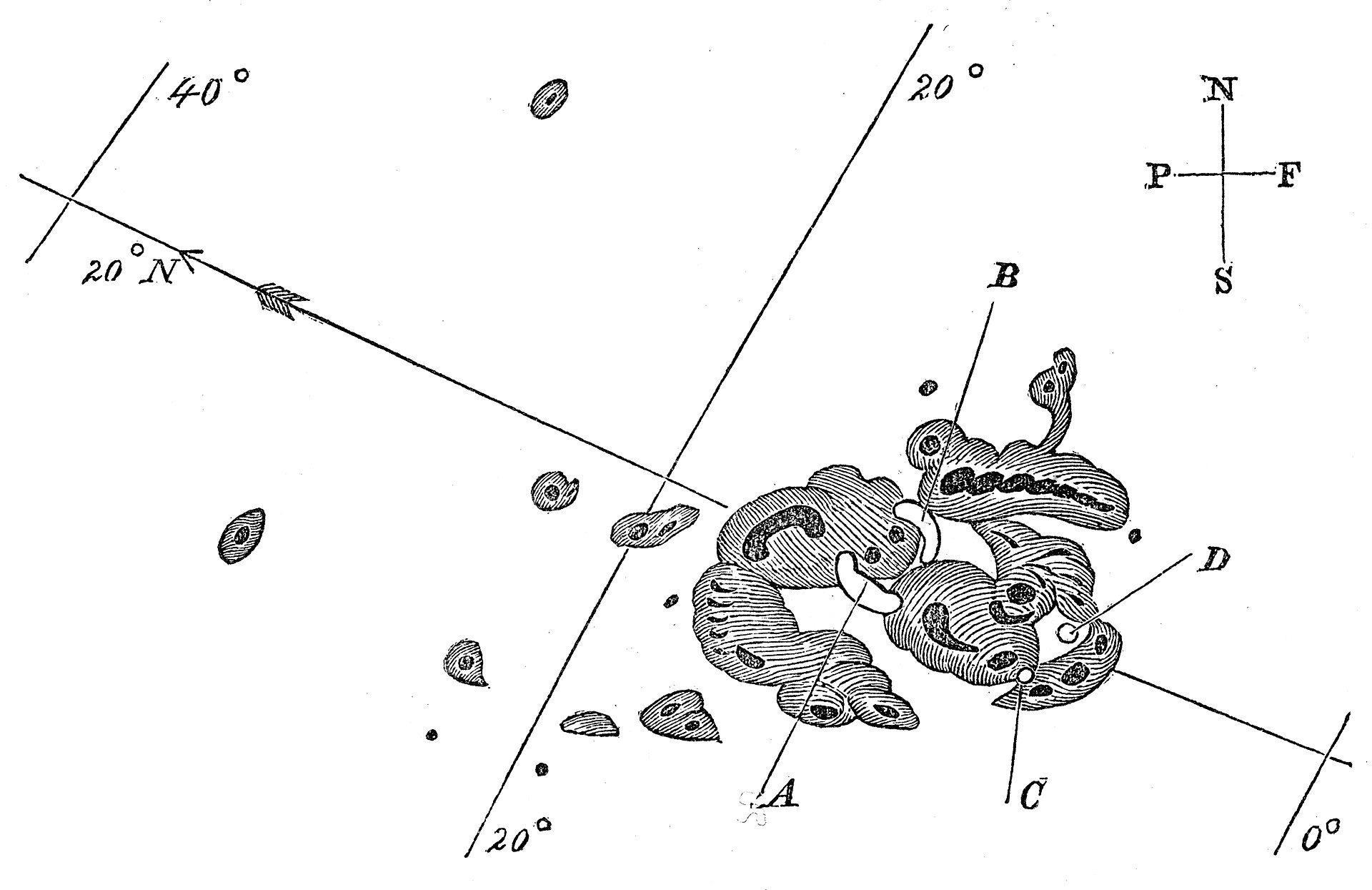

The record has its shadows: the early part of the sunspot record before 1800 is still characterized by large uncertainties due to poorly observed periods, while more recent sunspot numbers are affected by inhomogeneities in 1880-1915, 1947 and 1980-2014.8 Much of the nineteenth-century story survives through the astronomer-historian Clerke's popular history of astronomy, whose fourth edition appeared in 1902.9 One discovery stands out beyond the Sun itself: an unknown yellow emission line seen during a solar eclipse, later labelled D3, led the chemist Lockyer to name a new element, helium — its terrestrial discovery ensuing twenty-six years later, when Ramsay obtained a gas containing the line from the rare mineral cleveite in March 1895.9
The Sun in human life and culture
The Sun has inspired us since ancient times: it is central to mythology and religion in cultures around the world, including the ancient Egyptians, the Aztecs of Mexico, Native American tribes of North and South America, the Chinese and many others.3 The Sun's classical names — sol and Helios — survive in the words and stories of the present day, in song and on film as much as in myth.3
For life on Earth the connection is existential: life is only possible because of the Sun's light and energy, while the Sun itself could not harbor life as we know it because of its extreme temperatures and radiation.1 Sunlight powers photosynthesis and, through the seasons, the rhythms of life on the planet.3 Its ultraviolet light carries both benefit and hazard — vitamin D for the body, and in excess sunburn.3
Outlook: Solar Cycle 26 and the next decade
Solar Cycle 25 has already run hot against expectations: the smoothed sunspot number has peaked so far at 160.9 in October 2024.18 That is above the 115 that the 2019 NOAA/NASA/ISES Prediction Panel expected at the predicted maximum of July 2025.6 The latest monthly sunspot number, for August 2026, is a preliminary 76.0.18 Solar Cycle 26 is expected to begin some time between January 2029 and December 2032, and no prediction has yet been produced for it.6
On 4 September 2026 Parker Solar Probe completed its 29th close approach to the Sun, again matching its record speed and distance and training its camera on structures and activity near the Sun's north pole.19 Solar Orbiter, meanwhile, continues the closest-ever imaging of the Sun after its first close-up views of the poles in June 2025.16 Open questions remain: the source of coronal heating is a major unsolved puzzle in the study of the Sun.1 What drives the Sun's 11-year cycle of rising and subsiding magnetic activity is among the questions Solar Orbiter's ten instruments were sent to answer.16 In the longest view, scientists predict that the Sun is a little less than halfway through its lifetime and will last another 5 billion years or so before it becomes a white dwarf.1
Milestones in Sun science
Sunspots discovered with the telescope
Fabricius and Galileo became the first to observe sunspots through telescopes, opening the first path of inquiry into the Sun's physical constitution.
Official solar cycle numbering begins
The consecutive numbering of solar cycles — still in use by NOAA and the Solar Cycle Prediction Panel — begins with Solar Cycle 1 in 1755.
Schwabe begins his daily sunspot register
The German astronomer Heinrich Schwabe commenced keeping a regular register of the number of spots visible on the Sun, watching with a small telescope for hour after hour, day after day.
First announcement of a decennial sunspot period
After seventeen years of watching, Schwabe announced that sunspot numbers seemed to fluctuate with a period of about ten years — a result at first met with little general attention.
The Carrington Event
Richard Carrington observed a white-light solar flare; the resulting geomagnetic storm — the strongest on record — threw telegraph systems worldwide into chaos and sent auroras into the tropics.
Helium detected in the solar spectrum
An unknown yellow emission line seen during a solar eclipse — later labelled D3 — led the chemist Lockyer to name a new element, helium, 26 years before it was found on Earth.
Skylab becomes the greatest solar observatory of its time
Skylab, America's first space station, launched with the Apollo Telescope Mount aboard and served as the greatest solar observatory of its era before being deorbited in 1979.
SOHO launches to study the Sun inside out
The joint ESA-NASA Solar and Heliospheric Observatory launched; planned for a two-year mission, it has become one of the longest-lived Sun-watching spacecraft, discovering thousands of comets.
Solar Dynamics Observatory begins watching the Sun
SDO launched to monitor the Sun's interior, atmosphere, magnetic field and energy output and to study how solar activity is created and drives space weather.
Parker Solar Probe launches
NASA launched Parker Solar Probe to fly through the Sun's corona, protected by a carbon-composite heat shield and bound for the closest-ever passes of a star.
Solar Cycle 25 begins
Solar minimum occurred in December 2019, marking the end of Solar Cycle 24 and the start of Solar Cycle 25, according to the NASA/NOAA-co-sponsored prediction panel.
Solar Orbiter launches
ESA launched Solar Orbiter — the most complex scientific laboratory ever sent to the Sun — carrying ten instruments and eventually becoming the first spacecraft to look at the Sun's poles.
Parker Solar Probe touches the Sun
NASA announced that Parker Solar Probe had flown through the Sun's upper atmosphere, the corona, and sampled particles and magnetic fields there — the first time in history a spacecraft had touched the Sun.
Closest-ever approach to the Sun
Parker Solar Probe flew just 3.8 million miles (about 6.1 million kilometers) from the solar surface at 6:53 a.m. EST — no human-made object had ever passed closer to a star.
First world-first views of the Sun's poles
Solar Orbiter returned the first-ever close-up images of the Sun's polar regions, a view impossible from Earth, while continuing the closest-ever imaging of the Sun.
Parker completes its 29th solar flyby
Parker Solar Probe completed its 29th close approach to the Sun, again matching its record speed and distance and training its camera on structures near the Sun's north pole.
The Sun: quick answers
What kind of star is the Sun?
It is a yellow dwarf star — a hot, glowing ball of hydrogen and helium — and the solar system's only star.1 Astronomers classify it as a G2 V star, a main-sequence dwarf with a surface temperature of about 5,800 kelvins.2 It is an average-sized star; stars up to 100 times larger have been found.1
How old is the Sun?
It formed about 4.6 billion years ago in a giant, spinning cloud of gas and dust called the solar nebula.1 Scientists predict it is a little less than halfway through its lifetime and will last another 5 billion years or so before it becomes a white dwarf.1
How far is the Sun from Earth?
About 93 million miles (150 million kilometres) on average.1 At that distance it spans only about half a degree of sky — roughly the same as the Moon.2
Why are sunspots dark?
They sit in strong magnetic regions where intense magnetic flux pushes up from the solar interior, producing cooler (about 7000 °F), less dense areas against a photosphere of about 10,000 °F.5 The darkest part is the umbra, surrounded as the spot matures by a less dark, fibril-like penumbra.5
What is the solar cycle?
Roughly every 11 years the Sun's magnetic poles swap, and the photosphere, chromosphere and corona swing from quiet and calm to violently active.1 The total number of sunspots rises and falls with the same period: the peak is solar maximum, the lull solar minimum.5 Officially the cycles are numbered from Solar Cycle 1 in 1755.5
Where does Solar Cycle 25 stand?
It began in December 2019.1 The smoothed sunspot number has peaked so far at 160.9 in October 2024, above the maximum of 115 that the 2019 NOAA/NASA/ISES Prediction Panel expected in July 2025.186
What is the difference between a solar flare and a coronal mass ejection?
Solar flares are the most powerful explosions in the solar system, classified by intensity from A (the weakest) to X (the strongest), each higher class a 10-fold step in energy.4 A coronal mass ejection is an immense cloud of magnetized particles blasted into space at over a million miles per hour, often following after a solar flare.1 When directed at Earth, one can produce geomagnetic disturbances that ignite auroras, short-circuit satellites and power grids, and endanger astronauts in orbit.1
Has any spacecraft touched the Sun?
Yes: on 14 December 2021 NASA announced that Parker Solar Probe had flown through the corona and sampled particles and magnetic fields there — the first time in history a spacecraft had touched the Sun.14 On 24 December 2024 it passed just 3.8 million miles (about 6.1 million kilometres) from the solar surface.15
The Sun in numbers
Sources & citations
Every factual claim in this article is drawn from the sources below. Bracketed numbers in the text link to the corresponding source.
- 1
- 2
- 3
- 4
- 5
- 6
- 7
- 8
- 9
- 10
- 11
- 12
- 13
- 14
- 15
- 16
- 17
- 18
- 19