International Space Station
The largest structure humans have ever built in space: a modular laboratory in low Earth orbit, continuously crewed since November 2000 and assembled by five space agencies over more than a decade.
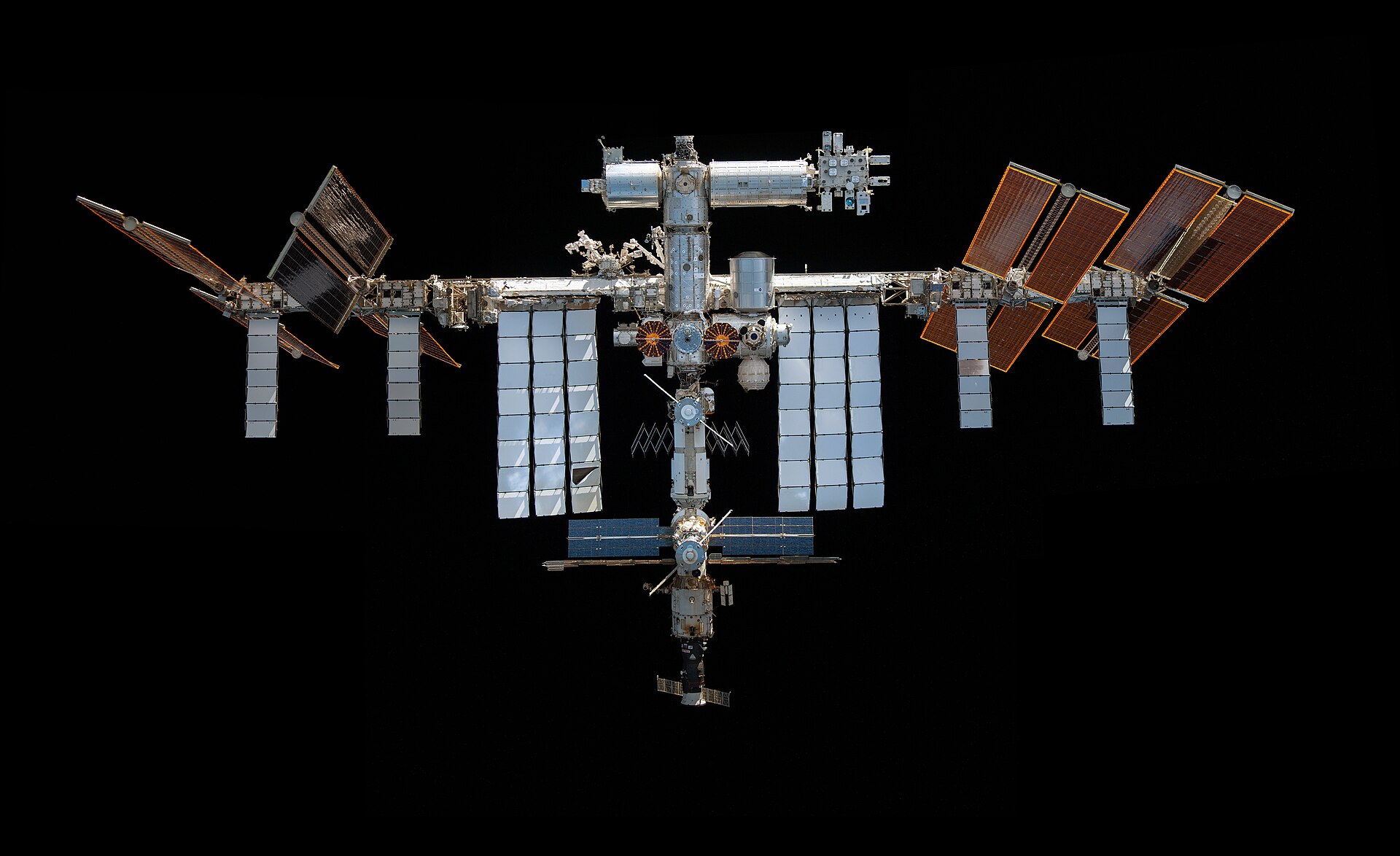
The International Space Station (ISS) is a modular space station assembled in low Earth orbit beginning in 1998 by the United States, Russia, Europe, Japan and Canada. It orbits at roughly 400 km altitude and 28,000 km/h, circling Earth about every 90 minutes — 16 sunrises and sunsets a day. Continuous occupation began on 2 November 2000; more than 280 people from 26 countries have visited since. The station supports research in biology, physics, materials science and human health, and serves as a testbed for technologies needed for deep-space exploration.
The station in brief
The International Space Station is a modular space station in low Earth orbit — the largest international cooperative programme in science and technology to date, run as a partnership of 10 European countries, the United States, Japan, Canada and Russia.1 Five space agencies contributed to its assembly: NASA, Roscosmos, ESA, JAXA and the Canadian Space Agency.2 Assembly began with the Russian control module Zarya on 20 November 1998.3 The first resident crew moved aboard on 2 November 2000, and the station has been continuously occupied ever since.4
| Fact | Value | As of / basis |
|---|---|---|
| Type | Modular space station in low Earth orbit; the largest international cooperative programme in science and technology1 | ESA, 2026 |
| Partner agencies | Five: NASA (USA), Roscosmos (Russia), ESA (Europe), JAXA (Japan) and CSA (Canada)2 | NASA, 2026 |
| First element | Zarya (FGB), launched 20 November 19983 | CSA, 1998 |
| Continuously crewed since | 2 November 2000 (Expedition 1)4 | Britannica, since 2000 |
| Current expedition | Expedition 75 — began 26 July 2026, scheduled to end in spring 20275 | NASA, 2026 |
| Current commander | Jessica Meir (NASA astronaut and Expedition 75 commander)5 | NASA, 2026 |
| Crew | 7 (more during handovers)2 | NASA, 2024 |
| Altitude | About 250 miles (400 km) above Earth6 | NASA, 2026 |
| Speed | 17,500 miles per hour — five miles per second; a full orbit takes about 90 minutes, 16 orbits a day6 | NASA, 2026 |
| Mass | 925,335 pounds (419,725 kilograms)2 | NASA, 2024 |
| Habitable volume | 13,696 ft3 (388 m3); pressurized volume 35,491 ft3 (1,005 m3), larger than a six-bedroom house2 | NASA, 2024 |
| Dimensions | Truss 310 ft (94 m); solar-array wingspan 356 ft (109 m); pressurized module length 218 ft (67 m)2 | NASA, 2024 |
| Power | 8 solar arrays generate 75-90 kilowatts; new iROSA arrays augment the originals2 | NASA, 2024 |
| Spacewalks | 259 spacewalks at the station since December 19986 | NASA, 2026 |
| Visitors to date | More than 280 individuals from 26 countries and five international partners6 | NASA, 2026 |
| Programme cost | About EUR 100 billion (development, assembly and 10 years of operation)7 | ESA, 2026 |
| Retirement horizon | Supported by the US, ESA, Japan and Canada through 2030; Russia announced support through 20284 | Britannica, 2026 |
In its third decade of continuous human presence, the station works as a microgravity laboratory, hosting scientific investigations and technology demonstrations from a range of fields.8 NASA calls it a classroom, laboratory and proving ground: orbiting 250 miles above Earth at 17,500 miles per hour, it has hosted nearly 300 astronauts from across the globe.6 Expedition 75, which began on 26 July 2026 and is scheduled to end in spring 2027, is the current crew, with Jessica Meir serving as commander.5
How the station works: orbit, power and life support
The station does not hover above Earth; it falls around it, flying about 400 km up at 28,800 km/h and completing one circuit of the planet every 92 minutes.9 Its orbit is inclined 51.6 degrees to the equator, so that is the farthest north or south it ever reaches.10 In 24 hours it makes 16 orbits of Earth, and the crew travels through 16 sunrises and 16 sunsets.2 Because everything aboard is in free fall, the apparent gravity is only about one millionth of that on Earth.11 From the ground the station appears to travel from west to east, while Earth's own rotation shifts its track 2,200 km westward on each orbit.9
Power comes from eight solar arrays generating between 75 and 90 kilowatts, with new iROSA arrays augmenting the originals.2 The wingspan of those arrays, 356 feet (109 m), is longer than the world's largest passenger aircraft, the Airbus A380, at 262 feet (80 m).2 About eight miles of wiring run through the structure, and its software monitors roughly 350,000 sensors.2
Resupply is expensive, so the station is built to recycle: the Water Recovery System has cut the crew's dependence on water delivered by cargo spacecraft by 65 percent — from about a gallon a day to a third of a gallon.2 The same traffic carries oxygen, food and water, exchanges the permanent crew, and replaces the docked lifeboat roughly every six months.1
Modules and elements: the anatomy of the station
The station could not be launched in one piece — no rocket is big enough or powerful enough — so it was taken into space piece by piece and gradually built in orbit about 400 km above Earth.1 The large modules and other pieces arrived on 42 assembly flights: 37 on U.S. space shuttles and five on Russian Proton/Soyuz rockets.2 Assembly depended on spacewalks and robotics; Canadarm2, a 55-foot arm with seven joints and two end-effectors, moved entire modules, deployed science experiments and even transported spacewalking astronauts.2
| Element | Origin | Added | Notes |
|---|---|---|---|
| Zarya | Russian control module | 20 November 19983 | The first element of the ISS and the start of assembly in orbit3 |
| Unity | U.S.-built connecting node | December 19984 | Linked to Zarya in orbit by U.S. space shuttle astronauts4 |
| Zvezda | Russian service module | Mid-20004 | A habitat and control centre; the first resident crew arrived on 2 November 20004 |
| Destiny | NASA microgravity laboratory | 20014 | Joined as the station grew into a complex of laboratories and habitats along a long truss carrying solar arrays and radiators4 |
| Canadarm2 | Canadian robotic arm (CSA) | 19 April 200112 | Launched aboard Endeavour and attached three days later by Chris Hadfield and Scott Parazynski; 17 m long, 1,497 kg, seven degrees of freedom12 |
| Harmony | European-built American node | October 20074 | Placed on the end of Destiny; it has a docking port for the shuttle and connecting ports for the Columbus and Kibo laboratories4 |
| Columbus | ESA laboratory | February 20084 | Europe's first long-duration crewed space laboratory, mounted on Harmony's starboard side, with experiments in biology and fluid dynamics4 |
| Kibo | JAXA laboratory | June 2008; Exposed Facility July 20094 | Japan's first crewed experiment facility and the largest experiment module on the station; its Pressurized Module is 11.2 m long and 4.4 m in diameter at one atmosphere11 |
| Dextre | Canadian robot (CSA) | March 20084 | Delivered by shuttle astronauts; able to perform tasks that previously required spacewalks4 |
| Tranquility and Cupola | Node and observation dome | 20104 | The Cupola's robotic workstation and many windows enabled astronauts to supervise external operations4 |
| Nauka | Russian science module | 20214 | Added to the station's Russian segment4 |
| Prichal | Russian docking module | 26 November 20212 | The most recent module installed on the station2 |
| BEAM and Bishop | Commercial modules | — | BEAM, the Bigelow Expandable Activity Module, and the NanoRacks Bishop airlock2 |
The station continues to be updated: new iROSA solar arrays augment the eight main arrays, and Prichal, added on 26 November 2021, remains the most recent module installed.2 Two commercial modules are also aboard: BEAM, the Bigelow Expandable Activity Module, and the NanoRacks Bishop airlock.2
Living and working in orbit
Inside, the station is larger than a six-bedroom house: it has six sleeping quarters, two bathrooms, a gym and a 360-degree view bay window.2 Its habitable volume is 13,696 cubic feet (388 m3) within a pressurized volume of 35,491 cubic feet (1,005 m3).2 An international crew of seven lives and works aboard while travelling at five miles per second, and sometimes more are aboard during a crew handover.2
Weightlessness is hard on the body, so to counter the loss of muscle and bone mass in microgravity, astronauts work out at least two hours a day.2 Crew members have access to a running treadmill, a cycle ergometer and a resistance exercise device.13 Even so, a study of nine crew members found that calf muscle volume decreased about 13 percent after six months aboard, with greater atrophy of the soleus than the gastrocnemius, and peak power 32 percent lower after spaceflight.13
Supplies arrive aboard four different cargo spacecraft: Northrop Grumman's Cygnus, SpaceX's Dragon, JAXA's HTV and the Russian Progress.2 As many as eight spaceships can be connected to the station at once, and a spacecraft can arrive as soon as four hours after launching from Earth.2 The docked lifeboat is replaced roughly every six months.1
A microgravity laboratory
The station is a working laboratory as well as a home: through Expedition 60 it had hosted nearly 3,000 research investigations from researchers in more than 108 countries.2 Some instruments sit in open space: Japan's Kibo carries an Exposed Facility directly exposed to space — unique among ISS laboratories — enabling long-term experiments as well as Earth and astronomical observations.11 The Alpha Magnetic Spectrometer measured the cosmic-ray positron fraction from 0.5 to 350 GeV using 6.8 million positron and electron events.14
Simulated real-time analyses of in-flight sequence data using an automated bioinformatic pipeline and laptop-based genomic assembly demonstrated the feasibility of sequencing analysis and microbial identification aboard the ISS.
Castro-Wallace et al., Nanopore DNA Sequencing and Genome Assembly on the International Space Station, Scientific Reports, 2017
The first results from the space-borne Alpha Magnetic Spectrometer confirm an unexplained excess of high-energy positrons in Earth-bound cosmic rays.
AMS Collaboration, First Result from the Alpha Magnetic Spectrometer, Physical Review Letters, 2013
While on the ISS, crewmembers had access to a running treadmill, cycle ergometer, and resistance exercise device.
Trappe et al., Exercise in space: human skeletal muscle after 6 months aboard the International Space Station, Journal of Applied Physiology, 2009
Molecular analysis demonstrated the presence of nucleic acids belonging to various pathogens, but no viable pathogens were recovered.
Novikova et al., Survey of environmental biocontamination on board the International Space Station, Research in Microbiology, 2006
Not all of that research belongs to NASA: in 2005 Congress designated the station a U.S. National Laboratory, enabling space research and development access to a broad range of commercial, academic and government users.6 The ISS National Lab manages all non-NASA research and investigations aboard.8 The peer-reviewed record shows what the setting makes possible: nine in-flight sequencing runs over a six-month period yielded 276,882 reads with no apparent decrease in performance, and automated pipelines demonstrated that sequencing analysis and microbial identification aboard the station are feasible.15 A six-year survey collected more than 500 samples aboard the station; molecular analysis found nucleic acids of various pathogens, but no viable pathogens were recovered.16 By the Canadian Space Agency's count, more than 24 Canadian studies have been conducted aboard the station, some of them still under way.3
Five agencies, one station: the international partnership
An international partnership of five space agencies from 15 countries operates the station, and the principals are the space agencies of the United States, Russia, Europe, Japan and Canada.6 Five space agencies including NASA, Roscosmos, ESA, JAXA and CSA have contributed to the station's assembly.2 Canada is one of the station's partners, along with the United States, Russia, Europe and Japan.3
| Agency | Party | Signature contributions |
|---|---|---|
| NASA | United States | American modules and laboratory elements, including the U.S.-built Unity node and the Destiny microgravity laboratory4; one of the five principals that provides and operates the elements of the station6 |
| Roscosmos | Russia | The control module Zarya, the habitat and control centre Zvezda and the 2021 science module Nauka; Soyuz crew flights and Progress cargo flights4 |
| ESA | Europe (10 member states) | The Columbus laboratory and the ATV freighter, which flew from 2008 to 20154; 10 ESA member states participate in the programme7 |
| JAXA | Japan | The Kibo laboratory, the largest experiment module on the station, and the HTV freighter (2009-2020), with HTV-X from 2025114 |
| CSA | Canada | Canadarm2, Dextre and the Mobile Base System, a transport and storage platform; seven CSA astronauts have completed nine missions aboard3 |
The project began as an American effort called Freedom, authorised by President Ronald Reagan, and in 1993 the United States and Russia agreed to merge their separate space station plans into a single facility, renamed and expanded internationally.4 Launched in 1998 and involving the U.S., Russia, Canada, Japan and the participating countries of the European Space Agency, the station is one of the most complex international collaborations ever attempted.6 ESA puts the cost of development, assembly and ten years of operation at about EUR 100 billion, shared over almost 30 years between the United States, Russia, Canada, Japan and 10 European nations.7 The 10 ESA member states in the programme are Belgium, Denmark, France, Germany, Italy, the Netherlands, Norway, Spain, Sweden and Switzerland.7
Assembly, 1998-2011
Assembly began with the launches of the Russian control module Zarya on 20 November 1998 and the U.S.-built Unity connecting node the following month, which were linked in orbit by U.S. space shuttle astronauts.4 In mid-2000 the Russian-built Zvezda, a habitat and control centre, was added, and on 2 November the station received its first resident crew — cosmonauts Sergey Krikalev and Yuri Gidzenko and astronaut William Shepherd, who flew up in a Soyuz spacecraft.4 NASA's Destiny microgravity laboratory and other elements were subsequently joined to the station, which grew into a complex of laboratories and habitats along a long truss carrying solar arrays and radiators.4 Canadarm2 launched aboard Space Shuttle Endeavour on 19 April 2001; three days later, Chris Hadfield and Scott Parazynski attached the robotic arm to the station.12
Construction was interrupted in February 2003, when the space shuttle orbiter Columbia broke up and the fleet was grounded, effectively halting expansion of the station.4 The crew was reduced from three to two, and its role was restricted mainly to caretaker status, limiting the amount of science that could be done.4
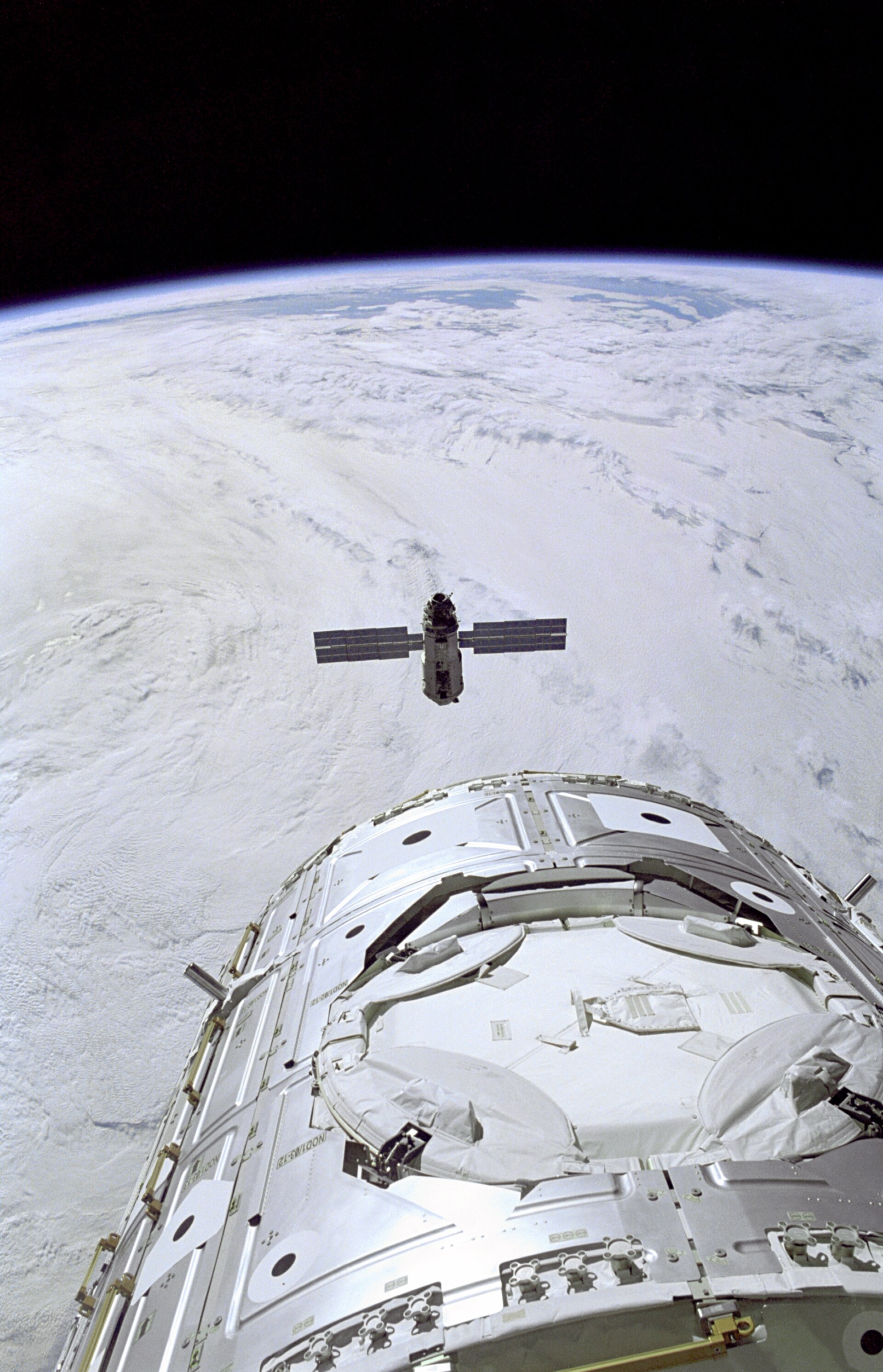
Expansion resumed later in the decade: the European-built American node Harmony was placed on the end of Destiny in October 2007, adding a docking port for the shuttle and connecting ports for a European laboratory, Columbus, and a Japanese laboratory, Kibo.4 Columbus was mounted on Harmony's starboard side in February 2008 — Europe's first long-duration crewed space laboratory, containing experiments in such fields as biology and fluid dynamics.4 In March, shuttle astronauts brought the Canadian robot Dextre, which was designed to perform tasks that previously required spacewalks, along with the first part of Kibo.4 A third node, Tranquility, was installed in 2010, and mounted on it was the Cupola, whose robotic workstation and many windows enabled astronauts to supervise external operations.4
The station became fully operational in May 2009 when it began hosting a six-person crew, which required two Soyuz lifeboats to be docked at all times.4 After completion of the station, the shuttle was retired from service in 2011, closing the assembly era.4 The large modules and other pieces had been delivered on 42 assembly flights: 37 on the U.S. space shuttles and five on Russian Proton/Soyuz rockets.2
Spacewalks and the maintenance era
Spacewalks have been the station's construction crews — used for building, repairs and the ongoing upgrade programme — and there have been 259 spacewalks at the station since December 1998.6 Robots now do part of the work: Canadarm2, 55 feet long with seven joints and two end-effectors, has moved entire modules, deployed science experiments and transported spacewalking astronauts.2 Dextre, the Canadian robot, can perform tasks that previously would have required astronauts to make space walks.4
Getting there: crews, cargo and visiting vehicles
Crews arrive aboard vehicles built on both sides of the old space race: during construction a Soyuz remained docked to the station at all times as a lifeboat, and before Crew Dragon all astronauts used Soyuz spacecraft to reach the station.4 SpaceX's Crew Dragon had its first flight to the station in 2020; it carried four astronauts, and the station was then able to accommodate a crew of seven.4 Boeing's CST-100 Starliner had its first crewed test flight on 5 June 2024, but during the flight to the station five thrusters failed and helium leaks were detected in its propulsion system.4 ESA, JAXA, Roscosmos, Northrop Grumman and SpaceX have each launched their own space freighters, while NASA, Roscosmos, SpaceX and Boeing have launched crew ships.6
| Vehicle | Operator | Role | Service notes |
|---|---|---|---|
| Soyuz | Roscosmos (Russia) and partner agencies | Crew transport and station lifeboat4 | A Soyuz remained docked at all times as a lifeboat during construction; before Crew Dragon, all crews reached the station by Soyuz4 |
| Progress | Russia | Cargo resupply4 | Among the freighters that serviced the station after the shuttle era4 |
| ATV | ESA (Europe) | Cargo freighter4 | Flew from 2008 to 20154 |
| HTV and HTV-X | JAXA (Japan) | Cargo freighters4 | HTV flew from 2009 to 2020; HTV-X from 20254 |
| Dragon | SpaceX | Cargo from 2010 and crew, as Crew Dragon, from 20204 | Crew Dragon carried four astronauts to the station, which was then able to accommodate a crew of seven4 |
| Cygnus | Orbital Sciences Corporation / Northrop Grumman | Cargo freighter from 20134 | One of four cargo spacecraft — with Dragon, HTV and Progress — that deliver science, cargo and supplies2 |
| CST-100 Starliner | Boeing | Crew spacecraft4 | First crewed test flight 5 June 2024; five thrusters failed and helium leaks were detected during the flight to the station4 |
Traffic is heavy and fast: eight spaceships can be connected to the space station at once, and a spacecraft can arrive as soon as four hours after launching from Earth.2 The docked lifeboat must also be replaced every six months or so.1
Records, visitors and spaceflight participants
More than 280 astronauts from 26 different countries have visited the station, and crews typically stay for about six months.4 NASA counts over 280 individuals representing 26 countries and five international partners, and nearly 300 astronauts hosted in a quarter of a century.6
Some visitors have stayed far longer than six months: on the mission called 'A Year in Space,' cosmonaut Mikhail Korniyenko and astronaut Scott Kelly spent 340 days in orbit from March 2015 to March 2016.4 In 2017 Peggy Whitson extended her mission to 289 days — at the time the longest single spaceflight by a woman — and she has spent more than 675 days in space in total, a record for an American and a woman.4 Christina Koch surpassed Whitson's consecutive-flight record with 328 days aboard from March 2019 to February 2020, and during that stay she and Jessica Meir performed the first all-female spacewalk.4 Cosmonaut Pyotr Dubrov and astronaut Mark Vande Hei stayed 355 days from April 2021 to March 2022, and Vande Hei broke Kelly's record for the longest American spaceflight.4
Not everyone who flies is an agency astronaut: eight other individuals paid for seats on Soyuz flights to the station between 2002 and 2021.4 Beginning in 2022, the American company Axiom Space has chartered flights on Crew Dragon spacecraft to the station.4
Spotting the station from Earth
The station is easy to see if you know when to look: it can be seen with the naked eye from the ground by looking up at the right time.9 To an observer it appears similar to an airplane or a very bright star moving across the night sky, except that it does not have flashing lights or change direction.10 It also moves faster than a typical airplane: airplanes fly at about 600 mph (965 kph), while the station flies at 17,500 mph (28,000 kph).10
Sightings happen at specific hours and latitudes: all station sightings occur within a few hours before or after sunrise or sunset, the optimum viewing period, when the Sun reflects off the station against the darker sky.10 The station orbits with an inclination of 51.6 degrees, so the farthest north or south of the equator it goes is 51.6 degrees latitude; for locations beyond that, including Alaska, it will never go directly overhead.10
For planning, NASA maintains the Spot the Station service, which helps observers find when the station will pass.10 The traffic overhead is constant: every day the ISS circles the Earth 16 times, a distance roughly equal to a round trip to the Moon.3
The road to 2030
The station's future is now measured in commitments rather than construction milestones: the United States, ESA, Japan and Canada have committed to support the station through 2030, while Russia announced that it would support the station through 2028 and then begin work on its own orbital space station.4 On 2 November 2025 the station marked 25 years of continuous human presence aboard.6
Timeline
Zarya: the first element reaches orbit
The Russian control module Zarya launches, becoming the first element of the ISS and the start of assembly in orbit. 3
Unity joins Zarya
The U.S.-built Unity connecting node launches the following month and is linked to Zarya in orbit by space shuttle astronauts. 4
Zvezda arrives; the first resident crew moves in
The Russian-built Zvezda service module, a habitat and control centre, is added in mid-2000; on 2 November cosmonauts Sergey Krikalev and Yuri Gidzenko and astronaut William Shepherd arrive by Soyuz as the first resident crew. The station has been continuously occupied ever since. 4
Canadarm2 launches aboard Endeavour
Canada's 17-metre robotic arm launches on shuttle Endeavour; three days later Chris Hadfield and Scott Parazynski attach it to the station. 12
Destiny: the U.S. laboratory joins the station
NASA's Destiny microgravity laboratory and other elements are subsequently joined to the station, as the station grows into a complex of laboratories and habitats along a long truss carrying solar arrays and radiators. 4
Columbia disaster halts expansion
After shuttle Columbia breaks up, the fleet is grounded, expansion stops, and the station crew is reduced from three to two in caretaker status. 4
Harmony node installed
The European-built American node Harmony is placed on the end of Destiny, providing a docking port for the shuttle and connecting ports for the Columbus and Kibo laboratories. 4
Columbus: Europe's laboratory in orbit
Columbus is mounted on Harmony's starboard side — Europe's first long-duration crewed space laboratory, with experiments in biology and fluid dynamics. 4
Six-person crews begin
The station becomes fully operational when it begins hosting a six-person crew, requiring two Soyuz lifeboats docked at all times. 4
Tranquility and the Cupola
A third node, Tranquility, is installed with the Cupola mounted on it — its robotic workstation and many windows let astronauts supervise external operations. 4
First commercial spacecraft docks
SpaceX's Dragon capsule becomes the first commercial spacecraft to dock with the ISS. 4
Crew Dragon restores U.S. crew launches
SpaceX's Crew Dragon makes its first flight to the station with four astronauts; the station can then accommodate a crew of seven. 4
Twenty-five years of continuous human presence
November 2, 2025, marks a historic milestone: 25 years of continuous human presence aboard the International Space Station. 6
Expedition 75 takes over
Expedition 75 begins on July 26, 2026, and will end in spring 2027, with a seven-member international crew aboard. 5
Frequently asked questions
What is the International Space Station?
It is a modular space station in low Earth orbit and the largest international cooperative programme in science and technology to date.1 Five space agencies — NASA, Roscosmos, ESA, JAXA and CSA — contributed to its assembly, starting with the first module in 1998.2
How high and how fast does the station travel?
It orbits about 250 miles (400 km) above Earth at 17,500 miles per hour, completing one circuit roughly every 90 minutes.6 At that pace it makes 16 orbits of Earth in 24 hours, so the crew sees 16 sunrises and 16 sunsets a day.2
How long has the ISS been continuously crewed?
Since 2 November 2000, when the first resident crew — cosmonauts Sergey Krikalev and Yuri Gidzenko and astronaut William Shepherd — arrived by Soyuz spacecraft.4 On 2 November 2025 the station marked 25 years of continuous human presence.6
Who operates the International Space Station?
An international partnership of five space agencies from 15 countries operates it, and the principals are the space agencies of the United States, Russia, Europe, Japan and Canada.6 The five agencies are NASA, Roscosmos, ESA, JAXA and CSA.2
How much did the station cost?
ESA puts the cost of development, assembly and ten years of operation at about EUR 100 billion, shared over almost 30 years between the United States, Russia, Canada, Japan and 10 European nations.7 Europe's share of around EUR 8 billion works out to about one euro spent by every European every year.7
How many people have visited the station?
More than 280 astronauts from 26 different countries have visited, and astronauts typically stay about six months.4 NASA counts over 280 individuals representing 26 countries and five international partners.6
Can I see the station from the ground?
Yes: it can be seen with the naked eye, appearing like a very bright star moving across the sky without flashing lights, and much faster than a typical airplane.10 Sightings occur within a few hours before or after sunrise or sunset, and the 51.6-degree orbit means it never passes directly overhead for locations farther north or south than that latitude.10
Knowledge graph
Sources & citations
Every factual claim in this article is drawn from the sources below. Bracketed numbers in the text link to the corresponding source.
- 1
- 2
- 3
- 4
- 5
- 6
- 7
- 8
- 9
- 10
- 11
- 12
- 13
- 14
- 15
- 16