Great Barrier Reef
The world's largest coral reef system: 2,300 kilometres of reefs, islands and marine life off Queensland, Australia — a World Heritage icon under pressure from a warming ocean.
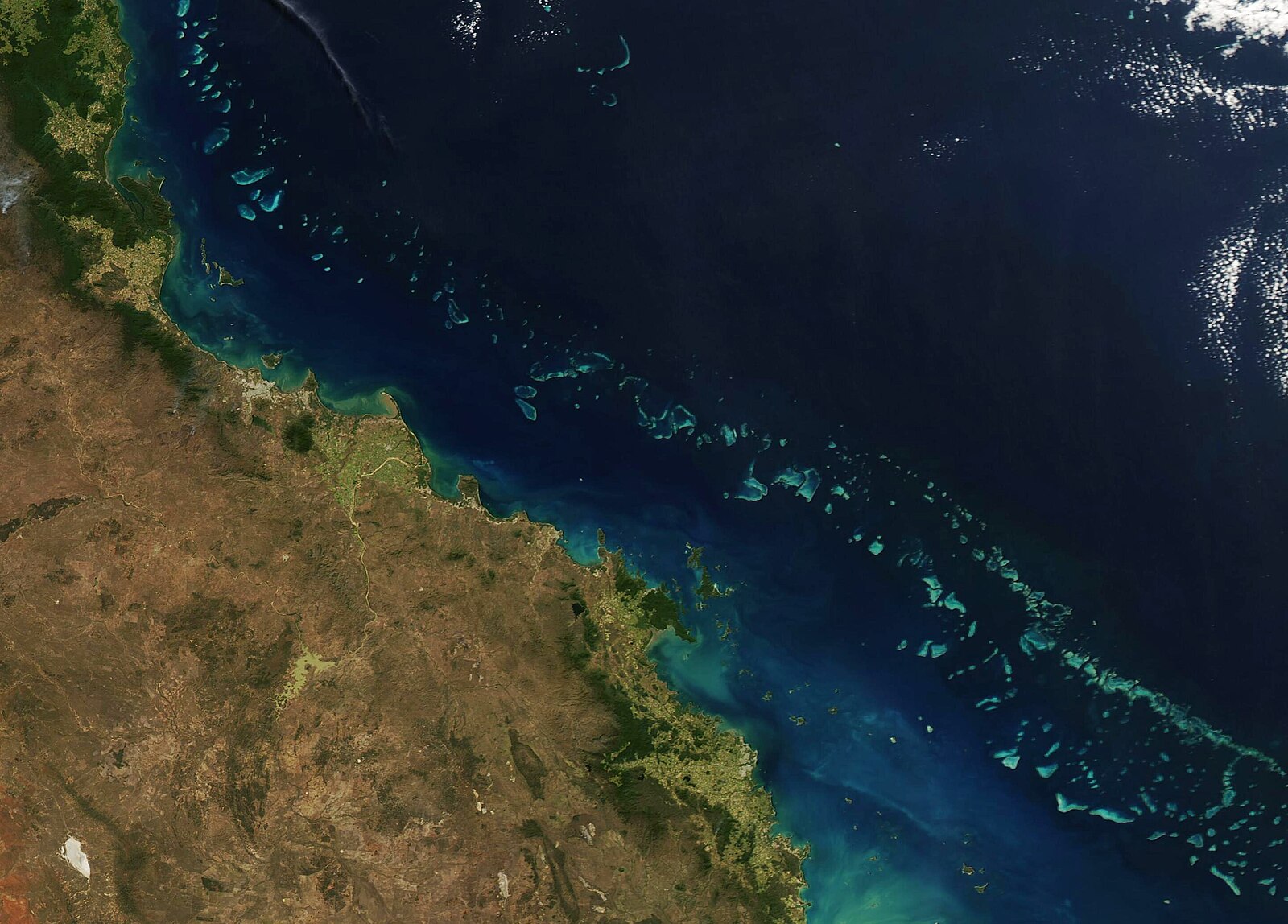
.jpg)
The Great Barrier Reef is the world's largest coral reef ecosystem, stretching about 2,300 kilometres along the Queensland coast of north-eastern Australia. Composed of roughly 3,000 individual reefs and more than a thousand islands and cays, it was inscribed as a UNESCO World Heritage Area in 1981 and supports an extraordinary concentration of marine life, from 450 hard-coral species to dugongs and six of the world's seven marine turtles. Since 1998 the Reef has suffered eight mass coral bleaching events driven by warming seas, and its long-term outlook is rated 'very poor' — even as a 2026 UNESCO decision kept it off the List of World Heritage in Danger.
Overview
The Great Barrier Reef is the world's most extensive coral reef ecosystem.1 It is also the longest and largest reef complex in the world, a complex of coral reefs, shoals and islets off Australia's northeastern coast.2 It lies in the Coral Sea, off the coast of Queensland in north-eastern Australia.3 Practically the entire ecosystem was inscribed as UNESCO World Heritage in 1981, under all four natural criteria — (vii), (viii), (ix) and (x).1 The Reef makes up about 10 per cent of the world's coral reef ecosystems and is one of the best known and most complex natural systems on Earth.3
The Marine Park stretches approximately 2,300 kilometres along the coast of Queensland in north-eastern Australia and covers 344,400 square kilometres.3 The World Heritage Area is slightly larger: 348,000 square kilometres, an expanse bigger than the United Kingdom, Holland and Switzerland combined.4 It extends across a latitudinal range of 14 degrees, from 10°S to 24°S.1 The Reef is one of the few living structures visible from space.4
UNESCO's inscription records document 400 types of coral, 1,500 species of fish and 4,000 types of mollusc.1 The Reef Authority counts 450 types of hard corals and 1,625 species of fish.3 The Reef is Sea Country for many First Australians, with more than 70 Traditional Owner groups whose connections to the marine environment date back more than 60,000 years.3 Economically, it contributes more than $9 billion each year to the Australian economy and supports around 77,000 full-time jobs.3
Geography and extent
The Reef stretches approximately 2,300 kilometres along the coast of Queensland in north-eastern Australia.3 It runs in a roughly northwest-southeast direction and lies 10 to 100 miles (16 to 160 kilometres) offshore.2 Its width ranges from 60 to 250 kilometres.3 Inshore waters average 35 metres in depth, while the continental slopes of the outer reefs descend to more than 2,000 metres.3
The World Heritage Area contains more than 3,000 separate coral reefs and 1,050 islands and cays: 600 continental islands, 300 coral cays and 150 inshore mangrove islands.4 Up until 2017 the official number of individual reefs stood at 3,000, but detailed sonar mapping has since revealed that there are roughly 3,800 reefs.4 UNESCO's listing documentation likewise describes some 2,500 individual reefs and over 900 islands, including rugged continental islands that in one instance rise more than 1,100 metres above sea level.1
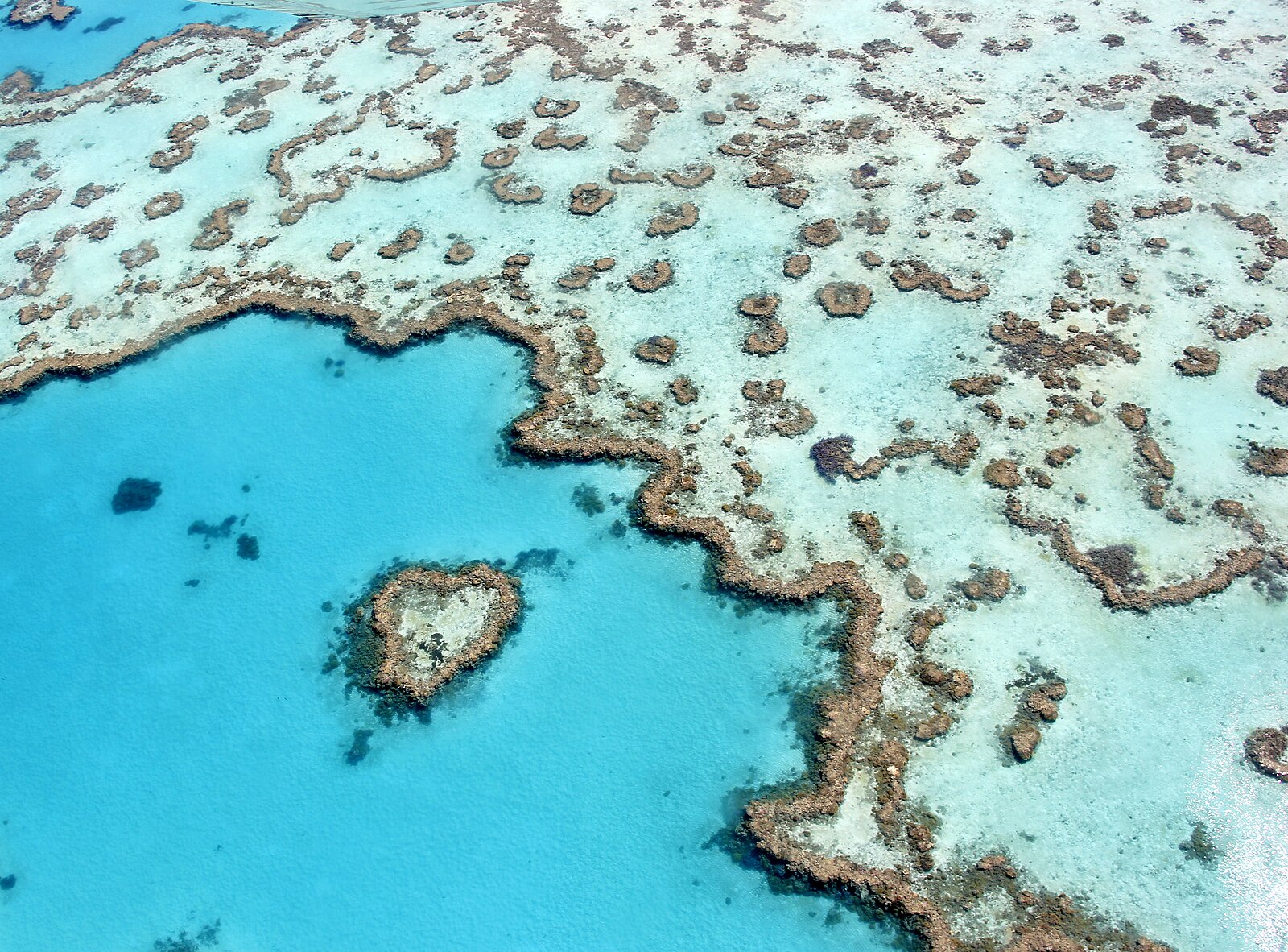
The Belize Reef, at 290 kilometres, is the world's second-longest barrier reef, while Western Australia's Ningaloo Reef is 280 kilometres long.3 For all its fame, coral reefs comprise only about seven per cent of the Marine Park and the World Heritage Area.3 Scientists have identified 70 bioregions within the property: 30 reef bioregions and 40 non-reefal ones, including algal and sponge gardens, sandy and muddy bottom communities, continental slopes and deep ocean troughs.4
How the reef is built
Corals look like plants but are in fact marine animals, closely related to jellyfish, and belong to the large group of invertebrates called Cnidaria.5 Hard corals are the reef-builders: they extract calcium from seawater to make limestone outer skeletons, which form coral reefs.5 Around 450 species of hard corals and more than a thousand species of soft corals live on the Reef.5 In the reef framework, the bricks are the calcareous remains of coral polyps and hydrocorals, while the cement that binds them is formed largely by coralline algae and bryozoans.2
Coral colours come from millions of microscopic algae, called zooxanthellae, that live inside the coral polyp in a symbiotic relationship.5 The host coral provides the algae with a home, protection from the elements and the components needed for photosynthesis.5 In return, the zooxanthellae's chlorophyll pigment converts carbon dioxide and water into glucose when exposed to sunlight, providing energy for both the algae and the coral.5 Coral bleaching is the whitening of the coral skeleton caused by the breakdown of this symbiosis.2
Around 25 million years ago, as Australia drifted northwards into the tropics, small coral reefs had already formed far offshore, and a few had established on the edge of the continental shelf in the far north.4 The northernmost part of the Great Barrier began to form roughly half a million years ago and is now its oldest section.4 The area has been exposed and flooded by at least four glacial and interglacial cycles, and reefs have grown on the continental shelf over the past 15,000 years.1
Biodiversity
| Group | Recorded number | Source |
|---|---|---|
| Hard corals | 450 | 3 |
| Soft corals and sea pens | 1,000+ | 3 |
| Fish | 1,625 | 3 |
| Molluscs | 6,000+ | 3 |
| Sharks and rays | 136 | 3 |
| Marine turtles | 6 of the world's 7 | 3 |
| Seabirds and shorebirds | 20 nesting species and 41 shorebird species | 3 |
| Whales and dolphins | 30+ | 3 |
| Jellyfish | 100+ | 3 |
| Sponges | 2,500+ | 3 |
The Reef is habitat for species threatened with extinction, including the dugong, or sea cow, and the large green turtle.1 It supports one of the world's most important dugong populations and six of the world's seven species of marine turtle.4 Raine Island is the world's largest green turtle breeding area.4 The Reef hosts some 39 species of mangroves, comprising 54 per cent of the world's mangrove diversity.4 Its 43,000 square kilometres of seagrass meadows hold 23 per cent of known global species diversity.4
First Nations custodians
That deep history also records the arrival of Europeans.6 Bana Yirriji artists from Wujal Wujal recount that Captain Cook's ship, the Endeavour, smashed on the reef off Weary Bay.6 According to their account, the crew threw barrels of grog, food, guns, cannons and clothes overboard, and some of those things washed up on the Weary Bay shore.6
Discovery and early science
European exploration of the reef began in 1770, when the British explorer Captain James Cook ran his ship aground on it.2 By early June of that year the Endeavour was sailing through the treacherous reef; just before midnight on 11 June 1770 it hit a reef and stuck fast.6 To lighten the ship, the crew threw cargo overboard — including ballast and six cast-iron cannons — and worked nonstop for 24 hours to keep her afloat.6 Cook sealed the hole with the fothering technique, hauling a sail stuffed with oakum and wool under the ship's bottom so it was carried into the leak.6 After getting off the reef, the Endeavour limped along the coast looking for a safe harbour to carry out repairs.6
The Great Barrier Reef Expedition of 1928–29 contributed important knowledge about coral physiology and the ecology of coral reefs.2 The Australian Institute of Marine Science has monitored mass bleaching throughout the Reef since the early 1980s.7
Management and protection
The Great Barrier Reef Marine Park was created in 1975 through the Great Barrier Reef Marine Park Act.3 Supervision of the reef is largely the responsibility of the Marine Park.2 Today nearly 99 per cent of the World Heritage Area lies within this multiple-use Marine Park; the remaining section, under Queensland Government jurisdiction, amounts to 3,600 square kilometres.4
In 2021 the World Heritage Committee requested Australia to invite a joint World Heritage Centre/IUCN Reactive Monitoring mission centred on ensuring that the revised Reef 2050 Plan addresses the threat posed to the property by climate change.8 Following the July 2026 Committee decision, the Reef Authority will provide input into a progress report due 1 December 2028 — focusing on implementation of the Reef 2050 Catchment Water Quality Strategy — and into a State of Conservation report due 1 December 2029.9
Coral bleaching and climate change
Climate change is the greatest threat to the world's coral reefs, and most coral reefs have already declined and are facing irreversible change.10 The primary cause of regional, or mass, bleaching is increased sea temperatures.7 Bleaching is the whitening of the coral skeleton caused by the breakdown of the coral's symbiosis with algae called zooxanthellae.2 The average sea surface temperature of the Great Barrier Reef has warmed by 0.94°C since 1900 (BoM 2023).10 Marine heatwaves triggered four mass coral bleaching events on the Reef between 2016 and 2022, which is unprecedented since records began.10 Key stressors on the ecosystem include above-average sea temperatures, cyclones and storms, flood plumes and crown-of-thorns starfish outbreaks.11
The Australian Institute of Marine Science has documented mass bleaching with full-scale surveys in 1998, 2002, 2016, 2017, 2020, 2022, 2024 and 2025.7 In the hot summer of 1997–1998, aerial surveys of 654 reefs found bleaching on 74 per cent of inshore and 21 per cent of offshore reefs, and up to 70 per cent of corals died in the worst-affected Palm Island area.7 The 2001–2002 event was slightly more severe, with bleaching on 54 per cent of the 641 reefs observed and about 70 per cent of corals lost in the worst-affected Bowen area.7 In 2016, record ocean temperatures produced the most intense bleaching to affect the Reef: severe bleaching struck 38 per cent of surveyed reefs, mostly in the far north between Cape York and Port Douglas, and overall coral mortality documented by June 2016 was 22 per cent for the entire Reef.7 Extreme temperatures in 2016 killed approximately 30 per cent of the Reef's shallow-water corals (Hughes et al 2018).10 The back-to-back 2016 and 2017 events were unprecedented and collectively affected two-thirds of the Reef.7 In 2020, the third mass bleaching event in five years, 25 per cent of surveyed reefs had severe bleaching and nearly 80 per cent were exposed to heat-stress levels that cause bleaching.7 In 2022, aerial surveys confirmed the fourth event in seven years — the first driven by heat stress during La Niña conditions — with severe bleaching on 43 per cent of reefs surveyed.7 2024 saw the fifth event since 2016, with the largest spatial footprint of coral bleaching yet recorded.12 A mass bleaching event occurred again in 2025 — the sixth since 2016 and the second time the Reef has suffered consecutive events, after 2016–2017 and 2024–2025.7
In March 2024 the fifth mass bleaching event was confirmed: almost half of reefs (46 per cent) experienced record levels of heat stress, 73 per cent of surveyed reefs showed prevalent bleaching, and for the first time extreme bleaching — more than 90 per cent of coral cover — was observed in all three regions of the Reef.7 Inshore reefs around the Keppel Islands recorded the highest heat stress ever measured on the Reef in 2024: 12 to 15.5 °C-weeks on the NOAA 5km Degree Heating Week product.7 In April 2024 NOAA confirmed the fourth global coral bleaching event on record — the second in the last 10 years — with mass bleaching confirmed on Australia's Great Barrier Reef among many regions.13 The central Reef was also struck in that period by two tropical cyclones: Cyclone Jasper (Category 5, December 2023) and Cyclone Kirrily (Category 3, January 2024).12 In the 2025 aerial surveys, bleaching prevalence was highest between Cooktown and Cape York, where 41 per cent of the 162 mid-shelf and inshore reefs surveyed showed medium to high prevalence.7 In the 2024 AIMS surveys, region-wide average hard coral cover increased to 39.5 per cent on the Northern GBR, 34.0 per cent on the Central GBR and 39.1 per cent on the Southern GBR, though most surveys were completed before that summer's mass bleaching and the two cyclones.12 Over 38 years of AIMS monitoring, hard coral cover has decreased and increased in response to cycles of disturbance and recovery.12
Other threats
Crown-of-thorns starfish outbreaks cause significant damage to coral reefs across large spatial scales and are one of the major causes of coral decline across the Great Barrier Reef over the past 40 years.14 The starfish is the world's second largest, growing up to a metre across with up to 21 arms, and is the fastest-moving starfish at up to 20 metres an hour.15 An adult can consume half its body weight of coral each day, and mature females can produce up to 100 million eggs when they spawn.15 The animals are native to the Reef and occur naturally across the Indo-Pacific; scientists have identified four species, of which Acanthaster cf. solaris is the most common on the Reef.15 In the 2024 AIMS surveys, outbreaks had persisted on four Southern GBR reefs, while four Northern GBR reefs held low numbers of starfish.12
The Reef ecosystem is also challenged by deteriorating water quality from land-based pollution, rising water temperatures, crown-of-thorns starfish, fishing, coastal development and increasing ocean acidification.16 Flood plumes from the land add to the stress.11 Some marine scientists noted that coral coverage fell by nearly 50 per cent between 1985 and 2012, under damage from coral bleaching, crown-of-thorns starfish and tropical cyclones.2 In 2025 the World Heritage Committee regretted that the 2025 water quality targets for sediment and dissolved inorganic nitrogen were not achieved.17 It also required that the property be fully gillnet-free by mid-2027 at the latest.17
World Heritage status and economy
The outstanding universal value of the Reef has been maintained, but it is increasingly challenged: significant components underpinning all four natural world heritage criteria have deteriorated since inscription.4 In 2021 the World Heritage Committee noted with utmost concern the 2019 Outlook Report's conclusion that the long-term outlook of the ecosystem had deteriorated from poor to very poor, and that the property had suffered significantly from mass coral bleaching in 2016, 2017 and 2020.8 In 2023 the Committee noted that the property had suffered four mass bleaching events since 2016, including the unprecedented 2022 event during a traditionally cooler La Niña period, and requested a progress report by 1 February 2024, raising the possible inscription of the property on the List of World Heritage in Danger.18 In 2024 it again noted with utmost concern the continued threat posed by climate change and the negative impacts of the ongoing 2023–2024 bleaching event.19 In 2025 it highlighted the 2024 Outlook Report's conclusions that the long-term outlook remains one of continued deterioration and that the ecosystem outlook remains very poor.17 In July 2026 the Committee decided not to place the Great Barrier Reef on the List of World Heritage in Danger.9
The Reef is an economic powerhouse, contributing more than $9 billion each year to the Australian economy and providing around 77,000 full-time jobs.3 Over the Outlook Report's assessment period from 2019 to 2023, coral reef and seagrass habitats recovered well overall.11 But the Reef's capacity to recover from impacts will continue to be compromised by a rapidly changing climate.11
Timeline of the Great Barrier Reef
Cook's Endeavour strikes the Reef
Captain James Cook's Endeavour hit a reef just before midnight and stuck fast; the crew threw ballast and six cannons overboard and kept the ship afloat with the fothering technique.6
Great Barrier Reef Expedition
The Great Barrier Reef Expedition of 1928–29 contributed important knowledge about coral physiology and the ecology of coral reefs.2
Marine Park created
The Great Barrier Reef Marine Park was created in 1975 through the Great Barrier Reef Marine Park Act.3
World Heritage inscription
Practically the entire Great Barrier Reef ecosystem was inscribed on the UNESCO World Heritage List in 1981 under all four natural criteria.1
First documented mass bleaching
In the hot summer of 1997–1998, aerial surveys of 654 reefs found bleaching on 74% of inshore and 21% of offshore reefs; up to 70% of corals died in the worst-affected Palm Island area.7
Record heat, severe bleaching
Record ocean temperatures produced the most intense bleaching to affect the Reef: severe bleaching hit 38% of surveyed reefs, mostly in the far north, and overall coral mortality documented by June 2016 was 22% for the entire Reef.7
Back-to-back bleaching
Severe bleaching struck the central third of the Reef; the back-to-back 2016 and 2017 events were unprecedented and collectively affected two-thirds of the Great Barrier Reef.7
First La Niña bleaching
Aerial surveys confirmed the fourth mass bleaching event in seven years — the first driven by heat stress during La Niña — with severe bleaching on 43% of surveyed reefs, concentrated in the central region.7
Fifth event, largest footprint
The fifth mass bleaching event since 2016 had the largest spatial footprint ever recorded; 46% of reefs saw record heat stress and extreme bleaching appeared in all three regions, alongside Cyclones Jasper and Kirrily in the central Reef.12
Sixth event since 2016
A mass bleaching event occurred in 2025 — the sixth since 2016 and the second time the Reef has suffered consecutive events (2016–2017 and 2024–2025), with the highest prevalence between Cooktown and Cape York.7
UNESCO decides against 'in danger' listing
The UNESCO World Heritage Committee decided not to place the Great Barrier Reef on the List of World Heritage in Danger, with a progress report due 1 December 2028 and a State of Conservation report due 1 December 2029.9
Frequently asked questions
How large is the Great Barrier Reef?
The Great Barrier Reef Marine Park stretches approximately 2,300 kilometres along the coast of Queensland and covers 344,400 square kilometres.3 The World Heritage Area is slightly larger, at 348,000 square kilometres.4
When did the Reef become a World Heritage site?
Practically the entire ecosystem was inscribed as World Heritage in 1981, under all four natural criteria.1 It was declared a World Heritage Area because of its outstanding universal value.4
Are corals plants or animals?
Despite looking like plants, corals are marine animals, closely related to jellyfish, and belong to the invertebrate group Cnidaria.5 Their colours come from microscopic algae called zooxanthellae that live inside the coral polyp.5
How many mass bleaching events has the Reef suffered?
Mass bleaching events have been documented with full-scale surveys in 1998, 2002, 2016, 2017, 2020, 2022, 2024 and 2025 — eight events in all.7
What causes coral bleaching?
The primary cause of regional, or mass, bleaching is increased sea temperatures.7 Bleaching is the whitening of the coral skeleton caused by the breakdown of the coral's symbiosis with algae called zooxanthellae.2
Is the Reef on the List of World Heritage in Danger?
No. In July 2026 the UNESCO World Heritage Committee decided not to place the Great Barrier Reef on that list.9 A progress report is due 1 December 2028 and a State of Conservation report is due 1 December 2029.9
How many islands does the Reef have?
The World Heritage Area contains 1,050 islands and cays: 600 continental islands, 300 coral cays and 150 inshore mangrove islands.4
Knowledge graph
Sources & citations
Every factual claim in this article is drawn from the sources below. Bracketed numbers in the text link to the corresponding source.
- 1
- 2
- 3
- 4
- 5
- 6
- 7
- 8
- 9
- 10
- 11
- 12
- 13
- 14
- 15
- 16
- 17
- 18
- 19