SpaceX
From a Falcon 1 that reached orbit in 2008 to a fully reusable Starship beginning orbital flight — the rockets, launch records, contracts and finances of Space Exploration Technologies Corp.
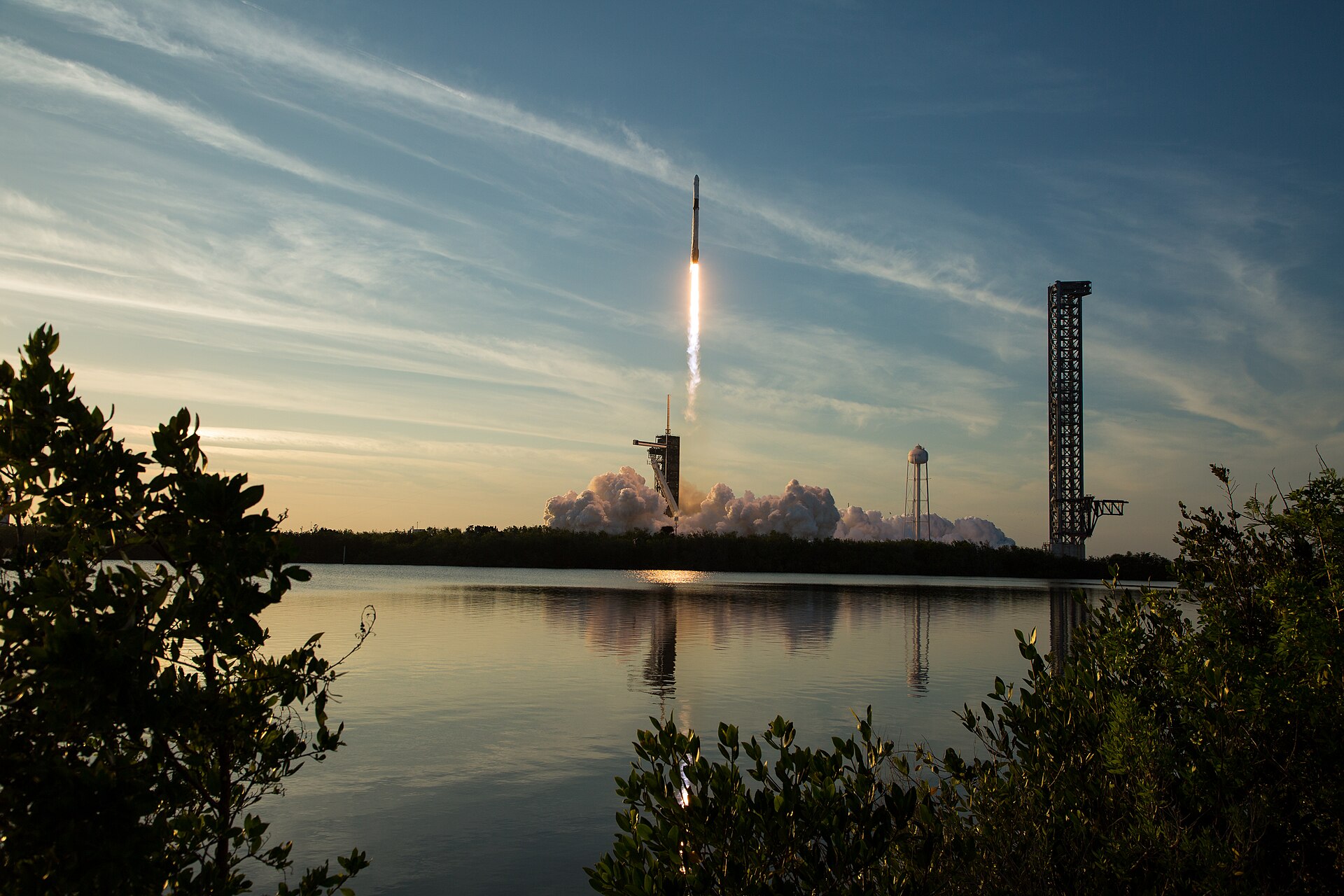
SpaceX (Space Exploration Technologies Corp.) is the American aerospace company founded by Elon Musk in 2002 that pioneered reusable orbital rockets, operates the Starlink satellite-internet constellation, flies NASA astronauts and cargo to the International Space Station, and is developing Starship — the largest rocket ever flown — for the Moon and Mars. This file tracks its vehicles, mission and flight-test records, contracts and finances from the founding through September 2026.
What SpaceX is
SpaceX is an American aerospace company founded in 2002 by Elon Musk that helped usher in the era of commercial spaceflight; its name in full is Space Exploration Technologies Corporation.1 It was the first private company to successfully launch and return a spacecraft from Earth orbit and the first to launch a crewed spacecraft and dock it with the International Space Station.1 Headquartered in Starbase, Texas, the company has more than 22,000 employees worldwide and operates launch, manufacturing, and testing facilities across the United States.1
The company's Starship work — development, manufacturing, testing and launch — is concentrated at Starbase, which serves as SpaceX headquarters and as one of the world's first commercial spaceports designed for orbital missions.2 Britannica's September 2026 company record lists the ticker as SPCX, a share price of $150.88 at the market close on 16 September 2026, a market capitalization of $1.89 trillion and annual revenue of $23.04 billion.1 This profile follows the company from its founding through September 2026 — the rockets, the launch and flight-test record, the Starlink constellation, the NASA contracts and the finances.1
The Falcon 1 years: from first failure to orbit
The company's first rocket was the Falcon 1, a two-stage liquid-fueled craft designed to send small satellites into Earth orbit.1 It was vastly cheaper to build and operate than its competitors in a field largely populated by publicly owned and government-funded companies such as Lockheed Martin and Boeing, partly because of the SpaceX-developed Merlin engine.1 In March 2006 SpaceX made its first Falcon 1 launch attempt, which began successfully but ended prematurely because of a fuel leak and fire.1 In August 2006 the company won a NASA competition for funds to build and demonstrate spacecraft that could potentially service the ISS after the decommissioning of the space shuttle.1
Falcon 1 launches that failed to attain Earth orbit followed in March 2007 and August 2008.1 In September 2008 SpaceX became the first privately owned company to send a liquid-fueled rocket into orbit.1 Three months later the company won a NASA contract for servicing the ISS worth more than $1 billion.1
Falcon 9, Dragon, and the road to the ISS
In 2010 SpaceX first launched its Falcon 9, a bigger craft so named for its use of nine engines.1 In December 2010 the company became the first commercial company to release a spacecraft — the Dragon capsule — into orbit and successfully return it to Earth.1 Dragon again made history on 25 May 2012 when it became the first commercial spacecraft to dock with the ISS, to which it successfully delivered cargo.1 The first crewed flight of a Dragon capsule to the ISS launched on 30 May 2020 with astronauts Doug Hurley and Robert Behnken.1
Since May 2020 SpaceX has safely flown 78 crewmembers from 20 countries to and from space across 20 missions aboard Dragon, including seven commercial and private astronaut missions.3 NASA's Commercial Crew Program is delivering on its goal of safe, reliable, and cost-effective human transportation to and from the International Space Station from the United States through a partnership with American private industry.4 NASA announced the crew of SpaceX Crew-13 — NASA astronauts Jessica Watkins and Luke Delaney, CSA astronaut Joshua Kutryk, and Roscosmos cosmonaut Sergey Teteryatnikov.4
Falcon 9 is a reusable two-stage rocket designed and manufactured by SpaceX for the reliable and safe transport of people and payloads into Earth orbit and beyond, and it is the world's first orbital-class reusable rocket.5 It stands 70 m tall with a diameter of 3.7 m and a mass of 549,054 kg, lifting up to 22,800 kg to low Earth orbit and 8,300 kg to geostationary transfer orbit.5 Its first stage incorporates nine Merlin engines and aluminum-lithium alloy tanks containing liquid oxygen and rocket-grade kerosene (RP-1) propellant.5 Dragon can carry up to 7 passengers to and from Earth orbit and beyond; it is the only spacecraft currently flying that can return significant amounts of cargo to Earth, and the first private spacecraft to take humans to the space station.6 It is 8.1 m tall and 4 m in diameter, with a pressurized volume of 9.3 m³ and a trunk of 37 m³; it can carry a launch payload of 6,000 kg and return payload of 3,000 kg.6
Reusability: landings, reflights, and what they changed
On 21 December 2015 a Falcon 9 first stage landed at Cape Canaveral, Florida — the first time a rocket stage launched a spacecraft into orbit and then returned to a landing on Earth.1 Beginning in 2016 SpaceX also began using drone ships for rocket stage landings.1 A rocket stage that had returned to Earth was successfully reused in a 2017 launch, and that same year a Dragon capsule was reused on a flight to the ISS.1
Falcon Heavy is composed of three reusable Falcon 9 nine-engine cores whose 27 Merlin engines together generate more than 5 million pounds of thrust at liftoff, equal to approximately eighteen 747 aircraft.7 It measures 70 m tall and 12.2 m wide with a mass of 1,420,788 kg, lifting 63,800 kg to low Earth orbit, 26,700 kg to geostationary transfer orbit and 16,800 kg to Mars.7 The company hoped the Falcon Heavy would be the first craft to break the $1,000-per-pound-to-orbit cost barrier, a goal set out when the Falcon 9 debuted in 2010.1 Writing in New Space, researcher Vidya Sagar Reddy argued that reusability is fast becoming the norm of the launch vehicle industry.8 A 2025 analysis in the CEAS Space Journal of Starship's first four integrated flight tests concluded that a fully reusable space transport system might become a reality within a few years.9
The fleet at a glance
The table below compares the operational fleet — Falcon 9, Falcon Heavy and Dragon — with the next-generation Starship and Super Heavy system, using the SpaceX vehicle pages as of September 2026.5 Falcon 9 is the world's first orbital-class reusable rocket, and Falcon Heavy is built from three reusable Falcon 9 cores.5 Dragon carries crew and cargo, while Starship is designed to carry more than 100 metric tonnes to orbit in a fully reusable configuration.2
| Vehicle | Key configuration | Payload capability | Current role |
|---|---|---|---|
| Falcon 9 | Reusable two-stage rocket; nine Merlin engines on the first stage; aluminum-lithium tanks holding liquid oxygen and RP-1 propellant.5 | Up to 22,800 kg to low Earth orbit and 8,300 kg to geostationary transfer orbit; 70 m tall with a mass of 549,054 kg.5 | The operational workhorse and the world's first orbital-class reusable rocket.5 |
| Falcon Heavy | Three reusable Falcon 9 nine-engine cores; 27 Merlin engines generating more than 5 million pounds of liftoff thrust.7 | 63,800 kg to low Earth orbit, 26,700 kg to geostationary transfer orbit and 16,800 kg to Mars; 70 m tall and 12.2 m wide.7 | Heavy-lift launcher; first operational flight on 11 April 2019.1 |
| Dragon | Capsule carrying up to 7 passengers; 8.1 m tall and 4 m in diameter, with a 9.3 m³ pressurized volume and a 37 m³ trunk.6 | 6,000 kg launch payload and 3,000 kg return payload; the only spacecraft flying that can return significant amounts of cargo to Earth.6 | Crew and cargo vehicle for the International Space Station and the first private spacecraft to take humans there.6 |
| Starship / Super Heavy | Fully reusable system standing 124 m (407 ft) tall with a 9 m diameter, built from the Super Heavy first stage and the Starship spacecraft.2 | More than 100 metric tonnes to orbit in a fully reusable configuration.2 | In flight test; orbital missions begin with Flight 14.3 |
Starship: from suborbital flight tests to orbital missions
Starship leverages tanker vehicles — essentially the Starship spacecraft minus the windows — to refill the Starship spacecraft in low-Earth orbit prior to departing for Mars.2 Starship and Super Heavy are designed to return to the launch site and be caught following their flight, with the ability to rapidly turn around and launch again without refurbishment.2 The third flight test completed a propellant transfer demonstration, moving liquid oxygen from a header tank into the main tank — data gathered for the eventual ship-to-ship transfers that would enable missions such as returning astronauts to the Moon under NASA's Artemis program.3 On its seventh flight test the landing burn slowed Super Heavy and maneuvered it to the launch and catch tower arms at Starbase, resulting in the second ever successful catch of the booster.3
Flight 9 began with the first Super Heavy booster to be reflown completing a full-duration ascent burn with all 33 of its Raptor engines before separating from the ship in a hot-staging maneuver.3 Investigators attributed the loss of the Flight 9 booster during its landing burn to higher than predicted forces on the booster's fuel transfer tube caused by the increased angle of attack experiment.3 On 18 June 2025 the Starship preparing for the tenth flight test — Ship 36 — experienced an anomaly while on a test stand at Starbase, during cryogenic propellant loading for a six-engine static fire.3 The third generation of Starship and Super Heavy, powered by Raptor 3 and launching from an entirely new launch pad, incorporates learnings from years of flight testing and development.3
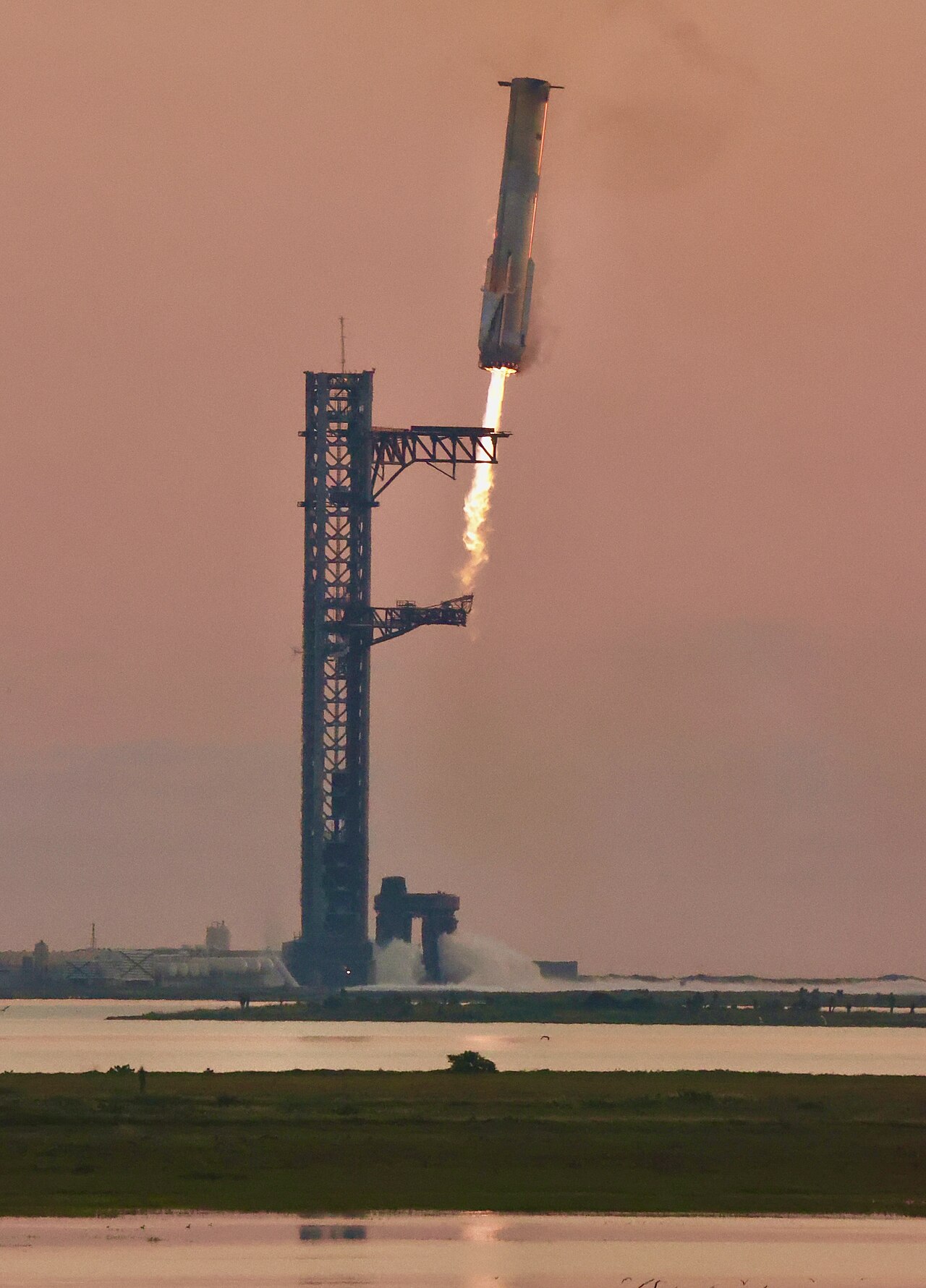
Starship V3 reduces the number of grid fins from four to three, with each fin now 50% larger and significantly stronger.3 The V3 fuel transfer tube, which channels cryogenic fuel from the main tank to the 33 Raptor engines, has been completely redesigned and is now roughly the size of a Falcon 9 first stage.3 Starting with Flight 14, Starship will begin flying orbital missions that will enable it to begin delivering Starlink V3 satellites and other payloads to space, and conduct new flight tests like the first orbital propellant transfer.3 As of late October 2025 SpaceX had produced more than three dozen Starships and 600 Raptor rocket engines, with more than 226,000 seconds of run time on the Raptor 2 engine.3
Researchers recorded far-field noise measurements 9.7–35.5 km from the pad during the fifth flight test, which included the first-ever booster catch.10 That research found Starship launch noise to be at least ten times greater than that of Falcon 9.10 A separate acoustic analysis put the acoustic energy of a Starship launch at about 11 Falcon 9 launches, or 2.2 Space Launch System launches.11
Starlink: the connectivity business
In 2019 SpaceX began launching satellites for its Starlink megaconstellation, which provides satellite Internet service; about 50 Starlink satellites are launched at a time on a Falcon 9 flight.1 An October 2020 Starlink mission marked the 100th successful flight of a Falcon rocket since Falcon 1 first flew to orbit in 2008.3 As of January 2026 Starlink had 9,633 active satellites, about two-thirds of all active satellites in orbit.1
The Federal Communications Commission has authorized SpaceX to deploy up to 15,000 second-generation Starlink satellites, and the company has said it ultimately aims to deploy a constellation numbering in the tens of thousands.1 SpaceX's Connectivity segment operates a worldwide high-speed, low-latency broadband data and communications network powered, as of 30 June 2026, by over 10,200 Starlink broadband and mobile satellites in Low-Earth Orbit.12 Starlink ended the second quarter of 2026 with 12.0 million subscribers, double the 6.0 million reported at 30 June 2025.12
To the Moon: the lunar Starship and NASA's contracts
The Human Landing System is the transportation mode that will take astronauts to the lunar surface as part of the Artemis program, which is managed at NASA's Marshall Space Flight Center in Huntsville, Alabama.13 Starship HLS is to carry astronauts from lunar orbit to the Moon's surface and back for Artemis III and Artemis IV.13 At about 165 feet (50 m), Starship HLS will be about the same height as a 15-story building, and an elevator will transport crew and cargo between the lander and the Moon's surface.13 NASA selected SpaceX to continue development of the first commercial human lander, and the firm-fixed price, milestone-based contract has a total award value of $2.89 billion.14
In November 2022 NASA modified its contract with SpaceX to further develop the Starship human landing system, adding support for a second human landing demonstration as part of the Artemis IV mission.3 Under the modified contract SpaceX will demonstrate Starship's capability to dock with Gateway — the small lunar-orbiting station designed to accommodate four crew members.3 A single Starship has a pressurized habitable volume of more than 600 cubic meters — roughly two-thirds the pressurized volume of the entire International Space Station — with dual airlocks for surface exploration.3 Cargo variants of the lander will be capable of landing up to 100 metric tons directly on the lunar surface, including large payloads such as rovers, nuclear reactors, and lunar habitats.3 SpaceX is self-funding the core Starship system — production facilities, test facilities, and launch sites — representing over 90% of system costs, alongside its work on the HLS-specific Starship for NASA.3
In January 2024 NASA adjusted the Artemis III launch date to September 2026 to allow contractors time to complete a significant amount of remaining complex work.15 GAO reported that the human landing system contractor has conducted two test flights of its human landing system.15 GAO also found that the Artemis III lunar landing was unlikely to occur in December 2025 as planned, given delays and remaining technical work.15
Money and contracts: backlog, IPO, and the public market
SpaceX reported revenues of $7,814 million for the second quarter of 2026 and $12,508 million for the first half of 2026, with $7,353 million of the half-year figure coming from services and $841 million from products.12 In the first half of 2026 the company flew 77 Falcon launches — 17 for customers and 60 internal — and one Starship launch, versus 81 Falcon and three Starship launches in the first half of 2025.12 The company completed its initial public offering in June 2026, issuing and selling 638.9 million Class A shares at $135.00 per share including the full over-allotment option, for net proceeds of $85,675 million after $575 million in underwriting commissions and offering costs.12 Also in June 2026 the company raised $25,000 million in the SpaceX Notes, partially used to repay the SpaceX Bridge Loan in full.12 Backlog totaled $47,461 million as of 30 June 2026, of which $14,286 million was recognized as deferred revenue.12 The company held cash and cash equivalents of $93,522 million and short-term marketable securities of $6,487 million as of 30 June 2026.12
| Item | Figure | As of | Source key |
|---|---|---|---|
| NASA Human Landing System award | $2.89 billion, firm-fixed price and milestone based.14 | April 2021.14 | nasa-hls-award — NASA news release 21-042, April 2021.14 |
| NASA commercial crew contracts — Boeing | $4.3 billion contract value.16 | May 2019.16 | nasa-oig-ccp — NASA Office of Inspector General, IG-20-005.16 |
| NASA commercial crew contracts — SpaceX | $2.5 billion contract value, of which $1.2 billion was development and test flight costs.16 | May 2019.16 | nasa-oig-ccp — NASA Office of Inspector General, IG-20-005.16 |
| NASA cost per seat | Approximately $90 million on Boeing versus approximately $55 million on SpaceX.16 | November 2019.16 | nasa-oig-ccp — NASA Office of Inspector General, IG-20-005.16 |
| June 2026 IPO net proceeds | $85,675 million, after $575 million in underwriting commissions and offering costs.12 | June 2026.12 | sec-spcx-10q — SEC Form 10-Q for the period ended June 30, 2026.12 |
| SpaceX Notes | $25,000 million raised, partially used to repay the SpaceX Bridge Loan in full.12 | June 2026.12 | sec-spcx-10q — SEC Form 10-Q for the period ended June 30, 2026.12 |
| Backlog | $47,461 million, including $14,286 million of deferred revenue.12 | 30 June 2026.12 | sec-spcx-10q — SEC Form 10-Q for the period ended June 30, 2026.12 |
| Cash and cash equivalents | $93,522 million; short-term marketable securities of $6,487 million.12 | 30 June 2026.12 | sec-spcx-10q — SEC Form 10-Q for the period ended June 30, 2026.12 |
| H1 2026 revenues | $12,508 million, versus $8,138 million in the first half of 2025.12 | 30 June 2026.12 | sec-spcx-10q — SEC Form 10-Q for the period ended June 30, 2026.12 |
xAI, orbital data centers, and what's next
On 2 February 2026 the Company completed its acquisition of X.AI Holdings Corp., and xAI became a wholly-owned subsidiary of the Company.12 The combination followed the earlier announcement that SpaceX would combine with xAI — Elon Musk's artificial intelligence company, which develops the Grok AI chatbot.1 The company has framed the logic of the combination around orbital data centers and AI compute at space scale.3
The Terafab project will be built in Grimes County, Texas; in April Tesla broke ground on a new research fab on the North Campus of Giga Texas as its precursor.3 Terafab is planned as a vertically integrated factory with more than 100 million square feet of manufacturing space housing the manufacturing, packaging, and testing of advanced logic and memory devices.3 The combined SpaceX and Tesla demand for chips is expected to be in excess of 1 terawatt of compute, significantly larger than the current global supply.3 Manufacturing hub Starfactory is sized to be capable of building up to 1,000 Starships per year, in order to send enough crew and cargo during Mars transfer windows to build a self-sustaining civilization.2
SpaceX agreed to acquire the AI start-up Cursor for $60 billion in stock, a deal expected to close in the third quarter of 2026.1 On the commercial deep-space side, Chun Wang — Mission Commander of Fram2, the first human spaceflight mission to fly over Earth's poles — is to fly aboard Starship's first human spaceflight interplanetary missions to Mars.3 Prior to those interplanetary flights, he will join Dennis and Akiko Tito on the first planned Starship commercial human spaceflight around the Moon, a week-long circumlunar fly-by mission.3
Voices: the sources in their own words
The quotations collected here run from NASA's April 2021 selection of SpaceX for the first crewed lunar lander to the company's own account of its combination with xAI.14 Alongside the NASA release and the company updates stand two findings from the peer-reviewed acoustics research on Starship's early flight tests.10
With this award, NASA and our partners will complete the first crewed demonstration mission to the surface of the Moon in the 21st century as the agency takes a step forward for women’s equality and long-term deep space exploration
Kathy Lueders, NASA associate administrator for Human Explorations and Operations Mission Directorate, April 2021
the most ambitious, vertically-integrated innovation engine on (and off) Earth
SpaceX, update on the acquisition of xAI
It’s always sunny in space!
SpaceX, xAI update, on orbital data centers
the far-field noise produced during a Starship launch is at least ten times that of Falcon 9.
Gee et al., JASA Express Letters, abstract via Crossref
reusability is fast becoming the norm of the launch vehicle industry.
Vidya Sagar Reddy, New Space
Timeline
SpaceX is founded
Entrepreneur Elon Musk forms SpaceX (Space Exploration Technologies) to make affordable spaceflight a reality, entering the field with the two-stage, liquid-fueled Falcon 1.
Falcon 1 reaches orbit — and a NASA contract follows
After failures in 2007 and 2008, SpaceX becomes the first privately owned company to send a liquid-fueled rocket into orbit; three months later it wins a NASA contract for servicing the ISS worth more than $1 billion.
Falcon 9 flies; Dragon returns from orbit
SpaceX first launches Falcon 9, a craft named for its nine engines; in December the Dragon capsule becomes the first commercial spacecraft released into orbit and successfully returned to Earth.
Dragon docks with the International Space Station
Dragon becomes the first commercial spacecraft to dock with the ISS and deliver cargo; that August, NASA awards SpaceX a contract to develop a crew transport successor to the space shuttle.
First landing of an orbital-class first stage
A Falcon 9 first stage lands at Cape Canaveral, Florida — the first time a rocket stage launched a spacecraft into orbit and then returned to a landing on Earth.
First reflights of a booster and a Dragon capsule
A rocket stage that had returned to Earth is reused in a launch, and a Dragon capsule is reused on a flight to the ISS — the beginning of routine reflight.
Falcon Heavy's first test flight
Two of the three first stages land successfully; the third hits the water near the drone ship. The rocket carries no satellite, instead placing a Tesla Roadster with a suited mannequin into orbit around the Sun.
Starlink launches begin; Falcon Heavy goes operational
SpaceX begins launching the Starlink megaconstellation for satellite Internet, with about 50 satellites per Falcon 9 flight; the first operational Falcon Heavy flight launches on April 11, 2019.
First crewed Dragon flight to the ISS
The Crew Dragon launches with NASA astronauts Doug Hurley and Robert Behnken — the first crewed orbital flight by a commercial spacecraft.
NASA selects SpaceX for the first crewed lunar lander
NASA picks SpaceX to develop the first commercial human lander for the Artemis program, under a firm-fixed-price, milestone-based contract with a total award value of $2.89 billion.
HLS contract expanded for Artemis IV
NASA modifies its Starship human landing system contract, adding a second human landing demonstration for Artemis IV and a demonstration of docking with the lunar Gateway station.
First-ever catch of a Super Heavy booster (Flight 5)
Starship's fifth flight test includes the first-ever catch of a Super Heavy booster at the launch tower; far-field noise measurements recorded during the flight later show Starship launch noise is at least ten times Falcon 9's.
Second booster catch (Flight 7)
Starship lifts off from Starbase and its landing burn maneuvers Super Heavy to the catch tower arms — the second ever successful catch of the booster. In May, Flight 9 debuts the first reflown Super Heavy before that booster is lost during its landing burn.
SpaceX completes the xAI acquisition
The Company completes its acquisition of X.AI Holdings Corp.; xAI becomes a wholly-owned subsidiary, joining AI, Starlink, direct-to-mobile communications and a real-time information platform under one roof.
Starship V3 flies
The third generation of Starship and Super Heavy — powered by Raptor 3 with a redesigned fuel transfer tube and three larger grid fins — makes its first launch, ahead of the move to orbital missions.
The record IPO — and orbital Starship
SpaceX completes the largest IPO in history at $135 per share and raises $25,000 million in notes; in mid-September the company announces that Starship will begin flying orbital missions starting with Flight 14.
Frequently asked questions
When was SpaceX founded and by whom?
SpaceX is an American aerospace company founded in 2002 by Elon Musk that helped usher in the era of commercial spaceflight; its name in full is Space Exploration Technologies Corporation.1
What did the Falcon 1 achieve?
In September 2008 SpaceX became the first privately owned company to send a liquid-fueled rocket into orbit.1 Three months later it won a NASA contract for servicing the ISS worth more than $1 billion.1
When did SpaceX begin landing and reusing rockets?
The first landing of a Falcon 9 first stage came at Cape Canaveral, Florida, on 21 December 2015.1 A rocket stage that had returned to Earth was successfully reused in a 2017 launch.1
How many people has SpaceX flown to space?
Since May 2020 SpaceX has safely flown 78 crewmembers from 20 countries to and from space across 20 missions aboard Dragon, including seven commercial and private astronaut missions.3
What is Starship designed to carry?
Starship stands 124 m (407 ft) tall and is designed to carry more than 100 metric tonnes to orbit in a fully reusable configuration.2 It will be able to carry up to 100 people on long-duration, interplanetary flights.2
How large is the Starlink constellation and business?
As of January 2026 Starlink had 9,633 active satellites, about two-thirds of all active satellites in orbit.1 Starlink ended the second quarter of 2026 with 12.0 million subscribers, double the 6.0 million reported at 30 June 2025.12
What is NASA paying SpaceX for the Moon lander?
The firm-fixed price, milestone-based contract for the first commercial human lander has a total award value of $2.89 billion.14 NASA modified the contract in November 2022 to add a second human landing demonstration for Artemis IV.3
When did SpaceX go public?
SpaceX completed its initial public offering in June 2026 — the largest IPO in history — raising $75 billion and valuing the company at about $1.77 trillion.1 The Form 10-Q for the quarter ended 30 June 2026 reports net proceeds of $85,675 million.12 The company's shares trade under the ticker SPCX.1
Knowledge graph
Sources & citations
Every factual claim in this article is drawn from the sources below. Bracketed numbers in the text link to the corresponding source.
- 1
- 2
- 3
- 4
- 5
- 6
- 7
- 8
- 9
- 10
- 11
- 12
- 13
- 14
- 15
- 16