World Wide Web
The hyperlinked information service that turned the Internet into a place — proposed at CERN in 1989, given away as an open standard, and used by billions of people today.
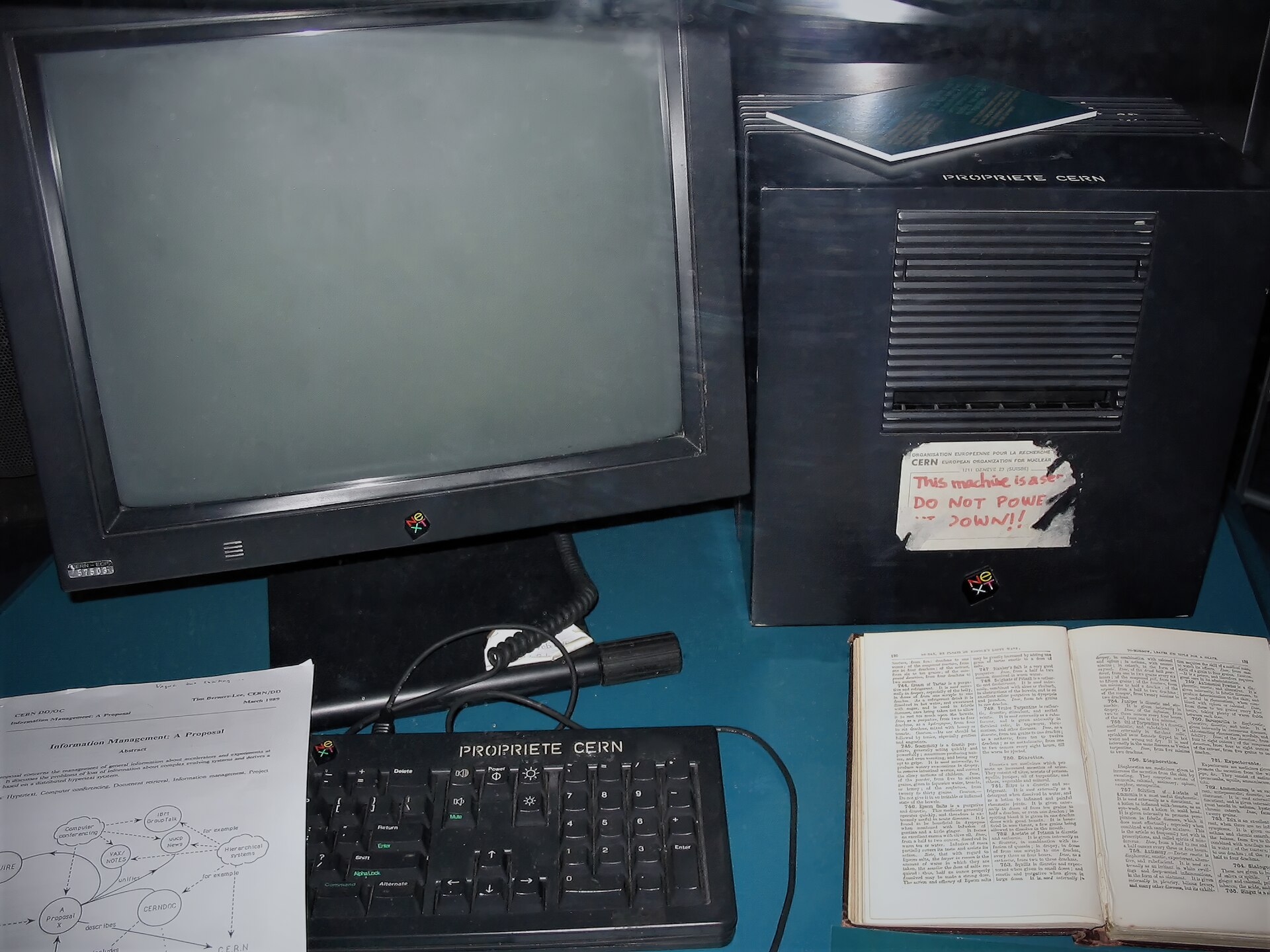
The World Wide Web is the leading information retrieval service of the Internet — a system of hyperlinked documents written in HTML, addressed by URLs and delivered by HTTP. British scientist Tim Berners-Lee invented it at CERN in 1989; by the end of 1990 the first web server and browser were running on a NeXT computer, and the world's first website went live at info.cern.ch. On 30 April 1993 CERN put the Web software in the public domain, a decision that allowed the web to flourish. The World Wide Web Consortium, founded in 1994, develops the Web's royalty-free open standards; the Internet the Web runs on now reaches an estimated 6 billion people (ITU, 2025).
Overview
The World Wide Web is the leading information retrieval service of the Internet, the worldwide computer network 1. It operates within the Internet's basic client-server format: servers store and transmit documents for clients that request them, and browser software allows users to view the retrieved documents 1. A hypertext document with its text and hyperlinks is written in HTML and is assigned an online address called a Uniform Resource Locator, or URL 1. British scientist Tim Berners-Lee invented the Web in 1989 while working at CERN 2.
In 2025 the International Telecommunication Union estimated that approximately 6 billion people — 74 per cent of the world's population — were using the Internet 3. That is an increase from 60 per cent in 2020, with an estimated 1.3 billion people having come online during the period 3. As of the same 2025 estimate, 2.2 billion people remained offline 3.
The first website described the WorldWideWeb as a wide-area hypermedia information retrieval initiative aiming to give universal access to a large universe of documents 4. From the outset it was essential that the web remain an open standard for all to use, and that no one should lock it up into a proprietary system 5. Berners-Lee's stated goal is a Web that truly is for everyone: one accessible to all, from any device, and one that empowers all people to achieve their dignity, rights and potential 6.
The Web and the Internet: one service, one network
The Internet does not need the Web to work: in late 1993 the Web carried just 1% of internet traffic, and the rest was remote access, e-mail and file transfer 5. E-mail's people-to-people traffic foreshadowed what the Web would later amplify into an enormous growth of person-to-person activity 7. The Web's own story runs from the March 1989 proposal to the August 1991 announcement on Internet newsgroups, after which interest in the project spread around the world 5. The network came first; the Web is one service among many that the Internet's general design made possible 7.
How it began: CERN, 1989
The Web was originally conceived and developed to meet the demand for automated information-sharing between scientists in universities and institutes around the world 2. It began at CERN, the international scientific organization based in Geneva, Switzerland 1. Berners-Lee's proposal, 'Information Management: A Proposal', concerned the management of general information about accelerators and experiments at CERN, and discussed the problems of losing information about complex evolving systems 8. Its central observation was that information was often recorded but simply could not be found 8. The document was an attempt to persuade CERN management that a global hypertext system was in CERN's interests 8, and it was submitted to his boss, Mike Sendall, in March 1989 9.
Robert Cailliau, a Belgian systems engineer, joined the effort, and by November 1990 the idea had been formalised as a management proposal describing a hypertext project called WorldWideWeb, in which a web of hypertext documents could be viewed by browsers 5. The name World Wide Web was chosen over alternatives including Information Mesh, Mine of Information, and Information Mine 10. Berners-Lee's earlier working name for the system was Mesh; he decided on World Wide Web only when writing the code in 1990 8.
In September 1990 Sendall approved the purchase of a NeXT cube and let Berners-Lee go ahead and write a global hypertext system 10. That October, Berners-Lee coined the term World Wide Web, wrote the first Web server, httpd, and the first client program — a browser and editor called WorldWideWeb 11. By the end of 1990 the first Web server and browser were up and running at CERN 5. To stop the machine being switched off by accident, it carried a hand-written label in red ink declaring that this machine was a server and was not to be powered down 5.
The three pillars: URL, HTTP and HTML
The basic idea of the WWW was to merge the evolving technologies of computers, data networks and hypertext into a powerful and easy-to-use global information system 5. Three pillars carry it: the address of a document, the protocol that transports it, and the language in which it is written — URL, HTTP and HTML 1. Berners-Lee wrote the first version of HTML, the document formatting language with hypertext links that became the Web's primary publishing format 11, and his initial specifications for URIs, HTTP and HTML were refined and discussed in larger circles as the technology spread 11. The table below sets out each pillar together with the specification behind it.
| Pillar | What it does | Key specification |
|---|---|---|
| URL — Uniform Resource Locator | The online address assigned to a hypertext document; specifies the syntax and semantics of formalized information for the location and access of resources via the Internet 12 | RFC 1738 — December 1994 12 |
| HTTP — Hypertext Transfer Protocol | Standardizes communication between servers and clients; an application-level protocol with the lightness and speed necessary for distributed, collaborative, hypermedia information systems 13. Today its core semantics are specified in RFC 9110 (STD 97) 14 | HTTP/1.0 — RFC 1945, May 1996 13; HTTP/1.1 — RFC 2616, June 1999 15; HTTP Semantics — RFC 9110, June 2022 14; HTTP/3 — RFC 9114, June 2022 16 |
| HTML — HyperText Markup Language | A simple markup language used to create hypertext documents that are platform independent; in use by the World Wide Web global information initiative since 1990 17 | RFC 1866 — HTML 2.0, November 1995 17 |
The first website and the browser boom
The world's first website and Web server answered to the address info.cern.ch, running on a NeXT computer at CERN 5. The first Web page lived at http://info.cern.ch/hypertext/WWW/TheProject.html 5 and was dedicated to the World Wide Web project itself 2. It contained links to information about the project — a description of hypertext, technical details for creating a Web server, and links to other servers as they became available 5; everything then online about the project was linked directly or indirectly to that document 4. In March 1991 the software became available to colleagues using CERN computers, and in August 1991 Berners-Lee announced it on Internet newsgroups, after which interest in the project spread around the world 5.
Access was initially limited: only a few users had a NeXT platform on which the first browser could run, so CERN developed a simpler, line-mode browser that could work on any system, written by the student Nicola Pellow during her work placement at CERN 5. In December 1991 the first Web server in the United States came online at the Stanford Linear Accelerator Center, thanks to Paul Kunz and Louise Addis 5. Launched in 1992, the line-mode browser was the first readily accessible browser for the Web 2.
Early independent browsers soon appeared — MIDAS by Tony Johnson at SLAC, Viola by Pei Wei at the technical publisher O'Reilly Books, and Erwise by Finnish students at Helsinki University of Technology 5. Early in 1993 the National Center for Supercomputing Applications at the University of Illinois released a first version of its Mosaic browser 5; developed in the United States by Marc Andreessen and others at NCSA, Mosaic was released in September 1993 1 and allowed Web users to employ the same point-and-click graphical manipulations that had been available on personal computers for some years 1. The Web's rise was helped by a rival's misstep: when the University of Minnesota announced licensing fees for Gopher, many volunteers and employees stopped using it and switched to the WWW 10.
Given away: the 30 April 1993 decision
On 30 April 1993 CERN issued a public statement that three components of Web software — the basic line-mode client, the basic server and the library of common code — were placed in the public domain 18. In the same statement CERN relinquished all intellectual property rights to the code, both source and binary, giving permission to anyone to use, duplicate, modify and distribute it 18. On the same day the source code of WorldWideWeb was made available on a royalty-free basis, making it free software 5.
The licensing work continued after Berners-Lee's departure. In November 1994 CERN's François Flückiger told the Web community that new software versions would remain freely available for general use at no cost, but that distributed material would remain copyrighted by CERN 18. Flückiger evaluated the options with CERN's legal service and chose to release the new version as open source: CERN would retain the copyright to protect the software from appropriation and to secure attribution, while granting anyone the perpetual and irrevocable right to use and modify it freely and at no cost 18. CERN's own open-source licence granted these permissions — to use, copy, change, modify, translate, display, distribute and make available the Web server software — on a royalty-free and non-exclusive basis 18.
W3C and the age of standards
In 1994 Berners-Lee left CERN to join MIT and founded the International World Wide Web Consortium 5, established in October 1994 at MIT's Laboratory for Computer Science in collaboration with CERN and with support from DARPA and the European Commission 11; the Consortium's own chronology dates the founding to 1 October 1994 10. European and Asian hosts followed — INRIA became the first European host in April 1995, Keio University of Japan followed in 1996, ERCIM took over the European role in 2003, and Beihang University became the fourth host in 2013 5. By September 2018 there were more than 400 member organisations from around the world 5, and in 2023 the Consortium began the year by forming a new public-interest non-profit organization 11.
The Consortium's mission is to shepherd the web by developing open web standards as a single global organization, with contributions from its Members, staff and the international community 11. Its royalty-free patent policy requires that a W3C RF licence be available to all, worldwide, whether or not they are W3C Members 19, and that it may not be conditioned on payment of royalties, fees or other consideration 19.
The stakes of openness were visible early: when the University of Minnesota announced licensing fees for Gopher, many volunteers and employees stopped using it and switched to the WWW 10. The royalty-free patent policy is that lesson made durable — the Web's shared standards stay usable by everyone, on equal terms 19.
An essential point was that the web should remain an open standard for all to use and that no-one should lock it up into a proprietary system.
CERN — A short history of the Web 5
I believe we can build a Web that truly is for everyone: one that is accessible to all, from any device, and one that empowers all of us to achieve our dignity, rights and potential as humans.
Tim Berners-Lee — World Wide Web Consortium, 25th anniversary 6
How the Web grew
The distance the Web travelled in its first years is measured best in servers, traffic and users 5. In January 1993 about 50 known HTTP servers existed; by late 1993 there were over 500, and the WWW accounted for 1% of internet traffic, which seemed substantial at the time 5. By the end of 1994 the Web had 10,000 servers — 2,000 of them commercial — and 10 million users 5. In 2014 W3C could report that over two in five of the world's population were connected 6, and the ITU's 2025 estimate of approximately 6 billion internet users — 74 per cent of the world's population — shows how far the curve has run 3.
| Date | Milestone | Scale |
|---|---|---|
| January 1993 | The early server count | About 50 known HTTP servers 5 |
| September 1993 | Traffic becomes measurable | WWW (port 80 http) traffic measures 1% of NSF backbone traffic 10 |
| Late 1993 | The Web starts to register | Over 500 known web servers; the WWW accounts for 1% of internet traffic 5 |
| End of 1994 | The first commercial wave | 10,000 servers — 2,000 of them commercial — and 10 million users 5 |
| 2014 | Two in five connected | Over two in five of the world's population are connected 6 |
| 2025 | The Internet approaches universality | Approximately 6 billion users — 74% of the world's population — with 2.2 billion people still offline (ITU estimate) 3 |
The modern Web: HTTP/2, HTTP/3 and beyond
The protocols underneath the Web have kept evolving. HTTP/2 (RFC 7540, 2015) enables a more efficient use of network resources and a reduced perception of latency by introducing header field compression and allowing multiple concurrent exchanges on the same connection 20. RFC 9110 (June 2022) describes HTTP as a stateless application-level protocol for distributed, collaborative, hypertext information systems, and covers the core protocol elements, extensibility mechanisms, and the http and https URI schemes 14. The same month saw RFC 9114, which maps HTTP semantics over the QUIC transport protocol, whose stream multiplexing, per-stream flow control and low-latency connection establishment are features desirable in a transport for HTTP 16.
The browser became the Web's front door. Netscape Navigator became the dominant Web browser soon after its release in December 1994 1, and Microsoft released Internet Explorer in 1995 as an add-on to the Windows 95 operating system, based initially on Mosaic 1. In 2008 Google launched Chrome, the first browser with isolated tabs, so that when one tab crashed, other tabs and the whole browser would still function 1.
The scale is now measured minute by minute: in 2014 W3C noted that web users sent each other hundreds of millions of messages, shared 20 million photos, and exchanged at least $15m worth of goods and services every minute 6. Yet the access question stays open — the ITU's 2025 estimate still leaves 2.2 billion people offline 3 — and Berners-Lee has written that the Web's billions of users are what have made it great 6.
Impact and legacy
First proposed in March 1989, the Web has transformed how the world communicates, creates and collaborates 6. Its success can be traced to its original design as a decentralised system and an open architecture anyone could help to build 6. What began as an information-management fix for physicists scaled to 10 million users by the end of 1994 5.
The open standard was the point, not a side effect: from the start it was essential that the web remain an open standard for all to use and that no one should lock it up into a proprietary system 5. That principle survived the public-domain statement of 30 April 1993 and the later open licence, which CERN credits with allowing the web to flourish 2. The Web also inherited the Internet's founding insight: a general infrastructure outlives any single application built on it 7.
Berners-Lee's goal remains a Web that truly is for everyone — accessible to all, from any device, and empowering all people to achieve their dignity, rights and potential 6. The first website's promise, universal access to a large universe of documents 4, is still the standard against which the Web is measured.
Timeline: from a CERN memo to a global information space
A proposal for a global hypertext system
At CERN, Tim Berners-Lee wrote "Information Management: A Proposal", the document that became the foundation of the Web; his boss Mike Sendall scrawled "Vague, but exciting" on it.9
The project takes shape
With Belgian systems engineer Robert Cailliau, Berners-Lee formalised the idea as a management proposal describing a "hypertext project" called "WorldWideWeb", whose "web" of "hypertext documents" would be viewed by "browsers".5
The first server and browser run
By the end of 1990 the first Web server and browser were up and running at CERN on a NeXT computer carrying a hand-written red-ink warning: "This machine is a server. DO NOT POWER IT DOWN!!"5
The Web goes public
Berners-Lee announced the WWW software on Internet newsgroups, and the world's first website and Web server — info.cern.ch — was serving its pages from a NeXT computer at CERN.5
Crossing the Atlantic
The first Web server in the United States came online at the Stanford Linear Accelerator Center, thanks to Paul Kunz and Louise Addis.5
Mosaic makes the Web friendly
The National Center for Supercomputing Applications released a first version of its Mosaic browser — friendly, window-based software that had an immediate impact on the spread of the WWW.5
CERN gives the Web away
CERN issued a public statement putting Web software in the public domain and relinquishing all intellectual property rights to the code, "permission is given to anyone to use, duplicate, modify and distribute it".18
The "Woodstock of the Web"
The First International World Wide Web Conference was held at CERN, attended by 380 users and developers and hailed as the "Woodstock of the Web".5
W3C is founded
Tim Berners-Lee founded the World Wide Web Consortium at MIT, in collaboration with CERN and with support from DARPA and the European Commission, to keep the Web's standards open and consistent.11
The Web goes mainstream
The Web was the main reason for the theme of the G7 meeting hosted by the European Commission in Brussels — a sign that the Web had become a matter for governments.10
HTTP/1.0 is published
The IETF published RFC 1945, "Hypertext Transfer Protocol -- HTTP/1.0", describing an application-level protocol with the lightness and speed necessary for distributed, collaborative, hypermedia information systems.13
HTTP/1.1 standardised
The IETF published RFC 2616, defining HTTP/1.1 as an update to RFC 2068.15
The Web turns 25
People around the world joined Tim Berners-Lee in wishing the Web a happy 25th birthday, with over two in five of the world's population then online.6
HTTP/3 arrives
The IETF published RFC 9114, mapping HTTP semantics over the QUIC transport protocol — the third major version of the protocol that carries the Web.16
Frequently asked questions
What exactly is the World Wide Web?
The World Wide Web is the leading information retrieval service of the Internet, the worldwide computer network 1. It works within the Internet's client-server format, with browser software displaying the documents that servers store and transmit 1.
Who invented the Web, and when?
British scientist Tim Berners-Lee invented it in 1989 while working at CERN 2. With Belgian systems engineer Robert Cailliau, the idea was formalised as a management proposal in November 1990 5.
What was the first website?
The first website at CERN — and in the world — was dedicated to the World Wide Web project itself and was hosted on Berners-Lee's NeXT computer 2. It ran at info.cern.ch, with the first page at the address http://info.cern.ch/hypertext/WWW/TheProject.html 5.
When did CERN make the Web free?
On 30 April 1993, CERN put the Web software in the public domain 2. The same day, the source code of WorldWideWeb was made available on a royalty-free basis, making it free software 5.
What do URL, HTTP and HTML each do?
The URL is the online address assigned to a hypertext document 1; RFC 1738 specifies its syntax and semantics for locating and accessing resources via the Internet 12. HTTP standardizes communication between servers and clients as an application-level protocol for distributed, collaborative, hypermedia information systems 13. HTML is the simple markup language used to create hypertext documents that are platform independent 17.
How many people use the Internet today?
The ITU estimates that approximately 6 billion people — 74 per cent of the world's population — were using the Internet in 2025 3. An estimated 1.3 billion people came online since 2020, while 2.2 billion remained offline 3.
Who keeps the Web's standards?
The World Wide Web Consortium, founded by Tim Berners-Lee in October 1994 at MIT in collaboration with CERN and with support from DARPA and the European Commission 11. Its royalty-free patent policy makes standard licences available to all worldwide, and they may not be conditioned on payment of royalties, fees or other consideration 19.
Is the Web the same thing as the Internet?
No. Britannica defines the Web as the leading information retrieval service of the Internet — the worldwide computer network 1. The Internet was designed as a general infrastructure on which new applications could be conceived, and the emergence of the World Wide Web illustrated it 7.
Knowledge graph
Sources & citations
Every factual claim in this article is drawn from the sources below. Bracketed numbers in the text link to the corresponding source.
- 1
- 2
- 3
- 4
- 5
- 6
- 7
- 8
- 9
- 10
- 11
- 12
- 13
- 14
- 15
- 16
- 17
- 18
- 19
- 20