Marie Curie
The physicist and chemist who isolated radium and polonium, won two Nobel Prizes, and became the first woman professor at the Sorbonne.
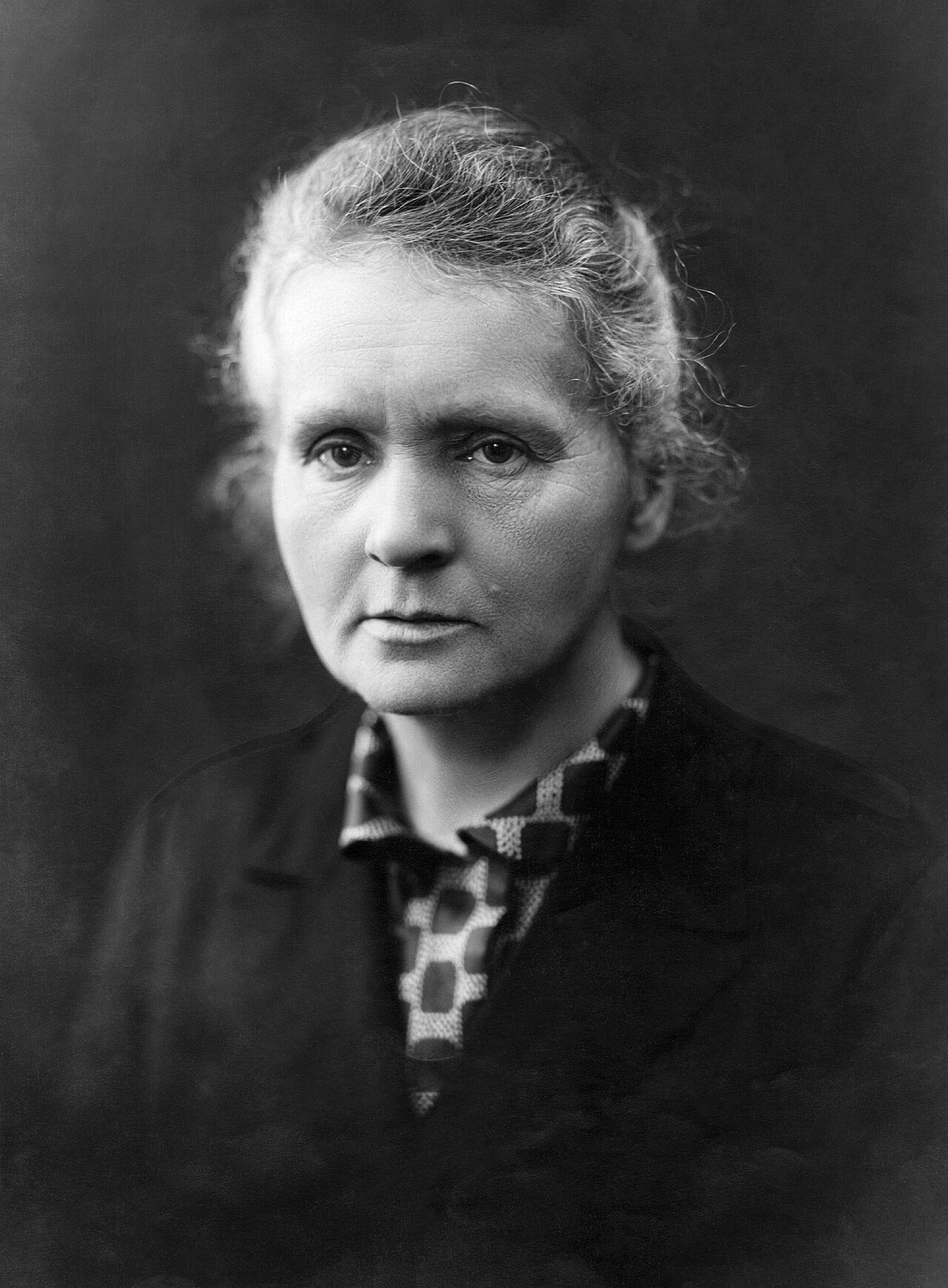

Marie Curie (1867–1934), born Maria Skłodowska in Warsaw, was a physicist and chemist whose work on radioactivity transformed science. Together with her husband Pierre, she isolated the elements polonium and radium, and shared the 1903 Nobel Prize in Physics with Henri Becquerel. In 1911 she received a second Nobel Prize, in Chemistry — the first person to be awarded the prize twice. She was also the first woman to hold a professorship at the Sorbonne.
Early life and education
On November 7, 1867, in Warsaw, Marie Curie was born as Maria Sklodowska, and her father earned the family's living as a secondary-school teacher.1 NobelPrize.org records the place of her birth as Warsaw, in the Russian Empire, which is now Poland.2 Warsaw at that time lay in the part of Poland dominated by Russia, and the city of her childhood thus stood under a foreign administration.1 The daughter of the schoolteacher entered the world as a subject of the Russian Empire, in a country whose territory was divided among outside powers.2 The city of her birth was a Polish city under foreign domination.1
She received a general education in local schools.1 Alongside that schooling, her father — himself the secondary-school teacher — gave her some scientific training of his own.1 The teacher's daughter thus met science at home, in lessons given by a parent rather than in any formal institution of higher learning.1 Her earliest scientific instruction, in other words, came from within the family.1 The local schools of Warsaw supplied the general foundation, and the family supplied what the schools did not.1 What the schools began, the father completed, and what the father began, the university would later extend.1
During her student years she became involved in a students' revolutionary organization.1 She found it prudent to leave Warsaw.1 The city then belonged to the part of Poland dominated by Russia, and involvement of that kind carried evident dangers under Russian rule.1 The decision to go was also a decision to continue her education elsewhere.1 Prudence, in the conditions of that time and place, outweighed attachment to the city of her birth.1 The organization in which she took part belonged to the student world of the city.1
She left for Cracow, which at that time was under Austrian rule.1 The move took her from the Russian zone of the country into the Austrian one, across an internal boundary of the same Polish territory.1 In Cracow she remained on Polish soil while stepping outside the reach of the Russian administration.1 It was a passing stage, however; Paris lay ahead.1 The crossing was a small matter of geography, but it changed her circumstances entirely.1 Cracow gave her shelter; Paris gave her the future.1
In 1891 she left for Paris and enrolled at the Sorbonne to continue her studies.1 There she obtained Licenciateships in Physics and in the Mathematical Sciences, two qualifications that together grounded her future work.1 The licenciateships in physics and the mathematical sciences equipped her for the laboratory work that followed.1 The Sorbonne became the fixed point of her career, and decades later, at the time of the 1911 Nobel Prize, her affiliation was still Sorbonne University, Paris, France.2 From 1891 onward Paris, not Warsaw, was the city in which her scientific life unfolded.1 The Sorbonne of those years was the setting in which she would meet the man who became her closest collaborator.1
At the Sorbonne she met Pierre Curie — a professor in the School of Physics — in 1894.1 In the following year they were married.1 From the outset their scientific work proceeded together, and the early researches she carried out were performed together with her husband.1 The partnership begun in Paris was to become one of the most celebrated collaborations in the history of the physical sciences.1 Their two names would henceforth appear side by side in the record of radioactivity.1 The marriage of 1895 joined two careers as well as two lives.1
Radioactivity and new elements
Henri Becquerel's discovery of radioactivity in 1896 inspired the researches and analyses of the Curies.1 His finding gave the couple the subject on which their most important work was built.1 The field Becquerel had opened became the field they cultivated, and their investigations grew directly out of his discovery.1 Radioactivity, as the phenomenon Becquerel had found, was new to the science of 1896.1 Becquerel's name stood at the head of the field from its first day.1 The discovery of 1896 was the seed of everything that followed in the Curies’ laboratory.1
The early researches she conducted with her husband were often carried out under difficult conditions.1 Their laboratory arrangements were poor, and both of them had to take on much teaching in order to earn a livelihood.1 The science of radioactivity was therefore advanced in borrowed hours and from an ill-equipped laboratory.1 Nothing in those conditions suggested the scale of what the couple were about to uncover.1 Teaching filled much of their time, and the laboratory gave them little comfort.1 The two of them taught because they had to, and researched because they chose to.1
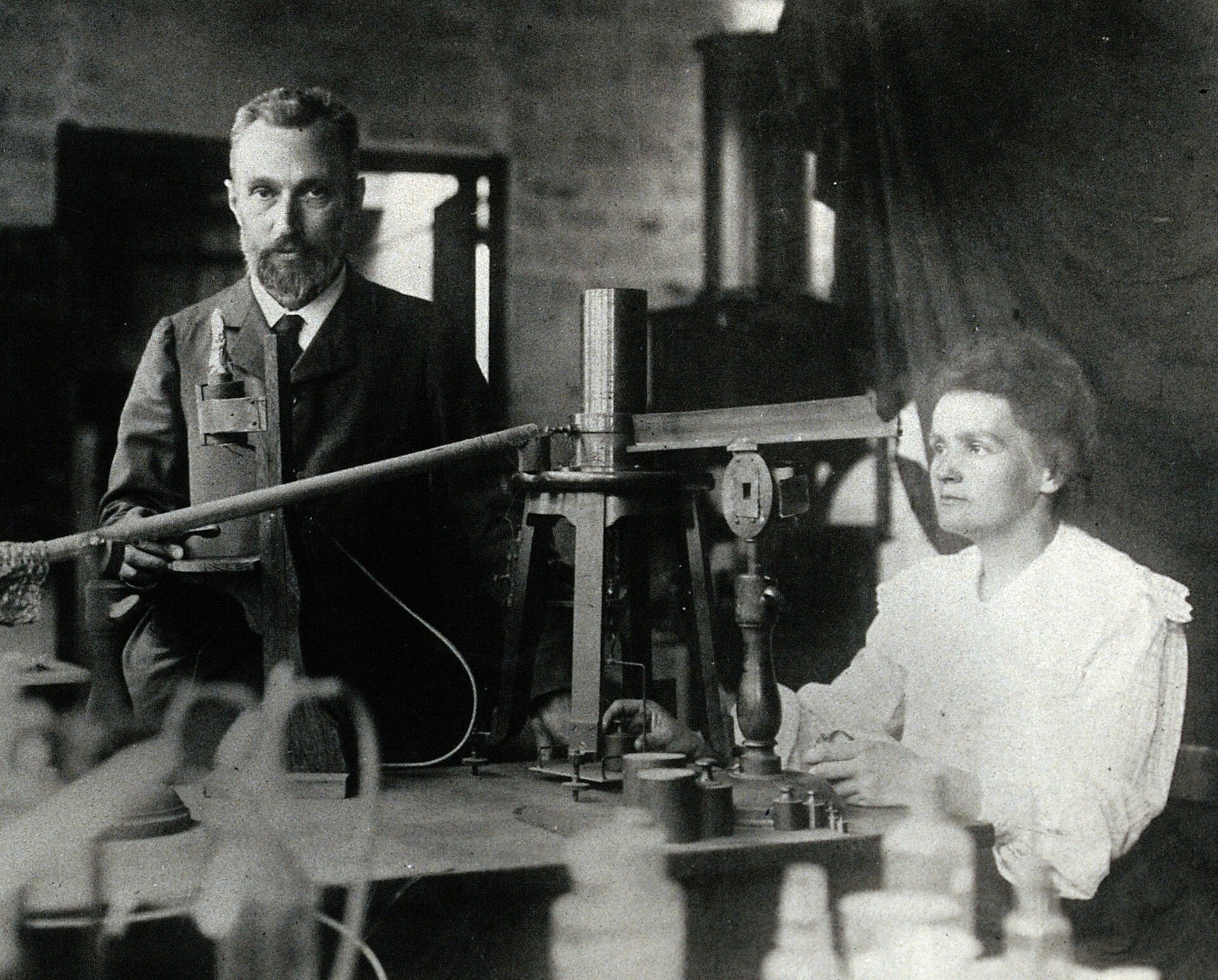

Those researches and analyses led to the isolation of two new elements.1 The first was polonium, named after the country of Marie's birth.1 The second was radium.1 With these two isolations, the periodic table gained elements that had never before been separated.1 The two isolations were the achievements for which the Chemistry prize of 1911 would later be given.2 The names of the two elements entered the literature of chemistry from that work.1
Curie worked out methods for separating radium out of radioactive residues.1 Her techniques delivered the element in quantities sufficient for it to be characterized.1 They also opened the way to a careful study of radium's properties.1 Among those properties, the therapeutic ones were singled out for particular attention.1 Characterization required quantity, and quantity required method; her methods supplied both.1 The methods were developed by her own hand.1
The therapeutic promise of radium became a constant thread of her later career.1 She promoted the use of radium to alleviate suffering throughout her life.1 The element she had separated for the laboratory was, in her hands, also an instrument of relief for the sick.1 From the laboratory bench, radium moved toward the bedside.1 The remedial use of radium was a theme she carried far beyond the laboratory.1
Two Nobel Prizes
The Nobel Prize for Physics came in 1903, when she and her husband together received half of the award.1 The prize honored their study into the spontaneous radiation discovered by Becquerel.1 Becquerel himself was awarded the other half.1 The physics prize thus went both to the discoverer of radioactivity and to the couple who had built their research upon his discovery.1 The award recognized work done in the difficult laboratory of their early years.1 The physics prize of 1903 arrived before the full course of her discoveries was known.1
The same year brought a second distinction.1 The Royal Society added its Davy Medal in 1903, awarded jointly to her and her husband.1 Recognition of the couple's work thus arrived from more than one quarter in a single year.1 The Davy Medal and the Nobel Prize came in the same year, 1903.1 The Royal Society thus joined the Nobel institution in honoring the couple in 1903.1
A second Nobel Prize followed in 1911, this one in Chemistry, in recognition of her work in radioactivity.1 The prize share was 1/1.2 The second award stood to her credit alone, a full prize rather than a divided one.2 Her name thus stood in the record of the Chemistry prize as it already stood in the record of Physics.2 The Chemistry prize completed the arc that the physics prize had begun.1
The official motivation of the 1911 prize cited "her services to the advancement of chemistry by the discovery of the elements radium and polonium, by the isolation of radium and the study of the nature and compounds of this remarkable element."2 The citation tied the Chemistry prize directly to the two elements she and Pierre had isolated.2 NobelPrize.org lists her affiliation at the time of the award as Sorbonne University, Paris, France.2 The words of the motivation state, in the committee’s own formulation, why the prize was given.2
In 1921 she received one gram of radium from President Harding of the United States, who made the presentation on behalf of the women of America in recognition of her service to science.1 Radium, the element her own methods had made obtainable in quantity, had by then become inseparable from her public name.1 The presentation was an American tribute to a scientist whose work was honored throughout the world.1 The gram of radium was presented to her in person by the American president.1
The Nobel record for 1911 notes that she was also awarded the Nobel Prize in Physics in 1903.2 The two entries, physics and chemistry, together summarize the double achievement on which her standing rested.2
Later life and legacy
Her Doctor of Science degree was conferred in 1903.1 The doctorate came in the same year as the Nobel Prize in Physics.1 With it, her formal training was complete.1 The degree marked the close of the years of study that had begun in Warsaw and continued in Paris.1 The degree and the prize arrived together in the same year.1
Pierre Curie died tragically in 1906, and the loss changed the course of her career.1 She took his place as Professor of General Physics in the Faculty of Sciences.1 No woman had held the position before her.1 The chair that had been her husband's passed to her, together with the teaching duties that went with it.1 In taking the chair she continued the teaching of the Sorbonne.1
The Radium Institute of the University of Paris, founded in 1914, made her Director of its Curie Laboratory.1 The appointment gave her an institutional base in Paris for the research that continued to the end of her life.1 The laboratory that carried her name became the center from which she worked in her final decades.1 The Curie Laboratory of the institute bore the family name under which she worked.1 The directorship dated from the institute’s founding year, 1914.1
From 1911 until her death she sat on the Conseil du Physique Solvay.1 From 1922 onward she belonged as well to the Committee of Intellectual Co-operation of the League of Nations.1 Her service thus extended beyond the laboratory into the institutions of international science.1 Her membership in the Solvay council ran unbroken for the rest of her life.1
Numerous papers in scientific journals record her work.1 Her books include Recherches sur les Substances Radioactives, published in 1904, and the classic Traité de Radioactivité, published in 1910.1 Honorary degrees came to her in science, medicine and law, together with honorary memberships of learned societies throughout the world.1 Between the papers, the books and the honors, the record of her work was set down in many forms.1 The Traité, called classic in the record, summarized the field she had helped to found.1
She died after a short illness in Savoy, France, on July 4, 1934.1 NobelPrize.org records the date of her death as 4 July 1934 and the place as Sallanches, France.2 Her death closed a scientific life that had begun in Warsaw in 1867.2 The two records — Savoy and Sallanches — both name France as the country of her death.1 She was, at her death, a figure known and honored throughout the world.1
Timeline
Born in Warsaw
Marie Curie, née Maria Sklodowska, was born in Warsaw, then in the part of Poland dominated by Russia.1
Paris and the Sorbonne
She went to Paris to continue her studies at the Sorbonne, where she obtained Licenciateships in Physics and the Mathematical Sciences.1
Marriage to Pierre Curie
She married Pierre Curie, whom she had met in 1894.1
Doctorate and the Nobel Prize in Physics
She gained her Doctor of Science degree and shared half of the Nobel Prize in Physics with her husband; Henri Becquerel received the other half.1
First woman professor at the Sorbonne
After Pierre Curie's death, she took his place as Professor of General Physics — the first time a woman had held the position.1
Second Nobel Prize
She received the Nobel Prize in Chemistry in recognition of her work in radioactivity — her second Nobel Prize.1
Director of the Radium Institute laboratory
She was appointed Director of the Curie Laboratory in the Radium Institute of the University of Paris, founded in 1914.1
Death in Savoy
Marie Curie died in Savoy, France, after a short illness.1
Frequently asked questions
Where and when was Marie Curie born?
Marie Curie was born Maria Sklodowska in Warsaw on November 7, 1867, the daughter of a secondary-school teacher.1 NobelPrize.org records her birth on 7 November 1867 in Warsaw, then in the Russian Empire, now Poland.2
Why did she leave Warsaw before going to Paris?
As a student she became involved in a students' revolutionary organization, and she found it prudent to leave Warsaw, which was then in the part of Poland dominated by Russia.1 She went to Cracow, which at that time was under Austrian rule.1
What did she study at the Sorbonne?
In 1891 she went to Paris to continue her studies at the Sorbonne, where she obtained Licenciateships in Physics and in the Mathematical Sciences.1
Which elements did she and Pierre Curie isolate?
Their researches, inspired by the discovery of radioactivity by Henri Becquerel in 1896, led to the isolation of polonium and radium.1 Polonium was named after the country of Marie's birth.1
What did the 1903 Nobel Prize in Physics recognize?
Together with her husband, she was awarded half of the prize for their study into the spontaneous radiation discovered by Becquerel.1 Becquerel was awarded the other half of the prize.1
Why did she receive the 1911 Nobel Prize in Chemistry?
The prize cited "her services to the advancement of chemistry by the discovery of the elements radium and polonium, by the isolation of radium and the study of the nature and compounds of this remarkable element."2 The prize share was 1/1.2
Knowledge graph
Sources & citations
Every factual claim in this article is drawn from the sources below. Bracketed numbers in the text link to the corresponding source.
- 1
- 2