Ibn al-Haytham
The 11th-century polymath of Basra and Cairo whose Book of Optics established the modern theory of vision — and whose legend must be separated from the record.
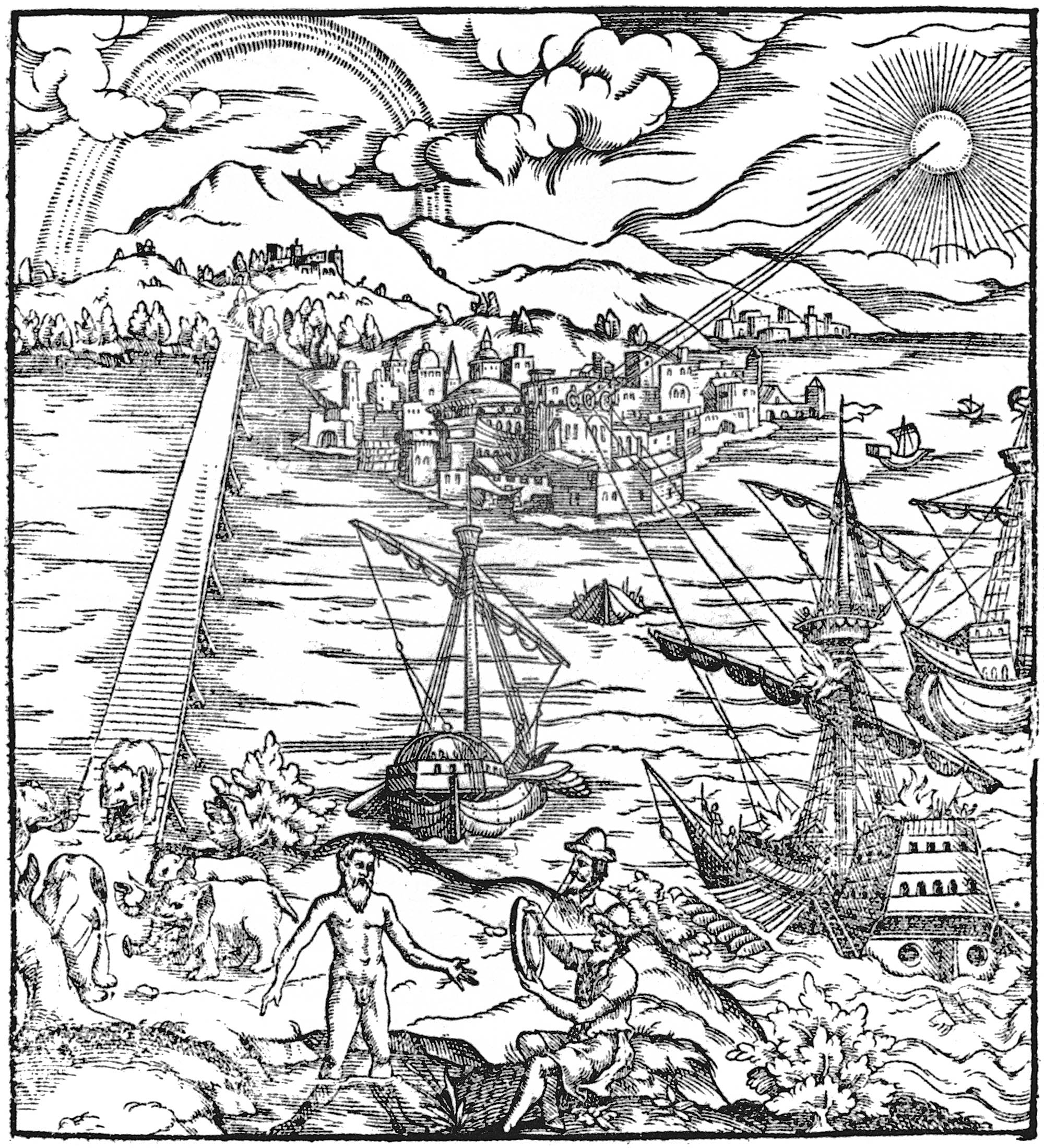

Abū ʿAlī al-Ḥasan ibn al-Haytham (c. 965–c. 1040), known in Latin Europe as Alhazen, was a mathematician, astronomer, and physicist who worked in Basra and in Fatimid Cairo. His seven-volume Kitāb al-Manāẓir (Book of Optics), composed around 1011–1021, argued that vision occurs when light rays reflected from objects enter the eye — overturning the ancient emission theory of Euclid and Ptolemy — and combined systematic experiment with geometrical reasoning. He wrote on reflection and refraction, discussed the camera obscura, framed the problem of reflection on curved mirrors that still bears his Latinized name, and criticized Ptolemy's astronomy. His Optics reached the Latin West in translation and shaped the optics of Roger Bacon, Witelo, and Johannes Kepler. His life is documented only through late and contradictory accounts — notably the 13th-century historian Ibn al-Qifṭī — so the Nile episode, the feigned madness, and popular claims that he 'invented the scientific method' must be handled with care.
Who was Ibn al-Haytham?
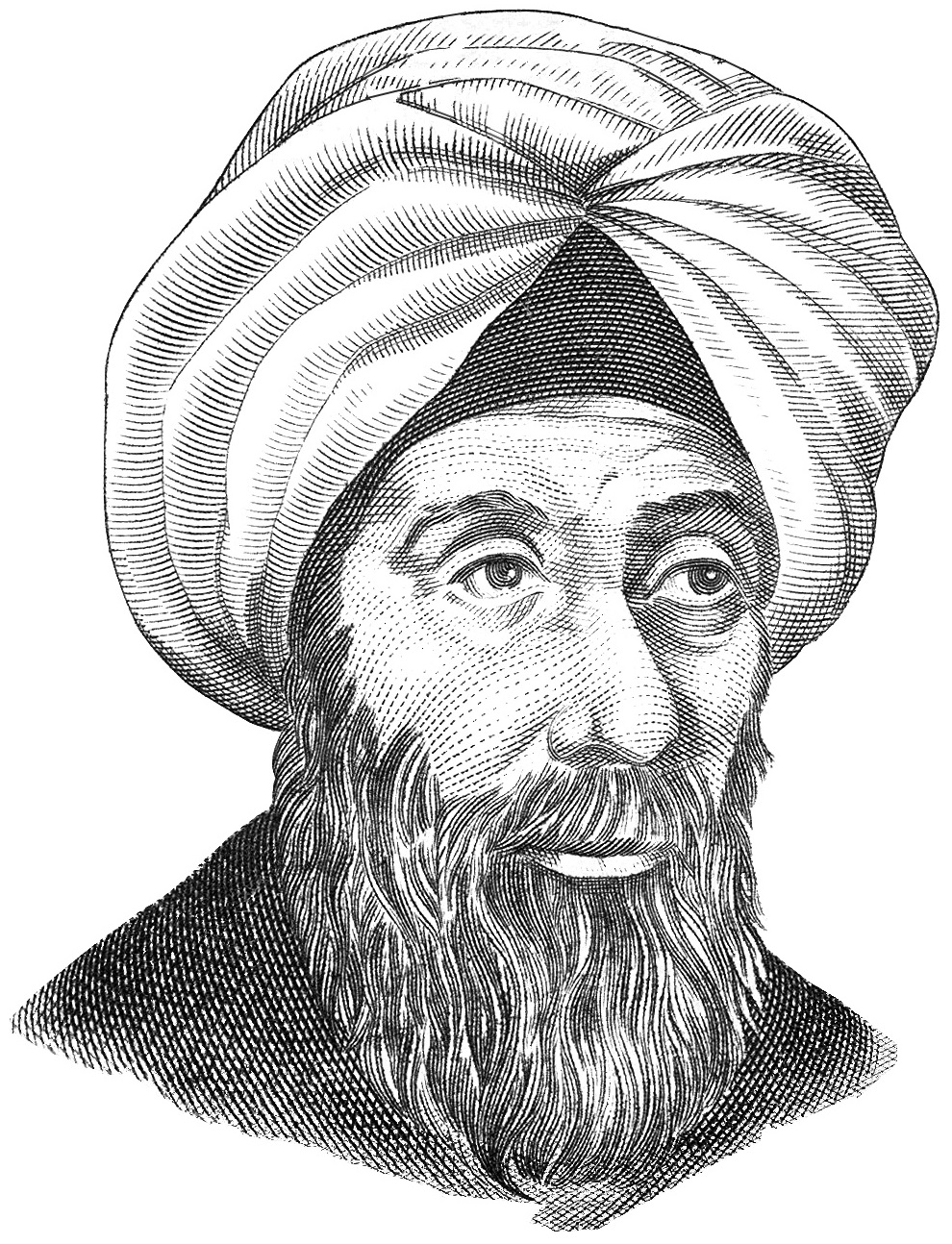
Abū ʿAlī al-Ḥasan ibn al-Haytham — known in Latin Europe as Alhazen — was born in Basra, Iraq, around 965 and died in Cairo, Egypt, around 1040.1 He was a mathematician and astronomer who made significant contributions to the principles of optics and to the use of scientific experiments.1 He was educated in Basra and Baghdad.2 The UNESCO Courier describes him as a scholar of many disciplines — mathematics, physics, mechanics, astronomy, philosophy, and medicine.3
Among Arab scholars he was called the “Second Ptolemy” (Baṭlamyūs Thānī).3 With al-Bīrūnī (973–1048) and Ibn Sīnā (980–1037) he was one of the leading Muslim scholars of the 10th–11th centuries.3 He is sometimes called al-Baṣrī, meaning from the city of Basra in Iraq, and sometimes al-Miṣrī, meaning that he came from Egypt.4 He seems to have written around 92 works, of which over 55 have survived4; by his own testimony he wrote 25 works on the mathematical sciences and 44 works on physics and metaphysics.3
From Basra to Cairo
While Ibn al-Haytham was a young boy growing up in Basra, the Fatimids conquered the Nile Valley in 969 and founded the city of Cairo as the capital of their new empire.4 He did not devote himself to academic study at a young age: he trained for what might best be described as a civil-service job and was appointed a minister for Basra and the surrounding region.4 In time he became increasingly unhappy with his deep studies of religion, and made the decision to devote himself entirely to the study of science, which he found most clearly described in the writings of Aristotle.4
According to one version of his life, told by the 13th-century historian Ibn al-Qifṭī (d. 1248), Ibn al-Haytham was invited to Egypt by the Fatimid caliph al-Ḥākim — who reigned 996–1021 and is known as “the Mad Caliph” — to demonstrate his claim that he could regulate the Nile.1 Al-Ḥākim requested that Ibn al-Haytham come to Egypt to carry out his proposal, and appointed him to head an engineering team which would undertake the task.4
After personally reconnoitering near the southern border of Egypt, Ibn al-Haytham confessed his inability to engineer such a project.1 As the team travelled up the Nile, he realized that his idea of regulating the water with large constructions would not work4; Tbakhi and Amr specify that the scheme was to regulate the river's flow by building a dam south of Aswan.2 Although still given an official position by the caliph, he began to fear for his life, feigned madness, and was confined to his own home until the end of al-Ḥākim's caliphate1; he was stripped of his possessions and books and kept under house arrest for about ten years, until al-Ḥākim's death in 1021.2 Ibn al-Qifṭī reports that he then earned a living in Egypt largely by copying manuscripts, and claimed to possess a manuscript in Ibn al-Haytham's handwriting from 1040.1 After his release he lived near the Azhar Mosque in Cairo — in a domed building, a qubbah — teaching mathematics and physics, writing science texts, and making money by copying texts.42
The surviving accounts must be handled with care: most of the biographical data on Ibn al-Haytham comes from the writings of the 13th-century Muslim historian Ibn al-Qifṭī (1172–1248), and the stories related to his life are often contradictory.2 A different report says that after failing in his mission to regulate the Nile, Ibn al-Haytham fled from Egypt to Syria; this seems unlikely, for other reports make it certain that he was in Egypt in 1038.4 Britannica notes that it has recently been plausibly argued that there were two Ibn al-Haythams: al-Ḥasan ibn al-Ḥasan, the mathematician who wrote on optics, and Muḥammad ibn al-Ḥasan, the astronomer-philosopher who wrote the autobiography and the works in the first and second lists.1 His own autobiography, written in 1027, survives — but it says nothing of the events of his life and concentrates on his intellectual development.4
The Book of Optics (Kitāb al-Manāẓir)
Ibn al-Haytham's most important work is the Kitāb al-Manāẓir, the Book of Optics.1 The seven-volume work is considered by many to be his most important contribution4, and it deals, in seven volumes, with an experimental and mathematical study of the properties of light.3 Tbakhi and Amr state that it was written while he was incarcerated, between 1011 and 1021, and that it has been ranked alongside Isaac Newton's Principia Mathematica as one of the most influential books ever written in physics.2 It reached Latin Europe as Opticae thesaurus Alhazeni: MacTutor dates the Latin translation to 12704, while Britannica places an anonymous translation probably early in the 13th century1 and the UNESCO Courier says it was translated anonymously in the 12th/13th century.3
Book I establishes the study of light and vision, making clear that the investigation will rest on experimental evidence rather than abstract theory.4 Book II discusses visual perception, while Book III examines the conditions necessary for good vision and how errors in vision are caused.4 In Book IV he gave experimental proof of the specular reflection of accidental as well as essential light, a complete formulation of the laws of reflection, and a description of the construction and use of a copper instrument for measuring reflections from plane, spherical, cylindrical, and conical mirrors.4 Book V contains Alhazen's problem; Book VI examines errors in vision due to reflection; and the final book, Book VII, examines refraction.4 The work also contains a detailed investigation of refraction, including experiments involving angles of incidence and deviation.1
The Optics appears to have been neglected in the East until the commentary on it by the mathematician Kamāl al-Dīn Abuʾl Ḥasan Muḥammad ibn al-Ḥasan al-Fārisī (d. 1320).1 In the West, a Latin translation of it — sometimes literal and sometimes interpretative — was made by an unknown scholar, probably early in the 13th century.1 The 1572 Latin printed edition, prepared by Friedrich Risner, presents Alhazen's seven books of optics together with Witelo's Perspectiva, and adds Risner's own commentaries on Alhazen.5 The work had a major influence on 13th-century thinkers such as Roger Bacon and on later scientists such as the astronomer Johannes Kepler (1571–1630).1
How we see: the intromission theory
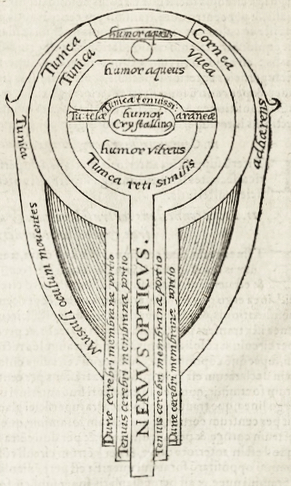
The central claim of the Optics is the correct model of vision: the passive reception by the eyes of light rays reflected from objects, not an active emanation of light rays from the eyes.1 MacTutor calls this the first correct explanation of vision, showing that light is reflected from an object into the eye.4 The model overturned the ancient emission theory of Euclid and Ptolemy, although the book shows some influence from Ptolemy's 2nd-century Optics.1

Light, color, and experiment
In Book I Ibn al-Haytham makes it clear that his investigation of light will be based on experimental evidence rather than on abstract theory, and he notes that light is the same irrespective of its source — sunlight, light from a fire, or light reflected from a mirror are all of the same nature.4 In the introduction of the Optics he declares that his method will rest on criticising premises and exercising caution in drawing conclusions, and that in all that he judges he will seek the truth and not be swayed by opinion.4 Ansari identifies the main feature of his method as the design of experiment in order to test a hypothesis, rather than using experiment merely for observation or discovery as his predecessors did.3 Tbakhi and Amr describe his working method as a repeating cycle of observation, hypothesis, experimentation, and the need for independent verification.2
His investigation of refraction included experiments involving angles of incidence and deviation1, and refraction is correctly explained in the Optics by light's moving slower in denser media.1 His other optical works include Ḍawʾ al-qamar (On the Light of the Moon), al-Hāla wa-qaws quzaḥ (On the Halo and the Rainbow), Ṣūrat al-kusūf (On the Shape of the Eclipse, which includes a discussion of the camera obscura), and al-Ḍawʾ (A Discourse on Light).1 MacTutor credits him as the first person to mention the camera obscura, whose use his studies of optics led him to propose.4 In Tbakhi and Amr's account he is known for the earliest use of the camera obscura and pinhole camera, and he carried out the first experiments on the dispersion of light into its constituent colors.2
He dealt at length with the theory of shadows, eclipses, and the rainbow, attempted to explain binocular vision, and gave a correct explanation of the apparent increase in size of the Sun and the Moon when near the horizon.2 His study of refraction led him to propose that the atmosphere has a finite depth of about 15 km, and he explained twilight by refraction of sunlight once the Sun was less than 19° below the horizon.4 The Discourse on Light and the tracts On the Light of Stars, On the Light of the Moon, and On the Halo and the Rainbow are the main sources from which his working method can be deduced.3 He is considered by some to be the founder of psychophysics and experimental psychology, for his pioneering work on the psychology of visual perception.2
Mathematics: mirrors, sums, and perfect numbers
Alhazen's problem — to determine the point of reflection from a plane or curved surface, given the centre of the eye and the observed point — is stated and solved in the Optics by means of conic sections.1 The problem, for which he is best remembered, is usually posed as: given a light source and a spherical mirror, find the point on the mirror where the light will be reflected to the eye of an observer.4 It appears in Book V, where drawing lines from two points in the plane of a circle that meet at a point on the circumference making equal angles with the normal leads to an equation of the fourth degree.2 Huygens later reformulated the problem, found a good solution, and Vincenzo Riccati and then Saladini simplified and improved it.4
The problem led Ibn al-Haytham to derive the earliest formula for the sum of fourth powers and, by using an early proof by mathematical induction, to develop a method for determining the general formula for the sum of any integral powers.2 In number theory he solved problems involving congruences using what is now called Wilson's theorem.4 In his Analysis and Synthesis he was the first to realize that every even perfect number is of the form 2^(n−1)(2^n−1), where 2^n−1 is prime, but he was not able to prove the result successfully; it was proved later, in the 18th century, by Euler.2 Rashed claims that Ibn al-Haytham was the first to state the converse of Euclid's perfect-number theorem, though the statement does not appear explicitly in his work; his attempt to prove it in Analysis and Synthesis was not entirely successful, yet Rashed calls it a deliberate attempt to characterise the set of perfect numbers.4
Beyond mirrors, he wrote a work on the area of lunes — crescents formed from two intersecting circles — and then wrote the first of two treatises on squaring the circle using lunes; the promised second treatise never appeared, suggesting he realized he could not solve the problem.4 His Maqāla fī tamām Kitāb al-Makhrūṭāt (Completion of the Conics) is an attempt to reconstruct the lost eighth book of Apollonius's Conics (c. 200 BC).1 In his Ḥall shukūk fī Kitāb Uqlīdis (Solution of the Difficulties of Euclid's Elements) he investigated particular cases of Euclid's theorems, offered alternative constructions, and replaced some indirect proofs with direct proofs.1 In his Sharḥ muṣādarāt Kitāb Uqlīdis (Commentary on the Premises of Euclid's Elements) he based his treatment of parallel lines on equidistant lines rather than Euclid's definition of lines that never meet.1
Astronomy: doubting Ptolemy
Ibn al-Haytham's most famous astronomical work is Hayʾat al-ʿālam (On the Configuration of the World), a nontechnical description of how the abstract mathematical models of Ptolemy's Almagest can be understood according to the natural philosophy of his time.1 In this popular work, intended for the layman, he completely accepts Ptolemy's views without question.4 There were several Latin translations of the Configuration, a book which influenced Georg Peuerbach (1423–61) among others.1
A later work, al-Shukūk ʿalā Baṭlamyūs (Doubts concerning Ptolemy), written between 1025 and 1028, criticizes the Almagest along with Ptolemy's Planetary Hypotheses and Optics.12 He considered that some of the mathematical devices Ptolemy introduced into astronomy, especially the equant, failed to satisfy the physical requirement of uniform circular motion.2 The Model of the Motions of Each of the Seven Planets, written in 1038, was an important book on astronomy; the surviving manuscript was only recently discovered, with much of it still missing, so the work has not yet been published in modern times.2
Verified biography vs popular myths
Popular accounts often credit Ibn al-Haytham with more than the sources document; the three most common exaggerations are audited below against the record.142

In his own words
Three passages are given below in the wording preserved in the sources: the method promised in the introduction of the Optics4, the account of concentrated solar heating in the Discourse of the Concave Spherical Mirror7, and the geocentric picture of the earth at rest in On the Configuration of the World.2
His methods will involve “criticising premises and exercising caution in drawing conclusions” while he aimed “to employ justice, not follow prejudice, and to take care in all that we judge and criticise that we seek the truth and not be swayed by opinions”.
Introduction to the Book of Optics, as quoted by MacTutor4
The sun's rays proceed from the sun along straight lines and are reflected from every polished object at equal angles, i.e. the reflected ray subtends, together with the line tangential to the polished object which is in the plane of the reflected ray, two equal angles. … And every ray which is reflected from a polished object to a point produces a certain heating at that point, so that if numerous rays are collected at one point, the heating at that point is multiplied: and if the number of rays increases, the effect of the heat increases accordingly.
Discourse of the Concave Spherical Mirror (trans. Winter 1950)7
The earth as a whole is a round sphere whose center is the center of the world. It is stationary in its [the world's] middle, fixed in it and not moving in any direction nor moving with any of the varieties of motion, but always at rest
On the Configuration of the World2
Legacy and commemoration
His optical writings influenced many Western intellectuals such as Roger Bacon, John Pecham, Witelo, and Johannes Kepler.2 The Optics had a major influence on 13th-century thinkers such as Roger Bacon and on later scientists such as Kepler (1571–1630).1 In the East, the book had been taken up again through the commentary of Kamāl al-Dīn al-Fārisī (d. 1320).1 The first real appreciation of the action of a lens — in particular the ability of a convex form to produce a magnified image of an object — appears to be credited to Ibn al-Haytham.2
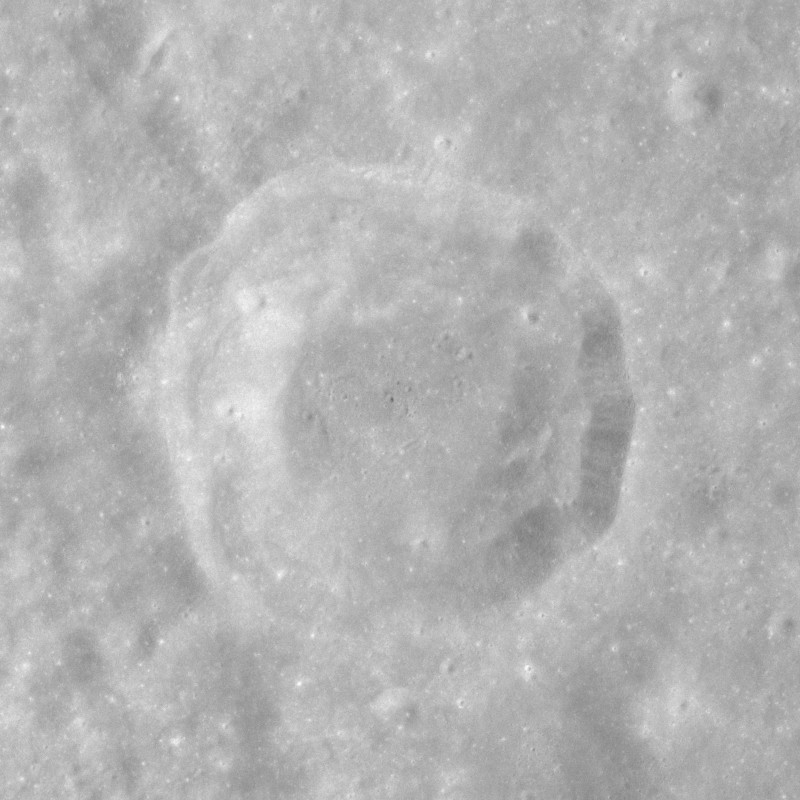
Modern astronomy commemorates him in the sky: the lunar crater Alhazen, 34.65 km in diameter and centred at 15.91° N, 71.83° E on the Moon, had its name adopted by the IAU in 1935, in honour of “Abū Ali Al-Hasan Ibn Al Haitham; Iraqi mathematician”.8 Main-belt asteroid (59239) Alhazen was discovered at Gnosca on 7 February 1999 by S. Sposetti, and the name was suggested by P. Venzi.9 The naming citation describes him as an astronomer, mathematician, doctor, philosopher, and physicist whose work mainly dealt with the study of the visual phenomenon and with optical geometry.9 The Gazetteer itself records his dates as 987–1038, at odds with the c. 965–c. 1040 dates given by Britannica.81

In 2015, during the International Year of Light, Ibn al-Haytham was celebrated at UNESCO as a pioneer of modern optics.3 UNESCO hosted an international conference about the Islamic Golden Age of science and the legacy of Ibn al-Haytham, calling him one of the inventors of modern optics, on 14–15 September 2015.6 The celebration coincided with the 1,000th anniversary of the publication of his Kitāb al-Manāẓir (Book of Optics).6 UNESCO describes him as considered the father of modern optics, a scholar who pioneered scientific experimental methodology.6
Timeline
Born in Basra
Ibn al-Haytham was born in Basra, Iraq; his full name was Abū ʿAlī al-Ḥasan ibn al-Haytham.1
Writing the Book of Optics
According to Tbakhi and Amr, Ibn al-Haytham wrote his seven-volume Kitāb al-Manāẓir (Book of Optics) while confined, between 1011 and 1021.2
Autobiography
An autobiography written in 1027 survives; it concentrates on his intellectual development rather than the events of his life.4
Doubts about Ptolemy
Ibn al-Haytham wrote al-Shukūk ʿalā Baṭlamyūs, arguing that Ptolemy's equant and other devices failed to satisfy the physical requirement of uniform circular motion.2
Model of the seven planets
He wrote The Model of the Motions of Each of the Seven Planets, a work whose surviving manuscript was only recently discovered.2
Latin translation of the Optics
An unknown scholar made a Latin translation of the Optics — sometimes literal, sometimes interpretative — probably early in the 13th century.1
Opticae thesaurus: the 1572 printed edition
The Latin Opticae thesaurus Alhazeni — Alhazen's seven books on optics together with Witelo's Perspectiva — appeared in a 1572 edition prepared by Friedrich Risner.5
Lunar crater Alhazen
The IAU adopted the name Alhazen for a 34.65 km lunar crater in honour of 'Abū Ali Al-Hasan Ibn Al Haitham; Iraqi mathematician.'8
Asteroid (59239) Alhazen
S. Sposetti discovered asteroid 1999 CR2 at Gnosca; it was later named (59239) Alhazen, a name suggested by P. Venzi.9
UNESCO International Year of Light
UNESCO hosted an international conference on the legacy of Ibn al-Haytham as part of the International Year of Light, coinciding with the 1,000th anniversary of the Book of Optics.6
Frequently asked questions
What is Ibn al-Haytham's most important work?
The seven-volume Kitāb al-Manāẓir, the Book of Optics, considered by many to be his most important contribution.4 According to Tbakhi and Amr, it was written while he was incarcerated, between 1011 and 1021.2
What was the intromission theory of vision?
Vision as the passive reception by the eyes of light rays reflected from objects, not an active emanation of light rays from the eyes.1 MacTutor calls it the first correct explanation of vision, showing that light is reflected from an object into the eye.4
Did Ibn al-Haytham invent the camera obscura?
The sources credit a discussion and an early use rather than an invention: his On the Shape of the Eclipse includes a discussion of the camera obscura1, and MacTutor credits him as the first person to mention it and to propose its use.4
What is Alhazen's problem?
Given the centre of the eye and the observed point, to determine the point of reflection from a plane or curved surface; it is stated and solved by means of conic sections.1 In Book V it leads to an equation of the fourth degree.2
Why did Ibn al-Haytham feign madness?
According to the version told by Ibn al-Qifṭī, after confessing that he could not regulate the Nile he began to fear for his life, feigned madness, and was confined to his own home until the end of al-Ḥākim's caliphate.1 The account comes from a 13th-century historian, and the stories of his life are often contradictory.2
Did Ibn al-Haytham invent the scientific method?
That claim is a modern retro-projection.12 Britannica notes that the Optics combines experiment with mathematical reasoning, even if the experiment is generally used for validation rather than discovery.1 “Pioneer of the modern scientific method” is the language of the historian Gorini.2
Knowledge graph
Sources & citations
Every factual claim in this article is drawn from the sources below. Bracketed numbers in the text link to the corresponding source.
- 1
- 2
- 3
- 4
- 5
- 6
- 7
- 8
- 9