Napoleon
The Corsican officer who became Emperor of the French — the documented record of the campaigns, the Code civil, the Empire, Waterloo and Saint Helena, with the evidence on his cause of death and the making of the legend.
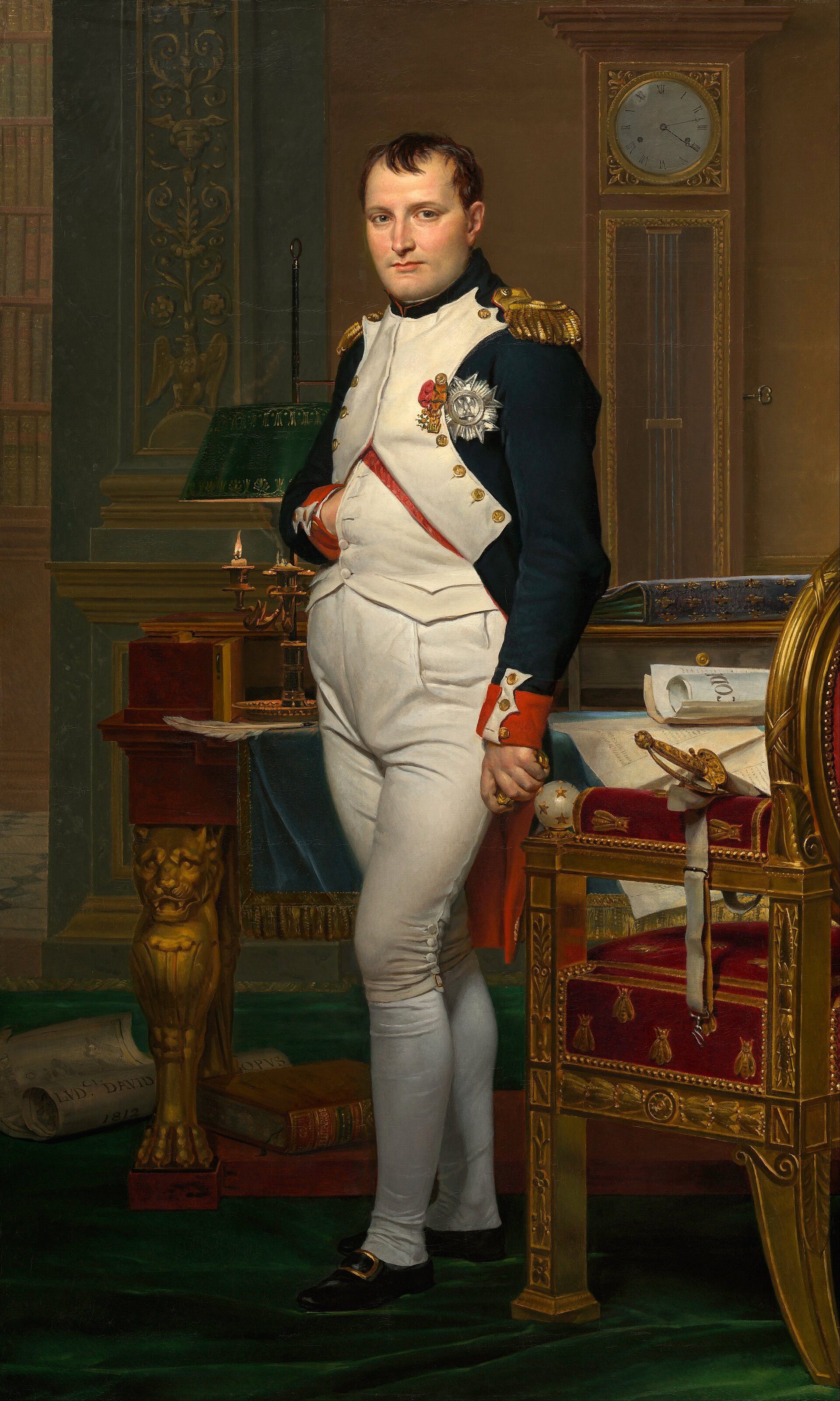

Napoleon Bonaparte (15 August 1769, Ajaccio, Corsica — 5 May 1821, Longwood, Saint Helena) was a French general and statesman: first consul of France from 1799 to 1804 and emperor of the French from 1804 to 1814/15. Born in Corsica a year after its cession to France, he emerged from the Revolutionary army — artillery commander at Toulon in 1793 and commander of the Army of Italy in 1796 — and took power in the coup of 18 Brumaire (9 November 1799), which replaced the Directory with a three-person Consulate. His civil code was promulgated on 21 March 1804 and became the main influence on the civil codes of most of continental Europe and Latin America. The Empire, created by a Sénatus-consulte of 18 May 1804, was consecrated by his self-coronation at Notre-Dame on 2 December 1804 and secured by Austerlitz a year later. The Russian campaign of 1812 — about 455,000 men crossing the Niemen against some 280,000 Russians, and 45,000 Russian casualties at Borodino — destroyed his army. He abdicated in 1814, returned from Elba for the Hundred Days, and was finally defeated at Waterloo on 18 June 1815. On Saint Helena he shaped his legend in memoirs and in a will asking to rest on the banks of the Seine; his death on 5 May 1821 has been debated for two centuries, and a consortium of gastrointestinal pathologists concluded that the autopsy reports point to advanced gastric cancer with upper gastrointestinal bleeding.
Corsica and the Revolutionary officer (1769-1795)
Corsica officially became French in 1768 under the treaty of Versailles dated 15 May 17681. French troops subdued Paoli's men at Ponte Nuovo on 9 May 1769, and among Paoli's partisans was Charles Bonaparte, Napoleon's father1. Napoleon was born on 15 August 1769 and baptised on 21 July 17711. In September 1771 the family's noble status was recognised — four degrees of nobility being the required measure — opening the way to the military college at Brienne on 15 May 17791.
He was educated at three schools: briefly at Autun, five years at Brienne, one year at the military academy in Paris2. During that Paris year his father died of stomach cancer, in February 1785, and Napoleon, though not the eldest son, became head of the family before sixteen2. In the École militaire examinations of September 1785, 58 of 137 candidates passed and Napoleon came 42nd; brevetted a second lieutenant, he joined the artillery regiment La Fère1.
When civil war broke out in Corsica in April 1793, Paoli had the Buonaparte family condemned, and they fled to France2. The family left Corsica on 11 June 1793, landed in Toulon on 13 June and settled soon afterwards in Marseilles1.
On 16 September 1793 Napoleon was appointed commander of artillery in Carteaux's army1. The British left Toulon on 18 December, and on 22 December Napoleon was promoted to brigadier general, at twenty-four, in recognition of his decisive part in the capture of the town12.
The Italian campaign and Egypt (1796-1799)
Bonaparte first drew the regime's attention in Paris by suppressing a royalist insurrection on 13 Vendémiaire (5 October 1795) with a volley of grapeshot3. On 2 March 1796 the Directory appointed him commander of the Army of Italy3. His first proclamation to those soldiers was blunt: they were destitute and hungry, and the government, though it owed them much, could give them nothing3.
He beat far more experienced Austrian generals: Beaulieu at Montenotte (12 April 1796), Sebottendorf at Lodi (10 May), Alvinczy at Arcole (17 November) and again at Rivoli (15 January 1797)3. After the Treaty of Campo Formio, in October 1797, he returned to Paris in triumph; in March 1798 the Directory gave him command of the expedition to Egypt3.
Eluding Nelson's fleet, the expedition landed in Egypt during the night of 1-2 July 17983. Bonaparte beat the Mamluks at the Battle of the Pyramids on 21 July 17983, but during the night of 1-2 August the British sank most of the French fleet at Aboukir Bay and the situation in Egypt swiftly unravelled3. Before long he was back in France3.
18 Brumaire and the Consulate (1799-1804)
The plot against the Directory needed a general: the veteran politician Sieyès sought a sword, and with Bonaparte available the negotiations began in mutual distrust3. The conspirators met at his apartment on Rue de la Victoire and fixed the date: 18 Brumaire An VIII (9 November 1799)3.
The coup began at 7am on 18 Brumaire3. The conspirators spread the rumour of a Jacobin plot, got the assemblies moved to the Château de Saint-Cloud, and put Bonaparte in charge of the army's 17th Division3. The directors resigned or were neutralised3.
On the second day the decisive scene was the Orangerie3. When the Council of Five Hundred resisted, the cavalryman Murat entered the assembly and made the dramatic declaration that the deputies had been dissolved3. The députés voted in favour, and the Directory was replaced by an executive commission made up of three Consuls3.
In Britannica's account, the coup exchanged a five-member Directory for a three-person Consulate, and the first consul — Napoleon — held all the real power2. As first consul from 1799 to 1804 he reformed French education, developed the civil code and negotiated the Concordat of 18012.
The Code civil (1800-1804)
The civil code began as a Consular bill passed on 18 August 18004. The commission comprised Bigot de Préameneu and Tronchet, specialists in customary oral law, and Maleville and Portalis, specialists in written law4. The articles took only four months to compose, and went to the Tribunal de Cassation, the courts of appeal and the Conseil d'État, whose sittings began on 17 July 1801 with Napoleon in the chair when present4.
The result comprised 36 laws and 2,281 articles, in three parts consecrated to people, goods and property, and written in a clear and concise style so as to avoid any ambiguity4. It made all male citizens equal and extinguished primogeniture, hereditary nobility and class privileges, while freedom of person, freedom of contract and inviolability of private property became fundamental principles5.
Its limits were as deliberate as its principles: Bonaparte left his personal mark on the code by restoring the legal superiority of the husband and father in the family4. The code subordinated women to their fathers and husbands, who controlled all family property and were favoured in divorce proceedings, and many of those provisions were reformed only in the second half of the twentieth century5.
The code was enacted piecemeal through 36 statutes passed between 1801 and 1803 and consolidated on 21 March 1804 into a single body of law, the Code Civil des Français5. The title changed to Code Napoléon in 18075, and the work was completed by the codes of civil procedure in 1806, commerce in 1807, criminal instruction in 1808 and penal law in 18104.
The code travelled with French power: introduced from 1804 into Belgium, Luxembourg, western Germany, north-western Italy, Geneva and Monaco, and later into conquered territories, it is still in use in Belgium, Luxembourg and Monaco5. Britannica calls it the main influence on the civil codes of most of continental Europe and Latin America, and more than two centuries on it remains living law across a great part of the world5.
The Empire: proclamation and coronation (1804)
Contrary to a widely held belief, the Napoleonic Empire was not created by the coronation of 2 December 1804 but by a Sénatus-consulte adopted by the Sénat at its meeting of 18 May 18046. The ceremony came to crown that law, by which the government of the French Republic had been entrusted to an emperor, Napoleon Bonaparte, First Consul7.
On 2 December 1804, in the presence of Pope Pius VII, Notre-Dame de Paris was the stage for Napoleon's coronation6. The new emperor crowned himself, breaking with tradition, and swore an oath to preserve the gains of the Revolution6.
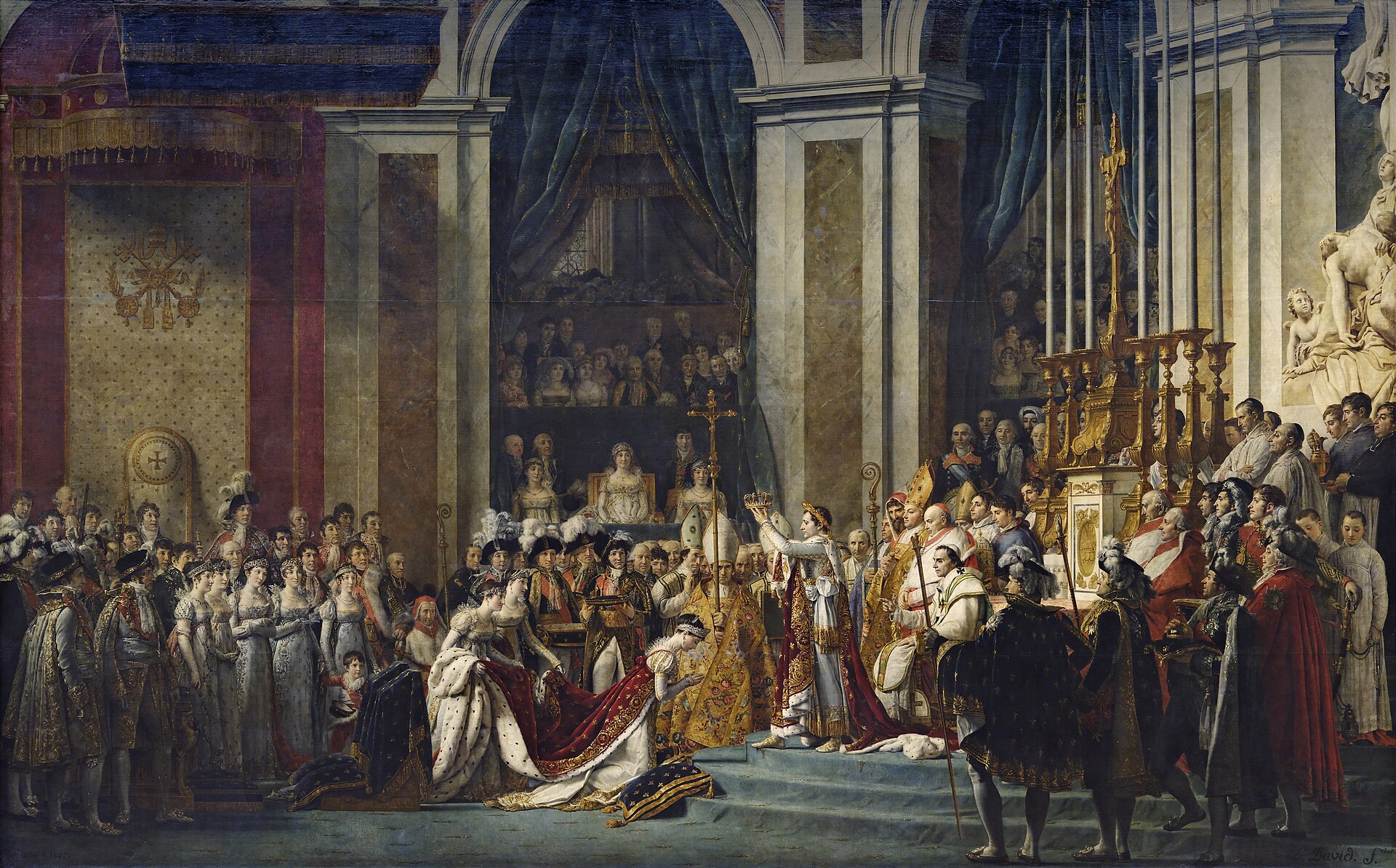

David's Coronation was commissioned in September 1804 without a fixed price or destination7. David estimated it at 100,000 francs in June 1806 but was paid 65,000 francs, and he painted it from 21 December 1805 to mid-November 18077. The scene is peopled with about 190 figures, of which 93 are identified portraits — 59 men, 33 women and one child7.
Four figures were in reality absent: Letizia Bonaparte was in Rome, the cardinal-legat Caprara was ill, and the ambassadors of the Ottoman Sultan and the Holy Roman Emperor did not attend7. The canvas also carries a correction: David had painted the self-coronation before erasing it in August 1806 and replacing it with the figure visible today7.
The campaigns: a table of the major battles
The Italian victories of 1796-97 were won against four disciplined Austrian armies in only a few months3. Austerlitz, fought on the first anniversary of the coronation, secured the imperial regime8, and the Russian campaign ended with the remnants of the Grande Armée recrossing the Niemen on 13 December 18129.
| Engagement | Date | Forces | Outcome and casualties |
|---|---|---|---|
| Montenotte | 12 April 17963 | French against Beaulieu's Austrian army3 | The Austrian commander is beaten in the opening victory of the Italian campaign3 |
| Lodi | 10 May 17963 | French against Sebottendorf's Austrian troops3 | The Austrians are beaten again at Lodi3 |
| Arcole | 17 November 17963 | French against Alvinczy's Austrian army3 | Alvinczy is beaten at Arcole3 |
| Rivoli | 15 January 17973 | French against Alvinczy's Austrian army3 | A fourth Austrian army is defeated; two sister republics are established3 |
| Austerlitz | 2 December 18058 | 68,000 French against about 90,000 allied troops8 | Allies: 15,000 killed or wounded, 11,000 captured, more than 130 guns abandoned; French: 9,000 lost8 |
| Crossing of the Niemen | 24 June 18129 | About 455,000 invaders against a frontline Russian army of about 280,0009 | The invasion opens; the Drissa camp is abandoned by the Russians on 17 July9 |
| Borodino | 7 September 18129 | French against the Russian army9 | 45,000 Russian dead, wounded or missing against 28,000-35,000 French losses; 587 French guns fire about 60,000 times9 |
| Occupation of Moscow | 15 September 18129 | — | A population of about 262,000 is reduced to about 10,000; a third of the houses are destroyed and only 122 of 329 churches remain standing9 |
| Crossing of the Berezina | 27 November 18129 | 50,000 men led by Ney, Oudinot and Victor9 | The crossing at Studienka is achieved, but between 25,000 and 40,000 men and most of the baggage are lost9 |
| Waterloo | 18 June 181510 | 72,000 French against Wellington's 68,000 allied troops and about 45,000 Prussians10 | By 10pm: 10,800 dead (6,800 of them French) and around 35,000 wounded; Prussian losses of 7,00011 |
Austerlitz and the mastery of Europe (1805-1810)
On 2 December 1805, north of Vienna, the Austro-Russian army was utterly destroyed; the Russians fell back to the east and the German campaign was closed12.
The battle turned on the Pratzen Heights, which the French found left apparently undefended12. Napoleon asked Soult how long his troops needed to reach the top; told no more than twenty minutes, he replied that they would wait another quarter of an hour, and fifteen minutes later gave the word to go12.
On the eve of the battle his proclamation told the army that the positions it held were formidable, and that an enemy marching to turn his right would expose its flank to French blows8.
The allies lost 15,000 killed or wounded and 11,000 captured, while Napoleon lost 9,000, and the scattered remnants left more than 130 guns on the field8. Austria made peace, and Prussia stayed out of the coalition for a time12. The victory reversed a dangerous military and political situation, secured the imperial regime and came on the one-year anniversary of Napoleon's coronation8.
The wider history of the period — the wars' international political dimensions together with the Empire's social, legal, political and economic structures — is the subject of Volume I of The Cambridge History of the Napoleonic Wars13. His reforms left lasting marks on French institutions and much of western Europe, but his driving passion remained military expansion2.
The Russian campaign, 1812
The alliance that broke in 1812 had been sealed at Tilsit on 7 July 1807, with a peace treaty signed on a raft anchored in the middle of the Niemen, and Russia joined the Continental Blockade9. By 1812 the arrangement had soured: Russia's half-hearted blockade and the Polish question lay behind the break, and the invading force was an army of twenty nations9.
On 24 June 1812 Napoleon crossed the Niemen near Kovno with about 455,000 men, against a frontline Russian army of about 280,000, in three groups spread over 650 kilometres9. His proclamation of 22 June had framed the campaign as the second Polish war, the first having ended at Friedland and Tilsit9.
On 17 July the Russians destroyed the magazines of the Drissa camp and marched out south-east, abandoning the foundation of their defensive strategy only three weeks after the invasion9.
At Borodino on 7 September the Russians had 45,000 dead, wounded or missing, against Napoleon's 28,000-35,0009. Chief surgeon Larrey estimated about two hundred amputations, most from artillery fire, in the first twenty-four hours9. The 587 French guns fired about 60,000 times, and the Russians some 50,000 cannon shots9. Bagration was mortally wounded, and at Fili Kutuzov decided to abandon Moscow9.
Napoleon entered an almost deserted Moscow early on 15 September9. The population, about 262,000, had left, with only 10,000 remaining9. Fires raged until the rain came on 20 September; a third of the houses were destroyed and only 122 of 329 churches remained standing9.
After Tarutino the retreat began, and the winter's first significant snowfall came on 3 November; the winter turned unusually cold and bitter9. On 27 November some 50,000 men under Ney, Oudinot and Victor crossed the Berezina near Studienka, at a cost of between 25,000 and 40,000 men and most of their baggage9. On 5 December Napoleon left the army at Smorgon for Paris, covering some 2,500 km in thirteen days9. Kutuzov entered Vilna on 12 December; the day after, the remnants of the Grande Armée recrossed the Niemen9.
Elba, the Hundred Days, and Waterloo (1814-1815)
After the defeats of 1812-13 Napoleon was forced to abdicate on 6 April 18142. The Congress of Vienna (autumn 1814) set about reorganising Europe, while the Peace of Paris and the Treaty of Fontainebleau granted Napoleon sovereignty over the tiny kingdom of Elba11. He had been exiled to the island in May 181410.
He landed near Cannes with 1,000 men on 1 March 1815 and marched on Paris, winning the support of the rural peasantry as he went10. Louis XVIII left the country before Napoleon reached the capital on 20 March10. The interlude is the Hundred Days, from Napoleon's escape from exile to the return of Louis XVIII10. In a treaty signed on 25 March, each power — Great Britain, Prussia, Austria and Russia — pledged 150,000 men until Napoleon was overthrown, and allied armies of about 794,000 troops were to assemble along the French frontier10.
Waterloo was fought on 18 June 1815, three miles south of Waterloo village, between Napoleon's 72,000 troops and Wellington's allied army of 68,000 with about 45,000 Prussians under Blücher10. A Fondation Napoléon account gives Napoleon around 65,000 men, roughly equal to his opponent, and records that nothing unfolded as he expected11. A terrible storm broke during the night, the rain-soaked ground delayed the start until 11am, and Napoleon was ill11.
By 10 o'clock in the evening it was all over: the field counted 10,800 dead — 6,800 of them French — and around 35,000 injured, two thirds of them French11. Prussian losses reached 7,00011. Between 9 and 10 pm Blücher met Wellington near the Belle-Alliance farm and used the only French he knew11. Napoleon abdicated for the second time on 22 June 181511.
Saint Helena, death, and the cause-of-death evidence (1815-1821)
In October 1815 Napoleon was exiled to the remote island of Saint Helena in the South Atlantic, where he remained until his death on 5 May 1821 at age 512. The island, chosen in 1815 as his place of exile, later held nearly 5,000 Boer prisoners of war14.
On 17 March 1821 he took to his bed and stayed there, apart from a few occasions, until the end on 5 May15. A new holograph will, dictated to Montholon and written between 15 and 27 April 1821, is conserved in the Armoire de fer of the Archives nationales since 186016. He died at 5.49pm on 5 May 1821 at Longwood; an autopsy followed on 6 May, a death mask was cast in preliminary form on 7 May, and he was buried on 9 May before French and English witnesses15.
The autopsy was performed on 6 May 1821 at 2pm at Longwood House, before a French and a British delegation17. The five British doctors who signed the official report reported sound lungs and nothing unhealthy in the liver18, while Antommarchi refused to sign that one-page report18. His own account described a liver grossly enlarged and distended with blood, affected by chronic hepatitis, and a stomach pierced at its centre, sealed by the liver's adhesion and filled with matter like coffee sediment18.
The second autopsy report Antommarchi published in 1825 was found in 2006 to resemble closely an article of 1823 in a French medical journal, and it was excluded from the review as a plagiarism17. An elevated arsenic concentration in Napoleon's hair had raised the poisoning hypothesis17, confirmed again by 1995 analyses at Saclay and Toronto15. Macé's update concludes that none of the speculation about criminal intoxication of the past forty years stands up to scientific scrutiny15.
In his own words: the quotations
Napoleon's words in the record stretch from the first proclamation to the Army of Italy to the will written at Longwood between 15 and 27 April 182116. Between them stand the declaration in the assembly at Brumaire, the address on the eve of Austerlitz, the proclamation of 22 June 1812 and the exchange between the two commanders on the night of Waterloo3.
Soldiers, you are naked, poorly fed. The Government owes you a great deal, but can give you nothing.
Napoleon, first proclamation to the Army of Italy (Fondation Napoléon)
Citizens, you have been dissolved!
Murat, to the Council of Five Hundred at Brumaire (Fondation Napoléon)
The positions which we occupy are formidable. While they are marching to turn my right, they must present their flank to your blows.
Napoleon, proclamation to the army on the eve of Austerlitz, 2 December 1805 (Britannica)
Soldiers! The second Polish war has begun; the first ended at Friedland and Tilsit.
Napoleon, proclamation of 22 June 1812 (Fondation Napoléon)
Quelle affaire!
Gebhard Leberecht von Blücher to Wellington, night of Waterloo, 18 June 1815 (Fondation Napoléon)
It is my wish that my ashes may repose on the banks of the Seine, in the midst of the French people, whom I have loved so well.
Napoleon, will written on Saint Helena, April 1821 (Fondation Napoléon)
My real glory is not the forty battles I won, for Waterloo’s defeat will destroy the memory of as many victories.…What nothing will destroy, what will live forever, is my Civil Code.
Napoleon, from exile (Britannica)
From the retour des cendres to the legend (1840-)
Despite Bertrand's petitions to the British government and to Louis XVIII, Napoleon's body lay in an unmarked grave on Saint Helena for twenty more years after his death in 182119.
In 1840 King Louis-Philippe decided to have his remains transferred to Les Invalides in Paris20. After a journey of more than 7,200 km from Saint Helena, the coffin arrived at the Hôtel des Invalides on 15 December 184019. To fit the imperial tomb inside the Dome, the architect Visconti undertook major excavation work, and the body of the Emperor was finally laid to rest there on 2 April 186120.
The relic of his death has itself become a puzzle: ever since his death on Saint Helena on 5 May 1821, the attribution of Napoleon's death masks has presented one of the most complex and fascinating mysteries19. The cult had formed in his lifetime: he was revered almost unanimously during his lifetime and until the end of the Second Empire under his nephew Napoleon III as one of history's great heroes2. Britannica records that he is today widely held to be one of the greatest military generals in history2. The monument he trusted has held best: more than two centuries on, the Napoleonic Code remains living law across a great part of the world5.
Timeline: Napoleon Bonaparte, 1769-1821
Birth in Ajaccio
Napoleon Bonaparte is born in Ajaccio, Corsica, a year after the island's cession to France; he is baptised on 21 July 1771.
Passes out of the École militaire
Out of 137 candidates, 58 passed the Paris École militaire examinations; Napoleon comes 42nd and is brevetted a second lieutenant, joining the Régiment de La Fère.
Brigadier general after Toulon
After the British evacuate Toulon on 18 December, Napoleon — appointed commander of artillery in September — is promoted to brigadier general on 22 December.
Commander of the Army of Italy
The Directory appoints Bonaparte commander of the Army of Italy; his proclamation tells the soldiers: 'Soldiers, you are naked, poorly fed.'
Treaty of Campo Formio
After defeating four Austrian armies and establishing two sister republics, Bonaparte negotiates the Treaty of Campo Formio with Austria and returns to Paris in triumph.
The coup of 18-19 Brumaire
The conspirators meet at Rue de la Victoire and set the coup for 18 Brumaire (9 November 1799); the deputies end by replacing the Directory with an executive commission of three Consuls.
Promulgation of the Code civil
Enacted piecemeal as 36 statutes between 1801 and 1803, the civil code is consolidated on 21 March 1804 as the Code Civil des Français; it is renamed the Code Napoléon in 1807.
The Empire proclaimed
A Sénatus-consulte adopted by the Sénat on 18 May 1804 creates the Empire — not the coronation that followed in December.
Coronation at Notre-Dame
Napoleon is crowned emperor in Notre-Dame de Paris in the presence of Pope Pius VII; he crowns himself and swears an oath to preserve the gains of the Revolution.
Austerlitz
North of Vienna, the Austro-Russian army is destroyed; the allies lose 15,000 killed or wounded and 11,000 captured, Napoleon 9,000, and Austria makes peace.
Borodino
The bloodiest single day of the Russian campaign: 45,000 Russian casualties against 28,000-35,000 French; the road to Moscow opens.
Napoleon leaves the army
From Smorgon Napoleon heads for Paris, covering some 2,500 km in thirteen days to face the crisis after the destruction of the Grande Armée.
First abdication and Elba
After the defeats of 1812-13 Napoleon abdicates on 6 April 1814; the Treaty of Fontainebleau grants him sovereignty over the tiny kingdom of Elba.
Return from Elba — the Hundred Days
Napoleon lands near Cannes with 1,000 men and marches on Paris; Louis XVIII flees and Napoleon enters the capital on 20 March.
Waterloo and the second abdication
Napoleon is defeated south of Waterloo by Wellington and Blücher; by 10 pm there are 10,800 dead and around 35,000 wounded, and he abdicates for the second time on 22 June.
Death at Longwood
Napoleon dies at 5.49pm on 5 May 1821 at Longwood on Saint Helena; he is buried there on 9 May, and his will asks that his ashes rest on the banks of the Seine.
Frequently asked questions
Who was Napoleon Bonaparte?
Napoleon Bonaparte (15 August 1769 — 5 May 1821) was a French military general and statesman of the Revolutionary era, first consul of France from 1799 to 1804 and first emperor of the French from 1804 to 1814/152. He was born at Ajaccio in Corsica and died in exile on Saint Helena at the age of 512.
How did Napoleon take power in 1799?
Through the coup d'état of 18 Brumaire An VIII (9 November 1799), planned by conspirators who met at Bonaparte's apartment on Rue de la Victoire3. The deputies voted to replace the Directory with an executive commission made up of three Consuls, and the coup d'état had been a success3. As Britannica records, the coup replaced the five-member Directory with a three-person Consulate, and the first consul had all the real power2.
What was the Napoleonic Code, and why is it still important?
The civil code was enacted piecemeal as 36 statutes between 1801 and 1803 and consolidated on 21 March 1804 into the Code Civil des Français, renamed Code Napoléon in 1807; it comprised 36 laws and 2,281 articles arranged in three parts consecrated to people, goods and property5. It made all male citizens equal and extinguished primogeniture, hereditary nobility and class privileges5. Britannica calls it the main influence on the nineteenth-century civil codes of most countries of continental Europe and Latin America, and it is still in use in Belgium, Luxembourg and Monaco5.
Did the coronation of 2 December 1804 create the Empire?
No — contrary to a widely held belief, the Empire was created by a Sénatus-consulte adopted by the Sénat at its meeting of 18 May 1804, not by the coronation6. The ceremony at Notre-Dame de Paris crowned that law when, in the presence of Pope Pius VII, Napoleon broke with tradition by crowning himself6.
What happened in the Russian campaign of 1812?
On 24 June 1812 Napoleon crossed the Niemen near Kovno with an initial invasion force of about 455,000 men, against a frontline Russian army of about 280,0009. At Borodino on 7 September the Russians suffered 45,000 dead, wounded or missing, against French losses of 28,000 to 35,0009. Moscow was entered on 15 September, and after the retreat the crossing of the Berezina on 27 November cost the army between 25,000 and 40,000 men and most of its baggage9.
What happened at the Battle of Waterloo?
Fought on 18 June 1815 during the Hundred Days, it pitted Napoleon's 72,000 troops against the duke of Wellington's allied army of 68,000 and about 45,000 Prussians under Blücher10. By 10 o'clock in the evening it was all over, with 10,800 dead (6,800 of them French) and around 35,000 injured11. Napoleon abdicated for the second time on 22 June 181511.
How did Napoleon die — and was he poisoned?
He died at 5.49pm on 5 May 1821 at Longwood on Saint Helena, and an autopsy was carried out on 6 May in the presence of a French and a British delegation15. The 2021 review of the autopsy evidence concluded that the reports allow a final diagnosis: advanced malignant gastric neoplasia associated with upper gastrointestinal bleeding as the cause of death17. The presence of an elevated arsenic concentration in his hair raised the hypothesis of arsenic poisoning and analyses at Saclay and Toronto in 1995 confirmed a significant level — but Macé's conclusion is that no theory of deliberate poisoning survives scientific scrutiny15.
Was Napoleon short?
The record says otherwise: at the time of his death in 1821 Napoleon measured about 5 feet 7 inches (roughly 1.68 metres), above the estimated average height of a French man in 1820, which was 5 feet 4 inches (about 1.65 metres)2.
Connections
Sources & citations
Every factual claim in this article is drawn from the sources below. Bracketed numbers in the text link to the corresponding source.
- 1
- 2
- 3
- 4
- 5
- 6
- 7
- 8
- 9
- 10
- 11
- 12
- 13
- 14
- 15
- 16
- 17
- 18
- 19
- 20