Alexander the Great
King of Macedonia and conqueror of the Achaemenid Empire — the documented campaign from Pella to the Indus, the ancient sources behind the story, and the birth of the Hellenistic world.
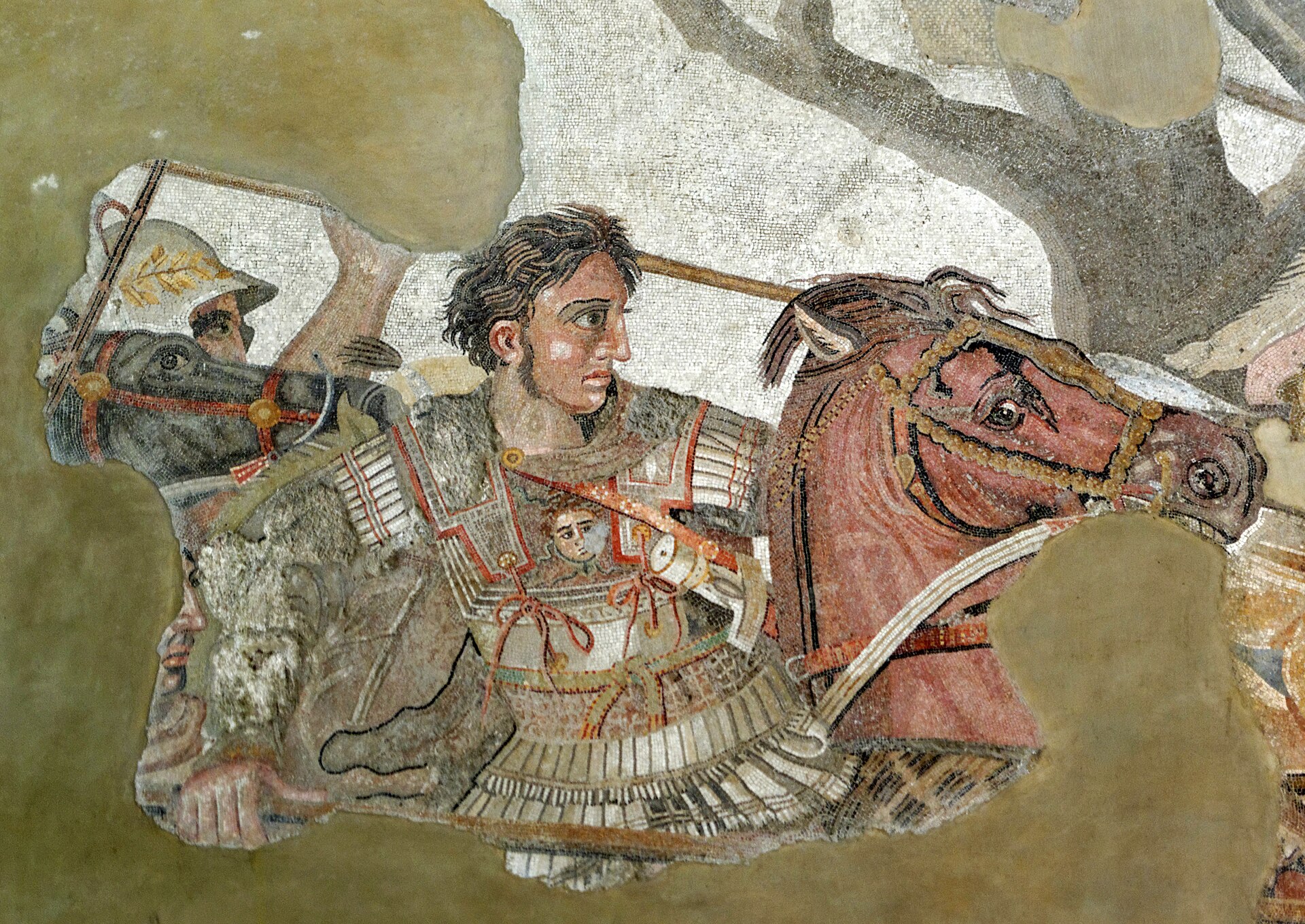

Alexander III of Macedon (356–323 BCE) became king of Macedonia in 336 BCE at the age of twenty and, across twelve years of campaigning, overthrew the Achaemenid Persian Empire, carried Macedonian arms to Egypt and the Indus, and laid the foundations of the Hellenistic world of territorial kingdoms. The ancient accounts — Arrian, Plutarch, Diodorus, and Curtius Rufus — were written centuries after his death and blend documented campaign history with legend, so this profile separates what the primary texts and modern reference sources attest from the stories that grew up around him.
How we know: ancient sources and modern scholarship
Ptolemy I Soter, Alexander's general and later king of Egypt, wrote a history that ancient tradition ranked first among the works about him, praising its accuracy and restraint1. Aristobulus, who marched with Alexander, wrote his account in old age at Cassandrea, recording careful observations on geography, ethnography, and natural science1. His book is highly praised for its trustworthiness, but only fragments have reached us1.
Cleitarchus was notoriously untrustworthy and inclined to believe in the marvellous, yet his narrative made him the most popular of all the writers on Alexander1. His book was the main authority for the narratives of Diodorus, Pompeius Trogus and Quintus Curtius Rufus1. Curtius Rufus, a Roman rhetorician of about the mid first century AD, wrote a history of Alexander in ten books1.
Callisthenes, the court historian who accompanied Alexander to Asia, offended the king by refusing to pay him servile homage in the Persian fashion1. He died in captivity in 328 BC, probably as a result of maltreatment1. Nearchus took part in the Indian expedition and returned as commander of the fleet, sailing down the Indus and along the coast to the mouth of the Tigris1.
Macedonia before Alexander: Philip's inheritance
Philip II was born in 382 BCE and ruled as the eighteenth king of Macedonia from 359 to 336 BCE4. By 339 he had gained domination over all of Greece by military and diplomatic means, laying the foundations for his son's expansion4. He was assassinated in 336 BCE5.
Improved catapults and siege machinery, and a new kind of infantry equipped with the enormous sarissa pike, placed Philip's armies at the forefront of military technology6.
At Aigai was rooted the royal dynasty of the Temenids, the family of Philip II and Alexander the Great7. Among the tombs are those of Euridice, mother of Philip II, and the unlooted tombs of Philip II and his grandson Alexander IV, discovered in 1977-8 and a worldwide sensation7.
Birth, youth, and education (356–336 BCE)
Alexander III was born in 356 BCE at Pella in Macedonia, the son of Philip II and Olympias, daughter of King Neoptolemus of Epirus5. Ancient tradition held him, on his father's side, a descendant of Heracles through Caranus, and on his mother's side a descendant of Aeacus through Neoptolemus8. The claim was accepted without any question8.
On the night before her marriage was consummated, Olympias dreamed that a thunderbolt fell upon her womb and kindled fire that spread and then went out8. A serpent was once seen lying by her side as she slept, a sight that dulled Philip's ardour more than anything else8. Such stories were already gathering around him in his lifetime5.
From age 13 to 16 Alexander was taught by Aristotle, who inspired him with an interest in philosophy, medicine, and scientific investigation5. A rougher education came from horses: Philoneicus the Thessalian brought Bucephalas, offering to sell him to Philip for thirteen talents8. The animal proved savage and altogether intractable, letting no one mount him8.
Alexander tamed him; Philip is said to have shed tears of joy and told his son to seek out a kingdom equal to himself, for Macedonia had not room for him8. Left in charge of Macedonia in 340 during Philip's attack on Byzantium, Alexander defeated the Maedi, a Thracian people5. Two years later he commanded the left wing at Chaeronea, where Philip defeated the allied Greek states, and displayed personal courage in breaking the Sacred Band of Thebes, an elite corps of 150 pairs5.
Accession and the taming of Greece (336–334 BCE)
Pausanias, outraged at the instigation of Attalus and Cleopatra and denied justice by Philip, slew the king, and most of the blame devolved upon Olympias8. In 336, on Philip's assassination, Alexander, acclaimed by the army, succeeded without opposition5. Plutarch puts the moment starkly: at twenty he received a kingdom exposed to great jealousies, dire hatreds, and dangers on every hand8.
Thebes was the first test: when the Thebans refused to surrender, Alexander razed their city to the ground, sparing only the temples and Pindar's house; 6,000 were killed and all the survivors sold into slavery5. He had marched 240 miles from Illyria to Thebes in 14 days to do it5.
Greece was settled to his purpose: at an assembly of the Greek League of Corinth he was appointed generalissimo for the invasion of Asia, already planned and initiated by Philip5. At Delphi, when the priestess refused to prophesy on an inauspicious day, he pressed her until she called him invincible, and he said he desired no further prophecy8. In spring 335 he advanced into Thrace, forced the Shipka Pass, crushed the Triballi, crossed the Danube to disperse the Getae, and shattered a coalition of Illyrians who had invaded Macedonia5.
Across the Hellespont: Granicus and Issus (334–333 BCE)
In spring 334 he crossed the Dardanelles, leaving Antipater as his deputy in Europe with over 13,000 soldiers5. He himself commanded about 30,000 foot and over 5,000 cavalry, of whom nearly 14,000 were Macedonians and about 7,000 allies sent by the Greek League5. The Metropolitan Museum of Art counts some 43,000 infantry and 5,500 cavalry, the most formidable expedition ever to leave Greece6. He needed the wealth of Persia to maintain the army built by Philip and pay off the 500 talents he owed5.
The core of the army was the phalanx, 9,000 heavy infantry with 13-foot spears and shields, and the 3,000 hypaspists of the royal battalions; the Companion cavalry were arguably the finest equestrian unit in the ancient world9. After visiting Ilium he confronted his first Persian army, led by three satraps, at the Granicus River near the Sea of Marmara in May or June 3345. Plutarch has him declare that the Hellespont would blush for shame if he feared the Granicus, and plunge in with thirteen troops of horsemen8. The fight nearly killed him: as Spithridates raised his arm for another stroke, Cleitus, 'Black Cleitus', ran him through the body with his spear8.
At Issus, in autumn 333, Alexander won a decisive victory: the struggle turned into a Persian rout, Darius fled leaving his family in Alexander's hands, and the women were treated with chivalrous care5. The World History Encyclopedia dates the encounter to November 333 BCE10. Darius offered a ransom of 10,000 talents and the cession of his lands west of the Euphrates; Parmenio said he would accept, were he Alexander, and Alexander retorted that he too would, were he Parmenio5.
Earlier, at Gordium, he saw the waggon bound fast with bark of the cornel-tree, and heard the story that whoever loosed the fastening was destined to become king of the whole world8. Most writers say that, at a loss how to proceed, he cut the knot through with his sword8.
Tyre, Egypt, and the oracle of Ammon (332–331 BCE)
The Phoenician coast resisted longest at Tyre, where the Tyrians refused him entry and held out for seven months5. The storming of the city in July 332 was his greatest military achievement; it was attended with great carnage and the sale of the women and children into slavery5. Further south, bitter resistance at Gaza halted him for two months, and he sustained a serious shoulder wound during a sortie5.
In November 332 he reached Egypt, where the people welcomed him as their deliverer and the Persian satrap Mazaces surrendered5. At Memphis he sacrificed to Apis, the sacred Egyptian bull, and was crowned with the double crown of the pharaohs while the native priests were placated5. He founded Alexandria near the western arm of the Nile, between the sea and Lake Mareotis, protected by the island of Pharos, and had it laid out by the Rhodian architect Deinocrates5. Alexandria was the capital of Egypt from its founding in 332 BCE until its surrender to the Arab forces led by ʿAmr ibn al-ʿĀṣ in 642 CE11.
Plutarch relates that after his conquest of Egypt Alexander wished to found a large and populous Greek city that should bear his name8. Viewing the site, he pronounced Homer not only admirable in other ways but also a very wise architect, and ordered the plan drawn accordingly8. The journey south produced his most famous honour: at the oasis oracle of Amon the priest gave him the salutation of a pharaoh, as son of Amon, and Alexander consulted the god but revealed the reply to no one5. Plutarch preserves the wordplay: the prophet's greeting, heard as 'O paidios', was taken as 'O pai Dios', or son of Zeus, a slip Alexander was pleased to accept8.
Gaugamela and the fall of the Achaemenid Empire (331–330 BCE)
The decisive encounter followed a year later: a lunar eclipse gives the exact day, September 20 of 331, on which the Macedonian army crossed the Tigris9. On October 1 the Battle of Gaugamela decided the fate of the Persian Achaemenian Empire9. In front of the Persian line were the scythed war chariots, 50 on the right and centre and 100 on the left; Darius had levelled the plain to give them a clear run9. From afar Alexander saw Darius towering through the deep ranks: a fine-looking man and tall, standing on a lofty chariot, fenced about by a dense array of horsemen8.
The Macedonian victory spelled the end of the Achaemenian Empire founded by Cyrus the Great and left Alexander the master of Southwest Asia9. The World History Encyclopedia writes that after this victory Alexander was, without question, the King of all Asia10. Arrian gives the Macedonian dead as 100, although Diodorus and Quintus Curtius give higher figures9.
The royal centres fell in turn: Alexander occupied Babylon, where Mazaeus, who surrendered it, was confirmed as satrap beside a Macedonian troop commander and quite exceptionally granted the right to coin5. Susa, the capital, also surrendered, releasing treasures amounting to 50,000 gold talents; there Alexander established Darius's family in comfort5. At Persepolis he ceremonially burned the palace of Xerxes as a symbol that the war of revenge was over, an act tradition later explained as a drunken frolic inspired by Thais, an Athenian courtesan5. Plutarch records Thais urging the revel, so that men might say the women in Alexander's train punished Persia more than all her famous commanders by sea and land8.
Bessus, the satrap of Bactria, had Darius stabbed and left him to die, and Alexander sent the body for burial with due honours in the royal tombs at Persepolis5.
Central Asia, India, and the limits of conquest (330–325 BCE)
Strain grew between the king and his Macedonians: Philotas, Parmenio's son and commander of the Companion cavalry, was implicated in an alleged plot, condemned by the army and executed, and Parmenio was then assassinated on Alexander's orders5. Alexander murdered Cleitus, one of his most trusted commanders, in a drunken quarrel, and his excessive display of remorse led the army to pass a decree convicting Cleitus posthumously of treason5. At Bactra he tried to impose the Persian prostration, proskynesis, on Greeks and Macedonians, to whom it was intolerable before a human being5.
Reconciliation took the form of marriage: when the crag of Oxyartes was seized, his daughter Roxana was among the captives, and Alexander married her5. In June he fought his last great battle on the left bank of the Hydaspes, founded Nicaea and Bucephala, the latter named after his horse Bucephalus, which died there, and Porus became his ally5.
The limit of conquest was set by his own men: at the Hyphasis his army mutinied, refusing to go farther in the tropical rain, and Coenus, one of his four chief marshals, spoke for the troops5. In the speech Arrian gives him, Alexander complains that when he would lead them on a new venture they no longer follow him with their old spirit12. The return was worse than the advance: the march through Gedrosia proved disastrous, waterless desert and shortages of food and fuel causing great suffering, and many, especially women and children, perished in a sudden monsoon flood while encamped in a wadi5.
The campaigns at a glance
Six engagements frame the campaign, from the Granicus to the Hydaspes in June 326 BCE5.
| Battle or siege | Year | Opponent | Outcome |
|---|---|---|---|
| Granicus5 | May/June 334 BCE5 | Persian satraps | First victory in Asia; the first Persian army, led by three satraps, broken5 |
| Issus5 | Autumn 333 BCE5 | Darius III | Decisive victory; Darius fled, leaving his family in Alexander's hands5 |
| Tyre5 | July 332 BCE5 | The city of Tyre | Seven-month siege; stormed in July, Alexander's greatest military achievement5 |
| Gaza5 | 332 BCE5 | The city of Gaza | Two months' resistance; Alexander sustained a serious shoulder wound during a sortie5 |
| Gaugamela9 | October 1, 331 BCE9 | Darius III | Empire decided; Arrian gives the Macedonian dead as 1009 |
| Hydaspes5 | June 326 BCE5 | Porus | Last great battle; Nicaea and Bucephala founded; Porus made ally5 |
| Gedrosia (a march, not a battle)5 | 325 BCE5 | Desert and monsoon | Waterless desert and shortages; many perished in a sudden monsoon flood5 |
Empire, army, and the policy of fusion
Where Persian officials submitted, they were kept: Mazaeus, who surrendered Babylon, was confirmed as satrap and exceptionally granted the right to coin5. Susa released treasures amounting to 50,000 gold talents, and there Alexander established Darius's family in comfort5.
The policy of fusion was personal as well as political: at Susa he and 80 of his officers took Persian wives, he and Hephaestion marrying Darius's daughters Barsine, also called Stateira, and Drypetis, and 10,000 soldiers with native wives were given generous dowries5. Resistance came to a head at Opis in 324, when Alexander's decision to send home Macedonian veterans under Craterus was interpreted as a move toward transferring the seat of power to Asia5. In autumn 324 Hephaestion died in Ecbatana; Alexander mourned extravagantly and gave his closest friend a royal funeral in Babylon with a pyre costing 10,000 talents5.
By then the reach of the conquests was unprecedented: during his leadership, from 336 to 323 BC, he conquered the Greek city-states and the Persian Empire and founded more than 70 cities, an empire across three continents covering about two million square miles13. The Hellenistic period his conquests opened is dated by the British Museum to 323-31 BCE13.
Death in Babylon and the wars of the successors (323 BCE and after)
The end came in Babylon, while he was planning to improve the irrigation of the Euphrates and settle the coast of the Persian Gulf5. He was taken ill after a prolonged banquet and drinking bout, and 10 days later, on June 13 of 323 BCE, he died in his 33rd year, after a reign of 12 years and eight months5. The World History Encyclopedia gives 10 or 11 June 323 BCE, an age of 32, after ten days of high fever14.
Most writers, Plutarch notes, think that the story of the poisoning is altogether a fabrication8. As evidence, they note that his body, though it lay without special care in moist and stifling places during the disputes of his commanders, showed no sign of decomposition8. There was nevertheless much speculation about the cause of death, the most popular theories claiming that he either contracted malaria or typhoid fever or that he was poisoned5.
No heir had been appointed: his generals adopted Philip Arrhidaeus and Alexander's posthumous son Alexander IV as kings, sharing out the satrapies after much bargaining5. Ptolemy, who became ruler of Egypt, founded the Ptolemaic dynasty, which reigned longer than any other dynasty of the Alexandrian empire and only succumbed to the Romans in 30 BCE15. In the end three dynasties emerged from the wars of the successors, remaining in power until the time of the Romans16.
The legend had begun to outstrip the record: already in his lifetime Alexander was the subject of fabulous stories, and he later became the hero of a full-scale legend bearing only the sketchiest resemblance to his historical career5. His campaigns became legendary after his death, influencing the tactics and careers of later Greek and Roman generals14. Modern historians have taken a more critical approach than earlier accounts, criticising his destruction of Persepolis and treatment of Tyre's citizens, but his fame remains intact14.
Voices from the sources
Passages quoted verbatim from the ancient sources and modern reference works used in this profile.
My son, seek thee out a kingdom equal to thyself; Macedonia has not room for thee.
Philip II to Alexander, after Bucephalus was tamed — Plutarch, Life of Alexander (Bernadotte Perrin, trans.)
Thou art invincible, my son!
The priestess at Delphi to Alexander — Plutarch, Life of Alexander (Bernadotte Perrin, trans.)
stand a little out of my sun
Diogenes to Alexander at Corinth — Plutarch, Life of Alexander (Bernadotte Perrin, trans.)
But verily, if I were not Alexander, I would be Diogenes.
Alexander, on Diogenes — Plutarch, Life of Alexander (Bernadotte Perrin, trans.)
I observe, gentlemen, that when I would lead you on a new venture you no longer follow me with your old spirit.
Alexander to his mutinous army — Arrian, The Campaigns of Alexander (Internet Ancient History Sourcebook)
it would be a still greater pleasure to go in revel rout and set fire to the house of the Xerxes who burned Athens, she herself kindling the fire under the eyes of Alexander
Thais, urging the burning of Persepolis — Plutarch, Life of Alexander (Bernadotte Perrin, trans.)
he later became the hero of a full-scale legend bearing only the sketchiest resemblance to his historical career
Encyclopaedia Britannica, on the growth of the Alexander legend
Timeline
Birth at Pella
Alexander III is born at Pella in Macedonia, son of Philip II and Olympias; Philip's reign had begun in 359 BCE.
Aristotle summoned as tutor
Philip brings Aristotle to the Macedonian court; Alexander studies with him from age 13 to 16.
Battle of Chaeronea
Philip defeats the allied Greek states; Alexander commands the left wing and breaks the Sacred Band of Thebes.
Philip assassinated; Alexander king
Philip II is killed at Aegae; the army acclaims Alexander, who succeeds without opposition at about age twenty.
Thebes razed
A report of Alexander's death sparks a Theban revolt; he marches 240 miles in 14 days, takes the city and razes it, selling the survivors.
Invasion of the Persian Empire begins
Alexander crosses the Dardanelles with about 30,000 foot and over 5,000 cavalry and defeats the Persians at the Granicus in May or June.
Issus and the Gordian knot
Darius III is defeated in the autumn at Issus, leaving his family in Alexander's hands; at Gordium Alexander cuts the famous knot.
Tyre stormed; Egypt reached
After a seven-month siege Tyre is stormed in July; Alexander reaches Egypt in November, is crowned pharaoh at Memphis, and founds Alexandria.
Gaugamela and the fall of the Persian gate
On October 1 Alexander defeats Darius at Gaugamela; Babylon and Susa surrender, Susa yielding treasures of 50,000 gold talents.
Persepolis burned; Darius III murdered
Alexander burns Xerxes' palace at Persepolis; Bessus has Darius stabbed, and Alexander sends the body for burial in the royal tombs.
Roxana married; the march to India
Alexander marries the Bactrian noblewoman Roxana and turns his attention to India.
Hydaspes and the mutiny at the Hyphasis
Alexander defeats Porus' elephants at the Hydaspes in June; at the Hyphasis the army refuses to go farther and he turns back.
The Gedrosian march
The army splits: Nearchus sails the fleet along the coast while Alexander leads the other half through the Gedrosian desert, where many perish.
Susa weddings and the Opis mutiny
At Susa Alexander and 80 officers take Persian wives; at Opis the veterans mutiny and 10,000 are sent home.
Death in Babylon
Alexander falls ill after a banquet and dies in Babylon in June at about age 32, after a reign of 12 years and eight months; no heir is named.
Frequently asked questions
When and where was Alexander the Great born?
Alexander III was born in 356 BCE at Pella in Macedonia, the son of Philip II and Olympias, daughter of King Neoptolemus of Epirus5. World History Encyclopedia dates his birth precisely to 21 July 356 BCE14.
How old was Alexander when he became king, and how long did he reign?
At the age of twenty years he received the kingdom, which was exposed to great jealousies, dire hatreds, and dangers on every hand8. In 336, on Philip's assassination, Alexander, acclaimed by the army, succeeded without opposition5. He had reigned for 12 years and eight months when he died in June 323 BCE5.
Why did Alexander invade the Persian Empire?
He needed the wealth of Persia to maintain the army built by Philip and pay off the 500 talents he owed5. The invasion was already planned and initiated by Philip, and Alexander was appointed generalissimo for it at an assembly of the Greek League of Corinth5.
What happened at the Battle of Gaugamela?
On October 1 of 331 BCE the Battle of Gaugamela decided the fate of the Persian Achaemenian Empire9. The Macedonian victory spelled the end of the empire founded by Cyrus the Great and left Alexander the master of Southwest Asia9.
Who was Bucephalus?
Bucephalas was the horse brought by Philoneicus the Thessalian, offered to Philip for thirteen talents, which proved savage and intractable until Alexander mastered him8. The city of Bucephala, one of two founded at the Hydaspes, was named after the horse, which died there5.
How far east did Alexander's army go, and why did it turn back?
In June he fought his last great battle on the left bank of the Hydaspes and made Porus his ally5. He had advanced to the Hyphasis when his army mutinied, refusing to go farther in the tropical rain, with Coenus, one of his four chief marshals, acting as spokesman5.
How did Alexander die?
In Babylon he was taken ill after a prolonged banquet and drinking bout and died 10 days later, on June 13 of 323 BCE, in his 33rd year5. Most writers think that the story of the poisoning is altogether a fabrication8. Modern speculation most often claims that he either contracted malaria or typhoid fever or that he was poisoned5.
What happened to Alexander's empire after his death?
No heir had been appointed, so his generals adopted Philip Arrhidaeus and Alexander's posthumous son Alexander IV as kings while sharing out the satrapies after much bargaining5. Ptolemy became ruler of Egypt and founded the Ptolemaic dynasty, which only succumbed to the Romans in 30 BCE15. In the end three dynasties emerged from the wars of the successors, remaining in power until the time of the Romans16.
Knowledge graph
Sources & citations
Every factual claim in this article is drawn from the sources below. Bracketed numbers in the text link to the corresponding source.
- 1
- 2
- 3
- 4
- 5
- 6
- 7
- 8
- 9
- 10
- 11
- 12
- 13
- 14
- 15
- 16
- 17