Cleopatra
The last Ptolemaic queen of Egypt — the documented reign, the alliances with Caesar and Antony, Actium and the contested accounts of her death, and an audit of the Roman propaganda that shaped her legend.
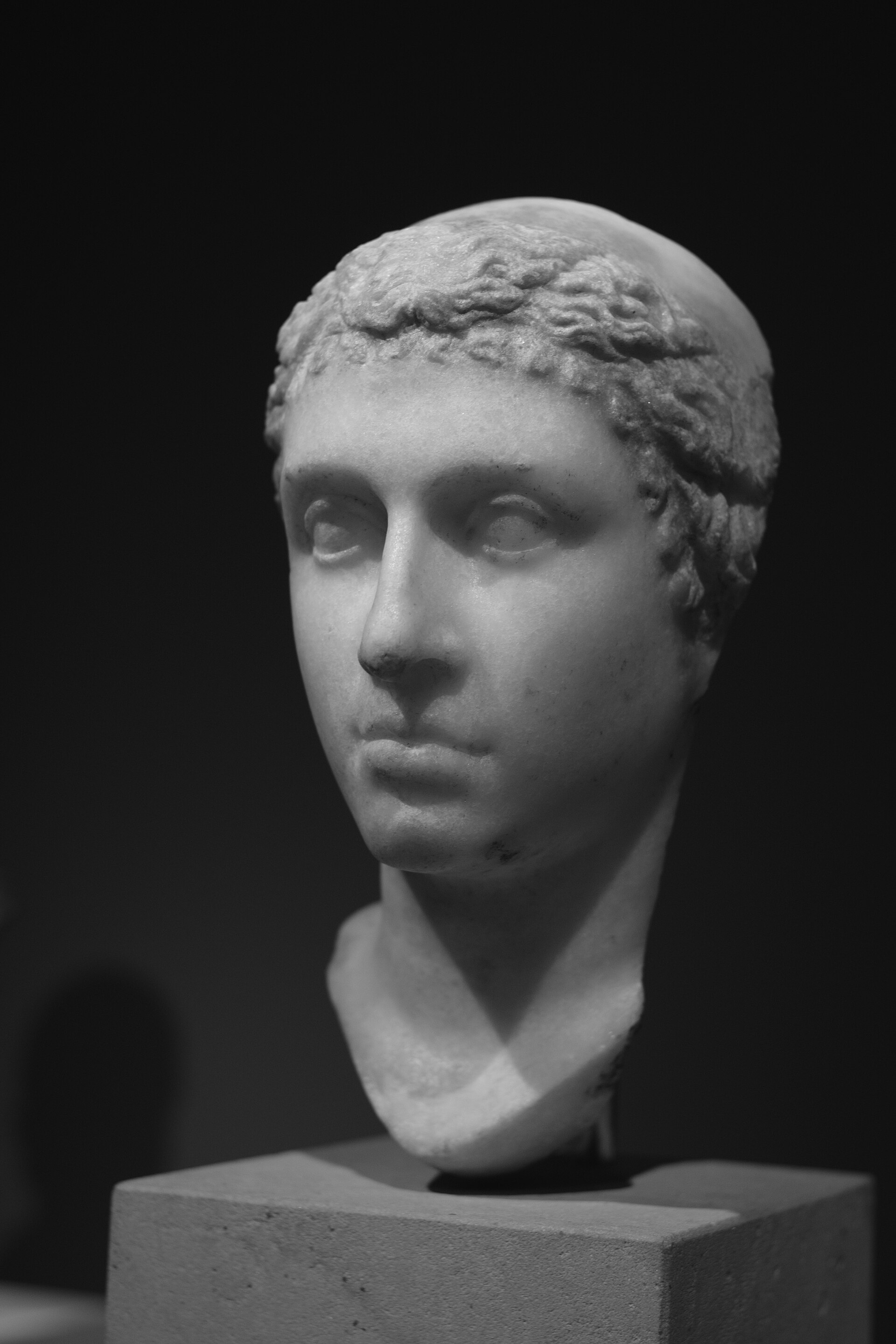

Cleopatra VII Thea Philopator (born 70/69 BCE — died August 30 BCE, Alexandria; some timelines give 12 August) was the last queen of the Ptolemaic dynasty, the Macedonian-Greek house founded by Ptolemy I Soter that ruled Egypt from 323 BCE until its annexation by Rome in 30 BCE. She came to the throne in 51 BCE on the death of her father Ptolemy XII Auletes and ruled successively with her brothers Ptolemy XIII (51–47) and Ptolemy XIV (47–44) and her son Ptolemy XV Caesar, called Caesarion (44–30). Restored to power with Caesar's help after the Alexandrian war, she visited Rome (46–44 BCE) and was there when Caesar was assassinated; Caesar never married her, and whether he fathered Caesarion cannot now be known. In 41 BCE she met Mark Antony at Tarsus; they had three children, and after Antony divorced Octavia she was his partner in the eastern Mediterranean until Octavian's propaganda war and the naval defeat at Actium (2 September 31 BCE). Antony killed himself on 1 August 30 BCE after a false report of her death; Cleopatra died weeks later. The ancient accounts of her death — the asp in a basket of figs, poison, or, as some modern scholars have hypothesized, murder by Octavian's agents — contradict one another, and only the Roman triumph's effigy gives the story of the snake a firm place in the record. Plutarch documents her command of many languages and her learning; the seductress of Roman propaganda has increasingly been read by scholarship as a working monarch of a diminished kingdom.
The Ptolemaic world: Macedonian kings on the Nile
After the death of Alexander the Great — whose dates the record gives as 356–323 BCE — Egypt passed to his Macedonian general Ptolemy I Soter1. Ptolemy became ruler of Egypt and founder of the dynasty that took his name2. Britannica dates his reign in Egypt to 323–285 BCE2. The house he founded reigned longer than any other dynasty established on the soil of the Alexandrian empire, and only succumbed to the Romans in 30 BCE2.
The dynasty's intellectual engine was Alexandria, described in the modern literature as a vibrant cosmopolitan city and a major centre of Greek culture3. The foundation of the renowned Museion, with its famous scholarship holders, and of the Royal Library as the main repository of books and rolls belongs to this same world3. The ruling house remained Macedonian in origin even as it governed Egypt: Cleopatra VII, its last ruler, was ethnically Greek and culturally Egyptian, and she presented herself as an Egyptian queen1.
The late Ptolemaic decline shows in her father's reign. Ptolemy XII Auletes earned his nickname — the Flute-Player — from his musicianship, while his illegitimate birth and drunkenness inspired ridicule4. Ever-larger bribes forced him to borrow money from Roman bankers, and his children Cleopatra VII and Ptolemy XIII inherited crippling debts4. In his will he left his kingdom to his oldest surviving children: the 18-year-old Cleopatra and the 10-year-old Ptolemy XIII4.
On her descent the record is precise and hedged at once. Cleopatra was the daughter of Ptolemy XII Auletes and, most likely, of his wife and sister Cleopatra V Tryphaeana5. Britannica adds that she probably had little, if any, Egyptian blood5, and that Plutarch wrote she alone of her house took the trouble to learn Egyptian5. She was, in short, ethnically Greek and culturally Egyptian — and she presented herself as an Egyptian queen1.
Accession, exile, and the Alexandrian war (51–47 BCE)
When Ptolemy XII died in 51 BCE, the throne passed to his young son Ptolemy XIII and his daughter Cleopatra VII5. Ptolemy XIII's reign had begun as co-ruler with his sister, the famous Cleopatra VII, following the wishes of their father, Ptolemy XII Auletes6. Cleopatra was about eighteen and at first the dominant ruler; the first decree in which her brother's name took precedence, Britannica's timeline notes, is dated to October 50 BCE5.
Faction then turned on her. In 48 BCE her chief advisor Pothinus, with Theodotus of Chios and the general Achillas, overthrew her and placed Ptolemy XIII on the throne alone1. Cleopatra fled to Syria and raised an army, only to be defeated near Pelusium; Pompey was murdered at the Egyptian court, and Julius Caesar arrived in Egypt1. After defeating Pompey at Pelusium, Caesar wintered at Alexandria, where he first met Cleopatra7.
The meeting that saved her was engineered in secret. Plutarch's Life of Caesar preserves the famous entry: Cleopatra took only Apollodorus the Sicilian from among her friends, crossed in a little skiff, and landed at the palace after dark, since daylight would have given her away8. She had herself carried indoors to Caesar rolled up inside a bed-sack, which Apollodorus tied with a cord8. Plutarch says it was by this device that Caesar was first captivated, for she showed herself a bold coquette8. Succumbing to the charm of her company, he reconciled her to her brother on the basis of a joint share in the royal power8.
Caesar and Cleopatra became lovers and spent the winter besieged in Alexandria5. Roman reinforcements arrived the following spring, and Ptolemy XIII fled and drowned in the Nile5. The settlement restored Cleopatra; her half-sister Arsinoe, who had been paraded in Caesar's four-day triumph at Rome, was later allegedly executed at Cleopatra's request, to prevent any future attempts on her throne9.
In the same season the queenship was settled again. In June 47 BCE Cleopatra gave birth to Ptolemy Caesar, called Caesarion5. Whether Caesar was the father of Caesarion, as his name implies, cannot now be known5. Her brother Ptolemy XIV ruled with her until he died in 44 BCE, soon after her return from Rome, when she began to rule with her infant son, Ptolemy XV Caesar5.
Caesar and Cleopatra: the documented relationship (48–44 BCE)
What the sources emphasize is a bargain as much as a romance. Cleopatra realized that she needed Roman support — specifically Caesar's support — if she was to regain her throne, and Caesar wanted repayment of the debts run up by her father Ptolemy XII as he struggled to keep his throne5. Britannica's summary is blunt: each side, it concludes, was determined to use the other5.
In 46 BCE, after his triumph, Caesar brought Cleopatra, their son and her entire entourage to Rome, openly acknowledging Caesarion as his son — though not his heir — and Cleopatra as his consort1. The visit left traces in the record: residence in Caesar's villa beyond the Tiber, and a golden statue of herself that she may have seen dedicated in the temple of Venus Genetrix5. Elite opinion was not friendly; in a letter of 45 BCE Cicero wrote that he detested the Queen and that the recollection of her insolence in Caesar's trans-Tiberine villa was painful to him1.
On the two questions posterity asks most, the record is firm and cautious in turn. Julius Caesar did not marry Cleopatra, though the couple had a romantic relationship7. Caesarion's paternity is the cautious part: whether Caesar was his father, as his name implies, cannot now be known5.
she stretched herself at full length inside a bed-sack, while Apollodorus tied the bedsack up with a cord and carried it indoors to Caesar
Plutarch, Life of Caesar 49 (Bernadotte Perrin, trans.)
There was sweetness also in the tones of her voice; and her tongue, like an instrument of many strings, she could readily turn to whatever language she pleased
Plutarch, Life of Antony (Bernadotte Perrin, trans.)
It was by this device of Cleopatra's, it is said, that Caesar was first captivated, for she showed herself to be a bold coquette
Plutarch, Life of Caesar 49 (Bernadotte Perrin, trans.)
Antony by the Cydnus: Tarsus and the Alexandria years (41–37 BCE)
After Caesar's assassination, Mark Antony controlled Rome's eastern territories, and in 41 BCE he sent for Cleopatra so that she might explain her role in the aftermath5. She set out for Tarsus in Asia Minor loaded with gifts, having delayed her departure to heighten his expectation5. Plutarch stages the arrival on the Cydnus as theatre: a barge with gilded stern and purple sails, rowers urging it on with silver oars to the sound of the flute blended with pipes and lutes, and incense drifting along the river-banks10. She came styled as the new Isis5, and the rumour spread that Venus had come to revel with Bacchus for the good of Asia10.
Plutarch is explicit that her power was not chiefly visual. Her beauty, as he reports it told, was in itself not altogether incomparable, nor of the kind to strike those who saw her10. What proved irresistible was her conversation: her presence, combined with the persuasiveness of her discourse, had something stimulating about it10.
The languages were the working instrument of that charm. Plutarch says her tongue, like an instrument of many strings, could turn to whatever language she pleased, so that in interviews with foreign peoples she very seldom had need of an interpreter10. He lists the peoples who came to her unassisted — Ethiopians, Troglodytes, Hebrews, Arabians, Syrians, Medes and Parthians10. She knew the speech of many other peoples too, he adds, while the kings of Egypt before her had not even made an effort to learn the native language, and some had given up their Macedonian dialect10. Britannica's summary agrees in substance: she alone of her house took the trouble to learn Egyptian5.
Alexandria, 40 BCE: Antony returned with her, and the pair formed their society of the Inimitable Livers9 — which some historians have read as an excuse for debauchery, though it was more likely a group dedicated to the cult of Dionysus9. That year Cleopatra bore the twins Alexander Helios and Cleopatra Selene5. The settlement at Brundisium pulled Antony back to Italy: Fulvia having died, he married Octavian's sister, Octavia5, yet WHE records that he considered Cleopatra his wife even before legally marrying her11. Three years later, at Antioch, the plans for his Parthian campaign were laid, Cleopatra conceived her third child by him — the future Ptolemy Philadelphus — and parts of Rome's eastern possessions came under her control9.
The Donations of Alexandria and the war of words (34–32 BCE)
In 34 BCE came the ceremony posterity calls the Donations of Alexandria. Cleopatra was hailed as queen of kings, and Caesarion as king of kings5. Alexander Helios was awarded Armenia and the territory beyond the Euphrates, his infant brother Ptolemy the lands to the west of it, and their sister, Cleopatra Selene, was to be ruler of Cyrene5. Watching from Rome, Octavian read the intent plainly: Antony meant his extended family to rule the civilized world5.
Octavian answered with disclosure and rumour. He seized Antony's will — or what he claimed to be Antony's will — from the temple of the Vestal Virgins, where it had been entrusted, and revealed to the Roman people that Antony had bestowed Roman possessions on a foreign woman and intended to be buried beside her in Egypt5. Many historians have argued that the will was actually a forgery12. Octavian's propaganda portrayed Cleopatra as an evil seductress of two of Rome's greatest generals, and gave the people to understand that Antony would surrender Rome to her and move the seat of Roman power to Alexandria12.
| The charge | Where it came from | What the record shows |
|---|---|---|
| Cleopatra as an evil seductress of Rome's two greatest generals | Octavian's propaganda12 | The alliance was politically useful on both sides: Cleopatra needed Antony to revive the old boundaries of her kingdom, and Antony needed Egypt as a source of supplies and funds13 |
| Antony would surrender Rome and move the seat of power to Alexandria | Octavian's propaganda12 | The people were given to understand this as a threat, and the record preserves it as propaganda rather than policy12 |
| Antony left Roman possessions to a foreign woman and would be buried in Egypt | Octavian's public reading of the seized will5 | Many historians have argued that the document was actually a forgery12 |
| Josephus's charges against Cleopatra | Josephus, as examined in modern scholarship14 | Analysis of Josephus's evidence confirms that his case against the queen does not stand up14 |
The legal end came in 32 BCE. Octavian had the Roman Senate deprive Antony of his powers and declare war against Cleopatra, calling her a whore and a drunken Oriental9. Cassius Dio is precise about the target: the Romans voted for war against Cleopatra, but made no such declaration against Antony, wishing to put on him the additional reproach that he had voluntarily taken up war on the side of the Egyptian woman15. Plutarch records the same decision: a vote was passed to wage war against Cleopatra, and to take away from Antony the authority which he had surrendered to a woman10.
Actium and the collapse (31–30 BCE)
By 31 BCE the decision had been forced to sea. The naval Battle of Actium, fought on 2 September, faced Octavian with the combined forces of Antony and Cleopatra and ended as a disaster for the Egyptians5. Plutarch's verdict is that Antony was far superior on land, yet wished the decision to rest with his navy, to please Cleopatra10, while Cleopatra prevailed with her opinion that the war should be decided by the ships — already contemplating flight and disposing her own forces where they could most easily get away10. The modern summaries give the combined force as 230 vessels and 50,000 sailors, defeated by Octavian's navy under Marcus Agrippa9.
But to such an extent, now, was Antony an appendage of the woman that although he was far superior on land, he wished the decision to rest with his navy, to please Cleopatra
Plutarch, Life of Antony 62 (Bernadotte Perrin, trans.)
However, Cleopatra prevailed with her opinion that the war should be decided by the ships, although she was already contemplating flight, and was disposing her own forces, not where they would be helpful in winning the victory, but where they could most easily get away if the cause was lost.
Plutarch, Life of Antony 63 (Bernadotte Perrin, trans.)
suddenly the sixty ships of Cleopatra were seen hoisting their sails for flight and making off through the midst of the combatants
Plutarch, Life of Antony 66 (Bernadotte Perrin, trans.)
| Source | Figures recorded for Actium | What the figures cover |
|---|---|---|
| Plutarch | No fewer than 500 fighting ships, among them vessels of eight and ten banks of oars, with 100,000 infantry and 12,000 horsemen10 | The forces Antony brought to the war10 |
| World History Encyclopedia | A combined force of 230 vessels and 50,000 sailors, defeated by Octavian's navy commanded by Marcus Agrippa9 | The modern summary of the battle's scale9 |
| Caesar himself, as quoted by Plutarch | Not more than 5,000 dead, and 300 ships captured10 | The outcome as claimed by the victor10 |
In the battle's train came the end-game rituals. When he saw her ship sailing off, Plutarch writes, Antony forgot everything else and hastened after the woman who had already ruined him, in a five-oared galley10. In Alexandria the pair dissolved their famous society of Inimitable Livers and founded another, the Partners in Death, whose friends enrolled as those who would die together10. Cleopatra, meanwhile, assembled all sorts of deadly poisons and tested their painlessness on prisoners under sentence of death10. When the quick poisons proved painful and the milder ones slow, she made trial of venomous animals, watching with her own eyes as they were set one upon another, and found that the bite of the asp alone brought a sleepy torpor and sinking, with no spasm or groan10.
The death of Cleopatra and the source problem
Antony's end came on 1 August 30 BCE, after a false report of Cleopatra's death10. Fearing his anger after his army went over to Octavian, she had taken refuge in her tomb, let fall the drop-doors, and sent messengers to tell him she was dead10. Antony believed the message and fell on his sword; he had himself carried to her tomb and was drawn up to her through a window by ropes, with the aid of the two women she had admitted with her10. He died in her arms, advising her to consult her own safety if she could do it without disgrace, and to put most confidence in Octavian's man Proculeius10.
Octavian's instructions were to take her alive, above all things: he was fearful about the treasures in her funeral pyre, and thought it would add greatly to the glory of his triumph if she were led in the procession10. Her last request, sent in a sealed tablet, was that he would bury her with Antony10.
Plutarch's account of the last day begins with a man from the country carrying a basket; asked what he was bringing, he opened it, took away the leaves, and showed the guards that the dish inside was full of figs, and they marvelled at their size, felt no mistrust, and bade him take them in10. After her meal, Cleopatra sent the tablet to Caesar and shut herself in with her two faithful women; when the doors were forced, she was found lying dead upon a golden couch, arrayed in royal state, Iras dying at her feet and Charmion, already tottering and heavy-headed, trying to arrange the diadem which encircled the queen's brow10. Charmion's last words — that it was indeed most fine, and befitting the descendant of so many kings — are the final speech Plutarch gives her10.
On the instrument of death, the record contradicts itself — and says so. It was said that the asp was brought with the figs and leaves and lay hidden beneath them, so that the reptile might fasten upon her without her being aware of it; others say it was kept shut up in a water jar and, irritated with a golden distaff, sprang and fastened itself upon her arm10. Plutarch states the limit of knowledge outright: the truth of the matter no one knows — and he reports the additional variant that she carried poison in a hollow comb hidden in her hair10. Some say two slight and indistinct punctures were seen on her arm, and Caesar seems to have believed the snake, for his triumph carried an image of Cleopatra with the asp clinging to her10. Cassius Dio agrees the manner is unknowable: no one knows clearly in what way she perished, for the only marks on her body were slight pricks on the arm16; his own version has the asp brought in a water-jar, or perhaps hidden in some flowers16.
The modern assessments do not resolve the conflict. Britannica notes that a popular belief in antiquity held that she and her servants had killed themselves by means of an asp — a symbol of divine royalty — but that the snake is scientifically unlikely to produce enough venom to kill three adults; a number of classical writers reported poison, and some modern scholars have hypothesized that she did not die by suicide but was surreptitiously poisoned by Octavian or his associates5. A toxicology review calls the snake theory itself problematic, given the variety of snake species that could have been used3, and reconstructs the logic of a queen convinced that ingested poisons meant slow pain, choosing instead a quick and pain-free end by venom3.
| Account | Where it is recorded | The difficulty |
|---|---|---|
| Death by asp, brought hidden in a basket of figs | Plutarch, Life of Antony10; Cassius Dio also reports the asp story16 | Plutarch concedes that the truth of the matter no one knows10; Britannica notes the snake is scientifically unlikely to produce enough venom to kill three adults5 |
| Poison carried in a hollow comb | Plutarch reports it as a variant10 | No ancient account settles the question, and Dio reports that no one knows clearly in what way she perished16 |
| Two slight punctures on the arm | Plutarch records what some say; Caesar seems to have believed the snake, and his triumph carried her image with the asp10 | The marks were slight and indistinct, and the manner of death remains unknown10 |
| Murder by Octavian or his associates | Hypothesized by some modern scholars5 | A hypothesis, not an established fact of the record5 |
What she actually did: monarch, diplomat, and scholar
Behind the affairs stands a working monarch. Cleopatra is probably best known for her love affair with Mark Antony and her earlier affair with Julius Caesar, but she was a powerful queen before her interaction with either, and a much stronger monarch than any of the later rulers of the Ptolemaic dynasty1. Her habit of making decisions and acting on them without the counsel of her court upset some high-ranking officials1. Her grip showed in deeds: when Roman mercenary lieutenants employed by the Ptolemaic crown murdered the sons of the Roman governor of Syria, she immediately arrested them and turned them over to the aggrieved father for punishment1. Her royal household kept 300 Celts as elite bodyguards1.
Presentation was part of the job: she styled herself as the new Isis for political reasons5. The title distinguished her from the earlier Ptolemaic queen Cleopatra III, who had also claimed to be the living embodiment of the goddess Isis5. Language was another working tool; Britannica records that she was the only member of her dynasty to learn Egyptian, and that she addressed many peoples without an interpreter5.
Alexandria's scholarly world was her inheritance. A modern review of the dynasty's medical history credits her with a treatise in Greek called the Cosmetics — a professional manual discussing remedies, potions and ointments, perhaps the work that Pliny cites as the Cleopatra gynaeciarum libri3. The Museion with its famous scholarship holders, and the Royal Library as the main repository of books and rolls, stood at the centre of learning in her city3. Plutarch's account of her systematic poison trials belongs to this practical, testing side of the queen10.
The financial weight is on the record. Cleopatra contributed 20,000 talents from Egypt to fund Antony's war preparations12. Her terms ran to territory: for backing his postponed Parthian campaign she asked for the return of much of Egypt's former eastern empire, including large portions of Syria and Lebanon and the rich balsam groves of Jericho5. The exchange was symmetrical in Britannica's account of the partnership: she needed Antony to revive the old boundaries of her kingdom, and he needed Egypt as a source of supplies and funds13.
Myth-audit: the Roman portrait versus the documentary record
The accusations of the war years, as a history of Actium observes, have echoed through the world ever since, and have sometimes been taken naively for facts12. Four of them deserve an audit against the evidence gathered above.
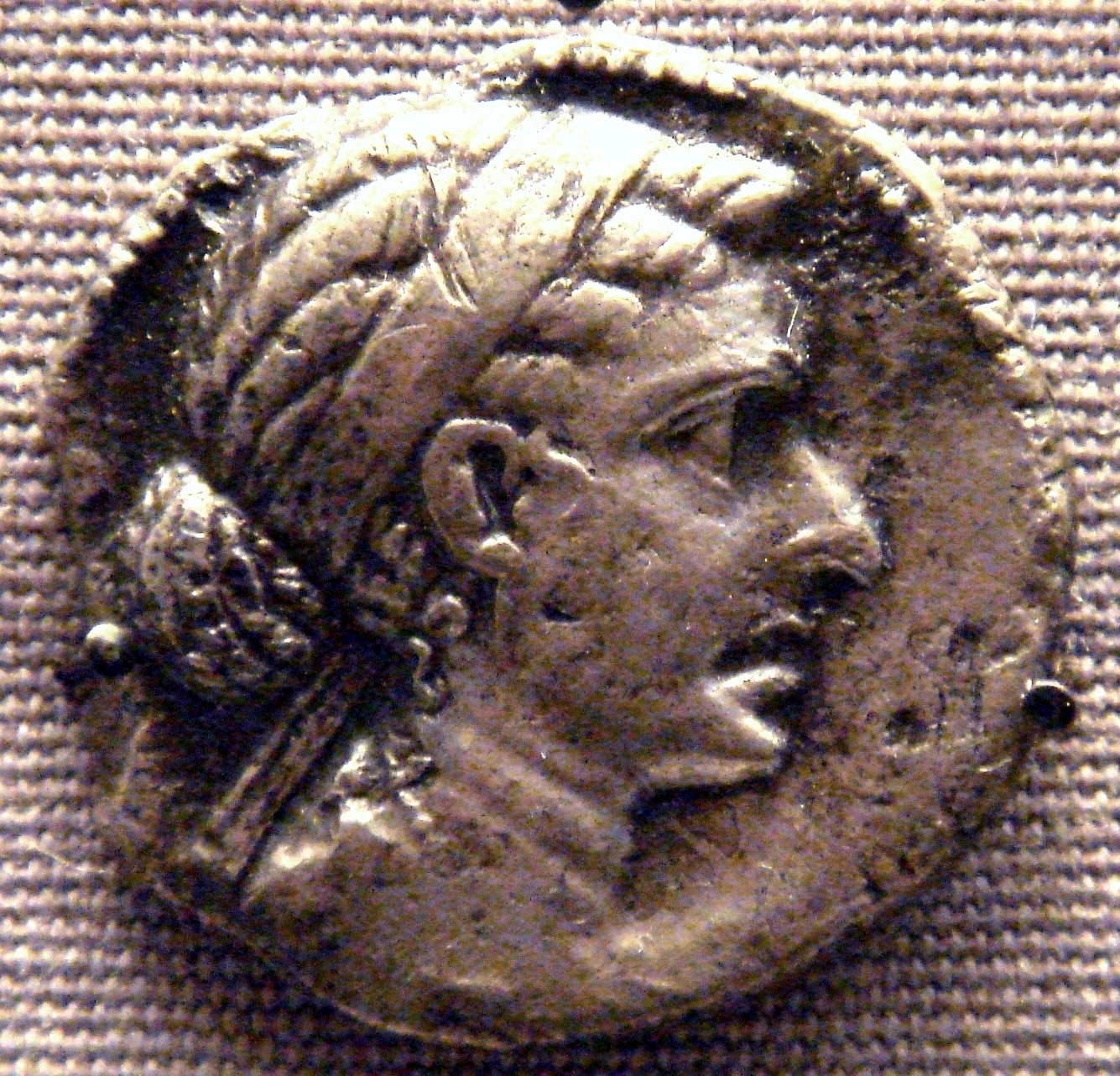

Afterlives: what Rome made of her
Rome's settlement opened with spectacle. In Octavian's triumph an effigy of the dead Cleopatra upon a couch was carried by, so that she, together with the other captives and with her children Alexander Helios and Cleopatra Selene, formed part of the spectacle and a trophy in the procession16. Egypt was annexed as a Roman province in 30 BCE, ending the Ptolemaic kingdom1. Octavian enhanced his reputation by personally taking charge of Egypt and its grain supply to feed the Romans12. To appeal to Cleopatra's former subjects he accepted the rites, honours and title of a Ptolemaic pharaoh, though he had no interest in any of these12.
Her family's fate followed the settlement's logic. Caesarion, technically sole ruler of the Ptolemaic kingdom, was executed by Octavian in late August 30 BCE19; Plutarch records it plainly — he was put to death by Caesar after the death of Cleopatra10. Antony had left seven children by his three wives; the eldest, Antyllus, was the only one put to death, and the rest were taken up by Octavia and reared with her own children10. Cleopatra Selene, the daughter of Cleopatra, was given by Octavia in marriage to Juba, the most accomplished of kings10. The statues told their own story of the settlement: Antony's were torn down, but Cleopatra's were left standing because her friend Archibius gave Caesar two thousand talents10.
The Roman image hardened early and lasted long. The ancient writers uniformly praise her intelligence and charm over her physical attributes, although tradition has remembered her as a great beauty1. Stacy Schiff's reading, preserved in the modern literature, is that the personal inevitably wins over the political in her afterlife: she is remembered for seducing two of the greatest men of her age, while what she accomplished in sustaining a vast, rich empire in its troubled twilight fades from memory1.
The end remains contested ground. Britannica records the modern hypothesis that she did not die by suicide but was secretly poisoned by Octavian or his associates5. The toxicology review finds the snake theory problematic because the species cannot be identified3. The burial itself is recorded as they had wished: they were buried together, and with them, Britannica notes, was buried the Roman Republic5.
Timeline
Birth of Cleopatra VII
Cleopatra VII is born, according to Britannica, in 70/69 BCE — daughter of Ptolemy XII Auletes, king of Egypt.
Accession after her father's death
On the death of Ptolemy XII the throne passes to Ptolemy XIII and Cleopatra VII; Cleopatra is about 18 and at first the dominant ruler.
First decree with Ptolemy first
The first decree in which Ptolemy XIII's name precedes Cleopatra's shows her losing precedence at court.
Exile, Pelusium, and Caesar's arrival
Cleopatra flees to Syria, raises an army and is defeated near Pelusium; Pompey is murdered at the Egyptian court and Julius Caesar arrives in Egypt.
Return to the throne and the birth of Caesarion
Caesar restores Cleopatra and she rules with her brother Ptolemy XIV; Ptolemy XIII drowns in the Nile; in June Cleopatra gives birth to Ptolemy Caesar, called Caesarion.
Cleopatra in Rome
Caesar celebrates a four-day triumph in which Cleopatra's sister Arsinoe is paraded; Cleopatra takes up residence in Caesar's villa beyond the Tiber and may see a golden statue of herself dedicated in the temple of Venus Genetrix.
Caesar murdered; Ptolemy XIV dies
Cleopatra is in Rome when Caesar is assassinated; back in Alexandria her co-ruler Ptolemy XIV dies (44 BCE) and she rules with her infant son Caesarion from 2 September 44 BCE.
Meeting at Tarsus
Antony summons Cleopatra to Tarsus; she arrives on the Cydnus in the dress of the new Isis, and the two become lovers and allies, wintering in Alexandria.
Twins born; Antony marries Octavia
Cleopatra bears Antony the twins Alexander Helios and Cleopatra Selene; Antony returns to Italy and marries Octavian's sister Octavia as part of the Brundisium settlement.
The Donations of Alexandria
Antony and Cleopatra stage the Donations of Alexandria: Cleopatra is hailed queen of kings, Caesarion king of kings, and territories are assigned to their children.
War declared on Cleopatra alone
Octavian seizes and publicizes Antony's will; the Senate deprives Antony of his powers and declares war on Cleopatra — not on Antony.
Battle of Actium
Octavian's fleet under Agrippa defeats Antony and Cleopatra in the Ionian Sea; Cleopatra's squadron breaks out and sails for Egypt, and Antony follows.
Death of Antony
After a false report that Cleopatra is dead, Antony falls on his sword and is carried to her mausoleum, where he dies.
Death of Cleopatra and the annexation of Egypt
Cleopatra dies (Britannica dates it 30 August; other timelines say 12 August); Caesarion is killed soon after, and Egypt becomes a Roman province.
Frequently asked questions
Who was Cleopatra VII?
Cleopatra VII was the last ruler of Egypt before it was annexed as a province of Rome1. She was ethnically Greek, a member of the Macedonian Ptolemaic dynasty that ruled Egypt after the death of Alexander the Great, but culturally Egyptian, and she presented herself as an Egyptian queen1. She reigned from 51 to 30 BCE — twenty-two years as queen and eleven as Antony's partner5.
How did she come to the throne, and how was she pushed off it the first time?
When Ptolemy XII died in 51 BCE, the throne passed to his young son Ptolemy XIII and his daughter Cleopatra VII5. His will had left the kingdom to his oldest surviving children, the 18-year-old Cleopatra and the 10-year-old Ptolemy XIII4. In 48 BCE her chief advisor Pothinus, with Theodotus of Chios and the general Achillas, overthrew her and placed Ptolemy XIII on the throne alone1.
Did Julius Caesar marry Cleopatra?
Julius Caesar did not marry Cleopatra, though the couple had a romantic relationship7. Whether Caesar was the father of Caesarion, as his name implies, cannot now be known5.
How did Cleopatra reach Caesar in the royal palace?
Plutarch describes her taking only Apollodorus the Sicilian, crossing in a little skiff after dark, and being carried indoors to Caesar concealed inside a bed-sack tied with a cord, since escaping notice otherwise was impossible8. Plutarch says it was by this device that Caesar was first captivated and, succumbing to her charm, reconciled her to her brother on the basis of a joint share in the royal power8.
What did the alliance with Mark Antony give each side?
Britannica's summary: Antony and Cleopatra were partners for 11 years and had three children together, and beyond their mutual affection the alliance was politically useful — Cleopatra needed Antony to revive the old boundaries of her kingdom, and Antony needed Egypt as a source of supplies and funds13. Cleopatra contributed 20,000 talents from Egypt to fund Antony's war preparations12.
How did Cleopatra die — and can we be sure?
A popular belief in antiquity held that she and her servants killed themselves by means of an asp, but Britannica notes the snake is scientifically unlikely to produce enough venom to kill three adults5. Plutarch states that the truth of the matter no one knows, and reports both the asp account and the variant of poison carried in a hollow comb10. Some modern scholars have hypothesized that she was secretly poisoned by Octavian or his associates5.
What happened to Egypt and to her family after her death?
Egypt was annexed as a Roman province in 30 BCE, ending the Ptolemaic kingdom1. Octavian took personal charge of Egypt and its grain supply, and accepted the rites, honours and title of a Ptolemaic pharaoh to appeal to Cleopatra's former subjects12. Her son Caesarion was executed by Octavian in late August 30 BCE19.
Was Cleopatra the seductress that Roman writers described?
That portrait was propaganda: Octavian presented her as an evil seductress of two of Rome's greatest generals12. The ancient writers uniformly praise her intelligence and charm over her physical attributes, though tradition has remembered her as a great beauty1. Even Plutarch notes that her beauty was in itself not altogether incomparable, and places her power in her conversation10.
Knowledge graph
Sources & citations
Every factual claim in this article is drawn from the sources below. Bracketed numbers in the text link to the corresponding source.
- 1
- 2
- 3
- 4
- 5
- 6
- 7
- 8
- 9
- 10
- 11
- 12
- 13
- 14
- 15
- 16
- 17
- 18
- 19