Roman Empire
From the Republic’s collapse to the fall of the West and the survival of Byzantium — the documented history, government, frontiers, cities, and legacy of Rome’s imperial centuries, built entirely on sourced evidence.
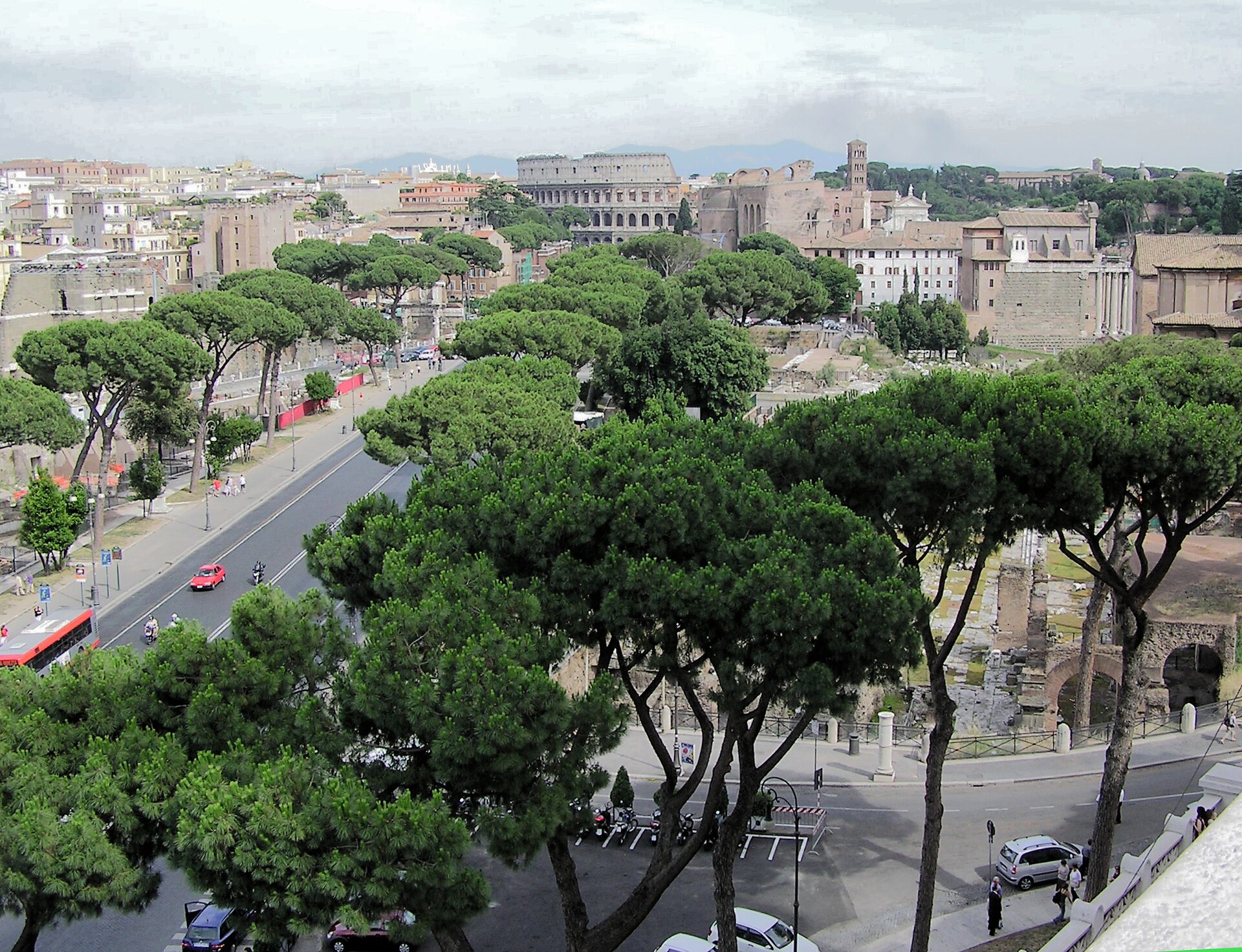

The Roman Empire was the ancient empire centred on the city of Rome, established in 27 BCE when Octavian took the name Augustus, and continuing as the empire of the West until the deposition of Romulus Augustulus in 476 CE; the Eastern Empire survived as the Byzantine Empire until 1453. At its greatest reach under Trajan the empire ran from Britain to Mesopotamia and from the Rhine and Danube to North Africa, defended by a frontier of about 5,000 km. This fact base follows the standard three-part periodization — Republic (509–27 BCE), Principate (27 BCE–284 CE), Dominate (284–476 CE in the West) — and covers government, economy, society, religion, archaeology (Pompeii, Rome, Hadrian’s Wall), and legacy, with every knowledge item carrying a verbatim evidence quote from the cited source.
What the Roman Empire was
The Roman Empire was the ancient empire centred on the city of Rome, established in 27 BCE when Octavian took the name Augustus 1. In the West, that empire ran to its final eclipse in the 5th century CE 1. The empire of the East outlived it for centuries, continuing as the Byzantine Empire until 1453 1.
In the course of centuries Rome grew from a small town on the Tiber River in central Italy into a vast empire 2. That empire ultimately embraced England, all of continental Europe west of the Rhine and south of the Danube, most of Asia west of the Euphrates, northern Africa, and the islands of the Mediterranean 2.
This article follows the standard three-part periodization of Roman history 3. It begins with the Republic, the state that started in 509 BCE and lasted until 27 BCE, when the Roman Empire was established 3. Then comes the Principate, the centuries of the princeps, or 'first citizen', behind revived republican forms 3. The sequence closes with the Dominate, the open autocracy that begins with Diocletian, ends in the West with the deposition of Romulus Augustulus in 476, and continues in the East until 1453 41.
From village to republic (753–27 BCE)
According to tradition the city of Rome was founded in 753 BCE, and the Republic dates from 509 BCE 2. Legend credited Romulus and Remus with the city's foundation on the banks of the Tiber in 753 BC 5. When the Romans expelled the monarchy they replaced the kingship with two annually elected magistrates called consuls 3.
In theory the people were sovereign and the Senate only advised, but in practice the Senate wielded enormous power through the collective prestige of its members 3. The Republic's two popular assemblies were the centuriate assembly, military in nature, and the tribal assembly, a civilian body 2. In 451 BCE Rome received its first written law code, the Law of the Twelve Tables, and it was this code that would form the basis of all later Roman private law 3. Society, meanwhile, was divided between the patricians and the plebeians, whose political struggle lasted more than 200 years 2.
The Punic Wars between Rome and Carthage spanned the years 264 to 146 BCE 2. The Romans occupied Carthage and eventually destroyed it completely in 146 BCE 3. The conquered peoples were organized into provinces under appointed governors, who held absolute power over all non-Roman citizens 3. Where the Greek city-states shut subject peoples out of political life, Rome from its beginning absorbed the peoples it conquered, and those who adopted Roman ways were eventually granted citizenship 2.
Julius Caesar eventually took full power over Rome as its dictator, and after his assassination in 44 BCE the triumvirate of Mark Antony, Lepidus, and Octavian ruled 3. On 27 November 43 BCE the three were formally given a five-year dictatorial appointment as triumvirs 6. Octavian then went to war against Antony, and after his victory at Actium in 31 BCE he was crowned Rome's first emperor, Augustus 3.
Period table: Republic, Principate, Dominate
The three periods organize the whole of the story: a Republic of elected magistrates and a Senate-led government, a Principate in which the emperor ruled behind revived republican forms, and a Dominate of open autocracy that begins with Diocletian 314. The anchor dates are those fixed by the record: 509 BCE for the Republic, 27 BCE for the establishment of the empire, 284 CE for the accession of Diocletian, 476 for the end in the West, and 1453 for the end in the East 314.
| Period | Years | Government and defining events |
|---|---|---|
| Republic | 509–27 BCE | Elected magistrates and Senate-led government; Mediterranean conquest by the legions; collapse in civil war 3 |
| Principate | 27 BCE–284 CE | The princeps, or 'first citizen', behind the image of limited power 3; the Julio-Claudian and Flavian dynasties and the high empire 1; greatest territorial reach under Trajan, who added Dacia, Arabia, Armenia, and Mesopotamia 7; then the third-century crisis 4 |
| Dominate | 284 CE onward — West ends 476, East to 1453 | Open autocracy from Diocletian's restoration and tetrarchic reform 4; a Christian empire from Constantine 8; the fall of the West in 476 1; Byzantium survives to 1453 1 |
The Augustan settlement
In 27 BCE Octavian was made princeps, or 'first citizen' — a title intended to maintain the image of limited power while he had in fact become Rome's autocratic ruler 3. His reign, from 27 BCE to 14 CE, was distinguished by stability and peace, and he was the first Roman emperor 1. The Cambridge Ancient History treats the transformation of the state into a dynastic monarchy as the theme of the age, with Augustus' achievement at its centre 9.
Augustus established a form of government known as the principate, which combined some elements from the republic with the traditional powers of a monarchy 1. He brought peace — the Pax Romana — to the Greco-Roman world 6. The Senate still functioned within the settlement, but government now turned on the person of the emperor 1.
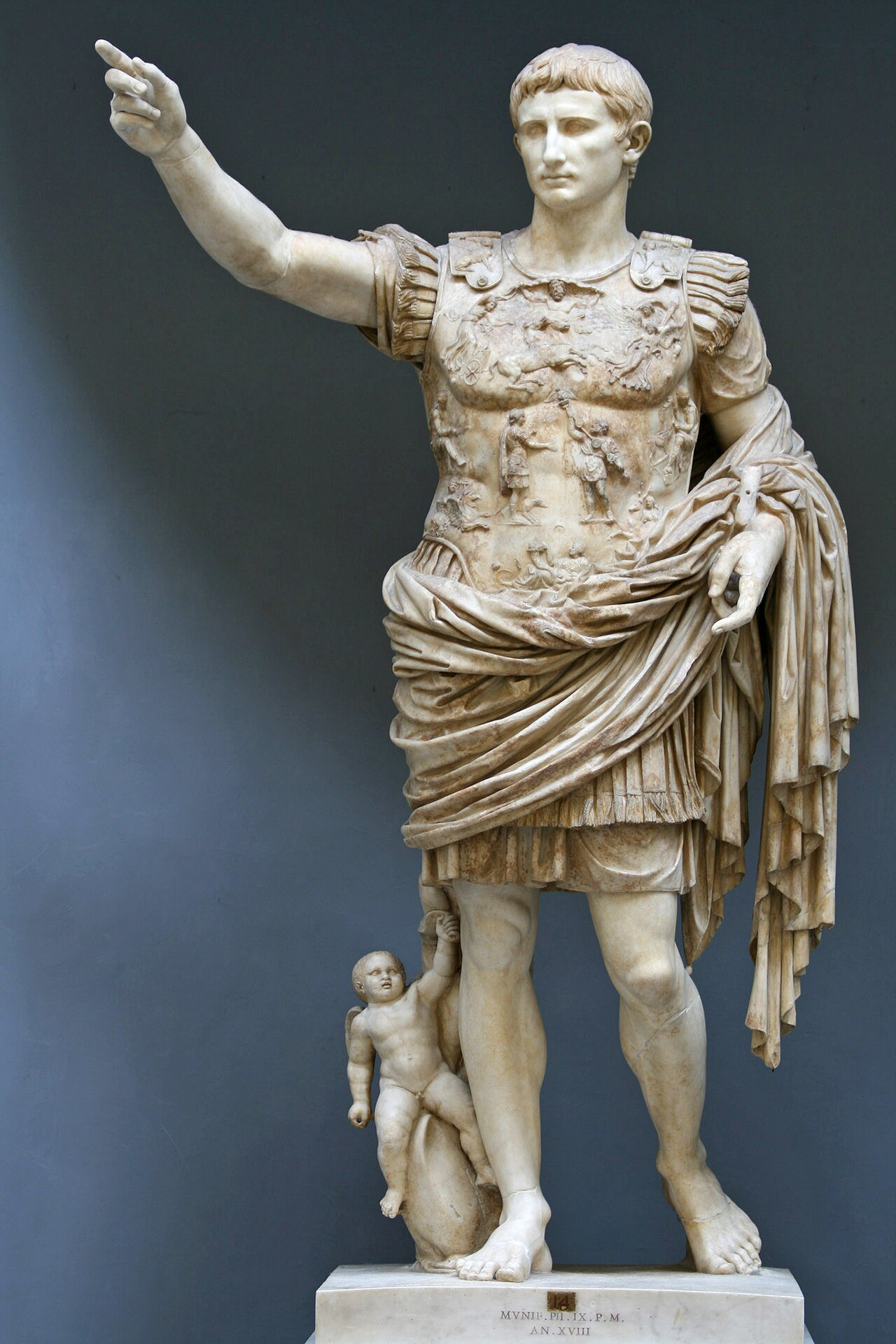

The emperor's own record of his deeds, the Res Gestae, preserves the official account of the settlement 10. By decree of the Senate he was given his name, and a golden shield in the Curia Julia testified to his courage, mercy, justice, and piety 10. The record lists citizenship censuses of 4,063,000, then 4,233,000, and finally 4,937,000 Roman citizens 10. It also states that about 500,000 Roman citizens were under military oath to him, and that he forced the Parthians to return the spoils and standards of three Roman armies 10.
senatus consulto Augustus appellatus sum et laureis postes aedium mearum vestiti publice coronaque civica super ianuam meam fixa est et clupeus aureus in curia Iulia positus, quem mihi senatum populumque Romanum dare virtutis clementiaeque et iustitiae et pietatis caussa testatum est per eius clupei inscriptionem.10
Augustus, Res Gestae Divi Augusti, in the original Latin (via The Latin Library); the passage records the Senate's decree of his name and the golden shield put up in the Curia Julia. Translation: “By decree of the Senate I was called Augustus…”
Parthos trium exercitum Romanorum spolia et signa reddere mihi supplicesque amicitiam populi Romani petere coegi.10
Augustus, Res Gestae Divi Augusti, in the original Latin (via The Latin Library); translation: “I forced the Parthians to return the spoils and standards of three Roman armies and to seek the friendship of the Roman people as suppliants.”
Succession and the first dynasties (14–96 CE)
Augustus eventually chose Tiberius as his successor and adopted him as his son in 4 CE, opening the Julio-Claudian dynasty 1. Tiberius reigned 14–37, Caligula 37–41, Claudius 41–54, and Nero 54–68 1. Nero brought the dynasty to its end, becoming the first emperor to suffer damnatio memoriae when his reign was officially stricken from the record by order of the Senate 1.
Following a war of succession, Vespasian became emperor in 69 CE and the Flavian dynasty was established 1. His reign (69–79) was noted for his expansion of the membership of the Senate, bringing in administrators with a sense of service, and for his increase and systematization of taxation 1. His son Titus reigned 79–81, and Domitian followed from 81 to 96 1.
The two centuries after Actium differed from the Republic above all in their relative peace: the empire's first 200 years were relatively peaceful compared with the Republic's near-constant war 3. The instruments of that peace were the army and the frontier: Vespasian reorganized the army, making it more loyal and professional, and strengthened the frontiers of the empire 1.
The high empire (96–192)
Trajan was Roman emperor from 98 to 117 CE, and he sought to extend the boundaries of the empire to the east, undertook a vast building program, and enlarged social welfare 7. He abandoned Augustus' policy of not extending the Roman frontiers and added Dacia, Arabia, Armenia, and Mesopotamia to the empire 7. His public works were extensive: roads, bridges, aqueducts, the reclamation of wastelands, and the construction of harbours and buildings 7. He distributed considerable cash gifts and increased the number of poor citizens who received free grain from the state 7.
Behind his forum rose the still-standing Trajan's Column, an innovative work of art commemorating his Dacian Wars 7. Its cubical base, carved with reliefs of heaps of captured arms, later received Trajan's ashes 7. For provincial administration the key source is Pliny the Younger's correspondence with Trajan, preserved as the tenth book of his letters 7.
Under Hadrian the frontier was fixed in masonry across northern Britain: Roman work on the Wall began around AD 122, and it ran for 73 miles, from Wallsend on the River Tyne in the east to Bowness on the Solway Firth in the west 11. In the eastern sector the plan called for a stone wall 10 Roman feet wide and at least 12 feet high; in the western sector, a turf rampart 20 Roman feet wide at its base 11. Antoninus Pius later pushed north with the 37-mile Antonine Wall in Scotland, but within two decades it was abandoned in favour of Hadrian's Wall 11.
Marcus Aurelius, the last of the Five Good Emperors, ruled from 161 to 180, and his reign marked the end of a period of internal tranquility and good government 12. The returning armies of the Parthian war brought back a plague that raged throughout the empire for many years 12. In 167 or 168 Marcus and Verus set out on a punitive expedition across the Danube, and a horde of German tribes invaded Italy and besieged Aquileia 12.
Caracalla ruled jointly with his father, Septimius Severus, from 198 to 211 and then alone from 211 until his assassination in 217 13. His principal achievements were his colossal baths in Rome and his edict of 212, which gave Roman citizenship to all free inhabitants of the empire 13. The grant of citizenship may also have served to widen the tax base 13.
The third-century crisis and Diocletian (235–305)
The golden age rested on strained finances: the letters of Pliny and Trajan show cities wasting money on lavish buildings and competing for municipal honours, an indication that the empire's finances were already beginning to show inflationary trends 7. The third century then fell into near anarchy before Diocletian restored efficient government 4.
Diocletian was acclaimed emperor on 17 November 284, and at first he possessed real power only in those countries dominated by his army 4. By midsummer 285 he was master of the empire 4. As emperor for more than 20 years (284–305), he brought stability, security, and efficient government to the Roman state after nearly half a century of chaos 4.
At the urging of the caesar Galerius, in 303 Diocletian began the last major persecution of Christians, with churches destroyed and Christians who refused to sacrifice to the Roman gods tortured and executed 4. Galerius, who succeeded Diocletian as augustus in 305, continued the persecution until 311 4. The reorganization of the fiscal, administrative, and military machinery of the empire laid the foundation for the Byzantine Empire in the East 4.
The same reorganization is credited with shoring up the West 4. In 305 the two emperors, Diocletian and Maximian, abdicated, to be succeeded by their respective deputy emperors, Galerius and Constantius 8. Within a decade a new emperor would march on Rome 8.
Constantine and the Christian empire (312–337)
Constantine invaded Italy in 312 and, after a lightning campaign, defeated his brother-in-law Maxentius at the Milvian Bridge near Rome 8. In 313 he made the persecution of Christians illegal by signing the Edict of Milan 8. After further tension he attacked Licinius in 324 and became sole emperor of East and West 8.
Constantine was the first Roman emperor to profess Christianity 8. He helped spread the religion by bankrolling church-building projects across the empire 8. He summoned the Councils of Arles in 314 and Nicaea in 325, which guided church doctrine for centuries afterward 8.
His crowning achievement was his dedication of Constantinople as his new imperial capital in 330 8. In the fourth century Rome itself became the capital of the Christian world 5. At his death in 337 Constantine left the empire to his three surviving sons 8.
The fall of the West and the survival of the East
The fall of the Western Roman Empire was a multifaceted process, attributable to a number of causes 1. The empire's ability to maintain political and military integrity was challenged by 'barbarian invasions', particularly in the 5th century CE 1. Internal governmental issues also played a significant role: corruption, abuse of power, undisciplined and poorly equipped soldiers, and the alienation of urban elites from public service 1.
The end came in stages 1. In 395 the empire split into Western and Eastern empires 1. In 410 Rome was sacked by the Visigoths, and in 476 the German chieftain Odoacer deposed Romulus Augustulus, the last Roman emperor of the West 1.
The Eastern Empire, always richer and stronger, continued as the Byzantine Empire until 1453 1.
Roman life: cities, society, and spectacle
Pompeii was destroyed by the violent eruption of Mount Vesuvius on 24 August 79 CE 14. An earthquake in 62 CE had done great damage in Pompeii and Herculaneum, and the cities had not yet recovered when destruction overcame them 17 years later 14. Just after midday on 24 August, ash, pumice, and volcanic debris began pouring down on the city, which remained buried under 19 to 23 feet of pumice stones and ash 14. The city had supported between 10,000 and 20,000 inhabitants at the time of its destruction 14. Many historians estimate the death toll at about 2,000, and more than 1,000 bodies have been uncovered thus far 14.
With its well-preserved buildings in an excavated area of 44 ha, Pompeii is the only archaeological site in the world that provides a complete picture of an ancient Roman city 15. The excavation of Pompeii and the surrounding areas in the mid-18th century marked the start of the modern science of archaeology 14. A vivid eyewitness report of the eruption is preserved in two letters written by Pliny the Younger to the historian Tacitus 14. At Herculaneum, more than 1,800 papyri scrolls containing Greek philosophical texts were found at the Villa of the Papyri 15.
Every five years the Romans enumerated citizens and their property 16. The practice was extended to the whole empire in 5 BCE 16. After the collapse of Rome the practice was discontinued in the West until the modern period 16.
Construction of the Colosseum was begun between 70 and 72 CE, during the reign of Vespasian 17. The structure was officially dedicated in 80 by Titus in a ceremony that included 100 days of games 17. It measures 620 by 513 feet and could hold as many as 50,000 spectators 17. The arena was paid for with plunder from Titus' sack of Jerusalem in 70 CE, and it was built by enslaved Jewish people from Judaea 17. After the fall of the Western Roman Empire the Colosseum fell into serious disrepair 17.
Slavery fueled the Roman economy, and it is believed that 10% of the Roman Empire's population were enslaved 18. Most of the population lived in insulae, the apartment blocks of the Roman city, and the urban masses were placated with bread and circuses 183.
Frontiers and World Heritage: reading Rome through its monuments
the city was the heart of a widespread civilization that found its highest expression in law, language and literature, and remains the basis of Western culture.5
UNESCO World Heritage Centre, on the Historic Centre of Rome
It stretched over 5,000 km from the Atlantic coast of northern Britain, through Europe to the Black Sea, and from there to the Red Sea and across North Africa to the Atlantic coast.19
UNESCO World Heritage Centre, on the Frontiers of the Roman Empire
The frontier also survives as a monument: the 118-km-long Hadrian's Wall was built on the orders of the Emperor Hadrian around AD 122 at the northernmost limits of the Roman province of Britannia 19. It also marked a cultural divide between the Romanised world and the non-Romanised Germanic peoples 19. In 1987 Hadrian's Wall was designated a UNESCO World Heritage site 11.
The inscriptions of Roman Britain cover funerary epitaphs, dedications to deities from all over the empire, and milestones 20. RIB Online digitizes the inscriptions on stone from Roman Britain: volume I contains those found up to 1955, while a further corpus complements it with stones recorded up to 2006 20. The Vindolanda Tablets of the late 1st and early 2nd centuries — nearly 780 texts written on thin sheets of wood — are a rich source for military, economic, and social history 20.
Legacy
Rome's cultural legacy reaches the modern world most visibly through language: the Romance languages — Italian, French, Spanish, Portuguese, and Romanian — all evolved from Latin, the language of the Romans 2. Western civilization still writes in an alphabet of 26 letters and keeps a calendar of 12 months and 365.25 days that are Rome's bequest 2. In law too, the Law of the Twelve Tables of 451 BCE formed the basis of all subsequent Roman private law 3.
In art, ancient Roman achievement in architecture, painting, and sculpture served as a universal model into the Renaissance, Baroque, and Neoclassical periods 5. Rome's historic centre, inscribed on the World Heritage List in 1980 and extended in 1990, testifies to the uninterrupted sequence of three millennia of history 5.
The site includes major monuments of antiquity such as the Forums, the Mausoleum of Augustus, the Mausoleum of Hadrian, the Pantheon, Trajan's Column, and the Column of Marcus Aurelius 5. The British Museum's Room 70 covers about 1,000 years, from Rome's legendary foundation in 753 BC to AD 324, when Constantine founded his new, Christian capital at Constantinople 18.
Timeline
Traditional founding of Rome
According to tradition Romulus was Rome’s first king, and 753 BCE was accepted in antiquity as the city’s foundation date; serious historical writing about early Rome began only centuries later.
The Republic is founded
The Romans replaced the kingship with two annually elected magistrates called consuls; on the traditional chronology the Republic began in 509 BCE.
Carthage is destroyed
The Romans occupied Carthage and destroyed it completely in 146 BCE, ending the Punic Wars and turning their ambitions toward the whole Mediterranean.
Assassination of Julius Caesar
Julius Caesar, who had taken full power over Rome as its dictator, was assassinated in 44 BCE; the triumvirate of Mark Antony, Lepidus, and Octavian then ruled.
Victory at Actium
Octavian went to war against Antony and, after his victory at Actium, was crowned Rome’s first emperor, Augustus.
The principate begins
Octavian was made princeps, “first citizen,” and the Roman Empire was established; his reign, from 27 BCE to 14 CE, was distinguished by stability and peace.
Jerusalem is sacked; the Colosseum is funded
The Colosseum’s arena was paid for with plunder from Titus’s sack of Jerusalem in 70 CE and built by enslaved Jewish people from Judaea.
Vesuvius destroys Pompeii
Vesuvius erupted on August 24, 79 CE; Pompeii was buried under pumice and ash 19 to 23 feet deep, which protected the city for centuries.
Hadrian's Wall is begun
The 118-km-long Hadrian’s Wall was built on the orders of the Emperor Hadrian around AD 122 at the northernmost limits of the province of Britannia.
Marcus Aurelius becomes emperor
Marcus Aurelius, the last of the Five Good Emperors, came to power in 161; his reign (161–180) marked the end of a period of internal tranquility and good government.
Caracalla grants universal citizenship
The edict of 212 gave Roman citizenship to all free inhabitants of the empire — one of Caracalla’s principal achievements.
Diocletian is acclaimed emperor
Diocletian was acclaimed emperor on November 17, 284; by midsummer 285 he was master of the empire, and his reign (284–305) brought stability after nearly half a century of chaos.
The Edict of Milan
Constantine made the persecution of Christians illegal by signing the Edict of Milan in 313.
Constantinople is dedicated
Constantine’s crowning achievement was his dedication of Constantinople as his new imperial capital in 330.
The empire splits in two
In 395 the empire split into Western and Eastern empires.
The Western Empire falls
Rome had been sacked by the Visigoths in 410, and in 476 the German chieftain Odoacer deposed Romulus Augustulus, the last Roman emperor of the West; the East continued as the Byzantine Empire until 1453.
Frequently asked questions
When was the Roman Empire founded, and when did it end?
The empire was established in 27 BCE, when Octavian took the name Augustus 1. In the West it ended in 476, when the German chieftain Odoacer deposed Romulus Augustulus, the last Roman emperor of the West 1. The Eastern Empire continued as the Byzantine Empire until 1453 1.
Who was the first Roman emperor?
Augustus was the first Roman emperor, reigning from 27 BCE to 14 CE 1. In 27 BCE Octavian was made princeps, or 'first citizen', the autocratic ruler behind the image of limited power 3.
How far did the Roman Empire extend?
In the course of centuries Rome grew from a small town on the Tiber into a vast empire that embraced England, continental Europe west of the Rhine and south of the Danube, most of Asia west of the Euphrates, northern Africa, and the islands of the Mediterranean 2. Under Trajan the empire reached its greatest territorial extent, when Dacia, Arabia, Armenia, and Mesopotamia were added 7.
Why did the Western Roman Empire fall?
The fall was a multifaceted process, attributable to 'barbarian invasions', particularly in the 5th century, and to internal governmental issues including corruption, abuse of power, undisciplined and poorly equipped soldiers, and the alienation of urban elites from public service 1. In 476 Odoacer deposed Romulus Augustulus, the last Roman emperor of the West 1.
What happened at Pompeii?
Pompeii was destroyed by the violent eruption of Mount Vesuvius on 24 August 79 CE and remained buried under pumice and ash 19 to 23 feet deep 14. The city had supported between 10,000 and 20,000 inhabitants at the time of its destruction 14. More than 1,000 bodies have been uncovered thus far 14.
What is Hadrian's Wall?
The 118-km-long wall was built on the orders of the Emperor Hadrian around AD 122 at the northernmost limits of the Roman province of Britannia 19. It ran 73 miles from Wallsend on the River Tyne in the east to Bowness on the Solway Firth in the west 11. In 1987 it was designated a UNESCO World Heritage site 11.
Knowledge graph
Sources & citations
Every factual claim in this article is drawn from the sources below. Bracketed numbers in the text link to the corresponding source.
- 1
- 2
- 3
- 4
- 5
- 6
- 7
- 8
- 9
- 10
- 11
- 12
- 13
- 14
- 15
- 16
- 17
- 18
- 19
- 20